What is ISO 26000
The International Organization for Standardization (ISO) is
an international standard-setting body composed of representatives from
various national standards organizations. ISO 26000 Guidance on social
responsibility is launched from ISO, the International
organization for Standardization. Is an International Standard providing
guidelines for social responsibility (SR) named ISO 26000 or simply ISO
SR. It was released on 1 November 2010. Its goal is to contribute to
global sustainable development, by encouraging business and other
organizations to practice social responsibility to improve their impacts on
their workers, their natural environments and their communities
Private, not-for-profit organization, established in 1947(headquartered in
Geneva Switzerland).
Promotes the development of international standards.
Voluntary standards: positive contribution to our world.
About ISO 26000
ISO 26000 gives
guidance/recommendations about
how any organization can improve
its SR & thus contribute to
sustainable environmental, social
&economic development.
Is not certifiable, as it does not
contain requirements. Its appeal is
to those who, for whatever
reasons, seek to improve their
operating processes & impacts
through socially responsible
behavior.
Is the world's largest
developer of voluntary
international
standards(vis), used by
businesses &
other organizations; its
members are national
standards bodies &
its standard & name-
recognition are global in
reach .
Purpose And Scope Of ISO 26000
To assist organizations in
addressing their SR.
To increase confidence
& satisfaction in organizations
among their customers & other
stakeholders.
To emphasize performance results
and improvement.
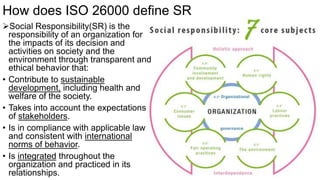
How does ISO 26000 define SR
Social Responsibility(SR) is the
responsibility of an organization for
the impacts of its decision and
activities on society and the
environment through transparent and
ethical behavior that:
• Contribute to sustainable
development, including health and
welfare of the society.
• Takes into account the expectations
of stakeholders.
• Is in compliance with applicable law
and consistent with international
norms of behavior.
• Is integrated throughout the
organization and practiced in its
relationships.
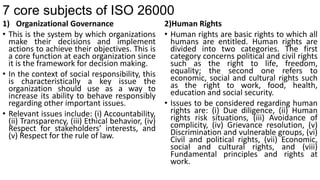
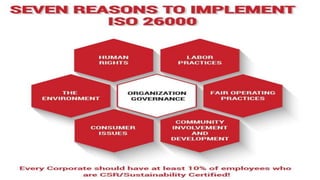
7 core subjects of ISO 26000
1) Organizational Governance
• This is the system by which organizations
make their decisions and implement
actions to achieve their objectives. This is
a core function at each organization since
it is the framework for decision making.
• In the context of social responsibility, this
is characteristically a key issue the
organization should use as a way to
increase its ability to behave responsibly
regarding other important issues.
• Relevant issues include: (i) Accountability,
(ii) Transparency, (iii) Ethical behavior, (iv)
Respect for stakeholders’ interests, and
(v) Respect for the rule of law.
2)Human Rights
• Human rights are basic rights to which all
humans are entitled. Human rights are
divided into two categories. The first
category concerns political and civil rights
such as the right to life, freedom,
equality; the second one refers to
economic, social and cultural rights such
as the right to work, food, health,
education and social security.
• Issues to be considered regarding human
rights are: (i) Due diligence, (ii) Human
rights risk situations, (iii) Avoidance of
complicity, (iv) Grievance resolution, (v)
Discrimination and vulnerable groups, (vi)
Civil and political rights, (vii) Economic,
social and cultural rights, and (viii)
Fundamental principles and rights at
work.
Continuation
3)Labor Practices
• Labor practices in an organization must
be in accordance with all policies and
actions related to the work done by the
organization and developed on its
behalf, including subcontracted work.
Labor practices extend beyond the
relationship between the organization
and its employees.
• Relevant issues to be considered
include: (i) Employment and
employment relationships, (ii)
Conditions of work and social protection,
(iii) Social dialog (iv) Health and safety
at work, and (v) Human development
and training in the workplace.
4)The Environment
• No matter where the organization is located,
both its decisions and activities will always
have an impact on the environment, normally
associated with the use of resources, location
of activities, the generation of pollution and
waste, and the impact of activities on natural
habitats.
• Organizations must at all times make an effort
to reduce their environmental impact by
adopting a holistic approach for the problem,
considering the implications and (direct and
indirect) impact of their decisions and activities
on the socio-economic, health-economic and
environmental aspects.
• Relevant issues to be considered include: (i)
Prevention of pollution, (ii) Sustainable
resource use, (iii) Climate change mitigation
and adaptation, and (iv) Protection of the
environment, biodiversity and restoration of
natural habitats.
continuation
5)Fair Operating Practices
• Fair operating practices refer to the ethical
conduct of organizations and their
transactions with other organizations.
Within social responsibility, they refer to
the way in which an organization uses its
relationships with other organizations to
produce positive results.
• Relevant issues include: (i) Anti–
corruption, (ii) Responsible political
involvement, (iii) Fair competition, (iv)
Promoting social responsibility in the
value chain and, (v) Respect for property
rights.
6)Consumer Issues
• Organizations that provide products and
services to consumers and customers
have responsibilities towards them.
Responsibilities include education about
the product, accurate information, fair
use, transparent marketing information
that is helpful, contractual processes,
promoting sustainable development,
design and service that enable access for
everyone, and when appropriate, for
vulnerable groups or groups with some
disadvantage.
• Issues to be considered regarding
consumer issues include: (i) Fair
marketing, factual and unbiased
information and fair contractual practices,
(ii) Protection of consumers’ health and
safety, (iii) Sustainable consumption,
LAST
• 7)Community Involvement and Development
• Organizations have a relationship and impact on the communities in which they
operate. This relationship should be based on community involvement to
contribute to its development. Both community involvement and development
are part of sustainable development.
• Issues to be considered regarding community involvement and development
include: (i) Active community involvement, (ii) Education and culture, (iii)
Employment creation and skills development, (iv) Technology development and
access (v) Wealth and income creation, (vi) Health, and (vii) Social investment.
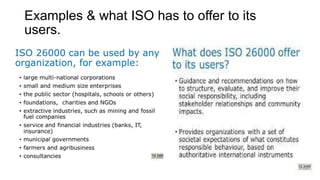
Examples & what ISO has to offer to its
users.
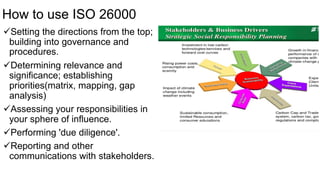
How to use ISO 26000
Setting the directions from the top;
building into governance and
procedures.
Determining relevance and
significance; establishing
priorities(matrix, mapping, gap
analysis)
Assessing your responsibilities in
your sphere of influence.
Performing 'due diligence'.
Reporting and other
communications with stakeholders.
Iso 26000 presentation (1)

Iso 26000 presentation (1)

  • 2.
    What is ISO26000 The International Organization for Standardization (ISO) is an international standard-setting body composed of representatives from various national standards organizations. ISO 26000 Guidance on social responsibility is launched from ISO, the International organization for Standardization. Is an International Standard providing guidelines for social responsibility (SR) named ISO 26000 or simply ISO SR. It was released on 1 November 2010. Its goal is to contribute to global sustainable development, by encouraging business and other organizations to practice social responsibility to improve their impacts on their workers, their natural environments and their communities Private, not-for-profit organization, established in 1947(headquartered in Geneva Switzerland). Promotes the development of international standards. Voluntary standards: positive contribution to our world.
  • 3.
    About ISO 26000 ISO26000 gives guidance/recommendations about how any organization can improve its SR & thus contribute to sustainable environmental, social &economic development. Is not certifiable, as it does not contain requirements. Its appeal is to those who, for whatever reasons, seek to improve their operating processes & impacts through socially responsible behavior. Is the world's largest developer of voluntary international standards(vis), used by businesses & other organizations; its members are national standards bodies & its standard & name- recognition are global in reach .
  • 4.
    Purpose And ScopeOf ISO 26000 To assist organizations in addressing their SR. To increase confidence & satisfaction in organizations among their customers & other stakeholders. To emphasize performance results and improvement.
  • 8.
    How does ISO26000 define SR Social Responsibility(SR) is the responsibility of an organization for the impacts of its decision and activities on society and the environment through transparent and ethical behavior that: • Contribute to sustainable development, including health and welfare of the society. • Takes into account the expectations of stakeholders. • Is in compliance with applicable law and consistent with international norms of behavior. • Is integrated throughout the organization and practiced in its relationships.
  • 9.
    7 core subjectsof ISO 26000 1) Organizational Governance • This is the system by which organizations make their decisions and implement actions to achieve their objectives. This is a core function at each organization since it is the framework for decision making. • In the context of social responsibility, this is characteristically a key issue the organization should use as a way to increase its ability to behave responsibly regarding other important issues. • Relevant issues include: (i) Accountability, (ii) Transparency, (iii) Ethical behavior, (iv) Respect for stakeholders’ interests, and (v) Respect for the rule of law. 2)Human Rights • Human rights are basic rights to which all humans are entitled. Human rights are divided into two categories. The first category concerns political and civil rights such as the right to life, freedom, equality; the second one refers to economic, social and cultural rights such as the right to work, food, health, education and social security. • Issues to be considered regarding human rights are: (i) Due diligence, (ii) Human rights risk situations, (iii) Avoidance of complicity, (iv) Grievance resolution, (v) Discrimination and vulnerable groups, (vi) Civil and political rights, (vii) Economic, social and cultural rights, and (viii) Fundamental principles and rights at work.
  • 10.
    Continuation 3)Labor Practices • Laborpractices in an organization must be in accordance with all policies and actions related to the work done by the organization and developed on its behalf, including subcontracted work. Labor practices extend beyond the relationship between the organization and its employees. • Relevant issues to be considered include: (i) Employment and employment relationships, (ii) Conditions of work and social protection, (iii) Social dialog (iv) Health and safety at work, and (v) Human development and training in the workplace. 4)The Environment • No matter where the organization is located, both its decisions and activities will always have an impact on the environment, normally associated with the use of resources, location of activities, the generation of pollution and waste, and the impact of activities on natural habitats. • Organizations must at all times make an effort to reduce their environmental impact by adopting a holistic approach for the problem, considering the implications and (direct and indirect) impact of their decisions and activities on the socio-economic, health-economic and environmental aspects. • Relevant issues to be considered include: (i) Prevention of pollution, (ii) Sustainable resource use, (iii) Climate change mitigation and adaptation, and (iv) Protection of the environment, biodiversity and restoration of natural habitats.
  • 11.
    continuation 5)Fair Operating Practices •Fair operating practices refer to the ethical conduct of organizations and their transactions with other organizations. Within social responsibility, they refer to the way in which an organization uses its relationships with other organizations to produce positive results. • Relevant issues include: (i) Anti– corruption, (ii) Responsible political involvement, (iii) Fair competition, (iv) Promoting social responsibility in the value chain and, (v) Respect for property rights. 6)Consumer Issues • Organizations that provide products and services to consumers and customers have responsibilities towards them. Responsibilities include education about the product, accurate information, fair use, transparent marketing information that is helpful, contractual processes, promoting sustainable development, design and service that enable access for everyone, and when appropriate, for vulnerable groups or groups with some disadvantage. • Issues to be considered regarding consumer issues include: (i) Fair marketing, factual and unbiased information and fair contractual practices, (ii) Protection of consumers’ health and safety, (iii) Sustainable consumption,
  • 12.
    LAST • 7)Community Involvementand Development • Organizations have a relationship and impact on the communities in which they operate. This relationship should be based on community involvement to contribute to its development. Both community involvement and development are part of sustainable development. • Issues to be considered regarding community involvement and development include: (i) Active community involvement, (ii) Education and culture, (iii) Employment creation and skills development, (iv) Technology development and access (v) Wealth and income creation, (vi) Health, and (vii) Social investment.
  • 14.
    Examples & whatISO has to offer to its users.
  • 15.
    How to useISO 26000 Setting the directions from the top; building into governance and procedures. Determining relevance and significance; establishing priorities(matrix, mapping, gap analysis) Assessing your responsibilities in your sphere of influence. Performing 'due diligence'. Reporting and other communications with stakeholders.