Introduction to ESGThe Key to Sustainable Financial Growth
Prepared by Ally Chin
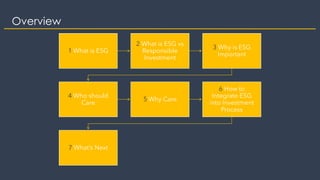
Overview
1 What is ESG
2 What is ESG vs
Responsible
Investment
3 Why is ESG
Important
4 Who should
Care
5 Why Care
6 How to
Integrate ESG
into Investment
Process
7 What’s Next
ESG
ESG
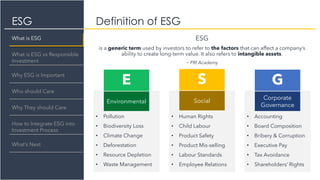
is a generic term used by investors to refer to the factors that can affect a company’s
ability to create long-term value. It also refers to intangible assets.
~ PRI Academy
Definition of ESG
What is ESG
What is ESG vs Responsible
Investment
Why ESG is Important
Who should Care
Why They should Care
How to Integrate ESG into
Investment Process
What’s Next
• Pollution
• Biodiversity Loss
• Climate Change
• Deforestation
• Resource Depletion
• Waste Management
E
Environmental
• Human Rights
• Child Labour
• Product Safety
• Product Mis-selling
• Labour Standards
• Employee Relations
S
Social
• Accounting
• Board Composition
• Bribery & Corruption
• Executive Pay
• Tax Avoidance
• Shareholders’ Rights
G
Corporate
Governance
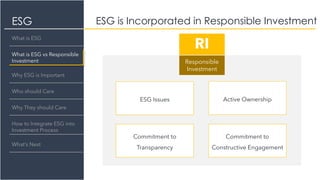
ESG ESG is Incorporated in Responsible Investment
What is ESG
What is ESG vs Responsible
Investment
Why ESG is Important
Who should Care
Why They should Care
How to Integrate ESG into
Investment Process
What’s Next
RI
Responsible
Investment
ESG Issues Active Ownership
Commitment to
Transparency
Commitment to
Constructive Engagement
ESG
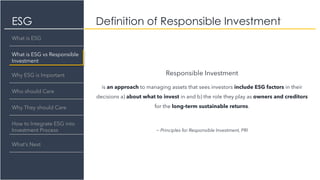
Responsible Investment
is an approach to managing assets that sees investors include ESG factors in their
decisions a) about what to invest in and b) the role they play as owners and creditors
for the long-term sustainable returns.
~ Principles for Responsible Investment, PRI
Definition of Responsible Investment
What is ESG
What is ESG vs Responsible
Investment
Why ESG is Important
Who should Care
Why They should Care
How to Integrate ESG into
Investment Process
What’s Next
ESG
.
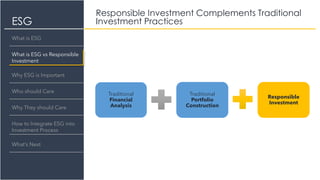
Responsible Investment Complements Traditional
Investment Practices
What is ESG
What is ESG vs Responsible
Investment
Why ESG is Important
Who should Care
Why They should Care
How to Integrate ESG into
Investment Process
What’s Next
Traditional
Financial
Analysis
Traditional
Portfolio
Construction
Responsible
Investment
ESG
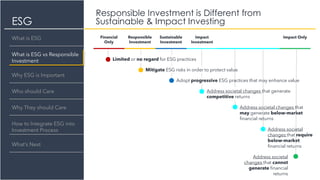
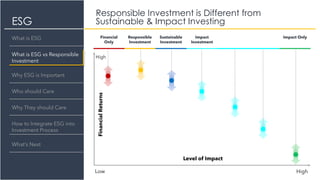
Responsible Investment is Different from
Sustainable & Impact Investing
What is ESG
What is ESG vs Responsible
Investment
Why ESG is Important
Who should Care
Why They should Care
How to Integrate ESG into
Investment Process
What’s Next
Financial
Only
Responsible
Investment
Sustainable
Investment
Impact
Investment
Impact Only
Limited or no regard for ESG practices
Mitigate ESG risks in order to protect value
Adopt progressive ESG practices that may enhance value
Address societal changes that generate
competitive returns
Address societal changes that
may generate below-market
financial returns
Address societal
changes that require
below-market
financial returns
Address societal
changes that cannot
generate financial
returns
ESG
Responsible Investment is Different from
Sustainable & Impact Investing
What is ESG
What is ESG vs Responsible
Investment
Why ESG is Important
Who should Care
Why They should Care
How to Integrate ESG into
Investment Process
What’s Next
Financial
Only
Responsible
Investment
Sustainable
Investment
Impact
Investment
Impact Only
Level of Impact
FinancialReturns
Low
High
High
ESG
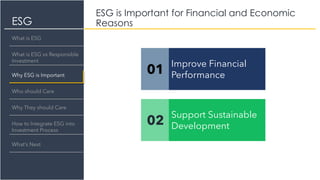
ESG is Important for Financial and Economic
Reasons
What is ESG
What is ESG vs Responsible
Investment
Why ESG is Important
Who should Care
Why They should Care
How to Integrate ESG into
Investment Process
What’s Next
01
Improve Financial
Performance
02
Support Sustainable
Development
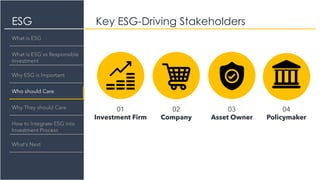
ESG Key ESG-Driving Stakeholders
What is ESG
What is ESG vs Responsible
Investment
Who should Care
Why They should Care
How to Integrate ESG into
Investment Process
What’s Next
Why ESG is Important
01
Investment Firm
02
Company
03
Asset Owner
04
Policymaker
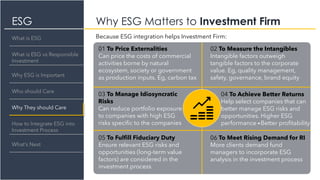
ESG Why ESG Matters to Investment Firm
What is ESG
What is ESG vs Responsible
Investment
Why They should Care
How to Integrate ESG into
Investment Process
What’s Next
Why ESG is Important
Who should Care
01 To Price Externalities
Can price the costs of commercial
activities borne by natural
ecosystem, society or government
as production inputs. Eg, carbon tax
02 To Measure the Intangibles
Intangible factors outweigh
tangible factors to the corporate
value. Eg, quality management,
safety, governance, brand equity
03 To Manage Idiosyncratic
Risks
Can reduce portfolio exposure
to companies with high ESG
risks specific to the companies
05 To Fulfill Fiduciary Duty
Ensure relevant ESG risks and
opportunities (long-term value
factors) are considered in the
investment process
06 To Meet Rising Demand for RI
More clients demand fund
managers to incorporate ESG
analysis in the investment process
04 To Achieve Better Returns
Help select companies that can
better manage ESG risks and
opportunities. Higher ESG
performance Better profitability
Because ESG integration helps Investment Firm:
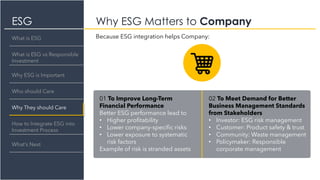
ESG Why ESG Matters to Company
What is ESG
What is ESG vs Responsible
Investment
Why They should Care
How to Integrate ESG into
Investment Process
What’s Next
Why ESG is Important
Who should Care
01 To Improve Long-Term
Financial Performance
Better ESG performance lead to
• Higher profitability
• Lower company-specific risks
• Lower exposure to systematic
risk factors
Example of risk is stranded assets
02 To Meet Demand for Better
Business Management Standards
from Stakeholders
• Investor: ESG risk management
• Customer: Product safety & trust
• Community: Waste management
• Policymaker: Responsible
corporate management
Because ESG integration helps Company:
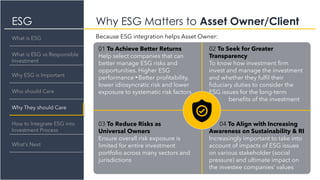
ESG Why ESG Matters to Asset Owner/Client
What is ESG
What is ESG vs Responsible
Investment
Why They should Care
How to Integrate ESG into
Investment Process
What’s Next
Why ESG is Important
Who should Care
01 To Achieve Better Returns
Help select companies that can
better manage ESG risks and
opportunities. Higher ESG
performance Better profitability,
lower idiosyncratic risk and lower
exposure to systematic risk factors
02 To Seek for Greater
Transparency
To know how investment firm
invest and manage the investment
and whether they fulfil their
fiduciary duties to consider the
ESG issues for the long-term
f benefits of the investment
03 To Reduce Risks as
Universal Owners
Ensure overall risk exposure is
limited for entire investment
portfolio across many sectors and
jurisdictions
04 To Align with Increasing
Awareness on Sustainability & RI
Increasingly important to take into
account of impacts of ESG issues
on various stakeholder (social
pressure) and ultimate impact on
the investee companies’ values
Because ESG integration helps Asset Owner:
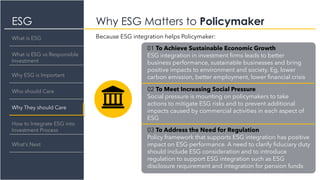
ESG Why ESG Matters to Policymaker
What is ESG
What is ESG vs Responsible
Investment
Why They should Care
How to Integrate ESG into
Investment Process
What’s Next
Why ESG is Important
Who should Care
01 To Achieve Sustainable Economic Growth
ESG integration in investment firms leads to better
business performance, sustainable businesses and bring
positive impacts to environment and society. Eg, lower
carbon emission, better employment, lower financial crisis
02 To Meet Increasing Social Pressure
Social pressure is mounting on policymakers to take
actions to mitigate ESG risks and to prevent additional
impacts caused by commercial activities in each aspect of
ESG
03 To Address the Need for Regulation
Policy framework that supports ESG integration has positive
impact on ESG performance. A need to clarify fiduciary duty
should include ESG consideration and to introduce
regulation to support ESG integration such as ESG
disclosure requirement and integration for pension funds
Because ESG integration helps Policymaker:
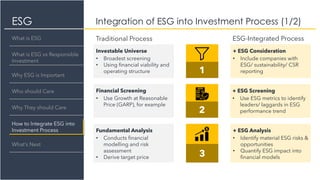
ESG Integration of ESG into Investment Process (1/2)
What is ESG
What is ESG vs Responsible
Investment
How to Integrate ESG into
Investment Process
What’s Next
Why ESG is Important
Who should Care
Why They should Care
1
Traditional Process ESG-Integrated Process
Investable Universe
• Broadest screening
• Using financial viability and
operating structure
+ ESG Consideration
• Include companies with
ESG/ sustainability/ CSR
reporting
Financial Screening
• Use Growth at Reasonable
Price (GARP), for example
+ ESG Screening
• Use ESG metrics to identify
leaders/ laggards in ESG
performance trend
Fundamental Analysis
• Conducts financial
modelling and risk
assessment
• Derive target price
+ ESG Analysis
• Identify material ESG risks &
opportunities
• Quantify ESG impact into
financial models
2
3
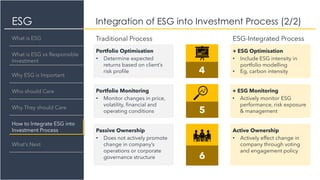
ESG Integration of ESG into Investment Process (2/2)
What is ESG
What is ESG vs Responsible
Investment
How to Integrate ESG into
Investment Process
What’s Next
Why ESG is Important
Who should Care
Why They should Care
Traditional Process ESG-Integrated Process
Portfolio Optimisation
• Determine expected
returns based on client’s
risk profile
+ ESG Optimisation
• Include ESG intensity in
portfolio modelling
• Eg, carbon intensity
Portfolio Monitoring
• Monitor changes in price,
volatility, financial and
operating conditions
+ ESG Monitoring
• Actively monitor ESG
performance, risk exposure
& management
Passive Ownership
• Does not actively promote
change in company’s
operations or corporate
governance structure
Active Ownership
• Actively effect change in
company through voting
and engagement policy
4
6
5
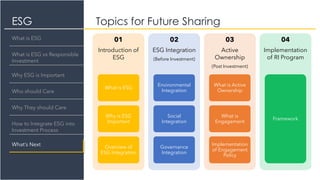
ESG Topics for Future Sharing
What is ESG
What is ESG vs Responsible
Investment
How to Integrate ESG into
Investment Process
What’s Next
Why ESG is Important
Who should Care
Why They should Care
01
Introduction of
ESG
What is ESG
Why is ESG
Important
Overview of
ESG Integration
02
ESG Integration
(Before Investment)
Environmental
Integration
Social
Integration
Governance
Integration
03
Active
Ownership
(Post Investment)
What is Active
Ownership
What is
Engagement
Implementation
of Engagement
Policy
04
Implementation
of RI Program
Framework
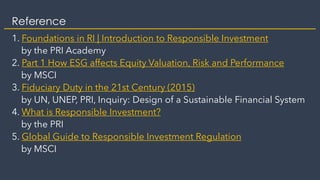
Reference
1. Foundations in RI | Introduction to Responsible Investment
by the PRI Academy
2. Part 1 How ESG affects Equity Valuation, Risk and Performance
by MSCI
3. Fiduciary Duty in the 21st Century (2015)
by UN, UNEP, PRI, Inquiry: Design of a Sustainable Financial System
4. What is Responsible Investment?
by the PRI
5. Global Guide to Responsible Investment Regulation
by MSCI
Thank You!
Connect with me
LinkedIn | Ally Chin

ESG Explained - Introduction

  • 1.
    Introduction to ESGTheKey to Sustainable Financial Growth Prepared by Ally Chin
  • 2.
    Overview 1 What isESG 2 What is ESG vs Responsible Investment 3 Why is ESG Important 4 Who should Care 5 Why Care 6 How to Integrate ESG into Investment Process 7 What’s Next
  • 3.
    ESG ESG is a genericterm used by investors to refer to the factors that can affect a company’s ability to create long-term value. It also refers to intangible assets. ~ PRI Academy Definition of ESG What is ESG What is ESG vs Responsible Investment Why ESG is Important Who should Care Why They should Care How to Integrate ESG into Investment Process What’s Next • Pollution • Biodiversity Loss • Climate Change • Deforestation • Resource Depletion • Waste Management E Environmental • Human Rights • Child Labour • Product Safety • Product Mis-selling • Labour Standards • Employee Relations S Social • Accounting • Board Composition • Bribery & Corruption • Executive Pay • Tax Avoidance • Shareholders’ Rights G Corporate Governance
  • 4.
    ESG ESG isIncorporated in Responsible Investment What is ESG What is ESG vs Responsible Investment Why ESG is Important Who should Care Why They should Care How to Integrate ESG into Investment Process What’s Next RI Responsible Investment ESG Issues Active Ownership Commitment to Transparency Commitment to Constructive Engagement
  • 5.
    ESG Responsible Investment is anapproach to managing assets that sees investors include ESG factors in their decisions a) about what to invest in and b) the role they play as owners and creditors for the long-term sustainable returns. ~ Principles for Responsible Investment, PRI Definition of Responsible Investment What is ESG What is ESG vs Responsible Investment Why ESG is Important Who should Care Why They should Care How to Integrate ESG into Investment Process What’s Next
  • 6.
    ESG . Responsible Investment ComplementsTraditional Investment Practices What is ESG What is ESG vs Responsible Investment Why ESG is Important Who should Care Why They should Care How to Integrate ESG into Investment Process What’s Next Traditional Financial Analysis Traditional Portfolio Construction Responsible Investment
  • 7.
    ESG Responsible Investment isDifferent from Sustainable & Impact Investing What is ESG What is ESG vs Responsible Investment Why ESG is Important Who should Care Why They should Care How to Integrate ESG into Investment Process What’s Next Financial Only Responsible Investment Sustainable Investment Impact Investment Impact Only Limited or no regard for ESG practices Mitigate ESG risks in order to protect value Adopt progressive ESG practices that may enhance value Address societal changes that generate competitive returns Address societal changes that may generate below-market financial returns Address societal changes that require below-market financial returns Address societal changes that cannot generate financial returns
  • 8.
    ESG Responsible Investment isDifferent from Sustainable & Impact Investing What is ESG What is ESG vs Responsible Investment Why ESG is Important Who should Care Why They should Care How to Integrate ESG into Investment Process What’s Next Financial Only Responsible Investment Sustainable Investment Impact Investment Impact Only Level of Impact FinancialReturns Low High High
  • 9.
    ESG ESG is Importantfor Financial and Economic Reasons What is ESG What is ESG vs Responsible Investment Why ESG is Important Who should Care Why They should Care How to Integrate ESG into Investment Process What’s Next 01 Improve Financial Performance 02 Support Sustainable Development
  • 10.
    ESG Key ESG-DrivingStakeholders What is ESG What is ESG vs Responsible Investment Who should Care Why They should Care How to Integrate ESG into Investment Process What’s Next Why ESG is Important 01 Investment Firm 02 Company 03 Asset Owner 04 Policymaker
  • 11.
    ESG Why ESGMatters to Investment Firm What is ESG What is ESG vs Responsible Investment Why They should Care How to Integrate ESG into Investment Process What’s Next Why ESG is Important Who should Care 01 To Price Externalities Can price the costs of commercial activities borne by natural ecosystem, society or government as production inputs. Eg, carbon tax 02 To Measure the Intangibles Intangible factors outweigh tangible factors to the corporate value. Eg, quality management, safety, governance, brand equity 03 To Manage Idiosyncratic Risks Can reduce portfolio exposure to companies with high ESG risks specific to the companies 05 To Fulfill Fiduciary Duty Ensure relevant ESG risks and opportunities (long-term value factors) are considered in the investment process 06 To Meet Rising Demand for RI More clients demand fund managers to incorporate ESG analysis in the investment process 04 To Achieve Better Returns Help select companies that can better manage ESG risks and opportunities. Higher ESG performance Better profitability Because ESG integration helps Investment Firm:
  • 12.
    ESG Why ESGMatters to Company What is ESG What is ESG vs Responsible Investment Why They should Care How to Integrate ESG into Investment Process What’s Next Why ESG is Important Who should Care 01 To Improve Long-Term Financial Performance Better ESG performance lead to • Higher profitability • Lower company-specific risks • Lower exposure to systematic risk factors Example of risk is stranded assets 02 To Meet Demand for Better Business Management Standards from Stakeholders • Investor: ESG risk management • Customer: Product safety & trust • Community: Waste management • Policymaker: Responsible corporate management Because ESG integration helps Company:
  • 13.
    ESG Why ESGMatters to Asset Owner/Client What is ESG What is ESG vs Responsible Investment Why They should Care How to Integrate ESG into Investment Process What’s Next Why ESG is Important Who should Care 01 To Achieve Better Returns Help select companies that can better manage ESG risks and opportunities. Higher ESG performance Better profitability, lower idiosyncratic risk and lower exposure to systematic risk factors 02 To Seek for Greater Transparency To know how investment firm invest and manage the investment and whether they fulfil their fiduciary duties to consider the ESG issues for the long-term f benefits of the investment 03 To Reduce Risks as Universal Owners Ensure overall risk exposure is limited for entire investment portfolio across many sectors and jurisdictions 04 To Align with Increasing Awareness on Sustainability & RI Increasingly important to take into account of impacts of ESG issues on various stakeholder (social pressure) and ultimate impact on the investee companies’ values Because ESG integration helps Asset Owner:
  • 14.
    ESG Why ESGMatters to Policymaker What is ESG What is ESG vs Responsible Investment Why They should Care How to Integrate ESG into Investment Process What’s Next Why ESG is Important Who should Care 01 To Achieve Sustainable Economic Growth ESG integration in investment firms leads to better business performance, sustainable businesses and bring positive impacts to environment and society. Eg, lower carbon emission, better employment, lower financial crisis 02 To Meet Increasing Social Pressure Social pressure is mounting on policymakers to take actions to mitigate ESG risks and to prevent additional impacts caused by commercial activities in each aspect of ESG 03 To Address the Need for Regulation Policy framework that supports ESG integration has positive impact on ESG performance. A need to clarify fiduciary duty should include ESG consideration and to introduce regulation to support ESG integration such as ESG disclosure requirement and integration for pension funds Because ESG integration helps Policymaker:
  • 15.
    ESG Integration ofESG into Investment Process (1/2) What is ESG What is ESG vs Responsible Investment How to Integrate ESG into Investment Process What’s Next Why ESG is Important Who should Care Why They should Care 1 Traditional Process ESG-Integrated Process Investable Universe • Broadest screening • Using financial viability and operating structure + ESG Consideration • Include companies with ESG/ sustainability/ CSR reporting Financial Screening • Use Growth at Reasonable Price (GARP), for example + ESG Screening • Use ESG metrics to identify leaders/ laggards in ESG performance trend Fundamental Analysis • Conducts financial modelling and risk assessment • Derive target price + ESG Analysis • Identify material ESG risks & opportunities • Quantify ESG impact into financial models 2 3
  • 16.
    ESG Integration ofESG into Investment Process (2/2) What is ESG What is ESG vs Responsible Investment How to Integrate ESG into Investment Process What’s Next Why ESG is Important Who should Care Why They should Care Traditional Process ESG-Integrated Process Portfolio Optimisation • Determine expected returns based on client’s risk profile + ESG Optimisation • Include ESG intensity in portfolio modelling • Eg, carbon intensity Portfolio Monitoring • Monitor changes in price, volatility, financial and operating conditions + ESG Monitoring • Actively monitor ESG performance, risk exposure & management Passive Ownership • Does not actively promote change in company’s operations or corporate governance structure Active Ownership • Actively effect change in company through voting and engagement policy 4 6 5
  • 17.
    ESG Topics forFuture Sharing What is ESG What is ESG vs Responsible Investment How to Integrate ESG into Investment Process What’s Next Why ESG is Important Who should Care Why They should Care 01 Introduction of ESG What is ESG Why is ESG Important Overview of ESG Integration 02 ESG Integration (Before Investment) Environmental Integration Social Integration Governance Integration 03 Active Ownership (Post Investment) What is Active Ownership What is Engagement Implementation of Engagement Policy 04 Implementation of RI Program Framework
  • 18.
    Reference 1. Foundations inRI | Introduction to Responsible Investment by the PRI Academy 2. Part 1 How ESG affects Equity Valuation, Risk and Performance by MSCI 3. Fiduciary Duty in the 21st Century (2015) by UN, UNEP, PRI, Inquiry: Design of a Sustainable Financial System 4. What is Responsible Investment? by the PRI 5. Global Guide to Responsible Investment Regulation by MSCI
  • 19.
    Thank You! Connect withme LinkedIn | Ally Chin