Islam
The Religion of Muslims
Basic Definition

   Religion based on the messages
    received by Muhammad
   Muhammad: man born around 570 CE
    in Mecca, believed by Muslims to be a
    prophet
True or False?

1.   Islam is a polytheistic faith.
2.   Followers of Islam are called Arabics.
3.   A building for Muslim prayer is called
     a mosque.
4.   Muslims are not allowed to drink
     alcohol.
5.   Muslim women are not allowed to
     own property.
Muslim or not?

1. Shaq, basketball
  player
Muslim or not?

2. Dave Chapelle,
  comedian
Muslim or not?

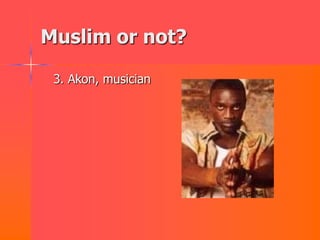
 3. Akon, musician
Muslim or not?

4. Janet Jackson
Muslim or not?

5. Everlast, musician
Muslim or not?

6. Mike Tyson, boxer
Two Ways of Life

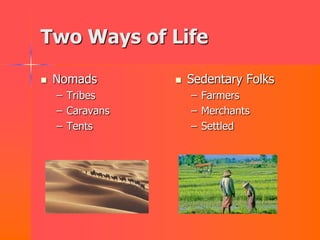
   Nomads          Sedentary Folks
    – Tribes         – Farmers
    – Caravans       – Merchants
    – Tents          – Settled
Where did they meet?

   Bazaars
   Nomads traded animal
    products and desert
    herbs for goods like
    cooking supplies &
    clothing
   Merchants sold spices,
    gold, leather, crops,
    and other goods
Star of the Caravan
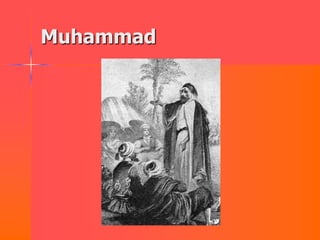
Muhammad
Muhammad’s Life

   Born in 570 CE in Mecca
   Caravan driver until age 30
   Muslims believe he was a prophet
   Angel appeared to Muhammad
   Teachings collected in Qur‟an
   Made hegira from Mecca to Medina
   Died at age 62
Arabia during his time
Biblical Lineage

   According to
    Muslims, Muhammad is
    related to Adam, Noah, and
    Abraham
   Thus, Jesus would be
    Muhammad‟s ancestor
What did he teach?

   One god, “Allah”
   Rich and poor should be equal
   World has definite beginning and will
    end someday
   Paradise is a beautiful garden
   Allah will judge all people in the end
   Guidelines for behavior & worship
The Qur’an
Qur’an: Sacred Book

   There is only one God.
   God will judge all
    people.
   The good will live in
    paradise.
   The bad will suffer.
Rules for Worship
   Don‟t eat pork or drink alcohol.
   Do ritual washing before prayer.
   5 Pillars of Islam
Rules for Society
   Slaves should be freed.
   Women have the right to
    – own property
    – earn money
    – receive an education
Why do Muslim women
wear the veil (hijab)?
   Sumayya Syed, 16, says that what parents
    or men want have nothing to do with it…
   She says it is a form of liberation (freedom).
   When a woman is covered, men cannot
    judge her by her appearance but are forced
    to evaluate her by her
    personality, character, and morals.
   "I tell them that the hijab is not a
    responsibility, it's a right given to me by my
    Creator who knows us best. It's a benefit to
    me, so why not? It's something every
    woman should strive to get and should
    want."
Jihad: Holy struggle

   “To make an effort, to struggle”
   Inner struggle people go through in
    trying to obey God & behave
    according to Islamic ways
   Also, struggle to get people to convert
    to Islam
Sunnah

   Way Muhammad lived
   Provides a model for
    the duties & way of life
    expected of Muslims
   Inspired 5 pillars of
    Islam
Shariah

   Islamic law
   Based on interpretations of Qur‟an and
    Sunnah, as well as human reason
   Rewards for good behavior
   Punishments for bad behavior
5 Pillars of Islam

   5 acts of worship required of all
    Muslims
    – Statement of faith
    – Prayer 5x a day
    – Almsgiving
    – Fasting
    – Hajj
1st Pillar

   Allah is the one true God
   Muhammad is Allah‟s prophet
    – “There is no god but God, and
      Muhammad is his prophet.”
2nd Pillar
                Prayer 5 times
                 a day
                 – Sunrise
                 – Midday
                 – Late afternoon
                 – Right after
                   sunset
                 – Before bed
3rd Pillar

   Yearly donation to charity
   Muslims pay part of salary to religious
    official
   Money used to help poor, build
    mosques, or pay debts
4th Pillar

   Fasting: going without food or drink
   Daily fasting during holy month of
    Ramadan, when Allah began
    communicating with Muhammad
    – No eating when sun is up
   Reminds Muslims of all those who go
    hungry/thirsty in the world
5th Pillar


   Hajj: pilgrimage to Mecca
   All Muslims must make their hajj once
    during lifetime
   Kaaba: Islam‟s most sacred place
Kaaba
Kaaba
Islamic Empires

   Controlled much of Europe, Asia, and
    Africa
   1400s to 1800s
   Ottomans
   Safavids
   Mughals
Ottomans
   Muslim Turkish warriors
   Ruled land from Eastern Europe to
    North Africa and Arabia
   Key to power: super army
   Janissaries: slave soldiers who
    converted to Islam and became fierce
   Gunpowder weapons
   Mehmed II: built up Istanbul
   Suleyman I: pushed into Europe
Safavids
   Persian Muslims
   Shia (Safavids): Muslims who thought
    only Muhammad‟s descendents should
    become caliphs
   Sunnis (Ottomans): believed caliphs
    didn‟t have to be related to
    Muhammad
   Esma‟il: spread Shiism
   „Abba: strengthened military
Mughals
   Turkish Muslims from Central Asia
   Babur: established empire
   Akbar: religious tolerance
   Built beautiful structures like Taj Mahal
    in India
   Hindus and Muslims could peacefully
    coexist in India
Taj Mahal, by Akbar
Islamic Contributions

   Art
   Science
   Math
   Literature
Art
Calligraphy
Muslim and Christian
Images of the Creator
Architecture
Poetry influenced by
Sufism
Sufi poets often wrote about their loyalty
  to God:

       The mighty Mahmud, the victorious Lord,
       That all the misbelieving and black Horde
       Of Fears and Sorrows that infest the Soul
                               Scatters and slays
                      with his enchanted Sword.
                                 -Omar Khayyam
Famous Stories
Astronomy
   Muslims greatly
    improved Greek
    astrolabe to figure out
    directions, location, &
    time of day
   Observatories to study
    sun, moon, stars
Math

   Combined Indian & Greek ideas to
    learn more about math
   “Arabic numerals” are what we use
    today
    –123456789
Geography

   Using knowledge of stars, explorers
    traveled throughout world
   Ibn Battuta wrote about his travels to
    Africa, India, China, Spain in 1320s
   Accurate maps were made
Medicine

   Combined Greek & Indian knowledge
    with own discoveries
   First pharmacy school to teach how to
    make medicine
   Medical encyclopedia written
   Treatment for smallpox
Philosophy

                Sufism: movement
                 that focuses on
                 spiritual issues
                Sufis believe they
                 can find God‟s love
                 by having a
                 personal
                 relationship with
                 him
Whirling Dervishes
Thank you, Islam!

   Write a thank-you note to Muslims for
    their contributions to
    – Art
    – Science
    – Math
    – Literature
   At least ½ page
   You have until the end of class

Islam

  • 1.
  • 2.
    Basic Definition  Religion based on the messages received by Muhammad  Muhammad: man born around 570 CE in Mecca, believed by Muslims to be a prophet
  • 3.
    True or False? 1. Islam is a polytheistic faith. 2. Followers of Islam are called Arabics. 3. A building for Muslim prayer is called a mosque. 4. Muslims are not allowed to drink alcohol. 5. Muslim women are not allowed to own property.
  • 4.
    Muslim or not? 1.Shaq, basketball player
  • 5.
    Muslim or not? 2.Dave Chapelle, comedian
  • 6.
    Muslim or not? 3. Akon, musician
  • 7.
    Muslim or not? 4.Janet Jackson
  • 8.
    Muslim or not? 5.Everlast, musician
  • 9.
    Muslim or not? 6.Mike Tyson, boxer
  • 11.
    Two Ways ofLife  Nomads  Sedentary Folks – Tribes – Farmers – Caravans – Merchants – Tents – Settled
  • 12.
    Where did theymeet?  Bazaars  Nomads traded animal products and desert herbs for goods like cooking supplies & clothing  Merchants sold spices, gold, leather, crops, and other goods
  • 13.
    Star of theCaravan
  • 14.
  • 15.
    Muhammad’s Life  Born in 570 CE in Mecca  Caravan driver until age 30  Muslims believe he was a prophet  Angel appeared to Muhammad  Teachings collected in Qur‟an  Made hegira from Mecca to Medina  Died at age 62
  • 16.
  • 17.
    Biblical Lineage  According to Muslims, Muhammad is related to Adam, Noah, and Abraham  Thus, Jesus would be Muhammad‟s ancestor
  • 18.
    What did heteach?  One god, “Allah”  Rich and poor should be equal  World has definite beginning and will end someday  Paradise is a beautiful garden  Allah will judge all people in the end  Guidelines for behavior & worship
  • 19.
  • 20.
    Qur’an: Sacred Book  There is only one God.  God will judge all people.  The good will live in paradise.  The bad will suffer.
  • 21.
    Rules for Worship  Don‟t eat pork or drink alcohol.  Do ritual washing before prayer.  5 Pillars of Islam
  • 22.
    Rules for Society  Slaves should be freed.  Women have the right to – own property – earn money – receive an education
  • 23.
    Why do Muslimwomen wear the veil (hijab)?  Sumayya Syed, 16, says that what parents or men want have nothing to do with it…  She says it is a form of liberation (freedom).  When a woman is covered, men cannot judge her by her appearance but are forced to evaluate her by her personality, character, and morals.  "I tell them that the hijab is not a responsibility, it's a right given to me by my Creator who knows us best. It's a benefit to me, so why not? It's something every woman should strive to get and should want."
  • 24.
    Jihad: Holy struggle  “To make an effort, to struggle”  Inner struggle people go through in trying to obey God & behave according to Islamic ways  Also, struggle to get people to convert to Islam
  • 25.
    Sunnah  Way Muhammad lived  Provides a model for the duties & way of life expected of Muslims  Inspired 5 pillars of Islam
  • 26.
    Shariah  Islamic law  Based on interpretations of Qur‟an and Sunnah, as well as human reason  Rewards for good behavior  Punishments for bad behavior
  • 27.
    5 Pillars ofIslam  5 acts of worship required of all Muslims – Statement of faith – Prayer 5x a day – Almsgiving – Fasting – Hajj
  • 28.
    1st Pillar  Allah is the one true God  Muhammad is Allah‟s prophet – “There is no god but God, and Muhammad is his prophet.”
  • 29.
    2nd Pillar  Prayer 5 times a day – Sunrise – Midday – Late afternoon – Right after sunset – Before bed
  • 30.
    3rd Pillar  Yearly donation to charity  Muslims pay part of salary to religious official  Money used to help poor, build mosques, or pay debts
  • 31.
    4th Pillar  Fasting: going without food or drink  Daily fasting during holy month of Ramadan, when Allah began communicating with Muhammad – No eating when sun is up  Reminds Muslims of all those who go hungry/thirsty in the world
  • 32.
    5th Pillar  Hajj: pilgrimage to Mecca  All Muslims must make their hajj once during lifetime  Kaaba: Islam‟s most sacred place
  • 33.
  • 34.
  • 35.
    Islamic Empires  Controlled much of Europe, Asia, and Africa  1400s to 1800s  Ottomans  Safavids  Mughals
  • 36.
    Ottomans  Muslim Turkish warriors  Ruled land from Eastern Europe to North Africa and Arabia  Key to power: super army  Janissaries: slave soldiers who converted to Islam and became fierce  Gunpowder weapons  Mehmed II: built up Istanbul  Suleyman I: pushed into Europe
  • 37.
    Safavids  Persian Muslims  Shia (Safavids): Muslims who thought only Muhammad‟s descendents should become caliphs  Sunnis (Ottomans): believed caliphs didn‟t have to be related to Muhammad  Esma‟il: spread Shiism  „Abba: strengthened military
  • 38.
    Mughals  Turkish Muslims from Central Asia  Babur: established empire  Akbar: religious tolerance  Built beautiful structures like Taj Mahal in India  Hindus and Muslims could peacefully coexist in India
  • 39.
  • 40.
    Islamic Contributions  Art  Science  Math  Literature
  • 41.
  • 45.
  • 46.
  • 47.
  • 48.
    Poetry influenced by Sufism Sufipoets often wrote about their loyalty to God: The mighty Mahmud, the victorious Lord, That all the misbelieving and black Horde Of Fears and Sorrows that infest the Soul Scatters and slays with his enchanted Sword. -Omar Khayyam
  • 49.
  • 50.
    Astronomy  Muslims greatly improved Greek astrolabe to figure out directions, location, & time of day  Observatories to study sun, moon, stars
  • 51.
    Math  Combined Indian & Greek ideas to learn more about math  “Arabic numerals” are what we use today –123456789
  • 52.
    Geography  Using knowledge of stars, explorers traveled throughout world  Ibn Battuta wrote about his travels to Africa, India, China, Spain in 1320s  Accurate maps were made
  • 54.
    Medicine  Combined Greek & Indian knowledge with own discoveries  First pharmacy school to teach how to make medicine  Medical encyclopedia written  Treatment for smallpox
  • 55.
    Philosophy  Sufism: movement that focuses on spiritual issues  Sufis believe they can find God‟s love by having a personal relationship with him
  • 56.
  • 57.
    Thank you, Islam!  Write a thank-you note to Muslims for their contributions to – Art – Science – Math – Literature  At least ½ page  You have until the end of class