Understanding Islam:
A Brief Introduction
By Alan D. DeSantis
Islam Today: Demographics
• There are an estimated 1.2 billion
Muslims worldwide
– Approximately 1/5th of the world's
population
– Growth without missionary efforts
• Where Do Muslims Live?
– Only 18% of Muslims live in the Arab world
– 20% are found in Sub-Saharan Africa
– 30% in the South Asian region of Pakistan,
India and Bangladesh
– The world's largest single Muslim
community is in Indonesia
• The Top 9: 1) Indonesia, 2) Pakistan, 3)
Bangladesh, 4) India, 5) Turkey, 6) Iran, 7)
Egypt, 8) Nigeria, and 9) China
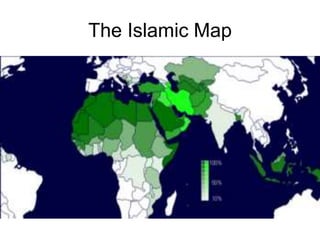
The Islamic Map
Two Main Braches of Islam
• There are two main branches of Islam today
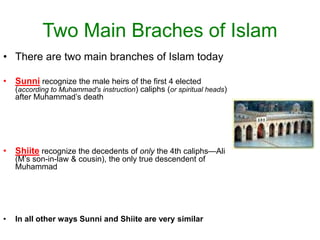
• Sunni recognize the male heirs of the first 4 elected
(according to Muhammad's instruction) caliphs (or spiritual heads)
after Muhammad’s death
• Shiite recognize the decedents of only the 4th caliphs—Ali
(M’s son-in-law & cousin), the only true descendent of
Muhammad
• In all other ways Sunni and Shiite are very similar
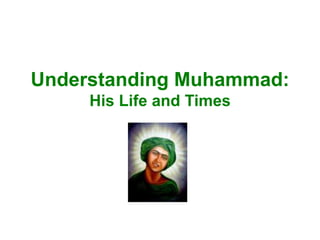
Understanding Muhammad:
His Life and Times
The Life of Muhammad:
The early years
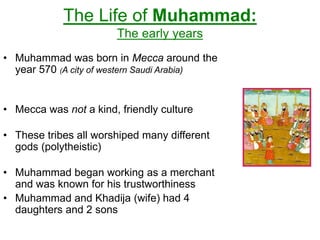
• Muhammad was born in Mecca around the
year 570 (A city of western Saudi Arabia)
• Mecca was not a kind, friendly culture
• These tribes all worshiped many different
gods (polytheistic)
• Muhammad began working as a merchant
and was known for his trustworthiness
• Muhammad and Khadija (wife) had 4
daughters and 2 sons
The Life of Muhammad:
The Visions and the Message
• Fifteen years after his marriage, he began to have visions and
hear mysterious voices
• When Muhammad was about 40 years old an angel appeared
to him in the form of a man
• This revelation was soon followed by others about the one true
God
– The key message:
• Unlike Jesus (who Christians believe was God's son) Muhammad was
a mortal, albeit with extraordinary qualities
• He preached a strong social justice message about equality
and poverty
The Life of Muhammad:
The Trouble
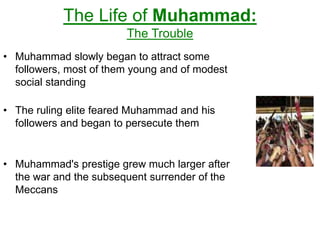
• Muhammad slowly began to attract some
followers, most of them young and of modest
social standing
• The ruling elite feared Muhammad and his
followers and began to persecute them
• Muhammad's prestige grew much larger after
the war and the subsequent surrender of the
Meccans
The Life of Muhammad:
Conclusion
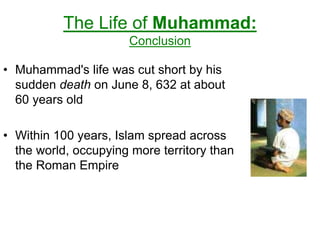
• Muhammad's life was cut short by his
sudden death on June 8, 632 at about
60 years old
• Within 100 years, Islam spread across
the world, occupying more territory than
the Roman Empire
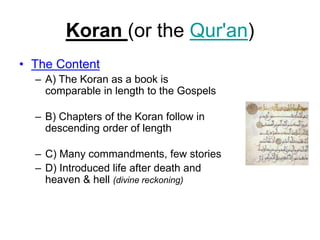
Koran (or the Qur'an)
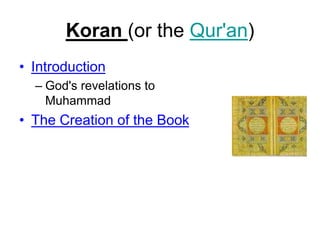
• Introduction
– God's revelations to
Muhammad
• The Creation of the Book
Koran (or the Qur'an)
• The Content
– A) The Koran as a book is
comparable in length to the Gospels
– B) Chapters of the Koran follow in
descending order of length
– C) Many commandments, few stories
– D) Introduced life after death and
heaven & hell (divine reckoning)
Muslims view other religions:
• Muslims believe that God had previously
revealed Himself to the earlier prophets
of the Jews and Christians
• Muslims therefore accept the teachings
of both the Jewish Torah and the
Christian Gospels
• They believe that Islam is the perfection
of the religion
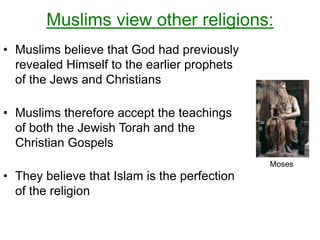
Moses
The Five Pillars
• The believer worships God directly without the
intercession of priests or clergy or saints.
• The believer's duties are summed up in five simple
rules, the so-called Five Pillars of Islam:
• 1) Belief
• 2) Worship
– A) Worship God five times a day — at dawn, noon,
mid-afternoon, sunset, and nightfall.
– B) All males gather together on Friday for the noon
prayer and listen to a sermon by the leader of the
community.
The Five Pillars
• 3) Fasting
• 4) Almsgiving
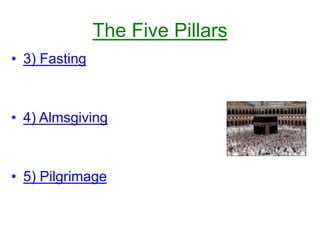
• 5) Pilgrimage
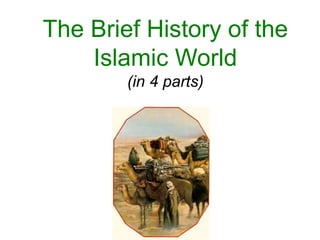
The Brief History of the
Islamic World
(in 4 parts)
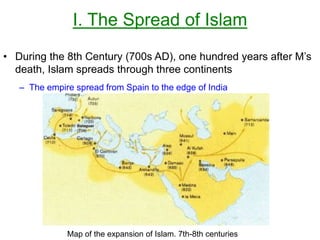
I. The Spread of Islam
• During the 8th Century (700s AD), one hundred years after M’s
death, Islam spreads through three continents
– The empire spread from Spain to the edge of India
Map of the expansion of Islam. 7th-8th centuries
II. The Spread of Islam
and the first Renaissance:
• Baghdad (Iraq) became the center of
learning and innovation
• While Europe was the Dark Ages:
– A)
– B)
– C)
II. The Spread of Islam
and the first Renaissance:
• The Muslims:
– 1) Translated
– 2) Invented
– 3) Understood
– 4) Developed
– 5) Utilized
– 6) Refined
– 7) Advanced
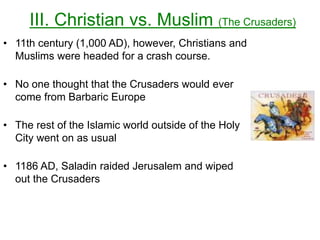
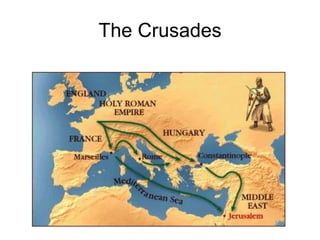
III. Christian vs. Muslim (The Crusaders)
• 11th century (1,000 AD), however, Christians and
Muslims were headed for a crash course.
• No one thought that the Crusaders would ever
come from Barbaric Europe
• The rest of the Islamic world outside of the Holy
City went on as usual
• 1186 AD, Saladin raided Jerusalem and wiped
out the Crusaders
The Crusades
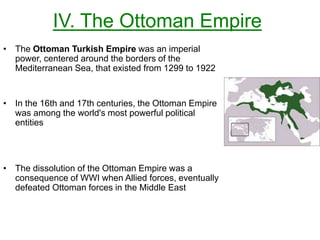
IV. The Ottoman Empire
• The Ottoman Turkish Empire was an imperial
power, centered around the borders of the
Mediterranean Sea, that existed from 1299 to 1922
• In the 16th and 17th centuries, the Ottoman Empire
was among the world's most powerful political
entities
• The dissolution of the Ottoman Empire was a
consequence of WWI when Allied forces, eventually
defeated Ottoman forces in the Middle East
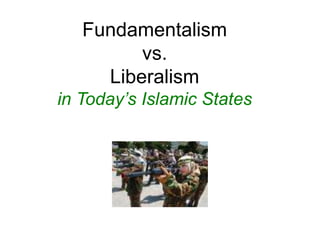
Fundamentalism
vs.
Liberalism
in Today’s Islamic States
Liberalism in Islam
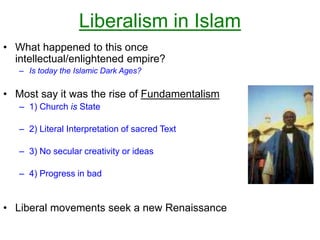
• What happened to this once
intellectual/enlightened empire?
– Is today the Islamic Dark Ages?
• Most say it was the rise of Fundamentalism
– 1) Church is State
– 2) Literal Interpretation of sacred Text
– 3) No secular creativity or ideas
– 4) Progress in bad
• Liberal movements seek a new Renaissance
Liberalism in Islam
• 1) Human rights
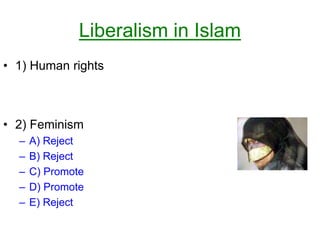
• 2) Feminism
– A) Reject
– B) Reject
– C) Promote
– D) Promote
– E) Reject
Liberalism in Islam
• 3) Political Secularism
– Favor the idea of modern secular democracy with
separation of church and state
• 4) Re-interpretation of the Quran
– A) Criticise the literal interpretations of the Qur'an
– B) Reject the authority of traditional scholars to issue
a fatwa (no leader as voice of God)
Liberalism in Islam
• 5) Tolerance towards non-Muslims
–
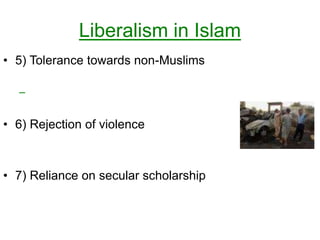
• 6) Rejection of violence
• 7) Reliance on secular scholarship
Criticism of Liberal Islam
• Producing a watered-down,
inauthentic form of Islam as a
compromise with Western
society
• Liberal Muslims are abandoning
Islam and just imitating the West
– Becoming cultural Muslims

UnderstandingIslamforweb.ppt

  • 1.
    Understanding Islam: A BriefIntroduction By Alan D. DeSantis
  • 2.
    Islam Today: Demographics •There are an estimated 1.2 billion Muslims worldwide – Approximately 1/5th of the world's population – Growth without missionary efforts • Where Do Muslims Live? – Only 18% of Muslims live in the Arab world – 20% are found in Sub-Saharan Africa – 30% in the South Asian region of Pakistan, India and Bangladesh – The world's largest single Muslim community is in Indonesia • The Top 9: 1) Indonesia, 2) Pakistan, 3) Bangladesh, 4) India, 5) Turkey, 6) Iran, 7) Egypt, 8) Nigeria, and 9) China
  • 3.
  • 4.
    Two Main Brachesof Islam • There are two main branches of Islam today • Sunni recognize the male heirs of the first 4 elected (according to Muhammad's instruction) caliphs (or spiritual heads) after Muhammad’s death • Shiite recognize the decedents of only the 4th caliphs—Ali (M’s son-in-law & cousin), the only true descendent of Muhammad • In all other ways Sunni and Shiite are very similar
  • 5.
  • 6.
    The Life ofMuhammad: The early years • Muhammad was born in Mecca around the year 570 (A city of western Saudi Arabia) • Mecca was not a kind, friendly culture • These tribes all worshiped many different gods (polytheistic) • Muhammad began working as a merchant and was known for his trustworthiness • Muhammad and Khadija (wife) had 4 daughters and 2 sons
  • 7.
    The Life ofMuhammad: The Visions and the Message • Fifteen years after his marriage, he began to have visions and hear mysterious voices • When Muhammad was about 40 years old an angel appeared to him in the form of a man • This revelation was soon followed by others about the one true God – The key message: • Unlike Jesus (who Christians believe was God's son) Muhammad was a mortal, albeit with extraordinary qualities • He preached a strong social justice message about equality and poverty
  • 8.
    The Life ofMuhammad: The Trouble • Muhammad slowly began to attract some followers, most of them young and of modest social standing • The ruling elite feared Muhammad and his followers and began to persecute them • Muhammad's prestige grew much larger after the war and the subsequent surrender of the Meccans
  • 9.
    The Life ofMuhammad: Conclusion • Muhammad's life was cut short by his sudden death on June 8, 632 at about 60 years old • Within 100 years, Islam spread across the world, occupying more territory than the Roman Empire
  • 10.
  • 11.
    Koran (or theQur'an) • Introduction – God's revelations to Muhammad • The Creation of the Book
  • 12.
    Koran (or theQur'an) • The Content – A) The Koran as a book is comparable in length to the Gospels – B) Chapters of the Koran follow in descending order of length – C) Many commandments, few stories – D) Introduced life after death and heaven & hell (divine reckoning)
  • 13.
    Muslims view otherreligions: • Muslims believe that God had previously revealed Himself to the earlier prophets of the Jews and Christians • Muslims therefore accept the teachings of both the Jewish Torah and the Christian Gospels • They believe that Islam is the perfection of the religion Moses
  • 14.
    The Five Pillars •The believer worships God directly without the intercession of priests or clergy or saints. • The believer's duties are summed up in five simple rules, the so-called Five Pillars of Islam: • 1) Belief • 2) Worship – A) Worship God five times a day — at dawn, noon, mid-afternoon, sunset, and nightfall. – B) All males gather together on Friday for the noon prayer and listen to a sermon by the leader of the community.
  • 15.
    The Five Pillars •3) Fasting • 4) Almsgiving • 5) Pilgrimage
  • 16.
    The Brief Historyof the Islamic World (in 4 parts)
  • 17.
    I. The Spreadof Islam • During the 8th Century (700s AD), one hundred years after M’s death, Islam spreads through three continents – The empire spread from Spain to the edge of India Map of the expansion of Islam. 7th-8th centuries
  • 18.
    II. The Spreadof Islam and the first Renaissance: • Baghdad (Iraq) became the center of learning and innovation • While Europe was the Dark Ages: – A) – B) – C)
  • 19.
    II. The Spreadof Islam and the first Renaissance: • The Muslims: – 1) Translated – 2) Invented – 3) Understood – 4) Developed – 5) Utilized – 6) Refined – 7) Advanced
  • 20.
    III. Christian vs.Muslim (The Crusaders) • 11th century (1,000 AD), however, Christians and Muslims were headed for a crash course. • No one thought that the Crusaders would ever come from Barbaric Europe • The rest of the Islamic world outside of the Holy City went on as usual • 1186 AD, Saladin raided Jerusalem and wiped out the Crusaders
  • 21.
  • 22.
    IV. The OttomanEmpire • The Ottoman Turkish Empire was an imperial power, centered around the borders of the Mediterranean Sea, that existed from 1299 to 1922 • In the 16th and 17th centuries, the Ottoman Empire was among the world's most powerful political entities • The dissolution of the Ottoman Empire was a consequence of WWI when Allied forces, eventually defeated Ottoman forces in the Middle East
  • 23.
  • 24.
    Liberalism in Islam •What happened to this once intellectual/enlightened empire? – Is today the Islamic Dark Ages? • Most say it was the rise of Fundamentalism – 1) Church is State – 2) Literal Interpretation of sacred Text – 3) No secular creativity or ideas – 4) Progress in bad • Liberal movements seek a new Renaissance
  • 25.
    Liberalism in Islam •1) Human rights • 2) Feminism – A) Reject – B) Reject – C) Promote – D) Promote – E) Reject
  • 26.
    Liberalism in Islam •3) Political Secularism – Favor the idea of modern secular democracy with separation of church and state • 4) Re-interpretation of the Quran – A) Criticise the literal interpretations of the Qur'an – B) Reject the authority of traditional scholars to issue a fatwa (no leader as voice of God)
  • 27.
    Liberalism in Islam •5) Tolerance towards non-Muslims – • 6) Rejection of violence • 7) Reliance on secular scholarship
  • 28.
    Criticism of LiberalIslam • Producing a watered-down, inauthentic form of Islam as a compromise with Western society • Liberal Muslims are abandoning Islam and just imitating the West – Becoming cultural Muslims