

SomeDistinctive
FeaturesofIslam
OTHER BOOKS BY THE SAME AUTHOR
Absolute Justice, Kindness and Kinship—
The Three Creative Principles
Christianity—A Journey from Facts to Fiction
An Elementary Study of Islam
The Gulf Crisis and the New World Order
Homeopathy: Like Cures Like
Islam’s Response to Contemporary Issues
Murder in the Name of Allah
Revelation, Rationality, Knowledge and Truth
The Seal of the Prophets, His Personality and Character
The True Islamic Concept of Jihad
The Truth about the Alleged Punishment
for Apostasy in Islam
With Love to the Muslims of the World
About The Author
Hadrat Mirza Tahir Ahmad (1928–2003), may Allah have infinite
mercy on his soul, a man of God, Voice articulate of the age, a great
orator, a deeply learned scholar of phenomenal intelligence, a prolific
and versatilewriter, a keenstudentofcomparativereligionswasloved
and devoutly followed by his more than 10 million Ahmadi Muslim
followersallover theworld astheirImam,thespiritualhead,beingthe
fourth successor of Hadrat Mirza Ghulam Ahmad (the Promised
Messiah and Mahdias
), to which august office he was elected as
Khalifatul Masih in 1982.
After the promulgation of general Zia-ul-Haq anti-Ahmadiyya
Ordinance of 26th
April 1984 he had to leave his beloved country,
Pakistan, and migrated to England from where he launched Muslim
Television Ahmadiyya International (MTA) which would (and still
does)telecastitsprogrammes24 hoursa daytothefourcornersofthe
world.
Besidesbeing a religiousleader, hewasa homeopathicphysicianof
world fame, a highly gifted poet and a sportsman.
He had his schooling in Qadian, India, and later joined the Govt.
College, Lahore, Pakistan, and after graduating from Jami‘ah
Ahmadiyya, Rabwah, Pakistan with distinction, he obtained his
iv Some Distinctive Features of Islam
honours degree in Arabic from the Punjab University, Lahore. From
1955 to 1957 he studied at the School of Oriental and African
Studies, University of London.
He had a divinely inspired and very deep knowledge of the Holy
Quran which he translated into Urdu. He also partially revised and
added explanatorynotesto theEnglishtranslationoftheHolyQuran
byHadratMaulawiSherAlira
. Revelation,Rationality,Knowledgeand
Truth is his magnum opus.
Thoughhehad noformaleducationinphilosophyand science,he
had a philosophical bent of mind and tackled most difficult and
abstruse theological-philosophical questions with great acumen and
ease and his intellectual approach was always rational and scientific.
For a layman he had an amazingly in-depth knowledge of science,
especially life sciences which attracted him most. He also had deep
knowledge of human psychology. His was an analytical mind of high
intelligence—an intellect scintillating with brilliance, capable of
solving knottiest problems with ease, leaving his listeners and readers
spellbound.
SomeDistinctive
Features ofIslam
Mirza TahirAhmad
Islam International Publications Ltd.
Tilford, Surrey
Some Distinctive Features of Islam
by Mirza Tahir Ahmad
Copyright by Islam International Publications Ltd.
First published in English 1985
Reprinted 1987, 1989, 1992, 1995
Present edition 2007
Published by
Islam International Publications Ltd.
Islamabad, Sheephatch Lane
Tilford, Surrey GU10 2AQ
Printed at
Raqeem Press
Islamabad, Tilford, Surrey
Cover design by Salman Muhammad Sajid
Book layout and index prepared by Dr. Abdul Majid Shah
All rights reserved. No part of this publication may be reproduced, stored in
a retrieval system, or transmitted in any form or by any means, electronic,
mechanical, photocopying, recording, or otherwise, without the prior written
permission of the publisher.
ISBN: 1 85372 052 6
Contents
Publisher’s Note.............................................................viii
Foreword to the Present Edition....................................xiii
No Monopoly of Truth.................................................4
A Universal Religion ......................................................6
Differences and Contradictions
among Faiths –Their Reality........................................7
An Eternal Religion........................................................9
Safeguarding of the Holy Quran ...............................10
A Complete Religion....................................................12
Zakat versus Interest.....................................................13
Directions in Political Matters...................................14
Islamic Concept of Justice...........................................17
Some Other Distinctions............................................21
A Religion of Peace.......................................................25
The Ahmadiyya Movement........................................26
Index................................................................................31
Publisher’s Note
According to our system of counting Quranic verses, the verse
Bismillah irrahman irrahim (In the name of Allah, the Most
Gracious, Ever Merciful) is counted as the first verse of the chapter,
whichitprecedes. SomepublishersoftheHolyQuranhowever,begin
counting following Bismillah irrahman irrahim. Should the reader
notfind therelevantverseunderthenumbermentioned inthisbook,
he or she is advised to deduct 1 from the number. For example, if this
book quotes Ch. 35: Al-Fatir: 25, then some copies of the Holy
Quran will list the same verse under Ch. 35: Al-Fatir: 24.
Wherenecessary,translationoftheArabictexthasbeenelaborated
by additional words to explain the meaning. Such words are not in
italics. The word and at the commencement of a translated verse has
been omitted.
The form ibn has been used in both initial and medial position in
the names of persons, in order to conform to current usage, although
bin also occurs medially in some original texts (abbreviated usually as
b.).
Quotations from the Holy Bible are from the New World
Translation.
Some Distinctive Features of Islam ix
The name of Muhammadsa
, the Holy Prophet of Islam, has been
followed bythesymbolsa
, whichisanabbreviationfortheprayer( )
Sallallahu ‘Alaihi Wasallam (may peace and blessings of Allah be
upon him). The names of other Prophetsas
and messengers are
followed by the symbol as
, an abbreviation for ( / )
‘Alaihissalam/‘Alaihimussalam (on whom be peace). The actual
prayers have not generally been set out in full, but they should
nevertheless, beunderstood asbeing repeated in fullineachcase. The
symbol ra
is used with the name of the Companions of the Holy
Prophetsa
and those of the Promised Messiahas
. It stands for
( / / )Radi Allahu‘anhu/‘anha/‘anhum(mayAllahbepleased
with him/with her/with them). rh
stands for ( ) Rahimahullahu
Ta‘ala (may Allah’s blessing be on him). at
stands for ( )
Ayyadahullahu Ta‘ala (may Allah, the Almighty help him).
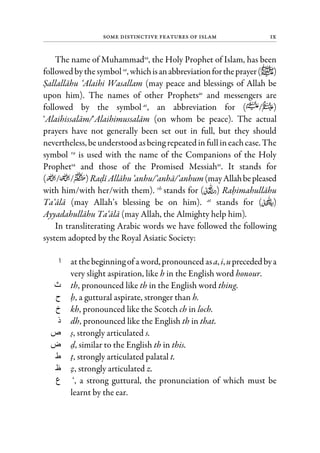
In transliterating Arabic words we have followed the following
system adopted by the Royal Asiatic Society:
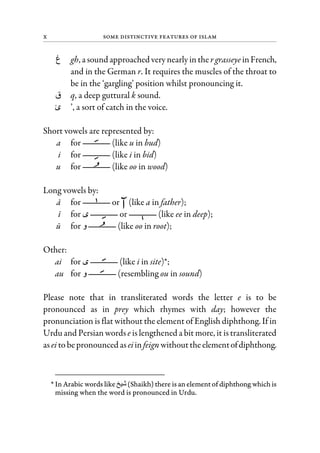
‫ا‬ at thebeginning of a word,pronounced asa, i,uprecededbya
very slight aspiration, like h in the English word honour.
‫ث‬ th, pronounced like th in the English word thing.
‫ح‬ h, a guttural aspirate, stronger than h.
‫خ‬ kh, pronounced like the Scotch ch in loch.
‫ذ‬ dh, pronounced like the English th in that.
‫ص‬ s, strongly articulated s.
‫ض‬ d, similar to the English th in this.
‫ط‬ t, strongly articulated palatal t.
‫ظ‬ z, strongly articulated z.
‫ع‬ ‘, a strong guttural, the pronunciation of which must be
learnt by the ear.
x Some Distinctive Features of Islam
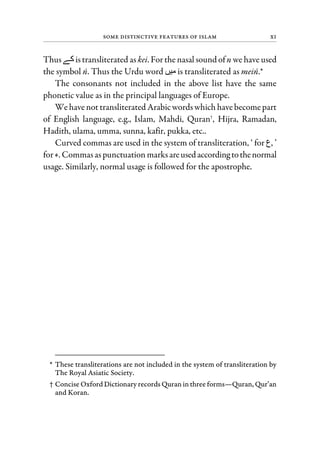
‫غ‬ gh, a sound approached very nearly inthe rgrasseye inFrench,
and in the German r. It requires the muscles of the throat to
be in the ‘gargling’ position whilst pronouncing it.
‫ق‬ q, a deep guttural k sound.
‫ئ‬ ’, a sort of catch in the voice.
Short vowels are represented by:
a for (like u in bud)
i for (like i in bid)
u for (like oo in wood)
Long vowels by:
a for or (like a in father);
i for or (like ee in deep);
u for ‫و‬ (like oo in root);
Other:
ai for (like i in site)*;
au for ‫و‬ (resembling ou in sound)
Please note that in transliterated words the letter e is to be
pronounced as in prey which rhymes with day; however the
pronunciation is flat without the element of English diphthong. If in
Urdu and Persian words e is lengthened a bit more, it is transliterated
asei tobepronounced aseiinfeign withouttheelementofdiphthong.
* In Arabic words like (Shaikh) there is an element of diphthong which is
missing when the word is pronounced in Urdu.
Some Distinctive Features of Islam xi
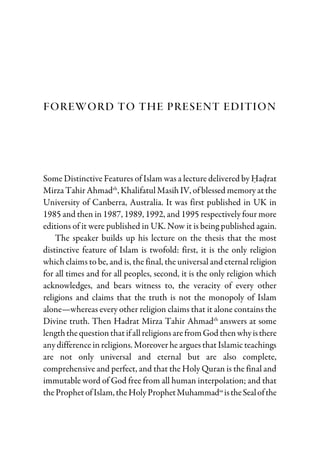
Thus‫ﮯ‬ istransliterated as kei. Forthe nasal sound ofn we have used
the symbol n. Thus the Urdu word ‫ﮟ‬ is transliterated as mein.*
The consonants not included in the above list have the same
phonetic value as in the principal languages of Europe.
Wehavenot transliterated Arabicwordswhich havebecomepart
of English language, e.g., Islam, Mahdi, Quran†
, Hijra, Ramadan,
Hadith, ulama, umma, sunna, kafir, pukka, etc..
Curved commas are used in the system of transliteration, ‘ for ‫,ع‬ ’
for ‫.ء‬ Commasaspunctuation marksareusedaccordingtothenormal
usage. Similarly, normal usage is followed for the apostrophe.
* These transliterations are not included in the system of transliteration by
The Royal Asiatic Society.
† Concise Oxford Dictionary records Quran in three forms—Quran, Qur’an
and Koran.
Foreword to the Present Edition
Some Distinctive Features of Islam was a lecture delivered by Hadrat
Mirza Tahir Ahmadrh
, Khalifatul Masih IV, of blessed memory at the
University of Canberra, Australia. It was first published in UK in
1985 and then in 1987, 1989, 1992, and 1995 respectively four more
editions of it were published in UK. Now it is being published again.
The speaker builds up his lecture on the thesis that the most
distinctive feature of Islam is twofold: first, it is the only religion
which claims to be, and is, the final, the universal and eternal religion
for all times and for all peoples, second, it is the only religion which
acknowledges, and bears witness to, the veracity of every other
religions and claims that the truth is not the monopoly of Islam
alone—whereas every other religion claims that it alone contains the
Divine truth. Then Hadrat Mirza Tahir Ahmadrh
answers at some
lengththequestionthatifallreligionsarefromGod thenwhyisthere
any difference in religions. Moreover he argues that Islamic teachings
are not only universal and eternal but are also complete,
comprehensive and perfect, and that the Holy Quran is the final and
immutable word of God free from all human interpolation; and that
theProphetofIslam, theHolyProphetMuhammadsa
istheSealofthe
xiv Some Distinctive Features of Islam
Prophetsand the bestofthemand theperfectmodel ofexcellencefor
mankind.
Inthemiddlepartof lecturehediscusesseventeenfeaturesofIslam
whichdistinguish itfromotherreligionsand ideologiesincluding the
Islamic concept of justice and Islamic teachings regarding the form
and function of government.
At the end the speaker introduces the Founder of Ahmadiyya
Jama‘at and the Jama‘at itself to his audience concluding his lecture
with an excerpt from the writings of the Promised Messiahas
.
Mirza Anas Ahmad
M.A. M. Litt. (oxon)
Wakilul Isha‘at
Rabwah
May 31, 2006
SomeDistinctive
FeaturesofIslam
*
After the traditional recitation and reciting the Surah Al-
Fatiha (theopening chapteroftheHolyQuran), theHead ofJama‘at
Ahmadiyya commenced as follows:
* I bear witness that there is no god but Allah, the One,
and I bear witness that Muhammad isHisservantandmessenger.Afterthat
I seek refuge with Allah from Satan, the rejected. In the name of Allah, the
Gracious, the Merciful. All praise belongs to Allah, Lord of all the worlds,
the Gracious, the Merciful, Master of the Day of Judgement. Thee alonedo
we worship and Thee alone do we implore for help. Guide us in the right
path—the path of those on whom Thou hast bestowed Thy blessings,those
who have not incurred Thy displeasure, and those who have not gone
astray. [Publisher]
4 Some Distinctive Features of Islam
No Monopoly of Truth
While speaking on the subject of the distinctive features of Islam, the
first and most attractive feature that strikes one, is its most endearing
disclaimer that Islam denies having a monopoly of truth, and that
there have been no other true religions. Nor does it claim that Arabs
alone have been the recipients of God’s love. Islam is the only religion
thattotally rejects the notionthat truth isthe monopoly ofanysingle
faith, race or people; instead it professes that Divine guidance is a
general bounty that has sustained humanity in all ages. The Holy
Quran tells us that there is neither a race nor a people, who have not
been blessed with the bounty of Divine guidance, and there is neither
a region of the earth nor a body of people who have not received
Prophets and Messengers of God.1
Contrary to this worldwide Islamic view of the manifestation of
Allah’s favour upon all people of the earth we are struck by the fact
that no Book of any other religion verifies or even mentions the
possibility of other peoples and nations having received light and
guidance from Allah at any stage in history. In fact, the truth and
validity of a local or regional religion is often emphasised so greatly,
and the truth of other faiths ignored so totally, as if the sun of truth
had only risen and set upon the limited horizon of certain people to
the exclusion of the rest of the world, so to say, abandoned and
condemned to eternal darkness. For instance, the Bible presents only
the God of Israel, and it repeatedly says:
Blessed be the Lord, the God of Israel.2
Some Distinctive Features of Islam 5
It does not, even in passing, verify the truth of religious revelations
bestowed on other lands and upon other peoples. Thus, the belief of
theJewsthatallIsraeliteProphetsweresentonlytothetribesofIsrael
is in full conformity with the intent and message of the Bible. Jesusas
had alsodeclared that hisadventwas intended for the guidanceofthe
Hebrew tribes alone, and had said, I was sent only to the lost sheep of
thehouseofIsrael,3
and he admonished hisdisciplesinthewords:‘Do
not give dogs what is holy, and do not throw your pearls before
swine.’4
Similarly, theHindu religionalsoaddressesitsbooksonlytothose
of high birth. It is said, ‘If one of base birth should per chance hear a
text of the Vedas, the King should seal his ears with molten wax and
lead. And should herecitea portionofthescripture,histongueshould
be severed; and should he succeed in reading the Veda, his body
should be hacked to pieces.’5
Even if we disregard such drastic injunctions, or offer some less
severe explanation of them, the fact remains that the holy books of
various faiths do not, even by implication, allude to the truth of the
religions of other lands and peoples. The basic question that arises
here is that if all these faiths were in fact true, then what was the
wisdom in presenting the concept of God in such limited and
restricted terms? The Holy Quran readily furnishes a solution of this
predicament. ItsaysthatevenbeforetherevelationoftheHolyQuran
and theadventoftheHoly ProphetMuhammadsa
, divineMessengers
had indeed been sent to every nation and every part of the globe, but
their sphere was regional and their assignments temporary. This is
becausehumancivilisation had notyetreachedastageofdevelopment
which merited the commissioning of a universal messenger, bearing a
universal message.
6 Some Distinctive Features of Islam
A Universal Religion
The very first leaf of the Holy Quran praises the Lord Who is the
Sustainer of all the worlds, and its last passage urges us to pray to the
Lord of mankind. Thus, both the first and the last words of the Holy
Quranpresenttheconcept oftheentireuniverse, and notmerelythat
of a God of the Arabs or the Muslims. Verily, no one before the Holy
Prophetsa
ofIslamhad beckoned thewhole ofhumanity, and nobook
beforetheHolyQuranhad addressed theentireworld. Thefirstsuch
claim was made in favour of the Holy Prophetsa
of Islam in these
words:
And We have not sent thee but as a bearer of glad tidings and a
Warner, for all mankind, but most men know not.6
And then:
Say, ‘O mankind! Truly I am a Messenger to you all.’7
And when the Holy Quran calls itself a message for all the worlds8
, it
upholds itself as the guidance with which is linked the true
development and advancement of mankind.
The Holy Quran has repeatedly been called the Verifier of other
Books and Muslims are admonished to believe in all other Prophetsas
in exactly the same manner as they believe in their own Prophetsa
. In
our faith, it is forbidden to make a distinction among any of them,
much less to believe in some and reject others. The Holy Quran says:
Some Distinctive Features of Islam 7
All (of us) believe in Allah, and in His angels, and in His Books,
and in His Messengers.9
It may not be without merit to examine if universality in itself is a
desirablefeature, and whyIslamhaslaid suchgreatstressuponit.Ever
sinceIslamhasbroughtthe messageoftheunityofmankind, thepace
of the march towards such unity has continued to accelerate in every
sphere. An example of this march in our times is the establishment of
different international bodies and federations. Indeed, these are but
milestones along the long and devious journey towards unity among
all mankind. So, the need that is keenly felt by the advanced and
civilised manof todayhad alreadybeenfulfilledbyplantingtheseedof
its solution in the message of Islam 1400 years ago. Today, of course,
the rapid development of travel and communication has lent a new
impetus to the march towards unity among peoples and nations.
Differences and Contradictions
among Faiths –Their Reality
A question that arises is: if all religions were in fact founded by
Messengersas
from God, then why is there any difference in their
teachings? Can the same God sends own different teachings?
This question is answered by Islam alone, and this, too, is a
distinctivefeatureofthisreligion. Islamholds thattherearetwobasic
causes of differences between various religions. First, that varying
conditions had needed varying dictates and rules, and the All-
Knowing and All-WiseGod had provided guidancefordifferentages,
regionsand peoplesinaccordancewiththeirrespectiveneeds.Second,
8 Some Distinctive Features of Islam
the contents of various faiths faded and wilted under the vicissitudes
oftime; hence theywerenotpreserved in theiroriginal form. Insome
cases, thefollowersthemselvesintroduced innovations andvariations
tosuitchanging needs, and theoriginallyrevealedBookscontinuedto
be interpolated for this purpose. Obviously, such adulteration of the
DivineMessageultimatelymandatedfreshguidancefromtheOriginal
Source. As God has said in the Holy Quran:
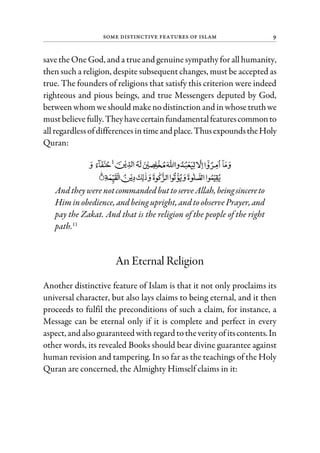
They pervert the words from their proper places and have
forgotten a good part of that with which they were exhorted.10
If we examine the history of differences between various faiths in the
lightoftheprinciplesenunciated bytheHolyQuran, wefindthatthe
differences tend to diminish as we reach nearer the source itself. For
instance, if we limit the comparison of Christianity and Islam only to
the life of Jesusas
and the four gospels in the Bible, then there will
appearonly very minor differences between the basic teachings of the
Bible and the Holy Quran. But, as we travel further down the road of
time, the chasm of these differences becomes wider and wider, till it
becomes totally unbridgeable—and all because of human endeavour
torevise thatwhich wasoriginallyrevealed.Thehistoryofotherfaiths
alsorevealsthesamebasicreality, and wefind strong corroborationof
the Quranic view, that the direction of human changes and revisions
of the Divine Message, has always been from the worship of one God
to that of several, and from reality to fiction, from humanity to
deification of human beings.
The Holy Quran tells us that the surest way to distinguish a true
religion, despite its subsequent mutilation, is to examine its origin. If
the origin reveals the teaching of the unity of God, worship of none
Some Distinctive Features of Islam 9
savethe One God, and a trueand genuinesympathy forall humanity,
then such a religion, despite subsequent changes, must be accepted as
true. The founders of religions that satisfy this criterion were indeed
righteous and pious beings, and true Messengers deputed by God,
betweenwhomwe should makenodistinctionand in whosetruthwe
mustbelieve fully.Theyhavecertainfundamentalfeaturescommonto
allregardlessofdifferences intimeandplace.ThusexpoundstheHoly
Quran:
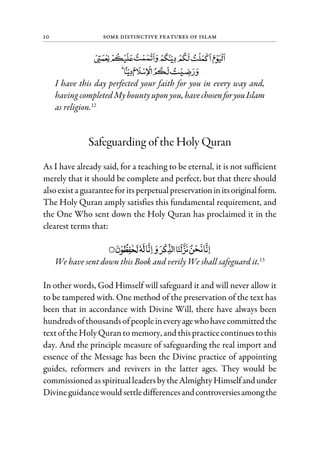
Andtheywere notcommandedbut toserveAllah,beingsincereto
Himin obedience, andbeing upright, andtoobservePrayer,and
pay the Zakat. And that is the religion of the people of the right
path.11
An Eternal Religion
Another distinctive feature of Islam is that it not only proclaims its
universal character, but also lays claims to being eternal, and it then
proceeds to fulfil the preconditions of such a claim, for instance, a
Message can be eternal only if it is complete and perfect in every
aspect, and alsoguaranteed withregard totheverityof itscontents.In
other words, its revealed Books should bear divine guarantee against
human revision and tampering. In so far as the teachings of the Holy
Quran are concerned, the Almighty Himself claims in it:
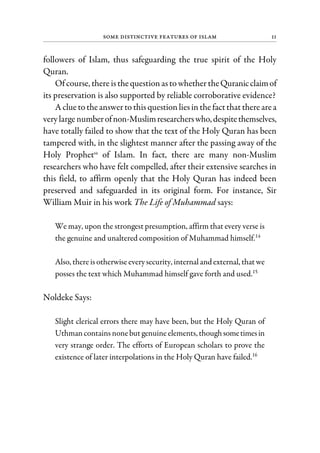
10 Some Distinctive Features of Islam
I have this day perfected your faith for you in every way and,
having completedMybountyupon you, havechosenforyouIslam
as religion.12
Safeguarding of the Holy Quran
As I have already said, for a teaching to be eternal, it is not sufficient
merely that it should be complete and perfect, but that there should
alsoexista guaranteeforits perpetualpreservationinitsoriginalform.
The Holy Quran amply satisfies this fundamental requirement, and
the One Who sent down the Holy Quran has proclaimed it in the
clearest terms that:
We have sent down this Book and verily We shall safeguard it.13
In other words, God Himself will safeguard it and will never allow it
to be tampered with. One method of the preservation of the text has
been that in accordance with Divine Will, there have always been
hundredsofthousandsofpeopleineveryagewhohavecommittedthe
textoftheHolyQuranto memory, and thispracticecontinuestothis
day. And the principle measure of safeguarding the real import and
essence of the Message has been the Divine practice of appointing
guides, reformers and revivers in the latter ages. They would be
commissioned asspiritualleadersbytheAlmightyHimselfandunder
Divineguidancewould settledifferencesandcontroversiesamongthe
Some Distinctive Features of Islam 11
followers of Islam, thus safeguarding the true spirit of the Holy
Quran.
Ofcourse, there isthequestionastowhethertheQuranicclaimof
its preservation is also supported by reliable corroborative evidence?
A cluetotheanswertothis questionliesinthefactthattherearea
verylargenumberofnon-Muslimresearcherswho,despitethemselves,
have totally failed to show that the text of the Holy Quran has been
tampered with, in the slightest manner after the passing away of the
Holy Prophetsa
of Islam. In fact, there are many non-Muslim
researchers who have felt compelled, after their extensive searches in
this field, to affirm openly that the Holy Quran has indeed been
preserved and safeguarded in its original form. For instance, Sir
William Muir in his work The Life of Muhammad says:
We may, upon the strongest presumption, affirm that every verse is
the genuine and unaltered composition of Muhammad himself.14
Also, there is otherwise everysecurity, internalandexternal, that we
posses the text which Muhammad himself gave forth and used.15
Noldeke Says:
Slight clerical errors there may have been, but the Holy Quran of
Uthman contains nonebut genuine elements,thoughsometimesin
very strange order. The efforts of European scholars to prove the
existence of later interpolations in the Holy Quran have failed.16
12 Some Distinctive Features of Islam
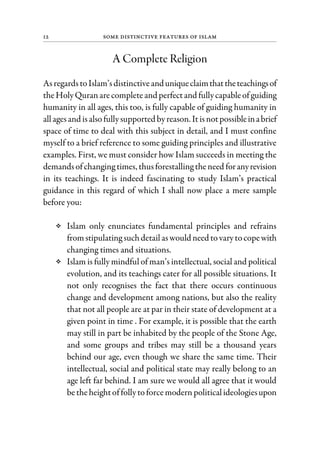
A Complete Religion
AsregardstoIslam’sdistinctiveanduniqueclaimthattheteachingsof
theHolyQuranarecompleteand perfectand fullycapableofguiding
humanity in all ages, this too, is fully capable of guiding humanity in
allagesand isalsofullysupported byreason. Itisnotpossibleinabrief
space of time to deal with this subject in detail, and I must confine
myself to a brief reference to some guiding principles and illustrative
examples. First, we must consider how Islam succeeds in meeting the
demandsofchanging times, thusforestalling theneed foranyrevision
in its teachings. It is indeed fascinating to study Islam’s practical
guidance in this regard of which I shall now place a mere sample
before you:
Islam only enunciates fundamental principles and refrains
fromstipulating suchdetail aswould need tovarytocopewith
changing times and situations.
Islam is fully mindful of man’s intellectual, social and political
evolution, and its teachings cater for all possible situations. It
not only recognises the fact that there occurs continuous
change and development among nations, but also the reality
that not all people are at par in their state of development at a
given point in time . For example, it is possible that the earth
may still in part be inhabited by the people of the Stone Age,
and some groups and tribes may still be a thousand years
behind our age, even though we share the same time. Their
intellectual, social and political state may really belong to an
age left far behind. I am sure we would all agree that it would
betheheightoffollytoforcemodernpoliticalideologiesupon
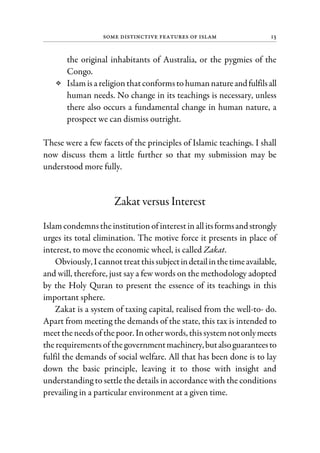
Some Distinctive Features of Islam 13
the original inhabitants of Australia, or the pygmies of the
Congo.
Islamisa religionthatconformstohumannatureandfulfilsall
human needs. No change in its teachings is necessary, unless
there also occurs a fundamental change in human nature, a
prospect we can dismiss outright.
These were a few facets of the principles of Islamic teachings. I shall
now discuss them a little further so that my submission may be
understood more fully.
Zakat versus Interest
Islamcondemnstheinstitutionof interestinallitsformsandstrongly
urges its total elimination. The motive force it presents in place of
interest, to move the economic wheel, is called Zakat.
Obviously, I cannottreatthissubjectindetailinthetimeavailable,
and will, therefore, just say a few words on the methodology adopted
by the Holy Quran to present the essence of its teachings in this
important sphere.
Zakat is a system of taxing capital, realised from the well-to- do.
Apart from meeting the demands of the state, this tax is intended to
meettheneedsof thepoor. Inotherwords, thissystemnotonlymeets
therequirementsof thegovernmentmachinery,butalsoguaranteesto
fulfil the demands of social welfare. All that has been done is to lay
down the basic principle, leaving it to those with insight and
understanding to settle the details in accordance with the conditions
prevailing in a particular environment at a given time.
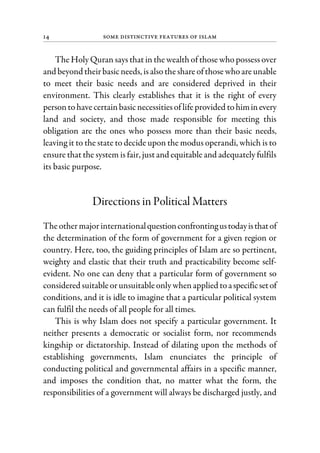
14 Some Distinctive Features of Islam
The Holy Quran says that in the wealth of those who possess over
and beyond theirbasicneeds, isalsotheshare ofthose whoareunable
to meet their basic needs and are considered deprived in their
environment. This clearly establishes that it is the right of every
persontohavecertainbasicnecessitiesof lifeprovided tohiminevery
land and society, and those made responsible for meeting this
obligation are the ones who possess more than their basic needs,
leaving it to the state to decide upon the modus operandi, which is to
ensure that the system is fair, just and equitable and adequately fulfils
its basic purpose.
Directions in Political Matters
Theothermajorinternationalquestionconfrontingustodayisthatof
the determination of the form of government for a given region or
country. Here, too, the guiding principles of Islam are so pertinent,
weighty and elastic that their truth and practicability become self-
evident. No one can deny that a particular form of government so
considered suitableorunsuitableonly whenapplied toaspecificsetof
conditions, and it is idle to imagine that a particular political system
can fulfil the needs of all people for all times.
This is why Islam does not specify a particular government. It
neither presents a democratic or socialist form, nor recommends
kingship or dictatorship. Instead of dilating upon the methods of
establishing governments, Islam enunciates the principle of
conducting political and governmental affairs in a specific manner,
and imposes the condition that, no matter what the form, the
responsibilities of a government will always be discharged justly, and
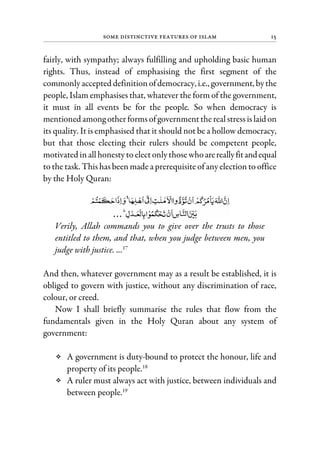
Some Distinctive Features of Islam 15
fairly, with sympathy; always fulfilling and upholding basic human
rights. Thus, instead of emphasising the first segment of the
commonlyaccepted definitionofdemocracy, i.e., government, bythe
people, Islam emphasises that, whatever the form of the government,
it must in all events be for the people. So when democracy is
mentioned among otherformsofgovernmentthereal stressislaidon
its quality. It is emphasised that it should not be a hollow democracy,
but that those electing their rulers should be competent people,
motivated inallhonesty to electonlythose whoarereallyfitandequal
to the task. This has been made a prerequisite of any election to office
by the Holy Quran:
Verily, Allah commands you to give over the trusts to those
entitled to them, and that, when you judge between men, you
judge with justice. ...17
And then, whatever government may as a result be established, it is
obliged to govern with justice, without any discrimination of race,
colour, or creed.
Now I shall briefly summarise the rules that flow from the
fundamentals given in the Holy Quran about any system of
government:
A government is duty-bound to protect the honour, life and
property of its people.18
A ruler must always act with justice, between individuals and
between people.19
16 Some Distinctive Features of Islam
National matters should be settled by consultation.20
Governmentmustarrangetofulfilthebasicneedsofman:that
is to say, provide him food, clothing and shelter.21
Peopleshould beprovided a peacefuland secureenvironment,
and their lives, property and honour protected.22
The economic system should be equitable and orderly.23
Health care should be organised.24
There should prevail total religious freedom.25
A vanquished people must be dealt with justly.26
Prisoners of war should be treated with compassion.27
Treaties and agreements must always be honoured.28
Iniquitous agreements must not be forced upon the weak.29
Muslim subjects are enjoined to obey the government in
authority. The only exception to this rule is a case where the
governmentblatantlyopposesand preventsthecarryingoutof
religious duties and obligations.30
If differences should arise with the ruler, then these should be
settled in the light of the principles enunciated in the Holy
Quran and by the Holy Prophetsa
. In no event should one be
swayed by selfish motives.31
People are enjoined to assist the authorities by supporting
schemesthataimtopromotegeneralwell-being andwelfare.It
isforbiddentolaunchso-callednon-cooperationmovements.32
Similarly, governments are obliged to assist in beneficent
undertakings, whether individual or collective, and not to
obstruct such endeavours.
A powerful country is forbidden from all forms of aggression
against another country. Recourse to arms is permitted in self-
defence only.33
Some Distinctive Features of Islam 17
Islamic Concept of Justice
I shallnowcitea fewimportantexamplesofIslamicprinciples, which
perhaps need particular emphasis in the world today. The first
concerns Islamic teaching in respect of equity and justice. Other
religions do not present a comprehensive direction about the
administrationofjusticeand fairplay, and eveniftheymentionthisat
all, it is in terms that can scarcely be applicable to us today. In fact,
some parts of these directions appear to conflict directly with the
intellectand sensibilitiesofourage, and onecannotbutconcludethat
these teachings have either become corrupted or were intended only
for local and temporary application. As Judaism presents God as only
the God of Israel to the exclusion of every one else, no wonder then,
thatitdoesnoteven inpassing dealwiththefundamentalquestionof
Human Rights as such.
As for Hinduism it seems outright hostile not only to the non-
Hindu but also to the Hindu of a low caste, hence narrowing further
the field of God’s mercy to a much smaller section of the human race.
Hinduism decrees:
If a Brahmin is unable to return a loan to one of low caste, the other
has norighttodemand its return. But if oneof low caste isunable to
return a loan taken from a Brahmin, he is to be made to work as a
labourerforBrahminstillsuchtimeashe isable topay backtheloan
in full.34
Again, in Judaism we fail to detect a concept of justice toward one’s
enemy. It is said:
18 Some Distinctive Features of Islam
And when your Lord your God gives them over to you, and you
defeat them: then you must utterly destroy them: you shallmake no
covenant with them.35
I shall now, by way of comparison, cite a few examples of Islamic
teachings in the same areas. The Holy Quran enjoins, and I quote:
And when you judge between people, do so fairly and justly.36
Be strict in observing justice, and be witness for Allah, even
though it be against yourselves or against your parents or
kindred.37
And let not a people’s enmity incite you to act otherwise than
with justice. Be always just, that is nearer to righteousness.38
And fight in the way of Allah against those who fight against
you but do not transgress. Surely, Allah loves not the
transgressors.39
And if they incline towards peace, incline thou also towards
it.40
The other example I wish to cite of the eternal teachings of Islam is
the one concerning revenge and forgiveness. When we compare
Islam’steachingsin thisspherewiththatof otherfaiths,weareatonce
struck by this injunction of the Old Testament:
Your eye shall not pity: it shall be life for life, eye for eye, tooth for
tooth, hand for hand, foot for foot.41
Doubtless, such emphasis on vengeance causes not mere wonder, but
also saddens our heart. However, I am not citing this example to
Some Distinctive Features of Islam 19
castigateanotherteaching, buttoshowthat, whenviewed inthelight
of the Quranic principles, even such drastic measures may also
sometimes be justified. The Holy Quran, thus helps us in following
the conflicting teachings of other faiths in a spirit of sympathy and
understanding, which, too, isanexclusive featureofIslam. According
to the Holy Quran, the extraction of full vengeance was decreed only
tomeetthespecificneeds ofa particularperiod. Thiswasnecessaryto
giveheart totheIsraelites tomakethemstand up fortheirrightsafter
they had remained victimized and enslaved for a prolonged period,
and had as a result, become cowardly and developed a deep-seated
complex ofbeing aninferiorpeople. Obviously,insuchasituation,it∗
would onlyhavemadetheIsraelitessink deeperintotheirmorassand
not give them the confidence and courage to break the shackles of
abject bondage. This teaching, therefore, was right and proper in the
situation, which then existed, and was indeed given by the All-Wise
God.
Ontheotherhand whenweconsidertheNewTestament,wefind
thatincontradictionofthe previousScripture, theOld Testament, it
emphasizes forgiveness to such an extent that it totally deprives the
Israelites of the right to extract any vengeance whatsoever. The real
reason for this was that practising the previous teaching over a long
period of time, the Israelites had become hardhearted and ferocious,
and this could only be remedied by suspending for a certain period
their right to extract vengeance. This is why Jesus admonished them:
You have heard that it was said, 'an eye for an eye, and a tooth for a
tooth', but I say to you do not resist one who is evil. But if anyone
∗ The teachings regarding forgiveness. [Publishers]
20 Some Distinctive Features of Islam
strikes you on the right cheek, turn to him the other also, and if
anyone would use you and take your coat, let him have yourcloak as
well.42
Islam holds these two opposing teachings to be complementary, each
suited to the conditions and situation prevailing at the time, and
neither, therefore, able to lay claim to being universal or eternal. This
perfectlystandstoreason, formanwasstillprogressingthroughearlier
stages of development and had not yet become one community to
which could be vouchsafed a law that would be final and universal.
We believe that Islam is that final law and presents a teaching not
influenced by place or time which fact is amply illustrated by its
teaching in the matter being considered. The Holy Quran says:
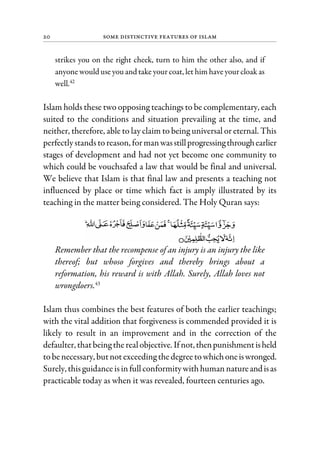
Remember that the recompense of an injury is an injury the like
thereof; but whoso forgives and thereby brings about a
reformation, his reward is with Allah. Surely, Allah loves not
wrongdoers.43
Islam thus combines the best features of both the earlier teachings;
with the vital addition that forgiveness is commended provided it is
likely to result in an improvement and in the correction of the
defaulter, thatbeing therealobjective. Ifnot,thenpunishmentisheld
tobenecessary, butnotexceeding thedegreetowhichoneiswronged.
Surely, thisguidanceisinfullconformitywithhuman natureandisas
practicable today as when it was revealed, fourteen centuries ago.
Some Distinctive Features of Islam 21
Some Other Distinctions
ThesubjectofIslam’sdistinctive featuresisa veryvast one, and I have
beenabletodealwith onlyjusta fewaspects thatI had chosen forthis
presentation. Time will permit no more than a passing reference for
certain other aspects which I would not wish to omit;
IslamholdsGod tobethe Creatoroftheuniverseandpresents
HisUnityin stark simpleterms,comprehensibleandappealing
both to a rustic and an intellectual. Islam calls God a Perfect
Being, the fountainhead of all Excellencies and free of all
blemishes. He is a living God Who manifests Himself
everywhere and Who loves His creation and listens to their
supplications. He, therefore, communicates with mankind as
before, and has not barred the avenues to reach Him directly.
Islamholdsthatthere isno contradictionbetweenGod’sword
and His deed. It, thus, frees us from the traditional rivalry
between science and religion, and does not require man to
believe in anything beyond the law of nature determined by
Him. He urges us to ponder over nature and to put it too
beneficent use, for everything has been created for the benefit
of mankind.
Islam does not make idle claims or compel us to believe what
we do not understand. It supports its teachings with reason
and explanation, satisfying our intellect and also the depths of
our soul.
Islam is not based on myths or folklore. It invites everyone to
experimentforhimselfand holdsthattruthisalwaysverifiable,
in one form or another.
22 Some Distinctive Features of Islam
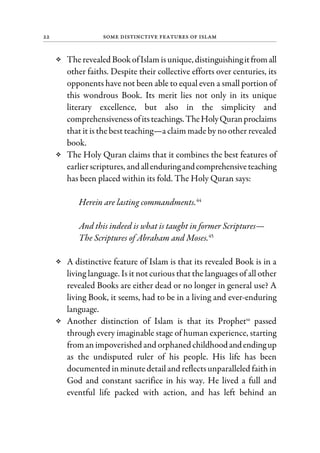
Therevealed Book ofIslam isunique, distinguishingitfromall
other faiths. Despite their collective efforts over centuries, its
opponents have not been able to equal even a small portion of
this wondrous Book. Its merit lies not only in its unique
literary excellence, but also in the simplicity and
comprehensivenessofitsteachings.TheHolyQuranproclaims
that it is the best teaching—a claim made by no other revealed
book.
The Holy Quran claims that it combines the best features of
earlierscriptures, andallenduringandcomprehensiveteaching
has been placed within its fold. The Holy Quran says:
Herein are lasting commandments.44
And this indeed is what is taught in former Scriptures—
The Scriptures of Abraham and Moses.45
A distinctive feature of Islam is that its revealed Book is in a
living language. Is it not curious that the languages of all other
revealed Books are either dead or no longer in general use? A
living Book, it seems, had to be in a living and ever-enduring
language.
Another distinction of Islam is that its Prophetsa
passed
through every imaginable stage of human experience, starting
fromanimpoverished and orphaned childhoodandendingup
as the undisputed ruler of his people. His life has been
documented inminutedetailand reflectsunparalleled faithin
God and constant sacrifice in his way. He lived a full and
eventful life packed with action, and has left behind an
Some Distinctive Features of Islam 23
example of perfect conduct in every sphere of human
endeavour. This is only fitting and proper, as he was a living
interpretation of the Holy Quran and by personal example
lighted the way of mankind for all time to come—a role not
fulfilled adequately by any other Prophet.
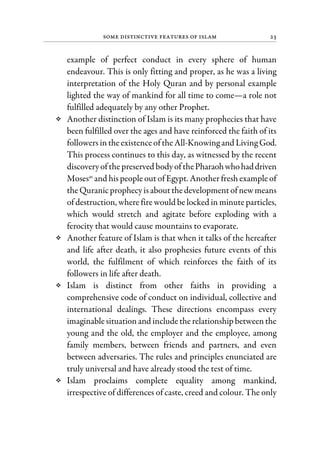
Another distinction of Islam is its many prophecies that have
been fulfilled over the ages and have reinforced the faith of its
followers intheexistenceoftheAll-Knowing and Living God.
This process continues to this day, as witnessed by the recent
discoveryofthepreserved bodyofthePharaohwhohaddriven
Mosesas
and his people out of Egypt. Another fresh example of
theQuranicprophecyisaboutthedevelopmentofnewmeans
of destruction, where fire would be locked in minute particles,
which would stretch and agitate before exploding with a
ferocity that would cause mountains to evaporate.
Another feature of Islam is that when it talks of the hereafter
and life after death, it also prophesies future events of this
world, the fulfilment of which reinforces the faith of its
followers in life after death.
Islam is distinct from other faiths in providing a
comprehensive code of conduct on individual, collective and
international dealings. These directions encompass every
imaginablesituationand includethe relationship betweenthe
young and the old, the employer and the employee, among
family members, between friends and partners, and even
between adversaries. The rules and principles enunciated are
truly universal and have already stood the test of time.
Islam proclaims complete equality among mankind,
irrespective of differences of caste, creed and colour. The only
24 Some Distinctive Features of Islam
criterion of honour it accepts is that of righteousness, not of
birth, riches, race or colour. The Holy Quran says:
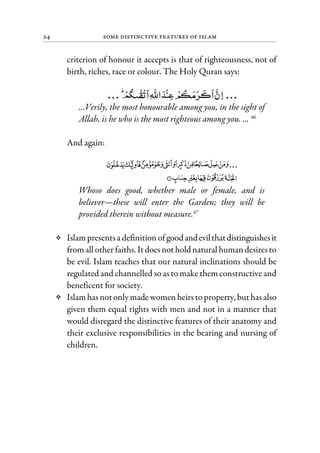
...Verily, the most honourable among you, in the sight of
Allah, is he who is the most righteous among you. ... 46
And again:
Whoso does good, whether male or female, and is
believer—these will enter the Garden; they will be
provided therein without measure.47
Islampresentsa definition ofgoodandevilthatdistinguishesit
fromall other faiths. Itdoes nothold natural humandesiresto
be evil. Islam teaches that our natural inclinations should be
regulated and channelled so as to make them constructive and
beneficent for society.
Islamhasnotonly madewomenheirsto property, but hasalso
given them equal rights with men and not in a manner that
would disregard the distinctive features of their anatomy and
their exclusive responsibilities in the bearing and nursing of
children.
Some Distinctive Features of Islam 25
A Religion of Peace
In the end, I would give all seekers of peace the glad tidings that Islam
alone is the faith that guarantees peace in all spheres and at all levels:
individual, social, economic, national and supranational. Islam alone
bears a name, the literal meaning of which is 'Peace', and one, who
becomes a Muslim, not only enters a safe haven himself but also
guarantees it for others, and shuns all actions that might lead to
iniquity and disruption. The Holy Prophetsa
said that a Muslim is he
whose word and deed do not harm others.48
The momentous address
of the Holy Prophetsa
delivered shortly before his death, and after the
performance of what has come to be called the Farewell Pilgrimage, is
an eternal Charter of Peace for all mankind. Islam enjoins peace not
only between men, but also between man and his Maker, so that not
only other men remain unharmed from the word and deed of a
Muslim, but he himself remains safe from God’s wrath and censure,
the recompense which is merited as a result of committing
transgression. So, a Muslim’s peace is obtained in this world and also
extends to the hereafter.
Islam’s teachings, if followed by the nations of the world, are fully
capable of saving them from strife and destruction. Islam is a living
faith and claims to be able to place the relationship of man with God
on the same plane as it was in the days long past. Islam does not
consider revelation and communion with God to be a thing of the
past. It believes that the avenues of spiritual bliss trodden upon by
Noahas
, Abrahamas
, Mosesas
, Jesusas
and, above all, the Prophetsa
of
Islam, are still open and beckoning to those desirous of close
communion with God.
26 Some Distinctive Features of Islam
The Ahmadiyya Movement
The Ahmadiyya Movement in Islam believes that these claims have
been fulfilled in our age in the person of its founder Hadrat Mirza
Ghulam Ahmadas
who was born in 1835 in the remote village of
QadianinIndia. Hewasenabled byDivinemercytotread thepathof
pietyand righteousness, and, strictlyfollowing theteachingsofIslam,
was blessed with intimate communion with the Almighty. He
received Divine revelation, which also formed the basis of his many
prophecies, whose unfailing fulfilment has continued beyond his life.
In accordance with Divine direction, he founded the Ahmadiyya
Movement in Islam in the year 1889, and, leaving behind a dedicated
and vibrant Community of disciples numbering several hundred
thousands, he departed from this earthly abode in 1908. His mission
continues, and the Community has all along been headed by elected
successors.
While describing his mission, the founder of our Movement had
said:
I have been sent that I should prove that Islam alone is a living
religion. And I have been blessed with spiritual powers that render
helpless those of other faiths, and also those from among us who are
spiritually blind.Ican demonstratetoeveryopponentthattheHoly
Quran is a miracle in its teachings, its enlightened knowledge, its
deep and delicate insight, and in its perfect eloquence. It excels the
miracles of Moses, and those of Jesus a hundred fold.49
He goes on to say:
Some Distinctive Features of Islam 27
I am the light in the darkness of this age. He who follows me, will be
saved from the pits and ditches dug by the Devil to ensnare those
straying in the dark. He has sent me so that I should lead the world,
gently and inpeace,totheOne True God,and re-establishthemoral
excellences of Islam. And I have been given heavenly signs to satisfy
those who seek the truth.50
I nowend myaddresswith anotherquotationfromthewritingsofthe
founder of the Ahmadiyya Movement, which is a call to the whole of
mankind:
The mirror which enables you to behold That Lofty Being, is His
communion withman..........Letonewhoseheartyearnsforthetruth,
stand up and search. I tell you in all truth, that if souls search
honestly and hearts really thirst forthe truth, then men should look
forthe right method and the right path. But how willthis open, and
how will this veil be lifted? I assure all seekers that Islam alone gives
the glad tidings of this path, for others have long since placed a seal
on God’s revelation. But, be assured that God has not placed this
seal: this is a mere excuse conjured up by man in his deprivation.
Verily, as it is not possible to see without our eyes, or hear
without our ears, in exactly the same way, it is impossible to behold
the countenance of That Beloved, without the help of the Holy
Quran. Iwas ayoungman,and now Iam grown old,butIhavenever
found anyone who has drunk of the ultimate spiritual elixir, except
from this holy spring.51
Doubtless, thiscallisa life-giving messageforeverysoulthatseeksthe
real truth.
28 Some Distinctive Features of Islam
References
1. The Holy Quran 35:25.
2. Chronicles 16:36.
3. Samuel 25:32.
4. Matthew 15:21-25.
5. Gotama Smriti:12.
6. The Holy Quran 34:29.
7. The Holy Quran 7:159.
8. The Holy Quran 81:28.
9. The Holy Quran 2:286.
10. The Holy Quran 5:14.
11. The Holy Quran 98:6.
12. The Holy Quran 5:4.
13. The Holy Quran 15:10.
14. P. XXVIII.
15. P. XXVII.
16. Enc. Brit. 9th Edition under the word: The Holy Quran.
17. The Holy Quran 4:59.
18. Verily, Allahcommands youtomake overthetrusttothoseentitledto
them... The Holy Quran 4:59.
19. ...And that, when you judge between men, you judge withjustice. The
Holy Quran 4:59.
20. And whose affairs are decided by mutual consultation. The Holy
Quran 42:39.
21. It is provided for thee that thou wilt not hunger therein, nor wilt
thou be naked. And that thou wilt not thirst therein, nor wilt
thou be exposed to the sun. The Holy Quran 20:119-120.
22. And when he is in authority, he runs about in the land to create
Some Distinctive Features of Islam 29
disorder in it and destroy the crops and the progeny of man; and
Allah loves not disorder. The Holy Quran 2:206.
23. See the Holy Quran 16:91
24. The Holy Quran 6:143.
The Holy Quran 2:169.
See the Holy Quran 16:91
25. There should be no compulsion in religion. The Holy Quran 2:257.
26. And let not a people’s enmity incite you to act otherwise than with
justice. Bealwaysjust,that isnearertorighteousness. TheHolyQuran
5:9.
27. It does not behove a Prophet that he should have captives until he
engages in regular fighting in the land. The Holy Quran 8:68.
Then afterwards eitherrelease themasafavourorbytakingransom—
until the war lays down its burdens. That is the ordinance. The Holy
Quran 47:5.
28. See the Holy Quran 16:92
29. See the Holy Quran 16:93
30. Obey Allah, and obey His Messenger and those who are in authority
among you. The Holy Quran 4:60.
31. And if you differ in anything among yourselves, refer it to Allah and
His Messenger. The Holy Quran 4:60.
32. And help one another in righteousness and piety; but help not one
another in sin and transgression. The Holy Quran 5:3.
33. And strainnotthy eyesafterwhat we have bestowed onsomeclassesof
them to enjoy for a short time. The Holy Quran 20:132.
34. Manu Smriti 10:35.
35. Deuteronomy 7:2.
36. The Holy Quran 4:59.
37. The Holy Quran 4:136.
30 Some Distinctive Features of Islam
38. The Holy Quran 5:9.
39. The Holy Quran 2:191.
40. The Holy Quran 8:62.
41. Exodus 21:24.
42. Matthew 5:35-45.
43. The Holy Quran 42:41.
44. The Holy Quran 98:4.
45. The Holy Quran 87:19-20.
46. The Holy Quran 49:14.
47. The Holy Quran 40:41.
48. Bukhari - Kitabul Iman.
49. Anjam-i-Atham, Ruhani Khaza’in Vol. 11. pp. 345, 346.
50. Masih Hindustan Mein, Ruhani Khaza’in Vol. 15 p. 13.
51. The Philosophy of the Teachings of Islam, Ruhani Khaza’in Vol. 10
pp. 442-443.
Index
A
Abraham
as
The prophet of God, 25
Aggression
Islam forbids all forms of, 16
Ahmadiyya Movement, 26
Allah, 4
Arabs, 4, 6
Australia, 13
B
Bible
message of the, 5
Brahmin
upper caste of Hindus, 17
C
Christianity
comparison with Islam, 8
Concept of Justice
in Hinduism, 17
in Islam, 17
in Judaism, 17
D
Differences and Contradictions
among faiths, 7
between the basic teachings
of the Bible and the Holy
Quran are minor, 8
History of, 8
Islam's response, 7
Divine guidance
all nations and regions are
blessed with, 4
32 Some Distinctive Features of Islam
Divine Message
adulteration of, 8
Divine Messengers
has been sent to every nation
and every part of the
globe, 5
reason for their limited
missions, 5
E
Egypt
Pharaoh drove Isralites out
of, 23
European scholars
efforts of, 11
F
Farewell Pilgrimage
Holy Prophetsa
delivered an
eternal Charter of Peace
for all mankind at, 25
Forgiveness
Islamic teachings about
revenge and, 18
philosophy of Israelites
teaching, 19
teachings of the New
Testament on, 19
teachings of the Old
Testament on, 19
G
God of Israel
Bible presents only, 4
God's Attributes
All-Wise & All-Knowing, 7
Creator of universe, 21
Sustainer of all the worlds, 6
Good and Evil
Islamic definition of, 24
H
Hadrat Mirza Ghulam Ahmad
as
Holy Founder of Ahmadiyya
Movement, 26
Hebrew, 5
Hinduism, 17
Holy Prophet Muhammadsa
Founder of Islam, 5
Holy Prophet
sa
of Islam
a bearer of glad tidings and
Warner, 6
A universal messenger for
whole humanity, 6
Holy Quran, 4
a message for all the worlds, 6
addressed the entire
mankind, 6
Divine guarantee against
tampering of, 9
Islam claims its teachings are
complete and perfect for
all ages, 12
Some Distinctive Features of Islam 33
presents the concept of entire
universe, 6
rules about the system of
government mentioned
in, 15
safeguarding of, 10
teachings about justice, 18
verifies the other religious
Books, 6
Human equality, 23
Human Rights
in Judaism, 17
I
Institution of Interest
Islam condemns the, 13
International bodies
need for establishing, 7
Islam
all avenues of revelation and
communion with God are
still open, 25
alone is a living religion, 26
an eternal religion, 9
forbids the non-cooperation
movements, 16
guarantees peace in all
spheres and all levels, 25
literal meaning - ‘Peace’, 25
made women heirs to the
property, 24
meets the demands of
changing times, 12
message for the unity of
mankind, 7
planted the seed of unity of
mankind, 7
proclaims equality among
mankind, 23
prophesies the future events
of the world, 23
provides complete code of
conduct, 23
recognises intellectual, social
and political evolution, 12
some other distinctive feature
of, 21
Israelite Prophets
all were sent only to tribes of
Israel, 5
Israelites, 19
J
Jesus
as
declared that his advent was
intended for the guidance
of Hebrew tribes only, 5
The prophet of God, 25
Jews
beliefs of, 5
L
Life after death
an Islamic belief, 23
34 Some Distinctive Features of Islam
M
Monopoly of Truth
Islam denies having a, 4
Moses
as
, 23
The prophet of God, 25
Muslim
definition of a, 25
must believe in angels, Holy
Books and Prophetsas
, 6
N
Noah
as
The prophet of God, 25
Noldeke
his statement about the
originality of the Holy
Quran, 11
O
Original revealed teachings
smpathy for the mankind, 8
worship of one God, 8
P
Pharaoh
Quranic prophecy about the
preservation of the body
of, 23
Political Matters
directions in, 14
Islam does not specify a
particular government, 14
Islamic principles about, 14
Prisoners of war
treatment of, 16
Promised Messiahas
call to the whole of mankind,
27
challenge to all regarding
Holy Quran, 26
mission in his own words, 26
Q
Qadian, India
birth place of the Promised
Messiahas
, 26
R
Religious Freedom, 16
Righteousness
the only criterion for honour
in Islam, 24
S
Sir William Muir
Some Distinctive Features of Islam 35
his testimony about the
preservation of the Holy
Quran, 11
Social welfare
system of Zakat fulfils the
demands of, 13
T
The Old Testament
teachings about justice in, 18
Treaties
Honouring of, 16
U
Unity of God, 21
Uthman
third Caliph of Islam, 11
V
Vedas
Books of Hindu religion, 5
only meant for high caste
hindus, 5
punishment of hearing and
reciting by the ordinary, 5
W
Ways and means
to distinguish a true religion,
8
Women in Islam
are heirs to the property, 24
have equal rights with men,
24
Z
Zakat
Islamic system for taxing
well-to-do people, 13

Some Distinctive features of islam

  • 1.
  • 2.
    OTHER BOOKS BYTHE SAME AUTHOR Absolute Justice, Kindness and Kinship— The Three Creative Principles Christianity—A Journey from Facts to Fiction An Elementary Study of Islam The Gulf Crisis and the New World Order Homeopathy: Like Cures Like Islam’s Response to Contemporary Issues Murder in the Name of Allah Revelation, Rationality, Knowledge and Truth The Seal of the Prophets, His Personality and Character The True Islamic Concept of Jihad The Truth about the Alleged Punishment for Apostasy in Islam With Love to the Muslims of the World
  • 3.
    About The Author HadratMirza Tahir Ahmad (1928–2003), may Allah have infinite mercy on his soul, a man of God, Voice articulate of the age, a great orator, a deeply learned scholar of phenomenal intelligence, a prolific and versatilewriter, a keenstudentofcomparativereligionswasloved and devoutly followed by his more than 10 million Ahmadi Muslim followersallover theworld astheirImam,thespiritualhead,beingthe fourth successor of Hadrat Mirza Ghulam Ahmad (the Promised Messiah and Mahdias ), to which august office he was elected as Khalifatul Masih in 1982. After the promulgation of general Zia-ul-Haq anti-Ahmadiyya Ordinance of 26th April 1984 he had to leave his beloved country, Pakistan, and migrated to England from where he launched Muslim Television Ahmadiyya International (MTA) which would (and still does)telecastitsprogrammes24 hoursa daytothefourcornersofthe world. Besidesbeing a religiousleader, hewasa homeopathicphysicianof world fame, a highly gifted poet and a sportsman. He had his schooling in Qadian, India, and later joined the Govt. College, Lahore, Pakistan, and after graduating from Jami‘ah Ahmadiyya, Rabwah, Pakistan with distinction, he obtained his
  • 4.
    iv Some DistinctiveFeatures of Islam honours degree in Arabic from the Punjab University, Lahore. From 1955 to 1957 he studied at the School of Oriental and African Studies, University of London. He had a divinely inspired and very deep knowledge of the Holy Quran which he translated into Urdu. He also partially revised and added explanatorynotesto theEnglishtranslationoftheHolyQuran byHadratMaulawiSherAlira . Revelation,Rationality,Knowledgeand Truth is his magnum opus. Thoughhehad noformaleducationinphilosophyand science,he had a philosophical bent of mind and tackled most difficult and abstruse theological-philosophical questions with great acumen and ease and his intellectual approach was always rational and scientific. For a layman he had an amazingly in-depth knowledge of science, especially life sciences which attracted him most. He also had deep knowledge of human psychology. His was an analytical mind of high intelligence—an intellect scintillating with brilliance, capable of solving knottiest problems with ease, leaving his listeners and readers spellbound.
  • 5.
    SomeDistinctive Features ofIslam Mirza TahirAhmad IslamInternational Publications Ltd. Tilford, Surrey
  • 6.
    Some Distinctive Featuresof Islam by Mirza Tahir Ahmad Copyright by Islam International Publications Ltd. First published in English 1985 Reprinted 1987, 1989, 1992, 1995 Present edition 2007 Published by Islam International Publications Ltd. Islamabad, Sheephatch Lane Tilford, Surrey GU10 2AQ Printed at Raqeem Press Islamabad, Tilford, Surrey Cover design by Salman Muhammad Sajid Book layout and index prepared by Dr. Abdul Majid Shah All rights reserved. No part of this publication may be reproduced, stored in a retrieval system, or transmitted in any form or by any means, electronic, mechanical, photocopying, recording, or otherwise, without the prior written permission of the publisher. ISBN: 1 85372 052 6
  • 7.
    Contents Publisher’s Note.............................................................viii Foreword tothe Present Edition....................................xiii No Monopoly of Truth.................................................4 A Universal Religion ......................................................6 Differences and Contradictions among Faiths –Their Reality........................................7 An Eternal Religion........................................................9 Safeguarding of the Holy Quran ...............................10 A Complete Religion....................................................12 Zakat versus Interest.....................................................13 Directions in Political Matters...................................14 Islamic Concept of Justice...........................................17 Some Other Distinctions............................................21 A Religion of Peace.......................................................25 The Ahmadiyya Movement........................................26 Index................................................................................31
  • 8.
    Publisher’s Note According toour system of counting Quranic verses, the verse Bismillah irrahman irrahim (In the name of Allah, the Most Gracious, Ever Merciful) is counted as the first verse of the chapter, whichitprecedes. SomepublishersoftheHolyQuranhowever,begin counting following Bismillah irrahman irrahim. Should the reader notfind therelevantverseunderthenumbermentioned inthisbook, he or she is advised to deduct 1 from the number. For example, if this book quotes Ch. 35: Al-Fatir: 25, then some copies of the Holy Quran will list the same verse under Ch. 35: Al-Fatir: 24. Wherenecessary,translationoftheArabictexthasbeenelaborated by additional words to explain the meaning. Such words are not in italics. The word and at the commencement of a translated verse has been omitted. The form ibn has been used in both initial and medial position in the names of persons, in order to conform to current usage, although bin also occurs medially in some original texts (abbreviated usually as b.). Quotations from the Holy Bible are from the New World Translation.
  • 9.
    Some Distinctive Featuresof Islam ix The name of Muhammadsa , the Holy Prophet of Islam, has been followed bythesymbolsa , whichisanabbreviationfortheprayer( ) Sallallahu ‘Alaihi Wasallam (may peace and blessings of Allah be upon him). The names of other Prophetsas and messengers are followed by the symbol as , an abbreviation for ( / ) ‘Alaihissalam/‘Alaihimussalam (on whom be peace). The actual prayers have not generally been set out in full, but they should nevertheless, beunderstood asbeing repeated in fullineachcase. The symbol ra is used with the name of the Companions of the Holy Prophetsa and those of the Promised Messiahas . It stands for ( / / )Radi Allahu‘anhu/‘anha/‘anhum(mayAllahbepleased with him/with her/with them). rh stands for ( ) Rahimahullahu Ta‘ala (may Allah’s blessing be on him). at stands for ( ) Ayyadahullahu Ta‘ala (may Allah, the Almighty help him). In transliterating Arabic words we have followed the following system adopted by the Royal Asiatic Society: ‫ا‬ at thebeginning of a word,pronounced asa, i,uprecededbya very slight aspiration, like h in the English word honour. ‫ث‬ th, pronounced like th in the English word thing. ‫ح‬ h, a guttural aspirate, stronger than h. ‫خ‬ kh, pronounced like the Scotch ch in loch. ‫ذ‬ dh, pronounced like the English th in that. ‫ص‬ s, strongly articulated s. ‫ض‬ d, similar to the English th in this. ‫ط‬ t, strongly articulated palatal t. ‫ظ‬ z, strongly articulated z. ‫ع‬ ‘, a strong guttural, the pronunciation of which must be learnt by the ear.
  • 10.
    x Some DistinctiveFeatures of Islam ‫غ‬ gh, a sound approached very nearly inthe rgrasseye inFrench, and in the German r. It requires the muscles of the throat to be in the ‘gargling’ position whilst pronouncing it. ‫ق‬ q, a deep guttural k sound. ‫ئ‬ ’, a sort of catch in the voice. Short vowels are represented by: a for (like u in bud) i for (like i in bid) u for (like oo in wood) Long vowels by: a for or (like a in father); i for or (like ee in deep); u for ‫و‬ (like oo in root); Other: ai for (like i in site)*; au for ‫و‬ (resembling ou in sound) Please note that in transliterated words the letter e is to be pronounced as in prey which rhymes with day; however the pronunciation is flat without the element of English diphthong. If in Urdu and Persian words e is lengthened a bit more, it is transliterated asei tobepronounced aseiinfeign withouttheelementofdiphthong. * In Arabic words like (Shaikh) there is an element of diphthong which is missing when the word is pronounced in Urdu.
  • 11.
    Some Distinctive Featuresof Islam xi Thus‫ﮯ‬ istransliterated as kei. Forthe nasal sound ofn we have used the symbol n. Thus the Urdu word ‫ﮟ‬ is transliterated as mein.* The consonants not included in the above list have the same phonetic value as in the principal languages of Europe. Wehavenot transliterated Arabicwordswhich havebecomepart of English language, e.g., Islam, Mahdi, Quran† , Hijra, Ramadan, Hadith, ulama, umma, sunna, kafir, pukka, etc.. Curved commas are used in the system of transliteration, ‘ for ‫,ع‬ ’ for ‫.ء‬ Commasaspunctuation marksareusedaccordingtothenormal usage. Similarly, normal usage is followed for the apostrophe. * These transliterations are not included in the system of transliteration by The Royal Asiatic Society. † Concise Oxford Dictionary records Quran in three forms—Quran, Qur’an and Koran.
  • 13.
    Foreword to thePresent Edition Some Distinctive Features of Islam was a lecture delivered by Hadrat Mirza Tahir Ahmadrh , Khalifatul Masih IV, of blessed memory at the University of Canberra, Australia. It was first published in UK in 1985 and then in 1987, 1989, 1992, and 1995 respectively four more editions of it were published in UK. Now it is being published again. The speaker builds up his lecture on the thesis that the most distinctive feature of Islam is twofold: first, it is the only religion which claims to be, and is, the final, the universal and eternal religion for all times and for all peoples, second, it is the only religion which acknowledges, and bears witness to, the veracity of every other religions and claims that the truth is not the monopoly of Islam alone—whereas every other religion claims that it alone contains the Divine truth. Then Hadrat Mirza Tahir Ahmadrh answers at some lengththequestionthatifallreligionsarefromGod thenwhyisthere any difference in religions. Moreover he argues that Islamic teachings are not only universal and eternal but are also complete, comprehensive and perfect, and that the Holy Quran is the final and immutable word of God free from all human interpolation; and that theProphetofIslam, theHolyProphetMuhammadsa istheSealofthe
  • 14.
    xiv Some DistinctiveFeatures of Islam Prophetsand the bestofthemand theperfectmodel ofexcellencefor mankind. Inthemiddlepartof lecturehediscusesseventeenfeaturesofIslam whichdistinguish itfromotherreligionsand ideologiesincluding the Islamic concept of justice and Islamic teachings regarding the form and function of government. At the end the speaker introduces the Founder of Ahmadiyya Jama‘at and the Jama‘at itself to his audience concluding his lecture with an excerpt from the writings of the Promised Messiahas . Mirza Anas Ahmad M.A. M. Litt. (oxon) Wakilul Isha‘at Rabwah May 31, 2006
  • 15.
  • 17.
    * After the traditionalrecitation and reciting the Surah Al- Fatiha (theopening chapteroftheHolyQuran), theHead ofJama‘at Ahmadiyya commenced as follows: * I bear witness that there is no god but Allah, the One, and I bear witness that Muhammad isHisservantandmessenger.Afterthat I seek refuge with Allah from Satan, the rejected. In the name of Allah, the Gracious, the Merciful. All praise belongs to Allah, Lord of all the worlds, the Gracious, the Merciful, Master of the Day of Judgement. Thee alonedo we worship and Thee alone do we implore for help. Guide us in the right path—the path of those on whom Thou hast bestowed Thy blessings,those who have not incurred Thy displeasure, and those who have not gone astray. [Publisher]
  • 18.
    4 Some DistinctiveFeatures of Islam No Monopoly of Truth While speaking on the subject of the distinctive features of Islam, the first and most attractive feature that strikes one, is its most endearing disclaimer that Islam denies having a monopoly of truth, and that there have been no other true religions. Nor does it claim that Arabs alone have been the recipients of God’s love. Islam is the only religion thattotally rejects the notionthat truth isthe monopoly ofanysingle faith, race or people; instead it professes that Divine guidance is a general bounty that has sustained humanity in all ages. The Holy Quran tells us that there is neither a race nor a people, who have not been blessed with the bounty of Divine guidance, and there is neither a region of the earth nor a body of people who have not received Prophets and Messengers of God.1 Contrary to this worldwide Islamic view of the manifestation of Allah’s favour upon all people of the earth we are struck by the fact that no Book of any other religion verifies or even mentions the possibility of other peoples and nations having received light and guidance from Allah at any stage in history. In fact, the truth and validity of a local or regional religion is often emphasised so greatly, and the truth of other faiths ignored so totally, as if the sun of truth had only risen and set upon the limited horizon of certain people to the exclusion of the rest of the world, so to say, abandoned and condemned to eternal darkness. For instance, the Bible presents only the God of Israel, and it repeatedly says: Blessed be the Lord, the God of Israel.2
  • 19.
    Some Distinctive Featuresof Islam 5 It does not, even in passing, verify the truth of religious revelations bestowed on other lands and upon other peoples. Thus, the belief of theJewsthatallIsraeliteProphetsweresentonlytothetribesofIsrael is in full conformity with the intent and message of the Bible. Jesusas had alsodeclared that hisadventwas intended for the guidanceofthe Hebrew tribes alone, and had said, I was sent only to the lost sheep of thehouseofIsrael,3 and he admonished hisdisciplesinthewords:‘Do not give dogs what is holy, and do not throw your pearls before swine.’4 Similarly, theHindu religionalsoaddressesitsbooksonlytothose of high birth. It is said, ‘If one of base birth should per chance hear a text of the Vedas, the King should seal his ears with molten wax and lead. And should herecitea portionofthescripture,histongueshould be severed; and should he succeed in reading the Veda, his body should be hacked to pieces.’5 Even if we disregard such drastic injunctions, or offer some less severe explanation of them, the fact remains that the holy books of various faiths do not, even by implication, allude to the truth of the religions of other lands and peoples. The basic question that arises here is that if all these faiths were in fact true, then what was the wisdom in presenting the concept of God in such limited and restricted terms? The Holy Quran readily furnishes a solution of this predicament. ItsaysthatevenbeforetherevelationoftheHolyQuran and theadventoftheHoly ProphetMuhammadsa , divineMessengers had indeed been sent to every nation and every part of the globe, but their sphere was regional and their assignments temporary. This is becausehumancivilisation had notyetreachedastageofdevelopment which merited the commissioning of a universal messenger, bearing a universal message.
  • 20.
    6 Some DistinctiveFeatures of Islam A Universal Religion The very first leaf of the Holy Quran praises the Lord Who is the Sustainer of all the worlds, and its last passage urges us to pray to the Lord of mankind. Thus, both the first and the last words of the Holy Quranpresenttheconcept oftheentireuniverse, and notmerelythat of a God of the Arabs or the Muslims. Verily, no one before the Holy Prophetsa ofIslamhad beckoned thewhole ofhumanity, and nobook beforetheHolyQuranhad addressed theentireworld. Thefirstsuch claim was made in favour of the Holy Prophetsa of Islam in these words: And We have not sent thee but as a bearer of glad tidings and a Warner, for all mankind, but most men know not.6 And then: Say, ‘O mankind! Truly I am a Messenger to you all.’7 And when the Holy Quran calls itself a message for all the worlds8 , it upholds itself as the guidance with which is linked the true development and advancement of mankind. The Holy Quran has repeatedly been called the Verifier of other Books and Muslims are admonished to believe in all other Prophetsas in exactly the same manner as they believe in their own Prophetsa . In our faith, it is forbidden to make a distinction among any of them, much less to believe in some and reject others. The Holy Quran says:
  • 21.
    Some Distinctive Featuresof Islam 7 All (of us) believe in Allah, and in His angels, and in His Books, and in His Messengers.9 It may not be without merit to examine if universality in itself is a desirablefeature, and whyIslamhaslaid suchgreatstressuponit.Ever sinceIslamhasbroughtthe messageoftheunityofmankind, thepace of the march towards such unity has continued to accelerate in every sphere. An example of this march in our times is the establishment of different international bodies and federations. Indeed, these are but milestones along the long and devious journey towards unity among all mankind. So, the need that is keenly felt by the advanced and civilised manof todayhad alreadybeenfulfilledbyplantingtheseedof its solution in the message of Islam 1400 years ago. Today, of course, the rapid development of travel and communication has lent a new impetus to the march towards unity among peoples and nations. Differences and Contradictions among Faiths –Their Reality A question that arises is: if all religions were in fact founded by Messengersas from God, then why is there any difference in their teachings? Can the same God sends own different teachings? This question is answered by Islam alone, and this, too, is a distinctivefeatureofthisreligion. Islamholds thattherearetwobasic causes of differences between various religions. First, that varying conditions had needed varying dictates and rules, and the All- Knowing and All-WiseGod had provided guidancefordifferentages, regionsand peoplesinaccordancewiththeirrespectiveneeds.Second,
  • 22.
    8 Some DistinctiveFeatures of Islam the contents of various faiths faded and wilted under the vicissitudes oftime; hence theywerenotpreserved in theiroriginal form. Insome cases, thefollowersthemselvesintroduced innovations andvariations tosuitchanging needs, and theoriginallyrevealedBookscontinuedto be interpolated for this purpose. Obviously, such adulteration of the DivineMessageultimatelymandatedfreshguidancefromtheOriginal Source. As God has said in the Holy Quran: They pervert the words from their proper places and have forgotten a good part of that with which they were exhorted.10 If we examine the history of differences between various faiths in the lightoftheprinciplesenunciated bytheHolyQuran, wefindthatthe differences tend to diminish as we reach nearer the source itself. For instance, if we limit the comparison of Christianity and Islam only to the life of Jesusas and the four gospels in the Bible, then there will appearonly very minor differences between the basic teachings of the Bible and the Holy Quran. But, as we travel further down the road of time, the chasm of these differences becomes wider and wider, till it becomes totally unbridgeable—and all because of human endeavour torevise thatwhich wasoriginallyrevealed.Thehistoryofotherfaiths alsorevealsthesamebasicreality, and wefind strong corroborationof the Quranic view, that the direction of human changes and revisions of the Divine Message, has always been from the worship of one God to that of several, and from reality to fiction, from humanity to deification of human beings. The Holy Quran tells us that the surest way to distinguish a true religion, despite its subsequent mutilation, is to examine its origin. If the origin reveals the teaching of the unity of God, worship of none
  • 23.
    Some Distinctive Featuresof Islam 9 savethe One God, and a trueand genuinesympathy forall humanity, then such a religion, despite subsequent changes, must be accepted as true. The founders of religions that satisfy this criterion were indeed righteous and pious beings, and true Messengers deputed by God, betweenwhomwe should makenodistinctionand in whosetruthwe mustbelieve fully.Theyhavecertainfundamentalfeaturescommonto allregardlessofdifferences intimeandplace.ThusexpoundstheHoly Quran: Andtheywere notcommandedbut toserveAllah,beingsincereto Himin obedience, andbeing upright, andtoobservePrayer,and pay the Zakat. And that is the religion of the people of the right path.11 An Eternal Religion Another distinctive feature of Islam is that it not only proclaims its universal character, but also lays claims to being eternal, and it then proceeds to fulfil the preconditions of such a claim, for instance, a Message can be eternal only if it is complete and perfect in every aspect, and alsoguaranteed withregard totheverityof itscontents.In other words, its revealed Books should bear divine guarantee against human revision and tampering. In so far as the teachings of the Holy Quran are concerned, the Almighty Himself claims in it:
  • 24.
    10 Some DistinctiveFeatures of Islam I have this day perfected your faith for you in every way and, having completedMybountyupon you, havechosenforyouIslam as religion.12 Safeguarding of the Holy Quran As I have already said, for a teaching to be eternal, it is not sufficient merely that it should be complete and perfect, but that there should alsoexista guaranteeforits perpetualpreservationinitsoriginalform. The Holy Quran amply satisfies this fundamental requirement, and the One Who sent down the Holy Quran has proclaimed it in the clearest terms that: We have sent down this Book and verily We shall safeguard it.13 In other words, God Himself will safeguard it and will never allow it to be tampered with. One method of the preservation of the text has been that in accordance with Divine Will, there have always been hundredsofthousandsofpeopleineveryagewhohavecommittedthe textoftheHolyQuranto memory, and thispracticecontinuestothis day. And the principle measure of safeguarding the real import and essence of the Message has been the Divine practice of appointing guides, reformers and revivers in the latter ages. They would be commissioned asspiritualleadersbytheAlmightyHimselfandunder Divineguidancewould settledifferencesandcontroversiesamongthe
  • 25.
    Some Distinctive Featuresof Islam 11 followers of Islam, thus safeguarding the true spirit of the Holy Quran. Ofcourse, there isthequestionastowhethertheQuranicclaimof its preservation is also supported by reliable corroborative evidence? A cluetotheanswertothis questionliesinthefactthattherearea verylargenumberofnon-Muslimresearcherswho,despitethemselves, have totally failed to show that the text of the Holy Quran has been tampered with, in the slightest manner after the passing away of the Holy Prophetsa of Islam. In fact, there are many non-Muslim researchers who have felt compelled, after their extensive searches in this field, to affirm openly that the Holy Quran has indeed been preserved and safeguarded in its original form. For instance, Sir William Muir in his work The Life of Muhammad says: We may, upon the strongest presumption, affirm that every verse is the genuine and unaltered composition of Muhammad himself.14 Also, there is otherwise everysecurity, internalandexternal, that we posses the text which Muhammad himself gave forth and used.15 Noldeke Says: Slight clerical errors there may have been, but the Holy Quran of Uthman contains nonebut genuine elements,thoughsometimesin very strange order. The efforts of European scholars to prove the existence of later interpolations in the Holy Quran have failed.16
  • 26.
    12 Some DistinctiveFeatures of Islam A Complete Religion AsregardstoIslam’sdistinctiveanduniqueclaimthattheteachingsof theHolyQuranarecompleteand perfectand fullycapableofguiding humanity in all ages, this too, is fully capable of guiding humanity in allagesand isalsofullysupported byreason. Itisnotpossibleinabrief space of time to deal with this subject in detail, and I must confine myself to a brief reference to some guiding principles and illustrative examples. First, we must consider how Islam succeeds in meeting the demandsofchanging times, thusforestalling theneed foranyrevision in its teachings. It is indeed fascinating to study Islam’s practical guidance in this regard of which I shall now place a mere sample before you: Islam only enunciates fundamental principles and refrains fromstipulating suchdetail aswould need tovarytocopewith changing times and situations. Islam is fully mindful of man’s intellectual, social and political evolution, and its teachings cater for all possible situations. It not only recognises the fact that there occurs continuous change and development among nations, but also the reality that not all people are at par in their state of development at a given point in time . For example, it is possible that the earth may still in part be inhabited by the people of the Stone Age, and some groups and tribes may still be a thousand years behind our age, even though we share the same time. Their intellectual, social and political state may really belong to an age left far behind. I am sure we would all agree that it would betheheightoffollytoforcemodernpoliticalideologiesupon
  • 27.
    Some Distinctive Featuresof Islam 13 the original inhabitants of Australia, or the pygmies of the Congo. Islamisa religionthatconformstohumannatureandfulfilsall human needs. No change in its teachings is necessary, unless there also occurs a fundamental change in human nature, a prospect we can dismiss outright. These were a few facets of the principles of Islamic teachings. I shall now discuss them a little further so that my submission may be understood more fully. Zakat versus Interest Islamcondemnstheinstitutionof interestinallitsformsandstrongly urges its total elimination. The motive force it presents in place of interest, to move the economic wheel, is called Zakat. Obviously, I cannottreatthissubjectindetailinthetimeavailable, and will, therefore, just say a few words on the methodology adopted by the Holy Quran to present the essence of its teachings in this important sphere. Zakat is a system of taxing capital, realised from the well-to- do. Apart from meeting the demands of the state, this tax is intended to meettheneedsof thepoor. Inotherwords, thissystemnotonlymeets therequirementsof thegovernmentmachinery,butalsoguaranteesto fulfil the demands of social welfare. All that has been done is to lay down the basic principle, leaving it to those with insight and understanding to settle the details in accordance with the conditions prevailing in a particular environment at a given time.
  • 28.
    14 Some DistinctiveFeatures of Islam The Holy Quran says that in the wealth of those who possess over and beyond theirbasicneeds, isalsotheshare ofthose whoareunable to meet their basic needs and are considered deprived in their environment. This clearly establishes that it is the right of every persontohavecertainbasicnecessitiesof lifeprovided tohiminevery land and society, and those made responsible for meeting this obligation are the ones who possess more than their basic needs, leaving it to the state to decide upon the modus operandi, which is to ensure that the system is fair, just and equitable and adequately fulfils its basic purpose. Directions in Political Matters Theothermajorinternationalquestionconfrontingustodayisthatof the determination of the form of government for a given region or country. Here, too, the guiding principles of Islam are so pertinent, weighty and elastic that their truth and practicability become self- evident. No one can deny that a particular form of government so considered suitableorunsuitableonly whenapplied toaspecificsetof conditions, and it is idle to imagine that a particular political system can fulfil the needs of all people for all times. This is why Islam does not specify a particular government. It neither presents a democratic or socialist form, nor recommends kingship or dictatorship. Instead of dilating upon the methods of establishing governments, Islam enunciates the principle of conducting political and governmental affairs in a specific manner, and imposes the condition that, no matter what the form, the responsibilities of a government will always be discharged justly, and
  • 29.
    Some Distinctive Featuresof Islam 15 fairly, with sympathy; always fulfilling and upholding basic human rights. Thus, instead of emphasising the first segment of the commonlyaccepted definitionofdemocracy, i.e., government, bythe people, Islam emphasises that, whatever the form of the government, it must in all events be for the people. So when democracy is mentioned among otherformsofgovernmentthereal stressislaidon its quality. It is emphasised that it should not be a hollow democracy, but that those electing their rulers should be competent people, motivated inallhonesty to electonlythose whoarereallyfitandequal to the task. This has been made a prerequisite of any election to office by the Holy Quran: Verily, Allah commands you to give over the trusts to those entitled to them, and that, when you judge between men, you judge with justice. ...17 And then, whatever government may as a result be established, it is obliged to govern with justice, without any discrimination of race, colour, or creed. Now I shall briefly summarise the rules that flow from the fundamentals given in the Holy Quran about any system of government: A government is duty-bound to protect the honour, life and property of its people.18 A ruler must always act with justice, between individuals and between people.19
  • 30.
    16 Some DistinctiveFeatures of Islam National matters should be settled by consultation.20 Governmentmustarrangetofulfilthebasicneedsofman:that is to say, provide him food, clothing and shelter.21 Peopleshould beprovided a peacefuland secureenvironment, and their lives, property and honour protected.22 The economic system should be equitable and orderly.23 Health care should be organised.24 There should prevail total religious freedom.25 A vanquished people must be dealt with justly.26 Prisoners of war should be treated with compassion.27 Treaties and agreements must always be honoured.28 Iniquitous agreements must not be forced upon the weak.29 Muslim subjects are enjoined to obey the government in authority. The only exception to this rule is a case where the governmentblatantlyopposesand preventsthecarryingoutof religious duties and obligations.30 If differences should arise with the ruler, then these should be settled in the light of the principles enunciated in the Holy Quran and by the Holy Prophetsa . In no event should one be swayed by selfish motives.31 People are enjoined to assist the authorities by supporting schemesthataimtopromotegeneralwell-being andwelfare.It isforbiddentolaunchso-callednon-cooperationmovements.32 Similarly, governments are obliged to assist in beneficent undertakings, whether individual or collective, and not to obstruct such endeavours. A powerful country is forbidden from all forms of aggression against another country. Recourse to arms is permitted in self- defence only.33
  • 31.
    Some Distinctive Featuresof Islam 17 Islamic Concept of Justice I shallnowcitea fewimportantexamplesofIslamicprinciples, which perhaps need particular emphasis in the world today. The first concerns Islamic teaching in respect of equity and justice. Other religions do not present a comprehensive direction about the administrationofjusticeand fairplay, and eveniftheymentionthisat all, it is in terms that can scarcely be applicable to us today. In fact, some parts of these directions appear to conflict directly with the intellectand sensibilitiesofourage, and onecannotbutconcludethat these teachings have either become corrupted or were intended only for local and temporary application. As Judaism presents God as only the God of Israel to the exclusion of every one else, no wonder then, thatitdoesnoteven inpassing dealwiththefundamentalquestionof Human Rights as such. As for Hinduism it seems outright hostile not only to the non- Hindu but also to the Hindu of a low caste, hence narrowing further the field of God’s mercy to a much smaller section of the human race. Hinduism decrees: If a Brahmin is unable to return a loan to one of low caste, the other has norighttodemand its return. But if oneof low caste isunable to return a loan taken from a Brahmin, he is to be made to work as a labourerforBrahminstillsuchtimeashe isable topay backtheloan in full.34 Again, in Judaism we fail to detect a concept of justice toward one’s enemy. It is said:
  • 32.
    18 Some DistinctiveFeatures of Islam And when your Lord your God gives them over to you, and you defeat them: then you must utterly destroy them: you shallmake no covenant with them.35 I shall now, by way of comparison, cite a few examples of Islamic teachings in the same areas. The Holy Quran enjoins, and I quote: And when you judge between people, do so fairly and justly.36 Be strict in observing justice, and be witness for Allah, even though it be against yourselves or against your parents or kindred.37 And let not a people’s enmity incite you to act otherwise than with justice. Be always just, that is nearer to righteousness.38 And fight in the way of Allah against those who fight against you but do not transgress. Surely, Allah loves not the transgressors.39 And if they incline towards peace, incline thou also towards it.40 The other example I wish to cite of the eternal teachings of Islam is the one concerning revenge and forgiveness. When we compare Islam’steachingsin thisspherewiththatof otherfaiths,weareatonce struck by this injunction of the Old Testament: Your eye shall not pity: it shall be life for life, eye for eye, tooth for tooth, hand for hand, foot for foot.41 Doubtless, such emphasis on vengeance causes not mere wonder, but also saddens our heart. However, I am not citing this example to
  • 33.
    Some Distinctive Featuresof Islam 19 castigateanotherteaching, buttoshowthat, whenviewed inthelight of the Quranic principles, even such drastic measures may also sometimes be justified. The Holy Quran, thus helps us in following the conflicting teachings of other faiths in a spirit of sympathy and understanding, which, too, isanexclusive featureofIslam. According to the Holy Quran, the extraction of full vengeance was decreed only tomeetthespecificneeds ofa particularperiod. Thiswasnecessaryto giveheart totheIsraelites tomakethemstand up fortheirrightsafter they had remained victimized and enslaved for a prolonged period, and had as a result, become cowardly and developed a deep-seated complex ofbeing aninferiorpeople. Obviously,insuchasituation,it∗ would onlyhavemadetheIsraelitessink deeperintotheirmorassand not give them the confidence and courage to break the shackles of abject bondage. This teaching, therefore, was right and proper in the situation, which then existed, and was indeed given by the All-Wise God. Ontheotherhand whenweconsidertheNewTestament,wefind thatincontradictionofthe previousScripture, theOld Testament, it emphasizes forgiveness to such an extent that it totally deprives the Israelites of the right to extract any vengeance whatsoever. The real reason for this was that practising the previous teaching over a long period of time, the Israelites had become hardhearted and ferocious, and this could only be remedied by suspending for a certain period their right to extract vengeance. This is why Jesus admonished them: You have heard that it was said, 'an eye for an eye, and a tooth for a tooth', but I say to you do not resist one who is evil. But if anyone ∗ The teachings regarding forgiveness. [Publishers]
  • 34.
    20 Some DistinctiveFeatures of Islam strikes you on the right cheek, turn to him the other also, and if anyone would use you and take your coat, let him have yourcloak as well.42 Islam holds these two opposing teachings to be complementary, each suited to the conditions and situation prevailing at the time, and neither, therefore, able to lay claim to being universal or eternal. This perfectlystandstoreason, formanwasstillprogressingthroughearlier stages of development and had not yet become one community to which could be vouchsafed a law that would be final and universal. We believe that Islam is that final law and presents a teaching not influenced by place or time which fact is amply illustrated by its teaching in the matter being considered. The Holy Quran says: Remember that the recompense of an injury is an injury the like thereof; but whoso forgives and thereby brings about a reformation, his reward is with Allah. Surely, Allah loves not wrongdoers.43 Islam thus combines the best features of both the earlier teachings; with the vital addition that forgiveness is commended provided it is likely to result in an improvement and in the correction of the defaulter, thatbeing therealobjective. Ifnot,thenpunishmentisheld tobenecessary, butnotexceeding thedegreetowhichoneiswronged. Surely, thisguidanceisinfullconformitywithhuman natureandisas practicable today as when it was revealed, fourteen centuries ago.
  • 35.
    Some Distinctive Featuresof Islam 21 Some Other Distinctions ThesubjectofIslam’sdistinctive featuresisa veryvast one, and I have beenabletodealwith onlyjusta fewaspects thatI had chosen forthis presentation. Time will permit no more than a passing reference for certain other aspects which I would not wish to omit; IslamholdsGod tobethe Creatoroftheuniverseandpresents HisUnityin stark simpleterms,comprehensibleandappealing both to a rustic and an intellectual. Islam calls God a Perfect Being, the fountainhead of all Excellencies and free of all blemishes. He is a living God Who manifests Himself everywhere and Who loves His creation and listens to their supplications. He, therefore, communicates with mankind as before, and has not barred the avenues to reach Him directly. Islamholdsthatthere isno contradictionbetweenGod’sword and His deed. It, thus, frees us from the traditional rivalry between science and religion, and does not require man to believe in anything beyond the law of nature determined by Him. He urges us to ponder over nature and to put it too beneficent use, for everything has been created for the benefit of mankind. Islam does not make idle claims or compel us to believe what we do not understand. It supports its teachings with reason and explanation, satisfying our intellect and also the depths of our soul. Islam is not based on myths or folklore. It invites everyone to experimentforhimselfand holdsthattruthisalwaysverifiable, in one form or another.
  • 36.
    22 Some DistinctiveFeatures of Islam Therevealed Book ofIslam isunique, distinguishingitfromall other faiths. Despite their collective efforts over centuries, its opponents have not been able to equal even a small portion of this wondrous Book. Its merit lies not only in its unique literary excellence, but also in the simplicity and comprehensivenessofitsteachings.TheHolyQuranproclaims that it is the best teaching—a claim made by no other revealed book. The Holy Quran claims that it combines the best features of earlierscriptures, andallenduringandcomprehensiveteaching has been placed within its fold. The Holy Quran says: Herein are lasting commandments.44 And this indeed is what is taught in former Scriptures— The Scriptures of Abraham and Moses.45 A distinctive feature of Islam is that its revealed Book is in a living language. Is it not curious that the languages of all other revealed Books are either dead or no longer in general use? A living Book, it seems, had to be in a living and ever-enduring language. Another distinction of Islam is that its Prophetsa passed through every imaginable stage of human experience, starting fromanimpoverished and orphaned childhoodandendingup as the undisputed ruler of his people. His life has been documented inminutedetailand reflectsunparalleled faithin God and constant sacrifice in his way. He lived a full and eventful life packed with action, and has left behind an
  • 37.
    Some Distinctive Featuresof Islam 23 example of perfect conduct in every sphere of human endeavour. This is only fitting and proper, as he was a living interpretation of the Holy Quran and by personal example lighted the way of mankind for all time to come—a role not fulfilled adequately by any other Prophet. Another distinction of Islam is its many prophecies that have been fulfilled over the ages and have reinforced the faith of its followers intheexistenceoftheAll-Knowing and Living God. This process continues to this day, as witnessed by the recent discoveryofthepreserved bodyofthePharaohwhohaddriven Mosesas and his people out of Egypt. Another fresh example of theQuranicprophecyisaboutthedevelopmentofnewmeans of destruction, where fire would be locked in minute particles, which would stretch and agitate before exploding with a ferocity that would cause mountains to evaporate. Another feature of Islam is that when it talks of the hereafter and life after death, it also prophesies future events of this world, the fulfilment of which reinforces the faith of its followers in life after death. Islam is distinct from other faiths in providing a comprehensive code of conduct on individual, collective and international dealings. These directions encompass every imaginablesituationand includethe relationship betweenthe young and the old, the employer and the employee, among family members, between friends and partners, and even between adversaries. The rules and principles enunciated are truly universal and have already stood the test of time. Islam proclaims complete equality among mankind, irrespective of differences of caste, creed and colour. The only
  • 38.
    24 Some DistinctiveFeatures of Islam criterion of honour it accepts is that of righteousness, not of birth, riches, race or colour. The Holy Quran says: ...Verily, the most honourable among you, in the sight of Allah, is he who is the most righteous among you. ... 46 And again: Whoso does good, whether male or female, and is believer—these will enter the Garden; they will be provided therein without measure.47 Islampresentsa definition ofgoodandevilthatdistinguishesit fromall other faiths. Itdoes nothold natural humandesiresto be evil. Islam teaches that our natural inclinations should be regulated and channelled so as to make them constructive and beneficent for society. Islamhasnotonly madewomenheirsto property, but hasalso given them equal rights with men and not in a manner that would disregard the distinctive features of their anatomy and their exclusive responsibilities in the bearing and nursing of children.
  • 39.
    Some Distinctive Featuresof Islam 25 A Religion of Peace In the end, I would give all seekers of peace the glad tidings that Islam alone is the faith that guarantees peace in all spheres and at all levels: individual, social, economic, national and supranational. Islam alone bears a name, the literal meaning of which is 'Peace', and one, who becomes a Muslim, not only enters a safe haven himself but also guarantees it for others, and shuns all actions that might lead to iniquity and disruption. The Holy Prophetsa said that a Muslim is he whose word and deed do not harm others.48 The momentous address of the Holy Prophetsa delivered shortly before his death, and after the performance of what has come to be called the Farewell Pilgrimage, is an eternal Charter of Peace for all mankind. Islam enjoins peace not only between men, but also between man and his Maker, so that not only other men remain unharmed from the word and deed of a Muslim, but he himself remains safe from God’s wrath and censure, the recompense which is merited as a result of committing transgression. So, a Muslim’s peace is obtained in this world and also extends to the hereafter. Islam’s teachings, if followed by the nations of the world, are fully capable of saving them from strife and destruction. Islam is a living faith and claims to be able to place the relationship of man with God on the same plane as it was in the days long past. Islam does not consider revelation and communion with God to be a thing of the past. It believes that the avenues of spiritual bliss trodden upon by Noahas , Abrahamas , Mosesas , Jesusas and, above all, the Prophetsa of Islam, are still open and beckoning to those desirous of close communion with God.
  • 40.
    26 Some DistinctiveFeatures of Islam The Ahmadiyya Movement The Ahmadiyya Movement in Islam believes that these claims have been fulfilled in our age in the person of its founder Hadrat Mirza Ghulam Ahmadas who was born in 1835 in the remote village of QadianinIndia. Hewasenabled byDivinemercytotread thepathof pietyand righteousness, and, strictlyfollowing theteachingsofIslam, was blessed with intimate communion with the Almighty. He received Divine revelation, which also formed the basis of his many prophecies, whose unfailing fulfilment has continued beyond his life. In accordance with Divine direction, he founded the Ahmadiyya Movement in Islam in the year 1889, and, leaving behind a dedicated and vibrant Community of disciples numbering several hundred thousands, he departed from this earthly abode in 1908. His mission continues, and the Community has all along been headed by elected successors. While describing his mission, the founder of our Movement had said: I have been sent that I should prove that Islam alone is a living religion. And I have been blessed with spiritual powers that render helpless those of other faiths, and also those from among us who are spiritually blind.Ican demonstratetoeveryopponentthattheHoly Quran is a miracle in its teachings, its enlightened knowledge, its deep and delicate insight, and in its perfect eloquence. It excels the miracles of Moses, and those of Jesus a hundred fold.49 He goes on to say:
  • 41.
    Some Distinctive Featuresof Islam 27 I am the light in the darkness of this age. He who follows me, will be saved from the pits and ditches dug by the Devil to ensnare those straying in the dark. He has sent me so that I should lead the world, gently and inpeace,totheOne True God,and re-establishthemoral excellences of Islam. And I have been given heavenly signs to satisfy those who seek the truth.50 I nowend myaddresswith anotherquotationfromthewritingsofthe founder of the Ahmadiyya Movement, which is a call to the whole of mankind: The mirror which enables you to behold That Lofty Being, is His communion withman..........Letonewhoseheartyearnsforthetruth, stand up and search. I tell you in all truth, that if souls search honestly and hearts really thirst forthe truth, then men should look forthe right method and the right path. But how willthis open, and how will this veil be lifted? I assure all seekers that Islam alone gives the glad tidings of this path, for others have long since placed a seal on God’s revelation. But, be assured that God has not placed this seal: this is a mere excuse conjured up by man in his deprivation. Verily, as it is not possible to see without our eyes, or hear without our ears, in exactly the same way, it is impossible to behold the countenance of That Beloved, without the help of the Holy Quran. Iwas ayoungman,and now Iam grown old,butIhavenever found anyone who has drunk of the ultimate spiritual elixir, except from this holy spring.51 Doubtless, thiscallisa life-giving messageforeverysoulthatseeksthe real truth.
  • 42.
    28 Some DistinctiveFeatures of Islam References 1. The Holy Quran 35:25. 2. Chronicles 16:36. 3. Samuel 25:32. 4. Matthew 15:21-25. 5. Gotama Smriti:12. 6. The Holy Quran 34:29. 7. The Holy Quran 7:159. 8. The Holy Quran 81:28. 9. The Holy Quran 2:286. 10. The Holy Quran 5:14. 11. The Holy Quran 98:6. 12. The Holy Quran 5:4. 13. The Holy Quran 15:10. 14. P. XXVIII. 15. P. XXVII. 16. Enc. Brit. 9th Edition under the word: The Holy Quran. 17. The Holy Quran 4:59. 18. Verily, Allahcommands youtomake overthetrusttothoseentitledto them... The Holy Quran 4:59. 19. ...And that, when you judge between men, you judge withjustice. The Holy Quran 4:59. 20. And whose affairs are decided by mutual consultation. The Holy Quran 42:39. 21. It is provided for thee that thou wilt not hunger therein, nor wilt thou be naked. And that thou wilt not thirst therein, nor wilt thou be exposed to the sun. The Holy Quran 20:119-120. 22. And when he is in authority, he runs about in the land to create
  • 43.
    Some Distinctive Featuresof Islam 29 disorder in it and destroy the crops and the progeny of man; and Allah loves not disorder. The Holy Quran 2:206. 23. See the Holy Quran 16:91 24. The Holy Quran 6:143. The Holy Quran 2:169. See the Holy Quran 16:91 25. There should be no compulsion in religion. The Holy Quran 2:257. 26. And let not a people’s enmity incite you to act otherwise than with justice. Bealwaysjust,that isnearertorighteousness. TheHolyQuran 5:9. 27. It does not behove a Prophet that he should have captives until he engages in regular fighting in the land. The Holy Quran 8:68. Then afterwards eitherrelease themasafavourorbytakingransom— until the war lays down its burdens. That is the ordinance. The Holy Quran 47:5. 28. See the Holy Quran 16:92 29. See the Holy Quran 16:93 30. Obey Allah, and obey His Messenger and those who are in authority among you. The Holy Quran 4:60. 31. And if you differ in anything among yourselves, refer it to Allah and His Messenger. The Holy Quran 4:60. 32. And help one another in righteousness and piety; but help not one another in sin and transgression. The Holy Quran 5:3. 33. And strainnotthy eyesafterwhat we have bestowed onsomeclassesof them to enjoy for a short time. The Holy Quran 20:132. 34. Manu Smriti 10:35. 35. Deuteronomy 7:2. 36. The Holy Quran 4:59. 37. The Holy Quran 4:136.
  • 44.
    30 Some DistinctiveFeatures of Islam 38. The Holy Quran 5:9. 39. The Holy Quran 2:191. 40. The Holy Quran 8:62. 41. Exodus 21:24. 42. Matthew 5:35-45. 43. The Holy Quran 42:41. 44. The Holy Quran 98:4. 45. The Holy Quran 87:19-20. 46. The Holy Quran 49:14. 47. The Holy Quran 40:41. 48. Bukhari - Kitabul Iman. 49. Anjam-i-Atham, Ruhani Khaza’in Vol. 11. pp. 345, 346. 50. Masih Hindustan Mein, Ruhani Khaza’in Vol. 15 p. 13. 51. The Philosophy of the Teachings of Islam, Ruhani Khaza’in Vol. 10 pp. 442-443.
  • 45.
    Index A Abraham as The prophet ofGod, 25 Aggression Islam forbids all forms of, 16 Ahmadiyya Movement, 26 Allah, 4 Arabs, 4, 6 Australia, 13 B Bible message of the, 5 Brahmin upper caste of Hindus, 17 C Christianity comparison with Islam, 8 Concept of Justice in Hinduism, 17 in Islam, 17 in Judaism, 17 D Differences and Contradictions among faiths, 7 between the basic teachings of the Bible and the Holy Quran are minor, 8 History of, 8 Islam's response, 7 Divine guidance all nations and regions are blessed with, 4
  • 46.
    32 Some DistinctiveFeatures of Islam Divine Message adulteration of, 8 Divine Messengers has been sent to every nation and every part of the globe, 5 reason for their limited missions, 5 E Egypt Pharaoh drove Isralites out of, 23 European scholars efforts of, 11 F Farewell Pilgrimage Holy Prophetsa delivered an eternal Charter of Peace for all mankind at, 25 Forgiveness Islamic teachings about revenge and, 18 philosophy of Israelites teaching, 19 teachings of the New Testament on, 19 teachings of the Old Testament on, 19 G God of Israel Bible presents only, 4 God's Attributes All-Wise & All-Knowing, 7 Creator of universe, 21 Sustainer of all the worlds, 6 Good and Evil Islamic definition of, 24 H Hadrat Mirza Ghulam Ahmad as Holy Founder of Ahmadiyya Movement, 26 Hebrew, 5 Hinduism, 17 Holy Prophet Muhammadsa Founder of Islam, 5 Holy Prophet sa of Islam a bearer of glad tidings and Warner, 6 A universal messenger for whole humanity, 6 Holy Quran, 4 a message for all the worlds, 6 addressed the entire mankind, 6 Divine guarantee against tampering of, 9 Islam claims its teachings are complete and perfect for all ages, 12
  • 47.
    Some Distinctive Featuresof Islam 33 presents the concept of entire universe, 6 rules about the system of government mentioned in, 15 safeguarding of, 10 teachings about justice, 18 verifies the other religious Books, 6 Human equality, 23 Human Rights in Judaism, 17 I Institution of Interest Islam condemns the, 13 International bodies need for establishing, 7 Islam all avenues of revelation and communion with God are still open, 25 alone is a living religion, 26 an eternal religion, 9 forbids the non-cooperation movements, 16 guarantees peace in all spheres and all levels, 25 literal meaning - ‘Peace’, 25 made women heirs to the property, 24 meets the demands of changing times, 12 message for the unity of mankind, 7 planted the seed of unity of mankind, 7 proclaims equality among mankind, 23 prophesies the future events of the world, 23 provides complete code of conduct, 23 recognises intellectual, social and political evolution, 12 some other distinctive feature of, 21 Israelite Prophets all were sent only to tribes of Israel, 5 Israelites, 19 J Jesus as declared that his advent was intended for the guidance of Hebrew tribes only, 5 The prophet of God, 25 Jews beliefs of, 5 L Life after death an Islamic belief, 23
  • 48.
    34 Some DistinctiveFeatures of Islam M Monopoly of Truth Islam denies having a, 4 Moses as , 23 The prophet of God, 25 Muslim definition of a, 25 must believe in angels, Holy Books and Prophetsas , 6 N Noah as The prophet of God, 25 Noldeke his statement about the originality of the Holy Quran, 11 O Original revealed teachings smpathy for the mankind, 8 worship of one God, 8 P Pharaoh Quranic prophecy about the preservation of the body of, 23 Political Matters directions in, 14 Islam does not specify a particular government, 14 Islamic principles about, 14 Prisoners of war treatment of, 16 Promised Messiahas call to the whole of mankind, 27 challenge to all regarding Holy Quran, 26 mission in his own words, 26 Q Qadian, India birth place of the Promised Messiahas , 26 R Religious Freedom, 16 Righteousness the only criterion for honour in Islam, 24 S Sir William Muir
  • 49.
    Some Distinctive Featuresof Islam 35 his testimony about the preservation of the Holy Quran, 11 Social welfare system of Zakat fulfils the demands of, 13 T The Old Testament teachings about justice in, 18 Treaties Honouring of, 16 U Unity of God, 21 Uthman third Caliph of Islam, 11 V Vedas Books of Hindu religion, 5 only meant for high caste hindus, 5 punishment of hearing and reciting by the ordinary, 5 W Ways and means to distinguish a true religion, 8 Women in Islam are heirs to the property, 24 have equal rights with men, 24 Z Zakat Islamic system for taxing well-to-do people, 13