Muhammad’s Final Sermon
" Hurt no one so that no one may hurt you.
  Remember that you will indeed meet your
  lord, and that he will indeed reckon your
  deeds.”
“All mankind is from Adam and Eve, an Arab
  has no superiority over a non-Arab nor a
  non-Arab has any superiority over an Arab;
  Learn that every Muslim is a brother to every
  Muslim and that the Muslims constitute one
  brotherhood.”
The Five Pillars of Islam
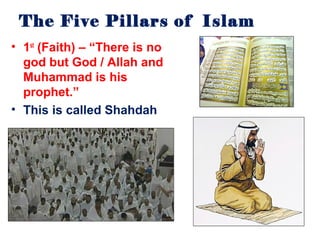
• 1st (Faith) – “There is no
  god but God / Allah and
  Muhammad is his
  prophet.”
• This is called Shahdah
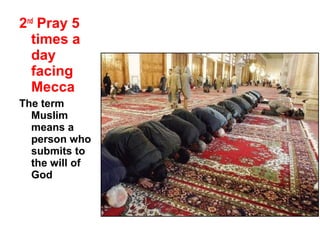
2nd Pray 5
  times a
  day
  facing
  Mecca
The term
  Muslim
  means a
  person who
  submits to
  the will of
  God
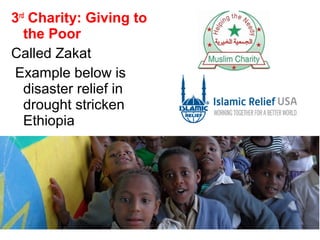
3rd Charity: Giving to
   the Poor
Called Zakat
Example below is
   disaster relief in
   drought stricken
   Ethiopia
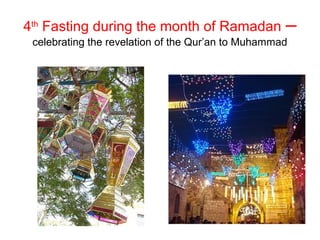
4th Fasting during the month of Ramadan             –
 celebrating the revelation of the Qur’an to Muhammad
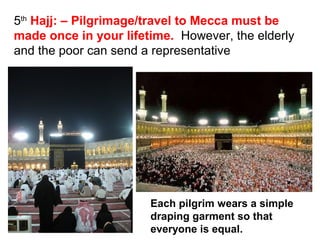
5th Hajj: – Pilgrimage/travel to Mecca must be
made once in your lifetime. However, the elderly
and the poor can send a representative


                       Each pilgrim wears a simple
                       draping garment so that
                       everyone is equal.
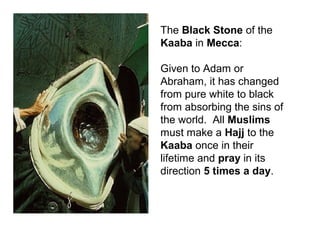
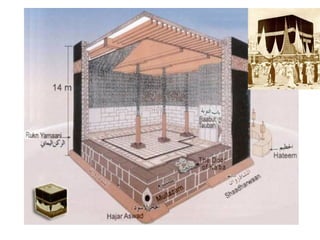
The Black Stone of the
Kaaba in Mecca:

Given to Adam or
Abraham, it has changed
from pure white to black
from absorbing the sins of
the world. All Muslims
must make a Hajj to the
Kaaba once in their
lifetime and pray in its
direction 5 times a day.
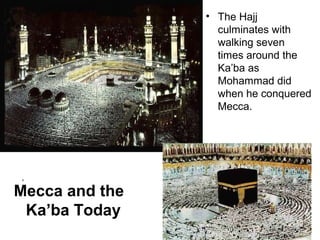
• The Hajj
                  culminates with
                  walking seven
                  times around the
                  Ka’ba as
                  Mohammad did
                  when he conquered
                  Mecca.


,
Mecca and the
 Ka’ba Today
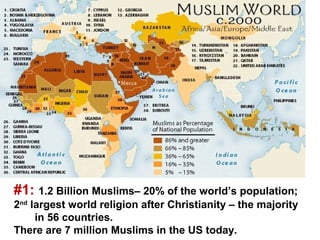
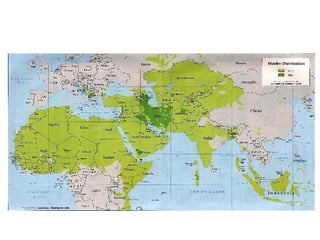
#1: 1.2 Billion Muslims– 20% of the world’s population;
2nd largest world religion after Christianity – the majority
     in 56 countries.
There are 7 million Muslims in the US today.
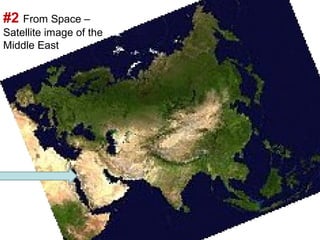
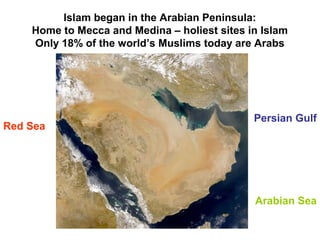
#2 From Space –
Satellite image of the
Middle East
Islam began in the Arabian Peninsula:
    Home to Mecca and Medina – holiest sites in Islam
    Only 18% of the world’s Muslims today are Arabs


                                              Persian Gulf
Red Sea


                                              Arabian Sea
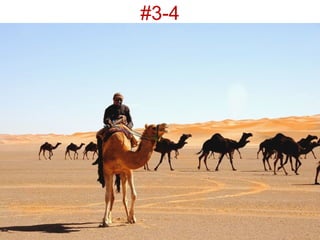
#3-4
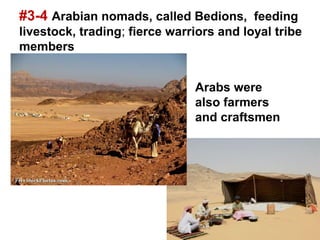
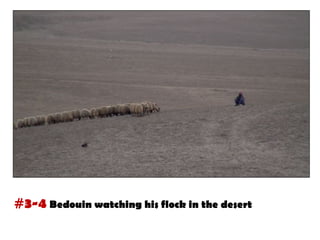
#3-4 Arabian nomads, called Bedions, feeding
livestock, trading; fierce warriors and loyal tribe
members


                               Arabs were
                               also farmers
                               and craftsmen
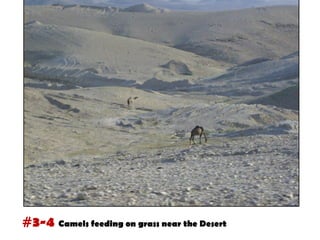
#3-4 Camels feeding on grass near the Desert
#3-4 Bedouin watching his flock in the desert
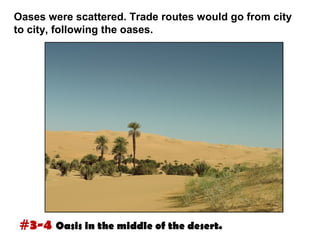
Oases were scattered. Trade routes would go from city
to city, following the oases.


 #3-4 Oasis in the middle of the desert.
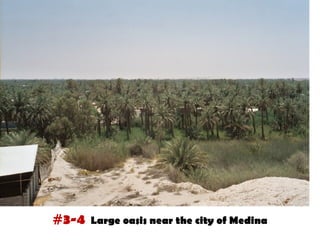
#3-4   Large oasis near the city of Medina
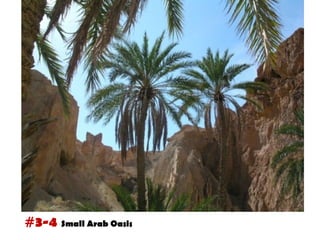
#3-4 Small Arab Oasis
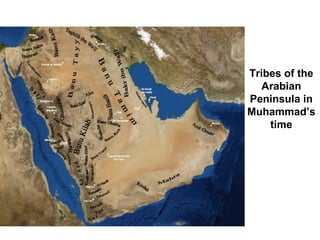
Tribes of the
   Arabian
Peninsula in
Muhammad’s
    time
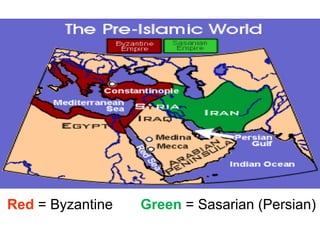
Red = Byzantine   Green = Sasarian (Persian)
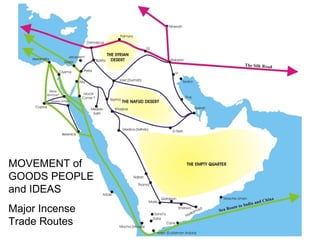
MOVEMENT of
GOODS PEOPLE
and IDEAS
Major Incense
Trade Routes
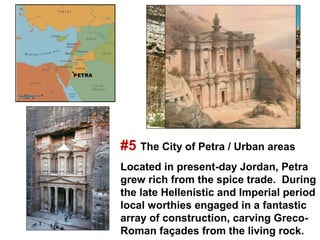
#5 The City of Petra / Urban areas
Located in present-day Jordan, Petra
grew rich from the spice trade. During
the late Hellenistic and Imperial period
local worthies engaged in a fantastic
array of construction, carving Greco-
Roman façades from the living rock.
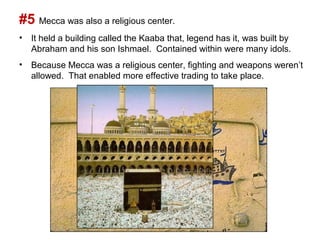
#5 Mecca was also a religious center.
• It held a building called the Kaaba that, legend has it, was built by
  Abraham and his son Ishmael. Contained within were many idols.
• Because Mecca was a religious center, fighting and weapons weren’t
  allowed. That enabled more effective trading to take place.
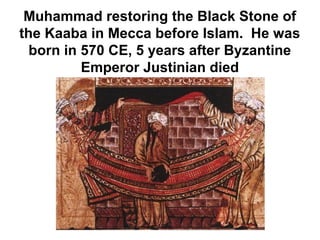
Muhammad restoring the Black Stone of
the Kaaba in Mecca before Islam. He was
  born in 570 CE, 5 years after Byzantine
          Emperor Justinian died
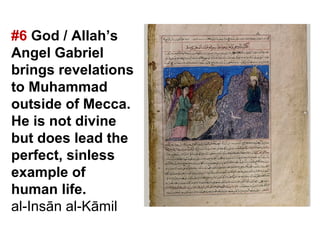
#6 God / Allah’s
Angel Gabriel
brings revelations
to Muhammad
outside of Mecca.
He is not divine
but does lead the
perfect, sinless
example of
human life.
al-Insān al-Kāmil
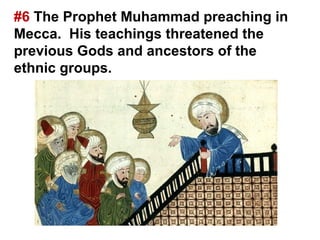
#6 The Prophet Muhammad preaching in
Mecca. His teachings threatened the
previous Gods and ancestors of the
ethnic groups.
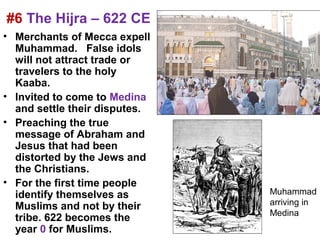
#6 The Hijra – 622 CE
• Merchants of Mecca expell
  Muhammad. False idols
  will not attract trade or
  travelers to the holy
  Kaaba.
• Invited to come to Medina
  and settle their disputes.
• Preaching the true
  message of Abraham and
  Jesus that had been
  distorted by the Jews and
  the Christians.
• For the first time people
  identify themselves as       Muhammad
  Muslims and not by their     arriving in
                               Medina
  tribe. 622 becomes the
  year 0 for Muslims.
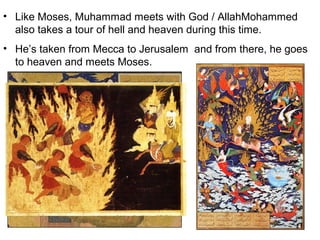
• Like Moses, Muhammad meets with God / AllahMohammed
  also takes a tour of hell and heaven during this time.
• He’s taken from Mecca to Jerusalem and from there, he goes
  to heaven and meets Moses.
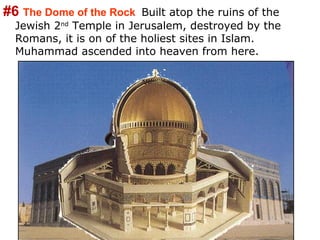
#6 The Dome of the Rock   Built atop the ruins of the
  Jewish 2nd Temple in Jerusalem, destroyed by the
  Romans, it is on of the holiest sites in Islam.
  Muhammad ascended into heaven from here.
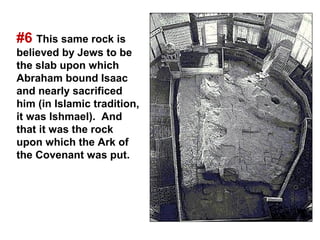
#6 This same rock is
believed by Jews to be
the slab upon which
Abraham bound Isaac
and nearly sacrificed
him (in Islamic tradition,
it was Ishmael). And
that it was the rock
upon which the Ark of
the Covenant was put.
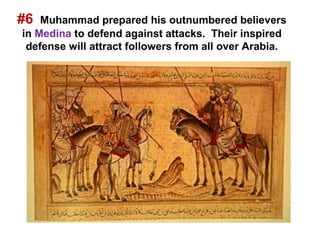
#6  Muhammad prepared his outnumbered believers
in Medina to defend against attacks. Their inspired
 defense will attract followers from all over Arabia.
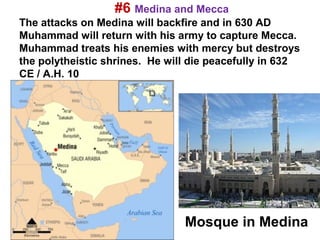
#6 Medina and Mecca
The attacks on Medina will backfire and in 630 AD
Muhammad will return with his army to capture Mecca.
Muhammad treats his enemies with mercy but destroys
the polytheistic shrines. He will die peacefully in 632
CE / A.H. 10
.


                                Mosque in Medina
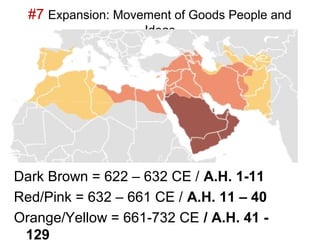
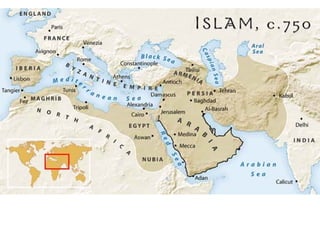
#7 Expansion: Movement of Goods People and
                    Ideas


Dark Brown = 622 – 632 CE / A.H. 1-11
Red/Pink = 632 – 661 CE / A.H. 11 – 40
Orange/Yellow = 661-732 CE / A.H. 41 -
 129
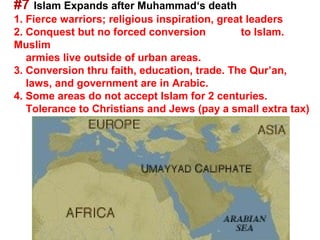
#7 Islam Expands after Muhammad‘s death
1. Fierce warriors; religious inspiration, great leaders
2. Conquest but no forced conversion           to Islam.
Muslim
   armies live outside of urban areas.
3. Conversion thru faith, education, trade. The Qur’an,
   laws, and government are in Arabic.
4. Some areas do not accept Islam for 2 centuries.
   Tolerance to Christians and Jews (pay a small extra tax)
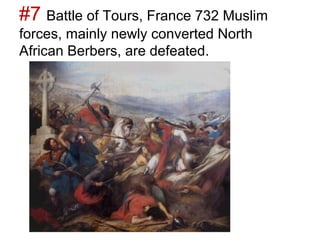
#7 Battle of Tours, France 732 Muslim
forces, mainly newly converted North
African Berbers, are defeated.
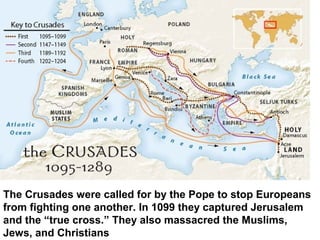
The Crusades were called for by the Pope to stop Europeans
from fighting one another. In 1099 they captured Jerusalem
and the “true cross.” They also massacred the Muslims,
Jews, and Christians
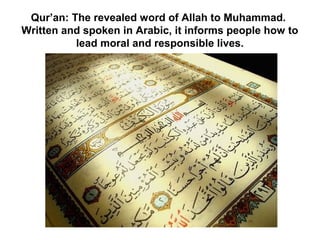
Qur’an: The revealed word of Allah to Muhammad.
Written and spoken in Arabic, it informs people how to
          lead moral and responsible lives.
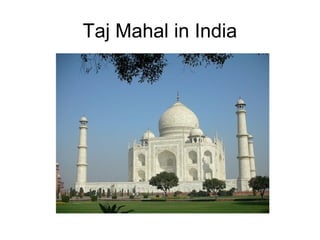
Taj Mahal in India
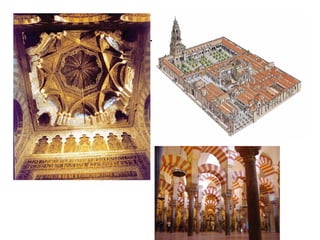
Mosque in __________?
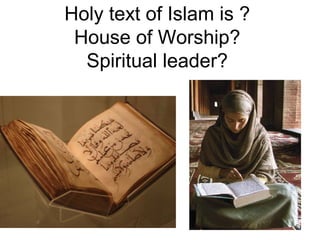
Holy text of Islam is ?
 House of Worship?
  Spiritual leader?
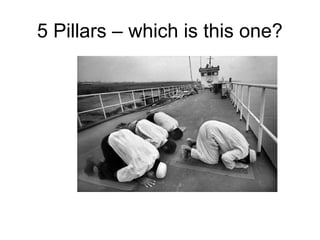
5 Pillars – which is this one?
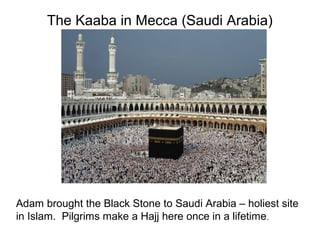
The Kaaba in Mecca (Saudi Arabia)


Adam brought the Black Stone to Saudi Arabia – holiest site
in Islam. Pilgrims make a Hajj here once in a lifetime.
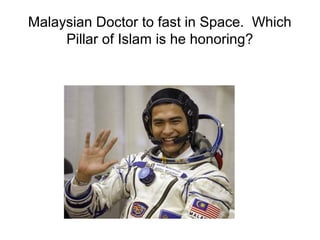
Malaysian Doctor to fast in Space. Which
     Pillar of Islam is he honoring?
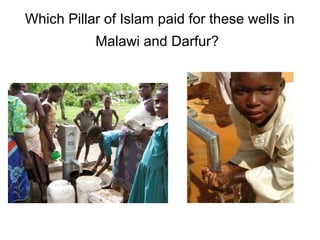
Which Pillar of Islam paid for these wells in
           Malawi and Darfur?
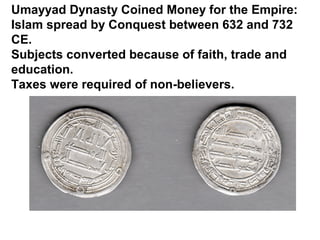
Umayyad Dynasty Coined Money for the Empire:
Islam spread by Conquest between 632 and 732
CE.
Subjects converted because of faith, trade and
education.
Taxes were required of non-believers.
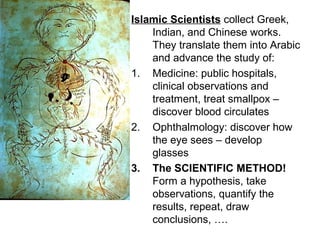
Islamic Scientists collect Greek,
    Indian, and Chinese works.
    They translate them into Arabic
    and advance the study of:
1. Medicine: public hospitals,
    clinical observations and
    treatment, treat smallpox –
    discover blood circulates
2. Ophthalmology: discover how
    the eye sees – develop
    glasses
3. The SCIENTIFIC METHOD!
    Form a hypothesis, take
    observations, quantify the
    results, repeat, draw
    conclusions, ….
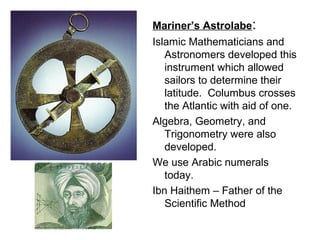
Mariner’s Astrolabe:
Islamic Mathematicians and
   Astronomers developed this
   instrument which allowed
   sailors to determine their
   latitude. Columbus crosses
   the Atlantic with aid of one.
Algebra, Geometry, and
   Trigonometry were also
   developed.
We use Arabic numerals
   today.
Ibn Haithem – Father of the
   Scientific Method
#11 Jihad: Personal Struggle
through Holy War in Islam
Read page 239 in your textbook
Sunnis believe: 2-3 facts
Shiites believe: 2-3 facts
2 Similarities/2 differences are
#11 Religious Divisions in Islam after
    Muhammad’s death in 632 CE
Sunnis : The Leader/Caliph should be
  picked by the community to bring Muslims
  together. 90% of all Muslims
Shiites: leadership should pass to the sons
  of Muhammad’s daughters – divinely
  inspired by Allah. 10% of Muslims; Iran
  +Iraq
Similarities: Allah, Quran, Hajj,…
Key Difference: Leadership, Iran
http://www.sfusd.k12.ca.us/sch
www/sch618/Education/Educati
            on.html

• Islam images of education
Islam geography and history

Islam geography and history

  • 1.
    Muhammad’s Final Sermon "Hurt no one so that no one may hurt you. Remember that you will indeed meet your lord, and that he will indeed reckon your deeds.” “All mankind is from Adam and Eve, an Arab has no superiority over a non-Arab nor a non-Arab has any superiority over an Arab; Learn that every Muslim is a brother to every Muslim and that the Muslims constitute one brotherhood.”
  • 2.
    The Five Pillarsof Islam • 1st (Faith) – “There is no god but God / Allah and Muhammad is his prophet.” • This is called Shahdah
  • 3.
    2nd Pray 5 times a day facing Mecca The term Muslim means a person who submits to the will of God
  • 4.
    3rd Charity: Givingto the Poor Called Zakat Example below is disaster relief in drought stricken Ethiopia
  • 5.
    4th Fasting duringthe month of Ramadan – celebrating the revelation of the Qur’an to Muhammad
  • 6.
    5th Hajj: –Pilgrimage/travel to Mecca must be made once in your lifetime. However, the elderly and the poor can send a representative Each pilgrim wears a simple draping garment so that everyone is equal.
  • 7.
    The Black Stoneof the Kaaba in Mecca: Given to Adam or Abraham, it has changed from pure white to black from absorbing the sins of the world. All Muslims must make a Hajj to the Kaaba once in their lifetime and pray in its direction 5 times a day.
  • 9.
    • The Hajj culminates with walking seven times around the Ka’ba as Mohammad did when he conquered Mecca. , Mecca and the Ka’ba Today
  • 10.
    #1: 1.2 BillionMuslims– 20% of the world’s population; 2nd largest world religion after Christianity – the majority in 56 countries. There are 7 million Muslims in the US today.
  • 11.
    #2 From Space– Satellite image of the Middle East
  • 12.
    Islam began inthe Arabian Peninsula: Home to Mecca and Medina – holiest sites in Islam Only 18% of the world’s Muslims today are Arabs Persian Gulf Red Sea Arabian Sea
  • 13.
  • 14.
    #3-4 Arabian nomads,called Bedions, feeding livestock, trading; fierce warriors and loyal tribe members Arabs were also farmers and craftsmen
  • 15.
    #3-4 Camels feedingon grass near the Desert
  • 16.
    #3-4 Bedouin watchinghis flock in the desert
  • 17.
    Oases were scattered.Trade routes would go from city to city, following the oases. #3-4 Oasis in the middle of the desert.
  • 18.
    #3-4 Large oasis near the city of Medina
  • 19.
  • 20.
    Tribes of the Arabian Peninsula in Muhammad’s time
  • 21.
    Red = Byzantine Green = Sasarian (Persian)
  • 22.
    MOVEMENT of GOODS PEOPLE andIDEAS Major Incense Trade Routes
  • 23.
    #5 The Cityof Petra / Urban areas Located in present-day Jordan, Petra grew rich from the spice trade. During the late Hellenistic and Imperial period local worthies engaged in a fantastic array of construction, carving Greco- Roman façades from the living rock.
  • 24.
    #5 Mecca wasalso a religious center. • It held a building called the Kaaba that, legend has it, was built by Abraham and his son Ishmael. Contained within were many idols. • Because Mecca was a religious center, fighting and weapons weren’t allowed. That enabled more effective trading to take place.
  • 25.
    Muhammad restoring theBlack Stone of the Kaaba in Mecca before Islam. He was born in 570 CE, 5 years after Byzantine Emperor Justinian died
  • 26.
    #6 God /Allah’s Angel Gabriel brings revelations to Muhammad outside of Mecca. He is not divine but does lead the perfect, sinless example of human life. al-Insān al-Kāmil
  • 27.
    #6 The ProphetMuhammad preaching in Mecca. His teachings threatened the previous Gods and ancestors of the ethnic groups.
  • 28.
    #6 The Hijra– 622 CE • Merchants of Mecca expell Muhammad. False idols will not attract trade or travelers to the holy Kaaba. • Invited to come to Medina and settle their disputes. • Preaching the true message of Abraham and Jesus that had been distorted by the Jews and the Christians. • For the first time people identify themselves as Muhammad Muslims and not by their arriving in Medina tribe. 622 becomes the year 0 for Muslims.
  • 29.
    • Like Moses,Muhammad meets with God / AllahMohammed also takes a tour of hell and heaven during this time. • He’s taken from Mecca to Jerusalem and from there, he goes to heaven and meets Moses.
  • 30.
    #6 The Domeof the Rock Built atop the ruins of the Jewish 2nd Temple in Jerusalem, destroyed by the Romans, it is on of the holiest sites in Islam. Muhammad ascended into heaven from here.
  • 31.
    #6 This samerock is believed by Jews to be the slab upon which Abraham bound Isaac and nearly sacrificed him (in Islamic tradition, it was Ishmael). And that it was the rock upon which the Ark of the Covenant was put.
  • 32.
    #6 Muhammadprepared his outnumbered believers in Medina to defend against attacks. Their inspired defense will attract followers from all over Arabia.
  • 33.
    #6 Medina andMecca The attacks on Medina will backfire and in 630 AD Muhammad will return with his army to capture Mecca. Muhammad treats his enemies with mercy but destroys the polytheistic shrines. He will die peacefully in 632 CE / A.H. 10 . Mosque in Medina
  • 34.
    #7 Expansion: Movementof Goods People and Ideas Dark Brown = 622 – 632 CE / A.H. 1-11 Red/Pink = 632 – 661 CE / A.H. 11 – 40 Orange/Yellow = 661-732 CE / A.H. 41 - 129
  • 35.
    #7 Islam Expandsafter Muhammad‘s death 1. Fierce warriors; religious inspiration, great leaders 2. Conquest but no forced conversion to Islam. Muslim armies live outside of urban areas. 3. Conversion thru faith, education, trade. The Qur’an, laws, and government are in Arabic. 4. Some areas do not accept Islam for 2 centuries. Tolerance to Christians and Jews (pay a small extra tax)
  • 36.
    #7 Battle ofTours, France 732 Muslim forces, mainly newly converted North African Berbers, are defeated.
  • 38.
    The Crusades werecalled for by the Pope to stop Europeans from fighting one another. In 1099 they captured Jerusalem and the “true cross.” They also massacred the Muslims, Jews, and Christians
  • 39.
    Qur’an: The revealedword of Allah to Muhammad. Written and spoken in Arabic, it informs people how to lead moral and responsible lives.
  • 40.
  • 41.
  • 42.
    Holy text ofIslam is ? House of Worship? Spiritual leader?
  • 43.
    5 Pillars –which is this one?
  • 44.
    The Kaaba inMecca (Saudi Arabia) Adam brought the Black Stone to Saudi Arabia – holiest site in Islam. Pilgrims make a Hajj here once in a lifetime.
  • 45.
    Malaysian Doctor tofast in Space. Which Pillar of Islam is he honoring?
  • 46.
    Which Pillar ofIslam paid for these wells in Malawi and Darfur?
  • 47.
    Umayyad Dynasty CoinedMoney for the Empire: Islam spread by Conquest between 632 and 732 CE. Subjects converted because of faith, trade and education. Taxes were required of non-believers.
  • 48.
    Islamic Scientists collectGreek, Indian, and Chinese works. They translate them into Arabic and advance the study of: 1. Medicine: public hospitals, clinical observations and treatment, treat smallpox – discover blood circulates 2. Ophthalmology: discover how the eye sees – develop glasses 3. The SCIENTIFIC METHOD! Form a hypothesis, take observations, quantify the results, repeat, draw conclusions, ….
  • 49.
    Mariner’s Astrolabe: Islamic Mathematiciansand Astronomers developed this instrument which allowed sailors to determine their latitude. Columbus crosses the Atlantic with aid of one. Algebra, Geometry, and Trigonometry were also developed. We use Arabic numerals today. Ibn Haithem – Father of the Scientific Method
  • 50.
    #11 Jihad: PersonalStruggle through Holy War in Islam Read page 239 in your textbook Sunnis believe: 2-3 facts Shiites believe: 2-3 facts 2 Similarities/2 differences are
  • 51.
    #11 Religious Divisionsin Islam after Muhammad’s death in 632 CE Sunnis : The Leader/Caliph should be picked by the community to bring Muslims together. 90% of all Muslims Shiites: leadership should pass to the sons of Muhammad’s daughters – divinely inspired by Allah. 10% of Muslims; Iran +Iraq Similarities: Allah, Quran, Hajj,… Key Difference: Leadership, Iran
  • 52.

Editor's Notes

  • #10 Mecca and the Ka’ba Today
  • #11 http://www.theislamproject.org/education/Africa_Mideast_etc.html Region: The Muslim World which continents from Ocean to Ocean
  • #13 http://en.wikipedia.org/wiki/Image:Ev3240_S2000062090456.jpg – no longer working Many good images for enviro and expansion on http://en.wikipedia.org/wiki/Arabian_peninsula
  • #15 http://www.box-of-frogs.co.uk/asir.htm http://www.dakhlabedouins.com/by_bedouin_life.html http://freestockphotos.com/ISRAEL2005/BedouinsSinai2.JPG
  • #26 Muhammad restoring the Black Stone of the Kaaba http://www.zombietime.com/mohammed_image_archive/islamic_mo_full/
  • #27 Muhammad receives the Angel Gabriel and revelation from Allah http://www.zombietime.com/mohammed_image_archive/islamic_mo_full/
  • #28 http://www.zombietime.com/mohammed_image_archive/islamic_mo_full/ http://www.eng.gees.org/articulo/9/ In reality, portrayal of Muhammad is not universally banned in Islam. It is true that Islam was marked from the beginning by a horror of idol-worship, and representations of the prophet are never found in mosques, which instead are often and famously ornamented with intricate nonrepresentational designs known as arabesques and hung with works of calligraphy. But the Koran itself is silent on the matter of images, and the warnings against them contained in the hadith , sayings of the prophet recorded centuries after he lived, have been subject to various interpretation.   Depictions of the prophet were once common, for instance, in Persian and Turkic Islamic art, although often in these pictures Muhammad's face or figure is veiled or left blank. Even before the Mongol conquest of Baghdad in 1258, Islamic civilization came under the influence of Oriental art, with its rich tradition of human representation. And after the conquest, there was an explosion of painting and other imagery in Islam, including depictions of Muhammad.   So it is that the Arthur M. Sackler Gallery at the Smithsonian Institution in Washington contains a picture of the prophet seated with his companions. The work appears in Bal'ami's Persian Version of Tabari's Universal History , from the 14th century. Another image, this one of the birth of the prophet, is found in one of the great achievements of the Islamic book, the Jami' al-tavarikh (Compendium of Chronicles), produced at Tabriz in Iran around 1314. The painting, in ink, color, and gold, draws on Christian imagery of Jesus' birth.   A favorite subject of Islamic illustration is the Night Journey of Muhammad, an out-of-body ride on a supernatural horse and ascent into the heavens that is a key element of Islamic theology. The prophet is shown on the magical steed Buraq, flying over Mecca, in a 15th-century manuscript, now in the British Museum, of the Khamseh or Five-Poem Cycle by Nizami Ganjavi, a poet from Azerbaijan. An even richer illuminated image appears in a Persian miniature from about a hundred years later.   In the late 18th century, the rise of the purist and intolerant Wahhabi sect, allied with the al Saud family in eastern Arabia, ushered in a new wave of iconoclasm wherever Wahhabism appeared. It saw the destruction of many famous manuscripts, books, and artistic works, including pictures of the prophet, on the argument that any depiction of living beings was idolatry. The Wahhabi-Saudi conquest of Mecca and Medina beginning in 1924, and the consolidation of the Kingdom of Saudi Arabia in 1932, soon enriched by oil wealth, empowered the Wahhabis to spread their extremist doctrine throughout the world of Sunni Islam.   Today, much Islamic opinion holds that representation of humans and animals is forbidden to Muslims. But no firm and universal rule on these issues has been enunciated. Shia Muslims often keep pictures in their homes of the prophet as well as Ali, the fourth caliph, or successor to Muhammad as leader of the faithful, and Hussein, the prophet's grandson. The deaths of Ali and Hussein mark the beginning of the Shia tradition.   Islam, of course, is not alone in finding the depiction of living beings a matter for debate. Orthodox Judaism and some Christian sects understand the Bible to forbid images. The second of the Ten Commandments (Exodus 20:4) has been variously rendered in English, "Thou shalt not make unto thee any graven image, or any likeness of any thing that is in heaven above, or that is in the earth beneath, or that is in the water under the earth" (King James Version) and "You shall not make for yourself an idol in the form of anything in heaven above or on the earth beneath or in the waters below" (New International Version)--to cite just two translations--clearly leaving room for differing views.
  • #33 Muhammad preparing for battle defending Medina http://www.zombietime.com/mohammed_image_archive/islamic_mo_full/
  • #34 http://en.wikipedia.org/wiki/Medina
  • #36 http://www.theislamproject.org/images/islam_750.jpg
  • #37 http://content.answers.com/main/content/wp/en-commons/thumb/c/c3/300px-Steuben_-_Bataille_de_Poitiers.png
  • #38 http://www.religionfacts.com/islam/images/UmayyadCaliphateGreatestExtent661-750Met.jpg
  • #39 The Crusades: 1096 to 1289 Beginning in 1096, some Christian Europeans heeded the call of the papacy to launch a series of “holy wars” aimed at gaining control of Jerusalem from the Muslim Arabs and Seljuk Turks. In all, eight crusades were carried out. Jerusalem fell to the Christians in 1099, partly due to the disarray among Muslims. It took Muslims nearly half a century to respond effectively with their own call for defensive jihad, which required fighting against the Crusaders. Under the leadership of Salah al-Din, the Muslims effectively ended the Christian hold on the Holy Land in 1187, shortly after which Jerusalem was restored to Muslim control. It would be another 100 years, however, before the last Christian strongholds (Tripoli and Acre) fell to the Muslims. In general, the Muslims considered the Crusades to be an invasion by European outsiders, and history indicates that the Europeans treated Muslims and Jews much more harshly in comparison to Muslim treatment of Christians. The Christian sacking of Jerusalem and the massacre of its Muslim and Jewish residents during the first Crusade are often remembered as tragic historical examples of religious intolerance. http://www.theislamproject.org/education/The_Crusades.html
  • #40 http://islamicmultimedia.blogspot.com/
  • #41 http://islamicmultimedia.blogspot.com/
  • #42 http://www.dkimages.com/discover/previews/777/550512.JPG Dk layout http://dl.coastline.edu/classes/internet/art100/images/S0017624.jpg Interior Great Mosque of Cordoba
  • #43 http://my.telegraph.co.uk/VirtualContent/87459/20070809112453.jpg
  • #44 http://blogs.citypages.com/blotter/images/9_Muslim%2520prayer%2520low%2520res.jpg
  • #46 http://wwwimage.cbsnews.com/images/2007/10/10/image3354833.jpg Boston Globe newstory 10-10-07
  • #47 http://www.islamic-relief.com/submenu/Appeal/africa-action-appeal/index-malawi.htm
  • #48 http://www.ancient-art.com/images/ac11b.jpg
  • #49 http://www.wsu.edu:8000/wciv/a/ab/abg/abg37.jpg Detailed info at http://www.mic.ki.se/Arab.html
  • #50 http://astrolabes.org/mariner.htm