Three C’s of Online Discussion 
Community, Construction & Coaching
Lolita Paff, Ph.D. 
Penn State Berks 
ISETL Conference, Denver, Oct. 16-18, 2014
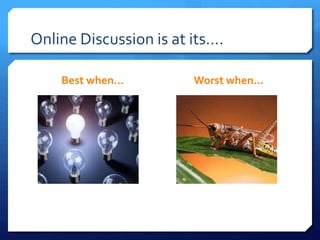
Online Discussion is at its…. 
Best when… Worst when…
“The key to development of effective 
critical thinking lies within the 
interactivity level of the instructor and 
the instructor’s ability to facilitate 
course interactions in a manner that 
prompts higher-order thought.” 
~ Mandernach, et al., 2009, p. 54
Session Objectives 
 Community: Explore online class climate, opportunities 
for connection, and netiquette. 
 Construction: Identify practical issues and propose 
solutions associated with developing and managing 
online discussions. 
 Coaching: Investigate techniques to foster 
development of students’ online discussion skills.
Community 
Explore online class climate, opportunities for connection, and netiquette.
COMMUNITY- First Impressions 
Learning begins from the very first click 
 What are students’ impressions of the course 
materials, structure, appearance? 
 What are students’ impressions of you as you 
welcome them to the class? 
 What are students learning about your priorities for 
the class during those first interactions? 
 What can students infer about participation and 
engagement expectations from your first 
interactions?
COMMUNITY- Online Presence 
A.V.A.I.L. Model (Penn State World Campus): 
 ACTIVE: Regular participation in course activities 
 VISIBLE: Leaving evidence of engagement & participation 
 ACCESSIBLE: Demonstrate availability & commitment to student 
success 
 INVOLVED: Create a social environment for learning; include 
human elements (Pallof & Pratt, 2007) 
 LEADER: Model behaviors expected of students
COMMUNITY- Netiquette 
Pallof & Pratt (2007): 
 Check discussions frequently; respond on topic 
 One subject per message; use pertinent titles 
 Avoid SHOUTING (no “flaming” / personal attacks); be 
professional in your online interaction 
 Cite all sources, references, quotes 
 Warn reader up front if a post is very long 
 It’s rude to forward someone else’s message without 
permission 
 Use humor carefully; emoticons signal you are being 
humorous 
Community in action: Case Studies 
Missing in Action :Student silence 
can be interpreted as non-participation, 
confusion, 
marginalization or thoughtful 
reflection. (Zembylas & Vrasidas, 
2007) 
 Which of these is most 
challenging for you? 
 Formulate a response. 
 What are some strategies to 
identify the cause(s) of student 
silence? 
 Brainstorm alternative delivery 
methods. 
The Flamethrower: A student 
responds in a rude manner to 
another student’s post, focusing 
on the cultural and world views 
expressed as they related to a 
topic in the assignment. Before 
you are able to respond, two other 
students contribute negatively, 
and a third posts a complaint 
about the “out of control” and 
“distracting” threads. 
 What would be the content of 
your response? 
 What method would you use to 
respond?
Construction 
Identify issues & propose solutions for developing & managing online discussions.
Construction- Role & Purpose 
 Formative learning? 
 Summative evaluation? 
 Voluntary or required participation? 
 Student or Teacher Driven 
 Open-ended / Exploratory 
 Require understanding of core concepts & application of 
knowledge
Construction- Practical Decisions 
 How many: Discussions? Posts? Comments? 
 Group size? 
 Large F2F class with online discussion component: 20-25 
(Bryant, 2005) 
 Groups of 5-7 provide for sufficient diversity to maintain interest 
while minimizing social loafing and free-riding (Baker, 2011) 
 Group composition? 
 Discussion format?
Construction- Groups 
Mandernach, Forrest, Babutzke & Manker (2009) 
 Learning community based on interests or 
experiences 
 Role plays with assigned positions, rotated 
 Buzz groups, short-term specific topic 
 Debate teams 
 Jigsaw 
Mock trial
Construction- Format 
Boettcher & Conrad (2010) 
 Stump the expert: student generated scenarios or 
questions 
 Student generated data gathering about videos, 
news clips, provocative statements 
 Expert interview: What three questions would you 
ask? 
 Three-part post: What? Why? Wish I Knew…? 
 Case studies 
 What-if Scenarios
Construction- Instructions 
 Do not assume… 
 Familiarity with discussion boards 
 Prior experience 
 SHOW them examples of deep online discussion, nested 
threads 
 Provide opportunities to PRACTICE in low-stakes situations 
first 
 Mechanics of posting 
 Appropriately commenting 
 Feedback mechanisms
Construction- Quality Control 
To ensure you are contributing a quality post, ask yourself the 
following questions (Cooper, 2009): 
 Is the information accurate? 
 Is your post relevant to the topic under discussion? 
 Does your post answer the question(s) required? 
 Does your post teach something new? Apply a concept in a 
new way? 
 Have you added to the academic atmosphere of the course?
Construction- Assessment 
 Comer & Lenaghan (2013): Original Examples (OEs) & Value-Added 
Comments (VACs) 
 Bliss & Lawrence (2009): Educationally Valuable Talk 
 Al-Shalchi (2009) 
 Criteria- Meet the deadline; Quality of Work; Mechanics 
 Performance levels: Excellent (5); Acceptable (3); Poor (1) 
 Pallof & Pratt (2007) 
 Synthesis (3) – critical thinking, well written, references the reading 
 Analysis (2) – adequate at analysis level, may have some writing issues, 
some critical thinking is present 
 Summary (1) – little response to discussion question, no responses to other 
learners, may have some writing issues, little evidence of critical thinking
coaching 
Investigate techniques to foster development of students’ online discussion skills.
Coaching- Advancing Discussion 
Facilitating Online Learning. Collison, Elbaum & Haavind (2000) 
 Probing questions 
 To whom is this of concern or relevance? 
 What audience is assumed? 
 Is this issue compelling or only of tangential benefit? 
 Is this issue of intellectual merit? 
 Appropriate action? 
 Question the notion of the quick fix 
 Who should be the ones acting here? 
 Consider quoting or rephrasing a student comment 
 Explore assumptions 
 Ponder uncertainty
Coaching- Timely Feedback 
 Recognize good work 
 Provide specific suggestions for improvement 
 Acknowledge differences in opinion 
 Diagnose misconceptions promptly 
 Provide resources for further study 
 Deliver gentle reminders to redirect and advance 
discussion 
 Encourage students’ use of real examples or 
literature to support their view
Coaching: Weak Discussions 
Postings by students 
indicate a pattern of 
sparse and very basic 
postings that do not 
reflect engagement. 
They appear to be 
doing the minimum to 
get by. 
 What would you 
communicate? 
 How would you deliver 
the message? 
A discussion is going off 
track with incorrect 
information being 
posted by students. 
 What would you 
communicate? 
 How would you deliver 
the message?
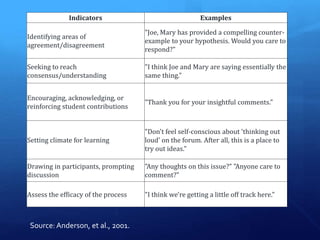
Indicators Examples 
Identifying areas of 
agreement/disagreement 
"Joe, Mary has provided a compelling counter-example 
to your hypothesis. Would you care to 
respond?" 
Seeking to reach 
consensus/understanding 
"I think Joe and Mary are saying essentially the 
same thing." 
Encouraging, acknowledging, or 
reinforcing student contributions 
"Thank you for your insightful comments." 
Setting climate for learning 
"Don't feel self-conscious about 'thinking out 
loud' on the forum. After all, this is a place to 
try out ideas." 
Drawing in participants, prompting 
discussion 
"Any thoughts on this issue?" "Anyone care to 
comment?" 
Assess the efficacy of the process "I think we're getting a little off track here." 
Source: Anderson, et al., 2001.
Coaching: Student Facilitators 
Baran & Correia (2009): Instructor as participant, 
student as facilitator who will: 
 Plan: objectives, guiding questions, scenarios 
 Clarify purpose: what is the expected outcome? 
 Manage over- and under-participators 
 Maintain discussion focus 
 Encourage multiple views 
 Summarize at the conclusion
“To those readers who were hoping to that we would 
provide more specific recommendations on what tools 
or techniques to use (and not use) for online teaching, 
the response should be clear by now. Whenever 
teachers are considering a 
tool/technique/strategy/approach (regardless of 
delivery mode), they would be best served to ask how 
that choice will impact student engagement, 
intellectual development, and personal connections. 
That is one of the most important challenges facing 
teachers who aspire to develop their students into life-long 
learners.” 
~ Brinthaupt, et al., 2011, p.522
Thank you! 
Additional comments? 
Questions? 
Lolita Paff 
LAP21@psu.edu 
@1313lolita on Twitter
References -1 
Anderson, T., Rourke, L., Garrison, D.R., & Archer, W. 2001. Assessing teaching presence in a computer conferencing 
context. Journal of Asynchronous Learning Networks, 5(2): 1-17. 
Al-Shalchi, O., and lla Najah N.2009. The Effectiveness and Development of Online Discussions. Journal of Online 
Learning and Teaching. (5)1: 104-108. 
Baker, David L. 2011. Designing and Orchestrating Online Discussions. Journal of Online Learning and Teaching, 7 
(3): 401-411. 
Baran, E. and Correia, A. 2009. Student-led Facilitation Strategies in Online Discussions. Distance Education, 30 
(3): 339-361. 
Bliss, C.A. and Lawrence, B.2009. From Posts to Patterns: A Metric to Characterize Discussion Board Activity in 
Online Courses. Journal of Asynchronous Learning Networks. 13(2): 15- 32. 
Boettcher, J.V. and. Conrad, R. M..2010.The Online Teaching Survival Guide. San Francisco: Jossey-Bass.
References -2 
Brinthaupt, T.M., Fisher,L.S., Gardner, J.G., Raffo, D.M., & Woodard, J.B.. 2011. What the Best Online Teachers 
Should Do. Journal of Online Learning and Teaching, 7(4):515-524. 
Bryant, B. K. 2005. Electronic Discussion Sections: A Useful Tool in Teaching Large University Classes. Teaching of 
Psychology. 32 (4): 271-275. 
Collison, G., Elbaum, B., Haavind, S., & Tinker, R. 2000. Facilitating Online Learning. Madison, WI: Atwood Publishing. 
Comer,D.R. & Lenaghan, J.A. 2013. Enhancing Discussions in the Asynchronous Online Classroom: The Lack of Face-to- 
Face Interaction Does Not Lessen the Lesson. Journal of Management Education, 37(2): 261-294. 
Cooper, T, E. 2009. Promoting Collaboration in Courses with Perceived Single Correct Solutions. Journal of Online 
Learning and Teaching, 5(2): 35-363. 
Mandernach, B. , Krista, J., Forrest, D., Babutzke, J. L., & Manker, L. R. 2009. The Role of Instructor Interactivity in 
Promoting Critical Thinking in Online and Face-to-face Classrooms. Journal of Online Learning and Teaching, 5(1): 49- 
62. 
Pallof, R. M. and. Pratt, K. 2007. Building Online Learning Communities: Effective Strategies for the Virtual Classroom. 
San Francisco: Jossey-Bass. 
Zembylas, M. & Vrasidas, C. 2007. Listening for silence in text-based, online encounters. Distance Education, 28(1): 5- 
24.

ISETL Denver 2014

  • 1.
    Three C’s ofOnline Discussion Community, Construction & Coaching
  • 2.
    Lolita Paff, Ph.D. Penn State Berks ISETL Conference, Denver, Oct. 16-18, 2014
  • 3.
    Online Discussion isat its…. Best when… Worst when…
  • 4.
    “The key todevelopment of effective critical thinking lies within the interactivity level of the instructor and the instructor’s ability to facilitate course interactions in a manner that prompts higher-order thought.” ~ Mandernach, et al., 2009, p. 54
  • 5.
    Session Objectives Community: Explore online class climate, opportunities for connection, and netiquette.  Construction: Identify practical issues and propose solutions associated with developing and managing online discussions.  Coaching: Investigate techniques to foster development of students’ online discussion skills.
  • 6.
    Community Explore onlineclass climate, opportunities for connection, and netiquette.
  • 7.
    COMMUNITY- First Impressions Learning begins from the very first click  What are students’ impressions of the course materials, structure, appearance?  What are students’ impressions of you as you welcome them to the class?  What are students learning about your priorities for the class during those first interactions?  What can students infer about participation and engagement expectations from your first interactions?
  • 8.
    COMMUNITY- Online Presence A.V.A.I.L. Model (Penn State World Campus):  ACTIVE: Regular participation in course activities  VISIBLE: Leaving evidence of engagement & participation  ACCESSIBLE: Demonstrate availability & commitment to student success  INVOLVED: Create a social environment for learning; include human elements (Pallof & Pratt, 2007)  LEADER: Model behaviors expected of students
  • 9.
    COMMUNITY- Netiquette Pallof& Pratt (2007):  Check discussions frequently; respond on topic  One subject per message; use pertinent titles  Avoid SHOUTING (no “flaming” / personal attacks); be professional in your online interaction  Cite all sources, references, quotes  Warn reader up front if a post is very long  It’s rude to forward someone else’s message without permission  Use humor carefully; emoticons signal you are being humorous 
  • 10.
    Community in action:Case Studies Missing in Action :Student silence can be interpreted as non-participation, confusion, marginalization or thoughtful reflection. (Zembylas & Vrasidas, 2007)  Which of these is most challenging for you?  Formulate a response.  What are some strategies to identify the cause(s) of student silence?  Brainstorm alternative delivery methods. The Flamethrower: A student responds in a rude manner to another student’s post, focusing on the cultural and world views expressed as they related to a topic in the assignment. Before you are able to respond, two other students contribute negatively, and a third posts a complaint about the “out of control” and “distracting” threads.  What would be the content of your response?  What method would you use to respond?
  • 11.
    Construction Identify issues& propose solutions for developing & managing online discussions.
  • 12.
    Construction- Role &Purpose  Formative learning?  Summative evaluation?  Voluntary or required participation?  Student or Teacher Driven  Open-ended / Exploratory  Require understanding of core concepts & application of knowledge
  • 13.
    Construction- Practical Decisions  How many: Discussions? Posts? Comments?  Group size?  Large F2F class with online discussion component: 20-25 (Bryant, 2005)  Groups of 5-7 provide for sufficient diversity to maintain interest while minimizing social loafing and free-riding (Baker, 2011)  Group composition?  Discussion format?
  • 14.
    Construction- Groups Mandernach,Forrest, Babutzke & Manker (2009)  Learning community based on interests or experiences  Role plays with assigned positions, rotated  Buzz groups, short-term specific topic  Debate teams  Jigsaw Mock trial
  • 15.
    Construction- Format Boettcher& Conrad (2010)  Stump the expert: student generated scenarios or questions  Student generated data gathering about videos, news clips, provocative statements  Expert interview: What three questions would you ask?  Three-part post: What? Why? Wish I Knew…?  Case studies  What-if Scenarios
  • 16.
    Construction- Instructions Do not assume…  Familiarity with discussion boards  Prior experience  SHOW them examples of deep online discussion, nested threads  Provide opportunities to PRACTICE in low-stakes situations first  Mechanics of posting  Appropriately commenting  Feedback mechanisms
  • 17.
    Construction- Quality Control To ensure you are contributing a quality post, ask yourself the following questions (Cooper, 2009):  Is the information accurate?  Is your post relevant to the topic under discussion?  Does your post answer the question(s) required?  Does your post teach something new? Apply a concept in a new way?  Have you added to the academic atmosphere of the course?
  • 18.
    Construction- Assessment Comer & Lenaghan (2013): Original Examples (OEs) & Value-Added Comments (VACs)  Bliss & Lawrence (2009): Educationally Valuable Talk  Al-Shalchi (2009)  Criteria- Meet the deadline; Quality of Work; Mechanics  Performance levels: Excellent (5); Acceptable (3); Poor (1)  Pallof & Pratt (2007)  Synthesis (3) – critical thinking, well written, references the reading  Analysis (2) – adequate at analysis level, may have some writing issues, some critical thinking is present  Summary (1) – little response to discussion question, no responses to other learners, may have some writing issues, little evidence of critical thinking
  • 19.
    coaching Investigate techniquesto foster development of students’ online discussion skills.
  • 20.
    Coaching- Advancing Discussion Facilitating Online Learning. Collison, Elbaum & Haavind (2000)  Probing questions  To whom is this of concern or relevance?  What audience is assumed?  Is this issue compelling or only of tangential benefit?  Is this issue of intellectual merit?  Appropriate action?  Question the notion of the quick fix  Who should be the ones acting here?  Consider quoting or rephrasing a student comment  Explore assumptions  Ponder uncertainty
  • 21.
    Coaching- Timely Feedback  Recognize good work  Provide specific suggestions for improvement  Acknowledge differences in opinion  Diagnose misconceptions promptly  Provide resources for further study  Deliver gentle reminders to redirect and advance discussion  Encourage students’ use of real examples or literature to support their view
  • 22.
    Coaching: Weak Discussions Postings by students indicate a pattern of sparse and very basic postings that do not reflect engagement. They appear to be doing the minimum to get by.  What would you communicate?  How would you deliver the message? A discussion is going off track with incorrect information being posted by students.  What would you communicate?  How would you deliver the message?
  • 23.
    Indicators Examples Identifyingareas of agreement/disagreement "Joe, Mary has provided a compelling counter-example to your hypothesis. Would you care to respond?" Seeking to reach consensus/understanding "I think Joe and Mary are saying essentially the same thing." Encouraging, acknowledging, or reinforcing student contributions "Thank you for your insightful comments." Setting climate for learning "Don't feel self-conscious about 'thinking out loud' on the forum. After all, this is a place to try out ideas." Drawing in participants, prompting discussion "Any thoughts on this issue?" "Anyone care to comment?" Assess the efficacy of the process "I think we're getting a little off track here." Source: Anderson, et al., 2001.
  • 24.
    Coaching: Student Facilitators Baran & Correia (2009): Instructor as participant, student as facilitator who will:  Plan: objectives, guiding questions, scenarios  Clarify purpose: what is the expected outcome?  Manage over- and under-participators  Maintain discussion focus  Encourage multiple views  Summarize at the conclusion
  • 25.
    “To those readerswho were hoping to that we would provide more specific recommendations on what tools or techniques to use (and not use) for online teaching, the response should be clear by now. Whenever teachers are considering a tool/technique/strategy/approach (regardless of delivery mode), they would be best served to ask how that choice will impact student engagement, intellectual development, and personal connections. That is one of the most important challenges facing teachers who aspire to develop their students into life-long learners.” ~ Brinthaupt, et al., 2011, p.522
  • 26.
    Thank you! Additionalcomments? Questions? Lolita Paff LAP21@psu.edu @1313lolita on Twitter
  • 27.
    References -1 Anderson,T., Rourke, L., Garrison, D.R., & Archer, W. 2001. Assessing teaching presence in a computer conferencing context. Journal of Asynchronous Learning Networks, 5(2): 1-17. Al-Shalchi, O., and lla Najah N.2009. The Effectiveness and Development of Online Discussions. Journal of Online Learning and Teaching. (5)1: 104-108. Baker, David L. 2011. Designing and Orchestrating Online Discussions. Journal of Online Learning and Teaching, 7 (3): 401-411. Baran, E. and Correia, A. 2009. Student-led Facilitation Strategies in Online Discussions. Distance Education, 30 (3): 339-361. Bliss, C.A. and Lawrence, B.2009. From Posts to Patterns: A Metric to Characterize Discussion Board Activity in Online Courses. Journal of Asynchronous Learning Networks. 13(2): 15- 32. Boettcher, J.V. and. Conrad, R. M..2010.The Online Teaching Survival Guide. San Francisco: Jossey-Bass.
  • 28.
    References -2 Brinthaupt,T.M., Fisher,L.S., Gardner, J.G., Raffo, D.M., & Woodard, J.B.. 2011. What the Best Online Teachers Should Do. Journal of Online Learning and Teaching, 7(4):515-524. Bryant, B. K. 2005. Electronic Discussion Sections: A Useful Tool in Teaching Large University Classes. Teaching of Psychology. 32 (4): 271-275. Collison, G., Elbaum, B., Haavind, S., & Tinker, R. 2000. Facilitating Online Learning. Madison, WI: Atwood Publishing. Comer,D.R. & Lenaghan, J.A. 2013. Enhancing Discussions in the Asynchronous Online Classroom: The Lack of Face-to- Face Interaction Does Not Lessen the Lesson. Journal of Management Education, 37(2): 261-294. Cooper, T, E. 2009. Promoting Collaboration in Courses with Perceived Single Correct Solutions. Journal of Online Learning and Teaching, 5(2): 35-363. Mandernach, B. , Krista, J., Forrest, D., Babutzke, J. L., & Manker, L. R. 2009. The Role of Instructor Interactivity in Promoting Critical Thinking in Online and Face-to-face Classrooms. Journal of Online Learning and Teaching, 5(1): 49- 62. Pallof, R. M. and. Pratt, K. 2007. Building Online Learning Communities: Effective Strategies for the Virtual Classroom. San Francisco: Jossey-Bass. Zembylas, M. & Vrasidas, C. 2007. Listening for silence in text-based, online encounters. Distance Education, 28(1): 5- 24.