Author: CSR-in-Action
INTRODUCTION
One of the major trends in our present world is the global rush to renewable energy
captured from natural processes such as sunlight, wind, flowing water, biological processes,
and geothermal heat flows. While the world moves to generate clean energy systems that do
not contribute to greenhouse gas (GHG) emissions and climate change, non-inclusion of
social consciousness and several other impacts on the ecosystem are unveiling the grey areas
of these renewables.
Generally, sustainability entails the integration of environmental, social, and economic
concerns into our development’s trajectory and business practices. Any intention to satisfy a
given dimension of sustainability at the cost of others, for example conserving the
environment without considering the health hazard or economic hardship to the people,
becomes an unsustainable practice. In this case, every major renewable energy technology
such as hydropower plants, wind turbines, solar energy, biofuels and more have drawn
criticisms from sustainability experts and have been termed unsustainable in certain areas
where adequate socio-economic impact assessments of projects were failed to be carried
out.
2 | Is Renewable Energy Really Sustainable?
Hydropower Plants
3 | Is Renewable Energy Really Sustainable?
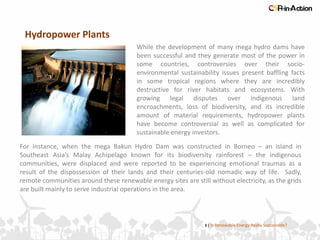
While the development of many mega hydro dams have
been successful and they generate most of the power in
some countries, controversies over their socio-
environmental sustainability issues present baffling facts
in some tropical regions where they are incredibly
destructive for river habitats and ecosystems. With
growing legal disputes over indigenous land
encroachments, loss of biodiversity, and its incredible
amount of material requirements, hydropower plants
have become controversial as well as complicated for
sustainable energy investors.
For instance, when the mega Bakun Hydro Dam was constructed in Borneo – an island in
Southeast Asia’s Malay Achipelago known for its biodiversity rainforest – the indigenous
communities, were displaced and were reported to be experiencing emotional traumas as a
result of the dispossession of their lands and their centuries-old nomadic way of life. Sadly,
remote communities around these renewable energy sites are still without electricity, as the grids
are built mainly to serve industrial operations in the area.
4 | Is Renewable Energy Really Sustainable?
With its energy contribution towards industrialisation, hydropower plants have also been
criticised for the incredible amount of materials required to construct them. This is not
consonant with the concept of sustainable consumption which requires responsible and
efficient use of materials without depleting them and compromising the ability of the future
generations to meet their own needs.
Wind Power
5 | Is Renewable Energy Really Sustainable?
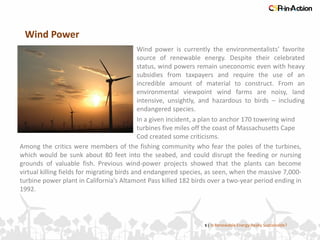
Wind power is currently the environmentalists’ favorite
source of renewable energy. Despite their celebrated
status, wind powers remain uneconomic even with heavy
subsidies from taxpayers and require the use of an
incredible amount of material to construct. From an
environmental viewpoint wind farms are noisy, land
intensive, unsightly, and hazardous to birds – including
endangered species.
Among the critics were members of the fishing community who fear the poles of the turbines,
which would be sunk about 80 feet into the seabed, and could disrupt the feeding or nursing
grounds of valuable fish. Previous wind-power projects showed that the plants can become
virtual killing fields for migrating birds and endangered species, as seen, when the massive 7,000-
turbine power plant in California’s Altamont Pass killed 182 birds over a two-year period ending in
1992.
In a given incident, a plan to anchor 170 towering wind
turbines five miles off the coast of Massachusetts Cape
Cod created some criticisms.
Biomass and Biofuels
6 | Is Renewable Energy Really Sustainable?
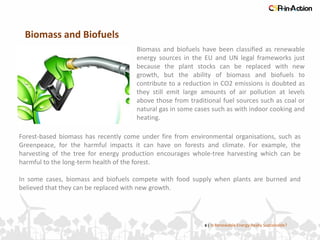
Biomass and biofuels have been classified as renewable
energy sources in the EU and UN legal frameworks just
because the plant stocks can be replaced with new
growth, but the ability of biomass and biofuels to
contribute to a reduction in CO2 emissions is doubted as
they still emit large amounts of air pollution at levels
above those from traditional fuel sources such as coal or
natural gas in some cases such as with indoor cooking and
heating.
Forest-based biomass has recently come under fire from environmental organisations, such as
Greenpeace, for the harmful impacts it can have on forests and climate. For example, the
harvesting of the tree for energy production encourages whole-tree harvesting which can be
harmful to the long-term health of the forest.
In some cases, biomass and biofuels compete with food supply when plants are burned and
believed that they can be replaced with new growth.
Solar Power
7 | Is Renewable Energy Really Sustainable?
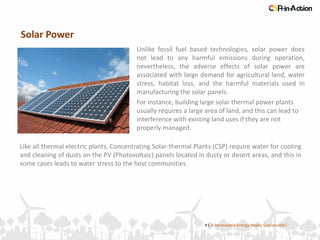
Unlike fossil fuel based technologies, solar power does
not lead to any harmful emissions during operation,
nevertheless, the adverse effects of solar power are
associated with large demand for agricultural land, water
stress, habitat loss, and the harmful materials used in
manufacturing the solar panels.
Like all thermal electric plants, Concentrating Solar-thermal Plants (CSP) require water for cooling
and cleaning of dusts on the PV (Photovoltaic) panels located in dusty or desert areas, and this in
some cases leads to water stress to the host communities.
For instance, building large solar thermal power plants
usually requires a large area of land, and this can lead to
interference with existing land uses if they are not
properly managed.
CONCLUSION
8 | Is Renewable Energy Really Sustainable?
It appears that environmental and social impact assessment (ESIA) reports have endorsed
massive relocation of indigenous communities and offered limited or no consideration of the
irreversible impact on wildlife and ecosystems from the mega renewable energy sites. But
with rising awareness of the population of conscious green consumers, it becomes pertinent
that every renewable energy projects should be subjected to greater scrutiny for societal and
environmental impacts and accountability prior to their implementation.
Renewable energy projects are more likely to succeed if they have broad public support and
the consent of local communities, or if communities are given both a say and a stake in the
projects. For instance, in countries like Germany and Denmark, many renewable projects are
owned by communities through cooperative structures and significantly contribute to overall
levels of renewable energy deployment.
To achieve sustainable renewable energies, the very true cost of such projects – the
economic, social, and environmental implications – need to be taken into account when the
cost of renewable energy is calculated. This can be achieved through adequate ESIA to
demonstrate greater socio-environmental accountability prior to any renewable energy
project execution.
Reference
1. Cato Institute Policy Analysis No. 280: Renewable Energy: Not Cheap, Not “Green”. –
Robert L. Bradley Jr, Forbes (August 27, 1997)
https://object.cato.org/sites/cato.org/files/pubs/pdf/pa280.pdf
2. Is Renewable Energy Really Green? - Kamala Vainy Pillai, Forbes (September 24, 2014)
https://www.forbes.com/sites/realspin/2014/09/24/is-renewable-energy-really-green/
3. Renewable Energy. – ScienceDaily
https://www.sciencedaily.com/terms/renewable_energy.htm
4. The Dark Side of Renewable Energy: Negative Impacts of Renewables on the Environment.
- Pradhnya Tajne (August 13, 2015) https://www.altenergymag.com/article/2015/08/the-
dark-side-of-renewable-energy-negative-impacts-of-renewables-on-the-
environment/20963/
5. Wind Proposal Whips up Controversy. - Amanda Onion (October, 29)
http://abcnews.go.com/Technology/story?id=97849
6. “Water Issues of Biofuel Production Plants”. - The National Academies Press (2008).
Retrieved 31 March 2017. https://www.nap.edu/read/12039/chapter/7
9 | Is Renewable Energy Really Sustainable?
About
CSR-in-Action is a conglomerate of 3 sustainability driven
businesses; Consulting, Training and Advocacy. Our mission is to
redefine the sustainability terrain in Africa, through collaborative
strategies with key stakeholders aimed at attaining higher levels of
corporate governance, workplace and sustainable philanthropy.
We have a clear vision to propel collective transformative action in
Africa by promoting responsibility amongst all entities in their day-
to-day individual or business activities.
Contact:
54, Udeco Medical Road,
Chevron Drive, Lekki Phase1,
Lagos State.
234-807-688-4871
info@csr-in-action.org
www.csr-in-action.org

Is Renewable Energy Really Sustainable?

  • 1.
  • 2.
    INTRODUCTION One of themajor trends in our present world is the global rush to renewable energy captured from natural processes such as sunlight, wind, flowing water, biological processes, and geothermal heat flows. While the world moves to generate clean energy systems that do not contribute to greenhouse gas (GHG) emissions and climate change, non-inclusion of social consciousness and several other impacts on the ecosystem are unveiling the grey areas of these renewables. Generally, sustainability entails the integration of environmental, social, and economic concerns into our development’s trajectory and business practices. Any intention to satisfy a given dimension of sustainability at the cost of others, for example conserving the environment without considering the health hazard or economic hardship to the people, becomes an unsustainable practice. In this case, every major renewable energy technology such as hydropower plants, wind turbines, solar energy, biofuels and more have drawn criticisms from sustainability experts and have been termed unsustainable in certain areas where adequate socio-economic impact assessments of projects were failed to be carried out. 2 | Is Renewable Energy Really Sustainable?
  • 3.
    Hydropower Plants 3 |Is Renewable Energy Really Sustainable? While the development of many mega hydro dams have been successful and they generate most of the power in some countries, controversies over their socio- environmental sustainability issues present baffling facts in some tropical regions where they are incredibly destructive for river habitats and ecosystems. With growing legal disputes over indigenous land encroachments, loss of biodiversity, and its incredible amount of material requirements, hydropower plants have become controversial as well as complicated for sustainable energy investors. For instance, when the mega Bakun Hydro Dam was constructed in Borneo – an island in Southeast Asia’s Malay Achipelago known for its biodiversity rainforest – the indigenous communities, were displaced and were reported to be experiencing emotional traumas as a result of the dispossession of their lands and their centuries-old nomadic way of life. Sadly, remote communities around these renewable energy sites are still without electricity, as the grids are built mainly to serve industrial operations in the area.
  • 4.
    4 | IsRenewable Energy Really Sustainable? With its energy contribution towards industrialisation, hydropower plants have also been criticised for the incredible amount of materials required to construct them. This is not consonant with the concept of sustainable consumption which requires responsible and efficient use of materials without depleting them and compromising the ability of the future generations to meet their own needs.
  • 5.
    Wind Power 5 |Is Renewable Energy Really Sustainable? Wind power is currently the environmentalists’ favorite source of renewable energy. Despite their celebrated status, wind powers remain uneconomic even with heavy subsidies from taxpayers and require the use of an incredible amount of material to construct. From an environmental viewpoint wind farms are noisy, land intensive, unsightly, and hazardous to birds – including endangered species. Among the critics were members of the fishing community who fear the poles of the turbines, which would be sunk about 80 feet into the seabed, and could disrupt the feeding or nursing grounds of valuable fish. Previous wind-power projects showed that the plants can become virtual killing fields for migrating birds and endangered species, as seen, when the massive 7,000- turbine power plant in California’s Altamont Pass killed 182 birds over a two-year period ending in 1992. In a given incident, a plan to anchor 170 towering wind turbines five miles off the coast of Massachusetts Cape Cod created some criticisms.
  • 6.
    Biomass and Biofuels 6| Is Renewable Energy Really Sustainable? Biomass and biofuels have been classified as renewable energy sources in the EU and UN legal frameworks just because the plant stocks can be replaced with new growth, but the ability of biomass and biofuels to contribute to a reduction in CO2 emissions is doubted as they still emit large amounts of air pollution at levels above those from traditional fuel sources such as coal or natural gas in some cases such as with indoor cooking and heating. Forest-based biomass has recently come under fire from environmental organisations, such as Greenpeace, for the harmful impacts it can have on forests and climate. For example, the harvesting of the tree for energy production encourages whole-tree harvesting which can be harmful to the long-term health of the forest. In some cases, biomass and biofuels compete with food supply when plants are burned and believed that they can be replaced with new growth.
  • 7.
    Solar Power 7 |Is Renewable Energy Really Sustainable? Unlike fossil fuel based technologies, solar power does not lead to any harmful emissions during operation, nevertheless, the adverse effects of solar power are associated with large demand for agricultural land, water stress, habitat loss, and the harmful materials used in manufacturing the solar panels. Like all thermal electric plants, Concentrating Solar-thermal Plants (CSP) require water for cooling and cleaning of dusts on the PV (Photovoltaic) panels located in dusty or desert areas, and this in some cases leads to water stress to the host communities. For instance, building large solar thermal power plants usually requires a large area of land, and this can lead to interference with existing land uses if they are not properly managed.
  • 8.
    CONCLUSION 8 | IsRenewable Energy Really Sustainable? It appears that environmental and social impact assessment (ESIA) reports have endorsed massive relocation of indigenous communities and offered limited or no consideration of the irreversible impact on wildlife and ecosystems from the mega renewable energy sites. But with rising awareness of the population of conscious green consumers, it becomes pertinent that every renewable energy projects should be subjected to greater scrutiny for societal and environmental impacts and accountability prior to their implementation. Renewable energy projects are more likely to succeed if they have broad public support and the consent of local communities, or if communities are given both a say and a stake in the projects. For instance, in countries like Germany and Denmark, many renewable projects are owned by communities through cooperative structures and significantly contribute to overall levels of renewable energy deployment. To achieve sustainable renewable energies, the very true cost of such projects – the economic, social, and environmental implications – need to be taken into account when the cost of renewable energy is calculated. This can be achieved through adequate ESIA to demonstrate greater socio-environmental accountability prior to any renewable energy project execution.
  • 9.
    Reference 1. Cato InstitutePolicy Analysis No. 280: Renewable Energy: Not Cheap, Not “Green”. – Robert L. Bradley Jr, Forbes (August 27, 1997) https://object.cato.org/sites/cato.org/files/pubs/pdf/pa280.pdf 2. Is Renewable Energy Really Green? - Kamala Vainy Pillai, Forbes (September 24, 2014) https://www.forbes.com/sites/realspin/2014/09/24/is-renewable-energy-really-green/ 3. Renewable Energy. – ScienceDaily https://www.sciencedaily.com/terms/renewable_energy.htm 4. The Dark Side of Renewable Energy: Negative Impacts of Renewables on the Environment. - Pradhnya Tajne (August 13, 2015) https://www.altenergymag.com/article/2015/08/the- dark-side-of-renewable-energy-negative-impacts-of-renewables-on-the- environment/20963/ 5. Wind Proposal Whips up Controversy. - Amanda Onion (October, 29) http://abcnews.go.com/Technology/story?id=97849 6. “Water Issues of Biofuel Production Plants”. - The National Academies Press (2008). Retrieved 31 March 2017. https://www.nap.edu/read/12039/chapter/7 9 | Is Renewable Energy Really Sustainable?
  • 10.
    About CSR-in-Action is aconglomerate of 3 sustainability driven businesses; Consulting, Training and Advocacy. Our mission is to redefine the sustainability terrain in Africa, through collaborative strategies with key stakeholders aimed at attaining higher levels of corporate governance, workplace and sustainable philanthropy. We have a clear vision to propel collective transformative action in Africa by promoting responsibility amongst all entities in their day- to-day individual or business activities. Contact: 54, Udeco Medical Road, Chevron Drive, Lekki Phase1, Lagos State. 234-807-688-4871 info@csr-in-action.org www.csr-in-action.org