Hybrid Energy Technology
Impacts of Renewable Energy Generation
on the
Environment
EE 3033
By : Tamilvendhan S &
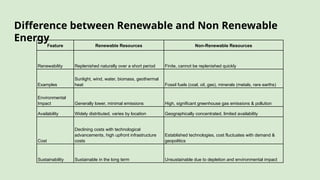
Difference between Renewable and Non Renewable
Energy
Feature Renewable Resources Non-Renewable Resources
Renewability Replenished naturally over a short period Finite, cannot be replenished quickly
Examples
Sunlight, wind, water, biomass, geothermal
heat Fossil fuels (coal, oil, gas), minerals (metals, rare earths)
Environmental
Impact Generally lower, minimal emissions High, significant greenhouse gas emissions & pollution
Availability Widely distributed, varies by location Geographically concentrated, limited availability
Cost
Declining costs with technological
advancements, high upfront infrastructure
costs
Established technologies, cost fluctuates with demand &
geopolitics
Sustainability Sustainable in the long term Unsustainable due to depletion and environmental impact
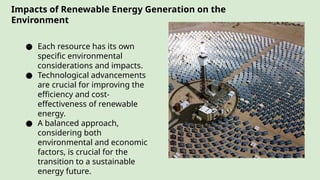
Impacts of Renewable Energy Generation on the
Environment
● Each resource has its own
specific environmental
considerations and impacts.
● Technological advancements
are crucial for improving the
efficiency and cost-
effectiveness of renewable
energy.
● A balanced approach,
considering both
environmental and economic
factors, is crucial for the
transition to a sustainable
energy future.
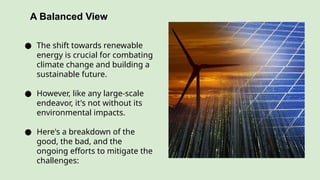
A Balanced View
● The shift towards renewable
energy is crucial for combating
climate change and building a
sustainable future.
● However, like any large-scale
endeavor, it's not without its
environmental impacts.
● Here's a breakdown of the
good, the bad, and the
ongoing efforts to mitigate the
challenges:
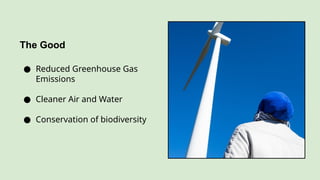
The Good
● Reduced Greenhouse Gas
Emissions
● Cleaner Air and Water
● Conservation of biodiversity
Reduced Greenhouse Gas Emissions
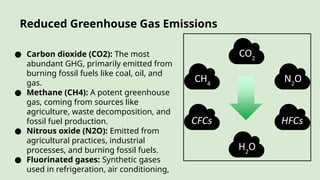
● Carbon dioxide (CO2): The most
abundant GHG, primarily emitted from
burning fossil fuels like coal, oil, and
gas.
● Methane (CH4): A potent greenhouse
gas, coming from sources like
agriculture, waste decomposition, and
fossil fuel production.
● Nitrous oxide (N2O): Emitted from
agricultural practices, industrial
processes, and burning fossil fuels.
● Fluorinated gases: Synthetic gases
used in refrigeration, air conditioning,
Cleaner Air and Water And Conservation of
Biodiversity
● Air: No more coughing! Clean energy like solar
and wind power don't make the air dirty like coal
and gas, so everyone (even plants and animals)
can breathe easier.
● Water: Sparkling rivers and streams! Unlike dirty
coal plants, most clean energy doesn't use much
water or make it messy. This means healthier
fish, cleaner drinking water, and less harm to
rivers and lakes.
● Biodiversity: More friends to play with! Careful
use of clean energy can even help protect
animal homes and create new ones, making the
world more colorful and exciting.
The Other Face of Renewable energy
Renewable Energy can also cause adverse effect on environment, let
us understand in detail about such impacts
Hydro – The Giant among Renewables Leading to Giant Floods
Hydropower dominates the global renewable energy market. Hydropower does not cause any air
quality impact directly; however, building and operating a hydroelectric reservoir can lead to
several harmful impacts on the environment. The dams constructed for harnessing hydropower
tend to greatly influence the flow of rivers, which can alter ecosystems and negatively impact
wildlife and people.
The most negative impact of this giant among the renewables is the flooding of an area. When the
water stored within the dam is released all at once, it can cause the river downstream to suddenly
flood. This can result in the destruction of agricultural land, forest, wildlife, and land. For example,
the Dhauliganga hydroelectric station in India, in 2013, led to unprecedented flash floods causing
Wind - It belongs to the Birds and Bats as Well
A report from the Joint Research Centre (JRC) states
that in 2014, wind energy provided 8% electricity to
Europe. This figure is expected to grow to 12% by
2020. Wind has a substantial share in the global
renewable energy market, and an appreciable
number of wind farms are to be constructed
worldwide in the coming few years. However, the
wind power sector has fallen under intense scrutiny
in the past few years due to its impact on birds and
other species.
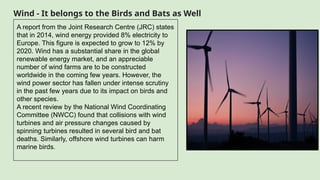
A recent review by the National Wind Coordinating
Committee (NWCC) found that collisions with wind
turbines and air pressure changes caused by
spinning turbines resulted in several bird and bat
deaths. Similarly, offshore wind turbines can harm
marine birds.
Solar – What about the Soil Erosion?
The sun is a tremendous source of
renewable energy. Nevertheless, the
adverse effects of solar power are
associated with land use, water use, habitat
loss, and the harmful materials used in
manufacturing of solar panels.
To build a utility-scale solar power facility, a
large area of land is required. This can
interfere with the existing land uses. The
use of many acres of land can result in
clearing and grading of land, which can
cause soil compaction, erosion, and
alteration of drainage channels.
Furthermore, solar energy systems can
impact the land in the process of materials
extraction, exploration, manufacturing, and
disposal.
Bioenergy – It is not really Green.
Some of the biomass resources used for
producing electricity are crops, forest
products, agricultural waste, and urban
waste. The bioenergy feedstock and the
way it is harvested can negatively impact
land use along with global warming
emissions. For example, human and animal
waste used to power engines may cut down
on carbon emissions, but increase harmful
methane emission.
Furthermore, using tree or tree products to
create bioenergy comes with its own set of
problems. To collect enough lumber,
substantial forest land needs to be cleared,
which again causes topical changes and
destroys animal habitat.
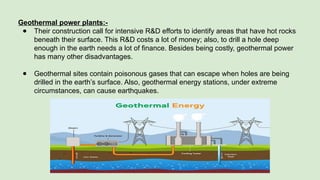
Geothermal power plants:-
● Their construction call for intensive R&D efforts to identify areas that have hot rocks
beneath their surface. This R&D costs a lot of money; also, to drill a hole deep
enough in the earth needs a lot of finance. Besides being costly, geothermal power
has many other disadvantages.
● Geothermal sites contain poisonous gases that can escape when holes are being
drilled in the earth’s surface. Also, geothermal energy stations, under extreme
circumstances, can cause earthquakes.
This shows how renewables can negatively impact the planet. However,
renewables are making a notable difference in the world as they are helping to
curb carbon emissions. What scientists, engineers, companies, and nations
expanding their power capacities need to focus on, is implementing solutions
that keep negative impacts of renewables in check. For example, instead of
building solar power stations by clearing a piece of land, homes and buildings
can be equipped with individual solar panels on a large scale.

Hybrid Energy Technology - EE3033.pptx

  • 1.
    Hybrid Energy Technology Impactsof Renewable Energy Generation on the Environment EE 3033 By : Tamilvendhan S &
  • 2.
    Difference between Renewableand Non Renewable Energy Feature Renewable Resources Non-Renewable Resources Renewability Replenished naturally over a short period Finite, cannot be replenished quickly Examples Sunlight, wind, water, biomass, geothermal heat Fossil fuels (coal, oil, gas), minerals (metals, rare earths) Environmental Impact Generally lower, minimal emissions High, significant greenhouse gas emissions & pollution Availability Widely distributed, varies by location Geographically concentrated, limited availability Cost Declining costs with technological advancements, high upfront infrastructure costs Established technologies, cost fluctuates with demand & geopolitics Sustainability Sustainable in the long term Unsustainable due to depletion and environmental impact
  • 3.
    Impacts of RenewableEnergy Generation on the Environment ● Each resource has its own specific environmental considerations and impacts. ● Technological advancements are crucial for improving the efficiency and cost- effectiveness of renewable energy. ● A balanced approach, considering both environmental and economic factors, is crucial for the transition to a sustainable energy future.
  • 4.
    A Balanced View ●The shift towards renewable energy is crucial for combating climate change and building a sustainable future. ● However, like any large-scale endeavor, it's not without its environmental impacts. ● Here's a breakdown of the good, the bad, and the ongoing efforts to mitigate the challenges:
  • 5.
    The Good ● ReducedGreenhouse Gas Emissions ● Cleaner Air and Water ● Conservation of biodiversity
  • 6.
    Reduced Greenhouse GasEmissions ● Carbon dioxide (CO2): The most abundant GHG, primarily emitted from burning fossil fuels like coal, oil, and gas. ● Methane (CH4): A potent greenhouse gas, coming from sources like agriculture, waste decomposition, and fossil fuel production. ● Nitrous oxide (N2O): Emitted from agricultural practices, industrial processes, and burning fossil fuels. ● Fluorinated gases: Synthetic gases used in refrigeration, air conditioning,
  • 7.
    Cleaner Air andWater And Conservation of Biodiversity ● Air: No more coughing! Clean energy like solar and wind power don't make the air dirty like coal and gas, so everyone (even plants and animals) can breathe easier. ● Water: Sparkling rivers and streams! Unlike dirty coal plants, most clean energy doesn't use much water or make it messy. This means healthier fish, cleaner drinking water, and less harm to rivers and lakes. ● Biodiversity: More friends to play with! Careful use of clean energy can even help protect animal homes and create new ones, making the world more colorful and exciting.
  • 8.
    The Other Faceof Renewable energy Renewable Energy can also cause adverse effect on environment, let us understand in detail about such impacts Hydro – The Giant among Renewables Leading to Giant Floods Hydropower dominates the global renewable energy market. Hydropower does not cause any air quality impact directly; however, building and operating a hydroelectric reservoir can lead to several harmful impacts on the environment. The dams constructed for harnessing hydropower tend to greatly influence the flow of rivers, which can alter ecosystems and negatively impact wildlife and people. The most negative impact of this giant among the renewables is the flooding of an area. When the water stored within the dam is released all at once, it can cause the river downstream to suddenly flood. This can result in the destruction of agricultural land, forest, wildlife, and land. For example, the Dhauliganga hydroelectric station in India, in 2013, led to unprecedented flash floods causing
  • 9.
    Wind - Itbelongs to the Birds and Bats as Well A report from the Joint Research Centre (JRC) states that in 2014, wind energy provided 8% electricity to Europe. This figure is expected to grow to 12% by 2020. Wind has a substantial share in the global renewable energy market, and an appreciable number of wind farms are to be constructed worldwide in the coming few years. However, the wind power sector has fallen under intense scrutiny in the past few years due to its impact on birds and other species. A recent review by the National Wind Coordinating Committee (NWCC) found that collisions with wind turbines and air pressure changes caused by spinning turbines resulted in several bird and bat deaths. Similarly, offshore wind turbines can harm marine birds.
  • 10.
    Solar – Whatabout the Soil Erosion? The sun is a tremendous source of renewable energy. Nevertheless, the adverse effects of solar power are associated with land use, water use, habitat loss, and the harmful materials used in manufacturing of solar panels. To build a utility-scale solar power facility, a large area of land is required. This can interfere with the existing land uses. The use of many acres of land can result in clearing and grading of land, which can cause soil compaction, erosion, and alteration of drainage channels. Furthermore, solar energy systems can impact the land in the process of materials extraction, exploration, manufacturing, and disposal. Bioenergy – It is not really Green. Some of the biomass resources used for producing electricity are crops, forest products, agricultural waste, and urban waste. The bioenergy feedstock and the way it is harvested can negatively impact land use along with global warming emissions. For example, human and animal waste used to power engines may cut down on carbon emissions, but increase harmful methane emission. Furthermore, using tree or tree products to create bioenergy comes with its own set of problems. To collect enough lumber, substantial forest land needs to be cleared, which again causes topical changes and destroys animal habitat.
  • 11.
    Geothermal power plants:- ●Their construction call for intensive R&D efforts to identify areas that have hot rocks beneath their surface. This R&D costs a lot of money; also, to drill a hole deep enough in the earth needs a lot of finance. Besides being costly, geothermal power has many other disadvantages. ● Geothermal sites contain poisonous gases that can escape when holes are being drilled in the earth’s surface. Also, geothermal energy stations, under extreme circumstances, can cause earthquakes.
  • 12.
    This shows howrenewables can negatively impact the planet. However, renewables are making a notable difference in the world as they are helping to curb carbon emissions. What scientists, engineers, companies, and nations expanding their power capacities need to focus on, is implementing solutions that keep negative impacts of renewables in check. For example, instead of building solar power stations by clearing a piece of land, homes and buildings can be equipped with individual solar panels on a large scale.