Journal of Enterprise Information Management
Is business process integration feasible?
Marinos Themistocleous Gail Corbitt
Article information:
To cite this document:
Marinos Themistocleous Gail Corbitt, (2006),"Is business process integration feasible?", Journal of
Enterprise Information Management, Vol. 19 Iss 4 pp. 434 - 449
Permanent link to this document:
http://dx.doi.org/10.1108/17410390610678340
Downloaded on: 27 February 2015, At: 04:32 (PT)
References: this document contains references to 29 other documents.
To copy this document: permissions@emeraldinsight.com
The fulltext of this document has been downloaded 2090 times since 2006*
Users who downloaded this article also downloaded:
Michael A. Abebe, (2007),"To integrate or not to integrate: factors affecting the adoption of virtual
integration strategy in organizations", Business Strategy Series, Vol. 8 Iss 3 pp. 196-202 http://
dx.doi.org/10.1108/17515630710684196
Christer Karlsson, Margaret Taylor, Andrew Taylor, (2010),"Integrating new technology in established
organizations: A mapping of integration mechanisms", International Journal of Operations &
Production Management, Vol. 30 Iss 7 pp. 672-699 http://dx.doi.org/10.1108/01443571011057290
Thomas Gulledge, (2006),"What is integration?", Industrial Management & Data Systems, Vol. 106 Iss
1 pp. 5-20 http://dx.doi.org/10.1108/02635570610640979
Access to this document was granted through an Emerald subscription provided by 552352 []
For Authors
If you would like to write for this, or any other Emerald publication, then please use our Emerald for
Authors service information about how to choose which publication to write for and submission guidelines
are available for all. Please visit www.emeraldinsight.com/authors for more information.
About Emerald www.emeraldinsight.com
Emerald is a global publisher linking research and practice to the benefit of society. The company
manages a portfolio of more than 290 journals and over 2,350 books and book series volumes, as well as
providing an extensive range of online products and additional customer resources and services.
Emerald is both COUNTER 4 and TRANSFER compliant. The organization is a partner of the Committee
on Publication Ethics (COPE) and also works with Portico and the LOCKSS initiative for digital archive
preservation.
*Related content and download information correct at time of download.
DownloadedbyWaldenUniversityAt04:3227February2015(PT)
Is business process integration
feasible?
Marinos Themistocleous
Brunel University, London, UK, and
Gail Corbitt
California State University, Chico, California, USA
Abstract
Purpose – The purpose of this paper is to investigate whether business process integration is
feasible.
Design/methodology/approach – This paper employs a single case study strategy to research the
aforementioned research question. The case study is exploratory.
Findings – Based on the findings and within the context of the case organisation, it appears that
enterprise application integration (EAI) technology can integrate business processes. However, since it
is not possible to generalize from a single case study, further research is suggested to investigate this
area. From the case study, it appears that EAI can easily integrate the business processes when it is
combined with enterprise resource planning (ERP) systems.
Research limitations/implications – This is a single case study and thus the results cannot be
generalized.
Practical implications – The empirical date suggest that organisations may combine ERP with
EAI to integrate their business processes in a more flexible way.
Originality/value – The contribution of the paper is threefold: it describes the business process
automation layer of EAI technology, it defines and presents a stage model for the business process
integration and it examines the research question.
Keywords Integration, Manufacturing resource planning
Paper type Case study
1. Introduction
The continuously changing nature in the business arena has led organisations to seek
ways to improve their performance and increase their profits. Managers have been
thinking about business process change, integration and improvement for several
decades. According to Harrington (1991) enterprises have turned to business process
improvement (BPI) for many reasons as it supports organisations to:
.
focus on their customers;
.
keep the business’s focus on processes; and
.
provide a method to prepare organisations to meet their future challenges.
Davenport (1993) suggested that significant improvements can be achieved when
organisations integrate and automate their processes at both enterprise and
cross-enterprise levels. In doing so, organisations could coordinate the development
of common business processes and IT infrastructures which better support business
goals and vision. Improvements on existing processes often require changes in the
organisational structure and/or the IT architecture. However, the transition to a
The current issue and full text archive of this journal is available at
www.emeraldinsight.com/1741-0398.htm
JEIM
19,4
434
Journal of Enterprise Information
Management
Vol. 19 No. 4, 2006
pp. 434-449
q Emerald Group Publishing Limited
1741-0398
DOI 10.1108/17410390610678340
DownloadedbyWaldenUniversityAt04:3227February2015(PT)
process-centric organisation is not an easy task. Significant problems appear with
organisations needing to address issues like:
(1) control;
(2) ownership;
(3) structure;
(4) culture; and
(5) responsibility (Hammer and Champy, 1993).
The idea of an integrated system, however, is not new. In 1965, Anthony described
three levels of information planning and control:
(1) a strategic level;
(2) a management control level; and
(3) an operational level.
The strategic level used information to guide the objectives and policy of the
organization. The management control level allowed for efficient and effective
allocation of resources to meet the organization’s objectives, and the operational level
essentially ran the day-to-day activities of the business (Anthony, 1965). A few years
later, Head (1967) articulated that this integrated information system (IS) needed to use
an organizational database that created, maintained, accessed and used different kinds
of data elements floating around. This is no doubt the beginning of conceptual
enterprise resource planning (ERP) systems.
Organisations shifted to the adoption of ERP technology to implement an integrated
IT infrastructure which automated a number of their business processes. ERP systems
are based on a set of internally integrated modules that support generic business
processes. In many cases, companies have replaced their existing software solutions
with ERP systems and managed to integrate their business processes. However, the
ERP approach has its limitations especially in those cases where ERP systems co-exist
alongside other software solutions. In addition to this, ERP systems have their own
philosophy for business process automation and integration. ERP limitations have
been well investigated in literature with Themistocleous et al. (2001) reporting that
ERP systems are a partial solution to the automation and integration of business
processes and IS.
In recent years, organisations have turned to enterprise application integration
(EAI) technology to integrate their systems and processes in a more flexible and
maintainable way (Zahavi, 1999). EAI is based on a set of integration technologies like
message brokers, ebXML and application servers that allow organisations to
incorporate functionality from disparate systems (Ruh et al., 2000). EAI has been
designed to support the integration of systems and processes at intra- and
inter-organisational level.
In this paper, the authors investigate approaches to business process automation
and integration. This paper is exploratory in nature and uses a case study method to
gather data related to the implementation of an EAI solution. The basic research
question addressed is: is business process integration really feasible if an EAI solution
Business process
integration
435
DownloadedbyWaldenUniversityAt04:3227February2015(PT)
is used. In answering this question, Section 2 summarizes the basic search for BPI via
legacy technologies. Thereafter, Section 3:
.
explains how EAI offers another BPI alternative to traditional approaches
(including ERP); and
.
presents EAI perspectives to the integration of ISs and processes.
Sections 4 and 5 describe a basic case study approach and investigates the EAI
approach through a real life case study with the remaining section discussing and
summarising the main findings of this research.
2. ERP systems and their route to business processes integration
For as long as software has been developed the goal has been to create systems that
support business requirements and processes. Numerous methods of systems analysis
and design, programming languages and integrated application suites such as MRP,
MRP II and most recently, ERP have been developed that include more and more
functionality required by business. Improvements in the technical infrastructure allow
for larger and more comprehensive systems but it seems that the systems are never a
perfect fit with organizations (Schulz, 2001).
So while the concept of ERP has been around for at least 40 years the infrastructure
technologies to deploy and support the concept of a truly integrated system did not
make the solution feasible until the late 1980s/early 1990s. The underlying database
and network technologies were not large enough or fast enough to accommodate the
data requirements of the software supporting integrated business processes used
throughout organizations. MRP and MRP II system solutions were certainly
forerunners to ERP systems which added more and more functionality with each new
release.
In implementing ERP systems, companies were faced with two approaches for
making the system support existing business processes:
(1) to change the software to fit the organization; or
(2) to change the organization to fit the process.
While in early implementations some companies did change the software provided by
the vendor to fit the business, most companies decided to change the organization and
keep the ERP system software delivered by the vendor unchanged. In fact, Forrester
reports that only about 5 per cent of the Fortune 1,000 changed the software (Lee et al.,
2003). Similarly, Davenport et al. (2002) reported that 75 per cent of the companies
implementing ERP had moderate to significant business process change and
modification. Another strategy to ERP implementations was the “best of breed”
approach, in which enterprises combined ERP modules from different vendors to meet
their goals.
In order to make the ERP system delivered fit as many variations in business
process as possible, each ERP vendor supplies multiple business process scenarios to
choose from. Companies then configure the system to fit their individual business. For
example, SAP’s R/3 has at least eight different ways that sales orders can be processed
and a company can choose as many of these processes as it wants to fit the business
processes actually used in the company. In addition, each vendor has ways that the
JEIM
19,4
436
DownloadedbyWaldenUniversityAt04:3227February2015(PT)
company can configure and change the software to fit unique situations within each
process. For example, SAP offers customers user and formula exits as ways to include
custom code within the system and JD Edwards allows for variable data elements that
are customer defined.
Yet companies still find gaps in fit between the ERP and the process requirements
of the business. Only 3 per cent of the companies in the Accenture study did no
customization to the ERP software system (Davenport et al., 2002), leaving 97 per cent
that had minimal to highly customized solutions. Furthermore, the companies in this
study were planning to expand the use of ERP within the organization, add new
systems such as CRM, supply chain, etc. Experiment with web services and
consolidate the multiple instances of ERP systems running in the company. All of these
things require not only technical integration but business process integration. The
latter may require enormous amount of change and according to Lee et al.(2003) the
behavioural integration is the biggest challenge in this case.
3. Enterprise application integration and business process integration
On the surface, EAI appears to be the answer to BPI by giving companies a third
choice; instead of having to change the organization or the software to make the
system(s) fit the organization’s processes, EAI promises to leave the organization and
systems in tact by offering a bridge between the two. In other words, EAI responds to
this need to support the flexible integration of business process and systems. EAI is an
emerging generation of integration software that effectively addresses the need to
integrate both intra- and inter-organisational systems. It securely incorporates
functionality from disparate applications by combining traditional middleware
technologies (e.g. MOM) with new EAI software (e.g. adapters, message brokers,.net)
(Linthicum, 1999, 2000; Serain, 1999). Thus, application integration results in
supporting data, objects and processes incorporation. In doing so, EAI integrates
different types of software like custom applications, packaged systems and e-business
solutions. However, the key to success is still the degree to which the business process
is supported seamlessly both from technical and behavioural perspectives (Lee et al.,
2003).
3.1 Integrating business processes through EAI: strategic and opportunistic approaches
Carrier (1999) differentiates two kinds of integration purposes namely data centric and
process centric. Data centric integration is defined by Carrier (1999) as the automation
and integration of data flows that are exchanged between ISs. It does not, however,
focus on improving and reengineering business processes. Data centric integration
results in shortening the time cycle of business processes, however, if the processes are
poorly designed or include errors, the data centric integration simply increases the
frequency of occurrence of these errors. One of the purposes of data centric integration
is to create mappings between data exchanged among disparate systems, to facilitate
data exchange and manipulation among systems. Based on this type of integration,
organisations increase their functionality and performance as IT becomes capable of
processing and combining data from various applications. This integration
significantly reduces manual integration in processes (e.g. manual data mapping
and formatting). For instance, electronic data interchange (EDI) supports data centric
integration and allows automatic data mapping, transmission and processing from
Business process
integration
437
DownloadedbyWaldenUniversityAt04:3227February2015(PT)
source application format to target using an EDI standard (e.g. EDIFACT). More
advanced EAI technologies that support data centric integration mechanisms include
message brokers and adapters (Ring and Ward-Dutton, 1999; Themistocleous and
Irani, 2001). When EAI technology is adopted, adapters are frequently used to map
data between applications or provide the libraries for formatting data in the right
format. Also, message brokers can be used to receive, format and distribute
appropriate data sets to target applications based on business logic and rules.
Process centric integration deals with the automation of business processes by
integrating functionality from disparate applications. According to Linthicum (1999,
2000) and Morgenthal and La Forge (2000) process integration is the highest level of
integration possible, as it requires the collaboration and incorporation of all involved
systems at all levels (e.g. data, components, interfaces and messages integration, etc.).
Although, process integration pieces together data and applications, it does not
mean that data centric integration achieves process incorporation. In some cases data
centric integration may result in process integration (e.g. the data integration of an
electronic ordering application with a back-office system may result in order process
integration) but this is not a fixed rule. For example, the integration of a database with
a decision-making system enriches the functionality of the system by providing more
integrated data but, it may not result in integrating and automating the
decision-making process.
Themistocleous and Irani (2001) found that organisations followed one of two
different approaches when introducing application integration solutions. These
strategies are labelled strategic or the opportunistic application of EAI. In the strategic
approach to EAI, companies implement an alternative business strategy that focuses
on an integrated model (e.g. develop a global integrated infrastructure instead of
having several independent infrastructures). In doing so, they make all the appropriate
changes to their IT infrastructure and redesign all their business processes to support
this strategy. This approach is also supported by Brown (2000), Kalakota and
Robinson (1999) and Linthicum (2000). All these authors suggest that organisations
redesign their business processes and IT infrastructure to develop an integrated IT
infrastructure that will allow them to take advantage of EAI technology. The strategic
EAI approach is defined as a process centric integration as enterprise wide and/or
cross enterprise integration which requires the redesign, automation and incorporation
of business processes.
Yet, some companies adopt application integration solutions to solve their
organisational problems and do not design an enterprise or cross-enterprise wide
integrated infrastructure. They adopt EAI to overcome point problems. This is the
opportunistic approach. Edwards and Newing (2000) reported that British Airways
faced problems in understanding and analysing market place and customer needs. The
business information infrastructure consisted of heterogeneous systems that stored
huge quantities of data. Nonetheless, data were not consistent and the systems could
not combine or produce the information needed for decision making. As a result,
British Airways took the decision not to integrate the whole organisation but to
integrate all data sources needed for supporting decision making. In this case, the
organisation did limited business process reengineering to piece together all these data
sources. Hence, it can be said that British Airways followed an opportunistic EAI
approach that was based on data centric integration. As a result, the authors observe
JEIM
19,4
438
DownloadedbyWaldenUniversityAt04:3227February2015(PT)
that opportunistic EAI adoption may follow either process centric or data centric
integration, depending on the point problem being solved.
3.2 Bridging the technical and behavioural aspects of EAI process integration
The purpose of this paper is not to describe and explain EAI technology. Numerous
papers have been published in the normative literature that discuss:
.
the nature of EAI (Linthicum, 1999; Ruh et al., 2000);
.
its benefits and barriers (Themistocleous and Irani, 2001); and
.
case studies on EAI (Edwards and Newing, 2000; Puschmann and Alt, 2001).
The aim of this paper is to move a step forward and to investigate for first time the
following research question:
RQ1. Is business process integration feasible through EAI technology?
From a technical perspective, Themistocleous (2002) proposes that EAI is achieved at
four integration layers. This approach extends previous publications by
Themistocleous et al. (2000, 2002) who originally proposed three integration layers.
Although, Themistocleous et al. (2000, 2002) highlighted the existence of points of
access between the incorporated applications they did not consider these another
integration layer. However, Themistocleous (2002) pointed out the importance of
adding a new layer entitled connectivity. The importance of such a layer has been
validated through a series of case studies. Evidence from these cases have shown that
enterprises evaluate EAI packages using many criteria including integration layers
(Themistocleous and Irani, 2003). It is, therefore, important for organisations to select
an EAI package that supports the connectivity of their applications with the
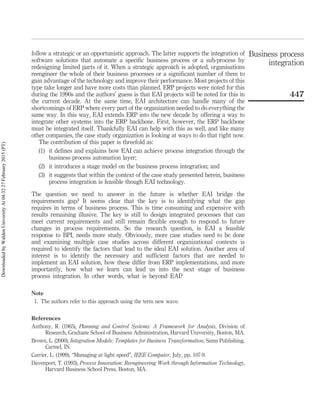
integration infrastructure. The four integration layers are the following:
(1) Connectivity layer – that creates common points of access among the
interconnected applications and the integration infrastructure.
(2) Transportation layer – which transfers the information from source application
to the integration infrastructure and from the latter to the target application.
(3) Transformation layer – that translates the information from source application
format to target system structure.
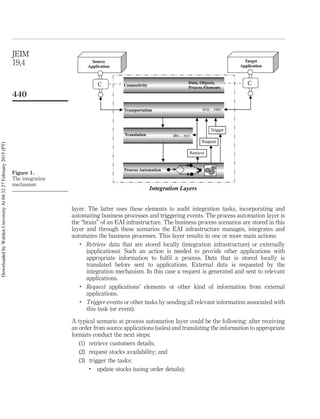
(4) Process automation layer – which integrates the business processes, manages
and controls the integration mechanism. This is shown in Figure 1.
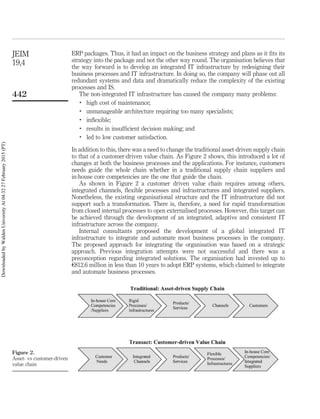
Figure 1 shows the incorporation of two ISs (source and target application) when EAI
is used. Source and target applications are integrated by exchanging their application
elements, which include data, objects and processes. Application elements are
transferred from source application to the target through the integration infrastructure
using the transportation layer. Meanwhile, application elements are translated from
source application structure to target application format using the translation layer.
The reason for using this layer is that source and target applications are not based on
the same structures (e.g. data structure) or platform. Thus, translation is required to
transform data into compatible format for target application. At a higher level,
elements that are used for the integration of processes or the integrity of information
(e.g. services, business logic, rules, constrains) are transferred to process automation
Business process
integration
439
DownloadedbyWaldenUniversityAt04:3227February2015(PT)
layer. The latter uses these elements to audit integration tasks, incorporating and
automating business processes and triggering events. The process automation layer is
the “brain” of an EAI infrastructure. The business process scenarios are stored in this
layer and through these scenarios the EAI infrastructure manages, integrates and
automates the business processes. This layer results in one or more main actions:
.
Retrieve data that are stored locally (integration infrastructure) or externally
(applications). Such an action is needed to provide other applications with
appropriate information to fulfil a process. Data that is stored locally is
translated before sent to applications. External data is requested by the
integration mechanism. In this case a request is generated and sent to relevant
applications.
.
Request applications’ elements or other kind of information from external
applications.
.
Trigger events or other tasks by sending all relevant information associated with
this task (or event).
A typical scenario at process automation layer could be the following: after receiving
an order from source applications (sales) and translating the information to appropriate
formats conduct the next steps:
(1) retrieve customers details;
(2) request stocks availability; and
(3) trigger the tasks:
.
update stocks (using order details);
Figure 1.
The integration
mechanism
JEIM
19,4
440
DownloadedbyWaldenUniversityAt04:3227February2015(PT)
.
update customer record (using customer id, order details);
.
invoicing customer (using customer id, order details);
.
update delivery services (using customer id, order details); and
.
place an order to supplier (in case of out of stock).
4. Methodology
ISs research has been plagued with difficulty in terms of studying things objectively.
As technologies become more complex and more interwoven into corporate
environments research methods like surveys, field experiments, and more
statistically oriented studies become harder and harder to do. By necessity it is
difficult to separate the issues being studied, like feasibility of EAI, from its context.
Therefore, because EAI technology is relatively new, embedded within its context and
highly complex, a case study approach to examine the feasibility of using EAI to
achieve true process integration is reasonable. While using multiple case studies is also
desirable not enough is known about all the factors that can influence EAI feasibility to
structure a study involving multiple companies at this time. This study is thus
exploratory and involves a single case at this time. In this case, the authors chose a
company that had ERP experience so that an EAI approach can be examined within
the context of traditional approaches to BPI. The observations within the context of
this company are to examine the technical solution and see if the process layers are
adequate to make BPI possible. Is the promise of EAI fulfilled in this case?
5. An exemplar case
The company under consideration is a multinational company that operates in more
than 135 countries and with more than 100,000 employees worldwide. During the last
decade, the tremendous changes in the global business arena led the company to adopt
e-business practices and applications (e.g. e-supply chain management) to gain
competitive advantages. However, the adoption of e-business applications was not
enough to allow the company to achieve its targets. The reason for this is that the
rapidly changing business environment, requires organisations to support flexible and
manageable IT infrastructures to gain competitive advantages. In this context, the
company recognised that integration was a significant parameter which influenced the
success of its e-business applications and supported the organisation in achieving a
competitive advantage. Traditional approaches to inter-organisational integration
such as EDI have proved insufficient and complex for the company.
Other approaches to integration such as ERP systems have failed to support the
company’s intra- and inter-organisational integration, since they co-exist alongside
other applications. The fragmentation in ERP implementations across the company is
a constraint for successful e-business transformation. The reason for this is that, there
are up to 90 ERP implementations at the organisation. Many of them run over
mainframes or they do not support real-time capabilities. In addition, there are many
compatibility problems among ERP systems (e.g. they do not support the same data
formats or they were customised in a different way). Thus, the co-ordination of all these
systems under an e-business umbrella that requires real-time data is an obstacle.
When the company adopted ERP solutions it was forced to alter many of its
business processes to adapt them to the ERP package philosophy. An interpretation of
this is that the company came across many difficulties regarding the customisation of
Business process
integration
441
DownloadedbyWaldenUniversityAt04:3227February2015(PT)
ERP packages. Thus, it had an impact on the business strategy and plans as it fits its
strategy into the package and not the other way round. The organisation believes that
the way forward is to develop an integrated IT infrastructure by redesigning their
business processes and IT infrastructure. In doing so, the company will phase out all
redundant systems and data and dramatically reduce the complexity of the existing
processes and IS.
The non-integrated IT infrastructure has caused the company many problems:
.
high cost of maintenance;
.
unmanageable architecture requiring too many specialists;
.
inflexible;
.
results in insufficient decision making; and
.
led to low customer satisfaction.
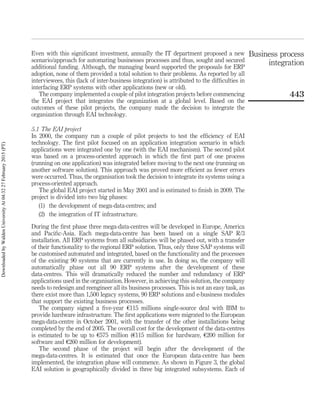
In addition to this, there was a need to change the traditional asset-driven supply chain
to that of a customer-driven value chain. As Figure 2 shows, this introduced a lot of
changes at both the business processes and the applications. For instance, customers
needs guide the whole chain whether in a traditional supply chain suppliers and
in-house core competencies are the one that guide the chain.
As shown in Figure 2 a customer driven value chain requires among others,
integrated channels, flexible processes and infrastructures and integrated suppliers.
Nonetheless, the existing organisational structure and the IT infrastructure did not
support such a transformation. There is, therefore, a need for rapid transformation
from closed internal processes to open externalised processes. However, this target can
be achieved through the development of an integrated, adaptive and consistent IT
infrastructure across the company.
Internal consultants proposed the development of a global integrated IT
infrastructure to integrate and automate most business processes in the company.
The proposed approach for integrating the organisation was based on a strategic
approach. Previous integration attempts were not successful and there was a
preconception regarding integrated solutions. The organisation had invested up to
e812.6 million in less than 10 years to adopt ERP systems, which claimed to integrate
and automate business processes.
Figure 2.
Asset- vs customer-driven
value chain
JEIM
19,4
442
DownloadedbyWaldenUniversityAt04:3227February2015(PT)
Even with this significant investment, annually the IT department proposed a new
scenario/approach for automating businesses processes and thus, sought and secured
additional funding. Although, the managing board supported the proposals for ERP
adoption, none of them provided a total solution to their problems. As reported by all
interviewees, this (lack of inter-business integration) is attributed to the difficulties in
interfacing ERP systems with other applications (new or old).
The company implemented a couple of pilot integration projects before commencing
the EAI project that integrates the organization at a global level. Based on the
outcomes of these pilot projects, the company made the decision to integrate the
organization through EAI technology.
5.1 The EAI project
In 2000, the company run a couple of pilot projects to test the efficiency of EAI
technology. The first pilot focused on an application integration scenario in which
applications were integrated one by one (with the EAI mechanism). The second pilot
was based on a process-oriented approach in which the first part of one process
(running on one application) was integrated before moving to the next one (running on
another software solution). This approach was proved more efficient as fewer errors
were occurred. Thus, the organisation took the decision to integrate its systems using a
process-oriented approach.
The global EAI project started in May 2001 and is estimated to finish in 2009. The
project is divided into two big phases:
(1) the development of mega-data-centres; and
(2) the integration of IT infrastructure.
During the first phase three mega-data-centres will be developed in Europe, America
and Pacific-Asia. Each mega-data-centre has been based on a single SAP R/3
installation. All ERP systems from all subsidiaries will be phased out, with a transfer
of their functionality to the regional ERP solution. Thus, only three SAP systems will
be customised automated and integrated, based on the functionality and the processes
of the existing 90 systems that are currently in use. In doing so, the company will
automatically phase out all 90 ERP systems after the development of these
data-centres. This will dramatically reduced the number and redundancy of ERP
applications used in the organisation. However, in achieving this solution, the company
needs to redesign and reengineer all its business processes. This is not an easy task, as
there exist more than 1,500 legacy systems, 90 ERP solutions and e-business modules
that support the existing business processes.
The company signed a five-year e115 millions single-source deal with IBM to
provide hardware infrastructure. The first applications were migrated to the European
mega-data-centre in October 2001, with the transfer of the other installations being
completed by the end of 2005. The overall cost for the development of the data-centres
is estimated to be up to e575 million (e115 million for hardware, e200 million for
software and e260 million for development).
The second phase of the project will begin after the development of the
mega-data-centres. It is estimated that once the European data-centre has been
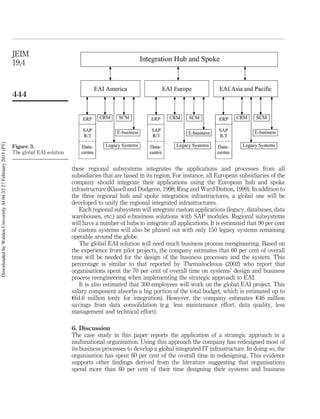
implemented, the integration phase will commence. As shown in Figure 3, the global
EAI solution is geographically divided in three big integrated subsystems. Each of
Business process
integration
443
DownloadedbyWaldenUniversityAt04:3227February2015(PT)
these regional subsystems integrates the applications and processes from all
subsidiaries that are based in its region. For instance, all European subsidiaries of the
company should integrate their applications using the European hub and spoke
infrastructure (Klasell and Dudgeon, 1998; Ring and Ward-Dutton, 1999). In addition to
the three regional hub and spoke integration infrastructures, a global one will be
developed to unify the regional integrated infrastructures.
Each regional subsystem will integrate custom applications (legacy, databases, data
warehouses, etc.) and e-business solutions with SAP modules. Regional subsystems
will have a number of hubs to integrate all applications. It is estimated that 90 per cent
of custom systems will also be phased out with only 150 legacy systems remaining
operable around the globe.
The global EAI solution will need much business process reengineering. Based on
the experience from pilot projects, the company estimates that 60 per cent of overall
time will be needed for the design of the business processes and the system. This
percentage is similar to that reported by Themistocleous (2002) who report that
organisations spent the 70 per cent of overall time on systems’ design and business
process reengineering when implementing the strategic approach to EAI.
It is also estimated that 300 employees will work on the global EAI project. This
salary component absorbs a big portion of the total budget, which is estimated up to
e64.6 million (only for integration). However, the company estimates e46 million
savings from data consolidation (e.g. less maintenance effort, data quality, less
management and technical effort).
6. Discussion
The case study in this paper reports the application of a strategic approach in a
multinational organisation. Using this approach the company has redesigned most of
its business processes to develop a global integrated IT infrastructure. In doing so, the
organisation has spent 60 per cent of the overall time in redesigning. This evidence
supports other findings derived from the literature suggesting that organisations
spend more than 60 per cent of their time designing their systems and business
Figure 3.
The global EAI solution
JEIM
19,4
444
DownloadedbyWaldenUniversityAt04:3227February2015(PT)
processes when they adopt a strategic approach of EAI technology. Evidences from
this case study show that a strategic adoption of EAI technology is not an easy task
and it takes time be achieved.
The company is taking on much bigger challenge to integrate processes across
multiple systems and environments. Unlike, the ERP approach, which requires
organisations to adapt their processes to the package philosophy, EAI efficiently,
supports the development of an integrated IT infrastructure that reflects the business
strategy and automates the business processes. It remains to be seen whether or not the
company will achieve the benefits proposed and what happens when the business
process change to respond to changes in the environments within which the company
operates.
The project has been run for more than 5 years now, and it is almost half-way to its
completion. During this period, the combination of the mega-data-centres with the EAI
infrastructure has been helpful. Owing to the high volume of data, the development of
the three mega-data-centres was proved extremely useful. Each of these data-centres is
based on an SAP R/3 implementation. The organisation was happy with the efficiency
and performance of many processes running on the ERP system. For that reason there
was no justification to re-engineer these processes. Thus, in practice the ERP system
has been emerged as one of the most important components of the integrated
architecture. This does not mean that the ERP solutions have replaced EAI but it
supported the integration of business processes. Since, all the data are stored in the
ERP system (data-centre), the EAI infrastructure makes better use of its resource to
integrate the processes. Also, some processes are internally integrated in ERP system
which further supports the performance of the integration mechanism.
The empirical data revealed that EAI achieves business process integration and,
therefore, the answer to the RQ1 is that within the context of this organisation,
business process integration was achieved through EAI technology. Since, the results
to this question are based on a single case study, they cannot be generalised. For that
reason more in depth research is required in this area to further investigate this
phenomenon. In the case study presented, EAI could achieve this integration without
any support from other applications. Nonetheless, it is worth noting that the
combination of ERP and EAI has resulted in a much more efficient and effective
infrastructure. To this end, it appears that there is a new way[1] to integrate business
processes based on the combination of EAI with ERP. Despite, the authors cannot
generalise this finding, the practice supports this evidence. For instance, recently SAP
has promoted a new software solution called NetWeaver which combines EAI
technology with SAP R/3 package to support better business process automation.
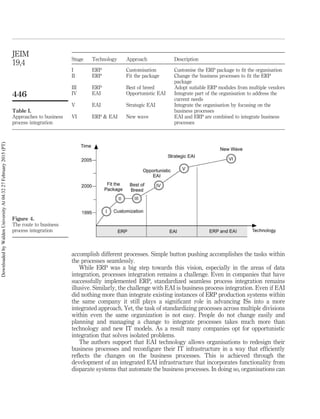
Table I summarises the approaches to business process integration and automation as
these derived from this section and Sections 2 and 3.1 as well. In addition to this, the
Figure 4 shows a stage model that explains the route to the business process
integration.
7. Conclusion and implications for future research
Since, 1965 the architects of corporate ISs envision a day when end-users can sit in
front of a computer and have access to any and all information and data required by
every process that they have a role. This end-user does not need to know where the
data are that he/she needs, nor do they need to log onto multiple systems in order to
Business process
integration
445
DownloadedbyWaldenUniversityAt04:3227February2015(PT)
accomplish different processes. Simple button pushing accomplishes the tasks within
the processes seamlessly.
While ERP was a big step towards this vision, especially in the areas of data
integration, processes integration remains a challenge. Even in companies that have
successfully implemented ERP, standardized seamless process integration remains
illusive. Similarly, the challenge with EAI is business process integration. Even if EAI
did nothing more than integrate existing instances of ERP production systems within
the same company it still plays a significant role in advancing ISs into a more
integrated approach. Yet, the task of standardizing processes across multiple divisions
within even the same organization is not easy. People do not change easily and
planning and managing a change to integrate processes takes much more than
technology and new IT models. As a result many companies opt for opportunistic
integration that solves isolated problems.
The authors support that EAI technology allows organisations to redesign their
business processes and reconfigure their IT infrastructure in a way that efficiently
reflects the changes on the business processes. This is achieved through the
development of an integrated EAI infrastructure that incorporates functionality from
disparate systems that automate the business processes. In doing so, organisations can
Figure 4.
The route to business
process integration
Stage Technology Approach Description
I ERP Customisation Customise the ERP package to fit the organisation
II ERP Fit the package Change the business processes to fit the ERP
package
III ERP Best of breed Adopt suitable ERP modules from multiple vendors
IV EAI Opportunistic EAI Integrate part of the organisation to address the
current needs
V EAI Strategic EAI Integrate the organisation by focusing on the
business processes
VI ERP & EAI New wave EAI and ERP are combined to integrate business
processes
Table I.
Approaches to business
process integration
JEIM
19,4
446
DownloadedbyWaldenUniversityAt04:3227February2015(PT)
follow a strategic or an opportunistic approach. The latter supports the integration of
software solutions that automate a specific business process or a sub-process by
redesigning limited parts of it. When a strategic approach is adopted, organisations
reengineer the whole of their business processes or a significant number of them to
gain advantage of the technology and improve their performance. Most projects of this
type take longer and have more costs than planned. ERP projects were noted for this
during the 1990s and the authors’ guess is that EAI projects will be noted for this in
the current decade. At the same time, EAI architecture can handle many of the
shortcomings of ERP where every part of the organization needed to do everything the
same way. In this way, EAI extends ERP into the new decade by offering a way to
integrate other systems into the ERP backbone. First, however, the ERP backbone
must be integrated itself. Thankfully EAI can help with this as well, and like many
other companies, the case study organization is looking at ways to do that right now.
The contribution of this paper is threefold as:
(1) it defines and explains how EAI can achieve process integration through the
business process automation layer;
(2) it introduces a stage model on the business process integration; and
(3) it suggests that within the context of the case study presented herein, business
process integration is feasible though EAI technology.
The question we need to answer in the future is whether EAI bridge the
requirements gap? It seems clear that the key is to identifying what the gap
requires in terms of business process. This is time consuming and expensive with
results remaining illusive. The key is still to design integrated processes that can
meet current requirements and still remain flexible enough to respond to future
changes in process requirements. So the research question, is EAI a feasible
response to BPI, needs more study. Obviously, more case studies need to be done
and examining multiple case studies across different organizational contexts is
required to identify the factors that lead to the ideal EAI solution. Another area of
interest is to identify the necessary and sufficient factors that are needed to
implement an EAI solution, how these differ from ERP implementations, and more
importantly, how what we learn can lead us into the next stage of business
process integration. In other words, what is beyond EAI?
Note
1. The authors refer to this approach using the term new wave.
References
Anthony, R. (1965), Planning and Control Systems: A Framework for Analysis, Division of
Research, Graduate School of Business Administration, Harvard University, Boston, MA.
Brown, L. (2000), Integration Models: Templates for Business Transformation, Sams Publishing,
Carmel, IN.
Carrier, L. (1999), “Managing at light speed”, IEEE Computer, July, pp. 107-9.
Davenport, T. (1993), Process Innovation: Reengineering Work through Information Technology,
Harvard Business School Press, Boston, MA.
Business process
integration
447
DownloadedbyWaldenUniversityAt04:3227February2015(PT)
Davenport, T.H., Harris, J. and Cantrell, S. (2002), The Return of Enterprise Solutions: The
Director’s Cut, Accenture, Cambridge, MA.
Edwards, P. and Newing, R. (2000), Application Integration for e-Business, Business Intelligence,
London.
Hammer, M. and Champy, J. (1993), Reengineering the Corporation: A Manifesto for Business
Revolution, Harper Collins, New York, NY.
Harrington, H. (1991), Business Process Improvement, McGraw-Hill, New York, NY.
Head, R. (1967), “Management information systems: a critical appraisal”, Datamation, Vol. 13
No. 5, pp. 22-7.
Kalakota, R. and Robinson, M. (1999), e-Business: Roadmap for Success, Addison-Wesley,
Boston, MA.
Klasell, T. and Dudgeon, S. (1998), Enterprise Application Integration, Dain Rauscher Wessels,
New York, NY.
Lee, J., Siau, K. and Hong, S. (2003), “Enterprise integration with ERP and EAI”, Communications
of the ACM, Vol. 46 No. 2, pp. 54-60.
Linthicum, D. (1999), Enterprise Application Integration, Addison-Wesley, Reading, MA.
Linthicum, D. (2000), B2B Application Integration, Addison-Wesley, Reading, MA.
Morgenthal, J. and La Forge, B. (2000), Enterprise Application Integration with XML and Java,
Prentice-Hall, Englewood Cliffs, NJ.
Puschmann, T. and Alt, R. (2001), “Enterprise application integration – the case of the Robert
Bosch group”, Proceedings of the 34th Hawaii International Conference on System
Sciences, Maui, Hawaii, USA, (CD Proceedings), 3-6 January.
Ring, K. and Ward-Dutton, N. (1999), Enterprise Application Integration: Making the Right
Connections, Ovum Ltd, London.
Ruh, W., Maginnis, F. and Brown, W. (2000), Enterprise Application Integration: A Wiley Tech
Brief, Wiley, New York, NY.
Schulz, Y. (2001), “Custom software closes the gap: both approaches are closer in cost, risk and
schedule than you might think”, Computing Canada, Vol. 27 No. 16, p. 21.
Serain, D. (1999), Middleware, Springer, Berlin.
Themistocleous, M. (2002), “Evaluating the adoption of enterprise application integration in
multinational organisations”, PhD thesis, Department of Information Systems and
Computing, Brunel University, London.
Themistocleous, M. and Irani, Z. (2001), “Benchmarking the benefits and barriers of application
integration”, Benchmarking: An International Journal, Vol. 8 No. 4, pp. 317-31.
Themistocleous, M. and Irani, Z. (2003), “Towards a novel framework for the assessment of
enterprise application integration packages”, in Sprague, R.J. (Ed.), Proceedings of
Thirty-Six Annual Hawaii International Conference on System Sciences, (Hicss 36), Big
Island, Hawaii, USA, IEEE Computer Society, Los Alamitos, California, USA, (CD
Proceedings), 5-8 January.
Themistocleous, M., Irani, Z. and Love, P. (2002), “Enterprise application integration: an
emerging technology for integrating ERP and supply chains”, in Wrycza, S. (Ed.),
Proceedings of Tenth European Conference on Information Systems (ECIS 2002), Gdansk,
Poland, 6-8 June, pp. 1087-96.
Themistocleous, M., Irani, Z. and O’Keefe, R. (2001), “ERP and application integration:
exploratory survey”, Business Process Management Journal, Vol. 7 No. 3, pp. 195-204.
JEIM
19,4
448
DownloadedbyWaldenUniversityAt04:3227February2015(PT)
Themistocleous, M., Irani, Z. and Sharif, A. (2000), “Evaluating application integration”, in
Brown, A. and Remenyi, D. (Eds), Proceedings of Seventh European Conference on
Evaluation of Information Technology (ECITE 2000), Dublin, Ireland, MCIL Reading UK,
28-29 September, pp. 193-202.
Zahavi, R. (1999), Enterprise Application Integration with CORBA, Wiley, New York, NY.
Further reading
Charlesworth, I., Hamilton, L., Holden, J., Holt, M., Jagger, E., Jennings, T. and Jones, T. (2002),
EAI and Web Services: Cutting the Cost of Enterprise Integration, Butler Group Limited,
Hull.
Duke, S., Makey, P. and Kiras, N. (1999), Application Integration Management Guide: Strategies
and Technologies, Butler Group Limited, Hull.
Corresponding author
Marinos Themistocleous can be contacted at: marinos.themistocleous@brunel.ac.uk
Business process
integration
449
To purchase reprints of this article please e-mail: reprints@emeraldinsight.com
Or visit our web site for further details: www.emeraldinsight.com/reprints
DownloadedbyWaldenUniversityAt04:3227February2015(PT)
This article has been cited by:
1. Magdy Abdel-Kader, Thu Phuong Nguyen. 2013. An Investigation of Enterprise Resource Planning
Implementation in a Small Firm. International Journal of Enterprise Information Systems 7:1, 18-40.
[CrossRef]
2. Markus Kohlbacher, Hajo A. Reijers. 2013. The effects of process‐oriented organizational design on firm
performance. Business Process Management Journal 19:2, 245-262. [Abstract] [Full Text] [PDF]
3. Muhammad Mustafa Kamal. 2011. The case of EAI facilitating knowledge management integration in
local government domain. International Journal of Information Management 31:3, 294-300. [CrossRef]
4. Markus Kohlbacher, Stefan Gruenwald. 2011. Process orientation: conceptualization and measurement.
Business Process Management Journal 17:2, 267-283. [Abstract] [Full Text] [PDF]
5. Ozgur Erol, Brian J. Sauser, Mo Mansouri. 2010. A framework for investigation into extended enterprise
resilience. Enterprise Information Systems 4:2, 111-136. [CrossRef]
6. Narcyz Roztocki, Heinz Roland Weistroffer. 2009. The impact of enterprise application integration on
stock prices. Journal of Enterprise Information Management 22:6, 709-721. [Abstract] [Full Text] [PDF]
7. Jaroslaw Woznica, Ken Healy. 2009. The level of information systems integration in SMEs in Irish
manufacturing sector. Journal of Small Business and Enterprise Development 16:1, 115-130. [Abstract] [Full
Text] [PDF]
8. Alan Smart. 2008. eBusiness and supply chain integration. Journal of Enterprise Information Management
21:3, 227-246. [Abstract] [Full Text] [PDF]
9. Magdy Abdel-Kader, Thu Phuong NguyenAn Investigation of Enterprise Resource Planning
Implementation in a Small Firm 57-80. [CrossRef]
10. Yucan Wang, Andrew GreasleyThe Contradictions and Complementarities of Combining ERP Systems
with Enterprise 2.0 Supported Informal Systems 132-155. [CrossRef]
DownloadedbyWaldenUniversityAt04:3227February2015(PT)

Is business process integration

  • 1.
    Journal of EnterpriseInformation Management Is business process integration feasible? Marinos Themistocleous Gail Corbitt Article information: To cite this document: Marinos Themistocleous Gail Corbitt, (2006),"Is business process integration feasible?", Journal of Enterprise Information Management, Vol. 19 Iss 4 pp. 434 - 449 Permanent link to this document: http://dx.doi.org/10.1108/17410390610678340 Downloaded on: 27 February 2015, At: 04:32 (PT) References: this document contains references to 29 other documents. To copy this document: permissions@emeraldinsight.com The fulltext of this document has been downloaded 2090 times since 2006* Users who downloaded this article also downloaded: Michael A. Abebe, (2007),"To integrate or not to integrate: factors affecting the adoption of virtual integration strategy in organizations", Business Strategy Series, Vol. 8 Iss 3 pp. 196-202 http:// dx.doi.org/10.1108/17515630710684196 Christer Karlsson, Margaret Taylor, Andrew Taylor, (2010),"Integrating new technology in established organizations: A mapping of integration mechanisms", International Journal of Operations & Production Management, Vol. 30 Iss 7 pp. 672-699 http://dx.doi.org/10.1108/01443571011057290 Thomas Gulledge, (2006),"What is integration?", Industrial Management & Data Systems, Vol. 106 Iss 1 pp. 5-20 http://dx.doi.org/10.1108/02635570610640979 Access to this document was granted through an Emerald subscription provided by 552352 [] For Authors If you would like to write for this, or any other Emerald publication, then please use our Emerald for Authors service information about how to choose which publication to write for and submission guidelines are available for all. Please visit www.emeraldinsight.com/authors for more information. About Emerald www.emeraldinsight.com Emerald is a global publisher linking research and practice to the benefit of society. The company manages a portfolio of more than 290 journals and over 2,350 books and book series volumes, as well as providing an extensive range of online products and additional customer resources and services. Emerald is both COUNTER 4 and TRANSFER compliant. The organization is a partner of the Committee on Publication Ethics (COPE) and also works with Portico and the LOCKSS initiative for digital archive preservation. *Related content and download information correct at time of download. DownloadedbyWaldenUniversityAt04:3227February2015(PT)
  • 2.
    Is business processintegration feasible? Marinos Themistocleous Brunel University, London, UK, and Gail Corbitt California State University, Chico, California, USA Abstract Purpose – The purpose of this paper is to investigate whether business process integration is feasible. Design/methodology/approach – This paper employs a single case study strategy to research the aforementioned research question. The case study is exploratory. Findings – Based on the findings and within the context of the case organisation, it appears that enterprise application integration (EAI) technology can integrate business processes. However, since it is not possible to generalize from a single case study, further research is suggested to investigate this area. From the case study, it appears that EAI can easily integrate the business processes when it is combined with enterprise resource planning (ERP) systems. Research limitations/implications – This is a single case study and thus the results cannot be generalized. Practical implications – The empirical date suggest that organisations may combine ERP with EAI to integrate their business processes in a more flexible way. Originality/value – The contribution of the paper is threefold: it describes the business process automation layer of EAI technology, it defines and presents a stage model for the business process integration and it examines the research question. Keywords Integration, Manufacturing resource planning Paper type Case study 1. Introduction The continuously changing nature in the business arena has led organisations to seek ways to improve their performance and increase their profits. Managers have been thinking about business process change, integration and improvement for several decades. According to Harrington (1991) enterprises have turned to business process improvement (BPI) for many reasons as it supports organisations to: . focus on their customers; . keep the business’s focus on processes; and . provide a method to prepare organisations to meet their future challenges. Davenport (1993) suggested that significant improvements can be achieved when organisations integrate and automate their processes at both enterprise and cross-enterprise levels. In doing so, organisations could coordinate the development of common business processes and IT infrastructures which better support business goals and vision. Improvements on existing processes often require changes in the organisational structure and/or the IT architecture. However, the transition to a The current issue and full text archive of this journal is available at www.emeraldinsight.com/1741-0398.htm JEIM 19,4 434 Journal of Enterprise Information Management Vol. 19 No. 4, 2006 pp. 434-449 q Emerald Group Publishing Limited 1741-0398 DOI 10.1108/17410390610678340 DownloadedbyWaldenUniversityAt04:3227February2015(PT)
  • 3.
    process-centric organisation isnot an easy task. Significant problems appear with organisations needing to address issues like: (1) control; (2) ownership; (3) structure; (4) culture; and (5) responsibility (Hammer and Champy, 1993). The idea of an integrated system, however, is not new. In 1965, Anthony described three levels of information planning and control: (1) a strategic level; (2) a management control level; and (3) an operational level. The strategic level used information to guide the objectives and policy of the organization. The management control level allowed for efficient and effective allocation of resources to meet the organization’s objectives, and the operational level essentially ran the day-to-day activities of the business (Anthony, 1965). A few years later, Head (1967) articulated that this integrated information system (IS) needed to use an organizational database that created, maintained, accessed and used different kinds of data elements floating around. This is no doubt the beginning of conceptual enterprise resource planning (ERP) systems. Organisations shifted to the adoption of ERP technology to implement an integrated IT infrastructure which automated a number of their business processes. ERP systems are based on a set of internally integrated modules that support generic business processes. In many cases, companies have replaced their existing software solutions with ERP systems and managed to integrate their business processes. However, the ERP approach has its limitations especially in those cases where ERP systems co-exist alongside other software solutions. In addition to this, ERP systems have their own philosophy for business process automation and integration. ERP limitations have been well investigated in literature with Themistocleous et al. (2001) reporting that ERP systems are a partial solution to the automation and integration of business processes and IS. In recent years, organisations have turned to enterprise application integration (EAI) technology to integrate their systems and processes in a more flexible and maintainable way (Zahavi, 1999). EAI is based on a set of integration technologies like message brokers, ebXML and application servers that allow organisations to incorporate functionality from disparate systems (Ruh et al., 2000). EAI has been designed to support the integration of systems and processes at intra- and inter-organisational level. In this paper, the authors investigate approaches to business process automation and integration. This paper is exploratory in nature and uses a case study method to gather data related to the implementation of an EAI solution. The basic research question addressed is: is business process integration really feasible if an EAI solution Business process integration 435 DownloadedbyWaldenUniversityAt04:3227February2015(PT)
  • 4.
    is used. Inanswering this question, Section 2 summarizes the basic search for BPI via legacy technologies. Thereafter, Section 3: . explains how EAI offers another BPI alternative to traditional approaches (including ERP); and . presents EAI perspectives to the integration of ISs and processes. Sections 4 and 5 describe a basic case study approach and investigates the EAI approach through a real life case study with the remaining section discussing and summarising the main findings of this research. 2. ERP systems and their route to business processes integration For as long as software has been developed the goal has been to create systems that support business requirements and processes. Numerous methods of systems analysis and design, programming languages and integrated application suites such as MRP, MRP II and most recently, ERP have been developed that include more and more functionality required by business. Improvements in the technical infrastructure allow for larger and more comprehensive systems but it seems that the systems are never a perfect fit with organizations (Schulz, 2001). So while the concept of ERP has been around for at least 40 years the infrastructure technologies to deploy and support the concept of a truly integrated system did not make the solution feasible until the late 1980s/early 1990s. The underlying database and network technologies were not large enough or fast enough to accommodate the data requirements of the software supporting integrated business processes used throughout organizations. MRP and MRP II system solutions were certainly forerunners to ERP systems which added more and more functionality with each new release. In implementing ERP systems, companies were faced with two approaches for making the system support existing business processes: (1) to change the software to fit the organization; or (2) to change the organization to fit the process. While in early implementations some companies did change the software provided by the vendor to fit the business, most companies decided to change the organization and keep the ERP system software delivered by the vendor unchanged. In fact, Forrester reports that only about 5 per cent of the Fortune 1,000 changed the software (Lee et al., 2003). Similarly, Davenport et al. (2002) reported that 75 per cent of the companies implementing ERP had moderate to significant business process change and modification. Another strategy to ERP implementations was the “best of breed” approach, in which enterprises combined ERP modules from different vendors to meet their goals. In order to make the ERP system delivered fit as many variations in business process as possible, each ERP vendor supplies multiple business process scenarios to choose from. Companies then configure the system to fit their individual business. For example, SAP’s R/3 has at least eight different ways that sales orders can be processed and a company can choose as many of these processes as it wants to fit the business processes actually used in the company. In addition, each vendor has ways that the JEIM 19,4 436 DownloadedbyWaldenUniversityAt04:3227February2015(PT)
  • 5.
    company can configureand change the software to fit unique situations within each process. For example, SAP offers customers user and formula exits as ways to include custom code within the system and JD Edwards allows for variable data elements that are customer defined. Yet companies still find gaps in fit between the ERP and the process requirements of the business. Only 3 per cent of the companies in the Accenture study did no customization to the ERP software system (Davenport et al., 2002), leaving 97 per cent that had minimal to highly customized solutions. Furthermore, the companies in this study were planning to expand the use of ERP within the organization, add new systems such as CRM, supply chain, etc. Experiment with web services and consolidate the multiple instances of ERP systems running in the company. All of these things require not only technical integration but business process integration. The latter may require enormous amount of change and according to Lee et al.(2003) the behavioural integration is the biggest challenge in this case. 3. Enterprise application integration and business process integration On the surface, EAI appears to be the answer to BPI by giving companies a third choice; instead of having to change the organization or the software to make the system(s) fit the organization’s processes, EAI promises to leave the organization and systems in tact by offering a bridge between the two. In other words, EAI responds to this need to support the flexible integration of business process and systems. EAI is an emerging generation of integration software that effectively addresses the need to integrate both intra- and inter-organisational systems. It securely incorporates functionality from disparate applications by combining traditional middleware technologies (e.g. MOM) with new EAI software (e.g. adapters, message brokers,.net) (Linthicum, 1999, 2000; Serain, 1999). Thus, application integration results in supporting data, objects and processes incorporation. In doing so, EAI integrates different types of software like custom applications, packaged systems and e-business solutions. However, the key to success is still the degree to which the business process is supported seamlessly both from technical and behavioural perspectives (Lee et al., 2003). 3.1 Integrating business processes through EAI: strategic and opportunistic approaches Carrier (1999) differentiates two kinds of integration purposes namely data centric and process centric. Data centric integration is defined by Carrier (1999) as the automation and integration of data flows that are exchanged between ISs. It does not, however, focus on improving and reengineering business processes. Data centric integration results in shortening the time cycle of business processes, however, if the processes are poorly designed or include errors, the data centric integration simply increases the frequency of occurrence of these errors. One of the purposes of data centric integration is to create mappings between data exchanged among disparate systems, to facilitate data exchange and manipulation among systems. Based on this type of integration, organisations increase their functionality and performance as IT becomes capable of processing and combining data from various applications. This integration significantly reduces manual integration in processes (e.g. manual data mapping and formatting). For instance, electronic data interchange (EDI) supports data centric integration and allows automatic data mapping, transmission and processing from Business process integration 437 DownloadedbyWaldenUniversityAt04:3227February2015(PT)
  • 6.
    source application formatto target using an EDI standard (e.g. EDIFACT). More advanced EAI technologies that support data centric integration mechanisms include message brokers and adapters (Ring and Ward-Dutton, 1999; Themistocleous and Irani, 2001). When EAI technology is adopted, adapters are frequently used to map data between applications or provide the libraries for formatting data in the right format. Also, message brokers can be used to receive, format and distribute appropriate data sets to target applications based on business logic and rules. Process centric integration deals with the automation of business processes by integrating functionality from disparate applications. According to Linthicum (1999, 2000) and Morgenthal and La Forge (2000) process integration is the highest level of integration possible, as it requires the collaboration and incorporation of all involved systems at all levels (e.g. data, components, interfaces and messages integration, etc.). Although, process integration pieces together data and applications, it does not mean that data centric integration achieves process incorporation. In some cases data centric integration may result in process integration (e.g. the data integration of an electronic ordering application with a back-office system may result in order process integration) but this is not a fixed rule. For example, the integration of a database with a decision-making system enriches the functionality of the system by providing more integrated data but, it may not result in integrating and automating the decision-making process. Themistocleous and Irani (2001) found that organisations followed one of two different approaches when introducing application integration solutions. These strategies are labelled strategic or the opportunistic application of EAI. In the strategic approach to EAI, companies implement an alternative business strategy that focuses on an integrated model (e.g. develop a global integrated infrastructure instead of having several independent infrastructures). In doing so, they make all the appropriate changes to their IT infrastructure and redesign all their business processes to support this strategy. This approach is also supported by Brown (2000), Kalakota and Robinson (1999) and Linthicum (2000). All these authors suggest that organisations redesign their business processes and IT infrastructure to develop an integrated IT infrastructure that will allow them to take advantage of EAI technology. The strategic EAI approach is defined as a process centric integration as enterprise wide and/or cross enterprise integration which requires the redesign, automation and incorporation of business processes. Yet, some companies adopt application integration solutions to solve their organisational problems and do not design an enterprise or cross-enterprise wide integrated infrastructure. They adopt EAI to overcome point problems. This is the opportunistic approach. Edwards and Newing (2000) reported that British Airways faced problems in understanding and analysing market place and customer needs. The business information infrastructure consisted of heterogeneous systems that stored huge quantities of data. Nonetheless, data were not consistent and the systems could not combine or produce the information needed for decision making. As a result, British Airways took the decision not to integrate the whole organisation but to integrate all data sources needed for supporting decision making. In this case, the organisation did limited business process reengineering to piece together all these data sources. Hence, it can be said that British Airways followed an opportunistic EAI approach that was based on data centric integration. As a result, the authors observe JEIM 19,4 438 DownloadedbyWaldenUniversityAt04:3227February2015(PT)
  • 7.
    that opportunistic EAIadoption may follow either process centric or data centric integration, depending on the point problem being solved. 3.2 Bridging the technical and behavioural aspects of EAI process integration The purpose of this paper is not to describe and explain EAI technology. Numerous papers have been published in the normative literature that discuss: . the nature of EAI (Linthicum, 1999; Ruh et al., 2000); . its benefits and barriers (Themistocleous and Irani, 2001); and . case studies on EAI (Edwards and Newing, 2000; Puschmann and Alt, 2001). The aim of this paper is to move a step forward and to investigate for first time the following research question: RQ1. Is business process integration feasible through EAI technology? From a technical perspective, Themistocleous (2002) proposes that EAI is achieved at four integration layers. This approach extends previous publications by Themistocleous et al. (2000, 2002) who originally proposed three integration layers. Although, Themistocleous et al. (2000, 2002) highlighted the existence of points of access between the incorporated applications they did not consider these another integration layer. However, Themistocleous (2002) pointed out the importance of adding a new layer entitled connectivity. The importance of such a layer has been validated through a series of case studies. Evidence from these cases have shown that enterprises evaluate EAI packages using many criteria including integration layers (Themistocleous and Irani, 2003). It is, therefore, important for organisations to select an EAI package that supports the connectivity of their applications with the integration infrastructure. The four integration layers are the following: (1) Connectivity layer – that creates common points of access among the interconnected applications and the integration infrastructure. (2) Transportation layer – which transfers the information from source application to the integration infrastructure and from the latter to the target application. (3) Transformation layer – that translates the information from source application format to target system structure. (4) Process automation layer – which integrates the business processes, manages and controls the integration mechanism. This is shown in Figure 1. Figure 1 shows the incorporation of two ISs (source and target application) when EAI is used. Source and target applications are integrated by exchanging their application elements, which include data, objects and processes. Application elements are transferred from source application to the target through the integration infrastructure using the transportation layer. Meanwhile, application elements are translated from source application structure to target application format using the translation layer. The reason for using this layer is that source and target applications are not based on the same structures (e.g. data structure) or platform. Thus, translation is required to transform data into compatible format for target application. At a higher level, elements that are used for the integration of processes or the integrity of information (e.g. services, business logic, rules, constrains) are transferred to process automation Business process integration 439 DownloadedbyWaldenUniversityAt04:3227February2015(PT)
  • 8.
    layer. The latteruses these elements to audit integration tasks, incorporating and automating business processes and triggering events. The process automation layer is the “brain” of an EAI infrastructure. The business process scenarios are stored in this layer and through these scenarios the EAI infrastructure manages, integrates and automates the business processes. This layer results in one or more main actions: . Retrieve data that are stored locally (integration infrastructure) or externally (applications). Such an action is needed to provide other applications with appropriate information to fulfil a process. Data that is stored locally is translated before sent to applications. External data is requested by the integration mechanism. In this case a request is generated and sent to relevant applications. . Request applications’ elements or other kind of information from external applications. . Trigger events or other tasks by sending all relevant information associated with this task (or event). A typical scenario at process automation layer could be the following: after receiving an order from source applications (sales) and translating the information to appropriate formats conduct the next steps: (1) retrieve customers details; (2) request stocks availability; and (3) trigger the tasks: . update stocks (using order details); Figure 1. The integration mechanism JEIM 19,4 440 DownloadedbyWaldenUniversityAt04:3227February2015(PT)
  • 9.
    . update customer record(using customer id, order details); . invoicing customer (using customer id, order details); . update delivery services (using customer id, order details); and . place an order to supplier (in case of out of stock). 4. Methodology ISs research has been plagued with difficulty in terms of studying things objectively. As technologies become more complex and more interwoven into corporate environments research methods like surveys, field experiments, and more statistically oriented studies become harder and harder to do. By necessity it is difficult to separate the issues being studied, like feasibility of EAI, from its context. Therefore, because EAI technology is relatively new, embedded within its context and highly complex, a case study approach to examine the feasibility of using EAI to achieve true process integration is reasonable. While using multiple case studies is also desirable not enough is known about all the factors that can influence EAI feasibility to structure a study involving multiple companies at this time. This study is thus exploratory and involves a single case at this time. In this case, the authors chose a company that had ERP experience so that an EAI approach can be examined within the context of traditional approaches to BPI. The observations within the context of this company are to examine the technical solution and see if the process layers are adequate to make BPI possible. Is the promise of EAI fulfilled in this case? 5. An exemplar case The company under consideration is a multinational company that operates in more than 135 countries and with more than 100,000 employees worldwide. During the last decade, the tremendous changes in the global business arena led the company to adopt e-business practices and applications (e.g. e-supply chain management) to gain competitive advantages. However, the adoption of e-business applications was not enough to allow the company to achieve its targets. The reason for this is that the rapidly changing business environment, requires organisations to support flexible and manageable IT infrastructures to gain competitive advantages. In this context, the company recognised that integration was a significant parameter which influenced the success of its e-business applications and supported the organisation in achieving a competitive advantage. Traditional approaches to inter-organisational integration such as EDI have proved insufficient and complex for the company. Other approaches to integration such as ERP systems have failed to support the company’s intra- and inter-organisational integration, since they co-exist alongside other applications. The fragmentation in ERP implementations across the company is a constraint for successful e-business transformation. The reason for this is that, there are up to 90 ERP implementations at the organisation. Many of them run over mainframes or they do not support real-time capabilities. In addition, there are many compatibility problems among ERP systems (e.g. they do not support the same data formats or they were customised in a different way). Thus, the co-ordination of all these systems under an e-business umbrella that requires real-time data is an obstacle. When the company adopted ERP solutions it was forced to alter many of its business processes to adapt them to the ERP package philosophy. An interpretation of this is that the company came across many difficulties regarding the customisation of Business process integration 441 DownloadedbyWaldenUniversityAt04:3227February2015(PT)
  • 10.
    ERP packages. Thus,it had an impact on the business strategy and plans as it fits its strategy into the package and not the other way round. The organisation believes that the way forward is to develop an integrated IT infrastructure by redesigning their business processes and IT infrastructure. In doing so, the company will phase out all redundant systems and data and dramatically reduce the complexity of the existing processes and IS. The non-integrated IT infrastructure has caused the company many problems: . high cost of maintenance; . unmanageable architecture requiring too many specialists; . inflexible; . results in insufficient decision making; and . led to low customer satisfaction. In addition to this, there was a need to change the traditional asset-driven supply chain to that of a customer-driven value chain. As Figure 2 shows, this introduced a lot of changes at both the business processes and the applications. For instance, customers needs guide the whole chain whether in a traditional supply chain suppliers and in-house core competencies are the one that guide the chain. As shown in Figure 2 a customer driven value chain requires among others, integrated channels, flexible processes and infrastructures and integrated suppliers. Nonetheless, the existing organisational structure and the IT infrastructure did not support such a transformation. There is, therefore, a need for rapid transformation from closed internal processes to open externalised processes. However, this target can be achieved through the development of an integrated, adaptive and consistent IT infrastructure across the company. Internal consultants proposed the development of a global integrated IT infrastructure to integrate and automate most business processes in the company. The proposed approach for integrating the organisation was based on a strategic approach. Previous integration attempts were not successful and there was a preconception regarding integrated solutions. The organisation had invested up to e812.6 million in less than 10 years to adopt ERP systems, which claimed to integrate and automate business processes. Figure 2. Asset- vs customer-driven value chain JEIM 19,4 442 DownloadedbyWaldenUniversityAt04:3227February2015(PT)
  • 11.
    Even with thissignificant investment, annually the IT department proposed a new scenario/approach for automating businesses processes and thus, sought and secured additional funding. Although, the managing board supported the proposals for ERP adoption, none of them provided a total solution to their problems. As reported by all interviewees, this (lack of inter-business integration) is attributed to the difficulties in interfacing ERP systems with other applications (new or old). The company implemented a couple of pilot integration projects before commencing the EAI project that integrates the organization at a global level. Based on the outcomes of these pilot projects, the company made the decision to integrate the organization through EAI technology. 5.1 The EAI project In 2000, the company run a couple of pilot projects to test the efficiency of EAI technology. The first pilot focused on an application integration scenario in which applications were integrated one by one (with the EAI mechanism). The second pilot was based on a process-oriented approach in which the first part of one process (running on one application) was integrated before moving to the next one (running on another software solution). This approach was proved more efficient as fewer errors were occurred. Thus, the organisation took the decision to integrate its systems using a process-oriented approach. The global EAI project started in May 2001 and is estimated to finish in 2009. The project is divided into two big phases: (1) the development of mega-data-centres; and (2) the integration of IT infrastructure. During the first phase three mega-data-centres will be developed in Europe, America and Pacific-Asia. Each mega-data-centre has been based on a single SAP R/3 installation. All ERP systems from all subsidiaries will be phased out, with a transfer of their functionality to the regional ERP solution. Thus, only three SAP systems will be customised automated and integrated, based on the functionality and the processes of the existing 90 systems that are currently in use. In doing so, the company will automatically phase out all 90 ERP systems after the development of these data-centres. This will dramatically reduced the number and redundancy of ERP applications used in the organisation. However, in achieving this solution, the company needs to redesign and reengineer all its business processes. This is not an easy task, as there exist more than 1,500 legacy systems, 90 ERP solutions and e-business modules that support the existing business processes. The company signed a five-year e115 millions single-source deal with IBM to provide hardware infrastructure. The first applications were migrated to the European mega-data-centre in October 2001, with the transfer of the other installations being completed by the end of 2005. The overall cost for the development of the data-centres is estimated to be up to e575 million (e115 million for hardware, e200 million for software and e260 million for development). The second phase of the project will begin after the development of the mega-data-centres. It is estimated that once the European data-centre has been implemented, the integration phase will commence. As shown in Figure 3, the global EAI solution is geographically divided in three big integrated subsystems. Each of Business process integration 443 DownloadedbyWaldenUniversityAt04:3227February2015(PT)
  • 12.
    these regional subsystemsintegrates the applications and processes from all subsidiaries that are based in its region. For instance, all European subsidiaries of the company should integrate their applications using the European hub and spoke infrastructure (Klasell and Dudgeon, 1998; Ring and Ward-Dutton, 1999). In addition to the three regional hub and spoke integration infrastructures, a global one will be developed to unify the regional integrated infrastructures. Each regional subsystem will integrate custom applications (legacy, databases, data warehouses, etc.) and e-business solutions with SAP modules. Regional subsystems will have a number of hubs to integrate all applications. It is estimated that 90 per cent of custom systems will also be phased out with only 150 legacy systems remaining operable around the globe. The global EAI solution will need much business process reengineering. Based on the experience from pilot projects, the company estimates that 60 per cent of overall time will be needed for the design of the business processes and the system. This percentage is similar to that reported by Themistocleous (2002) who report that organisations spent the 70 per cent of overall time on systems’ design and business process reengineering when implementing the strategic approach to EAI. It is also estimated that 300 employees will work on the global EAI project. This salary component absorbs a big portion of the total budget, which is estimated up to e64.6 million (only for integration). However, the company estimates e46 million savings from data consolidation (e.g. less maintenance effort, data quality, less management and technical effort). 6. Discussion The case study in this paper reports the application of a strategic approach in a multinational organisation. Using this approach the company has redesigned most of its business processes to develop a global integrated IT infrastructure. In doing so, the organisation has spent 60 per cent of the overall time in redesigning. This evidence supports other findings derived from the literature suggesting that organisations spend more than 60 per cent of their time designing their systems and business Figure 3. The global EAI solution JEIM 19,4 444 DownloadedbyWaldenUniversityAt04:3227February2015(PT)
  • 13.
    processes when theyadopt a strategic approach of EAI technology. Evidences from this case study show that a strategic adoption of EAI technology is not an easy task and it takes time be achieved. The company is taking on much bigger challenge to integrate processes across multiple systems and environments. Unlike, the ERP approach, which requires organisations to adapt their processes to the package philosophy, EAI efficiently, supports the development of an integrated IT infrastructure that reflects the business strategy and automates the business processes. It remains to be seen whether or not the company will achieve the benefits proposed and what happens when the business process change to respond to changes in the environments within which the company operates. The project has been run for more than 5 years now, and it is almost half-way to its completion. During this period, the combination of the mega-data-centres with the EAI infrastructure has been helpful. Owing to the high volume of data, the development of the three mega-data-centres was proved extremely useful. Each of these data-centres is based on an SAP R/3 implementation. The organisation was happy with the efficiency and performance of many processes running on the ERP system. For that reason there was no justification to re-engineer these processes. Thus, in practice the ERP system has been emerged as one of the most important components of the integrated architecture. This does not mean that the ERP solutions have replaced EAI but it supported the integration of business processes. Since, all the data are stored in the ERP system (data-centre), the EAI infrastructure makes better use of its resource to integrate the processes. Also, some processes are internally integrated in ERP system which further supports the performance of the integration mechanism. The empirical data revealed that EAI achieves business process integration and, therefore, the answer to the RQ1 is that within the context of this organisation, business process integration was achieved through EAI technology. Since, the results to this question are based on a single case study, they cannot be generalised. For that reason more in depth research is required in this area to further investigate this phenomenon. In the case study presented, EAI could achieve this integration without any support from other applications. Nonetheless, it is worth noting that the combination of ERP and EAI has resulted in a much more efficient and effective infrastructure. To this end, it appears that there is a new way[1] to integrate business processes based on the combination of EAI with ERP. Despite, the authors cannot generalise this finding, the practice supports this evidence. For instance, recently SAP has promoted a new software solution called NetWeaver which combines EAI technology with SAP R/3 package to support better business process automation. Table I summarises the approaches to business process integration and automation as these derived from this section and Sections 2 and 3.1 as well. In addition to this, the Figure 4 shows a stage model that explains the route to the business process integration. 7. Conclusion and implications for future research Since, 1965 the architects of corporate ISs envision a day when end-users can sit in front of a computer and have access to any and all information and data required by every process that they have a role. This end-user does not need to know where the data are that he/she needs, nor do they need to log onto multiple systems in order to Business process integration 445 DownloadedbyWaldenUniversityAt04:3227February2015(PT)
  • 14.
    accomplish different processes.Simple button pushing accomplishes the tasks within the processes seamlessly. While ERP was a big step towards this vision, especially in the areas of data integration, processes integration remains a challenge. Even in companies that have successfully implemented ERP, standardized seamless process integration remains illusive. Similarly, the challenge with EAI is business process integration. Even if EAI did nothing more than integrate existing instances of ERP production systems within the same company it still plays a significant role in advancing ISs into a more integrated approach. Yet, the task of standardizing processes across multiple divisions within even the same organization is not easy. People do not change easily and planning and managing a change to integrate processes takes much more than technology and new IT models. As a result many companies opt for opportunistic integration that solves isolated problems. The authors support that EAI technology allows organisations to redesign their business processes and reconfigure their IT infrastructure in a way that efficiently reflects the changes on the business processes. This is achieved through the development of an integrated EAI infrastructure that incorporates functionality from disparate systems that automate the business processes. In doing so, organisations can Figure 4. The route to business process integration Stage Technology Approach Description I ERP Customisation Customise the ERP package to fit the organisation II ERP Fit the package Change the business processes to fit the ERP package III ERP Best of breed Adopt suitable ERP modules from multiple vendors IV EAI Opportunistic EAI Integrate part of the organisation to address the current needs V EAI Strategic EAI Integrate the organisation by focusing on the business processes VI ERP & EAI New wave EAI and ERP are combined to integrate business processes Table I. Approaches to business process integration JEIM 19,4 446 DownloadedbyWaldenUniversityAt04:3227February2015(PT)
  • 15.
    follow a strategicor an opportunistic approach. The latter supports the integration of software solutions that automate a specific business process or a sub-process by redesigning limited parts of it. When a strategic approach is adopted, organisations reengineer the whole of their business processes or a significant number of them to gain advantage of the technology and improve their performance. Most projects of this type take longer and have more costs than planned. ERP projects were noted for this during the 1990s and the authors’ guess is that EAI projects will be noted for this in the current decade. At the same time, EAI architecture can handle many of the shortcomings of ERP where every part of the organization needed to do everything the same way. In this way, EAI extends ERP into the new decade by offering a way to integrate other systems into the ERP backbone. First, however, the ERP backbone must be integrated itself. Thankfully EAI can help with this as well, and like many other companies, the case study organization is looking at ways to do that right now. The contribution of this paper is threefold as: (1) it defines and explains how EAI can achieve process integration through the business process automation layer; (2) it introduces a stage model on the business process integration; and (3) it suggests that within the context of the case study presented herein, business process integration is feasible though EAI technology. The question we need to answer in the future is whether EAI bridge the requirements gap? It seems clear that the key is to identifying what the gap requires in terms of business process. This is time consuming and expensive with results remaining illusive. The key is still to design integrated processes that can meet current requirements and still remain flexible enough to respond to future changes in process requirements. So the research question, is EAI a feasible response to BPI, needs more study. Obviously, more case studies need to be done and examining multiple case studies across different organizational contexts is required to identify the factors that lead to the ideal EAI solution. Another area of interest is to identify the necessary and sufficient factors that are needed to implement an EAI solution, how these differ from ERP implementations, and more importantly, how what we learn can lead us into the next stage of business process integration. In other words, what is beyond EAI? Note 1. The authors refer to this approach using the term new wave. References Anthony, R. (1965), Planning and Control Systems: A Framework for Analysis, Division of Research, Graduate School of Business Administration, Harvard University, Boston, MA. Brown, L. (2000), Integration Models: Templates for Business Transformation, Sams Publishing, Carmel, IN. Carrier, L. (1999), “Managing at light speed”, IEEE Computer, July, pp. 107-9. Davenport, T. (1993), Process Innovation: Reengineering Work through Information Technology, Harvard Business School Press, Boston, MA. Business process integration 447 DownloadedbyWaldenUniversityAt04:3227February2015(PT)
  • 16.
    Davenport, T.H., Harris,J. and Cantrell, S. (2002), The Return of Enterprise Solutions: The Director’s Cut, Accenture, Cambridge, MA. Edwards, P. and Newing, R. (2000), Application Integration for e-Business, Business Intelligence, London. Hammer, M. and Champy, J. (1993), Reengineering the Corporation: A Manifesto for Business Revolution, Harper Collins, New York, NY. Harrington, H. (1991), Business Process Improvement, McGraw-Hill, New York, NY. Head, R. (1967), “Management information systems: a critical appraisal”, Datamation, Vol. 13 No. 5, pp. 22-7. Kalakota, R. and Robinson, M. (1999), e-Business: Roadmap for Success, Addison-Wesley, Boston, MA. Klasell, T. and Dudgeon, S. (1998), Enterprise Application Integration, Dain Rauscher Wessels, New York, NY. Lee, J., Siau, K. and Hong, S. (2003), “Enterprise integration with ERP and EAI”, Communications of the ACM, Vol. 46 No. 2, pp. 54-60. Linthicum, D. (1999), Enterprise Application Integration, Addison-Wesley, Reading, MA. Linthicum, D. (2000), B2B Application Integration, Addison-Wesley, Reading, MA. Morgenthal, J. and La Forge, B. (2000), Enterprise Application Integration with XML and Java, Prentice-Hall, Englewood Cliffs, NJ. Puschmann, T. and Alt, R. (2001), “Enterprise application integration – the case of the Robert Bosch group”, Proceedings of the 34th Hawaii International Conference on System Sciences, Maui, Hawaii, USA, (CD Proceedings), 3-6 January. Ring, K. and Ward-Dutton, N. (1999), Enterprise Application Integration: Making the Right Connections, Ovum Ltd, London. Ruh, W., Maginnis, F. and Brown, W. (2000), Enterprise Application Integration: A Wiley Tech Brief, Wiley, New York, NY. Schulz, Y. (2001), “Custom software closes the gap: both approaches are closer in cost, risk and schedule than you might think”, Computing Canada, Vol. 27 No. 16, p. 21. Serain, D. (1999), Middleware, Springer, Berlin. Themistocleous, M. (2002), “Evaluating the adoption of enterprise application integration in multinational organisations”, PhD thesis, Department of Information Systems and Computing, Brunel University, London. Themistocleous, M. and Irani, Z. (2001), “Benchmarking the benefits and barriers of application integration”, Benchmarking: An International Journal, Vol. 8 No. 4, pp. 317-31. Themistocleous, M. and Irani, Z. (2003), “Towards a novel framework for the assessment of enterprise application integration packages”, in Sprague, R.J. (Ed.), Proceedings of Thirty-Six Annual Hawaii International Conference on System Sciences, (Hicss 36), Big Island, Hawaii, USA, IEEE Computer Society, Los Alamitos, California, USA, (CD Proceedings), 5-8 January. Themistocleous, M., Irani, Z. and Love, P. (2002), “Enterprise application integration: an emerging technology for integrating ERP and supply chains”, in Wrycza, S. (Ed.), Proceedings of Tenth European Conference on Information Systems (ECIS 2002), Gdansk, Poland, 6-8 June, pp. 1087-96. Themistocleous, M., Irani, Z. and O’Keefe, R. (2001), “ERP and application integration: exploratory survey”, Business Process Management Journal, Vol. 7 No. 3, pp. 195-204. JEIM 19,4 448 DownloadedbyWaldenUniversityAt04:3227February2015(PT)
  • 17.
    Themistocleous, M., Irani,Z. and Sharif, A. (2000), “Evaluating application integration”, in Brown, A. and Remenyi, D. (Eds), Proceedings of Seventh European Conference on Evaluation of Information Technology (ECITE 2000), Dublin, Ireland, MCIL Reading UK, 28-29 September, pp. 193-202. Zahavi, R. (1999), Enterprise Application Integration with CORBA, Wiley, New York, NY. Further reading Charlesworth, I., Hamilton, L., Holden, J., Holt, M., Jagger, E., Jennings, T. and Jones, T. (2002), EAI and Web Services: Cutting the Cost of Enterprise Integration, Butler Group Limited, Hull. Duke, S., Makey, P. and Kiras, N. (1999), Application Integration Management Guide: Strategies and Technologies, Butler Group Limited, Hull. Corresponding author Marinos Themistocleous can be contacted at: marinos.themistocleous@brunel.ac.uk Business process integration 449 To purchase reprints of this article please e-mail: reprints@emeraldinsight.com Or visit our web site for further details: www.emeraldinsight.com/reprints DownloadedbyWaldenUniversityAt04:3227February2015(PT)
  • 18.
    This article hasbeen cited by: 1. Magdy Abdel-Kader, Thu Phuong Nguyen. 2013. An Investigation of Enterprise Resource Planning Implementation in a Small Firm. International Journal of Enterprise Information Systems 7:1, 18-40. [CrossRef] 2. Markus Kohlbacher, Hajo A. Reijers. 2013. The effects of process‐oriented organizational design on firm performance. Business Process Management Journal 19:2, 245-262. [Abstract] [Full Text] [PDF] 3. Muhammad Mustafa Kamal. 2011. The case of EAI facilitating knowledge management integration in local government domain. International Journal of Information Management 31:3, 294-300. [CrossRef] 4. Markus Kohlbacher, Stefan Gruenwald. 2011. Process orientation: conceptualization and measurement. Business Process Management Journal 17:2, 267-283. [Abstract] [Full Text] [PDF] 5. Ozgur Erol, Brian J. Sauser, Mo Mansouri. 2010. A framework for investigation into extended enterprise resilience. Enterprise Information Systems 4:2, 111-136. [CrossRef] 6. Narcyz Roztocki, Heinz Roland Weistroffer. 2009. The impact of enterprise application integration on stock prices. Journal of Enterprise Information Management 22:6, 709-721. [Abstract] [Full Text] [PDF] 7. Jaroslaw Woznica, Ken Healy. 2009. The level of information systems integration in SMEs in Irish manufacturing sector. Journal of Small Business and Enterprise Development 16:1, 115-130. [Abstract] [Full Text] [PDF] 8. Alan Smart. 2008. eBusiness and supply chain integration. Journal of Enterprise Information Management 21:3, 227-246. [Abstract] [Full Text] [PDF] 9. Magdy Abdel-Kader, Thu Phuong NguyenAn Investigation of Enterprise Resource Planning Implementation in a Small Firm 57-80. [CrossRef] 10. Yucan Wang, Andrew GreasleyThe Contradictions and Complementarities of Combining ERP Systems with Enterprise 2.0 Supported Informal Systems 132-155. [CrossRef] DownloadedbyWaldenUniversityAt04:3227February2015(PT)