Collaborative Project – FP7- ICT- 2009 - 257886
Design Principles for Competence-
based Recommender Systems
Valerio Bellandi, Paolo Ceravolo, Fulvio Frati, Jonatan Maggesi
Università degli Studi di Milano, Italy
Gabriela Waldhart, Isabella Seeber
Leopold-Franzens University of Innsbruck, Austria
IEEE DEST-CEE 2012
18-20 June 2012
2
Outline
 ARISTOTELE Project
 Introduction on Recommender Systems
 Recommendations in Competence Management Systems
 Analysis of ARISTOTELE Recommender System Scenario
 Competence-based Management System
 Conclusions
IEEE DEST-CEE 2012
18-20 June 2012
3
 Modern knowledge-intensive organizations are step by step
realizing that shifting the relevance from tangible to intangible assets
increase competitiveness
 It is important to consider complex environments that integrate models,
processes and technologies with organizational aspects in a systemic
approach
 The FP7 ARISTOTELE research project aims at relating learning to
organizational processes, as well as to the innovation process
management
 Three kinds of processes are identified:
 organizational processes (marketing & communication, HRM, business)
 learning processes (group training sessions)
 social collaboration processes (spontaneous formation of groups)
ARISTOTELE Project
IEEE DEST-CEE 2012
18-20 June 2012
4
 Recommender Systems (RSs) are considered critical in ARISTOTELE
approach to exploit interactions in collaborative environments and foster
the innovation process
 Basic RS concepts:
1. Homophily: similarity between sources and recipients
2. Tie strength: intensity of the relationship between the recipient and source
3. Trust: trust relationship between recipient and source
4. Social capital: source’s reputation
 Four main RS categories:
1. Content-based: RS calculates similarity of related contents
2. Collaborative: RS calculates similarity of user profiles basing on ratings
3. Knowledge-based: RS considers user requirements and domain knowledge
4. Hybrid
 ARISTOTELE RS falls in the 4th category, taking care of all RS
concepts
Recommender Systems - 1
IEEE DEST-CEE 2012
18-20 June 2012
5
 ARISTOTELE RS try to mix two important aspects of
modern RSs
 Diversity, Novelty and Serendipity
 Give to users suggestions that are not limited to the closest ones,
but also those suggestions that apparently are far from the user’s
interest, but she should also like it
“Serendipity is the art of making an unsought finding”
F.P. Adams
 Knowledge-sharing and Solidity
 The accuracy of recommendations will be improved with a
knowledge assessment service, exploiting users’ implicit and explicit
feedbacks on suggestions
Recommender Systems (RSs) - 2
IEEE DEST-CEE 2012
18-20 June 2012
6
 ARISTOTELE RS will assist the platform Competence
Management System (CompMS)
 Typical CompMS process:
 Identify the task to be completed
 Perform a gap analysis to identify available and missing
competences
 Use the results to identify the actions to fill the learning gaps
 Integration between RS and CompMS is difficult
 Example: suggestions on how a user can improve his CV cannot be
directly referred to users having similar CVs
 It requires the definition of specific design principles for the
algorithms guiding the recommendation process
Recommendations in CompMS
IEEE DEST-CEE 2012
18-20 June 2012
7
 The analysis started from the introduced RS concepts and
ARISTOTELE platform user requirements
 Four different analysis dimensions, taken from project user
scenarios:
 Competence Based Management
 Activity and Task Management
 Collaboration
 Knowledge
 Result of the analysis will be in terms of preconditions and
limitations, to define the boundaries of the ARISTOTELE RS
 Preconditions and limitations have been exploited for the design of
RS
Competence-based RS Principles
IEEE DEST-CEE 2012
18-20 June 2012
8
 ARISTOTELE will allow the representation and reasoning on related concepts
stored in the models
 Contextual information, e.g. a person with specific competences working on a specific
task, can be reused to express relations
Precondition 1 - Competence Profiles
 Competence profiles, and the awareness on which competences are required for
organizational tasks, are required
 Competence profiles need to be accessible and updatable by the platform
 RS must know to what extent a person is capable of fulfilling the task (proficiency)
 The knowledge base must be designed around the basic concept of competence
Limitation:
 In case competence profiles levels are not available, the RS will not be able to
suggest people related information
Competence Based Management - 1
IEEE DEST-CEE 2012
18-20 June 2012
9
Precondition 2 - Tagging/Annotating
 The platform needs to provide tagging or annotation
functionalities for artifacts, people, and processes
 Users need to have the corresponding rights and willingness to
annotate available contents
 Content-based recommendations are efficient only with the
availability of suitable tags or keywords
Limitation:
 If users cannot tag or annotate contents or resources, it is likely
that recommender results will not reach high accuracy
Competence Based Management - 2
IEEE DEST-CEE 2012
18-20 June 2012
10
 ARISTOTELE supplies a comprehensive workflow
management, where people can define, refine, monitor,
and assign objects
 Workers’ daily tasks can be improved with the help of accurate
resource recommendations
 The RS should support community work by
recommending appropriate groups that hold necessary
expertise or resources
 The platform needs to be able to merge information coming from
various sources, e.g. social networks, ERPs, CRMs
Activity and Task Management - 1
IEEE DEST-CEE 2012
18-20 June 2012
11
Precondition 3 - Activity/Task Monitoring
 RS needs to interface with the platform to extract necessary
information about users’ tasks/activities from enterprise systems
 These systems need to provide endpoints to extract necessary
information about users’ tasks/activities
 Users need to enrich tasks description with set of metadata that
will help RS to provide reliable suggestions
Limitation
 If activity/task information are not available for recommendation,
ARISTOTELE methodologies related to it might be restricted
Activity and Task Management - 2
IEEE DEST-CEE 2012
18-20 June 2012
12
 User scenarios included possible communication channels: instant
messaging, private message, discussion boards, shared
workspaces, forums, meetings arrangement, workflow management
systems, …
 Collaboration should result in annotations of users’ contents by
resource rating, tagging, or giving feedback or comments on
documents
Precondition 4) Willingness to change communication practices
 It is necessary that the organizational culture, and therefore people, accept and
are willing to use ARISTOTELE communication channels
 It is important that the RS will be able to access collaborative resources and
contents and give suggestions based on them
Collaboration
IEEE DEST-CEE 2012
18-20 June 2012
13
 ARISTOTELE core is the handling of explicit/codified
knowledge, giving the appropriate support of people to
exchange implicit knowledge successfully
 The platform needs to support activities to update and
share organizational knowledge
 Knowledge might also be found or stored outside the
organizational boundaries
 It is important to find mechanisms to determine trustable and
justifiable knowledge sources
 The platform needs to reach a critical mass of users and
contents to give reliable suggestions
Knowledge - 1
IEEE DEST-CEE 2012
18-20 June 2012
14
Precondition 5) Migration of existing knowledge base
 There is a need that the existing knowledge base gets migrated
into ARISTOTELE
 Ontology matching techniques could achieve that same things from
diverse systems will be described as one thing
 RS must rely on a common metamodel to be able to derive
suggestions from different sources
Limitation
 If a knowledge base is not available, the platform could have
problems in solving the start-up problem and create sufficient
positive network effects
Knowledge - 2
IEEE DEST-CEE 2012
18-20 June 2012
15
Precondition 6) Context Information
 To derive contextual information ARISTOTELE needs to have
interfaces to other enterprise systems (CRM, HRM, ERP,…)
 Information needs to be mapped among the different sources if
they deliver the same semantic information (e.g., worker, client,
user, etc.)
 It is important to have a common metamodel to uniform all the
data
Limitation
 If ARISTOTELE cannot draw on information stored elsewhere in
the organization, content-based recommendation will be highly
limited
Knowledge - 3
IEEE DEST-CEE 2012
18-20 June 2012
16
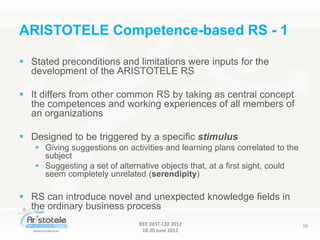
 Stated preconditions and limitations were inputs for the
development of the ARISTOTELE RS
 It differs from other common RS by taking as central concept
the competences and working experiences of all members of
an organizations
 Designed to be triggered by a specific stimulus
 Giving suggestions on activities and learning plans correlated to the
subject
 Suggesting a set of alternative objects that, at a first sight, could
seem completely unrelated (serendipity)
 RS can introduce novel and unexpected knowledge fields in
the ordinary business process
ARISTOTELE Competence-based RS - 1
IEEE DEST-CEE 2012
18-20 June 2012
17
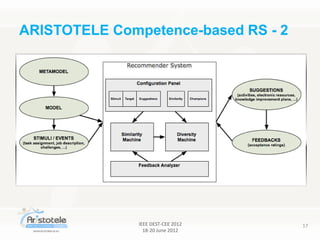
ARISTOTELE Competence-based RS - 2
IEEE DEST-CEE 2012
18-20 June 2012
18
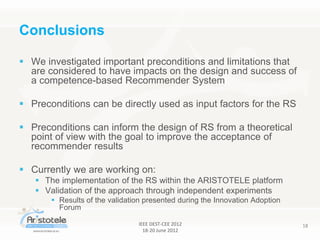
 We investigated important preconditions and limitations that
are considered to have impacts on the design and success of
a competence-based Recommender System
 Preconditions can be directly used as input factors for the RS
 Preconditions can inform the design of RS from a theoretical
point of view with the goal to improve the acceptance of
recommender results
 Currently we are working on:
 The implementation of the RS within the ARISTOTELE platform
 Validation of the approach through independent experiments
 Results of the validation presented during the Innovation Adoption
Forum
Conclusions
info@aristotele-ip.eu
Thank you
Any questions?
ADDITIONAL SLIDES
IEEE DEST-CEE 2012
18-20 June 2012
21
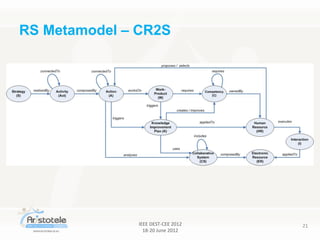
RS Metamodel – CR2S

Design Principles for Competence-based Recommender Systems

  • 1.
    Collaborative Project –FP7- ICT- 2009 - 257886 Design Principles for Competence- based Recommender Systems Valerio Bellandi, Paolo Ceravolo, Fulvio Frati, Jonatan Maggesi Università degli Studi di Milano, Italy Gabriela Waldhart, Isabella Seeber Leopold-Franzens University of Innsbruck, Austria
  • 2.
    IEEE DEST-CEE 2012 18-20June 2012 2 Outline  ARISTOTELE Project  Introduction on Recommender Systems  Recommendations in Competence Management Systems  Analysis of ARISTOTELE Recommender System Scenario  Competence-based Management System  Conclusions
  • 3.
    IEEE DEST-CEE 2012 18-20June 2012 3  Modern knowledge-intensive organizations are step by step realizing that shifting the relevance from tangible to intangible assets increase competitiveness  It is important to consider complex environments that integrate models, processes and technologies with organizational aspects in a systemic approach  The FP7 ARISTOTELE research project aims at relating learning to organizational processes, as well as to the innovation process management  Three kinds of processes are identified:  organizational processes (marketing & communication, HRM, business)  learning processes (group training sessions)  social collaboration processes (spontaneous formation of groups) ARISTOTELE Project
  • 4.
    IEEE DEST-CEE 2012 18-20June 2012 4  Recommender Systems (RSs) are considered critical in ARISTOTELE approach to exploit interactions in collaborative environments and foster the innovation process  Basic RS concepts: 1. Homophily: similarity between sources and recipients 2. Tie strength: intensity of the relationship between the recipient and source 3. Trust: trust relationship between recipient and source 4. Social capital: source’s reputation  Four main RS categories: 1. Content-based: RS calculates similarity of related contents 2. Collaborative: RS calculates similarity of user profiles basing on ratings 3. Knowledge-based: RS considers user requirements and domain knowledge 4. Hybrid  ARISTOTELE RS falls in the 4th category, taking care of all RS concepts Recommender Systems - 1
  • 5.
    IEEE DEST-CEE 2012 18-20June 2012 5  ARISTOTELE RS try to mix two important aspects of modern RSs  Diversity, Novelty and Serendipity  Give to users suggestions that are not limited to the closest ones, but also those suggestions that apparently are far from the user’s interest, but she should also like it “Serendipity is the art of making an unsought finding” F.P. Adams  Knowledge-sharing and Solidity  The accuracy of recommendations will be improved with a knowledge assessment service, exploiting users’ implicit and explicit feedbacks on suggestions Recommender Systems (RSs) - 2
  • 6.
    IEEE DEST-CEE 2012 18-20June 2012 6  ARISTOTELE RS will assist the platform Competence Management System (CompMS)  Typical CompMS process:  Identify the task to be completed  Perform a gap analysis to identify available and missing competences  Use the results to identify the actions to fill the learning gaps  Integration between RS and CompMS is difficult  Example: suggestions on how a user can improve his CV cannot be directly referred to users having similar CVs  It requires the definition of specific design principles for the algorithms guiding the recommendation process Recommendations in CompMS
  • 7.
    IEEE DEST-CEE 2012 18-20June 2012 7  The analysis started from the introduced RS concepts and ARISTOTELE platform user requirements  Four different analysis dimensions, taken from project user scenarios:  Competence Based Management  Activity and Task Management  Collaboration  Knowledge  Result of the analysis will be in terms of preconditions and limitations, to define the boundaries of the ARISTOTELE RS  Preconditions and limitations have been exploited for the design of RS Competence-based RS Principles
  • 8.
    IEEE DEST-CEE 2012 18-20June 2012 8  ARISTOTELE will allow the representation and reasoning on related concepts stored in the models  Contextual information, e.g. a person with specific competences working on a specific task, can be reused to express relations Precondition 1 - Competence Profiles  Competence profiles, and the awareness on which competences are required for organizational tasks, are required  Competence profiles need to be accessible and updatable by the platform  RS must know to what extent a person is capable of fulfilling the task (proficiency)  The knowledge base must be designed around the basic concept of competence Limitation:  In case competence profiles levels are not available, the RS will not be able to suggest people related information Competence Based Management - 1
  • 9.
    IEEE DEST-CEE 2012 18-20June 2012 9 Precondition 2 - Tagging/Annotating  The platform needs to provide tagging or annotation functionalities for artifacts, people, and processes  Users need to have the corresponding rights and willingness to annotate available contents  Content-based recommendations are efficient only with the availability of suitable tags or keywords Limitation:  If users cannot tag or annotate contents or resources, it is likely that recommender results will not reach high accuracy Competence Based Management - 2
  • 10.
    IEEE DEST-CEE 2012 18-20June 2012 10  ARISTOTELE supplies a comprehensive workflow management, where people can define, refine, monitor, and assign objects  Workers’ daily tasks can be improved with the help of accurate resource recommendations  The RS should support community work by recommending appropriate groups that hold necessary expertise or resources  The platform needs to be able to merge information coming from various sources, e.g. social networks, ERPs, CRMs Activity and Task Management - 1
  • 11.
    IEEE DEST-CEE 2012 18-20June 2012 11 Precondition 3 - Activity/Task Monitoring  RS needs to interface with the platform to extract necessary information about users’ tasks/activities from enterprise systems  These systems need to provide endpoints to extract necessary information about users’ tasks/activities  Users need to enrich tasks description with set of metadata that will help RS to provide reliable suggestions Limitation  If activity/task information are not available for recommendation, ARISTOTELE methodologies related to it might be restricted Activity and Task Management - 2
  • 12.
    IEEE DEST-CEE 2012 18-20June 2012 12  User scenarios included possible communication channels: instant messaging, private message, discussion boards, shared workspaces, forums, meetings arrangement, workflow management systems, …  Collaboration should result in annotations of users’ contents by resource rating, tagging, or giving feedback or comments on documents Precondition 4) Willingness to change communication practices  It is necessary that the organizational culture, and therefore people, accept and are willing to use ARISTOTELE communication channels  It is important that the RS will be able to access collaborative resources and contents and give suggestions based on them Collaboration
  • 13.
    IEEE DEST-CEE 2012 18-20June 2012 13  ARISTOTELE core is the handling of explicit/codified knowledge, giving the appropriate support of people to exchange implicit knowledge successfully  The platform needs to support activities to update and share organizational knowledge  Knowledge might also be found or stored outside the organizational boundaries  It is important to find mechanisms to determine trustable and justifiable knowledge sources  The platform needs to reach a critical mass of users and contents to give reliable suggestions Knowledge - 1
  • 14.
    IEEE DEST-CEE 2012 18-20June 2012 14 Precondition 5) Migration of existing knowledge base  There is a need that the existing knowledge base gets migrated into ARISTOTELE  Ontology matching techniques could achieve that same things from diverse systems will be described as one thing  RS must rely on a common metamodel to be able to derive suggestions from different sources Limitation  If a knowledge base is not available, the platform could have problems in solving the start-up problem and create sufficient positive network effects Knowledge - 2
  • 15.
    IEEE DEST-CEE 2012 18-20June 2012 15 Precondition 6) Context Information  To derive contextual information ARISTOTELE needs to have interfaces to other enterprise systems (CRM, HRM, ERP,…)  Information needs to be mapped among the different sources if they deliver the same semantic information (e.g., worker, client, user, etc.)  It is important to have a common metamodel to uniform all the data Limitation  If ARISTOTELE cannot draw on information stored elsewhere in the organization, content-based recommendation will be highly limited Knowledge - 3
  • 16.
    IEEE DEST-CEE 2012 18-20June 2012 16  Stated preconditions and limitations were inputs for the development of the ARISTOTELE RS  It differs from other common RS by taking as central concept the competences and working experiences of all members of an organizations  Designed to be triggered by a specific stimulus  Giving suggestions on activities and learning plans correlated to the subject  Suggesting a set of alternative objects that, at a first sight, could seem completely unrelated (serendipity)  RS can introduce novel and unexpected knowledge fields in the ordinary business process ARISTOTELE Competence-based RS - 1
  • 17.
    IEEE DEST-CEE 2012 18-20June 2012 17 ARISTOTELE Competence-based RS - 2
  • 18.
    IEEE DEST-CEE 2012 18-20June 2012 18  We investigated important preconditions and limitations that are considered to have impacts on the design and success of a competence-based Recommender System  Preconditions can be directly used as input factors for the RS  Preconditions can inform the design of RS from a theoretical point of view with the goal to improve the acceptance of recommender results  Currently we are working on:  The implementation of the RS within the ARISTOTELE platform  Validation of the approach through independent experiments  Results of the validation presented during the Innovation Adoption Forum Conclusions
  • 19.
  • 20.
  • 21.
    IEEE DEST-CEE 2012 18-20June 2012 21 RS Metamodel – CR2S