IRONMAN NUTRITION
Nutrition Guidelines for Endurance Events
Achieve your peak performance by properly fueling your
body before, during, and after your race.
MARISA FRAZIER
Personal Trainer and
Sports Nutritionist
2
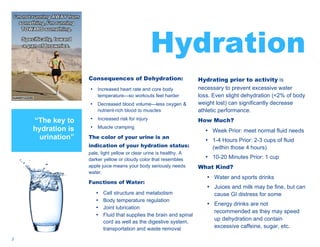
“The key to
hydration is
urination”
Hydration
1
Consequences of Dehydration:
• Increased heart rate and core body
temperature—so workouts feel harder
• Decreased blood volume—less oxygen &
nutrient-rich blood to muscles
• Increased risk for injury
• Muscle cramping
The color of your urine is an
indication of your hydration status:
pale, light yellow or clear urine is healthy. A
darker yellow or cloudy color that resembles
apple juice means your body seriously needs
water.
Functions of Water:
• Cell structure and metabolism
• Body temperature regulation
• Joint lubrication
• Fluid that supplies the brain and spinal
cord as well as the digestive system,
transportation and waste removal
2
Hydrating prior to activity is
necessary to prevent excessive water
loss. Even slight dehydration (<2% of body
weight lost) can significantly decrease
athletic performance.
How Much?
• Week Prior: meet normal fluid needs
• 1-4 Hours Prior: 2-3 cups of fluid
(within those 4 hours)
• 10-20 Minutes Prior: 1 cup
What Kind?
• Water and sports drinks
• Juices and milk may be fine, but can
cause GI distress for some
• Energy drinks are not
recommended as they may speed
up dehydration and contain
excessive caffeine, sugar, etc.
3
DRINKING DURING THE RACE
• Begin taking in fluid immediately—don’t wait an
hour before you start drinking!
• Drink ½ to 1 cup (about 4 gulps) every 15 minutes
• Alternate between water and sports drinks (i.e.
Gatorade). The sports drinks provide electrolytes
and carbohydrates for sustained energy.
• Choose beverages that quickly empty the
stomach—they absorb faster and are less irritating
to the stomach (nausea, sloshing, etc.)
• Some of the best sports drinks for fast gastric
emptying are Gatorade and Powerade!
• Some of the worst are fruit juices and soda (see the
column at right to determine whether your drink
meets the recommendations)
Factors Affecting Gastric Emptying
Concentration: 6-8% carbohydrate solution is optimal.
Fruit juices, sodas, and some sports drinks can have 8-
14% CHO.
Type of carbohydrate: a combination of glucose,
fructose, and sucrose is ideal.
Temperature: cold beverages empty fastest
Intensity of exercise: moderate-intensity facilitates
emptying, whereas high-intensity slows it down
To calculate the amount of carbohydrates (CHO):
[Total grams of CHO / amount of fluid in drink (ml)] x 100%
DIY Sports Drink Recipe: 1 cup OJ, ½ cup
sugar, 3/8 tsp. salt in 1,800 ml (7.5 cups) of water
4
Water Recommendations for
Athletes:
Rule of Thumb = 1ml water per kcal
consumed daily
1 cup = 8 oz. = 240 ml
For example, if you consume 2,400 kcal/day
= 2,400ml water / 240 = 10 cups (80 oz.).
This is in addition to the water needed to
replenish water loss from activity!
Overhydration (hyponatremia)
Hyponatremia (dangerously low blood sodium) often
occurs if an athlete sweats extensively and only drinks
water as a fluid replacement.
Symptoms: headache, nausea, confusion, bloating, and
puffiness of hands/feet. Severe cases can lead to
vomiting, seizures, coma, and death.
• Avoid overconsumption of fluids before, during, and
after exercise
• Sports drinks should be used for events that last
longer than 60 minutes, or are performed in intense
heat/humidity
• Consume extra sodium (electrolytes) in the days
prior to prolonged exercise
• Body weight should NOT increase during exercise
Hydrating After Activity
It can take 8-24 hours to fully rehydrate after strenuous
activity. For each pound lost during exercise/training,
replenish with 2 cups (16 oz.) fluid. Avoid chugging,
though, as it can cause stomach cramps.
To calculate your hourly sweat rate…
1. Weigh yourself before and after your run (get out of your
sweaty shoes and clothes for an accurate weighing)
2. Multiply the amount of weight you lost by 16 to get your
net sweat loss in ounces
3. Add the number of ounces of fluids you took in during the
workout to get your gross sweat loss.
4. Divide this number by the number of minutes of your
workout. This is your sweat loss in ounces per minute.
5. Multiply this number by 60. This is your hourly sweat rate
in ounces.
EATING BEFORE, DURING AND AFTER THE RACE
PRE-RACE
Endurance athletes should be
regularly consuming a high-carb
diet, which will not change leading
up to the race. A general rule is
that endurance athletes should
consume at least 60% of their daily
calories from carbohydrates.
1 day-1 week prior: eat low-GI,
complex carbohydrates with fiber to
store energy for race day. On the 3
days prior, eat up to 70% CHO.
4-24 hours prior: eat high-carb,
familiar, easily digested meals &
snacks to “top off” glycogen stores.
1-3 hours prior: eat a small,
easy-to-digest meal: high in CHO
(but low GI), low fiber & fat. Liquid
meals and fruit juices are fine, but
watch amounts.
<1-hour prior: don’t overdo it! It
is not necessary to eat right before,
but if you do, stick to a gel or about
20-60g CHO.
DURING THE RACE
During endurance exercise, carbs provide energy to
delay fatigue. This is a time when you want to
consume simple, high GI carbohydrates that will
digest quickly. Avoid complex, fibrous foods during
activity because they will digest too slowly to be used.
• 30-60g of CHO per hour (at regular
intervals) for events >90 minutes
• Start consuming CHO soon after beginning
• Rule of thumb: foods that contain a mix of
sugars are ideal (glucose, maltodextrin, &
fructose)
• Glucose, sucrose, maltodextrin, & starch are all
absorbed at high rates (high GI). Fructose and
galactose are absorbed slower, plus high levels of
only fructose are associated with GI distress or
cramping
• 1 cup serving of Powerade contains 19g CHO and
a mix of high-fructose corn syrup and maltodextrin.
• 1 cup serving of Gatorade contains 6-8% sugar
solution, 14g CHO, and a mix of sucrose,
glucose, and fructose—ideal for absorption!
POST-RACE
Immediately after:
consume 1.2 grams
CHO per kg of body
weight. Aim for fast-
acting, high GI foods.
Consume protein in a
3:1 CHO: PRO ratio.
I.e.: 75g CHO: 25g
PRO
This should be
consumed within
30 minutes!
2 hours after:
consume 1.5 grams
CHO per kg of body
weight with protein.
4-6 hours after: eat
a carb-rich meal with
protein and fat
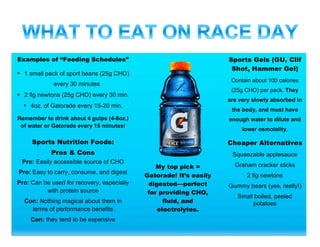
Examples of “Feeding Schedules”
• 1 small pack of sport beans (25g CHO)
every 30 minutes
• 2 fig newtons (25g CHO) every 30 min.
• 4oz. of Gatorade every 15-20 min.
Remember to drink about 4 gulps (4-8oz.)
of water or Gatorade every 15 minutes!
Sports Nutrition Foods:
Pros & Cons
Pro: Easily accessible source of CHO
Pro: Easy to carry, consume, and digest
Pro: Can be used for recovery, especially
with protein source
Con: Nothing magical about them in
terms of performance benefits
Con: they tend to be expensive
Sports Gels (GU, Clif
Shot, Hammer Gel)
Contain about 100 calories
(25g CHO) per pack. They
are very slowly absorbed in
the body, and must have
enough water to dilute and
lower osmolality.
Cheaper Alternatives
Squeezable applesauce
Graham cracker sticks
2 fig newtons
Gummy bears (yes, really!)
Small boiled, peeled
potatoes
My top pick =
Gatorade! It’s easily
digested—perfect
for providing CHO,
fluid, and
electrolytes.
FRAZIER FITNESS
Personal Training and Wellness Coaching
Website: http://www.frazier-fitness.com
Email: marisa@frazier-fitness.com
Written by:
Marisa Frazier
With information from:
Williams, M., Anderson, D., & Rawson,
E. (2013). Nutrition for Health, Fitness &
Sport (10th ed.). New York, NY:
McGraw-Hill.
Exercise and Fluid Replacement.
(2007). Medicine & Science in Sports &
Exercise, 39(2), 377-390. Retrieved from
www.acsm.org.
The pictures in this document are not my
own, and all rights are reserved for their
respective copyright owners.
The medical and/or nutritional
information on this document is not
intended to be a substitute for
professional medical advice,
diagnosis, or treatment. Information
and statements regarding dietary
supplements have not been
evaluated by the Food and Drug
Administration and are not intended
to diagnose, treat, cure, or prevent
any disease. Always seek the advice
of your physician or other qualified
health provider before engaging in
exercise. Never disregard
professional medical advice or delay
seeking it because of something you
have read on this document or any
documents by Frazier Fitness.

Ironman Nutrition

  • 1.
    IRONMAN NUTRITION Nutrition Guidelinesfor Endurance Events Achieve your peak performance by properly fueling your body before, during, and after your race. MARISA FRAZIER Personal Trainer and Sports Nutritionist
  • 2.
    2 “The key to hydrationis urination” Hydration 1 Consequences of Dehydration: • Increased heart rate and core body temperature—so workouts feel harder • Decreased blood volume—less oxygen & nutrient-rich blood to muscles • Increased risk for injury • Muscle cramping The color of your urine is an indication of your hydration status: pale, light yellow or clear urine is healthy. A darker yellow or cloudy color that resembles apple juice means your body seriously needs water. Functions of Water: • Cell structure and metabolism • Body temperature regulation • Joint lubrication • Fluid that supplies the brain and spinal cord as well as the digestive system, transportation and waste removal 2 Hydrating prior to activity is necessary to prevent excessive water loss. Even slight dehydration (<2% of body weight lost) can significantly decrease athletic performance. How Much? • Week Prior: meet normal fluid needs • 1-4 Hours Prior: 2-3 cups of fluid (within those 4 hours) • 10-20 Minutes Prior: 1 cup What Kind? • Water and sports drinks • Juices and milk may be fine, but can cause GI distress for some • Energy drinks are not recommended as they may speed up dehydration and contain excessive caffeine, sugar, etc.
  • 3.
    3 DRINKING DURING THERACE • Begin taking in fluid immediately—don’t wait an hour before you start drinking! • Drink ½ to 1 cup (about 4 gulps) every 15 minutes • Alternate between water and sports drinks (i.e. Gatorade). The sports drinks provide electrolytes and carbohydrates for sustained energy. • Choose beverages that quickly empty the stomach—they absorb faster and are less irritating to the stomach (nausea, sloshing, etc.) • Some of the best sports drinks for fast gastric emptying are Gatorade and Powerade! • Some of the worst are fruit juices and soda (see the column at right to determine whether your drink meets the recommendations) Factors Affecting Gastric Emptying Concentration: 6-8% carbohydrate solution is optimal. Fruit juices, sodas, and some sports drinks can have 8- 14% CHO. Type of carbohydrate: a combination of glucose, fructose, and sucrose is ideal. Temperature: cold beverages empty fastest Intensity of exercise: moderate-intensity facilitates emptying, whereas high-intensity slows it down To calculate the amount of carbohydrates (CHO): [Total grams of CHO / amount of fluid in drink (ml)] x 100% DIY Sports Drink Recipe: 1 cup OJ, ½ cup sugar, 3/8 tsp. salt in 1,800 ml (7.5 cups) of water
  • 4.
    4 Water Recommendations for Athletes: Ruleof Thumb = 1ml water per kcal consumed daily 1 cup = 8 oz. = 240 ml For example, if you consume 2,400 kcal/day = 2,400ml water / 240 = 10 cups (80 oz.). This is in addition to the water needed to replenish water loss from activity! Overhydration (hyponatremia) Hyponatremia (dangerously low blood sodium) often occurs if an athlete sweats extensively and only drinks water as a fluid replacement. Symptoms: headache, nausea, confusion, bloating, and puffiness of hands/feet. Severe cases can lead to vomiting, seizures, coma, and death. • Avoid overconsumption of fluids before, during, and after exercise • Sports drinks should be used for events that last longer than 60 minutes, or are performed in intense heat/humidity • Consume extra sodium (electrolytes) in the days prior to prolonged exercise • Body weight should NOT increase during exercise Hydrating After Activity It can take 8-24 hours to fully rehydrate after strenuous activity. For each pound lost during exercise/training, replenish with 2 cups (16 oz.) fluid. Avoid chugging, though, as it can cause stomach cramps. To calculate your hourly sweat rate… 1. Weigh yourself before and after your run (get out of your sweaty shoes and clothes for an accurate weighing) 2. Multiply the amount of weight you lost by 16 to get your net sweat loss in ounces 3. Add the number of ounces of fluids you took in during the workout to get your gross sweat loss. 4. Divide this number by the number of minutes of your workout. This is your sweat loss in ounces per minute. 5. Multiply this number by 60. This is your hourly sweat rate in ounces.
  • 5.
    EATING BEFORE, DURINGAND AFTER THE RACE PRE-RACE Endurance athletes should be regularly consuming a high-carb diet, which will not change leading up to the race. A general rule is that endurance athletes should consume at least 60% of their daily calories from carbohydrates. 1 day-1 week prior: eat low-GI, complex carbohydrates with fiber to store energy for race day. On the 3 days prior, eat up to 70% CHO. 4-24 hours prior: eat high-carb, familiar, easily digested meals & snacks to “top off” glycogen stores. 1-3 hours prior: eat a small, easy-to-digest meal: high in CHO (but low GI), low fiber & fat. Liquid meals and fruit juices are fine, but watch amounts. <1-hour prior: don’t overdo it! It is not necessary to eat right before, but if you do, stick to a gel or about 20-60g CHO. DURING THE RACE During endurance exercise, carbs provide energy to delay fatigue. This is a time when you want to consume simple, high GI carbohydrates that will digest quickly. Avoid complex, fibrous foods during activity because they will digest too slowly to be used. • 30-60g of CHO per hour (at regular intervals) for events >90 minutes • Start consuming CHO soon after beginning • Rule of thumb: foods that contain a mix of sugars are ideal (glucose, maltodextrin, & fructose) • Glucose, sucrose, maltodextrin, & starch are all absorbed at high rates (high GI). Fructose and galactose are absorbed slower, plus high levels of only fructose are associated with GI distress or cramping • 1 cup serving of Powerade contains 19g CHO and a mix of high-fructose corn syrup and maltodextrin. • 1 cup serving of Gatorade contains 6-8% sugar solution, 14g CHO, and a mix of sucrose, glucose, and fructose—ideal for absorption! POST-RACE Immediately after: consume 1.2 grams CHO per kg of body weight. Aim for fast- acting, high GI foods. Consume protein in a 3:1 CHO: PRO ratio. I.e.: 75g CHO: 25g PRO This should be consumed within 30 minutes! 2 hours after: consume 1.5 grams CHO per kg of body weight with protein. 4-6 hours after: eat a carb-rich meal with protein and fat
  • 6.
    Examples of “FeedingSchedules” • 1 small pack of sport beans (25g CHO) every 30 minutes • 2 fig newtons (25g CHO) every 30 min. • 4oz. of Gatorade every 15-20 min. Remember to drink about 4 gulps (4-8oz.) of water or Gatorade every 15 minutes! Sports Nutrition Foods: Pros & Cons Pro: Easily accessible source of CHO Pro: Easy to carry, consume, and digest Pro: Can be used for recovery, especially with protein source Con: Nothing magical about them in terms of performance benefits Con: they tend to be expensive Sports Gels (GU, Clif Shot, Hammer Gel) Contain about 100 calories (25g CHO) per pack. They are very slowly absorbed in the body, and must have enough water to dilute and lower osmolality. Cheaper Alternatives Squeezable applesauce Graham cracker sticks 2 fig newtons Gummy bears (yes, really!) Small boiled, peeled potatoes My top pick = Gatorade! It’s easily digested—perfect for providing CHO, fluid, and electrolytes.
  • 7.
    FRAZIER FITNESS Personal Trainingand Wellness Coaching Website: http://www.frazier-fitness.com Email: marisa@frazier-fitness.com Written by: Marisa Frazier With information from: Williams, M., Anderson, D., & Rawson, E. (2013). Nutrition for Health, Fitness & Sport (10th ed.). New York, NY: McGraw-Hill. Exercise and Fluid Replacement. (2007). Medicine & Science in Sports & Exercise, 39(2), 377-390. Retrieved from www.acsm.org. The pictures in this document are not my own, and all rights are reserved for their respective copyright owners. The medical and/or nutritional information on this document is not intended to be a substitute for professional medical advice, diagnosis, or treatment. Information and statements regarding dietary supplements have not been evaluated by the Food and Drug Administration and are not intended to diagnose, treat, cure, or prevent any disease. Always seek the advice of your physician or other qualified health provider before engaging in exercise. Never disregard professional medical advice or delay seeking it because of something you have read on this document or any documents by Frazier Fitness.