Downloaded 10 times
![Akshay P. Gholkar Int. Journal of Engineering Research and Applications www.ijera.com
ISSN : 2248-9622, Vol. 4, Issue 7( Version 1), July 2014, pp.142-145
www.ijera.com 142 | P a g e
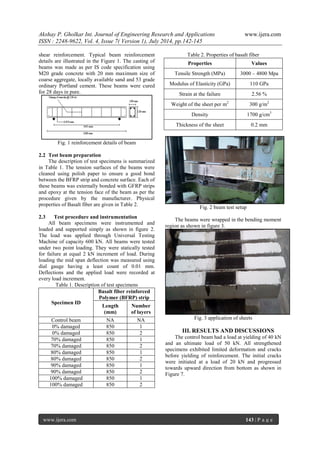
Experimental Study of the Flexural Behaviour of Damaged RC Beams Strengthened in Bending Moment Region with Basalt Fiber Reinforced Polymer (BFRP) Sheets Akshay P. Gholkar*, H. S. Jadhav** *(M. Tech (Structure) Student, Rajarambapu Institute of Technology, Rajaramnagar, Sakharale, Dist-Sangli (M. S.), India. 415414) **(Head, Civil Department, Rajarambapu Institute of Technology, Rajaramnagar, Sakharale, Dist-Sangli (M. S.), India. 415414) Abstract This paper presents the flexural behaviour of basalt fiber reinforced polymer (BFRP) strengthened reinforced concrete (RC) beams. For flexural strengthening of reinforced concrete beams, total twenty-two beams were cast and tested over an effective span of 900 mm up to failure of the beam under two-point loading. The beams were designed as under-reinforced beams. The beams were bonded with BFRP sheets in single layer and double layers in the bending moment region at the bottom face of the beam. Out of the twenty-two beams two beams were control beams and remaining beams were strengthened after being damaged for various degrees of damage (0 %, 70 %, 80 %, 90% and 100 %). The experimental results show that the beams strengthened show high load carrying capacity. Keywords: Basalt Fiber Reinforced Polymer (BFRP), Bending moment region, Control beam, Reinforced Concrete, Strengthened beam, Ultimate Load carrying capacity.
I. INTRODUCTION
Much of our current infrastructure is constructed of concrete. As time passes, deterioration and change of use requirements facilitate the need for new structures. Demolition of existing and construction of new structures is a costly, time consuming and resource intensive operation. If existing structures could be reinforced to meet new requirements then the associated operating costs of our infrastructure would be reduced. [1] In recent years repair and retrofitting of existing structures such as buildings, bridges, etc., have been amongst the most important challenges in Civil Engineering. The main reason for strengthening of RC structures is to upgrade the resistance of the structure to withstand underestimated loads and increase the load carrying capacity for loads such as seismic loads. The maintenance and rehabilitation of structural members, is perhaps one of the most crucial problems in civil engineering applications. [2] Basalt fibers
Basalt is a natural, hard, dense, dark brown to black volcanic igneous rock originating at a depth of hundreds of kilometres beneath the earth and resulting the surface as molten magma. And it’s grey, dark in colour, formed from the molten lava after solidification. The production of basalt fiber consists of melt preparation, extrusion, fiber formation, application of lubricates and finally winding. This method is also known as spinning. A fiber is a material made into a long filament with a density generally in the order of 300g/cm2 of 50 cm. [5] Experimental studies conducted by David E. et.al. [3] focused on the flexural behaviour of RC beams strengthened using Carbon Fibre Plates. Esfahani M.R. et.al. [4] investigated the flexural behaviour of reinforced concrete beams strengthened using Carbon Fibre Reinforced Polymers (CFRP) sheets. Jadhav H.S. et.al. [5] presented the results of experimental studies carried out to investigate the effect of length, width and number of layers of Glass Fiber Reinforced Polymer strips. In my work, I have conducted tests on beams wrapped in the bending moment region.
II. EXPERIMENTAL PROGRAM
The experimental programme consisted of casting reinforced concrete beams, damaging them to various degrees, applying the BFRP sheets and testing them under two point loading.
2.1 Details of the Beam Specimen
The experimental work consisted of a total of twenty-two rectangular beams under reinfor-ced concrete. All beams were of the same size 100 mm x 150 mm x 1200 mm, 2 -8 mm diameter bars were used for flexural reinforcement at the bottom of each beam, 2-8 mm at the top of each beam and 6 mm diameter stirrups spaced 150 mm center-to- center for
RESEARCH ARTICLE OPEN ACCESS](https://image.slidesharecdn.com/w04701142145-140909001236-phpapp01/85/Experimental-Study-of-the-Flexural-Behaviour-of-Damaged-RC-Beams-Strengthened-in-Bending-Moment-Region-with-Basalt-Fiber-Reinforced-Polymer-BFRP-Sheets-1-320.jpg)
![Akshay P. Gholkar Int. Journal of Engineering Research and Applications www.ijera.com
ISSN : 2248-9622, Vol. 4, Issue 7( Version 1), July 2014, pp.142-145
www.ijera.com 142 | P a g e
Experimental Study of the Flexural Behaviour of Damaged RC Beams Strengthened in Bending Moment Region with Basalt Fiber Reinforced Polymer (BFRP) Sheets Akshay P. Gholkar*, H. S. Jadhav** *(M. Tech (Structure) Student, Rajarambapu Institute of Technology, Rajaramnagar, Sakharale, Dist-Sangli (M. S.), India. 415414) **(Head, Civil Department, Rajarambapu Institute of Technology, Rajaramnagar, Sakharale, Dist-Sangli (M. S.), India. 415414) Abstract This paper presents the flexural behaviour of basalt fiber reinforced polymer (BFRP) strengthened reinforced concrete (RC) beams. For flexural strengthening of reinforced concrete beams, total twenty-two beams were cast and tested over an effective span of 900 mm up to failure of the beam under two-point loading. The beams were designed as under-reinforced beams. The beams were bonded with BFRP sheets in single layer and double layers in the bending moment region at the bottom face of the beam. Out of the twenty-two beams two beams were control beams and remaining beams were strengthened after being damaged for various degrees of damage (0 %, 70 %, 80 %, 90% and 100 %). The experimental results show that the beams strengthened show high load carrying capacity. Keywords: Basalt Fiber Reinforced Polymer (BFRP), Bending moment region, Control beam, Reinforced Concrete, Strengthened beam, Ultimate Load carrying capacity.
I. INTRODUCTION
Much of our current infrastructure is constructed of concrete. As time passes, deterioration and change of use requirements facilitate the need for new structures. Demolition of existing and construction of new structures is a costly, time consuming and resource intensive operation. If existing structures could be reinforced to meet new requirements then the associated operating costs of our infrastructure would be reduced. [1] In recent years repair and retrofitting of existing structures such as buildings, bridges, etc., have been amongst the most important challenges in Civil Engineering. The main reason for strengthening of RC structures is to upgrade the resistance of the structure to withstand underestimated loads and increase the load carrying capacity for loads such as seismic loads. The maintenance and rehabilitation of structural members, is perhaps one of the most crucial problems in civil engineering applications. [2] Basalt fibers
Basalt is a natural, hard, dense, dark brown to black volcanic igneous rock originating at a depth of hundreds of kilometres beneath the earth and resulting the surface as molten magma. And it’s grey, dark in colour, formed from the molten lava after solidification. The production of basalt fiber consists of melt preparation, extrusion, fiber formation, application of lubricates and finally winding. This method is also known as spinning. A fiber is a material made into a long filament with a density generally in the order of 300g/cm2 of 50 cm. [5] Experimental studies conducted by David E. et.al. [3] focused on the flexural behaviour of RC beams strengthened using Carbon Fibre Plates. Esfahani M.R. et.al. [4] investigated the flexural behaviour of reinforced concrete beams strengthened using Carbon Fibre Reinforced Polymers (CFRP) sheets. Jadhav H.S. et.al. [5] presented the results of experimental studies carried out to investigate the effect of length, width and number of layers of Glass Fiber Reinforced Polymer strips. In my work, I have conducted tests on beams wrapped in the bending moment region.
II. EXPERIMENTAL PROGRAM
The experimental programme consisted of casting reinforced concrete beams, damaging them to various degrees, applying the BFRP sheets and testing them under two point loading.
2.1 Details of the Beam Specimen
The experimental work consisted of a total of twenty-two rectangular beams under reinfor-ced concrete. All beams were of the same size 100 mm x 150 mm x 1200 mm, 2 -8 mm diameter bars were used for flexural reinforcement at the bottom of each beam, 2-8 mm at the top of each beam and 6 mm diameter stirrups spaced 150 mm center-to- center for
RESEARCH ARTICLE OPEN ACCESS](https://image.slidesharecdn.com/w04701142145-140909001236-phpapp01/75/Experimental-Study-of-the-Flexural-Behaviour-of-Damaged-RC-Beams-Strengthened-in-Bending-Moment-Region-with-Basalt-Fiber-Reinforced-Polymer-BFRP-Sheets-1-2048.jpg)
![Akshay P. Gholkar Int. Journal of Engineering Research and Applications www.ijera.com
ISSN : 2248-9622, Vol. 4, Issue 7( Version 1), July 2014, pp.142-145
www.ijera.com 145 | P a g e
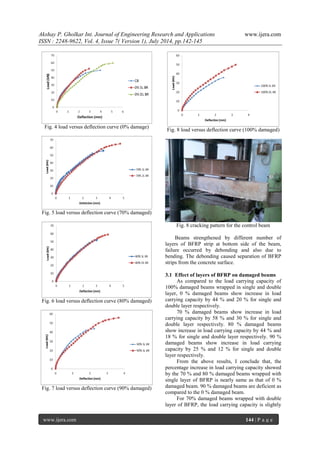
less compared to 0 % damaged beams. 80 % and 90 % beams are deficient in load carrying capacity.
IV. CONCLUSIONS
Based on the experimental investigation presented in this study, for the beams strengthened in flexure with sheets, it can be concluded that,
0%, 70% and 80% damaged degree beams showed higher performance in terms of load carrying capacity, while 90% and 100% damage degree beams did not show appreciable increase in load carrying capacity.
On increasing the number of layers of BFRP strip, increase in yield and ultimate displacement are observed.
Results of BFRP wrapping with 100mm wide in single and double layer showed increase in ultimate load carrying capacity by 44% and 20% respectively in 0% damaged beam.
With increase in degree of damage, deflection at ultimate load is found to be decreasing.
REFERENCES
[1] Lankinen C. W. and Soudki K. A. (2008). “Behaviour of rectangular reinforced concrete members confined with GFRP sheets”, Fourth International Conference on FRP Composites in Civil Engineering (CICE2008) 22-24 July 2008, Zurich, Switzerland.
[2] Singaravadivelan R., Sakthieswaren N. and Dr. Muthuramu K. L. (2012). “Experimental Investigation on the Behaviour of Flexural Strengthening of Beam Using Basalt Fiber”, International Conference on Automotive, Mechanical and Materials Engineering (ICAMME' 2012) Penang (Malaysia) May 19- 20.
[3] David E., Ragneau E. and Buyle-Bodin F. (2003). “Experimental analysis of flexural behavior of externally bonded CFRP reinforced concrete structures”, Materials and Structures, Vol. 36, pp.238-241.
[4] Esfahani M.R., Kianoush M.R., Tajari A.R. (2007). “Flexural behaviour of reinforced concrete beams strengthened by CFRP sheets”, Engineering Structures, Vol. 29, pp. 2428–2444.
[5] Jadhav H. S. and Shiyekar M. R. (2011). “Performance of reinforced concrete beams strengthened with GFRP laminate configuration”, International Journal of 3R’s, Vol. 1, No. 4, 2010, pp. 192-195.](https://image.slidesharecdn.com/w04701142145-140909001236-phpapp01/85/Experimental-Study-of-the-Flexural-Behaviour-of-Damaged-RC-Beams-Strengthened-in-Bending-Moment-Region-with-Basalt-Fiber-Reinforced-Polymer-BFRP-Sheets-4-320.jpg)

The document summarizes an experimental study on the flexural behavior of damaged reinforced concrete beams strengthened with basalt fiber reinforced polymer (BFRP) sheets. Twenty-two beams were tested with varying degrees of damage (0%, 70%, 80%, 90%, 100%) and BFRP strengthening configurations (single layer, double layer). The results showed that beams with 0-80% damage strengthened with single-layer BFRP exhibited higher load capacities than the control beam, while beams with 90-100% damage did not see appreciable increases. In general, load capacity increased with additional BFRP layers but began decreasing with higher damage levels. The BFRP wrapping improved cracking behavior and increased yield and ultimate displacements.


