International Research Journal of Engineering and Technology (IRJET) e-ISSN: 2395-0056
Volume: 05 Issue: 12 | Dec 2018 www.irjet.net p-ISSN: 2395-0072
© 2018, IRJET | Impact Factor value: 7.211 | ISO 9001:2008 Certified Journal | Page 828
Static and Dynamic Analysis of Multistorey Buildings Having
Floating Columns
Vandana Sharma1, Sourabh Dashore2
1PG Student, Dept. of Civil Engg., SIMS, Indore, M.P., India
2Asst. Prof., Dept. of Civil Engg., SIMS, Indore, M.P., India
----------------------------------------------------------------------***---------------------------------------------------------------------
Abstract - A column is supposed to be a vertical member
starting from foundation level and transferringtheloadto the
ground. The term floating column is also a vertical element
which (due to architectural design/ site situation) at its lower
level (termination Level) rests on a beam which isahorizontal
member. The beams in turn transfer the load to othercolumns
below it.
The object of the present work is to compare the behaviour of
multi-storey buildings having floating columns with and
without shear walls under seismic forces by using static and
dynamic analysis. For this purpose three cases of multi-storey
buildings are considered. To reduce lateral displacement and
storey drift shear walls have been provided. In case-I, total 9
storeys are provided. Building area provided is 20 m x 20 m
upto lower 4 storeys and 28 m x 28 m upto upper 5 storeys. In
case-II, total 12 storeys are provided. Building area provided
is 20 m x 20 m upto lower 4 storeys and 28 m x 28 m upto
upper 8 storeys. In case-III, total 15 storeys are provided.
Building area provided is 20 m x 20 m upto lower 4 storeys
and 28 m x 28 m upto upper 11 storeys. To study the behavior
the response parametersselectedarelateraldisplacement and
storey drift. All the cases are assumed to be located in zone III,
zone IV and zone V and analyzed using static and dynamic
methods. All the three cases are analyzed with and without
shear wall using Staad.Pro software.
From the analysis result parameters displacement and storey
drift of the building models increases from lower to higher
zones because the magnitude of intensity will be more for
higher zones. In comparison to methods of analysis, dynamic
method of analysis gives more appropriate results.
Present work provides good information on the result
parameters displacement and storey drift in the multistorey
buildings with floating columns.
Key Words: Seismic, Floating Columns, Shear Wall,
Lateral displacement, Storey drift.
1. INTRODUCTION
The behavior of a building during earthquakes depends
critically on its overall shape, size and geometry, in addition
to how the earthquake forces are carried to the ground. The
earthquake forces developed at different floor levels in a
building need to be brought down along the height to the
ground by the shortest path and any deviation or
discontinuity in this load transfer path results in poor
performance of the building.Buildingswithvertical setbacks
(like the hotel buildings with a few storey wider than the
rest) cause a sudden jump in earthquake forces at the level
of discontinuity. Buildings that have fewer columns or walls
in a particular storey or with unusually tall storey tend to
damage or collapse which is initiated in that storey. Many
buildings with an open ground storey intended for parking
collapsed or were severely damaged in Gujarat during the
2001 Bhuj earthquake. Buildings with columns that hang or
float on beams at an intermediate storey and do not go all
the way to the foundation, have discontinuities in the load
transfer path.
1.1 Floating Columns
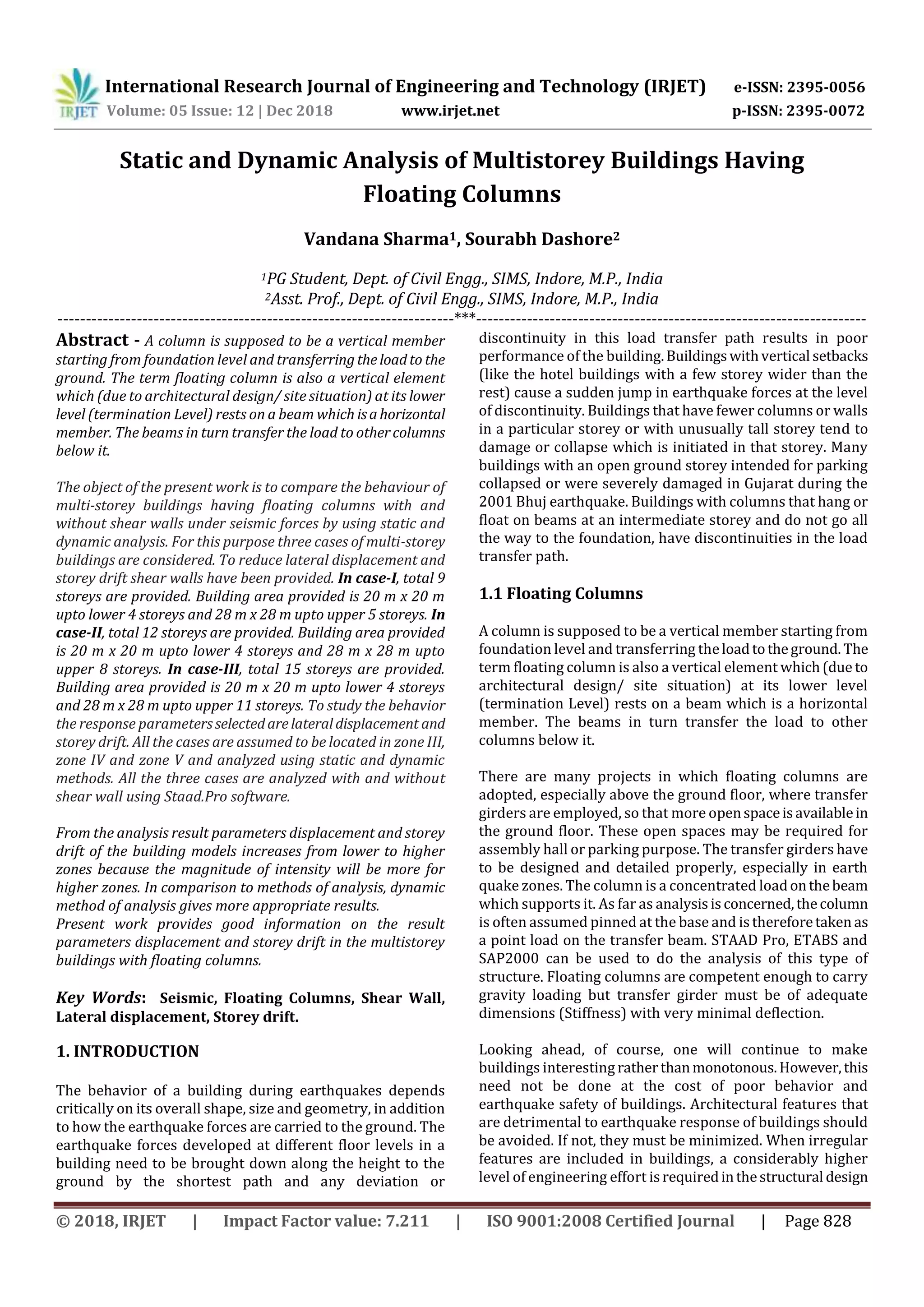
A column is supposed to be a vertical member starting from
foundation level and transferring theloadtotheground. The
term floating column is also a vertical element which(due to
architectural design/ site situation) at its lower level
(termination Level) rests on a beam which is a horizontal
member. The beams in turn transfer the load to other
columns below it.
There are many projects in which floating columns are
adopted, especially above the ground floor, where transfer
girders are employed, so that more openspaceisavailablein
the ground floor. These open spaces may be required for
assembly hall or parking purpose. The transfer girders have
to be designed and detailed properly, especially in earth
quake zones. The column is a concentrated loadonthebeam
which supports it. As far as analysisisconcerned,thecolumn
is often assumed pinned at the base and isthereforetaken as
a point load on the transfer beam. STAAD Pro, ETABS and
SAP2000 can be used to do the analysis of this type of
structure. Floating columns are competent enough to carry
gravity loading but transfer girder must be of adequate
dimensions (Stiffness) with very minimal deflection.
Looking ahead, of course, one will continue to make
buildings interesting ratherthanmonotonous.However,this
need not be done at the cost of poor behavior and
earthquake safety of buildings. Architectural features that
are detrimental to earthquake response of buildings should
be avoided. If not, they must be minimized. When irregular
features are included in buildings, a considerably higher
level of engineering effort isrequiredinthestructural design
International Research Journal of Engineering and Technology (IRJET) e-ISSN: 2395-0056
Volume: 05 Issue: 12 | Dec 2018 www.irjet.net p-ISSN: 2395-0072
© 2018, IRJET | Impact Factor value: 7.211 | ISO 9001:2008 Certified Journal | Page 829
and yet the building may not be as good as one with simple
architectural features.
Hence, the structures already made with these kinds of
discontinuous members are endangered in seismic regions.
But those structures cannot be demolished, ratherstudy can
be done to strengthen the structure or some remedial
features can be suggested. The columns of the first storey
can be made stronger, the stiffness of these columns can be
increased by retrofitting or these may be provided with
bracing to decrease the lateral deformation.
Fig -1: Floating Columns
2. PROBLEM FORMULATION & ANALYSIS
The object of the present work is to compare the behaviour
of multi-storey buildings having floating columns with and
without shear walls under seismic forces by using static and
dynamic analysis. For this purpose three cases of multi-
storey buildings are considered. To reduce lateral
displacement and storey drift shear walls have been
provided.
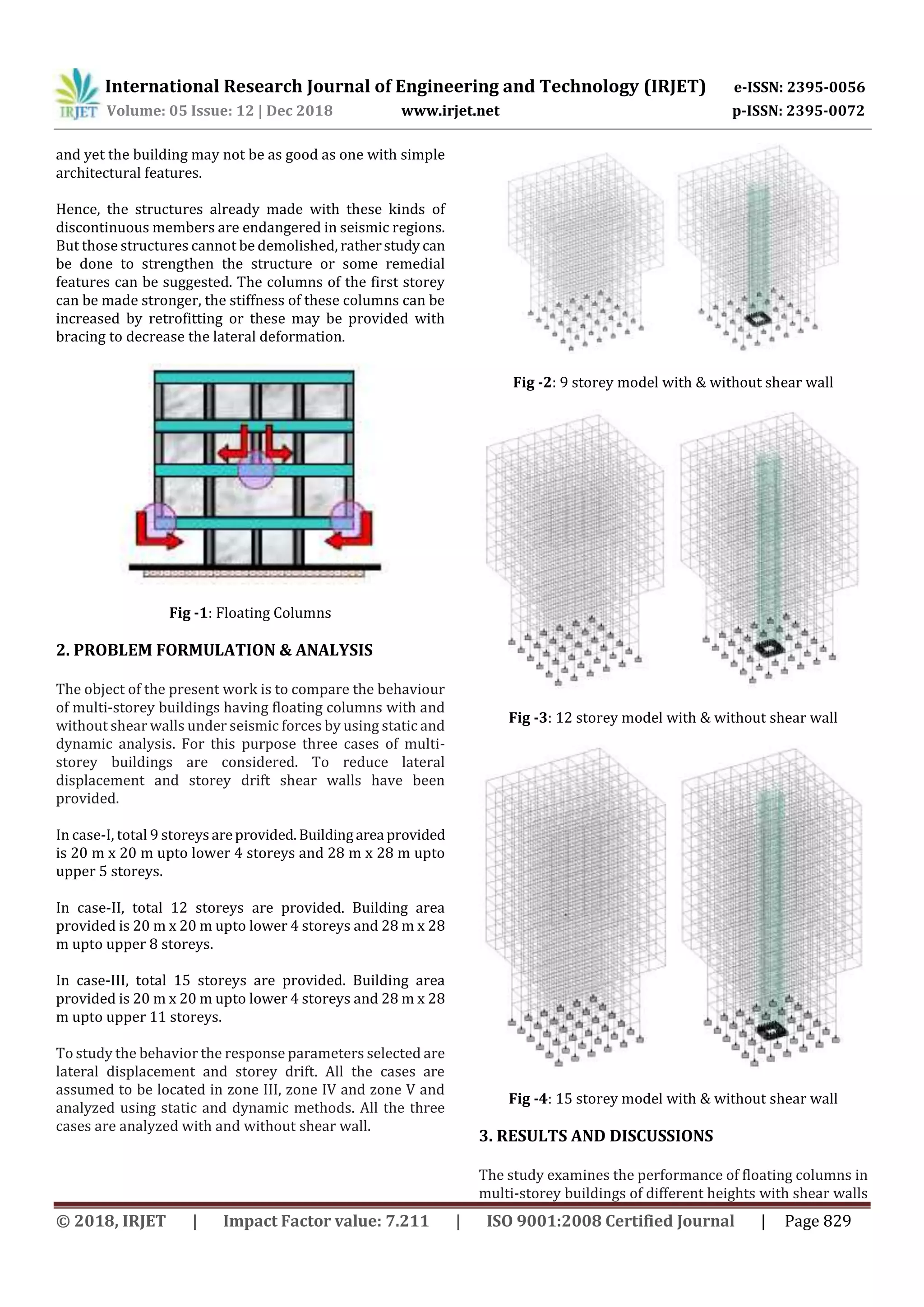
In case-I, total 9 storeysareprovided.Buildingarea provided
is 20 m x 20 m upto lower 4 storeys and 28 m x 28 m upto
upper 5 storeys.
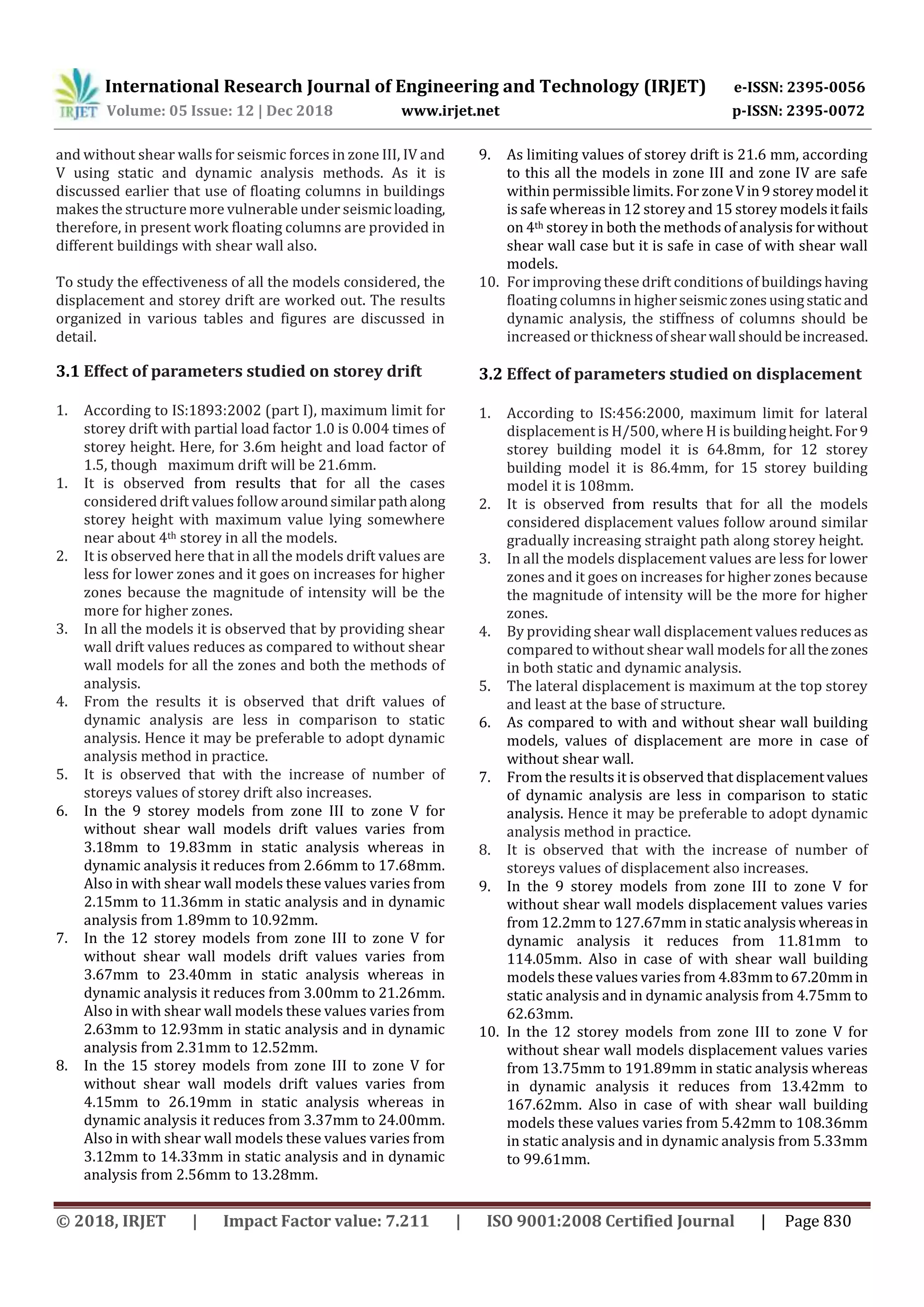
In case-II, total 12 storeys are provided. Building area
provided is 20 m x 20 m upto lower 4 storeys and 28 m x 28
m upto upper 8 storeys.
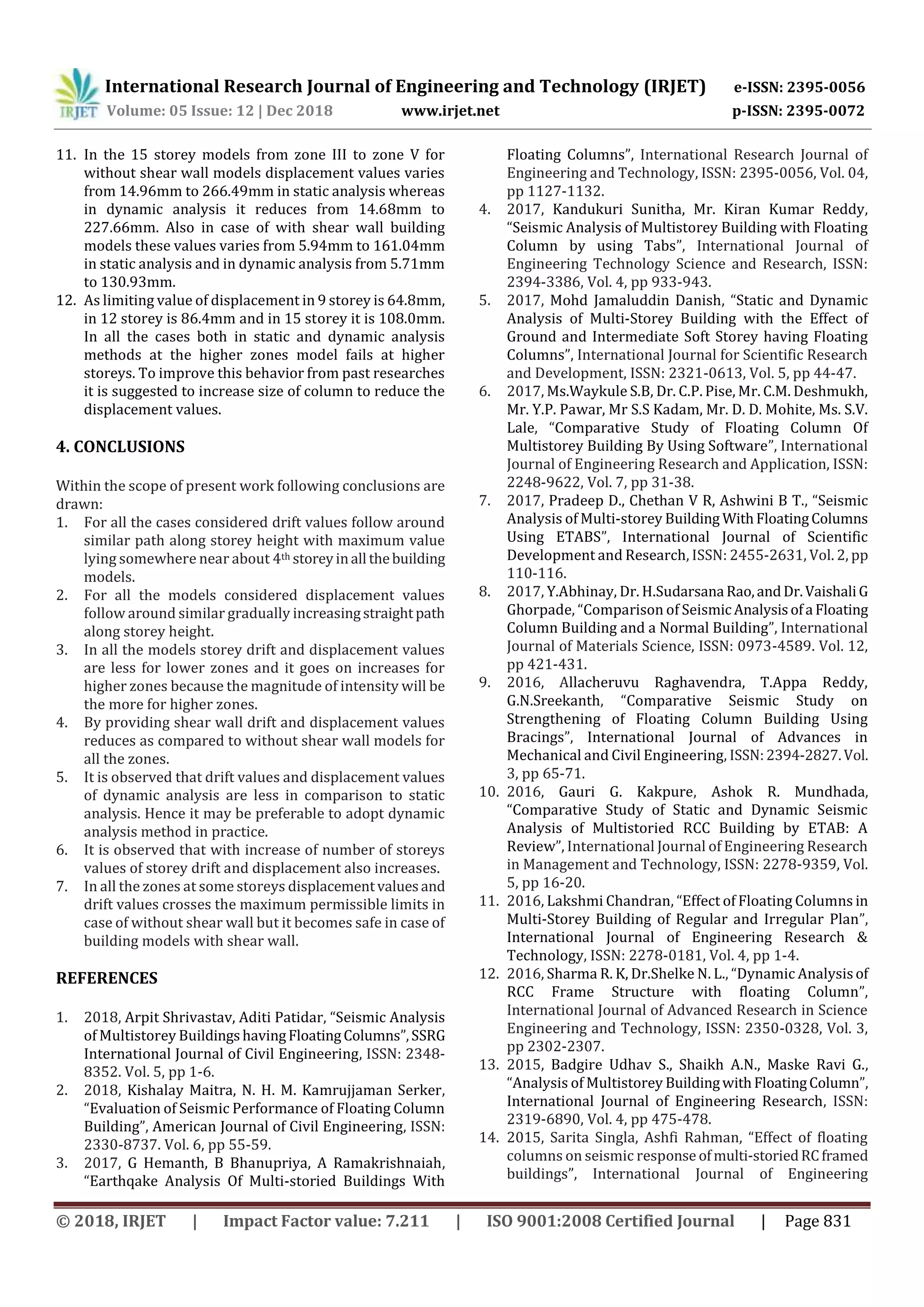
In case-III, total 15 storeys are provided. Building area
provided is 20 m x 20 m upto lower 4 storeys and 28 m x 28
m upto upper 11 storeys.
To study the behavior the response parameters selected are
lateral displacement and storey drift. All the cases are
assumed to be located in zone III, zone IV and zone V and
analyzed using static and dynamic methods. All the three
cases are analyzed with and without shear wall.
Fig -2: 9 storey model with & without shear wall
Fig -3: 12 storey model with & without shear wall
Fig -4: 15 storey model with & without shear wall
3. RESULTS AND DISCUSSIONS
The study examines the performance of floating columns in
multi-storey buildings of different heights with shear walls
International Research Journal of Engineering and Technology (IRJET) e-ISSN: 2395-0056
Volume: 05 Issue: 12 | Dec 2018 www.irjet.net p-ISSN: 2395-0072
© 2018, IRJET | Impact Factor value: 7.211 | ISO 9001:2008 Certified Journal | Page 830
and without shear walls for seismic forces in zone III, IV and
V using static and dynamic analysis methods. As it is
discussed earlier that use of floating columns in buildings
makes the structure more vulnerable under seismic loading,
therefore, in present work floating columns are provided in
different buildings with shear wall also.
To study the effectiveness of all the models considered, the
displacement and storey drift are worked out. The results
organized in various tables and figures are discussed in
detail.
3.1 Effect of parameters studied on storey drift
1. According to IS:1893:2002 (part I), maximum limit for
storey drift with partial load factor 1.0 is 0.004 times of
storey height. Here, for 3.6m height and load factor of
1.5, though maximum drift will be 21.6mm.
1. It is observed from results that for all the cases
considered drift values follow aroundsimilarpathalong
storey height with maximum value lying somewhere
near about 4th storey in all the models.
2. It is observed here that in all the models drift values are
less for lower zones and it goes on increases for higher
zones because the magnitude of intensity will be the
more for higher zones.
3. In all the models it is observed that by providing shear
wall drift values reduces as compared to without shear
wall models for all the zones and both the methods of
analysis.
4. From the results it is observed that drift values of
dynamic analysis are less in comparison to static
analysis. Hence it may be preferable to adopt dynamic
analysis method in practice.
5. It is observed that with the increase of number of
storeys values of storey drift also increases.
6. In the 9 storey models from zone III to zone V for
without shear wall models drift values varies from
3.18mm to 19.83mm in static analysis whereas in
dynamic analysis it reduces from 2.66mm to 17.68mm.
Also in with shear wall models these values varies from
2.15mm to 11.36mm in static analysis and in dynamic
analysis from 1.89mm to 10.92mm.
7. In the 12 storey models from zone III to zone V for
without shear wall models drift values varies from
3.67mm to 23.40mm in static analysis whereas in
dynamic analysis it reduces from 3.00mm to 21.26mm.
Also in with shear wall models these values varies from
2.63mm to 12.93mm in static analysis and in dynamic
analysis from 2.31mm to 12.52mm.
8. In the 15 storey models from zone III to zone V for
without shear wall models drift values varies from
4.15mm to 26.19mm in static analysis whereas in
dynamic analysis it reduces from 3.37mm to 24.00mm.
Also in with shear wall models these values varies from
3.12mm to 14.33mm in static analysis and in dynamic
analysis from 2.56mm to 13.28mm.
9. As limiting values of storey drift is 21.6 mm, according
to this all the models in zone III and zone IV are safe
within permissible limits. For zoneVin9storeymodel it
is safe whereas in 12 storey and 15 storey modelsitfails
on 4th storey in both the methods of analysis forwithout
shear wall case but it is safe in case of with shear wall
models.
10. For improving these drift conditions of buildingshaving
floating columns in higherseismiczonesusingstaticand
dynamic analysis, the stiffness of columns should be
increased or thicknessofshearwall shouldbeincreased.
3.2 Effect of parameters studied on displacement
1. According to IS:456:2000, maximum limit for lateral
displacement is H/500, where H is buildingheight.For9
storey building model it is 64.8mm, for 12 storey
building model it is 86.4mm, for 15 storey building
model it is 108mm.
2. It is observed from results that for all the models
considered displacement values follow around similar
gradually increasing straight path along storey height.
3. In all the models displacement values are less for lower
zones and it goes on increases for higher zones because
the magnitude of intensity will be the more for higher
zones.
4. By providing shear wall displacement values reducesas
compared to without shear wall models for all thezones
in both static and dynamic analysis.
5. The lateral displacement is maximum at the top storey
and least at the base of structure.
6. As compared to with and without shear wall building
models, values of displacement are more in case of
without shear wall.
7. From the results it is observed that displacementvalues
of dynamic analysis are less in comparison to static
analysis. Hence it may be preferable to adopt dynamic
analysis method in practice.
8. It is observed that with the increase of number of
storeys values of displacement also increases.
9. In the 9 storey models from zone III to zone V for
without shear wall models displacement values varies
from 12.2mm to 127.67mm in static analysiswhereasin
dynamic analysis it reduces from 11.81mm to
114.05mm. Also in case of with shear wall building
models these values varies from 4.83mmto67.20mmin
static analysis and in dynamic analysis from 4.75mm to
62.63mm.
10. In the 12 storey models from zone III to zone V for
without shear wall models displacement values varies
from 13.75mm to 191.89mm in static analysis whereas
in dynamic analysis it reduces from 13.42mm to
167.62mm. Also in case of with shear wall building
models these values varies from 5.42mm to 108.36mm
in static analysis and in dynamic analysis from 5.33mm
to 99.61mm.
International Research Journal of Engineering and Technology (IRJET) e-ISSN: 2395-0056
Volume: 05 Issue: 12 | Dec 2018 www.irjet.net p-ISSN: 2395-0072
© 2018, IRJET | Impact Factor value: 7.211 | ISO 9001:2008 Certified Journal | Page 831
11. In the 15 storey models from zone III to zone V for
without shear wall models displacement values varies
from 14.96mm to 266.49mm in static analysis whereas
in dynamic analysis it reduces from 14.68mm to
227.66mm. Also in case of with shear wall building
models these values varies from 5.94mm to 161.04mm
in static analysis and in dynamic analysis from 5.71mm
to 130.93mm.
12. As limiting value of displacement in 9 storey is 64.8mm,
in 12 storey is 86.4mm and in 15 storey it is 108.0mm.
In all the cases both in static and dynamic analysis
methods at the higher zones model fails at higher
storeys. To improve this behavior from past researches
it is suggested to increase size of column to reduce the
displacement values.
4. CONCLUSIONS
Within the scope of present work following conclusions are
drawn:
1. For all the cases considered drift values follow around
similar path along storey height with maximum value
lying somewhere near about 4th storeyinall thebuilding
models.
2. For all the models considered displacement values
follow around similar gradually increasingstraightpath
along storey height.
3. In all the models storey drift and displacement values
are less for lower zones and it goes on increases for
higher zones because the magnitude of intensity will be
the more for higher zones.
4. By providing shear wall drift and displacement values
reduces as compared to without shear wall models for
all the zones.
5. It is observed that drift values and displacement values
of dynamic analysis are less in comparison to static
analysis. Hence it may be preferable to adopt dynamic
analysis method in practice.
6. It is observed that with increase of number of storeys
values of storey drift and displacement also increases.
7. In all the zones at some storeys displacementvaluesand
drift values crosses the maximum permissible limits in
case of without shear wall but it becomes safe in case of
building models with shear wall.
REFERENCES
1. 2018, Arpit Shrivastav, Aditi Patidar, “Seismic Analysis
of Multistorey BuildingshavingFloatingColumns”,SSRG
International Journal of Civil Engineering, ISSN: 2348-
8352. Vol. 5, pp 1-6.
2. 2018, Kishalay Maitra, N. H. M. Kamrujjaman Serker,
“Evaluation of Seismic Performance of Floating Column
Building”, American Journal of Civil Engineering, ISSN:
2330-8737. Vol. 6, pp 55-59.
3. 2017, G Hemanth, B Bhanupriya, A Ramakrishnaiah,
“Earthqake Analysis Of Multi-storied Buildings With
Floating Columns”, International Research Journal of
Engineering and Technology, ISSN: 2395-0056, Vol. 04,
pp 1127-1132.
4. 2017, Kandukuri Sunitha, Mr. Kiran Kumar Reddy,
“Seismic Analysis of Multistorey Building with Floating
Column by using Tabs”, International Journal of
Engineering Technology Science and Research, ISSN:
2394-3386, Vol. 4, pp 933-943.
5. 2017, Mohd Jamaluddin Danish, “Static and Dynamic
Analysis of Multi-Storey Building with the Effect of
Ground and Intermediate Soft Storey having Floating
Columns”, International Journal for Scientific Research
and Development, ISSN: 2321-0613, Vol. 5, pp 44-47.
6. 2017, Ms.Waykule S.B, Dr. C.P. Pise, Mr. C.M. Deshmukh,
Mr. Y.P. Pawar, Mr S.S Kadam, Mr. D. D. Mohite, Ms. S.V.
Lale, “Comparative Study of Floating Column Of
Multistorey Building By Using Software”, International
Journal of Engineering Research and Application, ISSN:
2248-9622, Vol. 7, pp 31-38.
7. 2017, Pradeep D., Chethan V R, Ashwini B T., “Seismic
Analysis of Multi-storey Building WithFloatingColumns
Using ETABS”, International Journal of Scientific
Development and Research, ISSN: 2455-2631, Vol. 2, pp
110-116.
8. 2017, Y.Abhinay, Dr. H.Sudarsana Rao,andDr.VaishaliG
Ghorpade, “Comparison of SeismicAnalysisofa Floating
Column Building and a Normal Building”, International
Journal of Materials Science, ISSN: 0973-4589. Vol. 12,
pp 421-431.
9. 2016, Allacheruvu Raghavendra, T.Appa Reddy,
G.N.Sreekanth, “Comparative Seismic Study on
Strengthening of Floating Column Building Using
Bracings”, International Journal of Advances in
Mechanical and Civil Engineering, ISSN:2394-2827.Vol.
3, pp 65-71.
10. 2016, Gauri G. Kakpure, Ashok R. Mundhada,
“Comparative Study of Static and Dynamic Seismic
Analysis of Multistoried RCC Building by ETAB: A
Review”, International Journal of Engineering Research
in Management and Technology, ISSN: 2278-9359, Vol.
5, pp 16-20.
11. 2016, Lakshmi Chandran, “Effect of Floating Columns in
Multi-Storey Building of Regular and Irregular Plan”,
International Journal of Engineering Research &
Technology, ISSN: 2278-0181, Vol. 4, pp 1-4.
12. 2016, Sharma R. K, Dr.Shelke N. L., “Dynamic Analysisof
RCC Frame Structure with floating Column”,
International Journal of Advanced Research in Science
Engineering and Technology, ISSN: 2350-0328, Vol. 3,
pp 2302-2307.
13. 2015, Badgire Udhav S., Shaikh A.N., Maske Ravi G.,
“Analysis of Multistorey BuildingwithFloatingColumn”,
International Journal of Engineering Research, ISSN:
2319-6890, Vol. 4, pp 475-478.
14. 2015, Sarita Singla, Ashfi Rahman, “Effect of floating
columns on seismic response ofmulti-storiedRCframed
buildings”, International Journal of Engineering
International Research Journal of Engineering and Technology (IRJET) e-ISSN: 2395-0056
Volume: 05 Issue: 12 | Dec 2018 www.irjet.net p-ISSN: 2395-0072
© 2018, IRJET | Impact Factor value: 7.211 | ISO 9001:2008 Certified Journal | Page 832
Research and Technology, ISSN: 2278-0181, Vol. 4, pp
1131-1136.
15. 2015, Saurabh G. Lonkar, Prof. Riyaz Sameer Shah,
“Comparative Study of Static and Dynamic Analysis of
Multi-Storey Regular & Irregular Building – A Review”,
International Journal of Research in Engineering,
Science and Technologies, ISSN: 2395-6453, Vol. 1, pp
262-267.
16. 2014, A.P. Mundada, S.G. Sawdatkar, “Comparative
seismic analysis of multistory building withandwithout
floating column”, International Journal of Current
Engineering and Technology, ISSN: 2277-4106, Vol. 4,
pp 3395-3400.
17. 2014, Keerthigowda B.S., Syed Tajoddeen, “Seismic
analysis of multistory building with floating column”,
Researchgate Publication, pp 528-535.
18. 2014, Mr. P.V. Prasad, T. Raja Sekhar, “Study Of
Behaviour Of Seismic Analysis Of Multi Storied Building
With And Without Floating Column”, Caribbean Journal
of Science and Technology, ISSN: 0799-3757, Vol. 2, pp
697-710.
19. 2014, Sabari S, Praveen J.V., “Seismic analysis of
multistory building with floating column”,International
Journal of Civil and Structural Engineering Research,
ISSN: 2348-7607, Vol. 2, pp 12-23.
20. 2014, Srikanth M.K., Yogeendra R. Holebagilu, “Seismic
response of complex buildings with floatingcolumnsfor
zone II and zone V”, International Journal ofEngineering
Research, ISSN: 2321-7758, Vol. 2, pp 1-11.

IRJET- Static and Dynamic Analysis of Multistorey Buildings having Floating Columns

  • 1.
    International Research Journalof Engineering and Technology (IRJET) e-ISSN: 2395-0056 Volume: 05 Issue: 12 | Dec 2018 www.irjet.net p-ISSN: 2395-0072 © 2018, IRJET | Impact Factor value: 7.211 | ISO 9001:2008 Certified Journal | Page 828 Static and Dynamic Analysis of Multistorey Buildings Having Floating Columns Vandana Sharma1, Sourabh Dashore2 1PG Student, Dept. of Civil Engg., SIMS, Indore, M.P., India 2Asst. Prof., Dept. of Civil Engg., SIMS, Indore, M.P., India ----------------------------------------------------------------------***--------------------------------------------------------------------- Abstract - A column is supposed to be a vertical member starting from foundation level and transferringtheloadto the ground. The term floating column is also a vertical element which (due to architectural design/ site situation) at its lower level (termination Level) rests on a beam which isahorizontal member. The beams in turn transfer the load to othercolumns below it. The object of the present work is to compare the behaviour of multi-storey buildings having floating columns with and without shear walls under seismic forces by using static and dynamic analysis. For this purpose three cases of multi-storey buildings are considered. To reduce lateral displacement and storey drift shear walls have been provided. In case-I, total 9 storeys are provided. Building area provided is 20 m x 20 m upto lower 4 storeys and 28 m x 28 m upto upper 5 storeys. In case-II, total 12 storeys are provided. Building area provided is 20 m x 20 m upto lower 4 storeys and 28 m x 28 m upto upper 8 storeys. In case-III, total 15 storeys are provided. Building area provided is 20 m x 20 m upto lower 4 storeys and 28 m x 28 m upto upper 11 storeys. To study the behavior the response parametersselectedarelateraldisplacement and storey drift. All the cases are assumed to be located in zone III, zone IV and zone V and analyzed using static and dynamic methods. All the three cases are analyzed with and without shear wall using Staad.Pro software. From the analysis result parameters displacement and storey drift of the building models increases from lower to higher zones because the magnitude of intensity will be more for higher zones. In comparison to methods of analysis, dynamic method of analysis gives more appropriate results. Present work provides good information on the result parameters displacement and storey drift in the multistorey buildings with floating columns. Key Words: Seismic, Floating Columns, Shear Wall, Lateral displacement, Storey drift. 1. INTRODUCTION The behavior of a building during earthquakes depends critically on its overall shape, size and geometry, in addition to how the earthquake forces are carried to the ground. The earthquake forces developed at different floor levels in a building need to be brought down along the height to the ground by the shortest path and any deviation or discontinuity in this load transfer path results in poor performance of the building.Buildingswithvertical setbacks (like the hotel buildings with a few storey wider than the rest) cause a sudden jump in earthquake forces at the level of discontinuity. Buildings that have fewer columns or walls in a particular storey or with unusually tall storey tend to damage or collapse which is initiated in that storey. Many buildings with an open ground storey intended for parking collapsed or were severely damaged in Gujarat during the 2001 Bhuj earthquake. Buildings with columns that hang or float on beams at an intermediate storey and do not go all the way to the foundation, have discontinuities in the load transfer path. 1.1 Floating Columns A column is supposed to be a vertical member starting from foundation level and transferring theloadtotheground. The term floating column is also a vertical element which(due to architectural design/ site situation) at its lower level (termination Level) rests on a beam which is a horizontal member. The beams in turn transfer the load to other columns below it. There are many projects in which floating columns are adopted, especially above the ground floor, where transfer girders are employed, so that more openspaceisavailablein the ground floor. These open spaces may be required for assembly hall or parking purpose. The transfer girders have to be designed and detailed properly, especially in earth quake zones. The column is a concentrated loadonthebeam which supports it. As far as analysisisconcerned,thecolumn is often assumed pinned at the base and isthereforetaken as a point load on the transfer beam. STAAD Pro, ETABS and SAP2000 can be used to do the analysis of this type of structure. Floating columns are competent enough to carry gravity loading but transfer girder must be of adequate dimensions (Stiffness) with very minimal deflection. Looking ahead, of course, one will continue to make buildings interesting ratherthanmonotonous.However,this need not be done at the cost of poor behavior and earthquake safety of buildings. Architectural features that are detrimental to earthquake response of buildings should be avoided. If not, they must be minimized. When irregular features are included in buildings, a considerably higher level of engineering effort isrequiredinthestructural design
  • 2.
    International Research Journalof Engineering and Technology (IRJET) e-ISSN: 2395-0056 Volume: 05 Issue: 12 | Dec 2018 www.irjet.net p-ISSN: 2395-0072 © 2018, IRJET | Impact Factor value: 7.211 | ISO 9001:2008 Certified Journal | Page 829 and yet the building may not be as good as one with simple architectural features. Hence, the structures already made with these kinds of discontinuous members are endangered in seismic regions. But those structures cannot be demolished, ratherstudy can be done to strengthen the structure or some remedial features can be suggested. The columns of the first storey can be made stronger, the stiffness of these columns can be increased by retrofitting or these may be provided with bracing to decrease the lateral deformation. Fig -1: Floating Columns 2. PROBLEM FORMULATION & ANALYSIS The object of the present work is to compare the behaviour of multi-storey buildings having floating columns with and without shear walls under seismic forces by using static and dynamic analysis. For this purpose three cases of multi- storey buildings are considered. To reduce lateral displacement and storey drift shear walls have been provided. In case-I, total 9 storeysareprovided.Buildingarea provided is 20 m x 20 m upto lower 4 storeys and 28 m x 28 m upto upper 5 storeys. In case-II, total 12 storeys are provided. Building area provided is 20 m x 20 m upto lower 4 storeys and 28 m x 28 m upto upper 8 storeys. In case-III, total 15 storeys are provided. Building area provided is 20 m x 20 m upto lower 4 storeys and 28 m x 28 m upto upper 11 storeys. To study the behavior the response parameters selected are lateral displacement and storey drift. All the cases are assumed to be located in zone III, zone IV and zone V and analyzed using static and dynamic methods. All the three cases are analyzed with and without shear wall. Fig -2: 9 storey model with & without shear wall Fig -3: 12 storey model with & without shear wall Fig -4: 15 storey model with & without shear wall 3. RESULTS AND DISCUSSIONS The study examines the performance of floating columns in multi-storey buildings of different heights with shear walls
  • 3.
    International Research Journalof Engineering and Technology (IRJET) e-ISSN: 2395-0056 Volume: 05 Issue: 12 | Dec 2018 www.irjet.net p-ISSN: 2395-0072 © 2018, IRJET | Impact Factor value: 7.211 | ISO 9001:2008 Certified Journal | Page 830 and without shear walls for seismic forces in zone III, IV and V using static and dynamic analysis methods. As it is discussed earlier that use of floating columns in buildings makes the structure more vulnerable under seismic loading, therefore, in present work floating columns are provided in different buildings with shear wall also. To study the effectiveness of all the models considered, the displacement and storey drift are worked out. The results organized in various tables and figures are discussed in detail. 3.1 Effect of parameters studied on storey drift 1. According to IS:1893:2002 (part I), maximum limit for storey drift with partial load factor 1.0 is 0.004 times of storey height. Here, for 3.6m height and load factor of 1.5, though maximum drift will be 21.6mm. 1. It is observed from results that for all the cases considered drift values follow aroundsimilarpathalong storey height with maximum value lying somewhere near about 4th storey in all the models. 2. It is observed here that in all the models drift values are less for lower zones and it goes on increases for higher zones because the magnitude of intensity will be the more for higher zones. 3. In all the models it is observed that by providing shear wall drift values reduces as compared to without shear wall models for all the zones and both the methods of analysis. 4. From the results it is observed that drift values of dynamic analysis are less in comparison to static analysis. Hence it may be preferable to adopt dynamic analysis method in practice. 5. It is observed that with the increase of number of storeys values of storey drift also increases. 6. In the 9 storey models from zone III to zone V for without shear wall models drift values varies from 3.18mm to 19.83mm in static analysis whereas in dynamic analysis it reduces from 2.66mm to 17.68mm. Also in with shear wall models these values varies from 2.15mm to 11.36mm in static analysis and in dynamic analysis from 1.89mm to 10.92mm. 7. In the 12 storey models from zone III to zone V for without shear wall models drift values varies from 3.67mm to 23.40mm in static analysis whereas in dynamic analysis it reduces from 3.00mm to 21.26mm. Also in with shear wall models these values varies from 2.63mm to 12.93mm in static analysis and in dynamic analysis from 2.31mm to 12.52mm. 8. In the 15 storey models from zone III to zone V for without shear wall models drift values varies from 4.15mm to 26.19mm in static analysis whereas in dynamic analysis it reduces from 3.37mm to 24.00mm. Also in with shear wall models these values varies from 3.12mm to 14.33mm in static analysis and in dynamic analysis from 2.56mm to 13.28mm. 9. As limiting values of storey drift is 21.6 mm, according to this all the models in zone III and zone IV are safe within permissible limits. For zoneVin9storeymodel it is safe whereas in 12 storey and 15 storey modelsitfails on 4th storey in both the methods of analysis forwithout shear wall case but it is safe in case of with shear wall models. 10. For improving these drift conditions of buildingshaving floating columns in higherseismiczonesusingstaticand dynamic analysis, the stiffness of columns should be increased or thicknessofshearwall shouldbeincreased. 3.2 Effect of parameters studied on displacement 1. According to IS:456:2000, maximum limit for lateral displacement is H/500, where H is buildingheight.For9 storey building model it is 64.8mm, for 12 storey building model it is 86.4mm, for 15 storey building model it is 108mm. 2. It is observed from results that for all the models considered displacement values follow around similar gradually increasing straight path along storey height. 3. In all the models displacement values are less for lower zones and it goes on increases for higher zones because the magnitude of intensity will be the more for higher zones. 4. By providing shear wall displacement values reducesas compared to without shear wall models for all thezones in both static and dynamic analysis. 5. The lateral displacement is maximum at the top storey and least at the base of structure. 6. As compared to with and without shear wall building models, values of displacement are more in case of without shear wall. 7. From the results it is observed that displacementvalues of dynamic analysis are less in comparison to static analysis. Hence it may be preferable to adopt dynamic analysis method in practice. 8. It is observed that with the increase of number of storeys values of displacement also increases. 9. In the 9 storey models from zone III to zone V for without shear wall models displacement values varies from 12.2mm to 127.67mm in static analysiswhereasin dynamic analysis it reduces from 11.81mm to 114.05mm. Also in case of with shear wall building models these values varies from 4.83mmto67.20mmin static analysis and in dynamic analysis from 4.75mm to 62.63mm. 10. In the 12 storey models from zone III to zone V for without shear wall models displacement values varies from 13.75mm to 191.89mm in static analysis whereas in dynamic analysis it reduces from 13.42mm to 167.62mm. Also in case of with shear wall building models these values varies from 5.42mm to 108.36mm in static analysis and in dynamic analysis from 5.33mm to 99.61mm.
  • 4.
    International Research Journalof Engineering and Technology (IRJET) e-ISSN: 2395-0056 Volume: 05 Issue: 12 | Dec 2018 www.irjet.net p-ISSN: 2395-0072 © 2018, IRJET | Impact Factor value: 7.211 | ISO 9001:2008 Certified Journal | Page 831 11. In the 15 storey models from zone III to zone V for without shear wall models displacement values varies from 14.96mm to 266.49mm in static analysis whereas in dynamic analysis it reduces from 14.68mm to 227.66mm. Also in case of with shear wall building models these values varies from 5.94mm to 161.04mm in static analysis and in dynamic analysis from 5.71mm to 130.93mm. 12. As limiting value of displacement in 9 storey is 64.8mm, in 12 storey is 86.4mm and in 15 storey it is 108.0mm. In all the cases both in static and dynamic analysis methods at the higher zones model fails at higher storeys. To improve this behavior from past researches it is suggested to increase size of column to reduce the displacement values. 4. CONCLUSIONS Within the scope of present work following conclusions are drawn: 1. For all the cases considered drift values follow around similar path along storey height with maximum value lying somewhere near about 4th storeyinall thebuilding models. 2. For all the models considered displacement values follow around similar gradually increasingstraightpath along storey height. 3. In all the models storey drift and displacement values are less for lower zones and it goes on increases for higher zones because the magnitude of intensity will be the more for higher zones. 4. By providing shear wall drift and displacement values reduces as compared to without shear wall models for all the zones. 5. It is observed that drift values and displacement values of dynamic analysis are less in comparison to static analysis. Hence it may be preferable to adopt dynamic analysis method in practice. 6. It is observed that with increase of number of storeys values of storey drift and displacement also increases. 7. In all the zones at some storeys displacementvaluesand drift values crosses the maximum permissible limits in case of without shear wall but it becomes safe in case of building models with shear wall. REFERENCES 1. 2018, Arpit Shrivastav, Aditi Patidar, “Seismic Analysis of Multistorey BuildingshavingFloatingColumns”,SSRG International Journal of Civil Engineering, ISSN: 2348- 8352. Vol. 5, pp 1-6. 2. 2018, Kishalay Maitra, N. H. M. Kamrujjaman Serker, “Evaluation of Seismic Performance of Floating Column Building”, American Journal of Civil Engineering, ISSN: 2330-8737. Vol. 6, pp 55-59. 3. 2017, G Hemanth, B Bhanupriya, A Ramakrishnaiah, “Earthqake Analysis Of Multi-storied Buildings With Floating Columns”, International Research Journal of Engineering and Technology, ISSN: 2395-0056, Vol. 04, pp 1127-1132. 4. 2017, Kandukuri Sunitha, Mr. Kiran Kumar Reddy, “Seismic Analysis of Multistorey Building with Floating Column by using Tabs”, International Journal of Engineering Technology Science and Research, ISSN: 2394-3386, Vol. 4, pp 933-943. 5. 2017, Mohd Jamaluddin Danish, “Static and Dynamic Analysis of Multi-Storey Building with the Effect of Ground and Intermediate Soft Storey having Floating Columns”, International Journal for Scientific Research and Development, ISSN: 2321-0613, Vol. 5, pp 44-47. 6. 2017, Ms.Waykule S.B, Dr. C.P. Pise, Mr. C.M. Deshmukh, Mr. Y.P. Pawar, Mr S.S Kadam, Mr. D. D. Mohite, Ms. S.V. Lale, “Comparative Study of Floating Column Of Multistorey Building By Using Software”, International Journal of Engineering Research and Application, ISSN: 2248-9622, Vol. 7, pp 31-38. 7. 2017, Pradeep D., Chethan V R, Ashwini B T., “Seismic Analysis of Multi-storey Building WithFloatingColumns Using ETABS”, International Journal of Scientific Development and Research, ISSN: 2455-2631, Vol. 2, pp 110-116. 8. 2017, Y.Abhinay, Dr. H.Sudarsana Rao,andDr.VaishaliG Ghorpade, “Comparison of SeismicAnalysisofa Floating Column Building and a Normal Building”, International Journal of Materials Science, ISSN: 0973-4589. Vol. 12, pp 421-431. 9. 2016, Allacheruvu Raghavendra, T.Appa Reddy, G.N.Sreekanth, “Comparative Seismic Study on Strengthening of Floating Column Building Using Bracings”, International Journal of Advances in Mechanical and Civil Engineering, ISSN:2394-2827.Vol. 3, pp 65-71. 10. 2016, Gauri G. Kakpure, Ashok R. Mundhada, “Comparative Study of Static and Dynamic Seismic Analysis of Multistoried RCC Building by ETAB: A Review”, International Journal of Engineering Research in Management and Technology, ISSN: 2278-9359, Vol. 5, pp 16-20. 11. 2016, Lakshmi Chandran, “Effect of Floating Columns in Multi-Storey Building of Regular and Irregular Plan”, International Journal of Engineering Research & Technology, ISSN: 2278-0181, Vol. 4, pp 1-4. 12. 2016, Sharma R. K, Dr.Shelke N. L., “Dynamic Analysisof RCC Frame Structure with floating Column”, International Journal of Advanced Research in Science Engineering and Technology, ISSN: 2350-0328, Vol. 3, pp 2302-2307. 13. 2015, Badgire Udhav S., Shaikh A.N., Maske Ravi G., “Analysis of Multistorey BuildingwithFloatingColumn”, International Journal of Engineering Research, ISSN: 2319-6890, Vol. 4, pp 475-478. 14. 2015, Sarita Singla, Ashfi Rahman, “Effect of floating columns on seismic response ofmulti-storiedRCframed buildings”, International Journal of Engineering
  • 5.
    International Research Journalof Engineering and Technology (IRJET) e-ISSN: 2395-0056 Volume: 05 Issue: 12 | Dec 2018 www.irjet.net p-ISSN: 2395-0072 © 2018, IRJET | Impact Factor value: 7.211 | ISO 9001:2008 Certified Journal | Page 832 Research and Technology, ISSN: 2278-0181, Vol. 4, pp 1131-1136. 15. 2015, Saurabh G. Lonkar, Prof. Riyaz Sameer Shah, “Comparative Study of Static and Dynamic Analysis of Multi-Storey Regular & Irregular Building – A Review”, International Journal of Research in Engineering, Science and Technologies, ISSN: 2395-6453, Vol. 1, pp 262-267. 16. 2014, A.P. Mundada, S.G. Sawdatkar, “Comparative seismic analysis of multistory building withandwithout floating column”, International Journal of Current Engineering and Technology, ISSN: 2277-4106, Vol. 4, pp 3395-3400. 17. 2014, Keerthigowda B.S., Syed Tajoddeen, “Seismic analysis of multistory building with floating column”, Researchgate Publication, pp 528-535. 18. 2014, Mr. P.V. Prasad, T. Raja Sekhar, “Study Of Behaviour Of Seismic Analysis Of Multi Storied Building With And Without Floating Column”, Caribbean Journal of Science and Technology, ISSN: 0799-3757, Vol. 2, pp 697-710. 19. 2014, Sabari S, Praveen J.V., “Seismic analysis of multistory building with floating column”,International Journal of Civil and Structural Engineering Research, ISSN: 2348-7607, Vol. 2, pp 12-23. 20. 2014, Srikanth M.K., Yogeendra R. Holebagilu, “Seismic response of complex buildings with floatingcolumnsfor zone II and zone V”, International Journal ofEngineering Research, ISSN: 2321-7758, Vol. 2, pp 1-11.