International Research Journal of Engineering and Technology (IRJET) e-ISSN: 2395-0056
Volume: 06 Issue: 03 | Mar 2019 www.irjet.net p-ISSN: 2395-0072
© 2019, IRJET | Impact Factor value: 7.211 | ISO 9001:2008 Certified Journal | Page 1237
Single to Multi Cloud Data Security in Cloud Computing
Hipparkar Pragati Damodar1, Kadganchi Priyanka Vijay2, Karche Sujata Vitthal3,
Prof. Shinde Ganesh Maruti4
1,2,3,4Department of computer Science and Engineering, Shriram Institute of Engineering and Technology Centre,
Paniv-Solapur, Maharashtra, India.
---------------------------------------------------------------------***----------------------------------------------------------------------
Abstract –Cloud computing is internet based. Resource sharing in a pure plug and play model that dramatically simplifies
infrastructure planning is the promise of “cloud computing”. The two key advantages ofcloudcomputingareease-of-useandcost-
effectiveness. The cloud stores the large amount of data on single cloud as well as multi cloud. Here we implemented the single to
multi cloud concept. Single cloud is less popular because is to risky of service availability failureandpossibilityofmaliciousinsider
single cloud. So the multi cloud concept becomes to increase cloud security. This paper aims to promote the use of multi cloud due
to its ability to reduce security risks that affect the cloud users.
Key Words: Security, Single cloud, Multi-cloud, AES, Secrete sharing, User, Admin.
1. INTRODUCTION
The internet is the interconnection of thousands of networks. The ARPANET began as a US Government experiment back in
1969. ARPA , the Department of Defence (DoD) advanced research project agency, initially linked researchers with a remote
computer centers, allowing them to share hardware and software resources such as computer disk space, databases and
computers. Later, this was shortened as ―Internet. Cloudconceptgeneratedfromtheinternet. Therearedifferenttypeofcloud
services: SaaS, PaaS, IaaS. The underlying concept dates back to 1960 when John McCarthy opined that "computation may
someday be organized as a public utility"; indeed it shares characteristics with service bureaus which date back to the 1960s.
The term cloud had already come into commercial use in the early 1990s to refer to large ATM networks. By the turn of the
21st century, the term "cloud computing" had started to appear, although most of the focus at this time was on Software as a
service (SaaS). While these internet-based online services do provide huge amounts of storage space and customizable
computing resources, this computing platform shift, however, is eliminating the responsibility of local machines for data
maintenance at the same time. As a result, users are at the mercy of their cloud service providers for the availability and
integrity of their data. Clod computing is computing paradigm, where large pool of system are connected in private or public
networks, to provide dynamically scalable infrastructure for application data and file storage.
The proposed work considers data storage in Cloud Computing. Our contribution can be summarizedasthefollowingaspects:
1) The proposed work aims at data storage and efficient operations on data blocks.
2) The unauthorized users are prevented from accessing the data stored in cloud by using encryption and decryptionandalso
the admin can block such users IP addresses. Client can’t access and fetch resource which is stored in server until admin gives
privilege to respective users.
2. Characteristics of Cloud
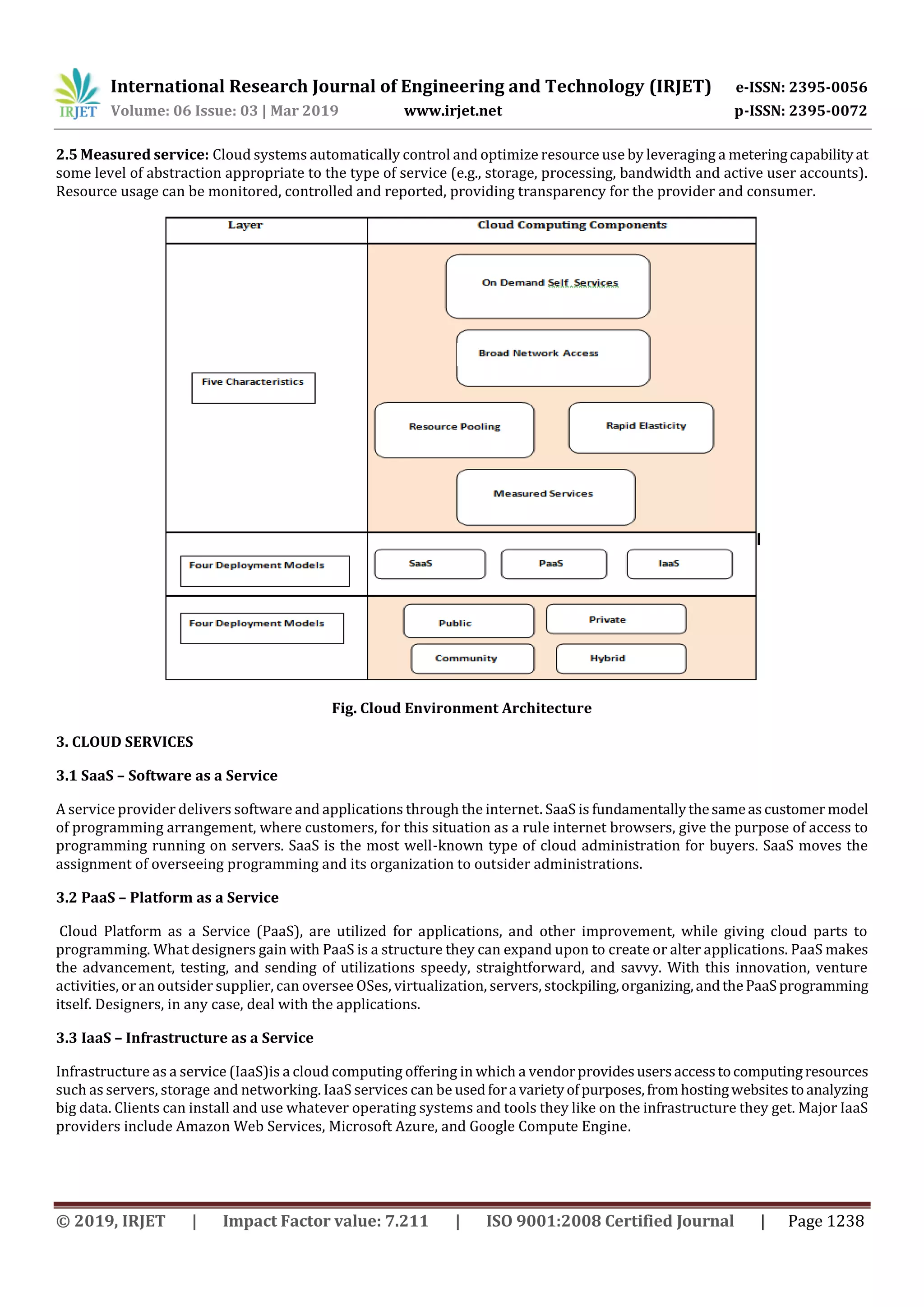
2.1 On-demand self-service: A user can unilaterally provision computing capabilities, such as server time and network
storage, as needed automatically without requiring human interaction with each service provider.
2.2 Broad network access: Capabilities are available over the network and accessed through standard mechanisms that
promote use by heterogeneous thin or thick client platforms (e.g., mobile phones, tablets, laptops and workstations).
2.3 Resource pooling: The provider's computing resources are pooled to serve multiple consumers using a multi-tenant
model, with different physical and virtual resources dynamically assigned and reassigned according to consumer demand.
There is a sense of location independence in that the customer generally has no control orknowledgeovertheexactlocation of
the provided resources but may be able to specify location at a higher level of abstraction (e.g., country, state or datacenter).
Examples of resources include storage, processing, memory and network bandwidth.
2.4 Rapid elasticity: Capabilities can be elastically provisioned and released, in some cases automatically, to scale rapidly
outward and inward commensurate with demand. To the consumer, the capabilities availableforprovisioningoften appearto
be unlimited and can be appropriated in any quantity at any time.
International Research Journal of Engineering and Technology (IRJET) e-ISSN: 2395-0056
Volume: 06 Issue: 03 | Mar 2019 www.irjet.net p-ISSN: 2395-0072
© 2019, IRJET | Impact Factor value: 7.211 | ISO 9001:2008 Certified Journal | Page 1238
2.5 Measured service: Cloud systems automatically control and optimize resource use by leveraging a meteringcapabilityat
some level of abstraction appropriate to the type of service (e.g., storage, processing, bandwidth and active user accounts).
Resource usage can be monitored, controlled and reported, providing transparency for the provider and consumer.
Fig. Cloud Environment Architecture
3. CLOUD SERVICES
3.1 SaaS – Software as a Service
A service provider delivers software and applications through the internet. SaaS is fundamentallythesameascustomer model
of programming arrangement, where customers, for this situation as a rule internet browsers, give the purpose of access to
programming running on servers. SaaS is the most well-known type of cloud administration for buyers. SaaS moves the
assignment of overseeing programming and its organization to outsider administrations.
3.2 PaaS – Platform as a Service
Cloud Platform as a Service (PaaS), are utilized for applications, and other improvement, while giving cloud parts to
programming. What designers gain with PaaS is a structure they can expand upon to create or alter applications. PaaS makes
the advancement, testing, and sending of utilizations speedy, straightforward, and savvy. With this innovation, venture
activities, or an outsider supplier, can oversee OSes, virtualization, servers, stockpiling,organizing,andthePaaSprogramming
itself. Designers, in any case, deal with the applications.
3.3 IaaS – Infrastructure as a Service
Infrastructure as a service (IaaS)is a cloud computing offering in which a vendorprovidesusersaccesstocomputingresources
such as servers, storage and networking. IaaS services can be usedfora varietyofpurposes,fromhostingwebsites toanalyzing
big data. Clients can install and use whatever operating systems and tools they like on the infrastructure they get. Major IaaS
providers include Amazon Web Services, Microsoft Azure, and Google Compute Engine.
International Research Journal of Engineering and Technology (IRJET) e-ISSN: 2395-0056
Volume: 06 Issue: 03 | Mar 2019 www.irjet.net p-ISSN: 2395-0072
© 2019, IRJET | Impact Factor value: 7.211 | ISO 9001:2008 Certified Journal | Page 1239
4. TYPES OF CLOUD COMPUTING
4.1 Private Cloud
Private clouds are used for single user as well as small scale organization dealing with data protection and serviceslevel issue.
It can access by only single user or authorized persons. Data access capacity of these cloud is limited. It is secure cloud based
environment in which only the specified client can operate.
4.2 Public Cloud
Public cloud is used for big organization where number of user can access butitisnotmoresecureascomparetoprivatecloud.
A public cloud is a type of computing in which a service provider makes resources available to the public via the internet.
Resources vary by provider but may include storage capabilities, applications or virtual machines. Public cloud allows for
scalability and resource sharing that would not otherwise be possible for a single organization to achieve.
4.3 Hybrid Cloud
Hybrid cloud is combination of private and public cloud. Hybrid cloud computing gives businesses the ability to seamlessly
scale their on-premises infrastructure up to the public cloud to handle any overflow without giving third-party datacenters
access to the entirety of their data.
5. MODULES
5.1 Admin Module
This module is responsible for authentication of client. User authentication is often the primary basis for access control.
Authentication provides the access permission to only the authorized users and restricts the unauthorizedusers.Thismodule
also maintains data of user as like total login time.
5.2 Client Module
This module is responsible for UI Design of client .UI is designed by Jsp,Html,JavaScript,CSS, andJQueryetc.Inthis module,the
client can send the query to the server for different requirement. Clientmoduleisalsoresponsibleforshowretrievedinproper
format means it also user friendly Design. It also responsible for client side validation for client pages.
6. ALGORITHMS
1. AES
The Advanced Encryption Standard (AES) is an encryption algorithm designed for securing electronic data established by the
U.S National Institute of Standards and Technology (NIST) in 2001. AES is based on Rijndael cipher developed by
cryptographers Joan Daemen and Vincent Rijmen. AES is currently available in three key sizes: 128, 192 and 256 bits. When
migration of data to the chosen CSP happens and in future whenever an application uploads any data on cloud, the data will
first encrypted using AES algorithm and then sent to provider. Once encrypted, data is uploaded on the cloud, any request to
read the data will occur after it is decrypted on the users end and then plain text data can be read by user. The plaintext data is
never written anywhere on cloud. This includes all types of data.
2. Secret sharing
Data stored in the cloud can be compromised or lost. So, we have to come up with a way to secure those files. We can encrypt
them before storing them in the cloud, which sorts out the disclosure aspects. The goal is to divide is secrets into piece of data
D1,…,Dn Such way that:
1. Knowledge of any k or more Di piece makes S easily computable.
2. Knowledge of any k-1 or any fewer Di piece makes leaves S completely undetermined(in this all possible values are equally
likely).This scheme is called as (k,n) threshold scheme. If k=n the all participants required to reconstruct secret.
International Research Journal of Engineering and Technology (IRJET) e-ISSN: 2395-0056
Volume: 06 Issue: 03 | Mar 2019 www.irjet.net p-ISSN: 2395-0072
© 2019, IRJET | Impact Factor value: 7.211 | ISO 9001:2008 Certified Journal | Page 1240
7. CONCLUSION
The purpose of this work is to survey the recent research on single clouds and multi-cloudsusing.Tosecuring data, encryption
and secret sharing algorithms are the techniquesused extensivelytosecure data.Alsointhispaperencryptionalgorithmshave
been proposed to make cloud data secure, vulnerable and gave concern to security issues, challenges and also comparisons
have been made between AES algorithms to find the best one encryption algorithm, which has to be used in cloud computing
for making cloud data secure and not to be hacked by attackers. Encryption algorithms play an important role in data security
on cloud and by comparison of different parameters used in algorithms, it has been found thatAESalgorithmusesleasttimeto
execute cloud data. DES algorithm consumes least encrypt-ion time. RSA consumes longest memory size and encryptiontime.
We have found that much research has been done to ensure the security of the single cloud and cloud storage whereas multi
clouds have received less attention in the area of security. We support the migration to multi-clouds due to its ability to
decrease security risks that affect the cloud computing user.
REFERENCES
1. Cloud Computing Security: From Single to Multi-Clouds, 2012, 45th Hawaii International Conference on System
Sciences.
2. Data Security In Cloud Computing, “International Journal of Science and Research” Volume 3 Issue 10, October 2014.
3. Data Security in Cloud “International Conference on Energy, Communication, Data Analytics and Soft Computing
(ICECDS-2017)”.
4. Data Secure in Cloud Computing Using EncryptionAlgorithms“International Journal of ScienceandResearch”,Volume
4 Issue 3, March 2015.
5. Data Security and Authentication in Hybrid Cloud Computing Model ” 2012 IEEE Global High Tech Congress on
Electronics”
6. Zhidong Shen, Li Li , Fei Yan, Xiaoping Wu , Cloud Computing System Based on Trusted Computing Platform,
International Conference on Intelligent Computation Technology and Automation, Volume 1, May 2010, On page(s):
942-945.
7. Pearson, S., Benameur, A., Privacy, Security and Trust Issues Arises from Cloud Computing, Cloud Computing
Technology and Science (Cloud Com), IEEE Second International Conference 2010, On page(s): 693-702.
8. Rohit Bhadauria and Sugata Sanyal, A Survey on Security Issues in Cloud Computing and Associated Mitigation
Techniques. International Journal of Computer Applications, Volume 47- Number 18, June 2012, On page(s): 47-66.
9. Gaidhankar Sushil, Kanase Amit, Lonkar Tushar, Patil Chetan "Multi-Cloud Storage Using Shamir’s Secret Sharing
Algorithm ", Volume 1 issue 7,December 2014.
10. J. Archer, A. Boehm, “Security Guidance for Critical Areas of Focus in Cloud Computing”, Cloud Security Alliance,
December 2009.
11. Seema L. Vandure , Jevi V. Gudaganavar “Security and data privacy in clouds”,2010
BIOGRAPHIES
Ms. Pragati Damodar Hipparkar is currently pursuing B.E (computer) from Dept. of Computer Science
and Engineering, Shriram Institute Of EngineeringandTechnologyCentre, Paniv,Maharashtra,India.She
has received Diploma (Computer Tech.)Sahakar MarasheShankarroMohitePatil InstituteOfTechnology
Research Shankarnagar Akluj. Her area of interest is Network Security, Developing.
Ms. Priyanka Vijay Kadganchi is currently pursuing B.E (computer) from Dept. of Computer Science and
Engineering, Shriram Institute Of Engineering and TechnologyCentre, Paniv,Maharashtra,India.Shehas
received Diploma (Computer Tech.) fromShriramInstituteOfEngineeringandTechnology(Poly.),Paniv.
Her area of interest Is Network Security.
International Research Journal of Engineering and Technology (IRJET) e-ISSN: 2395-0056
Volume: 06 Issue: 03 | Mar 2019 www.irjet.net p-ISSN: 2395-0072
© 2019, IRJET | Impact Factor value: 7.211 | ISO 9001:2008 Certified Journal | Page 1241
Ms. Sujata Vitthal Karche is currently pursuing B.E (computer) from Dept. of Computer Science and
Engineering, Shriram Institute Of Engineering and Technology Centre, Paniv, Maharashtra, India. Her
area of interest Is Network Security.
Prof. Ganesh Maruti Shinde is currently working HOD of CSE Department at Shriram Institute of
Engineering and Technology Centre, Paniv, Maharashtra, India. He has received M.E(IT) from DKGOI
FOE, Daund. B.E (computer) from Dept. of ComputerScienceandEngineeringfromSB patil CoEIndapur.
Maharashtra, India. Her area of interest Is Network Security and Operating 6 year Experience of
professor).

IRJET- Single to Multi Cloud Data Security in Cloud Computing

  • 1.
    International Research Journalof Engineering and Technology (IRJET) e-ISSN: 2395-0056 Volume: 06 Issue: 03 | Mar 2019 www.irjet.net p-ISSN: 2395-0072 © 2019, IRJET | Impact Factor value: 7.211 | ISO 9001:2008 Certified Journal | Page 1237 Single to Multi Cloud Data Security in Cloud Computing Hipparkar Pragati Damodar1, Kadganchi Priyanka Vijay2, Karche Sujata Vitthal3, Prof. Shinde Ganesh Maruti4 1,2,3,4Department of computer Science and Engineering, Shriram Institute of Engineering and Technology Centre, Paniv-Solapur, Maharashtra, India. ---------------------------------------------------------------------***---------------------------------------------------------------------- Abstract –Cloud computing is internet based. Resource sharing in a pure plug and play model that dramatically simplifies infrastructure planning is the promise of “cloud computing”. The two key advantages ofcloudcomputingareease-of-useandcost- effectiveness. The cloud stores the large amount of data on single cloud as well as multi cloud. Here we implemented the single to multi cloud concept. Single cloud is less popular because is to risky of service availability failureandpossibilityofmaliciousinsider single cloud. So the multi cloud concept becomes to increase cloud security. This paper aims to promote the use of multi cloud due to its ability to reduce security risks that affect the cloud users. Key Words: Security, Single cloud, Multi-cloud, AES, Secrete sharing, User, Admin. 1. INTRODUCTION The internet is the interconnection of thousands of networks. The ARPANET began as a US Government experiment back in 1969. ARPA , the Department of Defence (DoD) advanced research project agency, initially linked researchers with a remote computer centers, allowing them to share hardware and software resources such as computer disk space, databases and computers. Later, this was shortened as ―Internet. Cloudconceptgeneratedfromtheinternet. Therearedifferenttypeofcloud services: SaaS, PaaS, IaaS. The underlying concept dates back to 1960 when John McCarthy opined that "computation may someday be organized as a public utility"; indeed it shares characteristics with service bureaus which date back to the 1960s. The term cloud had already come into commercial use in the early 1990s to refer to large ATM networks. By the turn of the 21st century, the term "cloud computing" had started to appear, although most of the focus at this time was on Software as a service (SaaS). While these internet-based online services do provide huge amounts of storage space and customizable computing resources, this computing platform shift, however, is eliminating the responsibility of local machines for data maintenance at the same time. As a result, users are at the mercy of their cloud service providers for the availability and integrity of their data. Clod computing is computing paradigm, where large pool of system are connected in private or public networks, to provide dynamically scalable infrastructure for application data and file storage. The proposed work considers data storage in Cloud Computing. Our contribution can be summarizedasthefollowingaspects: 1) The proposed work aims at data storage and efficient operations on data blocks. 2) The unauthorized users are prevented from accessing the data stored in cloud by using encryption and decryptionandalso the admin can block such users IP addresses. Client can’t access and fetch resource which is stored in server until admin gives privilege to respective users. 2. Characteristics of Cloud 2.1 On-demand self-service: A user can unilaterally provision computing capabilities, such as server time and network storage, as needed automatically without requiring human interaction with each service provider. 2.2 Broad network access: Capabilities are available over the network and accessed through standard mechanisms that promote use by heterogeneous thin or thick client platforms (e.g., mobile phones, tablets, laptops and workstations). 2.3 Resource pooling: The provider's computing resources are pooled to serve multiple consumers using a multi-tenant model, with different physical and virtual resources dynamically assigned and reassigned according to consumer demand. There is a sense of location independence in that the customer generally has no control orknowledgeovertheexactlocation of the provided resources but may be able to specify location at a higher level of abstraction (e.g., country, state or datacenter). Examples of resources include storage, processing, memory and network bandwidth. 2.4 Rapid elasticity: Capabilities can be elastically provisioned and released, in some cases automatically, to scale rapidly outward and inward commensurate with demand. To the consumer, the capabilities availableforprovisioningoften appearto be unlimited and can be appropriated in any quantity at any time.
  • 2.
    International Research Journalof Engineering and Technology (IRJET) e-ISSN: 2395-0056 Volume: 06 Issue: 03 | Mar 2019 www.irjet.net p-ISSN: 2395-0072 © 2019, IRJET | Impact Factor value: 7.211 | ISO 9001:2008 Certified Journal | Page 1238 2.5 Measured service: Cloud systems automatically control and optimize resource use by leveraging a meteringcapabilityat some level of abstraction appropriate to the type of service (e.g., storage, processing, bandwidth and active user accounts). Resource usage can be monitored, controlled and reported, providing transparency for the provider and consumer. Fig. Cloud Environment Architecture 3. CLOUD SERVICES 3.1 SaaS – Software as a Service A service provider delivers software and applications through the internet. SaaS is fundamentallythesameascustomer model of programming arrangement, where customers, for this situation as a rule internet browsers, give the purpose of access to programming running on servers. SaaS is the most well-known type of cloud administration for buyers. SaaS moves the assignment of overseeing programming and its organization to outsider administrations. 3.2 PaaS – Platform as a Service Cloud Platform as a Service (PaaS), are utilized for applications, and other improvement, while giving cloud parts to programming. What designers gain with PaaS is a structure they can expand upon to create or alter applications. PaaS makes the advancement, testing, and sending of utilizations speedy, straightforward, and savvy. With this innovation, venture activities, or an outsider supplier, can oversee OSes, virtualization, servers, stockpiling,organizing,andthePaaSprogramming itself. Designers, in any case, deal with the applications. 3.3 IaaS – Infrastructure as a Service Infrastructure as a service (IaaS)is a cloud computing offering in which a vendorprovidesusersaccesstocomputingresources such as servers, storage and networking. IaaS services can be usedfora varietyofpurposes,fromhostingwebsites toanalyzing big data. Clients can install and use whatever operating systems and tools they like on the infrastructure they get. Major IaaS providers include Amazon Web Services, Microsoft Azure, and Google Compute Engine.
  • 3.
    International Research Journalof Engineering and Technology (IRJET) e-ISSN: 2395-0056 Volume: 06 Issue: 03 | Mar 2019 www.irjet.net p-ISSN: 2395-0072 © 2019, IRJET | Impact Factor value: 7.211 | ISO 9001:2008 Certified Journal | Page 1239 4. TYPES OF CLOUD COMPUTING 4.1 Private Cloud Private clouds are used for single user as well as small scale organization dealing with data protection and serviceslevel issue. It can access by only single user or authorized persons. Data access capacity of these cloud is limited. It is secure cloud based environment in which only the specified client can operate. 4.2 Public Cloud Public cloud is used for big organization where number of user can access butitisnotmoresecureascomparetoprivatecloud. A public cloud is a type of computing in which a service provider makes resources available to the public via the internet. Resources vary by provider but may include storage capabilities, applications or virtual machines. Public cloud allows for scalability and resource sharing that would not otherwise be possible for a single organization to achieve. 4.3 Hybrid Cloud Hybrid cloud is combination of private and public cloud. Hybrid cloud computing gives businesses the ability to seamlessly scale their on-premises infrastructure up to the public cloud to handle any overflow without giving third-party datacenters access to the entirety of their data. 5. MODULES 5.1 Admin Module This module is responsible for authentication of client. User authentication is often the primary basis for access control. Authentication provides the access permission to only the authorized users and restricts the unauthorizedusers.Thismodule also maintains data of user as like total login time. 5.2 Client Module This module is responsible for UI Design of client .UI is designed by Jsp,Html,JavaScript,CSS, andJQueryetc.Inthis module,the client can send the query to the server for different requirement. Clientmoduleisalsoresponsibleforshowretrievedinproper format means it also user friendly Design. It also responsible for client side validation for client pages. 6. ALGORITHMS 1. AES The Advanced Encryption Standard (AES) is an encryption algorithm designed for securing electronic data established by the U.S National Institute of Standards and Technology (NIST) in 2001. AES is based on Rijndael cipher developed by cryptographers Joan Daemen and Vincent Rijmen. AES is currently available in three key sizes: 128, 192 and 256 bits. When migration of data to the chosen CSP happens and in future whenever an application uploads any data on cloud, the data will first encrypted using AES algorithm and then sent to provider. Once encrypted, data is uploaded on the cloud, any request to read the data will occur after it is decrypted on the users end and then plain text data can be read by user. The plaintext data is never written anywhere on cloud. This includes all types of data. 2. Secret sharing Data stored in the cloud can be compromised or lost. So, we have to come up with a way to secure those files. We can encrypt them before storing them in the cloud, which sorts out the disclosure aspects. The goal is to divide is secrets into piece of data D1,…,Dn Such way that: 1. Knowledge of any k or more Di piece makes S easily computable. 2. Knowledge of any k-1 or any fewer Di piece makes leaves S completely undetermined(in this all possible values are equally likely).This scheme is called as (k,n) threshold scheme. If k=n the all participants required to reconstruct secret.
  • 4.
    International Research Journalof Engineering and Technology (IRJET) e-ISSN: 2395-0056 Volume: 06 Issue: 03 | Mar 2019 www.irjet.net p-ISSN: 2395-0072 © 2019, IRJET | Impact Factor value: 7.211 | ISO 9001:2008 Certified Journal | Page 1240 7. CONCLUSION The purpose of this work is to survey the recent research on single clouds and multi-cloudsusing.Tosecuring data, encryption and secret sharing algorithms are the techniquesused extensivelytosecure data.Alsointhispaperencryptionalgorithmshave been proposed to make cloud data secure, vulnerable and gave concern to security issues, challenges and also comparisons have been made between AES algorithms to find the best one encryption algorithm, which has to be used in cloud computing for making cloud data secure and not to be hacked by attackers. Encryption algorithms play an important role in data security on cloud and by comparison of different parameters used in algorithms, it has been found thatAESalgorithmusesleasttimeto execute cloud data. DES algorithm consumes least encrypt-ion time. RSA consumes longest memory size and encryptiontime. We have found that much research has been done to ensure the security of the single cloud and cloud storage whereas multi clouds have received less attention in the area of security. We support the migration to multi-clouds due to its ability to decrease security risks that affect the cloud computing user. REFERENCES 1. Cloud Computing Security: From Single to Multi-Clouds, 2012, 45th Hawaii International Conference on System Sciences. 2. Data Security In Cloud Computing, “International Journal of Science and Research” Volume 3 Issue 10, October 2014. 3. Data Security in Cloud “International Conference on Energy, Communication, Data Analytics and Soft Computing (ICECDS-2017)”. 4. Data Secure in Cloud Computing Using EncryptionAlgorithms“International Journal of ScienceandResearch”,Volume 4 Issue 3, March 2015. 5. Data Security and Authentication in Hybrid Cloud Computing Model ” 2012 IEEE Global High Tech Congress on Electronics” 6. Zhidong Shen, Li Li , Fei Yan, Xiaoping Wu , Cloud Computing System Based on Trusted Computing Platform, International Conference on Intelligent Computation Technology and Automation, Volume 1, May 2010, On page(s): 942-945. 7. Pearson, S., Benameur, A., Privacy, Security and Trust Issues Arises from Cloud Computing, Cloud Computing Technology and Science (Cloud Com), IEEE Second International Conference 2010, On page(s): 693-702. 8. Rohit Bhadauria and Sugata Sanyal, A Survey on Security Issues in Cloud Computing and Associated Mitigation Techniques. International Journal of Computer Applications, Volume 47- Number 18, June 2012, On page(s): 47-66. 9. Gaidhankar Sushil, Kanase Amit, Lonkar Tushar, Patil Chetan "Multi-Cloud Storage Using Shamir’s Secret Sharing Algorithm ", Volume 1 issue 7,December 2014. 10. J. Archer, A. Boehm, “Security Guidance for Critical Areas of Focus in Cloud Computing”, Cloud Security Alliance, December 2009. 11. Seema L. Vandure , Jevi V. Gudaganavar “Security and data privacy in clouds”,2010 BIOGRAPHIES Ms. Pragati Damodar Hipparkar is currently pursuing B.E (computer) from Dept. of Computer Science and Engineering, Shriram Institute Of EngineeringandTechnologyCentre, Paniv,Maharashtra,India.She has received Diploma (Computer Tech.)Sahakar MarasheShankarroMohitePatil InstituteOfTechnology Research Shankarnagar Akluj. Her area of interest is Network Security, Developing. Ms. Priyanka Vijay Kadganchi is currently pursuing B.E (computer) from Dept. of Computer Science and Engineering, Shriram Institute Of Engineering and TechnologyCentre, Paniv,Maharashtra,India.Shehas received Diploma (Computer Tech.) fromShriramInstituteOfEngineeringandTechnology(Poly.),Paniv. Her area of interest Is Network Security.
  • 5.
    International Research Journalof Engineering and Technology (IRJET) e-ISSN: 2395-0056 Volume: 06 Issue: 03 | Mar 2019 www.irjet.net p-ISSN: 2395-0072 © 2019, IRJET | Impact Factor value: 7.211 | ISO 9001:2008 Certified Journal | Page 1241 Ms. Sujata Vitthal Karche is currently pursuing B.E (computer) from Dept. of Computer Science and Engineering, Shriram Institute Of Engineering and Technology Centre, Paniv, Maharashtra, India. Her area of interest Is Network Security. Prof. Ganesh Maruti Shinde is currently working HOD of CSE Department at Shriram Institute of Engineering and Technology Centre, Paniv, Maharashtra, India. He has received M.E(IT) from DKGOI FOE, Daund. B.E (computer) from Dept. of ComputerScienceandEngineeringfromSB patil CoEIndapur. Maharashtra, India. Her area of interest Is Network Security and Operating 6 year Experience of professor).