International Research Journal of Engineering and Technology (IRJET) e-ISSN: 2395-0056
Volume: 07 Issue: 04 | Apr 2020 www.irjet.net p-ISSN: 2395-0072
© 2020, IRJET | Impact Factor value: 7.34 | ISO 9001:2008 Certified Journal | Page 737
Precaution of Trolling Intrusions in Online Ballot system
Using Optical Cryptology
V. Prasath Kumar[1], G.V. Jaghannath[2], R. Janani[2], R. Senbahakaviya[2]
*1Assistant Professor, Information Technology, Sri Shakthi Institute of Engineering and Technology, Coimbatore
*2Students, Information Technology, Sri Shakthi Institute of Engineering and Technology, Coimbatore
---------------------------------------------------------------------***----------------------------------------------------------------------
Abstract - In this trending technology in which the online
system is intended to provide work speed, errors are
reduced and the generation of exact results is updated,
making it difficult to have a traditional election system. A
ballot structure itself initiates the foundation of election
related to voters should select their respective ruler. Our
country recently utilizes the traditional ballot structure
that met with different types of troubles. Because our
election system is built on paper ballots, few troubles were
tackled on behalf of people while voting, some more
troubles were tackled by the coordinating team from
registration to declaration of results. Our extended
internet structure involving methods such as registration
of voters, casting of votes, counting of votes, and
declaration of outcome could provide a better suspension
for changing the manual structure with extended process
in these premises would provide favour to people through
any sources such as online or by official authorities. Our
project introduces authentication strategy to balloting
with inclusion of Quick Response-codes with optical
cryptology. They concentrate on accessibility for providing
an accessible scheme to voters with less technical
experience. The only requirement is that the system should
be the inclusion of Quick Response codes must be operated
by the user, most likely a mobiles. It is based on optical
cryptology like the labourer: authentication online ballot
system secret codes where compressed as dim slides
shadow transparencies. Therefore, diapositive does not
convey any details, but the hidden password is exposed
when the layers are combined. In addition, the extended
structure is to reduce danger to manipulation. This
frameworks are suggested by following the consultation
with two departmental authorities, Indian Election
Commission (ECP) and the Network Database and
Registration Authority India (NADRA).NADRA has an
online database of Indian voters and provides digital
National Identity Cards (CNIC) and supports the online
system of various corporations. With their system on line.
Thus, the use of an online system is trouble-free for
grouping all citizens who are all 18 years and older, as
well as validate and secure their data. Key Terms – Visual
cryptology, QR code, voting system.
Key W Key Terms – Visual cryptology, QR code, voting
system.
1. INTRODUCTION
Autonomy is probably an essential aspect in main
contemporary associations. The main essential schemes
in the autonomy where the ballot of surrogates. This is
most likely an intricate structure containing different
interruptions, like idle voters, fraud detection and more
to go. Our paper examines few of troubles, like details
about recent election process of India. In addition this
paper offers a systematic suspension for the troubles
according to models which show the essential troubles.
Affiliated constituency, in a democracy, expresses its will
through community choice. On behalf of the electorate,
these elected communities run the internet ballot
structure, which is essential for examining recent
systematic ballot structure and balloting apparatus
processing in various states. A lot of updated states like
China, Europe. To visualize and execute the voter's
claims, the ballots where nominators have been selected
should moderate to make the outcomes to be precisely
calculated. Looking at the history we analyze that rising-
based polling systems had only a security problem
(elections were not anonymous). Instead, there are at
least three problems with a paper-based polling system
(discussed below). Due to population density the model
shifted from manual election process to traditional-
based voting structure where found. Security is now
essential which the implemented model moves
traditional to the internet nowadays. There is no
workable out there. Due to a lot of security manners, the
updated ballot structure is advisable to use. It takes an
essential part to develop automation ballot structure.
There are also some other problems in India's recent
paper polling system other than the few number of
casting votes. By examining those issues, this
examination is compulsory for creating a system that
modifies those issues as to rectify the system. Electoral
system. In this cryptography a key technique of modern
sociology emerges. Voters can cast their vote in an extra
secure way.
1.1 Objectives of Study
The main goal is for examining recent ballot structure to
provide the internet electoral process that would make
voters to put their ballots in a convenient way by
International Research Journal of Engineering and Technology (IRJET) e-ISSN: 2395-0056
Volume: 07 Issue: 04 | Apr 2020 www.irjet.net p-ISSN: 2395-0072
© 2020, IRJET | Impact Factor value: 7.34 | ISO 9001:2008 Certified Journal | Page 738
utilizing the facilities that would promote casting of
votes while ballots.[7]
2. REVIEW OF LITERATURE
2.1 Introduction
For Updated Internet ballot structure, the current
computerized voting structure needed to be studied to
provide an internet ballot system in various states. The
updated states like China, Europe implemented the
internet ballot system in advance. [11][12].
2.2 Automated Balloting
Software contains indexed sheets, visual scanning ballot
structure, also more updated casting of votes in
booths[3].Electronic voting helps electors to cast their
votes through computerized equipment at an
election[4].It can also be utilized for taking votes
through the online.
2.2.1. Apparatus Counting
Apparatus-understandable voting structure allows the
balloters to cast the ballots in the polling papers by using
a bold pen to eliminate dirts with the stylus or
mechanical hole puncher from a perforated sheet[1][2].
2.2.2. Systematic Balloting
Apparatus balloting tools seem to be Digital devices
such as Laptops or any other gadgets utilised for bobcats
ballots, that helps for balloting via mouse, touching
panel, through the indicator to note the ballots.
2.2.3. Online Balloting
Internet balloting is coordinated in many methods:
1. Website poll balloting structure which needs the
balloters to approach the official constituency, balloters
can utilize systems to put their ballots. The purpose of
online is to move casted votes to regional tallying
centers from each polling place [6].
2. Regional voting platform voting system that allows
voters to cast their votes at any polling site in a given city
or region [7]. The structure examines the current status
of balloters who have put the ballots already, and
provides each voter with the correct ballot paper based
on where one resides[8].
3. Booth Online Balloting structures which make the
balloters to ballots through convenient locations such as
post offices and shopping malls through the booth which
was instantiated by the voting authority[9]. The KIOSKs
are not constantly monitored by poll workers, and may
require several days or weeks of voting[10].
4. Distant structure allowing balloters to put their
ballots through a convenient internet-connected
computer at home or at work. Home Online balloting
through digitized television, smartphones, as well as via
PCs. Distant Online balloting could utilize the replaced
polling balloting, it could also be utilized through the
non-presence voting [16]. The Internet's dramatic
impact where impacted the discussions related to the
relationship of electronic autonomy and internet
balloting.[14] In the beginning authorities quoted the
Online was capable of replacing leading autonomy, by
making the balloters to put their ballots by pressing the
icons[13]. These views over exploit autonomy. Some
have argued that e-voting could reduce costs and
increase turnout by making voting more convenient.
Of The various forms of alerts, phishing can occur
throughout the voting system[17], so it is important to
prevent social phishing scams or else their effects can
easily spread during an election cycle. Figure 1[17]
provides the geography of the phishing attacks in the
first quarter of 2015.
It is becoming increasingly difficult to create and to go
with the flow of safe analyzing platforms because of
growing online usage with gathering information
through the convenient way[14].
3. SYSTEM ANALYSIS
3.1. Existing System
No requirements of this type of computing stage
structure exist in the region in the present system for
conducting the voting and the entire procedure. There is
also no such application in use in the present status for
the automatic voting system in terms of balloting
framework included in India. Those authorized
authorities shall carry out all step-by-step procedures In
Terms of allocated jobs. But here the truth is that entire
operations were carried out traditionally through the
registration and ended with the publishing of results.
The government wastes a lot of time and money to do
this process manually. Thus the current system is
proving inefficient. The current structure is traditional
rather than online-based. Voters can also put respective
ballots in ballot stations.
3.1.1. Disadvantages of Existing System
1. Costly and Traggy: Gathering information and
grouping is so long expensive to carry out, for example,
the time and money spent on printing forms of data
capture, In preparing allocating places as a group with
authorities after advertising the scheduled days for the
registration process, including sensitizing voters to the
need for grouping, and also the duration taken for listing
the information into the database.
International Research Journal of Engineering and Technology (IRJET) e-ISSN: 2395-0056
Volume: 07 Issue: 04 | Apr 2020 www.irjet.net p-ISSN: 2395-0072
© 2020, IRJET | Impact Factor value: 7.34 | ISO 9001:2008 Certified Journal | Page 739
2. Maximum Paper Usage: maximum paper usage or
paper storage, which is difficult as papers become
voluminous with population size.
3. Bugs while grouping information: Bugs are the
inclusion of humans; in data entry, it is highly unlikely
that humans will be 100 percent efficient.
4. Lack of Enrollment Sheet: Often, enrollment sheets
go missing once it’s completed the information of the
voters, at maximum, it is complicated to cooperate.so
sometimes can’t register it with even though, if people
with citizens of balloting period. They are also involved
in gaining voting rights. Lack of duration to visualize
ballots enrollment: It is a highlighted issue as no one has
time to check and update the voter register during the
given short period of time. Apart from, balloters are
eventually curb of balloting.
3.2. Proposed System
In this updated balloting procedure contains the
essential schemes: voting and executive parts. In voting
function (that could be house, at working area, at special
polling station or any other device) is to perform
authorization of balloting function. Executives go with
initial works like registering voters, candidates
approving, validating the votes, data warehouse
validating, declaring the outcomes. In addition, it is
assumed that an administrator worthy of trust is
available. Besides that, access to the people is a major
part of the balloting procedure, that is the outcome of the
vote could be analyzed, even though the putting of the
ballots was kept in secret.
Some of principal benefits of updated procedure is as
follows
1. Inured to technical problems such as access
interruption, etc., recuperation is uncomplicated.
2. Possibility of configuration by policies and
greater performance for different voting models.
3. Administarator public transparency(release
of voter ID, key, etc)
3.2.1. Advantages
1. Voter registration depends on the user’s filled in the
information. Balloter offers with separate PASSWORD
with ID
2. Every voter's details were locked in the DATA
WAREHOUSE and each user's information is shown in
Database.
4. SYSTEM MODULES
The proposed system consists of two modules:
1. User Module
2. Admin Module
4.1 User Module
The login page contains a user name with a separate
password that she/he can use to log on to the voting
system online. That will be given to the user by the
admin. Upon logging in, the user He has privilege of
viewing the details of nominators and of viewing
outcomes once the election end date is reached. The User
module is one sub module only:
Candidate Registration
This makes it easier to view the registration form by
entering the details and finally submitting the details
within checking the details in the administrator so that
the registration is accepted by your particular details.
Otherwise cross-check the details, your registration will
be rejected immediately as false.
Sign In
All ballots are manually assigned with the admin ballots
are also assigned with the separate name with secret
code for accessing the balloter utilizes the name with
secret code to open, to examine the basic voting rules.
If the wrong username yet password is entered, the user
will be denied access to it. Yet voters can only vote once,
too. That's the protection feature that the device offers
against unauthorized access.
Balloting Structure
The balloters lists the voting login area after login that
contains the further navigation. It assigns balloters join
by entered candidates with their organization attached
with the alternatives to come up the selected nominator
from the enrollment(radio button).if the balloting is
done with before the due date, the ballots will be
consider, otherwise it will be inconsiderate.
Visualize Outcomes
It is a graphic and voter-oriented visualization of the
ballots received by every nominator. This requires the
measures of ballots casted by every single nominator.
Nevertheless, the outcome should be viewed only after
the election's closing date.
International Research Journal of Engineering and Technology (IRJET) e-ISSN: 2395-0056
Volume: 07 Issue: 04 | Apr 2020 www.irjet.net p-ISSN: 2395-0072
© 2020, IRJET | Impact Factor value: 7.34 | ISO 9001:2008 Certified Journal | Page 740
Sign Out
It offers a voter with an option for shutting down the
entire process at once he appears to the voting login
area.
4.1.2. Executive Module
The executive area includes the user name with secret
code that allows users to log in to the voting system
online. Executive has system main control. It will do the
further tasks by signing in to the Initial area.
Add Constituency
Voters List
This can visualize the balloters list.. Each organizations
will be having separate voters list
Candidate List
The election to be carried out is selected here. The
constituency should be selected to add an election, and
the date of termination of the election should be
specified. You can see the list of candidates who took
part in the election. It contains the name, party name and
party symbol of the candidates.
Given sub-modules of administrator are:
1. Voting Structure
2. Voters Enrollment
3. Candidate Registration
4. Counting & Categorization of Results
Voting structure
Here the right to vote may be used by assigned balloters
only allowed for logging the structure. Each voter in his /
her constituency will enroll one ballot for the
nominator’'s wish. The secure percentage adopting the
structure to prevent it without examining the ballots i.e.
then the same user's duplicate balloting is considered as
invalid. Administrator specifies the dates of election
being conducted. The balloter should contain id proof
with the confirmation of his name in enrollment.
Voting Enrollment
Each voter should enroll themselves during the election.
This registration method was performed in an executive
module. Every balloter is issued with the separate secret
codes for balloting, that include the name with unique
codes, In terms of balloters data warehouse.
Voters details including username, password, name,
venue, organisation, picture, also with the enrollment of
users, Group of voters with the given voters information
is thus produced. Anyone who accesses the webpage also
visualizes the balloters form. In the initial area, the
admin can view the voting list.
Candidate Registration
Candidate registration is done by the administrator in
each constituency. The candidate's details include name,
address, gender, constituency, party and image of him /
her. With candidate registration, the candidate list is
thus produced with the candidates ' information given.
The list of candidates can be viewed within their
respective homepages by admin and the vote. According
to candidate’s database (manual) each candidate
informations were locked at admin controlled data
warehouse including the details of the candidate.
Counting & Categorization of Results
When voting, the casted votes for the chosen nominator
will be increased. Then the outcome will only be
announced when the balloting is completed. These
results are accessible after the closing date from the next
day. Here we depict the outcome in the graphic
representation according to the candidate's percentage
of votes. The result can be viewed without any
authentication issue by anyone visiting the site. A link is
kept in the index page to view the result, both executives
with balloters able to visualize the outcome on the
official websites. If the balloters clicks the appropriate
link for the outcome, it will pop up with the messages
and the official result is declared. The outcome is
visualized as the guest mode in the website by showing
the measure of ballots every candidate has obtained.
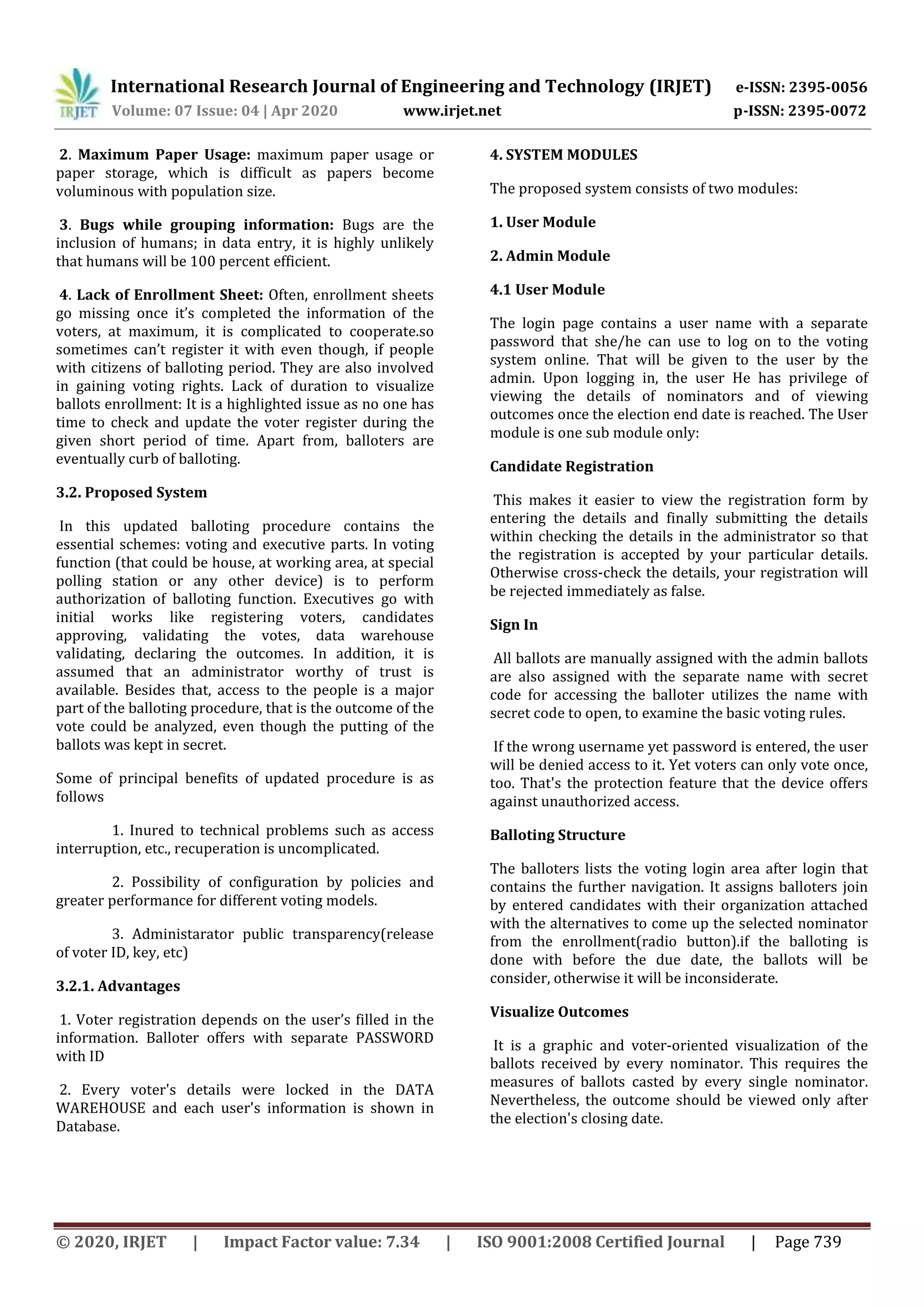
4. Block Diagram
QR Code
A QR code (Quick Response Code) is a combination of
white and black pixels. Black pixels reflect the pixels of
knowledge while white shows empty pixels. It is easier
to read, and has more storage capacity than barcodes.
QR code can be scanned to extract the information via
camera. Originally it was commonly used in the
International Journal of Computer Techniques – Volume
4 Issue 1, January – February 2014 industries but now it
has increased to industrial, entertainment, marketing,
transportation ticketing [12].
5. ALGORITHM
1. To encode, pick the text(Unicode String) or the binary
data(byte string)
2. Choose one of the 4 rates of Error Correction(ECL).A
higher ECC level will yield a barcode tolerating more
damaged parts while preserving the payload data, but
International Research Journal of Engineering and Technology (IRJET) e-ISSN: 2395-0056
Volume: 07 Issue: 04 | Apr 2020 www.irjet.net p-ISSN: 2395-0072
© 2020, IRJET | Impact Factor value: 7.34 | ISO 9001:2008 Certified Journal | Page 741
will tend to increase the number of versions (i.e., more
modules in width and height).
3. Encode the text into a series of segments zero
or more. A segment in byte mode may encode any data
but it is more compact to use alphanumeric or numeric
mode if the text falls into those subsets.
4. Based on the segments to be encoded and the
ECL, choose an appropriate version of QR Code to
contain the data, ideally the smallest.
5. Capture segments (with headers and payload)
and add a terminator. The product is a bits-sequence.
6. To fill out the remaining data space (based on
the version and ECL) add padding bits and bytes.
7. Reinterpret those bitstreams as a byte
sequence, then divide it up into blocks. Compute and add
bytes to each block for error correction. Interleave bytes
from each block to form the final sequence of drawable
8-bit codewords.
8. Initialize a blank square grid based on the
number of versions.
9. Draw feature patterns on those correct
modules (finders, spacing, positioning, version info, etc.);
This is overhead formatting to fit the standard QR code,
and does not encode user data.
10. Draw a sequence of codewords (data + error
correction) onto the QR code symbol, starting at the
bottom right. Two columns are used at a time, and
zigzags of the scanning process go up and down. In this
step any module drawn for a feature pattern is skipped
over.
11. Either choose a mask pattern manually or
automatically that applies to the data modules. If
automatically masking, then all 8 possibilities will be
checked and the one with the lowest penalty score will
be accepted. Note that information about the format is
redrawn to reflect the chosen mask. 12. The algorithmic
parts of QR Code generation are now finished. The rest of
the work is to make the newly generated barcode
symbol as a screen photo, or save it as a disk image file.
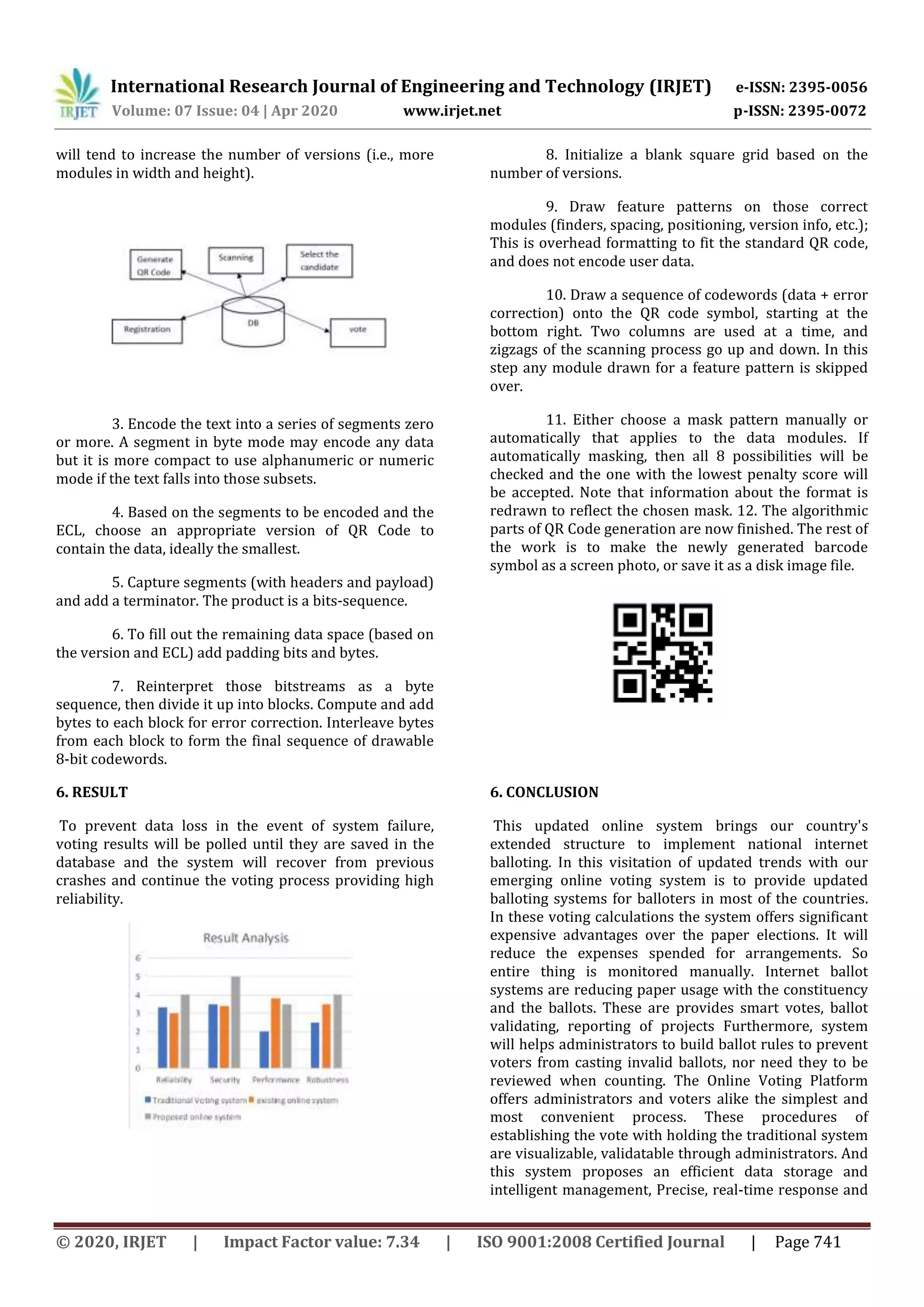
6. RESULT
To prevent data loss in the event of system failure,
voting results will be polled until they are saved in the
database and the system will recover from previous
crashes and continue the voting process providing high
reliability.
6. CONCLUSION
This updated online system brings our country's
extended structure to implement national internet
balloting. In this visitation of updated trends with our
emerging online voting system is to provide updated
balloting systems for balloters in most of the countries.
In these voting calculations the system offers significant
expensive advantages over the paper elections. It will
reduce the expenses spended for arrangements. So
entire thing is monitored manually. Internet ballot
systems are reducing paper usage with the constituency
and the ballots. These are provides smart votes, ballot
validating, reporting of projects Furthermore, system
will helps administrators to build ballot rules to prevent
voters from casting invalid ballots, nor need they to be
reviewed when counting. The Online Voting Platform
offers administrators and voters alike the simplest and
most convenient process. These procedures of
establishing the vote with holding the traditional system
are visualizable, validatable through administrators. And
this system proposes an efficient data storage and
intelligent management, Precise, real-time response and
International Research Journal of Engineering and Technology (IRJET) e-ISSN: 2395-0056
Volume: 07 Issue: 04 | Apr 2020 www.irjet.net p-ISSN: 2395-0072
© 2020, IRJET | Impact Factor value: 7.34 | ISO 9001:2008 Certified Journal | Page 742
user friendly which is the main drawback of the existing
system.
7. FUTURE ENHANCEMENT
We will extend the system capability and can add a SMS
query in the future we will get updates of the results at
the time of counting. We need to register on site with our
mobile number to receive the SMS.
We can also add a Fingerprint module in the online
voting system so that if the user’s fingerprint is already
registered in the system, then user can cast the vote else
the user is not valid for voting.
8. REFERENCES
[1] Authors:Tadayoshi Kohno, Adam Stubblefield,
Aviel D. Rubin, Dan S. Wallach. Proceeding of the
2004 IEEE Symposium on Security and Privacy
(S&P’04) with the topic of “Analysis of Electronic
Voting System”,
[2]Authors: A. D. Rubin. Communications of the ACM
45(12):39–44, Dec. 2002 with the topic of “Security
consideration for remote electronic voting”.
[3] Authors: Adam Stubblefield, Aviel D. Rubin, Dan
S. Wallach, and Tadayoshi kohno with the topic
of“Analysis of an Electronic Voting System”, in IEEE,
May 2004.
[4] Voting: What Is; What Could Be, July
2001.Available:
http://www.vote.caltech.edu/Reports/
[5] Voting, “Gujarat online voting model
system”.Available: http://sec.gujarat.gov.in/e-
voting-system. htm .
[6] Authors:Ashwini Walake, Prof. Ms., Pallavi
Chavan, with the topic of “Efficient Voting system
with (2,2) Secret Sharing Based Authentication”,
(IJCSlT) International Journal of Computer Science
and Information Technologies, Vol. 6 (1), 2015, 410-
412.
[7]Authors: Himanshu Agarwal, G.N.Pandey, with
the topic of“Online Voting System for India Based on
AADHAAR ID”, Eleventh International Conference on
ICT and Knowledge Engineering 2013. [8]Authors:
Pranay R. Pashine, Dhiraj p, Ninave, Mahendra R,
Kelapure, Sushil L. Raut, Rahul S, Rangari, Kamal O.
Hajari, with the topic of “A Remotely Secured
EVoting and Social Governance System Using
Android Platform”, International Journal of
Engineering Trends and Technology (UETT) -
Volume9 Number 13 - Mar 2014. [9]Authors: S.M,
Jambhulkar, Prof. Jagdish B. Chakole, Prof. Praful. R.
Pardhi with the topic of “A Secured Approach for
Web Based Internet Voting System using Multiple
Encryption”, 2014 International Conference on
Electronic Systems, Signal Processing, and
Computing Technologies, 2014.
[10]Authors: Shivendra Katiyar, Kullai Reddy Meka,
Ferdous A, Barbhuiya, Sukumar Nandi, with the
topic of “Online Voting System Powered By
Biometric Security Using Steganography” Second
International Conference on Emerging Applications
of Information Technology, 2011.
[11] Author:Douglas W. Jones, with the topic of “On
Optical Mark-Sense Scanning’’ University of Iowa,
iowa City IA 52242, USA. [12] with the topic of “QR
Code”-wikipedia, the free cyclopedia.
http://en.wikipedia.org/wiki/QR_code .
[13].on may 2015,Based on Network Security,
https://en.wikipedia.org/wiki/Network_security,acc
essed.
[14]On may 2015, Joey Paquet, who is the author
http://users.encs.concordia.ca/~paquet/wiki/index
.php?title= Capability_maturity_ model, accessed.
[15]Authors: Villafiorita A,Weldemariam K, Tiella R,
with the topic of “Development, Formal verification
and evaluation of an e-voting system with
VVPAT”,IEEE Transactions on Information Forensics
and Security, 2009, p.no. 651-661.
[16]Authors: Abdalla Al-Ameen and Samani Talab,
with the topic of “The Technical Feasibility and
Security of E-Voting”, The International Arab Journal
of Information Technology, Vol.10, No.4, July 2013,
p.no.397-404.
[17].https://securelist.com/analysis/quarterly-
spam-reports/6 9932/spam-and-phishing-in-the-
first-quarter-of-2015/, Phishing attack, accessed on
12.09.2015.

IRJET - Precaution of Trolling Intrusions in Online Ballot System using Optical Cryptology

  • 1.
    International Research Journalof Engineering and Technology (IRJET) e-ISSN: 2395-0056 Volume: 07 Issue: 04 | Apr 2020 www.irjet.net p-ISSN: 2395-0072 © 2020, IRJET | Impact Factor value: 7.34 | ISO 9001:2008 Certified Journal | Page 737 Precaution of Trolling Intrusions in Online Ballot system Using Optical Cryptology V. Prasath Kumar[1], G.V. Jaghannath[2], R. Janani[2], R. Senbahakaviya[2] *1Assistant Professor, Information Technology, Sri Shakthi Institute of Engineering and Technology, Coimbatore *2Students, Information Technology, Sri Shakthi Institute of Engineering and Technology, Coimbatore ---------------------------------------------------------------------***---------------------------------------------------------------------- Abstract - In this trending technology in which the online system is intended to provide work speed, errors are reduced and the generation of exact results is updated, making it difficult to have a traditional election system. A ballot structure itself initiates the foundation of election related to voters should select their respective ruler. Our country recently utilizes the traditional ballot structure that met with different types of troubles. Because our election system is built on paper ballots, few troubles were tackled on behalf of people while voting, some more troubles were tackled by the coordinating team from registration to declaration of results. Our extended internet structure involving methods such as registration of voters, casting of votes, counting of votes, and declaration of outcome could provide a better suspension for changing the manual structure with extended process in these premises would provide favour to people through any sources such as online or by official authorities. Our project introduces authentication strategy to balloting with inclusion of Quick Response-codes with optical cryptology. They concentrate on accessibility for providing an accessible scheme to voters with less technical experience. The only requirement is that the system should be the inclusion of Quick Response codes must be operated by the user, most likely a mobiles. It is based on optical cryptology like the labourer: authentication online ballot system secret codes where compressed as dim slides shadow transparencies. Therefore, diapositive does not convey any details, but the hidden password is exposed when the layers are combined. In addition, the extended structure is to reduce danger to manipulation. This frameworks are suggested by following the consultation with two departmental authorities, Indian Election Commission (ECP) and the Network Database and Registration Authority India (NADRA).NADRA has an online database of Indian voters and provides digital National Identity Cards (CNIC) and supports the online system of various corporations. With their system on line. Thus, the use of an online system is trouble-free for grouping all citizens who are all 18 years and older, as well as validate and secure their data. Key Terms – Visual cryptology, QR code, voting system. Key W Key Terms – Visual cryptology, QR code, voting system. 1. INTRODUCTION Autonomy is probably an essential aspect in main contemporary associations. The main essential schemes in the autonomy where the ballot of surrogates. This is most likely an intricate structure containing different interruptions, like idle voters, fraud detection and more to go. Our paper examines few of troubles, like details about recent election process of India. In addition this paper offers a systematic suspension for the troubles according to models which show the essential troubles. Affiliated constituency, in a democracy, expresses its will through community choice. On behalf of the electorate, these elected communities run the internet ballot structure, which is essential for examining recent systematic ballot structure and balloting apparatus processing in various states. A lot of updated states like China, Europe. To visualize and execute the voter's claims, the ballots where nominators have been selected should moderate to make the outcomes to be precisely calculated. Looking at the history we analyze that rising- based polling systems had only a security problem (elections were not anonymous). Instead, there are at least three problems with a paper-based polling system (discussed below). Due to population density the model shifted from manual election process to traditional- based voting structure where found. Security is now essential which the implemented model moves traditional to the internet nowadays. There is no workable out there. Due to a lot of security manners, the updated ballot structure is advisable to use. It takes an essential part to develop automation ballot structure. There are also some other problems in India's recent paper polling system other than the few number of casting votes. By examining those issues, this examination is compulsory for creating a system that modifies those issues as to rectify the system. Electoral system. In this cryptography a key technique of modern sociology emerges. Voters can cast their vote in an extra secure way. 1.1 Objectives of Study The main goal is for examining recent ballot structure to provide the internet electoral process that would make voters to put their ballots in a convenient way by
  • 2.
    International Research Journalof Engineering and Technology (IRJET) e-ISSN: 2395-0056 Volume: 07 Issue: 04 | Apr 2020 www.irjet.net p-ISSN: 2395-0072 © 2020, IRJET | Impact Factor value: 7.34 | ISO 9001:2008 Certified Journal | Page 738 utilizing the facilities that would promote casting of votes while ballots.[7] 2. REVIEW OF LITERATURE 2.1 Introduction For Updated Internet ballot structure, the current computerized voting structure needed to be studied to provide an internet ballot system in various states. The updated states like China, Europe implemented the internet ballot system in advance. [11][12]. 2.2 Automated Balloting Software contains indexed sheets, visual scanning ballot structure, also more updated casting of votes in booths[3].Electronic voting helps electors to cast their votes through computerized equipment at an election[4].It can also be utilized for taking votes through the online. 2.2.1. Apparatus Counting Apparatus-understandable voting structure allows the balloters to cast the ballots in the polling papers by using a bold pen to eliminate dirts with the stylus or mechanical hole puncher from a perforated sheet[1][2]. 2.2.2. Systematic Balloting Apparatus balloting tools seem to be Digital devices such as Laptops or any other gadgets utilised for bobcats ballots, that helps for balloting via mouse, touching panel, through the indicator to note the ballots. 2.2.3. Online Balloting Internet balloting is coordinated in many methods: 1. Website poll balloting structure which needs the balloters to approach the official constituency, balloters can utilize systems to put their ballots. The purpose of online is to move casted votes to regional tallying centers from each polling place [6]. 2. Regional voting platform voting system that allows voters to cast their votes at any polling site in a given city or region [7]. The structure examines the current status of balloters who have put the ballots already, and provides each voter with the correct ballot paper based on where one resides[8]. 3. Booth Online Balloting structures which make the balloters to ballots through convenient locations such as post offices and shopping malls through the booth which was instantiated by the voting authority[9]. The KIOSKs are not constantly monitored by poll workers, and may require several days or weeks of voting[10]. 4. Distant structure allowing balloters to put their ballots through a convenient internet-connected computer at home or at work. Home Online balloting through digitized television, smartphones, as well as via PCs. Distant Online balloting could utilize the replaced polling balloting, it could also be utilized through the non-presence voting [16]. The Internet's dramatic impact where impacted the discussions related to the relationship of electronic autonomy and internet balloting.[14] In the beginning authorities quoted the Online was capable of replacing leading autonomy, by making the balloters to put their ballots by pressing the icons[13]. These views over exploit autonomy. Some have argued that e-voting could reduce costs and increase turnout by making voting more convenient. Of The various forms of alerts, phishing can occur throughout the voting system[17], so it is important to prevent social phishing scams or else their effects can easily spread during an election cycle. Figure 1[17] provides the geography of the phishing attacks in the first quarter of 2015. It is becoming increasingly difficult to create and to go with the flow of safe analyzing platforms because of growing online usage with gathering information through the convenient way[14]. 3. SYSTEM ANALYSIS 3.1. Existing System No requirements of this type of computing stage structure exist in the region in the present system for conducting the voting and the entire procedure. There is also no such application in use in the present status for the automatic voting system in terms of balloting framework included in India. Those authorized authorities shall carry out all step-by-step procedures In Terms of allocated jobs. But here the truth is that entire operations were carried out traditionally through the registration and ended with the publishing of results. The government wastes a lot of time and money to do this process manually. Thus the current system is proving inefficient. The current structure is traditional rather than online-based. Voters can also put respective ballots in ballot stations. 3.1.1. Disadvantages of Existing System 1. Costly and Traggy: Gathering information and grouping is so long expensive to carry out, for example, the time and money spent on printing forms of data capture, In preparing allocating places as a group with authorities after advertising the scheduled days for the registration process, including sensitizing voters to the need for grouping, and also the duration taken for listing the information into the database.
  • 3.
    International Research Journalof Engineering and Technology (IRJET) e-ISSN: 2395-0056 Volume: 07 Issue: 04 | Apr 2020 www.irjet.net p-ISSN: 2395-0072 © 2020, IRJET | Impact Factor value: 7.34 | ISO 9001:2008 Certified Journal | Page 739 2. Maximum Paper Usage: maximum paper usage or paper storage, which is difficult as papers become voluminous with population size. 3. Bugs while grouping information: Bugs are the inclusion of humans; in data entry, it is highly unlikely that humans will be 100 percent efficient. 4. Lack of Enrollment Sheet: Often, enrollment sheets go missing once it’s completed the information of the voters, at maximum, it is complicated to cooperate.so sometimes can’t register it with even though, if people with citizens of balloting period. They are also involved in gaining voting rights. Lack of duration to visualize ballots enrollment: It is a highlighted issue as no one has time to check and update the voter register during the given short period of time. Apart from, balloters are eventually curb of balloting. 3.2. Proposed System In this updated balloting procedure contains the essential schemes: voting and executive parts. In voting function (that could be house, at working area, at special polling station or any other device) is to perform authorization of balloting function. Executives go with initial works like registering voters, candidates approving, validating the votes, data warehouse validating, declaring the outcomes. In addition, it is assumed that an administrator worthy of trust is available. Besides that, access to the people is a major part of the balloting procedure, that is the outcome of the vote could be analyzed, even though the putting of the ballots was kept in secret. Some of principal benefits of updated procedure is as follows 1. Inured to technical problems such as access interruption, etc., recuperation is uncomplicated. 2. Possibility of configuration by policies and greater performance for different voting models. 3. Administarator public transparency(release of voter ID, key, etc) 3.2.1. Advantages 1. Voter registration depends on the user’s filled in the information. Balloter offers with separate PASSWORD with ID 2. Every voter's details were locked in the DATA WAREHOUSE and each user's information is shown in Database. 4. SYSTEM MODULES The proposed system consists of two modules: 1. User Module 2. Admin Module 4.1 User Module The login page contains a user name with a separate password that she/he can use to log on to the voting system online. That will be given to the user by the admin. Upon logging in, the user He has privilege of viewing the details of nominators and of viewing outcomes once the election end date is reached. The User module is one sub module only: Candidate Registration This makes it easier to view the registration form by entering the details and finally submitting the details within checking the details in the administrator so that the registration is accepted by your particular details. Otherwise cross-check the details, your registration will be rejected immediately as false. Sign In All ballots are manually assigned with the admin ballots are also assigned with the separate name with secret code for accessing the balloter utilizes the name with secret code to open, to examine the basic voting rules. If the wrong username yet password is entered, the user will be denied access to it. Yet voters can only vote once, too. That's the protection feature that the device offers against unauthorized access. Balloting Structure The balloters lists the voting login area after login that contains the further navigation. It assigns balloters join by entered candidates with their organization attached with the alternatives to come up the selected nominator from the enrollment(radio button).if the balloting is done with before the due date, the ballots will be consider, otherwise it will be inconsiderate. Visualize Outcomes It is a graphic and voter-oriented visualization of the ballots received by every nominator. This requires the measures of ballots casted by every single nominator. Nevertheless, the outcome should be viewed only after the election's closing date.
  • 4.
    International Research Journalof Engineering and Technology (IRJET) e-ISSN: 2395-0056 Volume: 07 Issue: 04 | Apr 2020 www.irjet.net p-ISSN: 2395-0072 © 2020, IRJET | Impact Factor value: 7.34 | ISO 9001:2008 Certified Journal | Page 740 Sign Out It offers a voter with an option for shutting down the entire process at once he appears to the voting login area. 4.1.2. Executive Module The executive area includes the user name with secret code that allows users to log in to the voting system online. Executive has system main control. It will do the further tasks by signing in to the Initial area. Add Constituency Voters List This can visualize the balloters list.. Each organizations will be having separate voters list Candidate List The election to be carried out is selected here. The constituency should be selected to add an election, and the date of termination of the election should be specified. You can see the list of candidates who took part in the election. It contains the name, party name and party symbol of the candidates. Given sub-modules of administrator are: 1. Voting Structure 2. Voters Enrollment 3. Candidate Registration 4. Counting & Categorization of Results Voting structure Here the right to vote may be used by assigned balloters only allowed for logging the structure. Each voter in his / her constituency will enroll one ballot for the nominator’'s wish. The secure percentage adopting the structure to prevent it without examining the ballots i.e. then the same user's duplicate balloting is considered as invalid. Administrator specifies the dates of election being conducted. The balloter should contain id proof with the confirmation of his name in enrollment. Voting Enrollment Each voter should enroll themselves during the election. This registration method was performed in an executive module. Every balloter is issued with the separate secret codes for balloting, that include the name with unique codes, In terms of balloters data warehouse. Voters details including username, password, name, venue, organisation, picture, also with the enrollment of users, Group of voters with the given voters information is thus produced. Anyone who accesses the webpage also visualizes the balloters form. In the initial area, the admin can view the voting list. Candidate Registration Candidate registration is done by the administrator in each constituency. The candidate's details include name, address, gender, constituency, party and image of him / her. With candidate registration, the candidate list is thus produced with the candidates ' information given. The list of candidates can be viewed within their respective homepages by admin and the vote. According to candidate’s database (manual) each candidate informations were locked at admin controlled data warehouse including the details of the candidate. Counting & Categorization of Results When voting, the casted votes for the chosen nominator will be increased. Then the outcome will only be announced when the balloting is completed. These results are accessible after the closing date from the next day. Here we depict the outcome in the graphic representation according to the candidate's percentage of votes. The result can be viewed without any authentication issue by anyone visiting the site. A link is kept in the index page to view the result, both executives with balloters able to visualize the outcome on the official websites. If the balloters clicks the appropriate link for the outcome, it will pop up with the messages and the official result is declared. The outcome is visualized as the guest mode in the website by showing the measure of ballots every candidate has obtained. 4. Block Diagram QR Code A QR code (Quick Response Code) is a combination of white and black pixels. Black pixels reflect the pixels of knowledge while white shows empty pixels. It is easier to read, and has more storage capacity than barcodes. QR code can be scanned to extract the information via camera. Originally it was commonly used in the International Journal of Computer Techniques – Volume 4 Issue 1, January – February 2014 industries but now it has increased to industrial, entertainment, marketing, transportation ticketing [12]. 5. ALGORITHM 1. To encode, pick the text(Unicode String) or the binary data(byte string) 2. Choose one of the 4 rates of Error Correction(ECL).A higher ECC level will yield a barcode tolerating more damaged parts while preserving the payload data, but
  • 5.
    International Research Journalof Engineering and Technology (IRJET) e-ISSN: 2395-0056 Volume: 07 Issue: 04 | Apr 2020 www.irjet.net p-ISSN: 2395-0072 © 2020, IRJET | Impact Factor value: 7.34 | ISO 9001:2008 Certified Journal | Page 741 will tend to increase the number of versions (i.e., more modules in width and height). 3. Encode the text into a series of segments zero or more. A segment in byte mode may encode any data but it is more compact to use alphanumeric or numeric mode if the text falls into those subsets. 4. Based on the segments to be encoded and the ECL, choose an appropriate version of QR Code to contain the data, ideally the smallest. 5. Capture segments (with headers and payload) and add a terminator. The product is a bits-sequence. 6. To fill out the remaining data space (based on the version and ECL) add padding bits and bytes. 7. Reinterpret those bitstreams as a byte sequence, then divide it up into blocks. Compute and add bytes to each block for error correction. Interleave bytes from each block to form the final sequence of drawable 8-bit codewords. 8. Initialize a blank square grid based on the number of versions. 9. Draw feature patterns on those correct modules (finders, spacing, positioning, version info, etc.); This is overhead formatting to fit the standard QR code, and does not encode user data. 10. Draw a sequence of codewords (data + error correction) onto the QR code symbol, starting at the bottom right. Two columns are used at a time, and zigzags of the scanning process go up and down. In this step any module drawn for a feature pattern is skipped over. 11. Either choose a mask pattern manually or automatically that applies to the data modules. If automatically masking, then all 8 possibilities will be checked and the one with the lowest penalty score will be accepted. Note that information about the format is redrawn to reflect the chosen mask. 12. The algorithmic parts of QR Code generation are now finished. The rest of the work is to make the newly generated barcode symbol as a screen photo, or save it as a disk image file. 6. RESULT To prevent data loss in the event of system failure, voting results will be polled until they are saved in the database and the system will recover from previous crashes and continue the voting process providing high reliability. 6. CONCLUSION This updated online system brings our country's extended structure to implement national internet balloting. In this visitation of updated trends with our emerging online voting system is to provide updated balloting systems for balloters in most of the countries. In these voting calculations the system offers significant expensive advantages over the paper elections. It will reduce the expenses spended for arrangements. So entire thing is monitored manually. Internet ballot systems are reducing paper usage with the constituency and the ballots. These are provides smart votes, ballot validating, reporting of projects Furthermore, system will helps administrators to build ballot rules to prevent voters from casting invalid ballots, nor need they to be reviewed when counting. The Online Voting Platform offers administrators and voters alike the simplest and most convenient process. These procedures of establishing the vote with holding the traditional system are visualizable, validatable through administrators. And this system proposes an efficient data storage and intelligent management, Precise, real-time response and
  • 6.
    International Research Journalof Engineering and Technology (IRJET) e-ISSN: 2395-0056 Volume: 07 Issue: 04 | Apr 2020 www.irjet.net p-ISSN: 2395-0072 © 2020, IRJET | Impact Factor value: 7.34 | ISO 9001:2008 Certified Journal | Page 742 user friendly which is the main drawback of the existing system. 7. FUTURE ENHANCEMENT We will extend the system capability and can add a SMS query in the future we will get updates of the results at the time of counting. We need to register on site with our mobile number to receive the SMS. We can also add a Fingerprint module in the online voting system so that if the user’s fingerprint is already registered in the system, then user can cast the vote else the user is not valid for voting. 8. REFERENCES [1] Authors:Tadayoshi Kohno, Adam Stubblefield, Aviel D. Rubin, Dan S. Wallach. Proceeding of the 2004 IEEE Symposium on Security and Privacy (S&P’04) with the topic of “Analysis of Electronic Voting System”, [2]Authors: A. D. Rubin. Communications of the ACM 45(12):39–44, Dec. 2002 with the topic of “Security consideration for remote electronic voting”. [3] Authors: Adam Stubblefield, Aviel D. Rubin, Dan S. Wallach, and Tadayoshi kohno with the topic of“Analysis of an Electronic Voting System”, in IEEE, May 2004. [4] Voting: What Is; What Could Be, July 2001.Available: http://www.vote.caltech.edu/Reports/ [5] Voting, “Gujarat online voting model system”.Available: http://sec.gujarat.gov.in/e- voting-system. htm . [6] Authors:Ashwini Walake, Prof. Ms., Pallavi Chavan, with the topic of “Efficient Voting system with (2,2) Secret Sharing Based Authentication”, (IJCSlT) International Journal of Computer Science and Information Technologies, Vol. 6 (1), 2015, 410- 412. [7]Authors: Himanshu Agarwal, G.N.Pandey, with the topic of“Online Voting System for India Based on AADHAAR ID”, Eleventh International Conference on ICT and Knowledge Engineering 2013. [8]Authors: Pranay R. Pashine, Dhiraj p, Ninave, Mahendra R, Kelapure, Sushil L. Raut, Rahul S, Rangari, Kamal O. Hajari, with the topic of “A Remotely Secured EVoting and Social Governance System Using Android Platform”, International Journal of Engineering Trends and Technology (UETT) - Volume9 Number 13 - Mar 2014. [9]Authors: S.M, Jambhulkar, Prof. Jagdish B. Chakole, Prof. Praful. R. Pardhi with the topic of “A Secured Approach for Web Based Internet Voting System using Multiple Encryption”, 2014 International Conference on Electronic Systems, Signal Processing, and Computing Technologies, 2014. [10]Authors: Shivendra Katiyar, Kullai Reddy Meka, Ferdous A, Barbhuiya, Sukumar Nandi, with the topic of “Online Voting System Powered By Biometric Security Using Steganography” Second International Conference on Emerging Applications of Information Technology, 2011. [11] Author:Douglas W. Jones, with the topic of “On Optical Mark-Sense Scanning’’ University of Iowa, iowa City IA 52242, USA. [12] with the topic of “QR Code”-wikipedia, the free cyclopedia. http://en.wikipedia.org/wiki/QR_code . [13].on may 2015,Based on Network Security, https://en.wikipedia.org/wiki/Network_security,acc essed. [14]On may 2015, Joey Paquet, who is the author http://users.encs.concordia.ca/~paquet/wiki/index .php?title= Capability_maturity_ model, accessed. [15]Authors: Villafiorita A,Weldemariam K, Tiella R, with the topic of “Development, Formal verification and evaluation of an e-voting system with VVPAT”,IEEE Transactions on Information Forensics and Security, 2009, p.no. 651-661. [16]Authors: Abdalla Al-Ameen and Samani Talab, with the topic of “The Technical Feasibility and Security of E-Voting”, The International Arab Journal of Information Technology, Vol.10, No.4, July 2013, p.no.397-404. [17].https://securelist.com/analysis/quarterly- spam-reports/6 9932/spam-and-phishing-in-the- first-quarter-of-2015/, Phishing attack, accessed on 12.09.2015.