PROJECT SYNOPSIS ON ONLINE VOTING SYSTEM 
Submited by : 
Mrs. Lhakpa yangjee Sherpa 
University Reg No. 1208022961 
Campus Roll no. 123151447 
Bsc IT 3rd semester 
Date:May 27, 2014 
Submitted to : 
Lord Buddha Education Foundation Opp, Maitidevi temple 
Kathmandu, Nepal
Synopsis index: 
DESCRIPTION 
Tittle of the project 
Project Profile 
Introduction 
Statement about the problem 
Objective and scope 
Methodology and Feasibility 
Testing method 
Over view 
Data flow diagram 
Flowchart 
E R Diagram 
Project category 
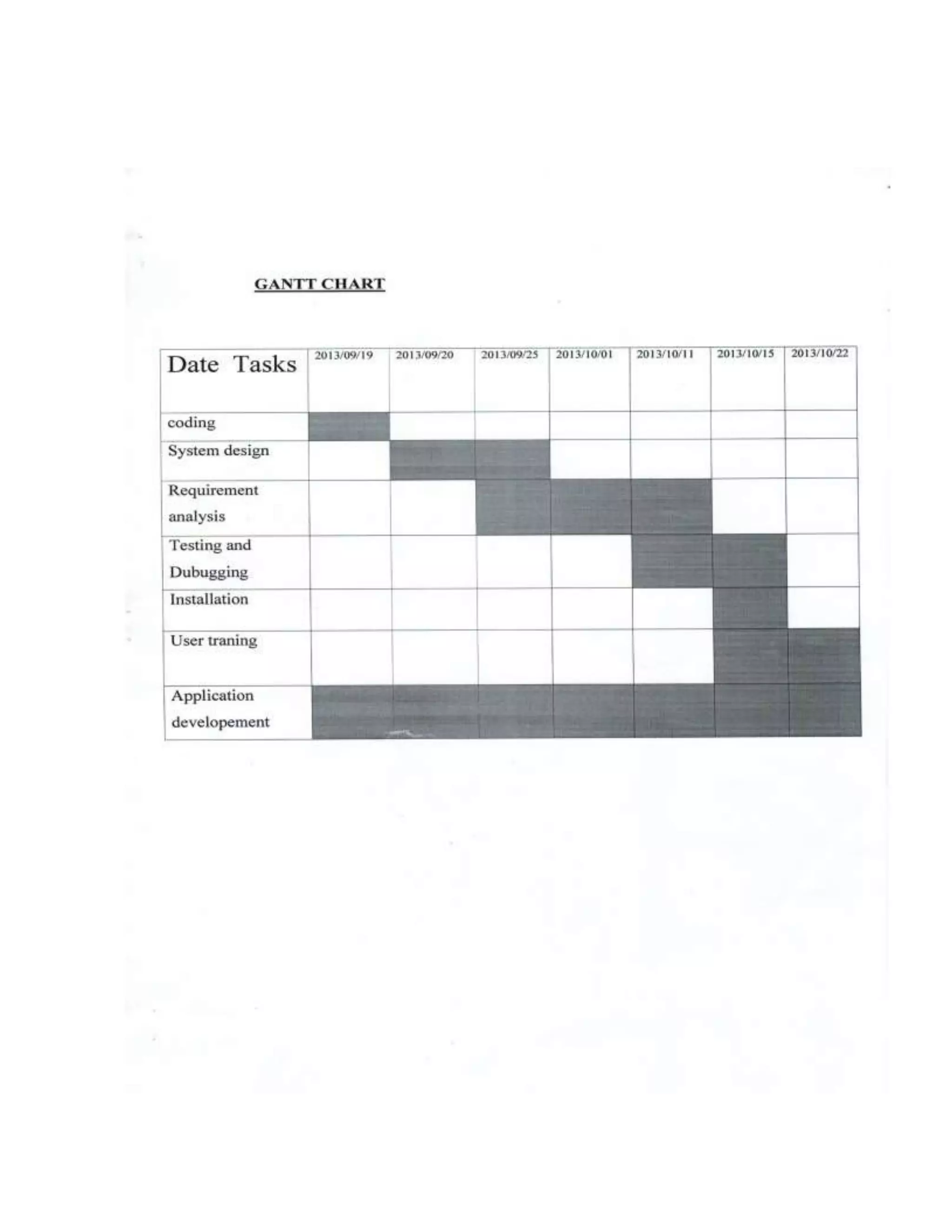
Gantt chart 
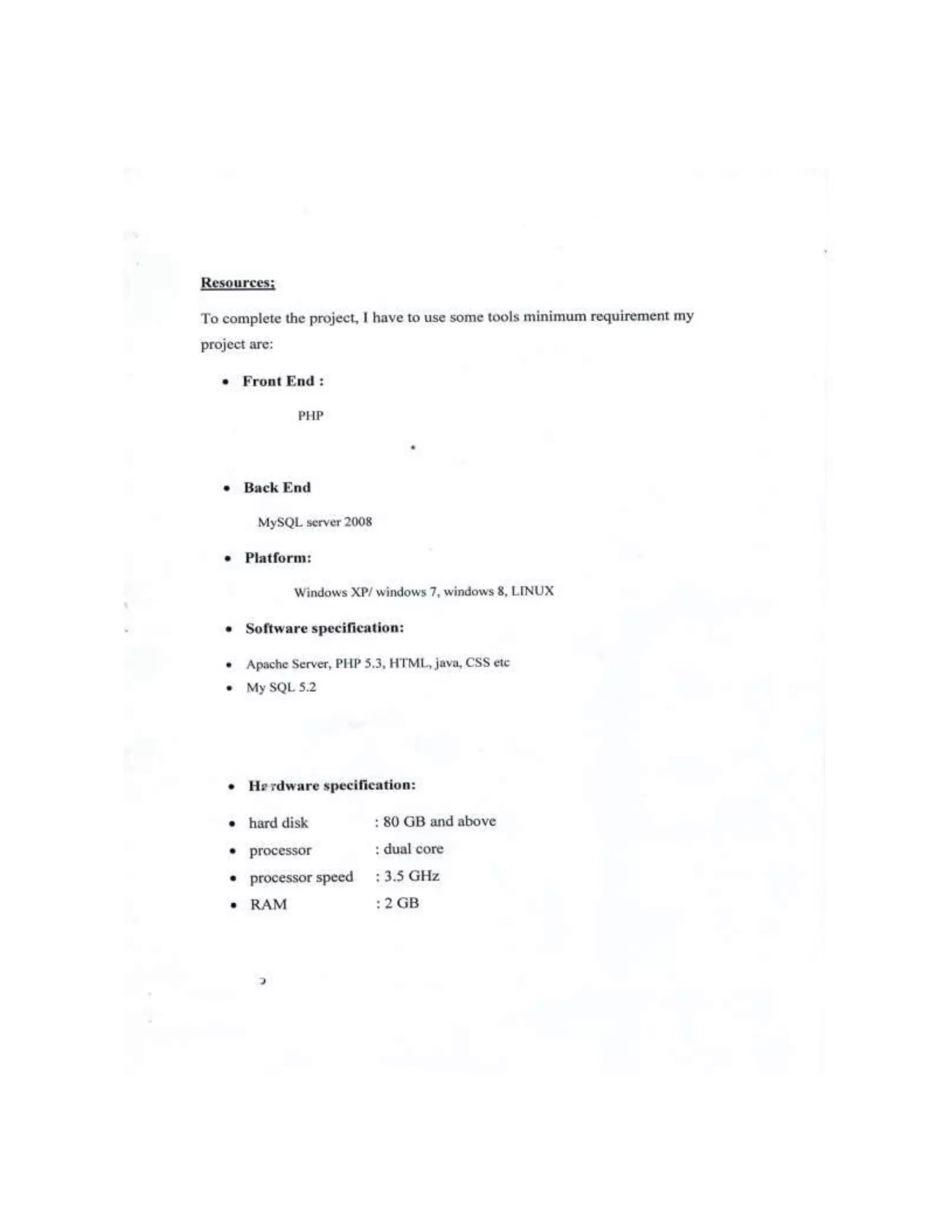
Resources 
Hardware and software application 
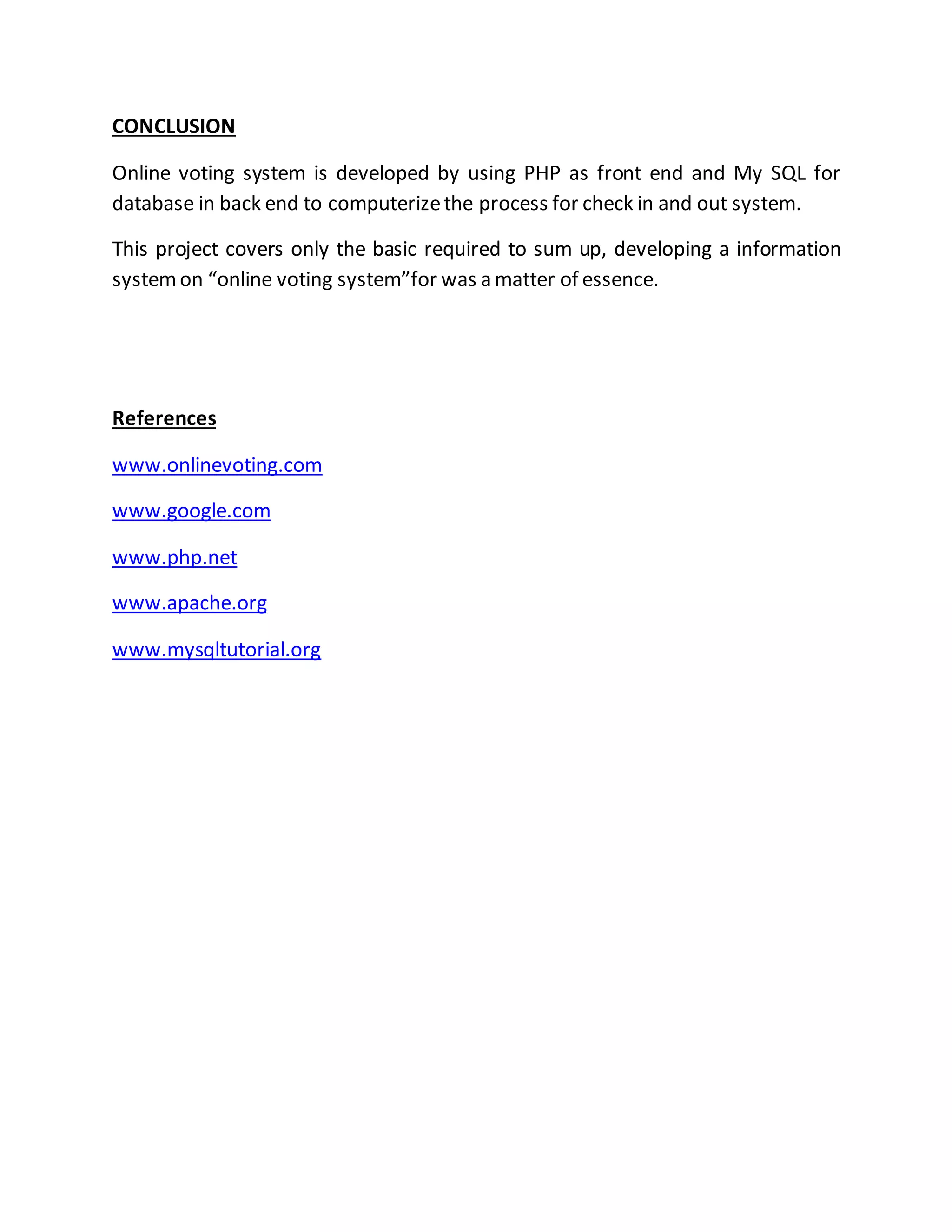
Conclusion 
Bibliography
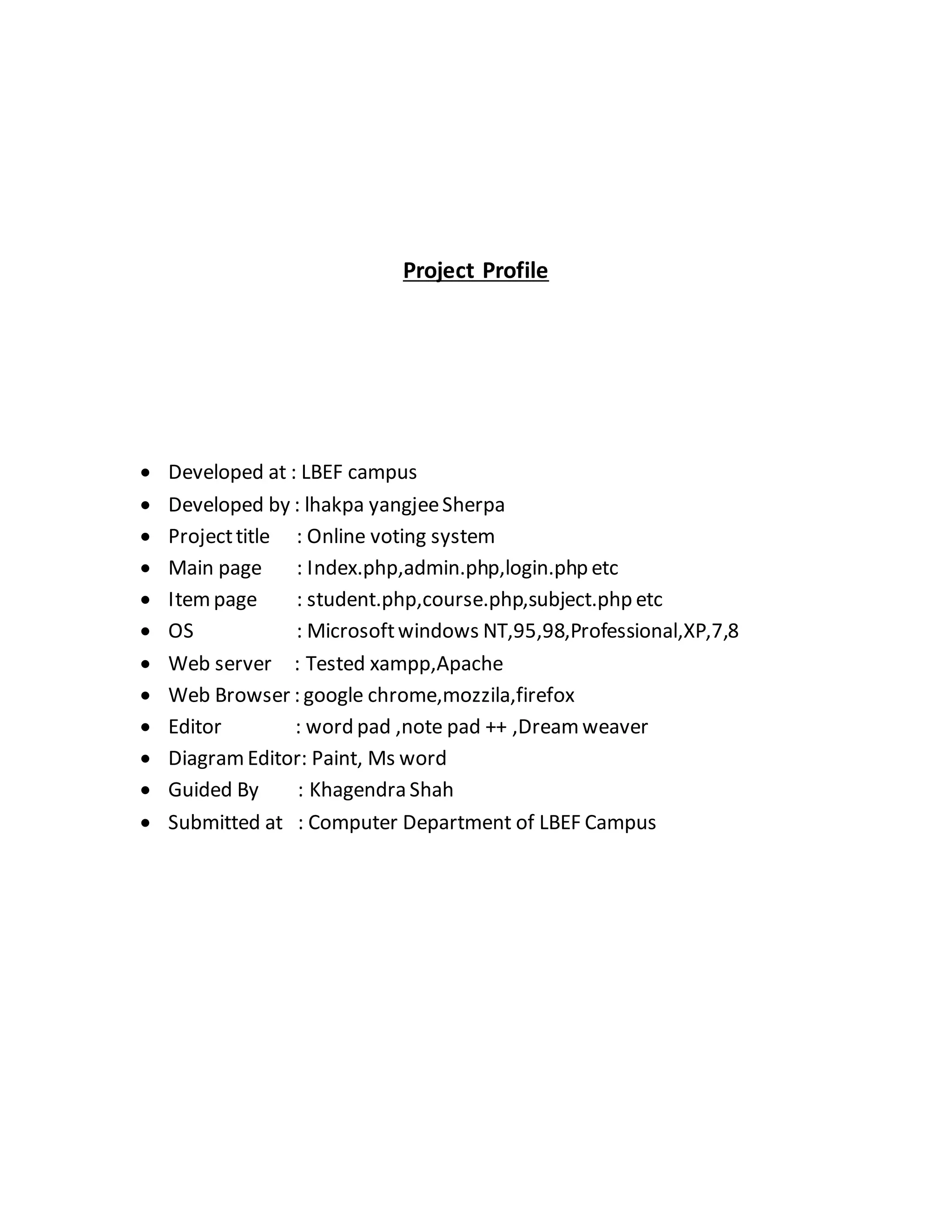
Project Profile 
 Developed at : LBEF campus 
 Developed by : lhakpa yangjee Sherpa 
 Project title : Online voting system 
 Main page : Index.php,admin.php,login.php etc 
 Item page : student.php,course.php,subject.php etc 
 OS : Microsoft windows NT,95,98,Professional,XP,7,8 
 Web server : Tested xampp,Apache 
 Web Browser : google chrome,mozzila,firefox 
 Editor : word pad ,note pad ++ ,Dream weaver 
 Diagram Editor: Paint, Ms word 
 Guided By : Khagendra Shah 
 Submitted at : Computer Department of LBEF Campus
ONLINE VOTING SYSTEM 
Introduction 
“ONLINE VOTING SYSTEM” is an online voting technique. It is based on the other online services like 
“ONLINE RESERVATION SYSTEM” .In this system people who have citizenship of INDIA and whose age is 
above 18 years of any [censored] can give hisher vote online without going to any polling booth. 
In “ONLINE VOTING SYSTEM” a voter can use hisher voting right online without any difficulty. HeShe 
has to fill a registration form to register himselfherself. All the entries is checked by the DATABASE 
which has already all information about the voter. If all the entries are correct then a USER ID and 
PASSWORD is given to the voter, by using that ID and PASSWORD heshe can use hisher vote. If 
conditions are wrong then that entry will be discarded. 
Statement about the problem 
Internet has led to discussion of e-democracy and online voting. Many peoples think that the internet 
could replace representative democracy, enabling everyone to vote on everything and anything by 
online voting .Online voting could reduce cost and make voting more convenient. This type of voting can 
be done for e-democracy, or it may be used for finalizing a solution, if many alternatives are present. 
Online voting make’s use of authentication, hence it needs security, and the system must be able to 
address obtaining, marking, delivering and counting ballots via computer. Advantage of online voting is 
it could increase voter turnout because of convenience, and it helps to reduce fraud voting.
SCOPE 
A Scope survey suggested more than two thirds of the general election polling stations failed 
basic access tests.Ms Scott [of Scope] said the country’s voting system “isn’t working for other 
voters either,” demonstrated by “scores of people queuing outside polling stations” at the recent 
general election. 
“O ver the last decade there has been next to no improvement in the overall accessibility of 
polling stations or postal voting“There is a pressing need for clearer accountability over how 
elections are delivered, to help improve the accessibility of current voting methods, as well as 
expanding these to include alternative methods.“Unless this happens disabled people will 
continue to struggle to exercise their right to vote“In a digital age where people can vote by text 
for the X-Factor and shop and bank online, our voting system really needs to catch up.” 
Although Scope’s report highlights a significant problems, the proposed solution – online and 
text voting – would bring its own major problems. Both have been tested out in the UK in a 
series of pilots with mixed results. Although the pilot series was often popular with the public, it 
has also been unpopular with many IT security experts who doubt the security of such voting 
methods, the systems were often unreliable and they were far more expensive than traditional 
voting methods. They also did not raise turnout significantly. For a good recent summary of the 
case against these sorts of new voting methods. 
OBJECTIVE 
The most crucial factor for a system like e-VOTE to be successful is to exhibit a Voting Protocol 
that can prevent opportunities for fraud or for sacrificing the voter's privacy 
The Voting Protocol that will be designed and implemented for the e-VOTE system will 
combine the advantages of existing protocols and techniques, while at the same time it will aim 
at eliminating most of the identified deficiencies and problems. The related attributes that the e- 
VOTE system will fully support, and against which it will be extensively tested and validated, 
are listed below. These attributes can be also considered, according to the literature, as a set of 
criteria for a "good" electronic voting system that can easily enjoy the trust and confidence of the 
voters and process organizers.
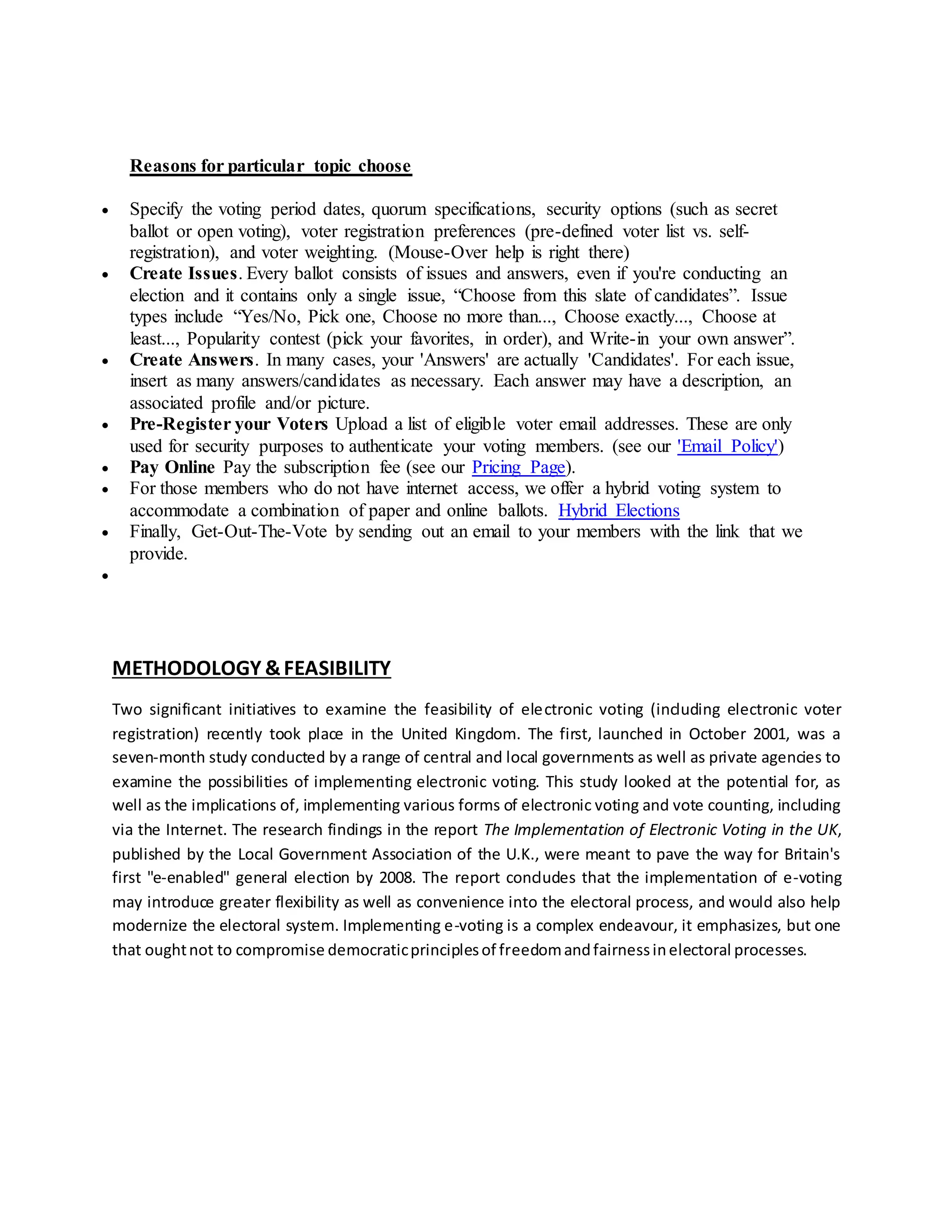
Reasons for particular topic choose 
 Specify the voting period dates, quorum specifications, security options (such as secret 
ballot or open voting), voter registration preferences (pre-defined voter list vs. self-registration), 
and voter weighting. (Mouse-Over help is right there) 
 Create Issues. Every ballot consists of issues and answers, even if you're conducting an 
election and it contains only a single issue, “Choose from this slate of candidates”. Issue 
types include “Yes/No, Pick one, Choose no more than..., Choose exactly..., Choose at 
least..., Popularity contest (pick your favorites, in order), and Write-in your own answer”. 
 Create Answers. In many cases, your 'Answers' are actually 'Candidates'. For each issue, 
insert as many answers/candidates as necessary. Each answer may have a description, an 
associated profile and/or picture. 
 Pre-Register your Voters Upload a list of eligible voter email addresses. These are only 
used for security purposes to authenticate your voting members. (see our 'Email Policy') 
 Pay Online Pay the subscription fee (see our Pricing Page). 
 For those members who do not have internet access, we offer a hybrid voting system to 
accommodate a combination of paper and online ballots. Hybrid Elections 
 Finally, Get-Out-The-Vote by sending out an email to your members with the link that we 
provide. 
 
METHODOLOGY & FEASIBILITY 
Two significant initiatives to examine the feasibility of electronic voting (including electronic voter 
registration) recently took place in the United Kingdom. The first, launched in October 2001, was a 
seven-month study conducted by a range of central and local governments as well as private agencies to 
examine the possibilities of implementing electronic voting. This study looked at the potential for, as 
well as the implications of, implementing various forms of electronic voting and vote counting, including 
via the Internet. The research findings in the report The Implementation of Electronic Voting in the UK, 
published by the Local Government Association of the U.K., were meant to pave the way for Britain's 
first "e-enabled" general election by 2008. The report concludes that the implementation of e-voting 
may introduce greater flexibility as well as convenience into the electoral process, and would also help 
modernize the electoral system. Implementing e-voting is a complex endeavour, it emphasizes, but one 
that ought not to compromise democratic principles of freedom and fairness in electoral processes.
Testing method 
Time framework of I-voting: I-votes may be given during 7 days from 10th day until 4th day 
before the Election Day. 
Possibility to recast I-vote: during the I-voting period a voter can recast his/her I-vote in which 
case the last cast I-vote counts. 
Precedence of the ballot paper voting: if a voter goes to the polling place during advance polls 
and casts his/her vote using paper ballot (having I-voted prior to that), then the I-vote is 
cancelled. After that voter can not recast his vote electronically or by using a paper ballot. On 
Election Day the I-vote cannot be changed. 
Similarity of I-voting to regular voting: I-voting adheres to the election acts, general election 
principles and customs. Thus, it is uniform and secret, only eligible voters may vote, every 
person may cast only one vote, it should be impossible for voter to prove the way he/she voted. 
The collecting of votes is secure, reliable and verifiable. 
The voter must be able to cast his/her vote freely and without outside coercion or influence. 
Incitement to e-voting by offering a computer for that purpose or influencing voters in any other 
way is prohibited, among other things, no collective I-voting events (opening of e-voting offices 
or service desks, etc.) shall be organised insofar as such activities may be considered violation of 
the freedom of voting. 
An e-voter shall vote himself/herself. Using another person’s ID card (or mobile-ID) for voting 
and transfer of the card's PIN codes to another person is prohibited. In order to avoid security 
risks only a trusted computer should be used, either owned by the voter or a person the voter can 
trust. 
OVERVIEW 
Electronic voting systems allow lecturers to add question and answer activities to lecture 
sessions to add interactivity and engagement with large groups. Such systems have been used in 
the University since 2004/2005. The College of Science and Engineering uses them widely and 
have adopted the name Clickers. 
Clickers are hand-held personal response systems (similar to those used in the television 
programme "Who wants to be a Millionaire?") that students can use to respond to questions 
posed by their lecturer. Gathering responses from students during lectures can be used in many 
ways. For example, it could allow a lecturer to gauge student understanding of common 
misconceptions and so giving them a chance to focus on material the class is struggling with as it 
is being taught.Currently about 100+ lecturers are using clickers in the University - mainly in 
first and second year science and engineering courses.
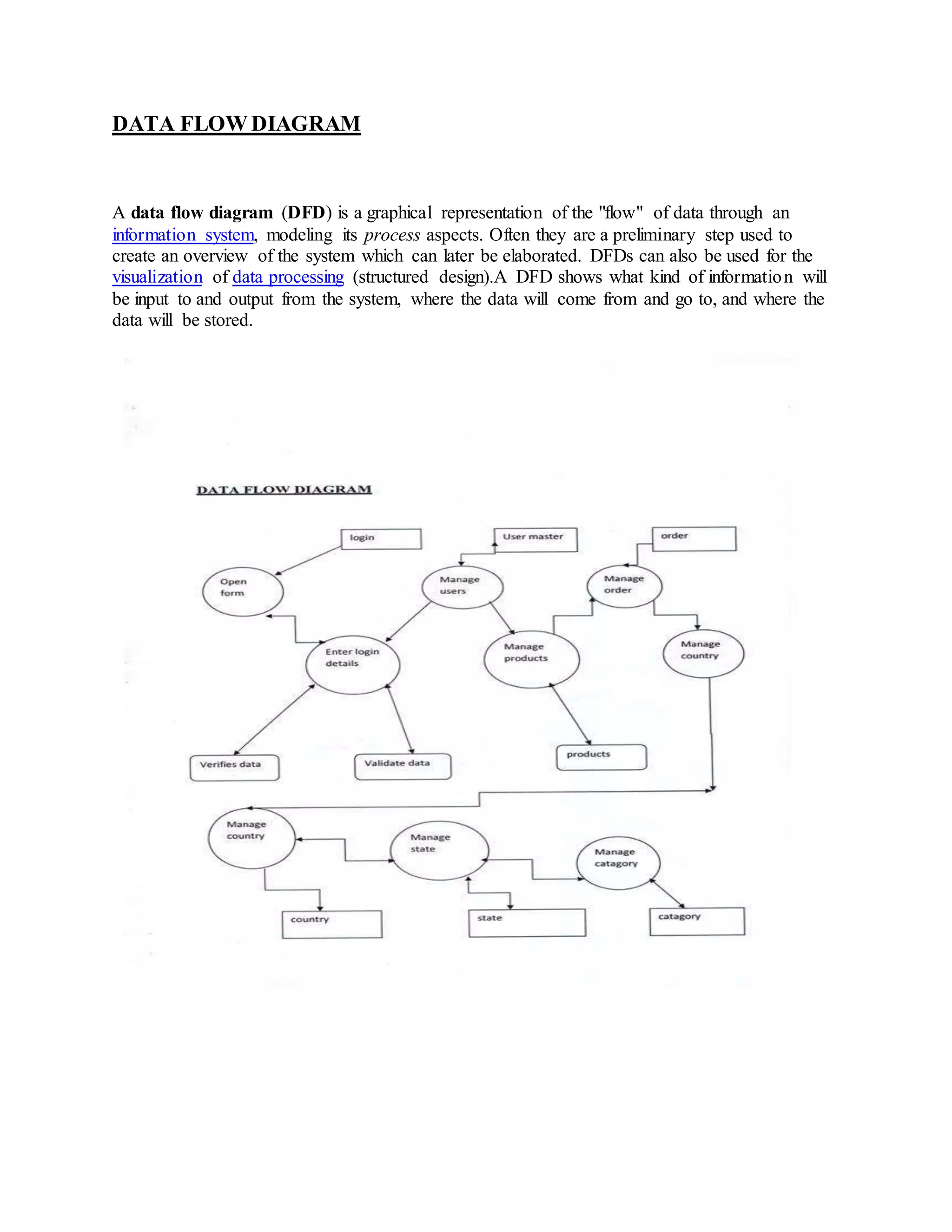
DATA FLOW DIAGRAM 
A data flow diagram (DFD) is a graphical representation of the "flow" of data through an 
information system, modeling its process aspects. Often they are a preliminary step used to 
create an overview of the system which can later be elaborated. DFDs can also be used for the 
visualization of data processing (structured design).A DFD shows what kind of information will 
be input to and output from the system, where the data will come from and go to, and where the 
data will be stored.
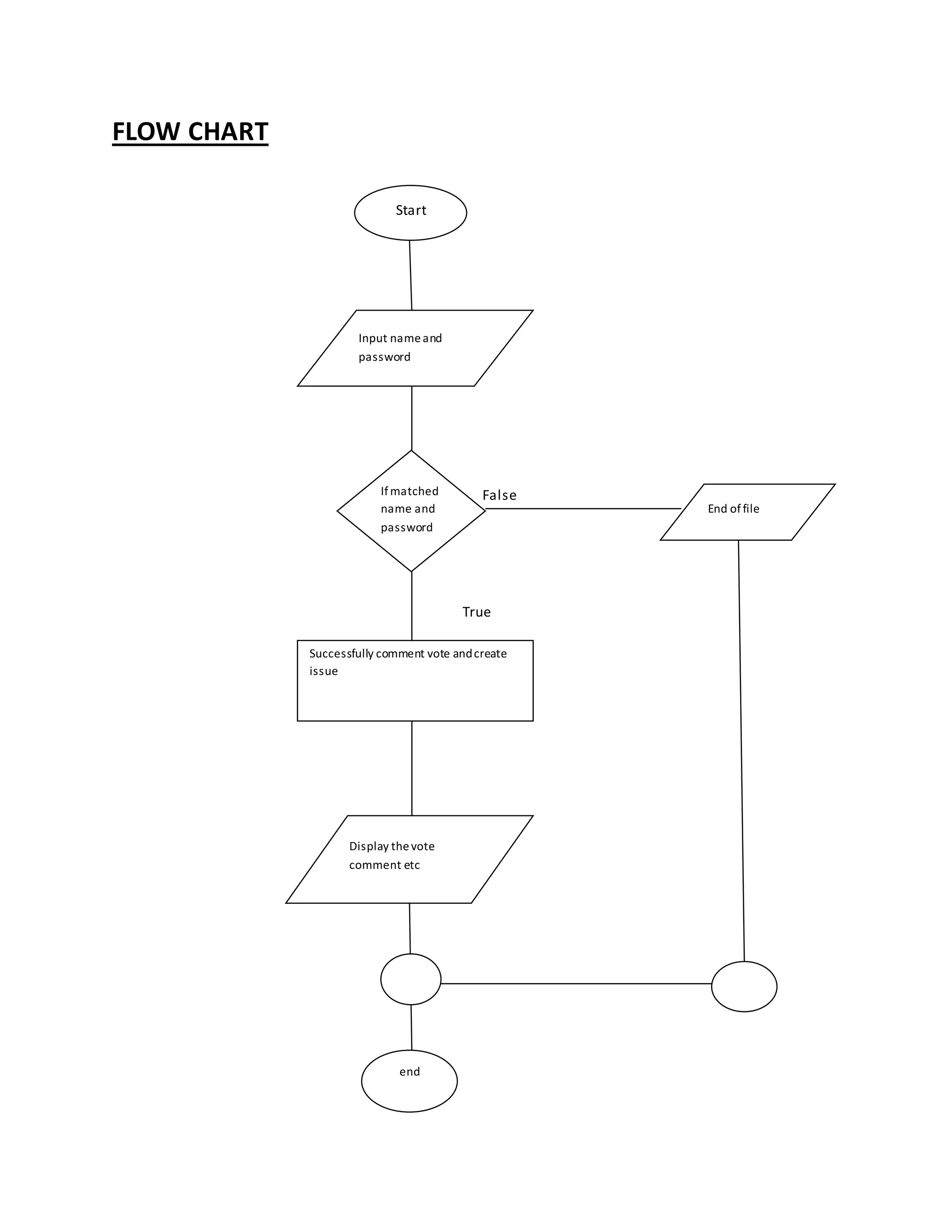
FLOW CHART 
False 
True 
Start 
Input name and 
password 
If matched 
name and 
password 
Successfully comment vote and create 
issue 
End of file 
Display the vote 
comment etc 
end
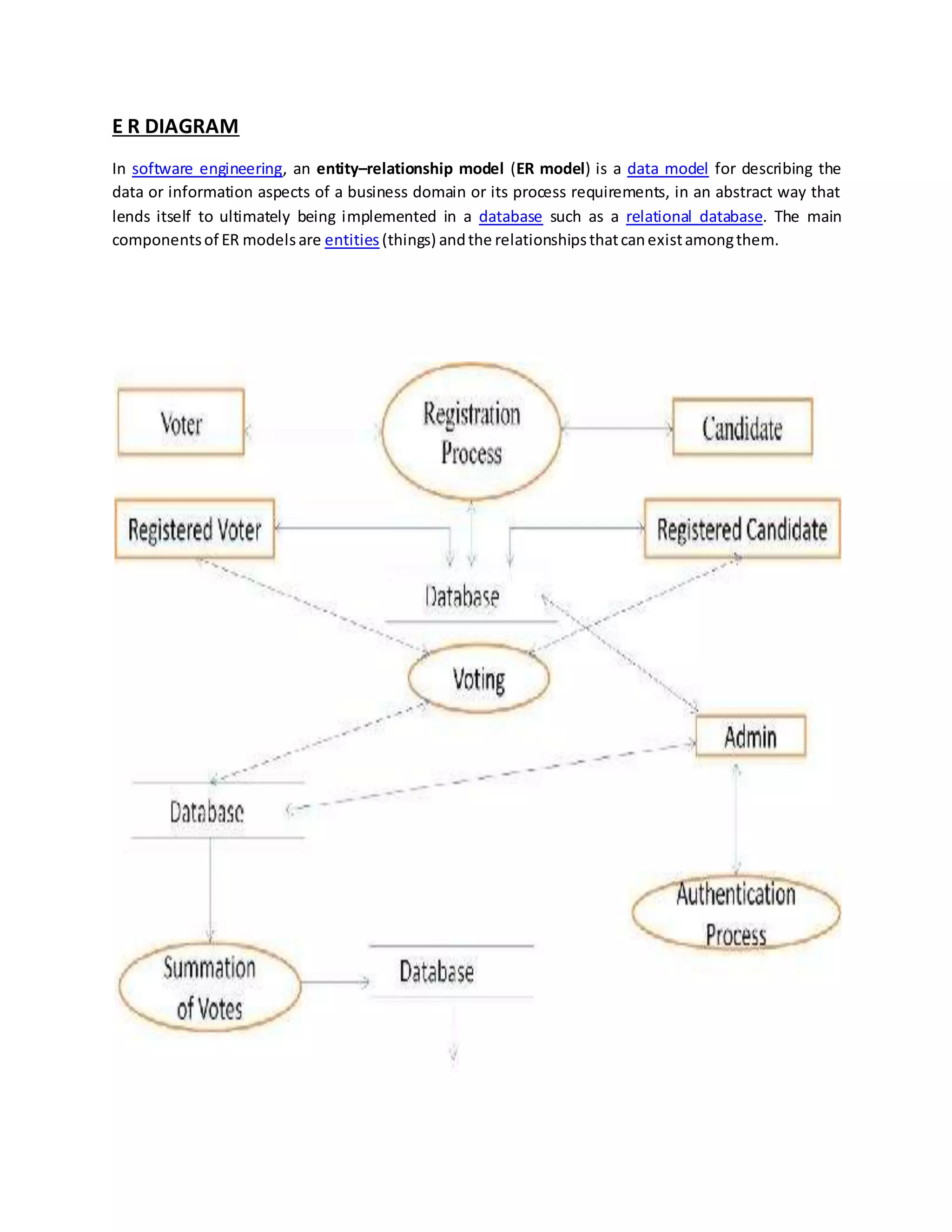
E R DIAGRAM 
In software engineering, an entity–relationship model (ER model) is a data model for describing the 
data or information aspects of a business domain or its process requirements, in an abstract way that 
lends itself to ultimately being implemented in a database such as a relational database. The main 
components of ER models are entities (things) and the relationships that can exist among them.
CONCLUSION 
Online voting system is developed by using PHP as front end and My SQL for 
database in back end to computerize the process for check in and out system. 
This project covers only the basic required to sum up, developing a information 
system on “online voting system”for was a matter of essence. 
References 
www.onlinevoting.com 
www.google.com 
www.php.net 
www.apache.org 
www.mysqltutorial.org
Project synopsis on online voting system

Project synopsis on online voting system

  • 1.
    PROJECT SYNOPSIS ONONLINE VOTING SYSTEM Submited by : Mrs. Lhakpa yangjee Sherpa University Reg No. 1208022961 Campus Roll no. 123151447 Bsc IT 3rd semester Date:May 27, 2014 Submitted to : Lord Buddha Education Foundation Opp, Maitidevi temple Kathmandu, Nepal
  • 2.
    Synopsis index: DESCRIPTION Tittle of the project Project Profile Introduction Statement about the problem Objective and scope Methodology and Feasibility Testing method Over view Data flow diagram Flowchart E R Diagram Project category Gantt chart Resources Hardware and software application Conclusion Bibliography
  • 3.
    Project Profile Developed at : LBEF campus  Developed by : lhakpa yangjee Sherpa  Project title : Online voting system  Main page : Index.php,admin.php,login.php etc  Item page : student.php,course.php,subject.php etc  OS : Microsoft windows NT,95,98,Professional,XP,7,8  Web server : Tested xampp,Apache  Web Browser : google chrome,mozzila,firefox  Editor : word pad ,note pad ++ ,Dream weaver  Diagram Editor: Paint, Ms word  Guided By : Khagendra Shah  Submitted at : Computer Department of LBEF Campus
  • 4.
    ONLINE VOTING SYSTEM Introduction “ONLINE VOTING SYSTEM” is an online voting technique. It is based on the other online services like “ONLINE RESERVATION SYSTEM” .In this system people who have citizenship of INDIA and whose age is above 18 years of any [censored] can give hisher vote online without going to any polling booth. In “ONLINE VOTING SYSTEM” a voter can use hisher voting right online without any difficulty. HeShe has to fill a registration form to register himselfherself. All the entries is checked by the DATABASE which has already all information about the voter. If all the entries are correct then a USER ID and PASSWORD is given to the voter, by using that ID and PASSWORD heshe can use hisher vote. If conditions are wrong then that entry will be discarded. Statement about the problem Internet has led to discussion of e-democracy and online voting. Many peoples think that the internet could replace representative democracy, enabling everyone to vote on everything and anything by online voting .Online voting could reduce cost and make voting more convenient. This type of voting can be done for e-democracy, or it may be used for finalizing a solution, if many alternatives are present. Online voting make’s use of authentication, hence it needs security, and the system must be able to address obtaining, marking, delivering and counting ballots via computer. Advantage of online voting is it could increase voter turnout because of convenience, and it helps to reduce fraud voting.
  • 5.
    SCOPE A Scopesurvey suggested more than two thirds of the general election polling stations failed basic access tests.Ms Scott [of Scope] said the country’s voting system “isn’t working for other voters either,” demonstrated by “scores of people queuing outside polling stations” at the recent general election. “O ver the last decade there has been next to no improvement in the overall accessibility of polling stations or postal voting“There is a pressing need for clearer accountability over how elections are delivered, to help improve the accessibility of current voting methods, as well as expanding these to include alternative methods.“Unless this happens disabled people will continue to struggle to exercise their right to vote“In a digital age where people can vote by text for the X-Factor and shop and bank online, our voting system really needs to catch up.” Although Scope’s report highlights a significant problems, the proposed solution – online and text voting – would bring its own major problems. Both have been tested out in the UK in a series of pilots with mixed results. Although the pilot series was often popular with the public, it has also been unpopular with many IT security experts who doubt the security of such voting methods, the systems were often unreliable and they were far more expensive than traditional voting methods. They also did not raise turnout significantly. For a good recent summary of the case against these sorts of new voting methods. OBJECTIVE The most crucial factor for a system like e-VOTE to be successful is to exhibit a Voting Protocol that can prevent opportunities for fraud or for sacrificing the voter's privacy The Voting Protocol that will be designed and implemented for the e-VOTE system will combine the advantages of existing protocols and techniques, while at the same time it will aim at eliminating most of the identified deficiencies and problems. The related attributes that the e- VOTE system will fully support, and against which it will be extensively tested and validated, are listed below. These attributes can be also considered, according to the literature, as a set of criteria for a "good" electronic voting system that can easily enjoy the trust and confidence of the voters and process organizers.
  • 6.
    Reasons for particulartopic choose  Specify the voting period dates, quorum specifications, security options (such as secret ballot or open voting), voter registration preferences (pre-defined voter list vs. self-registration), and voter weighting. (Mouse-Over help is right there)  Create Issues. Every ballot consists of issues and answers, even if you're conducting an election and it contains only a single issue, “Choose from this slate of candidates”. Issue types include “Yes/No, Pick one, Choose no more than..., Choose exactly..., Choose at least..., Popularity contest (pick your favorites, in order), and Write-in your own answer”.  Create Answers. In many cases, your 'Answers' are actually 'Candidates'. For each issue, insert as many answers/candidates as necessary. Each answer may have a description, an associated profile and/or picture.  Pre-Register your Voters Upload a list of eligible voter email addresses. These are only used for security purposes to authenticate your voting members. (see our 'Email Policy')  Pay Online Pay the subscription fee (see our Pricing Page).  For those members who do not have internet access, we offer a hybrid voting system to accommodate a combination of paper and online ballots. Hybrid Elections  Finally, Get-Out-The-Vote by sending out an email to your members with the link that we provide.  METHODOLOGY & FEASIBILITY Two significant initiatives to examine the feasibility of electronic voting (including electronic voter registration) recently took place in the United Kingdom. The first, launched in October 2001, was a seven-month study conducted by a range of central and local governments as well as private agencies to examine the possibilities of implementing electronic voting. This study looked at the potential for, as well as the implications of, implementing various forms of electronic voting and vote counting, including via the Internet. The research findings in the report The Implementation of Electronic Voting in the UK, published by the Local Government Association of the U.K., were meant to pave the way for Britain's first "e-enabled" general election by 2008. The report concludes that the implementation of e-voting may introduce greater flexibility as well as convenience into the electoral process, and would also help modernize the electoral system. Implementing e-voting is a complex endeavour, it emphasizes, but one that ought not to compromise democratic principles of freedom and fairness in electoral processes.
  • 7.
    Testing method Timeframework of I-voting: I-votes may be given during 7 days from 10th day until 4th day before the Election Day. Possibility to recast I-vote: during the I-voting period a voter can recast his/her I-vote in which case the last cast I-vote counts. Precedence of the ballot paper voting: if a voter goes to the polling place during advance polls and casts his/her vote using paper ballot (having I-voted prior to that), then the I-vote is cancelled. After that voter can not recast his vote electronically or by using a paper ballot. On Election Day the I-vote cannot be changed. Similarity of I-voting to regular voting: I-voting adheres to the election acts, general election principles and customs. Thus, it is uniform and secret, only eligible voters may vote, every person may cast only one vote, it should be impossible for voter to prove the way he/she voted. The collecting of votes is secure, reliable and verifiable. The voter must be able to cast his/her vote freely and without outside coercion or influence. Incitement to e-voting by offering a computer for that purpose or influencing voters in any other way is prohibited, among other things, no collective I-voting events (opening of e-voting offices or service desks, etc.) shall be organised insofar as such activities may be considered violation of the freedom of voting. An e-voter shall vote himself/herself. Using another person’s ID card (or mobile-ID) for voting and transfer of the card's PIN codes to another person is prohibited. In order to avoid security risks only a trusted computer should be used, either owned by the voter or a person the voter can trust. OVERVIEW Electronic voting systems allow lecturers to add question and answer activities to lecture sessions to add interactivity and engagement with large groups. Such systems have been used in the University since 2004/2005. The College of Science and Engineering uses them widely and have adopted the name Clickers. Clickers are hand-held personal response systems (similar to those used in the television programme "Who wants to be a Millionaire?") that students can use to respond to questions posed by their lecturer. Gathering responses from students during lectures can be used in many ways. For example, it could allow a lecturer to gauge student understanding of common misconceptions and so giving them a chance to focus on material the class is struggling with as it is being taught.Currently about 100+ lecturers are using clickers in the University - mainly in first and second year science and engineering courses.
  • 8.
    DATA FLOW DIAGRAM A data flow diagram (DFD) is a graphical representation of the "flow" of data through an information system, modeling its process aspects. Often they are a preliminary step used to create an overview of the system which can later be elaborated. DFDs can also be used for the visualization of data processing (structured design).A DFD shows what kind of information will be input to and output from the system, where the data will come from and go to, and where the data will be stored.
  • 9.
    FLOW CHART False True Start Input name and password If matched name and password Successfully comment vote and create issue End of file Display the vote comment etc end
  • 10.
    E R DIAGRAM In software engineering, an entity–relationship model (ER model) is a data model for describing the data or information aspects of a business domain or its process requirements, in an abstract way that lends itself to ultimately being implemented in a database such as a relational database. The main components of ER models are entities (things) and the relationships that can exist among them.
  • 13.
    CONCLUSION Online votingsystem is developed by using PHP as front end and My SQL for database in back end to computerize the process for check in and out system. This project covers only the basic required to sum up, developing a information system on “online voting system”for was a matter of essence. References www.onlinevoting.com www.google.com www.php.net www.apache.org www.mysqltutorial.org