International Research Journal of Engineering and Technology (IRJET) e-ISSN: 2395-0056
Volume: 06 Issue: 05 | May 2019 www.irjet.net p-ISSN: 2395-0072
© 2019, IRJET | Impact Factor value: 7.211 | ISO 9001:2008 Certified Journal | Page 7487
Porting Android 8.0 onto iMX6 Processor based Platform with driving
an LVDS Display
Shriyanka Jamadade1, Dr. Rajashekar JS2
1Student, DSCE, Bangalore
2Professor & HOD, DSCE, Bangalore
---------------------------------------------------------------------***---------------------------------------------------------------------
Abstract - Nowadays for the embedded devices use ofandroid
operating system has become current emerging trend in the
market. The most widely used embedded device in industries
which built with android OS is mobile phone. Theadvantage of
using android OS compared to other OS is that, it is an open
source and responds quickly to functional changes. It is
becoming default OS for devices which requires the
multimedia support. Porting of android onto ARM processor
based platform is very necessary in order to bring the
effectiveness of ARM and capability of android onto aproduct.
The proposed work is to port android 8.0(oreo) onto iMX6
processor based Media Accelerated Graphics Innovation Kit
(MAGIK-II).
Key Words: MAGIK-II, Qseven, IMX6 Processor, Carrier
board, MFG tool, Booting, Flashing.
1. INTRODUCTION
Android operating system is based on linux platform which
is developed by Google. The embedded systems are framed
using particular real time operating system by specific
vendors. These days android operating system is widely
used for mobile phones, tablets etc. android is so popular
because of its open source nature allowing user to build
application using it And also modify the kernel as per the
requirement. Further Google has developed android wrist
watches, android TVs and more devices each with a specific
user interface. ARM processor is the family of CPUs which is
based on Reduced Instruction Set Architecture. It is used in
many electronic devices such as tablets and smart phones.
They require small sized integrated circuit due to their
compressed instructions such as SOC which reduce the
memory managementandpowermanagementconstraintby
inbuilt support. It has greaterperformance intermsofspeed,
cost and accuracy hence it is used in many different
embedded applications. An OS is required to establish
communicationbetween processor,peripheralsandmemory
to perform a task. In order to improve speed and
performance Google updated different androidversions and
the latest version is 8.0 (oreo). The enormous growth of
android OS made developers, tothink ofportingitontoother
embedded platform whichhaspowerful peripheralssupport
and power management. To make use of portability of
android , user started porting android OS onto ARM baesd
module. Since android user interface is optimized for the
touch display and it can be perfectly developed for the next
generation smart devices. Hence the current work ofporting
android 8.0 onto a costom board has significant importance
in building application in the area of automotives,
multimedia and medical applications.
2. ANDROID ARCHITECTURE
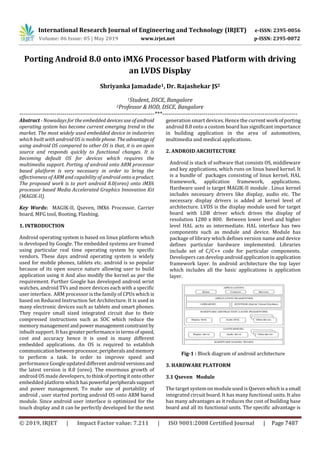
Android is stack of software that consists OS, middleware
and key applications, which runs on linux based kernel. It
is a bundle of packages consisting of linux kernel, HAL
framework, application framework, applications.
Hardware used is target MAGIK-II module . Linux kernel
includes necessary drivers like display, audio etc. The
necessary display drivers is added at kernel level of
architecture. LVDS is the display module used for target
board with LDB driver which drives the display of
resolution 1280 x 800. Between lower level and higher
level HAL acts as intermediate. HAL interface has two
components such as module and device. Module has
package of library which defines version name and device
defines particular hardware implemented. Libraries
include set of C/C++ code for particular components.
Developers can develop android application in application
framework layer. In android architecture the top layer
which includes all the basic applications is application
layer.
Fig-1 : Block diagram of android architecture
3. HARDWARE PLATFORM
3.1 Qseven Module
The target system on module used is Qsevenwhichisa small
integrated circuit board. It has many functional units. It also
has many advantages as it reduces the cost of building base
board and all its functional units. The specific advantage is
International Research Journal of Engineering and Technology (IRJET) e-ISSN: 2395-0056
Volume: 06 Issue: 05 | May 2019 www.irjet.net p-ISSN: 2395-0072
© 2019, IRJET | Impact Factor value: 7.211 | ISO 9001:2008 Certified Journal | Page 7488
that the board can be reused for other embedded
applications. The board consists of SOC processor, EMMC
memory unit SD card and many peripheral interfaces. Fig 2
shows the photograph of MAGIK-II Qseven module. It has
70mm x 70mm diamension and it uses one 230 pin MXM
edge connector to connect all power and signal lanes to the
carrier board. The frequency of the processor is 1.2GHz,
EMMC 4GB to 64 GB.
Fig2: Photograph of Qseven system on module
3.2 iMX6 Processor (SOC)
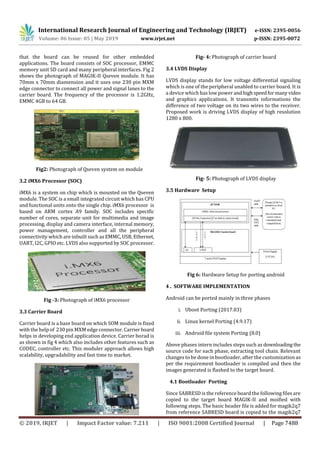
iMX6 is a system on chip which is mounted on the Qseven
module. The SOC is a small integrated circuit which has CPU
and functional units onto the single chip. iMX6 processor is
based on ARM cortex A9 family. SOC includes specific
number of cores, separate unit for multimedia and image
processing, display and camera interface, internal memory,
power management, controller and all the peripheral
connectivity which are inbuilt such as EMMC, USB, Ethernet,
UART, I2C, GPIO etc. LVDS also supported by SOC processor.
Fig -3: Photograph of iMX6 processor
3.3 Carrier Board
Carrier board is a base board on which SOM module is fixed
with the help of 230 pin MXM edge connector. Carrier board
helps in developing end application device. Carrier borad is
as shown in fig 4 which also includes other features such as
CODEC, controller etc. This moduler approach allows high
scalability, upgradability and fast time to market.
Fig- 4: Photograph of carrier board
3.4 LVDS Display
LVDS display stands for low voltage differential signaling
which is one of the peripheral unabled to carrier board. It is
a device which has low power andhighspeedformanyvideo
and graphics applications. It transmits informations the
difference of two voltage on its two wires to the receiver.
Proposed work is driving LVDS display of high resolution
1280 x 800.
Fig- 5: Photograph of LVDS display
3.5 Hardware Setup
Fig 6: Hardware Setup for porting android
4 . SOFTWARE IMPLEMENTATION
Android can be ported mainly in three phases
i. Uboot Porting (2017.03)
ii. Linux kernel Porting (4.9.17)
iii. Android file system Porting (8.0)
Above phases intern includes steps such as downloading the
source code for each phase, extracting tool chain. Relevant
changes to be done in bootloader, after the customization as
per the requirement bootloader is compiled and then the
images generated is flashed to the target board.
4.1 Bootloader Porting
Since SABRESD is the reference board the following files are
copied to the target board MAGIK-II and moified with
following steps. The basic header file is added for magik2q7
from reference SABRESD board is copied to the magik2q7
International Research Journal of Engineering and Technology (IRJET) e-ISSN: 2395-0056
Volume: 06 Issue: 05 | May 2019 www.irjet.net p-ISSN: 2395-0072
© 2019, IRJET | Impact Factor value: 7.211 | ISO 9001:2008 Certified Journal | Page 7489
board.
include/configs/magik2q7.h
4.2 Compilation of source code
The steps involved for compilation of source code as
follows.
Fig- 7: flowchart of compilation of source code
4.3 LVDS Interface
Fig- 7: LVDS Display
mxcfb1: fb@0 {
compatible = "fsl,mxc_sdc_fb";
disp_dev = "ldb";
interface_pix_fmt = "RGB24
mode_str ="TIANMA-MIN-WXGA";
default_bpp = <32>;
int_clk = <0>;
late_init = <0>;
status = "disabled";
};
4.4 Flashing the Images
After the compilation of the sourcecodethe binaryimages
generated are boot.imx, partion.img, recovery.img,
system.img created are copied to MFG tool. OTG cable is
connected between computer and target module and 12V
supply is given to the board. As soon as power flows thehost
system displays amressageHID deviceisdetected,onlywhen
target board is detected as shown in fig 8. All the images are
flashed.
Fig- 8: MFG tool terminal panel
6. RESULTS
Display test is performed by using different resolution
images and video. Fig 9 shows image displayed with
resolution 1280 x 800. Image of resolution less than actual
resolution will not be seen clear.Video files of mp4 format
are also played. Video with 4k resolution failed to play on
LVDS display.
Table- 1: Test procedure and Results
7. CONCLUSION
Android has evolved greatly with mobile devices because of
its features like open source nature and rich user interface.
Android is being integrated and portedtovariousembedded
devices. The main advantage of using android framework
beyond mobile device is that functionality of the android
devices. To take advantageof Android,speedandaccuracyof
International Research Journal of Engineering and Technology (IRJET) e-ISSN: 2395-0056
Volume: 06 Issue: 05 | May 2019 www.irjet.net p-ISSN: 2395-0072
© 2019, IRJET | Impact Factor value: 7.211 | ISO 9001:2008 Certified Journal | Page 7490
the ARM based processor in the current work Android 8.0 is
ported onto MAGIK2 ARM based i.MX6 processor.Androidis
ported onto the target board by three steps as u-boot
2017.03, kernel 4.9.17 and Android8.0filesystem.MAGIK-II
is ported with Android OS to drive a LVDS display with
different resolution images and video.
8. REFERENCES
[1] AbhyudaiShanker, SomyaLal, “Android Porting
Concepts”, Electronics Computer Technology (ICECT), 3
International Conference, V olume: 5, 8-10 April 2011.
[2] Pratyusha. Gandham, Ramesh N.V.K, “Porting the linux
kernel to an arm based development board”, IJERA, Vol. 2,
Issue 2, MarApr 2012, pp.1614-1618.
[3] V. Hari Prasad, Ashok Kumar Yadav and K Radha,
“Porting of Android OS BSP Customization on NXP2120
Application Processor Platform”, International Journal of
VLSI and Embedded Systems, Vol 04, Article 08146;
September 2013
[4] Kalpik M. Patel, Chirag K. Patel, “Porting Android on Arm
Based Platform”, IJIRCCE, Vol. 1, Issue 3, may 2013 [5]
ZuberahmedPunekar, Harish V Mekali, VivekKaushik,
“Porting and BSP Customization Of Android 4.3 on I.MX6
Based Custom Hardware Platform”, IJAREEIE, Vol.3,Issue6,
June 2014
[6] Manjunath Joshi1, Harsha B.K, VivekKaushik, Harish
Mekali, “BSP customization and porting of Linux on ARM
CORTEX based i.MX6 processor with yocto build
environment”,IJRET, Vol. 3, Issue 5, May 2014
[7]Irina-IoanaPatru,MihaiCarabas,Laura Gheorghe“Porting
Android on Intel based Embedded platforms”, IEEE, 2015
[8] i.MX BSP Porting Guide, Rev. 0,12/2015
[8]Deexith V, B S Rajeshwari, VivekKaushik, “Android 7.1.2
porting on MAGIK-II board based imx6 processor” Science
Globe International Conference, 10th June,2018, Bangalore.

IRJET- Porting Android 8.0 onto iMX6 Processor based Platform with Driving an LVDS Display

  • 1.
    International Research Journalof Engineering and Technology (IRJET) e-ISSN: 2395-0056 Volume: 06 Issue: 05 | May 2019 www.irjet.net p-ISSN: 2395-0072 © 2019, IRJET | Impact Factor value: 7.211 | ISO 9001:2008 Certified Journal | Page 7487 Porting Android 8.0 onto iMX6 Processor based Platform with driving an LVDS Display Shriyanka Jamadade1, Dr. Rajashekar JS2 1Student, DSCE, Bangalore 2Professor & HOD, DSCE, Bangalore ---------------------------------------------------------------------***--------------------------------------------------------------------- Abstract - Nowadays for the embedded devices use ofandroid operating system has become current emerging trend in the market. The most widely used embedded device in industries which built with android OS is mobile phone. Theadvantage of using android OS compared to other OS is that, it is an open source and responds quickly to functional changes. It is becoming default OS for devices which requires the multimedia support. Porting of android onto ARM processor based platform is very necessary in order to bring the effectiveness of ARM and capability of android onto aproduct. The proposed work is to port android 8.0(oreo) onto iMX6 processor based Media Accelerated Graphics Innovation Kit (MAGIK-II). Key Words: MAGIK-II, Qseven, IMX6 Processor, Carrier board, MFG tool, Booting, Flashing. 1. INTRODUCTION Android operating system is based on linux platform which is developed by Google. The embedded systems are framed using particular real time operating system by specific vendors. These days android operating system is widely used for mobile phones, tablets etc. android is so popular because of its open source nature allowing user to build application using it And also modify the kernel as per the requirement. Further Google has developed android wrist watches, android TVs and more devices each with a specific user interface. ARM processor is the family of CPUs which is based on Reduced Instruction Set Architecture. It is used in many electronic devices such as tablets and smart phones. They require small sized integrated circuit due to their compressed instructions such as SOC which reduce the memory managementandpowermanagementconstraintby inbuilt support. It has greaterperformance intermsofspeed, cost and accuracy hence it is used in many different embedded applications. An OS is required to establish communicationbetween processor,peripheralsandmemory to perform a task. In order to improve speed and performance Google updated different androidversions and the latest version is 8.0 (oreo). The enormous growth of android OS made developers, tothink ofportingitontoother embedded platform whichhaspowerful peripheralssupport and power management. To make use of portability of android , user started porting android OS onto ARM baesd module. Since android user interface is optimized for the touch display and it can be perfectly developed for the next generation smart devices. Hence the current work ofporting android 8.0 onto a costom board has significant importance in building application in the area of automotives, multimedia and medical applications. 2. ANDROID ARCHITECTURE Android is stack of software that consists OS, middleware and key applications, which runs on linux based kernel. It is a bundle of packages consisting of linux kernel, HAL framework, application framework, applications. Hardware used is target MAGIK-II module . Linux kernel includes necessary drivers like display, audio etc. The necessary display drivers is added at kernel level of architecture. LVDS is the display module used for target board with LDB driver which drives the display of resolution 1280 x 800. Between lower level and higher level HAL acts as intermediate. HAL interface has two components such as module and device. Module has package of library which defines version name and device defines particular hardware implemented. Libraries include set of C/C++ code for particular components. Developers can develop android application in application framework layer. In android architecture the top layer which includes all the basic applications is application layer. Fig-1 : Block diagram of android architecture 3. HARDWARE PLATFORM 3.1 Qseven Module The target system on module used is Qsevenwhichisa small integrated circuit board. It has many functional units. It also has many advantages as it reduces the cost of building base board and all its functional units. The specific advantage is
  • 2.
    International Research Journalof Engineering and Technology (IRJET) e-ISSN: 2395-0056 Volume: 06 Issue: 05 | May 2019 www.irjet.net p-ISSN: 2395-0072 © 2019, IRJET | Impact Factor value: 7.211 | ISO 9001:2008 Certified Journal | Page 7488 that the board can be reused for other embedded applications. The board consists of SOC processor, EMMC memory unit SD card and many peripheral interfaces. Fig 2 shows the photograph of MAGIK-II Qseven module. It has 70mm x 70mm diamension and it uses one 230 pin MXM edge connector to connect all power and signal lanes to the carrier board. The frequency of the processor is 1.2GHz, EMMC 4GB to 64 GB. Fig2: Photograph of Qseven system on module 3.2 iMX6 Processor (SOC) iMX6 is a system on chip which is mounted on the Qseven module. The SOC is a small integrated circuit which has CPU and functional units onto the single chip. iMX6 processor is based on ARM cortex A9 family. SOC includes specific number of cores, separate unit for multimedia and image processing, display and camera interface, internal memory, power management, controller and all the peripheral connectivity which are inbuilt such as EMMC, USB, Ethernet, UART, I2C, GPIO etc. LVDS also supported by SOC processor. Fig -3: Photograph of iMX6 processor 3.3 Carrier Board Carrier board is a base board on which SOM module is fixed with the help of 230 pin MXM edge connector. Carrier board helps in developing end application device. Carrier borad is as shown in fig 4 which also includes other features such as CODEC, controller etc. This moduler approach allows high scalability, upgradability and fast time to market. Fig- 4: Photograph of carrier board 3.4 LVDS Display LVDS display stands for low voltage differential signaling which is one of the peripheral unabled to carrier board. It is a device which has low power andhighspeedformanyvideo and graphics applications. It transmits informations the difference of two voltage on its two wires to the receiver. Proposed work is driving LVDS display of high resolution 1280 x 800. Fig- 5: Photograph of LVDS display 3.5 Hardware Setup Fig 6: Hardware Setup for porting android 4 . SOFTWARE IMPLEMENTATION Android can be ported mainly in three phases i. Uboot Porting (2017.03) ii. Linux kernel Porting (4.9.17) iii. Android file system Porting (8.0) Above phases intern includes steps such as downloading the source code for each phase, extracting tool chain. Relevant changes to be done in bootloader, after the customization as per the requirement bootloader is compiled and then the images generated is flashed to the target board. 4.1 Bootloader Porting Since SABRESD is the reference board the following files are copied to the target board MAGIK-II and moified with following steps. The basic header file is added for magik2q7 from reference SABRESD board is copied to the magik2q7
  • 3.
    International Research Journalof Engineering and Technology (IRJET) e-ISSN: 2395-0056 Volume: 06 Issue: 05 | May 2019 www.irjet.net p-ISSN: 2395-0072 © 2019, IRJET | Impact Factor value: 7.211 | ISO 9001:2008 Certified Journal | Page 7489 board. include/configs/magik2q7.h 4.2 Compilation of source code The steps involved for compilation of source code as follows. Fig- 7: flowchart of compilation of source code 4.3 LVDS Interface Fig- 7: LVDS Display mxcfb1: fb@0 { compatible = "fsl,mxc_sdc_fb"; disp_dev = "ldb"; interface_pix_fmt = "RGB24 mode_str ="TIANMA-MIN-WXGA"; default_bpp = <32>; int_clk = <0>; late_init = <0>; status = "disabled"; }; 4.4 Flashing the Images After the compilation of the sourcecodethe binaryimages generated are boot.imx, partion.img, recovery.img, system.img created are copied to MFG tool. OTG cable is connected between computer and target module and 12V supply is given to the board. As soon as power flows thehost system displays amressageHID deviceisdetected,onlywhen target board is detected as shown in fig 8. All the images are flashed. Fig- 8: MFG tool terminal panel 6. RESULTS Display test is performed by using different resolution images and video. Fig 9 shows image displayed with resolution 1280 x 800. Image of resolution less than actual resolution will not be seen clear.Video files of mp4 format are also played. Video with 4k resolution failed to play on LVDS display. Table- 1: Test procedure and Results 7. CONCLUSION Android has evolved greatly with mobile devices because of its features like open source nature and rich user interface. Android is being integrated and portedtovariousembedded devices. The main advantage of using android framework beyond mobile device is that functionality of the android devices. To take advantageof Android,speedandaccuracyof
  • 4.
    International Research Journalof Engineering and Technology (IRJET) e-ISSN: 2395-0056 Volume: 06 Issue: 05 | May 2019 www.irjet.net p-ISSN: 2395-0072 © 2019, IRJET | Impact Factor value: 7.211 | ISO 9001:2008 Certified Journal | Page 7490 the ARM based processor in the current work Android 8.0 is ported onto MAGIK2 ARM based i.MX6 processor.Androidis ported onto the target board by three steps as u-boot 2017.03, kernel 4.9.17 and Android8.0filesystem.MAGIK-II is ported with Android OS to drive a LVDS display with different resolution images and video. 8. REFERENCES [1] AbhyudaiShanker, SomyaLal, “Android Porting Concepts”, Electronics Computer Technology (ICECT), 3 International Conference, V olume: 5, 8-10 April 2011. [2] Pratyusha. Gandham, Ramesh N.V.K, “Porting the linux kernel to an arm based development board”, IJERA, Vol. 2, Issue 2, MarApr 2012, pp.1614-1618. [3] V. Hari Prasad, Ashok Kumar Yadav and K Radha, “Porting of Android OS BSP Customization on NXP2120 Application Processor Platform”, International Journal of VLSI and Embedded Systems, Vol 04, Article 08146; September 2013 [4] Kalpik M. Patel, Chirag K. Patel, “Porting Android on Arm Based Platform”, IJIRCCE, Vol. 1, Issue 3, may 2013 [5] ZuberahmedPunekar, Harish V Mekali, VivekKaushik, “Porting and BSP Customization Of Android 4.3 on I.MX6 Based Custom Hardware Platform”, IJAREEIE, Vol.3,Issue6, June 2014 [6] Manjunath Joshi1, Harsha B.K, VivekKaushik, Harish Mekali, “BSP customization and porting of Linux on ARM CORTEX based i.MX6 processor with yocto build environment”,IJRET, Vol. 3, Issue 5, May 2014 [7]Irina-IoanaPatru,MihaiCarabas,Laura Gheorghe“Porting Android on Intel based Embedded platforms”, IEEE, 2015 [8] i.MX BSP Porting Guide, Rev. 0,12/2015 [8]Deexith V, B S Rajeshwari, VivekKaushik, “Android 7.1.2 porting on MAGIK-II board based imx6 processor” Science Globe International Conference, 10th June,2018, Bangalore.