© 2018, IRJET | Impact Factor value: 6.171 | ISO 9001:2008 Certified Journal | Page 579
Highway Navigation System using Light Fidelity Technology
Shruti Srivastava1, Shivam Bhardwaj2, Prateek Gupta3, Kamakshi4
1, 2, 3 B.Tech students, Department of Electronics and Communication Engineering, IMS engineering college
4 Assistant Professor, Department of Electronics and Communication Engineering, IMS engineering college
----------------------------------------------------------------------***---------------------------------------------------------------------
Abstract - This paper presents a smart highway
navigation system by using Li-Fi technology. The light
fidelity technology refers to visible light communication that
uses light as a medium to deliver high-speed data in a
manner which is much greater than that of Wi-Fi. Over here
the proposed prototype is simulated on PROTEUS 8
professional software to explore the possibilities of using Li-
Fi in highway routing. The transmitter and receiver sections
contain atmega328 which is programmed by using Arduino
IDE. High intensity LEDs are used in the transmitter section
for delivering high-speed data to moving vehicles. Further,
in the receiver section LDR module is used to detect the
signal generated by the LEDs. According to the received
signal the information of present location and further
diversions is displayed on the LCD installed at the receiver.
Thus, this technology is more useful for automatic
navigation on highways and broad-lanes.
Index Terms— Li-Fi, Wi-Fi, VLC, LED.
1. INTRODUCTION
It is quite often that traveller travelling to remote areas
find it difficult to get onto the right path. The problem
grows up during night, due to lack of visibility, non-
functioning of GPS since not everywhere on the highway
we find the mobile networks which can be used for
navigation [1]. At that time if there is another mean which
can provide the traveller with the right pathway and
location, it will surely reduce the panic and encourage
more travellers to take the road trip [2]. Thus to tackle
with this problem, we propose to install Li-Fi in the
streetlights. Li-Fi (light fidelity technology) is the recent
technology that emerged in the Field of wireless
communication [3]. It is a part of visible light
communication (VLC) PAN IEEE 802.15.7 standard [4]. It
is transmission of data using visible light by sending data
through LED bulbs that switches faster than the human
eye can detect. Li-Fi is wireless communication which is
an improvised technology of Wi-Fi but it is different in
every aspect such as data transmission rates, security,
high frequency and bandwidth, etc [5]. We are living in an
era where we are surrounded by wireless technologies
around us like cell phones, Wi-Fi, IOT, etc.
Nowadays, everyone wants most of the things based
on wireless technologies. It includes the use of radio
waves for communication like Bluetooth & Wi-Fi and also
the new emerging technology Li-Fi. The Li-Fi technology
uses LEDs for data transmission [6]. Li-Fi is rapidly
growing and taking a place in the market as it is fast and
secure compared to other wireless technologies and can
transmit the data at a very high speeds. There are many
researches are going in these fields such as: “Li-Fi the path
to a new way of communication” [7]. These units have
microcontrollers having data previously stored in it (i.e.
direction indications). As soon as a vehicle comes in the
range of the visible light of these poles, it transmits the
data to that vehicle. The available information gets
displayed on the LCD installed with receiver in the vehicle
[8]. This Li-Fi based highway navigation system where the
LEDs that are used in streetlights for illumination purpose
will also be providing the travellers with the information
of the present location and all the divergence ahead. This
project has a very wide scope in near future as it can help
setup outdoor as well as indoor navigation system [9]. The
main idea of our paper is to create a navigation system for
the areas like highways and broad-lanes to create
automatic navigation for the travellers using Li-Fi
technology [10]. This will revolutionize the highway
routing as it become a better alternative to GPS system.
2. DESIGN COMPONENT
The basic main components involved in this project are
transmitter and receiver. LED is used for transmitting the
signal and LDR is used for reception purpose. In the
presented design a white light LED, crystal oscillator
(16MHz), Buck converter for 5V voltage regulation
(LM2596), LED driver circuit, Tip 122 Darlington
transistors, LDR module, Microcontroller AT Mega 328,
LCD and Buzzer are used.
First of all, the proposed system is designed on the
PROTEUS 8 professional software. When the results are
found satisfactory then hardware is designed. The whole
system is break into two sections, first transmitter section
and other one is receiver section.
Transmitter
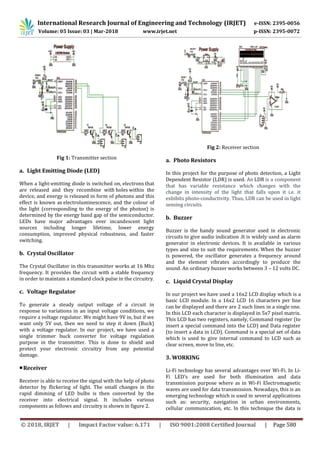
The transmitter consists of following components that are
as follows and the circuitry is shown in figure 1.
International Research Journal of Engineering and Technology (IRJET) e-ISSN: 2395-0056
Volume: 05 Issue: 03 | Mar-2018 www.irjet.net p-ISSN: 2395-0072
© 2018, IRJET | Impact Factor value: 6.171 | ISO 9001:2008 Certified Journal | Page 580
Fig 1: Transmitter section
a. Light Emitting Diode (LED)
When a light-emitting diode is switched on, electrons that
are released and they recombine with holes within the
device, and energy is released in form of photons and this
effect is known as electroluminescence, and the colour of
the light (corresponding to the energy of the photon) is
determined by the energy band gap of the semiconductor.
LEDs have major advantages over incandescent light
sources including longer lifetime, lower energy
consumption, improved physical robustness, and faster
switching.
b. Crystal Oscillator
The Crystal Oscillator in this transmitter works at 16 Mhz
frequency. It provides the circuit with a stable frequency
in order to maintain a standard clock pulse in the circuitry.
c. Voltage Regulator
To generate a steady output voltage of a circuit in
response to variations in an input voltage conditions, we
require a voltage regulator. We might have 9V in, but if we
want only 5V out, then we need to step it down (Buck)
with a voltage regulator. In our project, we have used a
single trimmer buck converter for voltage regulation
purpose in the transmitter. This is done to shield and
protect your electronic circuitry from any potential
damage.
Receiver
Receiver is able to receive the signal with the help of photo
detector by flickering of light. The small changes in the
rapid dimming of LED bulbs is then converted by the
receiver into electrical signal. It includes various
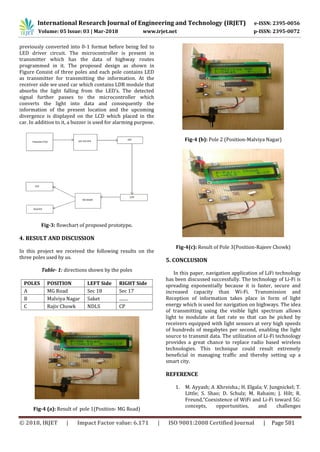
components as follows and circuitry is shown in figure 2.
Fig 2: Receiver section
a. Photo Resistors
In this project for the purpose of photo detection, a Light
Dependent Resistor (LDR) is used. An LDR is a component
that has variable resistance which changes with the
change in intensity of the light that falls upon it i.e. it
exhibits photo-conductivity. Thus, LDR can be used in light
sensing circuits.
b. Buzzer
Buzzer is the handy sound generator used in electronic
circuits to give audio indication .It is widely used as alarm
generator in electronic devices. It is available in various
types and size to suit the requirements. When the buzzer
is powered, the oscillator generates a frequency around
and the element vibrates accordingly to produce the
sound. An ordinary buzzer works between 3 – 12 volts DC.
c. Liquid Crystal Display
In our project we have used a 16x2 LCD display which is a
basic LCD module. In a 16x2 LCD 16 characters per line
can be displayed and there are 2 such lines in a single one.
In this LCD each character is displayed in 5x7 pixel matrix.
This LCD has two registers, namely, Command register (to
insert a special command into the LCD) and Data register
(to insert a data in LCD). Command is a special set of data
which is used to give internal command to LCD such as
clear screen, move to line, etc.
3. WORKING
Li-Fi technology has several advantages over Wi-Fi. In Li-
Fi LED’s are used for both illumination and data
transmission purpose where as in Wi-Fi Electromagnetic
waves are used for data transmission. Nowadays, this is an
emerging technology which is used in several applications
such as: security, navigation in urban environments,
cellular communication, etc. In this technique the data is
International Research Journal of Engineering and Technology (IRJET) e-ISSN: 2395-0056
Volume: 05 Issue: 03 | Mar-2018 www.irjet.net p-ISSN: 2395-0072
© 2018, IRJET | Impact Factor value: 6.171 | ISO 9001:2008 Certified Journal | Page 581
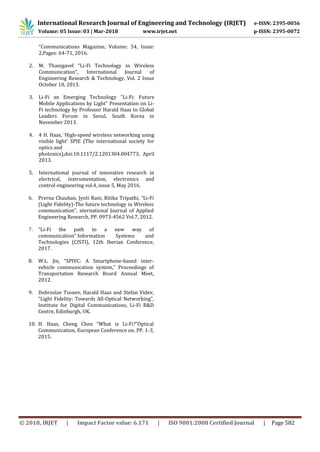
previously converted into 0-1 format before being fed to
LED driver circuit. The microcontroller is present in
transmitter which has the data of highway routes
programmed in it. The proposed design as shown in
Figure Consist of three poles and each pole contains LED
as transmitter for transmitting the information. At the
receiver side we used car which contains LDR module that
absorbs the light falling from the LED’s. The detected
signal further passes to the microcontroller which
converts the light into data and consequently the
information of the present location and the upcoming
divergence is displayed on the LCD which placed in the
car. In addition to it, a buzzer is used for alarming purpose.
Fig-3: flowchart of proposed prototype.
4. RESULT AND DISCUSSION
In this project we received the following results on the
three poles used by us.
Table- 1: directions shown by the poles
POLES POSITION LEFT Side RIGHT Side
A MG Road Sec 18 Sec 17
B Malviya Nagar Saket ........
C Rajiv Chowk NDLS CP
Fig-4 (a): Result of pole 1(Position- MG Road)
Fig-4 (b): Pole 2 (Position-Malviya Nagar)
Fig-4(c): Result of Pole 3(Position-Rajeev Chowk)
5. CONCLUSION
In this paper, navigation application of LiFi technology
has been discussed successfully. The technology of Li-Fi is
spreading exponentially because it is faster, secure and
increased capacity than Wi-Fi. Transmission and
Reception of information takes place in form of light
energy which is used for navigation on highways. The idea
of transmitting using the visible light spectrum allows
light to modulate at fast rate so that can be picked by
receivers equipped with light sensors at very high speeds
of hundreds of megabytes per second, enabling the light
source to transmit data. The utilization of Li-Fi technology
provides a great chance to replace radio based wireless
technologies. This technique could result extremely
beneficial in managing traffic and thereby setting up a
smart city.
REFERENCE
1. M. Ayyash; A .Khreisha.; H. Elgala; V. Jungnickel; T.
Little; S. Shao; D. Schulz; M. Rahaim; J. Hilt; R.
Freund,“Coexistence of WiFi and Li-Fi toward 5G:
concepts, opportunities, and challenges
International Research Journal of Engineering and Technology (IRJET) e-ISSN: 2395-0056
Volume: 05 Issue: 03 | Mar-2018 www.irjet.net p-ISSN: 2395-0072
© 2018, IRJET | Impact Factor value: 6.171 | ISO 9001:2008 Certified Journal | Page 582
“Communications Magazine, Volume: 54, Issue:
2,Pages: 64-71, 2016.
2. M. Thanigavel “Li-Fi Technology in Wireless
Communication”, International Journal of
Engineering Research & Technology, Vol. 2 Issue
October 10, 2013.
3. Li-Fi an Emerging Technology "Li-Fi: Future
Mobile Applications by Light" Presentation on Li-
Fi technology by Professor Harald Haas to Global
Leaders Forum in Seoul, South Korea in
November 2013.
4. 4 H. Haas, 'High-speed wireless networking using
visible light' SPIE (The international society for
optics and
photonics),doi:10.1117/2.1201304.004773, April
2013.
5. International journal of innovative research in
electrical, instrumentation, electronics and
control engineering vol.4, issue 5, May 2016.
6. Prerna Chauhan, Jyoti Rani, Ritika Tripathi, “Li-Fi
(Light Fidelity)-The future technology in Wireless
communication”, nternational Journal of Applied
Engineering Research, PP. 0973-4562 Vol.7, 2012.
7. “Li-Fi the path to a new way of
communication” Information Systems and
Technologies (CISTI), 12th Iberian Conference,
2017.
8. W.L. Jin, “SPIVC: A Smartphone-based inter-
vehicle communication system,” Proceedings of
Transportation Research Board Annual Meet,
2012.
9. Dobroslav Tsonev, Harald Haas and Stefan Videv,
“Light Fidelity: Towards All-Optical Networking”,
Institute for Digital Communications, Li-Fi R&D
Centre, Edinburgh, UK.
10. H. Haas, Cheng Chen “What is Li-Fi?”Optical
Communication, European Conference on, PP. 1-3,
2015.
International Research Journal of Engineering and Technology (IRJET) e-ISSN: 2395-0056
Volume: 05 Issue: 03 | Mar-2018 www.irjet.net p-ISSN: 2395-0072

IRJET- Highway Navigation System using Light Fidelity Technology

  • 1.
    © 2018, IRJET| Impact Factor value: 6.171 | ISO 9001:2008 Certified Journal | Page 579 Highway Navigation System using Light Fidelity Technology Shruti Srivastava1, Shivam Bhardwaj2, Prateek Gupta3, Kamakshi4 1, 2, 3 B.Tech students, Department of Electronics and Communication Engineering, IMS engineering college 4 Assistant Professor, Department of Electronics and Communication Engineering, IMS engineering college ----------------------------------------------------------------------***--------------------------------------------------------------------- Abstract - This paper presents a smart highway navigation system by using Li-Fi technology. The light fidelity technology refers to visible light communication that uses light as a medium to deliver high-speed data in a manner which is much greater than that of Wi-Fi. Over here the proposed prototype is simulated on PROTEUS 8 professional software to explore the possibilities of using Li- Fi in highway routing. The transmitter and receiver sections contain atmega328 which is programmed by using Arduino IDE. High intensity LEDs are used in the transmitter section for delivering high-speed data to moving vehicles. Further, in the receiver section LDR module is used to detect the signal generated by the LEDs. According to the received signal the information of present location and further diversions is displayed on the LCD installed at the receiver. Thus, this technology is more useful for automatic navigation on highways and broad-lanes. Index Terms— Li-Fi, Wi-Fi, VLC, LED. 1. INTRODUCTION It is quite often that traveller travelling to remote areas find it difficult to get onto the right path. The problem grows up during night, due to lack of visibility, non- functioning of GPS since not everywhere on the highway we find the mobile networks which can be used for navigation [1]. At that time if there is another mean which can provide the traveller with the right pathway and location, it will surely reduce the panic and encourage more travellers to take the road trip [2]. Thus to tackle with this problem, we propose to install Li-Fi in the streetlights. Li-Fi (light fidelity technology) is the recent technology that emerged in the Field of wireless communication [3]. It is a part of visible light communication (VLC) PAN IEEE 802.15.7 standard [4]. It is transmission of data using visible light by sending data through LED bulbs that switches faster than the human eye can detect. Li-Fi is wireless communication which is an improvised technology of Wi-Fi but it is different in every aspect such as data transmission rates, security, high frequency and bandwidth, etc [5]. We are living in an era where we are surrounded by wireless technologies around us like cell phones, Wi-Fi, IOT, etc. Nowadays, everyone wants most of the things based on wireless technologies. It includes the use of radio waves for communication like Bluetooth & Wi-Fi and also the new emerging technology Li-Fi. The Li-Fi technology uses LEDs for data transmission [6]. Li-Fi is rapidly growing and taking a place in the market as it is fast and secure compared to other wireless technologies and can transmit the data at a very high speeds. There are many researches are going in these fields such as: “Li-Fi the path to a new way of communication” [7]. These units have microcontrollers having data previously stored in it (i.e. direction indications). As soon as a vehicle comes in the range of the visible light of these poles, it transmits the data to that vehicle. The available information gets displayed on the LCD installed with receiver in the vehicle [8]. This Li-Fi based highway navigation system where the LEDs that are used in streetlights for illumination purpose will also be providing the travellers with the information of the present location and all the divergence ahead. This project has a very wide scope in near future as it can help setup outdoor as well as indoor navigation system [9]. The main idea of our paper is to create a navigation system for the areas like highways and broad-lanes to create automatic navigation for the travellers using Li-Fi technology [10]. This will revolutionize the highway routing as it become a better alternative to GPS system. 2. DESIGN COMPONENT The basic main components involved in this project are transmitter and receiver. LED is used for transmitting the signal and LDR is used for reception purpose. In the presented design a white light LED, crystal oscillator (16MHz), Buck converter for 5V voltage regulation (LM2596), LED driver circuit, Tip 122 Darlington transistors, LDR module, Microcontroller AT Mega 328, LCD and Buzzer are used. First of all, the proposed system is designed on the PROTEUS 8 professional software. When the results are found satisfactory then hardware is designed. The whole system is break into two sections, first transmitter section and other one is receiver section. Transmitter The transmitter consists of following components that are as follows and the circuitry is shown in figure 1. International Research Journal of Engineering and Technology (IRJET) e-ISSN: 2395-0056 Volume: 05 Issue: 03 | Mar-2018 www.irjet.net p-ISSN: 2395-0072
  • 2.
    © 2018, IRJET| Impact Factor value: 6.171 | ISO 9001:2008 Certified Journal | Page 580 Fig 1: Transmitter section a. Light Emitting Diode (LED) When a light-emitting diode is switched on, electrons that are released and they recombine with holes within the device, and energy is released in form of photons and this effect is known as electroluminescence, and the colour of the light (corresponding to the energy of the photon) is determined by the energy band gap of the semiconductor. LEDs have major advantages over incandescent light sources including longer lifetime, lower energy consumption, improved physical robustness, and faster switching. b. Crystal Oscillator The Crystal Oscillator in this transmitter works at 16 Mhz frequency. It provides the circuit with a stable frequency in order to maintain a standard clock pulse in the circuitry. c. Voltage Regulator To generate a steady output voltage of a circuit in response to variations in an input voltage conditions, we require a voltage regulator. We might have 9V in, but if we want only 5V out, then we need to step it down (Buck) with a voltage regulator. In our project, we have used a single trimmer buck converter for voltage regulation purpose in the transmitter. This is done to shield and protect your electronic circuitry from any potential damage. Receiver Receiver is able to receive the signal with the help of photo detector by flickering of light. The small changes in the rapid dimming of LED bulbs is then converted by the receiver into electrical signal. It includes various components as follows and circuitry is shown in figure 2. Fig 2: Receiver section a. Photo Resistors In this project for the purpose of photo detection, a Light Dependent Resistor (LDR) is used. An LDR is a component that has variable resistance which changes with the change in intensity of the light that falls upon it i.e. it exhibits photo-conductivity. Thus, LDR can be used in light sensing circuits. b. Buzzer Buzzer is the handy sound generator used in electronic circuits to give audio indication .It is widely used as alarm generator in electronic devices. It is available in various types and size to suit the requirements. When the buzzer is powered, the oscillator generates a frequency around and the element vibrates accordingly to produce the sound. An ordinary buzzer works between 3 – 12 volts DC. c. Liquid Crystal Display In our project we have used a 16x2 LCD display which is a basic LCD module. In a 16x2 LCD 16 characters per line can be displayed and there are 2 such lines in a single one. In this LCD each character is displayed in 5x7 pixel matrix. This LCD has two registers, namely, Command register (to insert a special command into the LCD) and Data register (to insert a data in LCD). Command is a special set of data which is used to give internal command to LCD such as clear screen, move to line, etc. 3. WORKING Li-Fi technology has several advantages over Wi-Fi. In Li- Fi LED’s are used for both illumination and data transmission purpose where as in Wi-Fi Electromagnetic waves are used for data transmission. Nowadays, this is an emerging technology which is used in several applications such as: security, navigation in urban environments, cellular communication, etc. In this technique the data is International Research Journal of Engineering and Technology (IRJET) e-ISSN: 2395-0056 Volume: 05 Issue: 03 | Mar-2018 www.irjet.net p-ISSN: 2395-0072
  • 3.
    © 2018, IRJET| Impact Factor value: 6.171 | ISO 9001:2008 Certified Journal | Page 581 previously converted into 0-1 format before being fed to LED driver circuit. The microcontroller is present in transmitter which has the data of highway routes programmed in it. The proposed design as shown in Figure Consist of three poles and each pole contains LED as transmitter for transmitting the information. At the receiver side we used car which contains LDR module that absorbs the light falling from the LED’s. The detected signal further passes to the microcontroller which converts the light into data and consequently the information of the present location and the upcoming divergence is displayed on the LCD which placed in the car. In addition to it, a buzzer is used for alarming purpose. Fig-3: flowchart of proposed prototype. 4. RESULT AND DISCUSSION In this project we received the following results on the three poles used by us. Table- 1: directions shown by the poles POLES POSITION LEFT Side RIGHT Side A MG Road Sec 18 Sec 17 B Malviya Nagar Saket ........ C Rajiv Chowk NDLS CP Fig-4 (a): Result of pole 1(Position- MG Road) Fig-4 (b): Pole 2 (Position-Malviya Nagar) Fig-4(c): Result of Pole 3(Position-Rajeev Chowk) 5. CONCLUSION In this paper, navigation application of LiFi technology has been discussed successfully. The technology of Li-Fi is spreading exponentially because it is faster, secure and increased capacity than Wi-Fi. Transmission and Reception of information takes place in form of light energy which is used for navigation on highways. The idea of transmitting using the visible light spectrum allows light to modulate at fast rate so that can be picked by receivers equipped with light sensors at very high speeds of hundreds of megabytes per second, enabling the light source to transmit data. The utilization of Li-Fi technology provides a great chance to replace radio based wireless technologies. This technique could result extremely beneficial in managing traffic and thereby setting up a smart city. REFERENCE 1. M. Ayyash; A .Khreisha.; H. Elgala; V. Jungnickel; T. Little; S. Shao; D. Schulz; M. Rahaim; J. Hilt; R. Freund,“Coexistence of WiFi and Li-Fi toward 5G: concepts, opportunities, and challenges International Research Journal of Engineering and Technology (IRJET) e-ISSN: 2395-0056 Volume: 05 Issue: 03 | Mar-2018 www.irjet.net p-ISSN: 2395-0072
  • 4.
    © 2018, IRJET| Impact Factor value: 6.171 | ISO 9001:2008 Certified Journal | Page 582 “Communications Magazine, Volume: 54, Issue: 2,Pages: 64-71, 2016. 2. M. Thanigavel “Li-Fi Technology in Wireless Communication”, International Journal of Engineering Research & Technology, Vol. 2 Issue October 10, 2013. 3. Li-Fi an Emerging Technology "Li-Fi: Future Mobile Applications by Light" Presentation on Li- Fi technology by Professor Harald Haas to Global Leaders Forum in Seoul, South Korea in November 2013. 4. 4 H. Haas, 'High-speed wireless networking using visible light' SPIE (The international society for optics and photonics),doi:10.1117/2.1201304.004773, April 2013. 5. International journal of innovative research in electrical, instrumentation, electronics and control engineering vol.4, issue 5, May 2016. 6. Prerna Chauhan, Jyoti Rani, Ritika Tripathi, “Li-Fi (Light Fidelity)-The future technology in Wireless communication”, nternational Journal of Applied Engineering Research, PP. 0973-4562 Vol.7, 2012. 7. “Li-Fi the path to a new way of communication” Information Systems and Technologies (CISTI), 12th Iberian Conference, 2017. 8. W.L. Jin, “SPIVC: A Smartphone-based inter- vehicle communication system,” Proceedings of Transportation Research Board Annual Meet, 2012. 9. Dobroslav Tsonev, Harald Haas and Stefan Videv, “Light Fidelity: Towards All-Optical Networking”, Institute for Digital Communications, Li-Fi R&D Centre, Edinburgh, UK. 10. H. Haas, Cheng Chen “What is Li-Fi?”Optical Communication, European Conference on, PP. 1-3, 2015. International Research Journal of Engineering and Technology (IRJET) e-ISSN: 2395-0056 Volume: 05 Issue: 03 | Mar-2018 www.irjet.net p-ISSN: 2395-0072