International Research Journal of Engineering and Technology (IRJET) e-ISSN: 2395-0056
Volume: 06 Issue: 04 | Apr 2019 www.irjet.net p-ISSN: 2395-0072
© 2019, IRJET | Impact Factor value: 7.211 | ISO 9001:2008 Certified Journal | Page 2334
Heart Disease Prediction and Recommendation
Maunish Shah1, Akshit Modi2, Jay Jethwa3, Harsh Bhor4
1,2,3Student, Dept. of IT Engineering, K. J. Somaiya Institute of Engineering And Information Technology,
Sion, Mumbai
4Professor, Dept. of IT Engineering, K. J. Somaiya Institute of Engineering and Information Technology,
Sion, Mumbai
---------------------------------------------------------------------***----------------------------------------------------------------------
Abstract - Over the last fewdecades, heart-relateddiseasesare
the main reason for a huge amount of death in the world and
has emerged as the most life-threatening disease, not only in
India but in the whole world. There's a need for a reliable and
accurate system to diagnose and treat such diseases in time
for proper treatment. To automate the process of diagnosis
and treatment Machine Learningalgorithmsandtechniquesis
applied to the medical dataset. As technology is advancing,
researchers have been using Machine Learning techniques in
the diagnosis of heart-related diseases to help the healthcare
industry.
Key Words: cardiovascular, decision tree, Cleveland, Gini,
recommendation, Scikit-learn
1. INTRODUCTION
One of the biggest cause of death nowadays is heart
disease. Abnormal variations in blood pressure, cholesterol,
pulse rate etc. are the major reasons for heart disease. The
heart is one of the important functional part of the body and
if it gets affected, the functions of the whole body get
disturbed. In the medical field, heart disease is one of the
major challenges; because a lot of parameters and
technicality is involved foraccuratelypredictingthisdisease.
According to the latest survey conducted by WHO, the
medical professionals were able to correctly predict only
67% of heart disease, so there is a vast scope of research in
the area of predicting heart disease in humans[3]. A huge
amount of clinical data is available, where vital information
is hidden is seldom visited and remains untapped,
researchers use data mining techniques to help health care
professionals in the diagnosis of heart disease[7].Inorder to
predict the risk level of heart disease, the Decision Tree
algorithm is being used. The tree takes in 14 attributesasit's
input such as age, sex, chest pain type, resting blood
pressure, cholesterol in mg/dl, fasting blood sugar, etc.Once
the prediction of the risk level is performed, the
precautionary suggestions would be provided to the user,
which would help them to control their risk level
temporarily. "How can we turn data into useful information
that can enable users to make effective clinical decisions"[8]
This is the main objective of this paper. This paper is
dedicated to a wide scope in the field of heart-related
disease. Later part of the scope discusses how the user can
go about understanding the various parameters related to
the prediction and also the various ways throughwhichthey
can control those parameters.
2. LITERATURE SURVEY
The existing papers that are surveyed have their focus on
the prediction of heart disease. The processed dataset that is
collected from various sources is used to train the algorithm
and are then used for prediction.
T. Princy, J. Thomas[1] intends to give details about various
techniques of knowledge abstraction by using data mining
methods that are being used in today's research for
prediction of heart disease. In this paper, data mining
methods namely, Naive Bayes, Neural network,Decisiontree
algorithmareanalyzedonmedicaldatasetsusingalgorithms.
While Priyanga and Naveen[2] mainly focus on to create a
decision support system using Naive Bayes algorithm for
predicting heart disease. A web application is created to get
user input and theapplicationcanretrievehiddenknowledge
related to heart disease from ahistoricaldatabase(Cleveland
dataset). M. Gandhi, S. Singh[4] focusesmon classification
methods of data mining used in data discovery. Different
classification techniques of data mining have merits and
demerits for data classification and knowledge extraction.
Purushottam, K. Saxena and Richa Sharma[8] depicted the
extraction of risk level from the heart disease database. The
input database contains the screening ofclinicaldataofheart
patients. Initially, the database is pre-processed to make the
mining process more efficient. Decision tree is used for the
prediction. The papers majorly focusonfindingtheefficiency
of various algorithms as the predictions in the domain of
medical has to be accurate.
3. PROPOSED SYSTEM
The heart report when generated has terms that are only
understood by the doctors and according to that, they
provide the necessary medications. The aim is to provide an
Android application to the users, wherein they can provide
the application the above-mentionedattributes whichwould
then be used to predict the risk level of having a heart
disease. The users are then provided with an in-depth
explanation of all the terms that are responsible for the risk
level generated in the predictionandarerecommended with
various ways to reduce their risk level.
International Research Journal of Engineering and Technology (IRJET) e-ISSN: 2395-0056
Volume: 06 Issue: 04 | Apr 2019 www.irjet.net p-ISSN: 2395-0072
© 2019, IRJET | Impact Factor value: 7.211 | ISO 9001:2008 Certified Journal | Page 2335
3.1 ALGORITHM USED
Decision Tree - Decision Trees being a non-parametric
supervised learning method they are used for classification.
The goal is to create a model that predicts the value of a
target variable (risk level) by learning simple decision rules
inferred from the data features (Dataset). The major
challenge in the decision tree is to identify the attribute for
the root nodein each level. This processisknownasattribute
selection. One of the main advantages of using decision tree
was that it is able to handle both numerical and categorical
data. Other techniques are usually specialized in analyzing
datasets that have only one type of variable.
The decision tree learning algorithm learns recursively as
follows:
Steps:
1.Compute the Gini index for data-set
2.For every attribute/feature:
1.Calculate Gini index for all categorical values
2.Take average information entropy for the current
attribute
3.Calculate the Gini gain
3. Pick the best Gini gain attribute.
4. Repeat until we get the desired tree.
Machine learning library Scikit-learn is used for prediction.
Scikit-learn has a range of supervised and unsupervised
learning algorithms provided through a consistent interface
in Python. The sklearn.tree module includes decision tree-
based models for classification.
class sklearn.tree.DecisionTreeClassifier(criterion=’gini’,s
plitter=’best’, max_depth=None, min_samples_split=2, min_sa
mples_leaf=1, min_weight_fraction_leaf=0.0, max_features=N
one, random_state=None, max_leaf_nodes=None)
The method uses gini as the splitting criterion for attribute
selection. Gini provides a statistical measure of the degree of
variation or inequality representedinthedataset.Giniindex-
Given a training set S, the target attribute takes on k different
values (i.e. classes), the Gini index of S is defined as
n
G(S) = Σ P(i) * (1 - P(i))
i=1
Where P(i) is the probability of a certain classification i, per
the training data set.
3.2 TECHNOLOGY STACK
A. Android application
An Android app is a software application which runs on
Android platform. Because the Android platform is built for
mobile devices, a typical Android app is designed for a
smartphone or a tablet PC running on the Android OS.
The main advantages of building an android application
that it is easier to access and also the android phones are
much cheaper than other alternatives. The target audienceis
also comparatively very high and hence it makes a suitable
platform for the idea being suggested here.
B. Python
Python being an object-oriented, high-level programming
language with dynamic semantics. Its high-level built in data
structures, makes it a very attractive language for machine
learning applications.
Many libraries are available to perform data analysis and
mining on large sets of medical datasets:
NumPy is important to perform scientific computing with
Python. It is used to operateon multi-dimensionalarraysand
matrices.
SciPy works in association with NumPy arrays and offers
effectiveroutinesfornumericalintegrationandup-gradation.
Pandas, also developed on top of NumPy, is used to manage
and manipulate the CSV (Comma Separated Value) files
generated from the android application.
Developed on NumPy, SciPy. Scikit-learn acts as a machine
learning library that leads to the generation of the decision
tree used in predictions.
C. Flask
Flask is used for connecting the backend server with the
frontend android application.
Flask is a microweb framework written in Python that does
not require particular tools or libraries. Flask can be used for
RESTful request dispatching in Python. A RESTful
architectureuses HTTP coding formuchofitsfunctionality.A
REST API defines a set of functions which developers can
perform like requests and receive responses via HTTP
protocol such as GETand POST. The datacanbepassedtothe
server with the help of URL, with which the server would
fetch the data and the servercan senda responsebackforthe
request.
4. SYSTEM DESIGN
The system design includes the overall structure of the
system including its components, flow of data and also it
explains how the input is accepted from and the output is
presented to the user.
International Research Journal of Engineering and Technology (IRJET) e-ISSN: 2395-0056
Volume: 06 Issue: 04 | Apr 2019 www.irjet.net p-ISSN: 2395-0072
© 2019, IRJET | Impact Factor value: 7.211 | ISO 9001:2008 Certified Journal | Page 2336
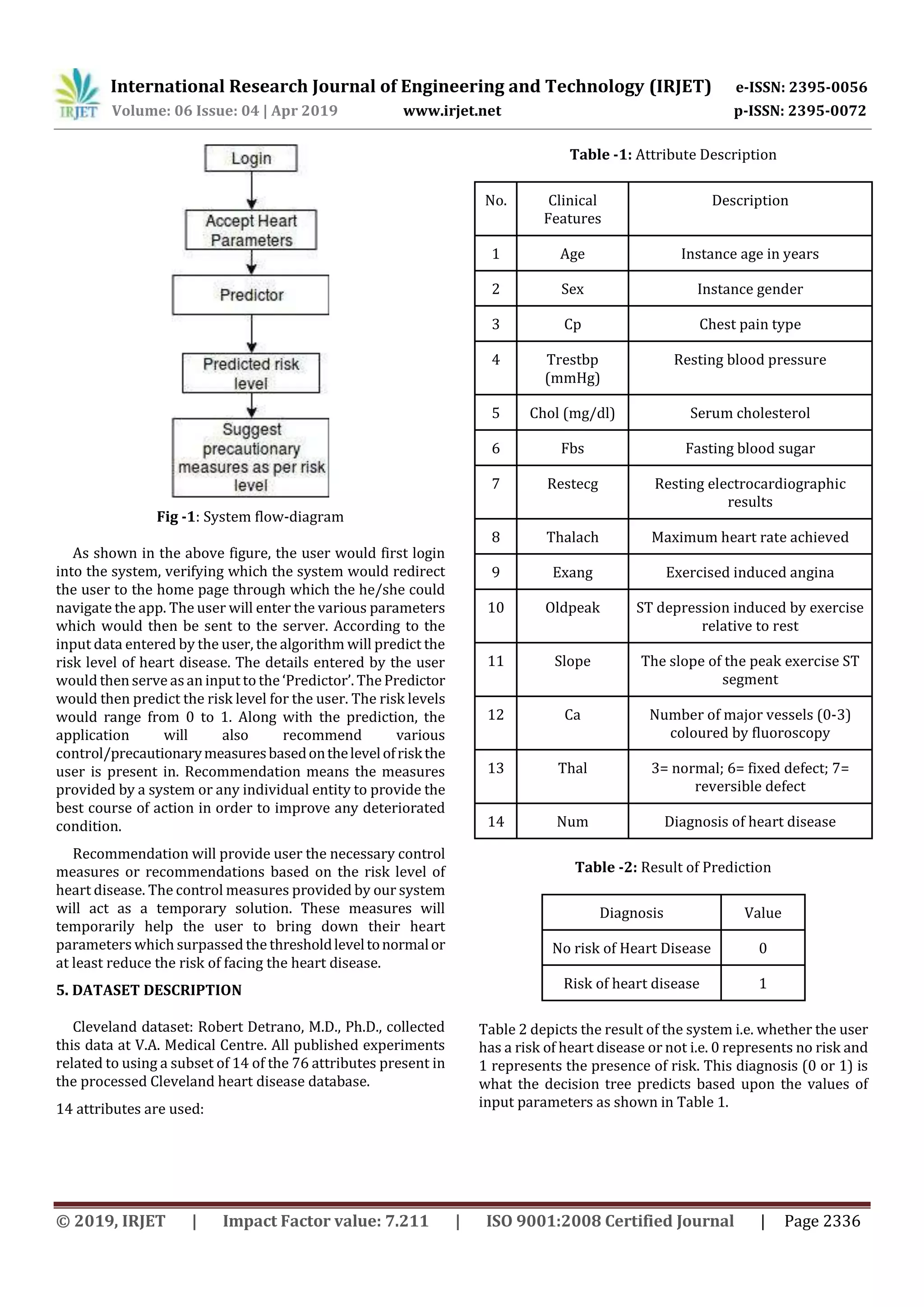
Fig -1: System flow-diagram
As shown in the above figure, the user would first login
into the system, verifying which the system would redirect
the user to the home page through which the he/she could
navigate the app. The user will enter the various parameters
which would then be sent to the server. According to the
input data entered by the user, the algorithm will predict the
risk level of heart disease. The details entered by the user
would then serve asan input to the ‘Predictor’. The Predictor
would then predict the risk level for the user. The risk levels
would range from 0 to 1. Along with the prediction, the
application will also recommend various
control/precautionarymeasuresbasedonthelevelofriskthe
user is present in. Recommendation means the measures
provided by a system or any individual entity to provide the
best course of action in order to improve any deteriorated
condition.
Recommendation will provide user the necessary control
measures or recommendations based on the risk level of
heart disease. The control measures provided by our system
will act as a temporary solution. These measures will
temporarily help the user to bring down their heart
parameters which surpassed the thresholdleveltonormalor
at least reduce the risk of facing the heart disease.
5. DATASET DESCRIPTION
Cleveland dataset: Robert Detrano, M.D., Ph.D., collected
this data at V.A. Medical Centre. All published experiments
related to using a subset of 14 of the 76 attributes present in
the processed Cleveland heart disease database.
14 attributes are used:
Table -1: Attribute Description
No. Clinical
Features
Description
1 Age Instance age in years
2 Sex Instance gender
3 Cp Chest pain type
4 Trestbp
(mmHg)
Resting blood pressure
5 Chol (mg/dl) Serum cholesterol
6 Fbs Fasting blood sugar
7 Restecg Resting electrocardiographic
results
8 Thalach Maximum heart rate achieved
9 Exang Exercised induced angina
10 Oldpeak ST depression induced by exercise
relative to rest
11 Slope The slope of the peak exercise ST
segment
12 Ca Number of major vessels (0-3)
coloured by fluoroscopy
13 Thal 3= normal; 6= fixed defect; 7=
reversible defect
14 Num Diagnosis of heart disease
Table -2: Result of Prediction
Diagnosis Value
No risk of Heart Disease 0
Risk of heart disease 1
Table 2 depicts the result of the system i.e. whether the user
has a risk of heart disease or not i.e. 0 represents no risk and
1 represents the presence of risk. This diagnosis (0 or 1) is
what the decision tree predicts based upon the values of
input parameters as shown in Table 1.
International Research Journal of Engineering and Technology (IRJET) e-ISSN: 2395-0056
Volume: 06 Issue: 04 | Apr 2019 www.irjet.net p-ISSN: 2395-0072
© 2019, IRJET | Impact Factor value: 7.211 | ISO 9001:2008 Certified Journal | Page 2337
6. CONCLUSION
To make effective clinical decisions in the medical field
plays a vital role as there is a need for a reliable and accurate
system. The paper studies how the machine learning and
decision tree algorithm works can be used for predicting the
heart disease bytakingintoconsiderationcertainparameters
such as thal, cholesterol, heart rate, age, gender. Using these
parameters, the algorithm predicts the risk level of heart
disease between the range 0 - 1 where 0 depicts noriskand1
depicts the presence of risk.Based ontherisklevelpredicted,
the user is suggested some precautionary measures in order
to lower the risk and stay fit.
ACKNOWLEDGEMENT
We are grateful to K J Somaiya Institute ofEngineeringand
IT and express our thanks to Principal, Dr. Suresh Ukarande
for extending his support. We are highly indebted to Prof.
Harsh Bhor forhis guidance and constantsupervisionaswell
as for providing necessary information.
REFERENCES
[1] T. Princy, J. Thomas, “Human Heart Disease Prediction
System using Data Mining Techniques,” International
Conference on Circuit, Power and Computing
Technologies [ICCPCT], 5090-1277, 2016.
[2] Priyanga, Naveen, “Web Analytics Support System for
Prediction of Heart Disease Using NaiveBayesWeighted
Approach (NBwa),” Asia Modelling Symposium (AMS),
2376-1172, 2017.
[3] H. Sharma, M. Rizvi, “Predicting and DiagnosingofHeart
Disease Using Machine Learning Algorithms”, 2319-
7242, International Journal Of Engineering And
Computer Science [ISSN], pp. 21623-21631, June 2017.
[4] M. Gandhi, S. Singh, “Predictions in Heart Disease using
Techniques of Data Mining,” 1st International
Conference on Futuristic trend in Computational
Analysis and Knowledge Management, 4799-8433, pp.
520-525, June 2015.
[5] M. Jabbar, S. Samreen, “Heart disease prediction system
based on hidden naïve bayes classifier,” International
Conference on Circuits, Controls, Communications and
Computing (I4C), 1721-4328, October 2016.
[6] H. Sharma, M. Rizvi, “Prediction of Heart Disease using
Machine Learning Algorithms: A Survey,” International
Journal on Recent and Innovation Trends in Computing
and Communication[IJRITCC],2321-8169,August2017.
[7] M. Kirmani, S. Ansarullah, “Prediction of Heart Disease
using Decision Tree a Data Mining Technique”, 2277-
5420, International Journal of Computer Science and
Network [IJCSN], December 2016.
[8] Purushottam, K. Saxena, R. Sharma, “Efficient Heart
Disease Prediction System using Decision Tree”, 4799-
8890, International Conference on Computing,
Communication and Automation (ICCCA), pp. 72-77,
July 2015.
[9] V.V. Ramalingam, A. Dandapath, M. Raja, "Heart disease
prediction usingmachinelearningtechniques:a survey,"
International Journal of Engineering & Technology
[IJET], pp. 684-687, 2018.
[10] A. Pandey, P. Pandey, K. Jaiswal, A. Sen, “A Heart Disease
Prediction Model using Decision Tree,” IOSR Journal of
Computer Engineering [IOSR-JCE], e-ISSN: 2278-0661,
p-ISSN: 2278-8727, pp.83-86, July-August 2013.
[11] A. Mahmood1, M. Kuppa, “Early detection of clinical
parameters in heart disease by improved decision tree
algorithm,” Second Vaagdevi International Conference
on Information Technology for Real World Problems,
2010.
[12] J. Yang, J. Kim, Un-Gu Kang, Y. Lee, “Coronary heart
diseaseoptimizationsystem onadaptive-network-based
fuzzy inference system and linear discriminant analysis
(ANFIS–LDA),” Pers Ubiquit Comput (2014), pp. 1351–
1362, 2013.
[13] T. Tang, G. Zheng, Y. Huang, G. Shu, P. Wang, “A
Comparative Study of Medical Data Classification
Methods Based on Decision Tree and System
Reconstruction Analysis,” IEMS, Vol. 4, No. 1, pp. 102-
108, June 2005.
[14] S. Palaniappan and R. Awang, “Intelligent heart disease
prediction system using data mining techniques,”
IEEE/ACS Int. Conf. Comput. Syst. Appl., pp. 108–115,
2008.
[15] A. T. Azar and S. M. El-Metwally, “Decision tree
classifiers for automated medical diagnosis,” Neural
Comput. Appl., vol. 23, no. 7–8, pp. 2387–2403, Dec.
2013.
[16] C. Dangare, S. Apte, “Improved Study of Heart Disease
Prediction System using Data Mining Classification
Techniques,” Volume 47– No.10, June 2012.

IRJET- Heart Disease Prediction and Recommendation

  • 1.
    International Research Journalof Engineering and Technology (IRJET) e-ISSN: 2395-0056 Volume: 06 Issue: 04 | Apr 2019 www.irjet.net p-ISSN: 2395-0072 © 2019, IRJET | Impact Factor value: 7.211 | ISO 9001:2008 Certified Journal | Page 2334 Heart Disease Prediction and Recommendation Maunish Shah1, Akshit Modi2, Jay Jethwa3, Harsh Bhor4 1,2,3Student, Dept. of IT Engineering, K. J. Somaiya Institute of Engineering And Information Technology, Sion, Mumbai 4Professor, Dept. of IT Engineering, K. J. Somaiya Institute of Engineering and Information Technology, Sion, Mumbai ---------------------------------------------------------------------***---------------------------------------------------------------------- Abstract - Over the last fewdecades, heart-relateddiseasesare the main reason for a huge amount of death in the world and has emerged as the most life-threatening disease, not only in India but in the whole world. There's a need for a reliable and accurate system to diagnose and treat such diseases in time for proper treatment. To automate the process of diagnosis and treatment Machine Learningalgorithmsandtechniquesis applied to the medical dataset. As technology is advancing, researchers have been using Machine Learning techniques in the diagnosis of heart-related diseases to help the healthcare industry. Key Words: cardiovascular, decision tree, Cleveland, Gini, recommendation, Scikit-learn 1. INTRODUCTION One of the biggest cause of death nowadays is heart disease. Abnormal variations in blood pressure, cholesterol, pulse rate etc. are the major reasons for heart disease. The heart is one of the important functional part of the body and if it gets affected, the functions of the whole body get disturbed. In the medical field, heart disease is one of the major challenges; because a lot of parameters and technicality is involved foraccuratelypredictingthisdisease. According to the latest survey conducted by WHO, the medical professionals were able to correctly predict only 67% of heart disease, so there is a vast scope of research in the area of predicting heart disease in humans[3]. A huge amount of clinical data is available, where vital information is hidden is seldom visited and remains untapped, researchers use data mining techniques to help health care professionals in the diagnosis of heart disease[7].Inorder to predict the risk level of heart disease, the Decision Tree algorithm is being used. The tree takes in 14 attributesasit's input such as age, sex, chest pain type, resting blood pressure, cholesterol in mg/dl, fasting blood sugar, etc.Once the prediction of the risk level is performed, the precautionary suggestions would be provided to the user, which would help them to control their risk level temporarily. "How can we turn data into useful information that can enable users to make effective clinical decisions"[8] This is the main objective of this paper. This paper is dedicated to a wide scope in the field of heart-related disease. Later part of the scope discusses how the user can go about understanding the various parameters related to the prediction and also the various ways throughwhichthey can control those parameters. 2. LITERATURE SURVEY The existing papers that are surveyed have their focus on the prediction of heart disease. The processed dataset that is collected from various sources is used to train the algorithm and are then used for prediction. T. Princy, J. Thomas[1] intends to give details about various techniques of knowledge abstraction by using data mining methods that are being used in today's research for prediction of heart disease. In this paper, data mining methods namely, Naive Bayes, Neural network,Decisiontree algorithmareanalyzedonmedicaldatasetsusingalgorithms. While Priyanga and Naveen[2] mainly focus on to create a decision support system using Naive Bayes algorithm for predicting heart disease. A web application is created to get user input and theapplicationcanretrievehiddenknowledge related to heart disease from ahistoricaldatabase(Cleveland dataset). M. Gandhi, S. Singh[4] focusesmon classification methods of data mining used in data discovery. Different classification techniques of data mining have merits and demerits for data classification and knowledge extraction. Purushottam, K. Saxena and Richa Sharma[8] depicted the extraction of risk level from the heart disease database. The input database contains the screening ofclinicaldataofheart patients. Initially, the database is pre-processed to make the mining process more efficient. Decision tree is used for the prediction. The papers majorly focusonfindingtheefficiency of various algorithms as the predictions in the domain of medical has to be accurate. 3. PROPOSED SYSTEM The heart report when generated has terms that are only understood by the doctors and according to that, they provide the necessary medications. The aim is to provide an Android application to the users, wherein they can provide the application the above-mentionedattributes whichwould then be used to predict the risk level of having a heart disease. The users are then provided with an in-depth explanation of all the terms that are responsible for the risk level generated in the predictionandarerecommended with various ways to reduce their risk level.
  • 2.
    International Research Journalof Engineering and Technology (IRJET) e-ISSN: 2395-0056 Volume: 06 Issue: 04 | Apr 2019 www.irjet.net p-ISSN: 2395-0072 © 2019, IRJET | Impact Factor value: 7.211 | ISO 9001:2008 Certified Journal | Page 2335 3.1 ALGORITHM USED Decision Tree - Decision Trees being a non-parametric supervised learning method they are used for classification. The goal is to create a model that predicts the value of a target variable (risk level) by learning simple decision rules inferred from the data features (Dataset). The major challenge in the decision tree is to identify the attribute for the root nodein each level. This processisknownasattribute selection. One of the main advantages of using decision tree was that it is able to handle both numerical and categorical data. Other techniques are usually specialized in analyzing datasets that have only one type of variable. The decision tree learning algorithm learns recursively as follows: Steps: 1.Compute the Gini index for data-set 2.For every attribute/feature: 1.Calculate Gini index for all categorical values 2.Take average information entropy for the current attribute 3.Calculate the Gini gain 3. Pick the best Gini gain attribute. 4. Repeat until we get the desired tree. Machine learning library Scikit-learn is used for prediction. Scikit-learn has a range of supervised and unsupervised learning algorithms provided through a consistent interface in Python. The sklearn.tree module includes decision tree- based models for classification. class sklearn.tree.DecisionTreeClassifier(criterion=’gini’,s plitter=’best’, max_depth=None, min_samples_split=2, min_sa mples_leaf=1, min_weight_fraction_leaf=0.0, max_features=N one, random_state=None, max_leaf_nodes=None) The method uses gini as the splitting criterion for attribute selection. Gini provides a statistical measure of the degree of variation or inequality representedinthedataset.Giniindex- Given a training set S, the target attribute takes on k different values (i.e. classes), the Gini index of S is defined as n G(S) = Σ P(i) * (1 - P(i)) i=1 Where P(i) is the probability of a certain classification i, per the training data set. 3.2 TECHNOLOGY STACK A. Android application An Android app is a software application which runs on Android platform. Because the Android platform is built for mobile devices, a typical Android app is designed for a smartphone or a tablet PC running on the Android OS. The main advantages of building an android application that it is easier to access and also the android phones are much cheaper than other alternatives. The target audienceis also comparatively very high and hence it makes a suitable platform for the idea being suggested here. B. Python Python being an object-oriented, high-level programming language with dynamic semantics. Its high-level built in data structures, makes it a very attractive language for machine learning applications. Many libraries are available to perform data analysis and mining on large sets of medical datasets: NumPy is important to perform scientific computing with Python. It is used to operateon multi-dimensionalarraysand matrices. SciPy works in association with NumPy arrays and offers effectiveroutinesfornumericalintegrationandup-gradation. Pandas, also developed on top of NumPy, is used to manage and manipulate the CSV (Comma Separated Value) files generated from the android application. Developed on NumPy, SciPy. Scikit-learn acts as a machine learning library that leads to the generation of the decision tree used in predictions. C. Flask Flask is used for connecting the backend server with the frontend android application. Flask is a microweb framework written in Python that does not require particular tools or libraries. Flask can be used for RESTful request dispatching in Python. A RESTful architectureuses HTTP coding formuchofitsfunctionality.A REST API defines a set of functions which developers can perform like requests and receive responses via HTTP protocol such as GETand POST. The datacanbepassedtothe server with the help of URL, with which the server would fetch the data and the servercan senda responsebackforthe request. 4. SYSTEM DESIGN The system design includes the overall structure of the system including its components, flow of data and also it explains how the input is accepted from and the output is presented to the user.
  • 3.
    International Research Journalof Engineering and Technology (IRJET) e-ISSN: 2395-0056 Volume: 06 Issue: 04 | Apr 2019 www.irjet.net p-ISSN: 2395-0072 © 2019, IRJET | Impact Factor value: 7.211 | ISO 9001:2008 Certified Journal | Page 2336 Fig -1: System flow-diagram As shown in the above figure, the user would first login into the system, verifying which the system would redirect the user to the home page through which the he/she could navigate the app. The user will enter the various parameters which would then be sent to the server. According to the input data entered by the user, the algorithm will predict the risk level of heart disease. The details entered by the user would then serve asan input to the ‘Predictor’. The Predictor would then predict the risk level for the user. The risk levels would range from 0 to 1. Along with the prediction, the application will also recommend various control/precautionarymeasuresbasedonthelevelofriskthe user is present in. Recommendation means the measures provided by a system or any individual entity to provide the best course of action in order to improve any deteriorated condition. Recommendation will provide user the necessary control measures or recommendations based on the risk level of heart disease. The control measures provided by our system will act as a temporary solution. These measures will temporarily help the user to bring down their heart parameters which surpassed the thresholdleveltonormalor at least reduce the risk of facing the heart disease. 5. DATASET DESCRIPTION Cleveland dataset: Robert Detrano, M.D., Ph.D., collected this data at V.A. Medical Centre. All published experiments related to using a subset of 14 of the 76 attributes present in the processed Cleveland heart disease database. 14 attributes are used: Table -1: Attribute Description No. Clinical Features Description 1 Age Instance age in years 2 Sex Instance gender 3 Cp Chest pain type 4 Trestbp (mmHg) Resting blood pressure 5 Chol (mg/dl) Serum cholesterol 6 Fbs Fasting blood sugar 7 Restecg Resting electrocardiographic results 8 Thalach Maximum heart rate achieved 9 Exang Exercised induced angina 10 Oldpeak ST depression induced by exercise relative to rest 11 Slope The slope of the peak exercise ST segment 12 Ca Number of major vessels (0-3) coloured by fluoroscopy 13 Thal 3= normal; 6= fixed defect; 7= reversible defect 14 Num Diagnosis of heart disease Table -2: Result of Prediction Diagnosis Value No risk of Heart Disease 0 Risk of heart disease 1 Table 2 depicts the result of the system i.e. whether the user has a risk of heart disease or not i.e. 0 represents no risk and 1 represents the presence of risk. This diagnosis (0 or 1) is what the decision tree predicts based upon the values of input parameters as shown in Table 1.
  • 4.
    International Research Journalof Engineering and Technology (IRJET) e-ISSN: 2395-0056 Volume: 06 Issue: 04 | Apr 2019 www.irjet.net p-ISSN: 2395-0072 © 2019, IRJET | Impact Factor value: 7.211 | ISO 9001:2008 Certified Journal | Page 2337 6. CONCLUSION To make effective clinical decisions in the medical field plays a vital role as there is a need for a reliable and accurate system. The paper studies how the machine learning and decision tree algorithm works can be used for predicting the heart disease bytakingintoconsiderationcertainparameters such as thal, cholesterol, heart rate, age, gender. Using these parameters, the algorithm predicts the risk level of heart disease between the range 0 - 1 where 0 depicts noriskand1 depicts the presence of risk.Based ontherisklevelpredicted, the user is suggested some precautionary measures in order to lower the risk and stay fit. ACKNOWLEDGEMENT We are grateful to K J Somaiya Institute ofEngineeringand IT and express our thanks to Principal, Dr. Suresh Ukarande for extending his support. We are highly indebted to Prof. Harsh Bhor forhis guidance and constantsupervisionaswell as for providing necessary information. REFERENCES [1] T. Princy, J. Thomas, “Human Heart Disease Prediction System using Data Mining Techniques,” International Conference on Circuit, Power and Computing Technologies [ICCPCT], 5090-1277, 2016. [2] Priyanga, Naveen, “Web Analytics Support System for Prediction of Heart Disease Using NaiveBayesWeighted Approach (NBwa),” Asia Modelling Symposium (AMS), 2376-1172, 2017. [3] H. Sharma, M. Rizvi, “Predicting and DiagnosingofHeart Disease Using Machine Learning Algorithms”, 2319- 7242, International Journal Of Engineering And Computer Science [ISSN], pp. 21623-21631, June 2017. [4] M. Gandhi, S. Singh, “Predictions in Heart Disease using Techniques of Data Mining,” 1st International Conference on Futuristic trend in Computational Analysis and Knowledge Management, 4799-8433, pp. 520-525, June 2015. [5] M. Jabbar, S. Samreen, “Heart disease prediction system based on hidden naïve bayes classifier,” International Conference on Circuits, Controls, Communications and Computing (I4C), 1721-4328, October 2016. [6] H. Sharma, M. Rizvi, “Prediction of Heart Disease using Machine Learning Algorithms: A Survey,” International Journal on Recent and Innovation Trends in Computing and Communication[IJRITCC],2321-8169,August2017. [7] M. Kirmani, S. Ansarullah, “Prediction of Heart Disease using Decision Tree a Data Mining Technique”, 2277- 5420, International Journal of Computer Science and Network [IJCSN], December 2016. [8] Purushottam, K. Saxena, R. Sharma, “Efficient Heart Disease Prediction System using Decision Tree”, 4799- 8890, International Conference on Computing, Communication and Automation (ICCCA), pp. 72-77, July 2015. [9] V.V. Ramalingam, A. Dandapath, M. Raja, "Heart disease prediction usingmachinelearningtechniques:a survey," International Journal of Engineering & Technology [IJET], pp. 684-687, 2018. [10] A. Pandey, P. Pandey, K. Jaiswal, A. Sen, “A Heart Disease Prediction Model using Decision Tree,” IOSR Journal of Computer Engineering [IOSR-JCE], e-ISSN: 2278-0661, p-ISSN: 2278-8727, pp.83-86, July-August 2013. [11] A. Mahmood1, M. Kuppa, “Early detection of clinical parameters in heart disease by improved decision tree algorithm,” Second Vaagdevi International Conference on Information Technology for Real World Problems, 2010. [12] J. Yang, J. Kim, Un-Gu Kang, Y. Lee, “Coronary heart diseaseoptimizationsystem onadaptive-network-based fuzzy inference system and linear discriminant analysis (ANFIS–LDA),” Pers Ubiquit Comput (2014), pp. 1351– 1362, 2013. [13] T. Tang, G. Zheng, Y. Huang, G. Shu, P. Wang, “A Comparative Study of Medical Data Classification Methods Based on Decision Tree and System Reconstruction Analysis,” IEMS, Vol. 4, No. 1, pp. 102- 108, June 2005. [14] S. Palaniappan and R. Awang, “Intelligent heart disease prediction system using data mining techniques,” IEEE/ACS Int. Conf. Comput. Syst. Appl., pp. 108–115, 2008. [15] A. T. Azar and S. M. El-Metwally, “Decision tree classifiers for automated medical diagnosis,” Neural Comput. Appl., vol. 23, no. 7–8, pp. 2387–2403, Dec. 2013. [16] C. Dangare, S. Apte, “Improved Study of Heart Disease Prediction System using Data Mining Classification Techniques,” Volume 47– No.10, June 2012.