International Research Journal of Engineering and Technology (IRJET) e-ISSN: 2395-0056
Volume: 07 Issue: 07 | July 2020 www.irjet.net p-ISSN: 2395-0072
© 2020, IRJET | Impact Factor value: 7.529 | ISO 9001:2008 Certified Journal | Page 3586
Comparative Investigation of 7-level Cascaded Multilevel Inverter
using Multicarrier Level Shifted PWM Techniques
Priyanka Meena1, Kapil Kansal2, Dr. Ahmed Hasan Khan3, Anil Kumar Sharma4
1Mtech Scholar, JIT Jaipur
2Asst. Professor, JIT Jaipur
3Professor, JIT Jaipur
4Asst. Professor, JIT Jaipur
1-4Dept. of electrical Engineering, Jaipur Institute of Technology and Group of Institutions, Jaipur, Rajasthan, India
----------------------------------------------------------------------***---------------------------------------------------------------------
Abstract - This manuscript presents the achieved efforts
on 1-ϕ 7-level cascaded H-bridge multilevel inverter. To
cheer the quality of 7-level CHBMLI output parameters
primarily THD and switching losses, multicarrier level
shifted technique is consider forcontrollingthegatepulse of
7level CHBMLI and the complete analysis of THD for 7-level
is done. This work is performed and results are validated
using MATLAB/SIMULINK.
Keywords: Multilevel Inverter (MLI), Cascaded H-Bridge
(CHBMLI), Multicarrier pulse width modulation technique
(MCPWM).
MULTILEVEL INVERTER:
An inverter is a tool that transfers DC to AC, with the use of
transformers the rehabilitated AC can be used at any
necessary voltages and frequencies. The inverters which
have no moving parts are static inverters and are employed
in various applications. Industries are now demanding
equipments with high powers, of the ranges of megawatt
level. Nowadays, it is tough to fix a sole power
semiconductor switch directly to medium voltagegrids(2.3,
3.3, 4.16, or 6.9 kV). So for higher level of voltage, a new
family of MLI has materializedasthewayoutforfunctioning.
MLI comprise an array of power semiconductors and
capacitor voltage sources, the output of which generate
voltages with stepped waveforms. Fig.1 shows a schematic
diagram of one phase leg of inverterswithdifferent numbers
of levels.[12, 13, 15]
Fig 1: One leg inverters (a) 1-level (b) 2-level (c) n-level
Classification of Multilevel Inverter:
(a) Diode clamped multilevel inverter (DC MLI)
A 3-phase 6-level DCMLI is given away in Fig 2 Each of the
three phases of the inverter shares a common DC bus, which
has been subdivided by five capacitors into six levels. The
voltage across each capacitor is Vdc, and the voltage stress
across each switching device is limited to Vdc through the
clamping diodes. This engages the (n-1) main DC link
capacitors and also Σ(2n-2) clamping diodes, where, n is the
number of levels [9, 11].
Fig 2: Structure of Three Phase Six Level DCMLI
Fig 3: Line Voltage Waveform of Six-Level DCMLI
International Research Journal of Engineering and Technology (IRJET) e-ISSN: 2395-0056
Volume: 07 Issue: 07 | July 2020 www.irjet.net p-ISSN: 2395-0072
© 2020, IRJET | Impact Factor value: 7.529 | ISO 9001:2008 Certified Journal | Page 3587
Advantages and Disadvantages of DCMLI.
(1) Advantages:
 All of the phases share a common dc bus, which
minimizes the capacitance requirements of the
converter.
 The capacitors can be pre charged as a group.
 Effectiveness is elevated for elementary switching
of frequency.
(2) Disadvantages:
 Real power flow is difficult for a single inverter
because the intermediate dc levels will tend to
overcharge or discharge without precise
monitoring and control.
 The number of clamping diodes required is
quadratically related to the number oflevelswhich
can be cumbersome for units witha highnumberof
levels.
(b) FLYING CAPACITOR BASED MULTILEVEL
INVERTER(FCMLI)
The FCMLI necessitate a big number of capacitors to clamp
the device voltage to one capacitor voltage level provided all
the capacitors are equal value. An n-level inverter will
necessitate a total number of (n-1)*(n-2)/2 clamping
capacitors per phase. Fig 4 demonstratesthe3-phase6-level
FCMLI [10].
Fig 4: Structure of Three Phase Six-Level Flying Capacitor
Inverter.
Fig 5: Line Voltage Waveform of FCMLI Based.
Advantages and Disadvantages of FCMLI
(1) Advantages:
 Additional clamping diodes are not required.
 It has switching idleness inside the phase, which
can be used to balance the flying capacitors so that
only one DC source is desirable.
 The requisite number of level of voltage can be
attained with no use of the transformer. This aid in
dropping the charge of the inverter and yet again
diminish loss of power.
(2) Disadvantages
 Inverter initialization i.e., previous to the converter
can be adapted by any modulation method the
capacitors ought to bearrangedwiththeobligatory
voltage level as the preliminary charge.Thismakes
difficult the modulation procedure and turn out to
be an obstacle to the procedure of the converter.
 Organizing is difficult to footpath the level of
voltage for every capacitor.
 Pre charging every capacitor to identical level of
voltage and bring into being is difficult.
(c) CASCADED MULTILEVEL INVERTER(CHBMLI)
Fig. 6 deprived the basic layout of CHBMLI for single phase.
Every splitting voltage source (Vdc1, Vdc2, Vdc3) associated in
cascade through additional supply via a unique H-bridge
circuit linked through it. Every circuitcontainsfourswitches
that can create the voltage output source in positive or
negative polarity; or it can be simplyzerovoltsdepending on
the switching condition of the switches in the circuit [1, 2].
The level of output can be given by
2 1levelN S  (1)
Where, S is the H-bridge
The voltage at every phase can be calculated by
𝑉𝑠𝑖 = 1 𝑉 𝑑𝑐 ( 𝑖 = 1,2,3 … ) (2)
The number of switches used in this topology is given by the
equation,
𝑁𝑠𝑤𝑖𝑡𝑐ℎ = 4𝑆 (3)
The rewards of the CHBMLI are series H-bridges for
modularized outline and wrapping. The Fig 7 demonstrates
the waveform of voltage output for a 7-level CHBMLI [7, 8].
International Research Journal of Engineering and Technology (IRJET) e-ISSN: 2395-0056
Volume: 07 Issue: 07 | July 2020 www.irjet.net p-ISSN: 2395-0072
© 2020, IRJET | Impact Factor value: 7.529 | ISO 9001:2008 Certified Journal | Page 3588
Fig 6: Topology for CHBMLI
Fig 7: Typical Output Waveform for CHBMLI
Advantages and Disadvantages of CHBMLI.
(1) Advantages
 Very simple to regulate DC busses.
 Modularity of control can be achieved.
 Involve the slightest number of apparatus amongst
all MLI to attain the similar number of levels.
 Flexible switching can be used in this arrangement
to keep away from hefty and lossy resistor
capacitor diode snubbers.
(2) Disadvantages
 Communication between the bridges is essential to
accomplish the harmonization of referenceandthe
carrier waveforms.
 Requires splited DC sources for real power
conversions, and therefore its purposes are a bit
inadequate.
MODULATION TECHNIQUES: ModulationTechnique
is Low and High switching Frequency fort high switching
frequency is considered above 1 KHz [13].
Multicarrier PWM: Multicarrier Pulse Width Modulation
Technique is used in three level or more than three levels.
These are classified into two types: - Level Shift, Phase Shift.
Level / Vertically Shifted PWM: Level shifted technique is
the reasonable addition of sine triangle PWM for MLI, in
which n-1 carriers are required for n-level inverter.They are
approved in vertical shifts in constant bands defined by the
levels of the inverter [8]. 3(n-1) carriers are requisite for 3-
phases. Based on managed degrees of liberty grouping, the
level shifted PWM is divided into PD, APOD and POD PWM
techniques [3, 5, 6].
Fig 8: Types of PWM control techniques
Phase Disposition Pulse Width Modulation (PD PWM):
The PDPWM with single reference is basedontheevaluation
of a sinusoidal reference signal with n-1 carriers which are
vertically shifted. From Fig 11 it can be known that the
carriers that have the similar frequency fc and amplitude Ac
are in phase. The modulating signal has a frequency of fr and
an amplitude Ar.
Alternate Phase Opposition Disposition Pulse Width
Modulation (APOD PWM): In APODPWM, the contiguous
carriers with identical frequency and amplitude are
positioned and overlapped and are phase displaced by 180o
in a mode as exposed in Fig 13. These carriers are evaluated
with single sinusoidal reference wave for the appropriate
procedure of CHBMLI.
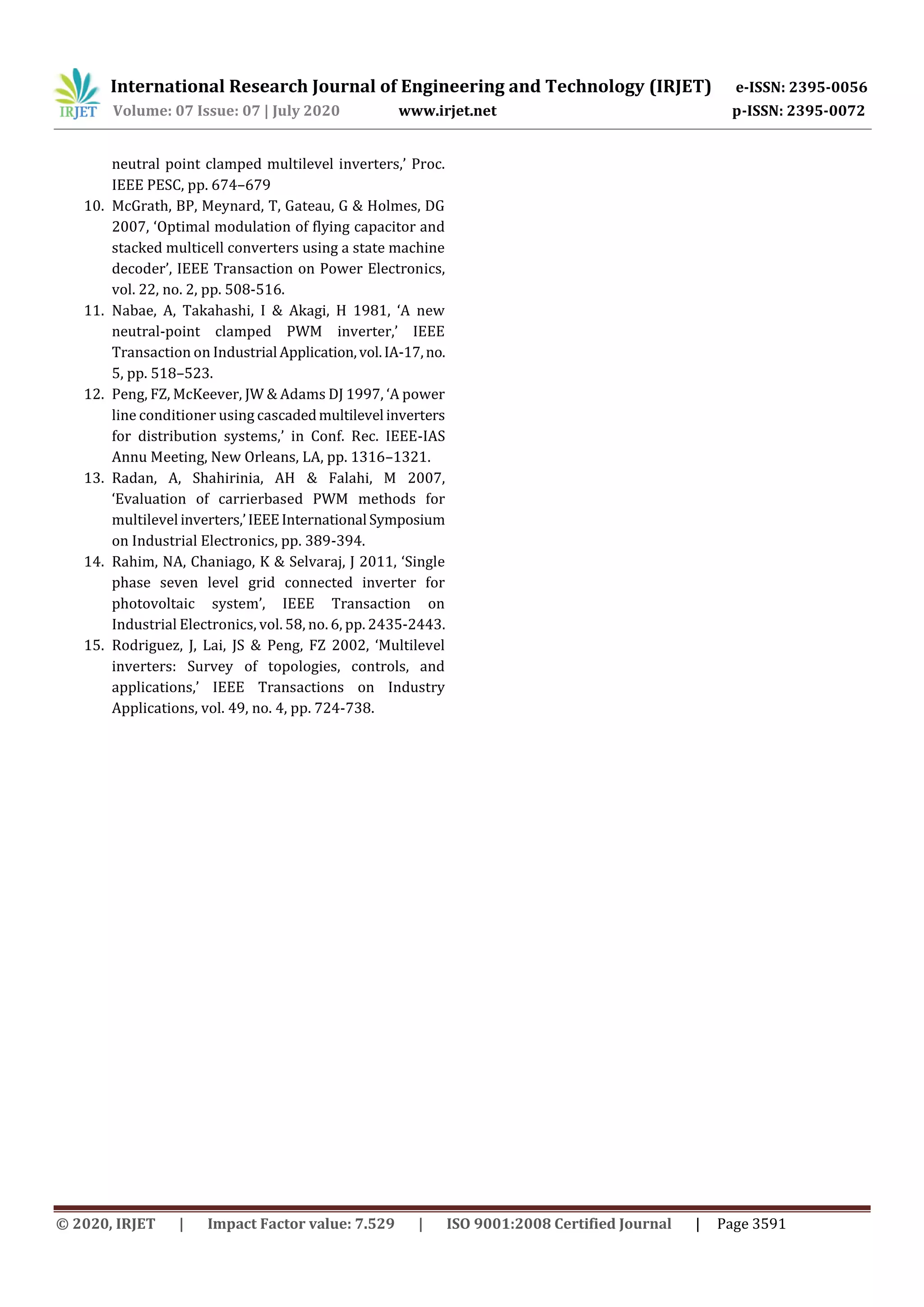
Phase Opposition Disposition Pulse Width Modulation
(POD PWM): The carrier signal with similar amplitude and
frequency are in phase over and under the zero reference
value. However, as exposed in Fig 15, there is 180o phase
International Research Journal of Engineering and Technology (IRJET) e-ISSN: 2395-0056
Volume: 07 Issue: 07 | July 2020 www.irjet.net p-ISSN: 2395-0072
© 2020, IRJET | Impact Factor value: 7.529 | ISO 9001:2008 Certified Journal | Page 3589
shift flanked by the ones over and under the zero reference.
These carriers are overlay with single reference signal to
produce the pulses for calculating the switches of MLI.
3. SIMULATION AND RESULTS:
Simulation of Seven Level CHBMLI: 7-level inverter is
simulated similar to that of the 5-level inverter. The
difference here is the number of carrier signals. Here six
carrier signals are employed. Three of them are applied
across the positive half cycle of the modulating signal [14].
Remaining three of them are applied acrossthenegativehalf
cycle of the modulating signal. From these signals twelve
PWM signals are generated and then given to the eight
switches of a leg. Pulses are generated for remainingphases.
Here the pulses were generated using various level shifting
techniques like PDPWM, PODPWM, APODPWM.
Fig. 9: Simulation for 7-level CHBMLI with PWM
technique.
5.3.1 Simulation Results:
Fig. 10 Output waveform for 7-level CHBMLI.
Fig. 11 Carrier arrangements for PD PWM
Fig.12 THD for PDPWM technique.
Fig. 13 Carrier arrangements for APOD PWM
International Research Journal of Engineering and Technology (IRJET) e-ISSN: 2395-0056
Volume: 07 Issue: 07 | July 2020 www.irjet.net p-ISSN: 2395-0072
© 2020, IRJET | Impact Factor value: 7.529 | ISO 9001:2008 Certified Journal | Page 3590
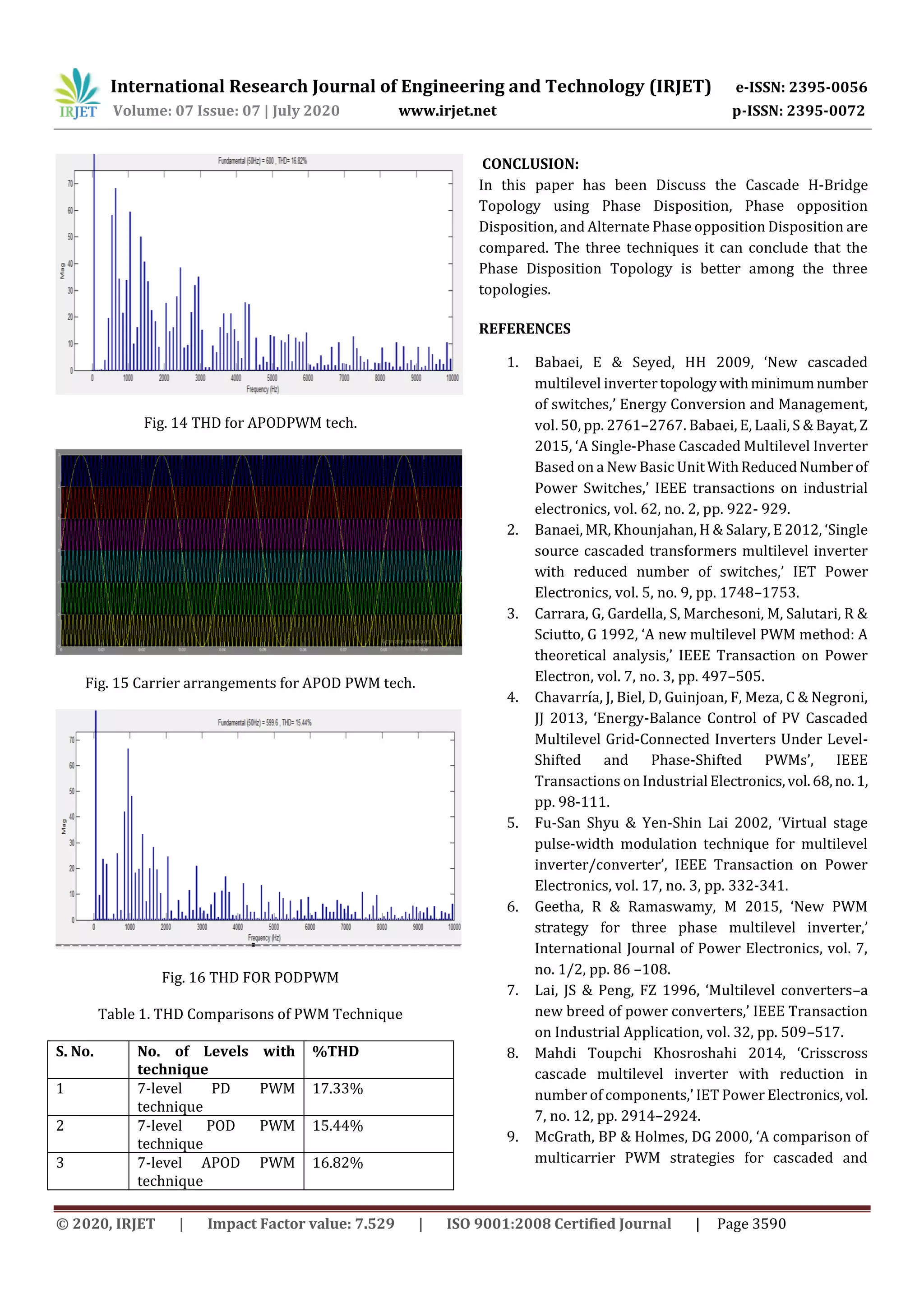
Fig. 14 THD for APODPWM tech.
Fig. 15 Carrier arrangements for APOD PWM tech.
Fig. 16 THD FOR PODPWM
Table 1. THD Comparisons of PWM Technique
S. No. No. of Levels with
technique
%THD
1 7-level PD PWM
technique
17.33%
2 7-level POD PWM
technique
15.44%
3 7-level APOD PWM
technique
16.82%
CONCLUSION:
In this paper has been Discuss the Cascade H-Bridge
Topology using Phase Disposition, Phase opposition
Disposition, and Alternate Phase opposition Disposition are
compared. The three techniques it can conclude that the
Phase Disposition Topology is better among the three
topologies.
REFERENCES
1. Babaei, E & Seyed, HH 2009, ‘New cascaded
multilevel invertertopologywithminimumnumber
of switches,’ Energy Conversion and Management,
vol. 50, pp. 2761–2767. Babaei, E, Laali, S & Bayat, Z
2015, ‘A Single-Phase Cascaded Multilevel Inverter
Based on a New Basic UnitWithReducedNumberof
Power Switches,’ IEEE transactions on industrial
electronics, vol. 62, no. 2, pp. 922- 929.
2. Banaei, MR, Khounjahan, H & Salary, E 2012, ‘Single
source cascaded transformers multilevel inverter
with reduced number of switches,’ IET Power
Electronics, vol. 5, no. 9, pp. 1748–1753.
3. Carrara, G, Gardella, S, Marchesoni, M, Salutari, R &
Sciutto, G 1992, ‘A new multilevel PWM method: A
theoretical analysis,’ IEEE Transaction on Power
Electron, vol. 7, no. 3, pp. 497–505.
4. Chavarría, J, Biel, D, Guinjoan, F, Meza, C & Negroni,
JJ 2013, ‘Energy-Balance Control of PV Cascaded
Multilevel Grid-Connected Inverters Under Level-
Shifted and Phase-Shifted PWMs’, IEEE
Transactions on Industrial Electronics,vol.68,no.1,
pp. 98-111.
5. Fu-San Shyu & Yen-Shin Lai 2002, ‘Virtual stage
pulse-width modulation technique for multilevel
inverter/converter’, IEEE Transaction on Power
Electronics, vol. 17, no. 3, pp. 332-341.
6. Geetha, R & Ramaswamy, M 2015, ‘New PWM
strategy for three phase multilevel inverter,’
International Journal of Power Electronics, vol. 7,
no. 1/2, pp. 86 –108.
7. Lai, JS & Peng, FZ 1996, ‘Multilevel converters–a
new breed of power converters,’ IEEE Transaction
on Industrial Application, vol. 32, pp. 509–517.
8. Mahdi Toupchi Khosroshahi 2014, ‘Crisscross
cascade multilevel inverter with reduction in
number of components,’ IET Power Electronics,vol.
7, no. 12, pp. 2914–2924.
9. McGrath, BP & Holmes, DG 2000, ‘A comparison of
multicarrier PWM strategies for cascaded and
International Research Journal of Engineering and Technology (IRJET) e-ISSN: 2395-0056
Volume: 07 Issue: 07 | July 2020 www.irjet.net p-ISSN: 2395-0072
© 2020, IRJET | Impact Factor value: 7.529 | ISO 9001:2008 Certified Journal | Page 3591
neutral point clamped multilevel inverters,’ Proc.
IEEE PESC, pp. 674–679
10. McGrath, BP, Meynard, T, Gateau, G & Holmes, DG
2007, ‘Optimal modulation of flying capacitor and
stacked multicell converters using a state machine
decoder’, IEEE Transaction on Power Electronics,
vol. 22, no. 2, pp. 508-516.
11. Nabae, A, Takahashi, I & Akagi, H 1981, ‘A new
neutral-point clamped PWM inverter,’ IEEE
Transaction on Industrial Application,vol.IA-17,no.
5, pp. 518–523.
12. Peng, FZ, McKeever, JW & Adams DJ 1997, ‘A power
line conditioner using cascadedmultilevel inverters
for distribution systems,’ in Conf. Rec. IEEE-IAS
Annu Meeting, New Orleans, LA, pp. 1316–1321.
13. Radan, A, Shahirinia, AH & Falahi, M 2007,
‘Evaluation of carrierbased PWM methods for
multilevel inverters,’IEEEInternational Symposium
on Industrial Electronics, pp. 389-394.
14. Rahim, NA, Chaniago, K & Selvaraj, J 2011, ‘Single
phase seven level grid connected inverter for
photovoltaic system’, IEEE Transaction on
Industrial Electronics, vol. 58, no. 6, pp. 2435-2443.
15. Rodriguez, J, Lai, JS & Peng, FZ 2002, ‘Multilevel
inverters: Survey of topologies, controls, and
applications,’ IEEE Transactions on Industry
Applications, vol. 49, no. 4, pp. 724-738.

IRJET - Comparative Investigation of 7-level Cascaded Multilevel Inverter using Multicarrier Level Shifted PWM Techniques

  • 1.
    International Research Journalof Engineering and Technology (IRJET) e-ISSN: 2395-0056 Volume: 07 Issue: 07 | July 2020 www.irjet.net p-ISSN: 2395-0072 © 2020, IRJET | Impact Factor value: 7.529 | ISO 9001:2008 Certified Journal | Page 3586 Comparative Investigation of 7-level Cascaded Multilevel Inverter using Multicarrier Level Shifted PWM Techniques Priyanka Meena1, Kapil Kansal2, Dr. Ahmed Hasan Khan3, Anil Kumar Sharma4 1Mtech Scholar, JIT Jaipur 2Asst. Professor, JIT Jaipur 3Professor, JIT Jaipur 4Asst. Professor, JIT Jaipur 1-4Dept. of electrical Engineering, Jaipur Institute of Technology and Group of Institutions, Jaipur, Rajasthan, India ----------------------------------------------------------------------***--------------------------------------------------------------------- Abstract - This manuscript presents the achieved efforts on 1-ϕ 7-level cascaded H-bridge multilevel inverter. To cheer the quality of 7-level CHBMLI output parameters primarily THD and switching losses, multicarrier level shifted technique is consider forcontrollingthegatepulse of 7level CHBMLI and the complete analysis of THD for 7-level is done. This work is performed and results are validated using MATLAB/SIMULINK. Keywords: Multilevel Inverter (MLI), Cascaded H-Bridge (CHBMLI), Multicarrier pulse width modulation technique (MCPWM). MULTILEVEL INVERTER: An inverter is a tool that transfers DC to AC, with the use of transformers the rehabilitated AC can be used at any necessary voltages and frequencies. The inverters which have no moving parts are static inverters and are employed in various applications. Industries are now demanding equipments with high powers, of the ranges of megawatt level. Nowadays, it is tough to fix a sole power semiconductor switch directly to medium voltagegrids(2.3, 3.3, 4.16, or 6.9 kV). So for higher level of voltage, a new family of MLI has materializedasthewayoutforfunctioning. MLI comprise an array of power semiconductors and capacitor voltage sources, the output of which generate voltages with stepped waveforms. Fig.1 shows a schematic diagram of one phase leg of inverterswithdifferent numbers of levels.[12, 13, 15] Fig 1: One leg inverters (a) 1-level (b) 2-level (c) n-level Classification of Multilevel Inverter: (a) Diode clamped multilevel inverter (DC MLI) A 3-phase 6-level DCMLI is given away in Fig 2 Each of the three phases of the inverter shares a common DC bus, which has been subdivided by five capacitors into six levels. The voltage across each capacitor is Vdc, and the voltage stress across each switching device is limited to Vdc through the clamping diodes. This engages the (n-1) main DC link capacitors and also Σ(2n-2) clamping diodes, where, n is the number of levels [9, 11]. Fig 2: Structure of Three Phase Six Level DCMLI Fig 3: Line Voltage Waveform of Six-Level DCMLI
  • 2.
    International Research Journalof Engineering and Technology (IRJET) e-ISSN: 2395-0056 Volume: 07 Issue: 07 | July 2020 www.irjet.net p-ISSN: 2395-0072 © 2020, IRJET | Impact Factor value: 7.529 | ISO 9001:2008 Certified Journal | Page 3587 Advantages and Disadvantages of DCMLI. (1) Advantages:  All of the phases share a common dc bus, which minimizes the capacitance requirements of the converter.  The capacitors can be pre charged as a group.  Effectiveness is elevated for elementary switching of frequency. (2) Disadvantages:  Real power flow is difficult for a single inverter because the intermediate dc levels will tend to overcharge or discharge without precise monitoring and control.  The number of clamping diodes required is quadratically related to the number oflevelswhich can be cumbersome for units witha highnumberof levels. (b) FLYING CAPACITOR BASED MULTILEVEL INVERTER(FCMLI) The FCMLI necessitate a big number of capacitors to clamp the device voltage to one capacitor voltage level provided all the capacitors are equal value. An n-level inverter will necessitate a total number of (n-1)*(n-2)/2 clamping capacitors per phase. Fig 4 demonstratesthe3-phase6-level FCMLI [10]. Fig 4: Structure of Three Phase Six-Level Flying Capacitor Inverter. Fig 5: Line Voltage Waveform of FCMLI Based. Advantages and Disadvantages of FCMLI (1) Advantages:  Additional clamping diodes are not required.  It has switching idleness inside the phase, which can be used to balance the flying capacitors so that only one DC source is desirable.  The requisite number of level of voltage can be attained with no use of the transformer. This aid in dropping the charge of the inverter and yet again diminish loss of power. (2) Disadvantages  Inverter initialization i.e., previous to the converter can be adapted by any modulation method the capacitors ought to bearrangedwiththeobligatory voltage level as the preliminary charge.Thismakes difficult the modulation procedure and turn out to be an obstacle to the procedure of the converter.  Organizing is difficult to footpath the level of voltage for every capacitor.  Pre charging every capacitor to identical level of voltage and bring into being is difficult. (c) CASCADED MULTILEVEL INVERTER(CHBMLI) Fig. 6 deprived the basic layout of CHBMLI for single phase. Every splitting voltage source (Vdc1, Vdc2, Vdc3) associated in cascade through additional supply via a unique H-bridge circuit linked through it. Every circuitcontainsfourswitches that can create the voltage output source in positive or negative polarity; or it can be simplyzerovoltsdepending on the switching condition of the switches in the circuit [1, 2]. The level of output can be given by 2 1levelN S  (1) Where, S is the H-bridge The voltage at every phase can be calculated by 𝑉𝑠𝑖 = 1 𝑉 𝑑𝑐 ( 𝑖 = 1,2,3 … ) (2) The number of switches used in this topology is given by the equation, 𝑁𝑠𝑤𝑖𝑡𝑐ℎ = 4𝑆 (3) The rewards of the CHBMLI are series H-bridges for modularized outline and wrapping. The Fig 7 demonstrates the waveform of voltage output for a 7-level CHBMLI [7, 8].
  • 3.
    International Research Journalof Engineering and Technology (IRJET) e-ISSN: 2395-0056 Volume: 07 Issue: 07 | July 2020 www.irjet.net p-ISSN: 2395-0072 © 2020, IRJET | Impact Factor value: 7.529 | ISO 9001:2008 Certified Journal | Page 3588 Fig 6: Topology for CHBMLI Fig 7: Typical Output Waveform for CHBMLI Advantages and Disadvantages of CHBMLI. (1) Advantages  Very simple to regulate DC busses.  Modularity of control can be achieved.  Involve the slightest number of apparatus amongst all MLI to attain the similar number of levels.  Flexible switching can be used in this arrangement to keep away from hefty and lossy resistor capacitor diode snubbers. (2) Disadvantages  Communication between the bridges is essential to accomplish the harmonization of referenceandthe carrier waveforms.  Requires splited DC sources for real power conversions, and therefore its purposes are a bit inadequate. MODULATION TECHNIQUES: ModulationTechnique is Low and High switching Frequency fort high switching frequency is considered above 1 KHz [13]. Multicarrier PWM: Multicarrier Pulse Width Modulation Technique is used in three level or more than three levels. These are classified into two types: - Level Shift, Phase Shift. Level / Vertically Shifted PWM: Level shifted technique is the reasonable addition of sine triangle PWM for MLI, in which n-1 carriers are required for n-level inverter.They are approved in vertical shifts in constant bands defined by the levels of the inverter [8]. 3(n-1) carriers are requisite for 3- phases. Based on managed degrees of liberty grouping, the level shifted PWM is divided into PD, APOD and POD PWM techniques [3, 5, 6]. Fig 8: Types of PWM control techniques Phase Disposition Pulse Width Modulation (PD PWM): The PDPWM with single reference is basedontheevaluation of a sinusoidal reference signal with n-1 carriers which are vertically shifted. From Fig 11 it can be known that the carriers that have the similar frequency fc and amplitude Ac are in phase. The modulating signal has a frequency of fr and an amplitude Ar. Alternate Phase Opposition Disposition Pulse Width Modulation (APOD PWM): In APODPWM, the contiguous carriers with identical frequency and amplitude are positioned and overlapped and are phase displaced by 180o in a mode as exposed in Fig 13. These carriers are evaluated with single sinusoidal reference wave for the appropriate procedure of CHBMLI. Phase Opposition Disposition Pulse Width Modulation (POD PWM): The carrier signal with similar amplitude and frequency are in phase over and under the zero reference value. However, as exposed in Fig 15, there is 180o phase
  • 4.
    International Research Journalof Engineering and Technology (IRJET) e-ISSN: 2395-0056 Volume: 07 Issue: 07 | July 2020 www.irjet.net p-ISSN: 2395-0072 © 2020, IRJET | Impact Factor value: 7.529 | ISO 9001:2008 Certified Journal | Page 3589 shift flanked by the ones over and under the zero reference. These carriers are overlay with single reference signal to produce the pulses for calculating the switches of MLI. 3. SIMULATION AND RESULTS: Simulation of Seven Level CHBMLI: 7-level inverter is simulated similar to that of the 5-level inverter. The difference here is the number of carrier signals. Here six carrier signals are employed. Three of them are applied across the positive half cycle of the modulating signal [14]. Remaining three of them are applied acrossthenegativehalf cycle of the modulating signal. From these signals twelve PWM signals are generated and then given to the eight switches of a leg. Pulses are generated for remainingphases. Here the pulses were generated using various level shifting techniques like PDPWM, PODPWM, APODPWM. Fig. 9: Simulation for 7-level CHBMLI with PWM technique. 5.3.1 Simulation Results: Fig. 10 Output waveform for 7-level CHBMLI. Fig. 11 Carrier arrangements for PD PWM Fig.12 THD for PDPWM technique. Fig. 13 Carrier arrangements for APOD PWM
  • 5.
    International Research Journalof Engineering and Technology (IRJET) e-ISSN: 2395-0056 Volume: 07 Issue: 07 | July 2020 www.irjet.net p-ISSN: 2395-0072 © 2020, IRJET | Impact Factor value: 7.529 | ISO 9001:2008 Certified Journal | Page 3590 Fig. 14 THD for APODPWM tech. Fig. 15 Carrier arrangements for APOD PWM tech. Fig. 16 THD FOR PODPWM Table 1. THD Comparisons of PWM Technique S. No. No. of Levels with technique %THD 1 7-level PD PWM technique 17.33% 2 7-level POD PWM technique 15.44% 3 7-level APOD PWM technique 16.82% CONCLUSION: In this paper has been Discuss the Cascade H-Bridge Topology using Phase Disposition, Phase opposition Disposition, and Alternate Phase opposition Disposition are compared. The three techniques it can conclude that the Phase Disposition Topology is better among the three topologies. REFERENCES 1. Babaei, E & Seyed, HH 2009, ‘New cascaded multilevel invertertopologywithminimumnumber of switches,’ Energy Conversion and Management, vol. 50, pp. 2761–2767. Babaei, E, Laali, S & Bayat, Z 2015, ‘A Single-Phase Cascaded Multilevel Inverter Based on a New Basic UnitWithReducedNumberof Power Switches,’ IEEE transactions on industrial electronics, vol. 62, no. 2, pp. 922- 929. 2. Banaei, MR, Khounjahan, H & Salary, E 2012, ‘Single source cascaded transformers multilevel inverter with reduced number of switches,’ IET Power Electronics, vol. 5, no. 9, pp. 1748–1753. 3. Carrara, G, Gardella, S, Marchesoni, M, Salutari, R & Sciutto, G 1992, ‘A new multilevel PWM method: A theoretical analysis,’ IEEE Transaction on Power Electron, vol. 7, no. 3, pp. 497–505. 4. Chavarría, J, Biel, D, Guinjoan, F, Meza, C & Negroni, JJ 2013, ‘Energy-Balance Control of PV Cascaded Multilevel Grid-Connected Inverters Under Level- Shifted and Phase-Shifted PWMs’, IEEE Transactions on Industrial Electronics,vol.68,no.1, pp. 98-111. 5. Fu-San Shyu & Yen-Shin Lai 2002, ‘Virtual stage pulse-width modulation technique for multilevel inverter/converter’, IEEE Transaction on Power Electronics, vol. 17, no. 3, pp. 332-341. 6. Geetha, R & Ramaswamy, M 2015, ‘New PWM strategy for three phase multilevel inverter,’ International Journal of Power Electronics, vol. 7, no. 1/2, pp. 86 –108. 7. Lai, JS & Peng, FZ 1996, ‘Multilevel converters–a new breed of power converters,’ IEEE Transaction on Industrial Application, vol. 32, pp. 509–517. 8. Mahdi Toupchi Khosroshahi 2014, ‘Crisscross cascade multilevel inverter with reduction in number of components,’ IET Power Electronics,vol. 7, no. 12, pp. 2914–2924. 9. McGrath, BP & Holmes, DG 2000, ‘A comparison of multicarrier PWM strategies for cascaded and
  • 6.
    International Research Journalof Engineering and Technology (IRJET) e-ISSN: 2395-0056 Volume: 07 Issue: 07 | July 2020 www.irjet.net p-ISSN: 2395-0072 © 2020, IRJET | Impact Factor value: 7.529 | ISO 9001:2008 Certified Journal | Page 3591 neutral point clamped multilevel inverters,’ Proc. IEEE PESC, pp. 674–679 10. McGrath, BP, Meynard, T, Gateau, G & Holmes, DG 2007, ‘Optimal modulation of flying capacitor and stacked multicell converters using a state machine decoder’, IEEE Transaction on Power Electronics, vol. 22, no. 2, pp. 508-516. 11. Nabae, A, Takahashi, I & Akagi, H 1981, ‘A new neutral-point clamped PWM inverter,’ IEEE Transaction on Industrial Application,vol.IA-17,no. 5, pp. 518–523. 12. Peng, FZ, McKeever, JW & Adams DJ 1997, ‘A power line conditioner using cascadedmultilevel inverters for distribution systems,’ in Conf. Rec. IEEE-IAS Annu Meeting, New Orleans, LA, pp. 1316–1321. 13. Radan, A, Shahirinia, AH & Falahi, M 2007, ‘Evaluation of carrierbased PWM methods for multilevel inverters,’IEEEInternational Symposium on Industrial Electronics, pp. 389-394. 14. Rahim, NA, Chaniago, K & Selvaraj, J 2011, ‘Single phase seven level grid connected inverter for photovoltaic system’, IEEE Transaction on Industrial Electronics, vol. 58, no. 6, pp. 2435-2443. 15. Rodriguez, J, Lai, JS & Peng, FZ 2002, ‘Multilevel inverters: Survey of topologies, controls, and applications,’ IEEE Transactions on Industry Applications, vol. 49, no. 4, pp. 724-738.