International Research Journal of Engineering and Technology (IRJET) e-ISSN: 2395-0056
Volume: 06 Issue: 06 | June 2019 www.irjet.net p-ISSN: 2395-0072
© 2019, IRJET | Impact Factor value: 7.211 | ISO 9001:2008 Certified Journal | Page 3547
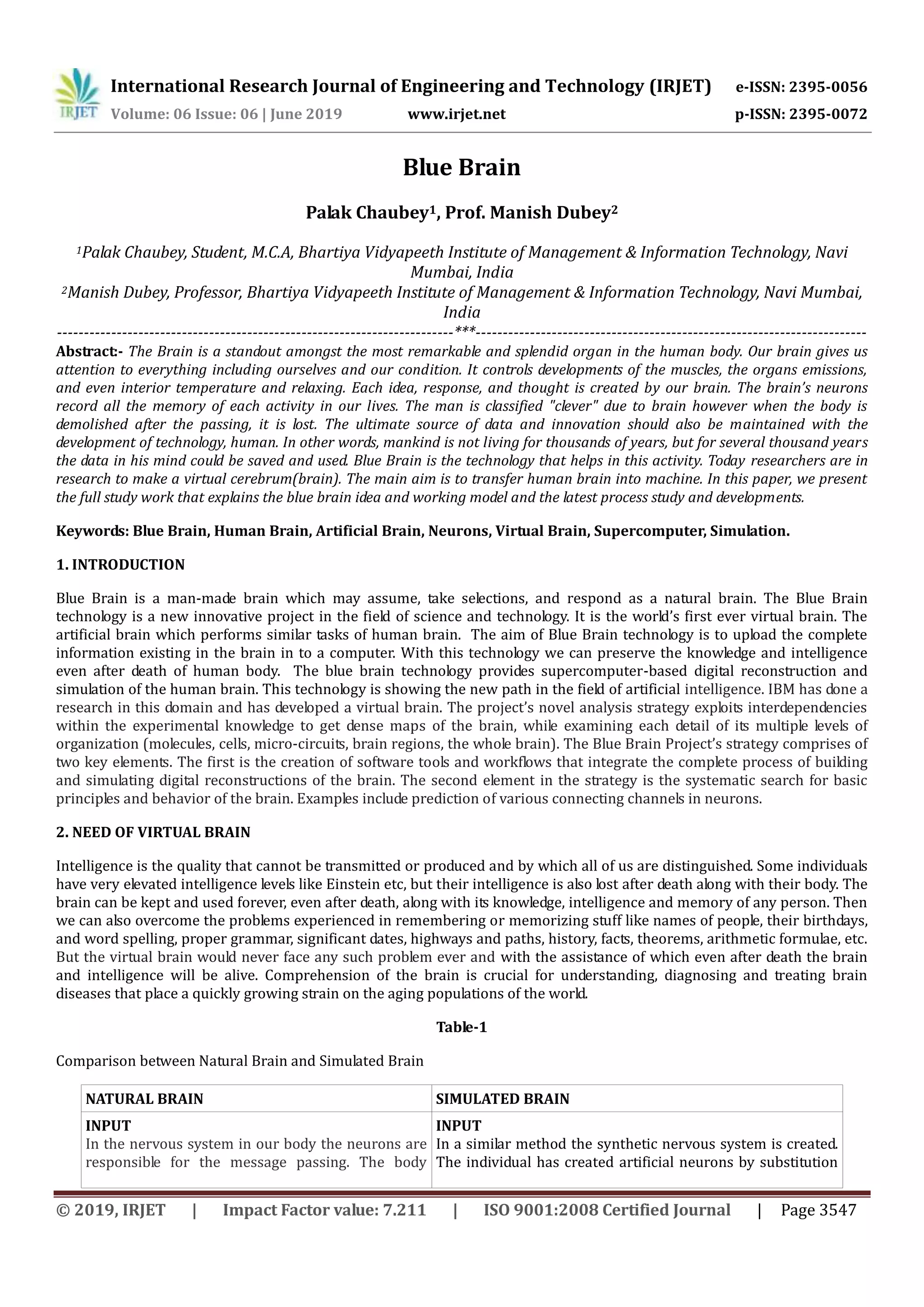
Blue Brain
Palak Chaubey1, Prof. Manish Dubey2
1Palak Chaubey, Student, M.C.A, Bhartiya Vidyapeeth Institute of Management & Information Technology, Navi
Mumbai, India
2Manish Dubey, Professor, Bhartiya Vidyapeeth Institute of Management & Information Technology, Navi Mumbai,
India
-------------------------------------------------------------------------***------------------------------------------------------------------------
Abstract:- The Brain is a standout amongst the most remarkable and splendid organ in the human body. Our brain gives us
attention to everything including ourselves and our condition. It controls developments of the muscles, the organs emissions,
and even interior temperature and relaxing. Each idea, response, and thought is created by our brain. The brain’s neurons
record all the memory of each activity in our lives. The man is classified "clever" due to brain however when the body is
demolished after the passing, it is lost. The ultimate source of data and innovation should also be maintained with the
development of technology, human. In other words, mankind is not living for thousands of years, but for several thousand years
the data in his mind could be saved and used. Blue Brain is the technology that helps in this activity. Today researchers are in
research to make a virtual cerebrum(brain). The main aim is to transfer human brain into machine. In this paper, we present
the full study work that explains the blue brain idea and working model and the latest process study and developments.
Keywords: Blue Brain, Human Brain, Artificial Brain, Neurons, Virtual Brain, Supercomputer, Simulation.
1. INTRODUCTION
Blue Brain is a man-made brain which may assume, take selections, and respond as a natural brain. The Blue Brain
technology is a new innovative project in the field of science and technology. It is the world’s first ever virtual brain. The
artificial brain which performs similar tasks of human brain. The aim of Blue Brain technology is to upload the complete
information existing in the brain in to a computer. With this technology we can preserve the knowledge and intelligence
even after death of human body. The blue brain technology provides supercomputer-based digital reconstruction and
simulation of the human brain. This technology is showing the new path in the field of artificial intelligence. IBM has done a
research in this domain and has developed a virtual brain. The project’s novel analysis strategy exploits interdependencies
within the experimental knowledge to get dense maps of the brain, while examining each detail of its multiple levels of
organization (molecules, cells, micro-circuits, brain regions, the whole brain). The Blue Brain Project’s strategy comprises of
two key elements. The first is the creation of software tools and workflows that integrate the complete process of building
and simulating digital reconstructions of the brain. The second element in the strategy is the systematic search for basic
principles and behavior of the brain. Examples include prediction of various connecting channels in neurons.
2. NEED OF VIRTUAL BRAIN
Intelligence is the quality that cannot be transmitted or produced and by which all of us are distinguished. Some individuals
have very elevated intelligence levels like Einstein etc, but their intelligence is also lost after death along with their body. The
brain can be kept and used forever, even after death, along with its knowledge, intelligence and memory of any person. Then
we can also overcome the problems experienced in remembering or memorizing stuff like names of people, their birthdays,
and word spelling, proper grammar, significant dates, highways and paths, history, facts, theorems, arithmetic formulae, etc.
But the virtual brain would never face any such problem ever and with the assistance of which even after death the brain
and intelligence will be alive. Comprehension of the brain is crucial for understanding, diagnosing and treating brain
diseases that place a quickly growing strain on the aging populations of the world.
Table-1
Comparison between Natural Brain and Simulated Brain
NATURAL BRAIN SIMULATED BRAIN
INPUT
In the nervous system in our body the neurons are
responsible for the message passing. The body
INPUT
In a similar method the synthetic nervous system is created.
The individual has created artificial neurons by substitution
International Research Journal of Engineering and Technology (IRJET) e-ISSN: 2395-0056
Volume: 06 Issue: 06 | June 2019 www.irjet.net p-ISSN: 2395-0072
© 2019, IRJET | Impact Factor value: 7.211 | ISO 9001:2008 Certified Journal | Page 3548
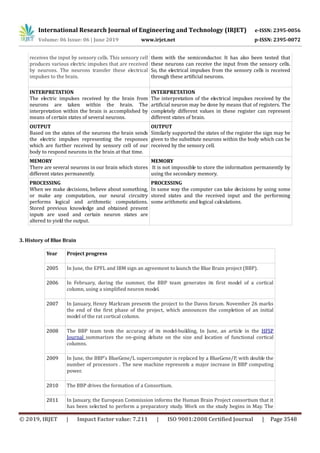
receives the input by sensory cells. This sensory cell
produces various electric impulses that are received
by neurons. The neurons transfer these electrical
impulses to the brain.
them with the semiconductor. It has also been tested that
these neurons can receive the input from the sensory cells.
So, the electrical impulses from the sensory cells is received
through these artificial neurons.
INTERPRETATION
The electric impulses received by the brain from
neurons are taken within the brain. The
interpretation within the brain is accomplished by
means of certain states of several neurons.
INTERPRETATION
The interpretation of the electrical impulses received by the
artificial neuron may be done by means that of registers. The
completely different values in these register can represent
different states of brain.
OUTPUT
Based on the states of the neurons the brain sends
the electric impulses representing the responses
which are further received by sensory cell of our
body to respond neurons in the brain at that time.
OUTPUT
Similarly supported the states of the register the sign may be
given to the substitute neurons within the body which can be
received by the sensory cell.
MEMORY
There are several neurons in our brain which stores
different states permanently.
MEMORY
It is not impossible to store the information permanently by
using the secondary memory.
PROCESSING
When we make decisions, believe about something,
or make any computation, our neural circuitry
performs logical and arithmetic computations.
Stored previous knowledge and obtained present
inputs are used and certain neuron states are
altered to yield the output.
PROCESSING
In same way the computer can take decisions by using some
stored states and the received input and the performing
some arithmetic and logical calculations.
3. History of Blue Brain
Year Project progress
2005 In June, the EPFL and IBM sign an agreement to launch the Blue Brain project (BBP).
2006 In February, during the summer, the BBP team generates its first model of a cortical
column, using a simplified neuron model.
2007 In January, Henry Markram presents the project to the Davos forum. November 26 marks
the end of the first phase of the project, which announces the completion of an initial
model of the rat cortical column.
2008 The BBP team tests the accuracy of its model-building, In June, an article in the HFSP
Journal summarizes the on-going debate on the size and location of functional cortical
columns.
2009 In June, the BBP’s BlueGene/L supercomputer is replaced by a BlueGene/P, with double the
number of processors . The new machine represents a major increase in BBP computing
power.
2010 The BBP drives the formation of a Consortium.
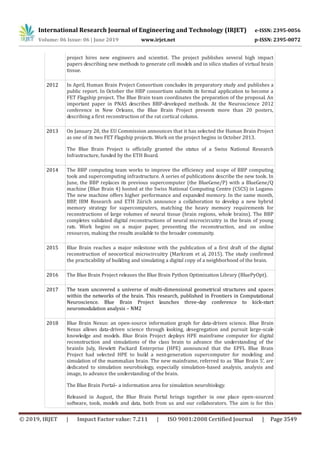
2011 In January, the European Commission informs the Human Brain Project consortium that it
has been selected to perform a preparatory study. Work on the study begins in May. The
International Research Journal of Engineering and Technology (IRJET) e-ISSN: 2395-0056
Volume: 06 Issue: 06 | June 2019 www.irjet.net p-ISSN: 2395-0072
© 2019, IRJET | Impact Factor value: 7.211 | ISO 9001:2008 Certified Journal | Page 3549
project hires new engineers and scientist. The project publishes several high impact
papers describing new methods to generate cell models and in silico studies of virtual brain
tissue.
2012 In April, Human Brain Project Consortium concludes its preparatory study and publishes a
public report. In October the HBP consortium submits its formal application to become a
FET Flagship project. The Blue Brain team coordinates the preparation of the proposal. An
important paper in PNAS describes BBP-developed methods. At the Neuroscience 2012
conference in New Orleans, the Blue Brain Project presents more than 20 posters,
describing a first reconstruction of the rat cortical column.
2013 On January 28, the EU Commission announces that it has selected the Human Brain Project
as one of its two FET Flagship projects. Work on the project begins in October 2013.
The Blue Brain Project is officially granted the status of a Swiss National Research
Infrastructure, funded by the ETH Board.
2014 The BBP computing team works to improve the efficiency and scope of BBP computing
tools and supercomputing infrastructure. A series of publications describe the new tools. In
June, the BBP replaces its previous supercomputer (the BlueGene/P) with a BlueGene/Q
machine (Blue Brain 4) hosted at the Swiss National Computing Centre (CSCS) in Lugano.
The new machine offers higher performance and expanded memory. In the same month,
BBP, IBM Research and ETH Zürich announce a collaboration to develop a new hybrid
memory strategy for supercomputers, matching the heavy memory requirements for
reconstructions of large volumes of neural tissue (brain regions, whole brains). The BBP
completes validated digital reconstructions of neural microcircuitry in the brain of young
rats. Work begins on a major paper, presenting the reconstruction, and on online
resources, making the results available to the broader community.
2015 Blue Brain reaches a major milestone with the publication of a first draft of the digital
reconstruction of neocortical microcircuitry (Markram et al, 2015). The study confirmed
the practicability of building and simulating a digital copy of a neighborhood of the brain.
2016 The Blue Brain Project releases the Blue Brain Python Optimization Library (BluePyOpt).
2017 The team uncovered a universe of multi-dimensional geometrical structures and spaces
within the networks of the brain. This research, published in Frontiers in Computational
Neuroscience. Blue Brain Project launches three-day conference to kick-start
neuromodulation analysis – NM2
2018 Blue Brain Nexus: an open-source information graph for data-driven science. Blue Brain
Nexus allows data-driven science through looking, desegregation and pursuit large-scale
knowledge and models. Blue Brain Project deploys HPE mainframe computer for digital
reconstruction and simulations of the class brain to advance the understanding of the
brainIn July, Hewlett Packard Enterprise (HPE) announced that the EPFL Blue Brain
Project had selected HPE to build a next-generation supercomputer for modeling and
simulation of the mammalian brain. The new mainframe, referred to as ‘Blue Brain 5’, are
dedicated to simulation neurobiology, especially simulation-based analysis, analysis and
image, to advance the understanding of the brain.
The Blue Brain Portal– a information area for simulation neurobiology.
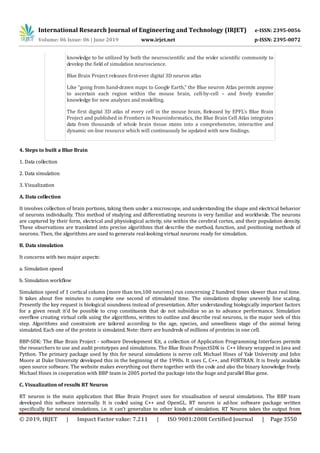
Released in August, the Blue Brain Portal brings together in one place open-sourced
software, tools, models and data, both from us and our collaborators. The aim is for this
International Research Journal of Engineering and Technology (IRJET) e-ISSN: 2395-0056
Volume: 06 Issue: 06 | June 2019 www.irjet.net p-ISSN: 2395-0072
© 2019, IRJET | Impact Factor value: 7.211 | ISO 9001:2008 Certified Journal | Page 3550
knowledge to be utilized by both the neuroscientific and the wider scientific community to
develop the field of simulation neuroscience.
Blue Brain Project releases first-ever digital 3D neuron atlas
Like “going from hand-drawn maps to Google Earth,” the Blue neuron Atlas permits anyone
to ascertain each region within the mouse brain, cell-by-cell – and freely transfer
knowledge for new analyses and modelling.
The first digital 3D atlas of every cell in the mouse brain, Released by EPFL’s Blue Brain
Project and published in Frontiers in Neuroinformatics, the Blue Brain Cell Atlas integrates
data from thousands of whole brain tissue stains into a comprehensive, interactive and
dynamic on-line resource which will continuously be updated with new findings.
4. Steps to built a Blue Brain
1. Data collection
2. Data simulation
3. Visualization
A. Data collection
It involves collection of brain portions, taking them under a microscope, and understanding the shape and electrical behavior
of neurons individually. This method of studying and differentiating neurons is very familiar and worldwide. The neurons
are captured by their form, electrical and physiological activity, site within the cerebral cortex, and their population density.
These observations are translated into precise algorithms that describe the method, function, and positioning methods of
neurons. Then, the algorithms are used to generate real-looking virtual neurons ready for simulation.
B. Data simulation
It concerns with two major aspects:
a. Simulation speed
b. Simulation workflow
Simulation speed of 1 cortical column (more than ten,100 neurons) run concerning 2 hundred times slower than real time.
It takes about five minutes to complete one second of stimulated time. The simulations display unevenly line scaling.
Presently the key request is biological soundness instead of presentation. After understanding biologically important factors
for a given result it'd be possible to crop constituents that do not subsidize so as to advance performance. Simulation
overflow creating virtual cells using the algorithms, written to outline and describe real neurons, is the major seek of this
step. Algorithms and constraints are tailored according to the age, species, and unwellness stage of the animal being
simulated. Each one of the protein is simulated. Note: there are hundreds of millions of proteins in one cell.
BBP-SDK: The Blue Brain Project - software Development Kit, a collection of Application Programming Interfaces permits
the researchers to use and audit prototypes and simulations. The Blue Brain ProjectSDK is C++ library wrapped in Java and
Python. The primary package used by this for neural simulations is nerve cell. Michael Hines of Yale University and John
Moore at Duke University developed this in the beginning of the 1990s. It uses C, C++, and FORTRAN. It is freely available
open source software. The website makes everything out there together with the code and also the binary knowledge freely.
Michael Hines in cooperation with BBP team in 2005 ported the package into the huge and parallel Blue gene.
C. Visualization of results RT Neuron
RT neuron is the main application that Blue Brain Project uses for visualisation of neural simulations. The BBP team
developed this software internally. It is coded using C++ and OpenGL. RT neuron is ad-hoc software package written
specifically for neural simulations, i.e. it can’t generalize to other kinds of simulation. RT Neuron takes the output from
International Research Journal of Engineering and Technology (IRJET) e-ISSN: 2395-0056
Volume: 06 Issue: 06 | June 2019 www.irjet.net p-ISSN: 2395-0072
© 2019, IRJET | Impact Factor value: 7.211 | ISO 9001:2008 Certified Journal | Page 3551
Hodgkin-Huxley simulations as input in NEURON and delivers them in 3D. This allows the programmers and researchers to
look at as activation potentials propagate through or between neurons. The animations can be paused, stopped, started and
zoomed, hence allowing the researchers to interact with the model. The visualizations are multi-scale (they can render
individual neurons or a whole cortical column).
5. Conclusion
The blue brain project, if implemented successfully, would indeed change many things around us and it will boost the area
of research and technology. Hence, the whole idea is that mental illness, memory and perception triggered by neurons and
electric signals could be soon treated with a supercomputer that models all the 1,000,000 million synapses of brain. we can
say that with some improvement in today‟s technology, the Blue Brain can be implemented in future and transferring
ourselves into computer would be possible. The intelligence of human brain will be stored even after the death for
betterment of society. We can make decisions without the actual presence of a person. But it is also true that we will depend
on the computer. It will bring both positive and negative effects to human society. This technology will be accepted all over
the world widely very soon. It may take several years to decades to accomplish this.
Reference
[1] Priya Babel, Blue Brain - The Future Generation, Research Journal of Computer and Information Technology Sciences
ISSN 2320 – 6527 Vol. 3(2), 1-5, May (2015)
[2] Ms Akanksha V. Patil, Ms. Ruchita R. Kesarkar, Mrs. Sapana G. Buwa, Ms. Jyotsna T. Kumbhar, Mr. Vijay U. Patil, BLUE
BRAIN, IRACST - International Journal of Computer Science and Information Technology & Security (IJCSITS), ISSN: 2249-
9555 Vol. 2, No.6, December 2012
[3] Mythili.M, Nandhini.S, A Study on Artificial Intelligence- The Blue Brain, International Journal of Innovative Research in
Computer and Communication Engineering Vol. 4, Issue 8, August 2016
[4] Iyer Mili Venkat, Sachin Gala, Ruchik Thakkar, Manan Mehta, Yash Bhawre, Blue Brain: Bringing a Virtual Brain to Life,
International Journal on Recent and Innovation Trends in Computing and Communication Volume: 4 Issue: 1
[5] Ms. K. Kaviya, THE BLUE BRAIN, IJAICT Volume 1, Issue 3, July 2014
[6] Surya Verma, Bhumika Kohli, Blue Brain, International Journal of Scientific and Research Publications, Volume 5, Issue
10, October 2015
[7] http://www.artificialbrains.com/blue-brain-project [10] https://en.wikipedia.org/wiki/Blue_Brain_Project

IRJET- Blue Brain

  • 1.
    International Research Journalof Engineering and Technology (IRJET) e-ISSN: 2395-0056 Volume: 06 Issue: 06 | June 2019 www.irjet.net p-ISSN: 2395-0072 © 2019, IRJET | Impact Factor value: 7.211 | ISO 9001:2008 Certified Journal | Page 3547 Blue Brain Palak Chaubey1, Prof. Manish Dubey2 1Palak Chaubey, Student, M.C.A, Bhartiya Vidyapeeth Institute of Management & Information Technology, Navi Mumbai, India 2Manish Dubey, Professor, Bhartiya Vidyapeeth Institute of Management & Information Technology, Navi Mumbai, India -------------------------------------------------------------------------***------------------------------------------------------------------------ Abstract:- The Brain is a standout amongst the most remarkable and splendid organ in the human body. Our brain gives us attention to everything including ourselves and our condition. It controls developments of the muscles, the organs emissions, and even interior temperature and relaxing. Each idea, response, and thought is created by our brain. The brain’s neurons record all the memory of each activity in our lives. The man is classified "clever" due to brain however when the body is demolished after the passing, it is lost. The ultimate source of data and innovation should also be maintained with the development of technology, human. In other words, mankind is not living for thousands of years, but for several thousand years the data in his mind could be saved and used. Blue Brain is the technology that helps in this activity. Today researchers are in research to make a virtual cerebrum(brain). The main aim is to transfer human brain into machine. In this paper, we present the full study work that explains the blue brain idea and working model and the latest process study and developments. Keywords: Blue Brain, Human Brain, Artificial Brain, Neurons, Virtual Brain, Supercomputer, Simulation. 1. INTRODUCTION Blue Brain is a man-made brain which may assume, take selections, and respond as a natural brain. The Blue Brain technology is a new innovative project in the field of science and technology. It is the world’s first ever virtual brain. The artificial brain which performs similar tasks of human brain. The aim of Blue Brain technology is to upload the complete information existing in the brain in to a computer. With this technology we can preserve the knowledge and intelligence even after death of human body. The blue brain technology provides supercomputer-based digital reconstruction and simulation of the human brain. This technology is showing the new path in the field of artificial intelligence. IBM has done a research in this domain and has developed a virtual brain. The project’s novel analysis strategy exploits interdependencies within the experimental knowledge to get dense maps of the brain, while examining each detail of its multiple levels of organization (molecules, cells, micro-circuits, brain regions, the whole brain). The Blue Brain Project’s strategy comprises of two key elements. The first is the creation of software tools and workflows that integrate the complete process of building and simulating digital reconstructions of the brain. The second element in the strategy is the systematic search for basic principles and behavior of the brain. Examples include prediction of various connecting channels in neurons. 2. NEED OF VIRTUAL BRAIN Intelligence is the quality that cannot be transmitted or produced and by which all of us are distinguished. Some individuals have very elevated intelligence levels like Einstein etc, but their intelligence is also lost after death along with their body. The brain can be kept and used forever, even after death, along with its knowledge, intelligence and memory of any person. Then we can also overcome the problems experienced in remembering or memorizing stuff like names of people, their birthdays, and word spelling, proper grammar, significant dates, highways and paths, history, facts, theorems, arithmetic formulae, etc. But the virtual brain would never face any such problem ever and with the assistance of which even after death the brain and intelligence will be alive. Comprehension of the brain is crucial for understanding, diagnosing and treating brain diseases that place a quickly growing strain on the aging populations of the world. Table-1 Comparison between Natural Brain and Simulated Brain NATURAL BRAIN SIMULATED BRAIN INPUT In the nervous system in our body the neurons are responsible for the message passing. The body INPUT In a similar method the synthetic nervous system is created. The individual has created artificial neurons by substitution
  • 2.
    International Research Journalof Engineering and Technology (IRJET) e-ISSN: 2395-0056 Volume: 06 Issue: 06 | June 2019 www.irjet.net p-ISSN: 2395-0072 © 2019, IRJET | Impact Factor value: 7.211 | ISO 9001:2008 Certified Journal | Page 3548 receives the input by sensory cells. This sensory cell produces various electric impulses that are received by neurons. The neurons transfer these electrical impulses to the brain. them with the semiconductor. It has also been tested that these neurons can receive the input from the sensory cells. So, the electrical impulses from the sensory cells is received through these artificial neurons. INTERPRETATION The electric impulses received by the brain from neurons are taken within the brain. The interpretation within the brain is accomplished by means of certain states of several neurons. INTERPRETATION The interpretation of the electrical impulses received by the artificial neuron may be done by means that of registers. The completely different values in these register can represent different states of brain. OUTPUT Based on the states of the neurons the brain sends the electric impulses representing the responses which are further received by sensory cell of our body to respond neurons in the brain at that time. OUTPUT Similarly supported the states of the register the sign may be given to the substitute neurons within the body which can be received by the sensory cell. MEMORY There are several neurons in our brain which stores different states permanently. MEMORY It is not impossible to store the information permanently by using the secondary memory. PROCESSING When we make decisions, believe about something, or make any computation, our neural circuitry performs logical and arithmetic computations. Stored previous knowledge and obtained present inputs are used and certain neuron states are altered to yield the output. PROCESSING In same way the computer can take decisions by using some stored states and the received input and the performing some arithmetic and logical calculations. 3. History of Blue Brain Year Project progress 2005 In June, the EPFL and IBM sign an agreement to launch the Blue Brain project (BBP). 2006 In February, during the summer, the BBP team generates its first model of a cortical column, using a simplified neuron model. 2007 In January, Henry Markram presents the project to the Davos forum. November 26 marks the end of the first phase of the project, which announces the completion of an initial model of the rat cortical column. 2008 The BBP team tests the accuracy of its model-building, In June, an article in the HFSP Journal summarizes the on-going debate on the size and location of functional cortical columns. 2009 In June, the BBP’s BlueGene/L supercomputer is replaced by a BlueGene/P, with double the number of processors . The new machine represents a major increase in BBP computing power. 2010 The BBP drives the formation of a Consortium. 2011 In January, the European Commission informs the Human Brain Project consortium that it has been selected to perform a preparatory study. Work on the study begins in May. The
  • 3.
    International Research Journalof Engineering and Technology (IRJET) e-ISSN: 2395-0056 Volume: 06 Issue: 06 | June 2019 www.irjet.net p-ISSN: 2395-0072 © 2019, IRJET | Impact Factor value: 7.211 | ISO 9001:2008 Certified Journal | Page 3549 project hires new engineers and scientist. The project publishes several high impact papers describing new methods to generate cell models and in silico studies of virtual brain tissue. 2012 In April, Human Brain Project Consortium concludes its preparatory study and publishes a public report. In October the HBP consortium submits its formal application to become a FET Flagship project. The Blue Brain team coordinates the preparation of the proposal. An important paper in PNAS describes BBP-developed methods. At the Neuroscience 2012 conference in New Orleans, the Blue Brain Project presents more than 20 posters, describing a first reconstruction of the rat cortical column. 2013 On January 28, the EU Commission announces that it has selected the Human Brain Project as one of its two FET Flagship projects. Work on the project begins in October 2013. The Blue Brain Project is officially granted the status of a Swiss National Research Infrastructure, funded by the ETH Board. 2014 The BBP computing team works to improve the efficiency and scope of BBP computing tools and supercomputing infrastructure. A series of publications describe the new tools. In June, the BBP replaces its previous supercomputer (the BlueGene/P) with a BlueGene/Q machine (Blue Brain 4) hosted at the Swiss National Computing Centre (CSCS) in Lugano. The new machine offers higher performance and expanded memory. In the same month, BBP, IBM Research and ETH Zürich announce a collaboration to develop a new hybrid memory strategy for supercomputers, matching the heavy memory requirements for reconstructions of large volumes of neural tissue (brain regions, whole brains). The BBP completes validated digital reconstructions of neural microcircuitry in the brain of young rats. Work begins on a major paper, presenting the reconstruction, and on online resources, making the results available to the broader community. 2015 Blue Brain reaches a major milestone with the publication of a first draft of the digital reconstruction of neocortical microcircuitry (Markram et al, 2015). The study confirmed the practicability of building and simulating a digital copy of a neighborhood of the brain. 2016 The Blue Brain Project releases the Blue Brain Python Optimization Library (BluePyOpt). 2017 The team uncovered a universe of multi-dimensional geometrical structures and spaces within the networks of the brain. This research, published in Frontiers in Computational Neuroscience. Blue Brain Project launches three-day conference to kick-start neuromodulation analysis – NM2 2018 Blue Brain Nexus: an open-source information graph for data-driven science. Blue Brain Nexus allows data-driven science through looking, desegregation and pursuit large-scale knowledge and models. Blue Brain Project deploys HPE mainframe computer for digital reconstruction and simulations of the class brain to advance the understanding of the brainIn July, Hewlett Packard Enterprise (HPE) announced that the EPFL Blue Brain Project had selected HPE to build a next-generation supercomputer for modeling and simulation of the mammalian brain. The new mainframe, referred to as ‘Blue Brain 5’, are dedicated to simulation neurobiology, especially simulation-based analysis, analysis and image, to advance the understanding of the brain. The Blue Brain Portal– a information area for simulation neurobiology. Released in August, the Blue Brain Portal brings together in one place open-sourced software, tools, models and data, both from us and our collaborators. The aim is for this
  • 4.
    International Research Journalof Engineering and Technology (IRJET) e-ISSN: 2395-0056 Volume: 06 Issue: 06 | June 2019 www.irjet.net p-ISSN: 2395-0072 © 2019, IRJET | Impact Factor value: 7.211 | ISO 9001:2008 Certified Journal | Page 3550 knowledge to be utilized by both the neuroscientific and the wider scientific community to develop the field of simulation neuroscience. Blue Brain Project releases first-ever digital 3D neuron atlas Like “going from hand-drawn maps to Google Earth,” the Blue neuron Atlas permits anyone to ascertain each region within the mouse brain, cell-by-cell – and freely transfer knowledge for new analyses and modelling. The first digital 3D atlas of every cell in the mouse brain, Released by EPFL’s Blue Brain Project and published in Frontiers in Neuroinformatics, the Blue Brain Cell Atlas integrates data from thousands of whole brain tissue stains into a comprehensive, interactive and dynamic on-line resource which will continuously be updated with new findings. 4. Steps to built a Blue Brain 1. Data collection 2. Data simulation 3. Visualization A. Data collection It involves collection of brain portions, taking them under a microscope, and understanding the shape and electrical behavior of neurons individually. This method of studying and differentiating neurons is very familiar and worldwide. The neurons are captured by their form, electrical and physiological activity, site within the cerebral cortex, and their population density. These observations are translated into precise algorithms that describe the method, function, and positioning methods of neurons. Then, the algorithms are used to generate real-looking virtual neurons ready for simulation. B. Data simulation It concerns with two major aspects: a. Simulation speed b. Simulation workflow Simulation speed of 1 cortical column (more than ten,100 neurons) run concerning 2 hundred times slower than real time. It takes about five minutes to complete one second of stimulated time. The simulations display unevenly line scaling. Presently the key request is biological soundness instead of presentation. After understanding biologically important factors for a given result it'd be possible to crop constituents that do not subsidize so as to advance performance. Simulation overflow creating virtual cells using the algorithms, written to outline and describe real neurons, is the major seek of this step. Algorithms and constraints are tailored according to the age, species, and unwellness stage of the animal being simulated. Each one of the protein is simulated. Note: there are hundreds of millions of proteins in one cell. BBP-SDK: The Blue Brain Project - software Development Kit, a collection of Application Programming Interfaces permits the researchers to use and audit prototypes and simulations. The Blue Brain ProjectSDK is C++ library wrapped in Java and Python. The primary package used by this for neural simulations is nerve cell. Michael Hines of Yale University and John Moore at Duke University developed this in the beginning of the 1990s. It uses C, C++, and FORTRAN. It is freely available open source software. The website makes everything out there together with the code and also the binary knowledge freely. Michael Hines in cooperation with BBP team in 2005 ported the package into the huge and parallel Blue gene. C. Visualization of results RT Neuron RT neuron is the main application that Blue Brain Project uses for visualisation of neural simulations. The BBP team developed this software internally. It is coded using C++ and OpenGL. RT neuron is ad-hoc software package written specifically for neural simulations, i.e. it can’t generalize to other kinds of simulation. RT Neuron takes the output from
  • 5.
    International Research Journalof Engineering and Technology (IRJET) e-ISSN: 2395-0056 Volume: 06 Issue: 06 | June 2019 www.irjet.net p-ISSN: 2395-0072 © 2019, IRJET | Impact Factor value: 7.211 | ISO 9001:2008 Certified Journal | Page 3551 Hodgkin-Huxley simulations as input in NEURON and delivers them in 3D. This allows the programmers and researchers to look at as activation potentials propagate through or between neurons. The animations can be paused, stopped, started and zoomed, hence allowing the researchers to interact with the model. The visualizations are multi-scale (they can render individual neurons or a whole cortical column). 5. Conclusion The blue brain project, if implemented successfully, would indeed change many things around us and it will boost the area of research and technology. Hence, the whole idea is that mental illness, memory and perception triggered by neurons and electric signals could be soon treated with a supercomputer that models all the 1,000,000 million synapses of brain. we can say that with some improvement in today‟s technology, the Blue Brain can be implemented in future and transferring ourselves into computer would be possible. The intelligence of human brain will be stored even after the death for betterment of society. We can make decisions without the actual presence of a person. But it is also true that we will depend on the computer. It will bring both positive and negative effects to human society. This technology will be accepted all over the world widely very soon. It may take several years to decades to accomplish this. Reference [1] Priya Babel, Blue Brain - The Future Generation, Research Journal of Computer and Information Technology Sciences ISSN 2320 – 6527 Vol. 3(2), 1-5, May (2015) [2] Ms Akanksha V. Patil, Ms. Ruchita R. Kesarkar, Mrs. Sapana G. Buwa, Ms. Jyotsna T. Kumbhar, Mr. Vijay U. Patil, BLUE BRAIN, IRACST - International Journal of Computer Science and Information Technology & Security (IJCSITS), ISSN: 2249- 9555 Vol. 2, No.6, December 2012 [3] Mythili.M, Nandhini.S, A Study on Artificial Intelligence- The Blue Brain, International Journal of Innovative Research in Computer and Communication Engineering Vol. 4, Issue 8, August 2016 [4] Iyer Mili Venkat, Sachin Gala, Ruchik Thakkar, Manan Mehta, Yash Bhawre, Blue Brain: Bringing a Virtual Brain to Life, International Journal on Recent and Innovation Trends in Computing and Communication Volume: 4 Issue: 1 [5] Ms. K. Kaviya, THE BLUE BRAIN, IJAICT Volume 1, Issue 3, July 2014 [6] Surya Verma, Bhumika Kohli, Blue Brain, International Journal of Scientific and Research Publications, Volume 5, Issue 10, October 2015 [7] http://www.artificialbrains.com/blue-brain-project [10] https://en.wikipedia.org/wiki/Blue_Brain_Project