HHIS403 - Political & Social Movements in Twentieth-Century Ireland 
The Irish Labour Movement, 1889 – 1924 
Friday @ 10am 
Introduction: Irish Labour movement, 1889-1924 
The Rise of New Unionism, 1889-1906 
James Connolly and the Irish Socialist Republican Party, 1896-1904 
Jim Larkin and ‘Larkinism’, 1907-1914 
The 1913 Lockout and the Irish Citizen Army 
Syndicalism, 1917-1921 
Civil War and Retreat, 1921-1924 
Required Reading: 
Emmet O’Connor, A Labour History of Ireland 1824-2000 (Dublin: UCD Press, 2011): 51-127. 
Supplementary Reading: 
Conor McCabe, ‘Your only God is profit’: Irish class relations and the 1913 Lockout ’ in David Convery (ed) 
Locked Out: A Century of Irish Working-Class Life (Dublin: Irish Academic Press 2013) 
Lorcan Collins, James Connolly: 16 Lives (Dublin: O’Brien Press, 2012) 
Fintan Lane, The Origins of Modern Irish Socialism, 1881-1896 (Cork: Cork University Press, 1997) 
David Lynch, Radical Politics in Modern Ireland: The Irish Socialist Republican Party, 1896-1904 
(Dublin: Irish Academic Press, 2005) 
Emmet O’Connor, Syndicalism in Ireland, 1917-1923 (Cork: Cork University Press, 1988) 
Emmet O’Connor, James Larkin (Cork: Cork University Press, 2002)
The New Departure 
A compact made between 
Parnell, Davitt, and the 
Fenian leader John Devoy in 
June 1879 
Fenians, parliamentarians 
and ‘advanced’ nationalists 
agreed to work together 
The New Departure provided 
the basis for the effective 
prosecution of the Land War
Thirty ‘new’ unions formed in Ireland between 
1885 and 1891 
Notable developments: 
NUDL - National Union of Dock Labourers 
(liverpool) 
ASRS – Amalgamated Society Railway Servants 
(London) 
NAUL – National Amalgamated Union of Labour 
(Tyneside)
‘New’ Politics 
April 1894 – Irish Trade Union Congress convened 
in Dublin
‘New’ Politics 
April 1894 – Irish Trade Union Congress convened 
in Dublin 
“Oblivious to the contrasts in employment structure, trade unionism and politics 
between Ireland and Britain, the ITUC was a miniature version of the BTUC. 
Herein lay a damnable design fault. The BTUC’s political influence rested on its 
industrial power.
‘New’ Politics 
April 1894 – Irish Trade Union Congress convened 
in Dublin 
“Oblivious to the contrasts in employment structure, trade unionism and politics 
between Ireland and Britain, the ITUC was a miniature version of the BTUC. 
Herein lay a damnable design fault. The BTUC’s political influence rested on its 
industrial power. 
Trying to copy the British model meant that the ITUC would be primarily an 
industrial rather than a political body, pursuing its objectives on the basis of 
union organisation, where it was weak, rather than through the national 
movement, where it would have some leverage.
‘New’ Politics 
April 1894 – Irish Trade Union Congress convened 
in Dublin 
Congress rejected reality by abjuring the nationalism which most workers 
believed in for a strictly Labour politics which most of them did not. 
The result was not a seedling socialism, but depoliticisation.” (O’Connor, p.63)
JAMES CONNOLLY: 1868-1916
1868 – Born, Cowgate, Edinburgh 
1882 – joins British army. 
1889 – deserts and returns to Edinburgh, active in socialist politics 
1892 – Secretary of the Scottish Socialist Federation 
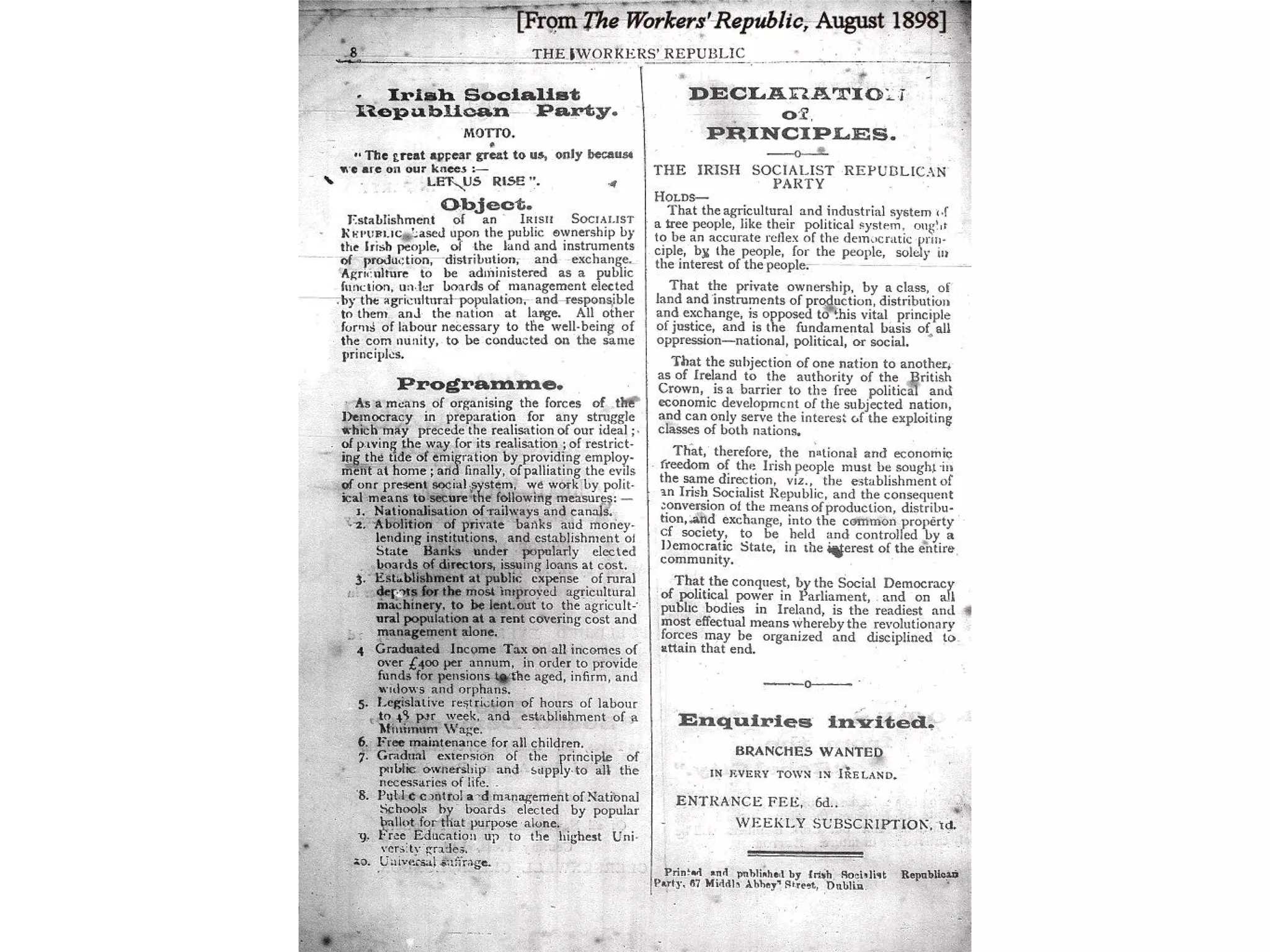
1896 – arrives in Dublin, helps form Irish Socialist Republican Party (ISRP) 
1898 – Workers’ Republic – serializes Labour in Irish History 
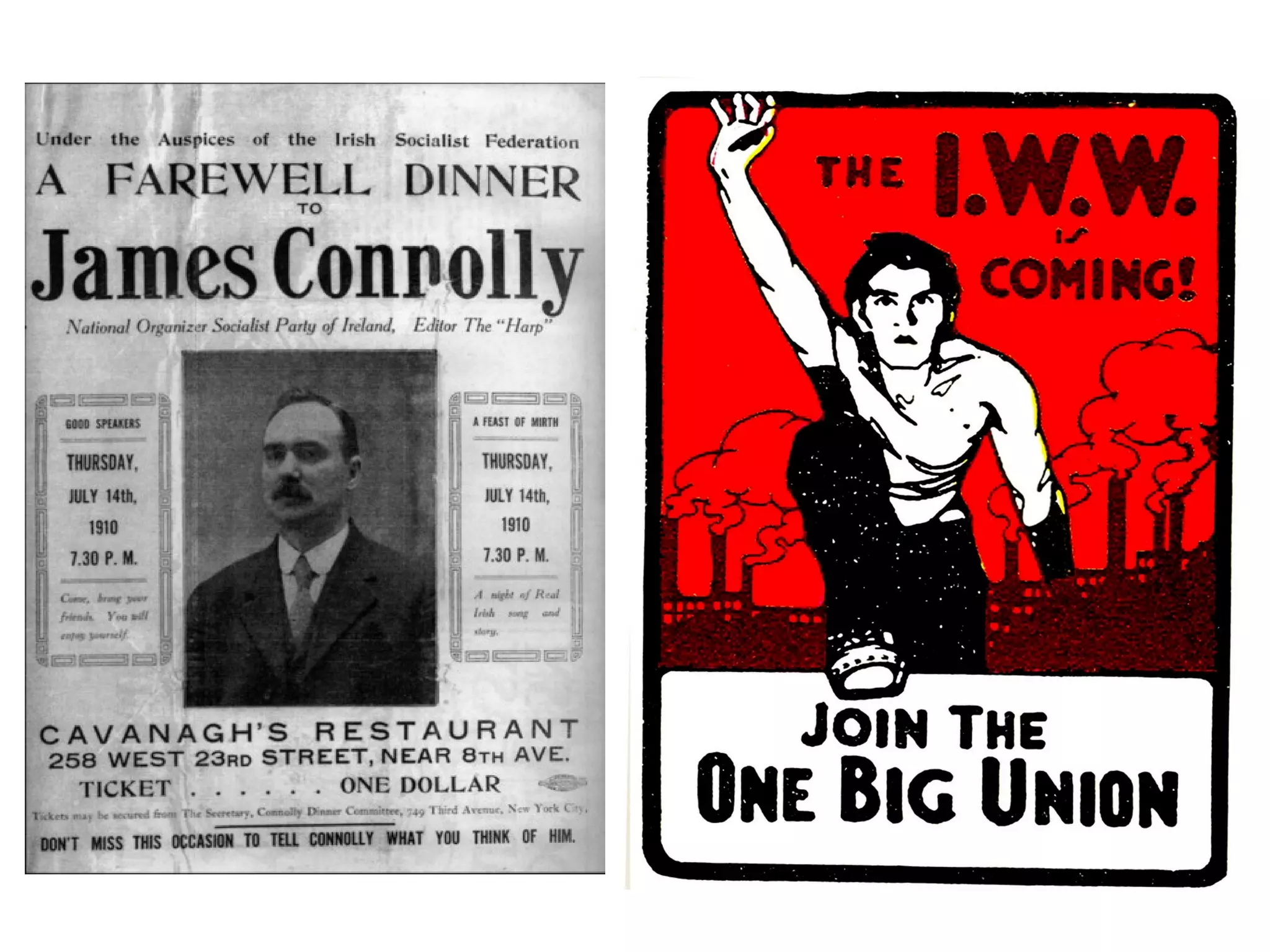
1903 – emigrates to the US 
1911 – returns to Ireland 
1913 – co-founder (with Jack White), Irish Citizen Army 
1916 – Easter Rising and execution
JIM LARKIN: 1876-1947
1876 – Born, Liverpool 
1903 – Dock foreman, Liverpool 
1905 – Full-time trade union official 
1907 – moves to Belfast – 
1908 – forms ITGWU 
1913 – Lockout 
1914 – moves to U.S.A. 
1919 – founding member, American Communist Party 
1920 – jailed for ‘criminal anarchy’ 
1923 – pardoned and returns to Ireland, forms Irish Workers’ League 
1924 – forms Workers’ Union of Ireland 
1947 – dies. Buried in Glasnevin cemetary
ITGWU branches 
1920
Bruree Workers Soviet Mills, April 1919
Irish Labour Movement 1880-1924: Lecture One - Introduction

Irish Labour Movement 1880-1924: Lecture One - Introduction

  • 1.
    HHIS403 - Political& Social Movements in Twentieth-Century Ireland The Irish Labour Movement, 1889 – 1924 Friday @ 10am Introduction: Irish Labour movement, 1889-1924 The Rise of New Unionism, 1889-1906 James Connolly and the Irish Socialist Republican Party, 1896-1904 Jim Larkin and ‘Larkinism’, 1907-1914 The 1913 Lockout and the Irish Citizen Army Syndicalism, 1917-1921 Civil War and Retreat, 1921-1924 Required Reading: Emmet O’Connor, A Labour History of Ireland 1824-2000 (Dublin: UCD Press, 2011): 51-127. Supplementary Reading: Conor McCabe, ‘Your only God is profit’: Irish class relations and the 1913 Lockout ’ in David Convery (ed) Locked Out: A Century of Irish Working-Class Life (Dublin: Irish Academic Press 2013) Lorcan Collins, James Connolly: 16 Lives (Dublin: O’Brien Press, 2012) Fintan Lane, The Origins of Modern Irish Socialism, 1881-1896 (Cork: Cork University Press, 1997) David Lynch, Radical Politics in Modern Ireland: The Irish Socialist Republican Party, 1896-1904 (Dublin: Irish Academic Press, 2005) Emmet O’Connor, Syndicalism in Ireland, 1917-1923 (Cork: Cork University Press, 1988) Emmet O’Connor, James Larkin (Cork: Cork University Press, 2002)
  • 6.
    The New Departure A compact made between Parnell, Davitt, and the Fenian leader John Devoy in June 1879 Fenians, parliamentarians and ‘advanced’ nationalists agreed to work together The New Departure provided the basis for the effective prosecution of the Land War
  • 24.
    Thirty ‘new’ unionsformed in Ireland between 1885 and 1891 Notable developments: NUDL - National Union of Dock Labourers (liverpool) ASRS – Amalgamated Society Railway Servants (London) NAUL – National Amalgamated Union of Labour (Tyneside)
  • 25.
    ‘New’ Politics April1894 – Irish Trade Union Congress convened in Dublin
  • 26.
    ‘New’ Politics April1894 – Irish Trade Union Congress convened in Dublin “Oblivious to the contrasts in employment structure, trade unionism and politics between Ireland and Britain, the ITUC was a miniature version of the BTUC. Herein lay a damnable design fault. The BTUC’s political influence rested on its industrial power.
  • 27.
    ‘New’ Politics April1894 – Irish Trade Union Congress convened in Dublin “Oblivious to the contrasts in employment structure, trade unionism and politics between Ireland and Britain, the ITUC was a miniature version of the BTUC. Herein lay a damnable design fault. The BTUC’s political influence rested on its industrial power. Trying to copy the British model meant that the ITUC would be primarily an industrial rather than a political body, pursuing its objectives on the basis of union organisation, where it was weak, rather than through the national movement, where it would have some leverage.
  • 28.
    ‘New’ Politics April1894 – Irish Trade Union Congress convened in Dublin Congress rejected reality by abjuring the nationalism which most workers believed in for a strictly Labour politics which most of them did not. The result was not a seedling socialism, but depoliticisation.” (O’Connor, p.63)
  • 29.
  • 30.
    1868 – Born,Cowgate, Edinburgh 1882 – joins British army. 1889 – deserts and returns to Edinburgh, active in socialist politics 1892 – Secretary of the Scottish Socialist Federation 1896 – arrives in Dublin, helps form Irish Socialist Republican Party (ISRP) 1898 – Workers’ Republic – serializes Labour in Irish History 1903 – emigrates to the US 1911 – returns to Ireland 1913 – co-founder (with Jack White), Irish Citizen Army 1916 – Easter Rising and execution
  • 35.
  • 36.
    1876 – Born,Liverpool 1903 – Dock foreman, Liverpool 1905 – Full-time trade union official 1907 – moves to Belfast – 1908 – forms ITGWU 1913 – Lockout 1914 – moves to U.S.A. 1919 – founding member, American Communist Party 1920 – jailed for ‘criminal anarchy’ 1923 – pardoned and returns to Ireland, forms Irish Workers’ League 1924 – forms Workers’ Union of Ireland 1947 – dies. Buried in Glasnevin cemetary
  • 44.
  • 49.
    Bruree Workers SovietMills, April 1919