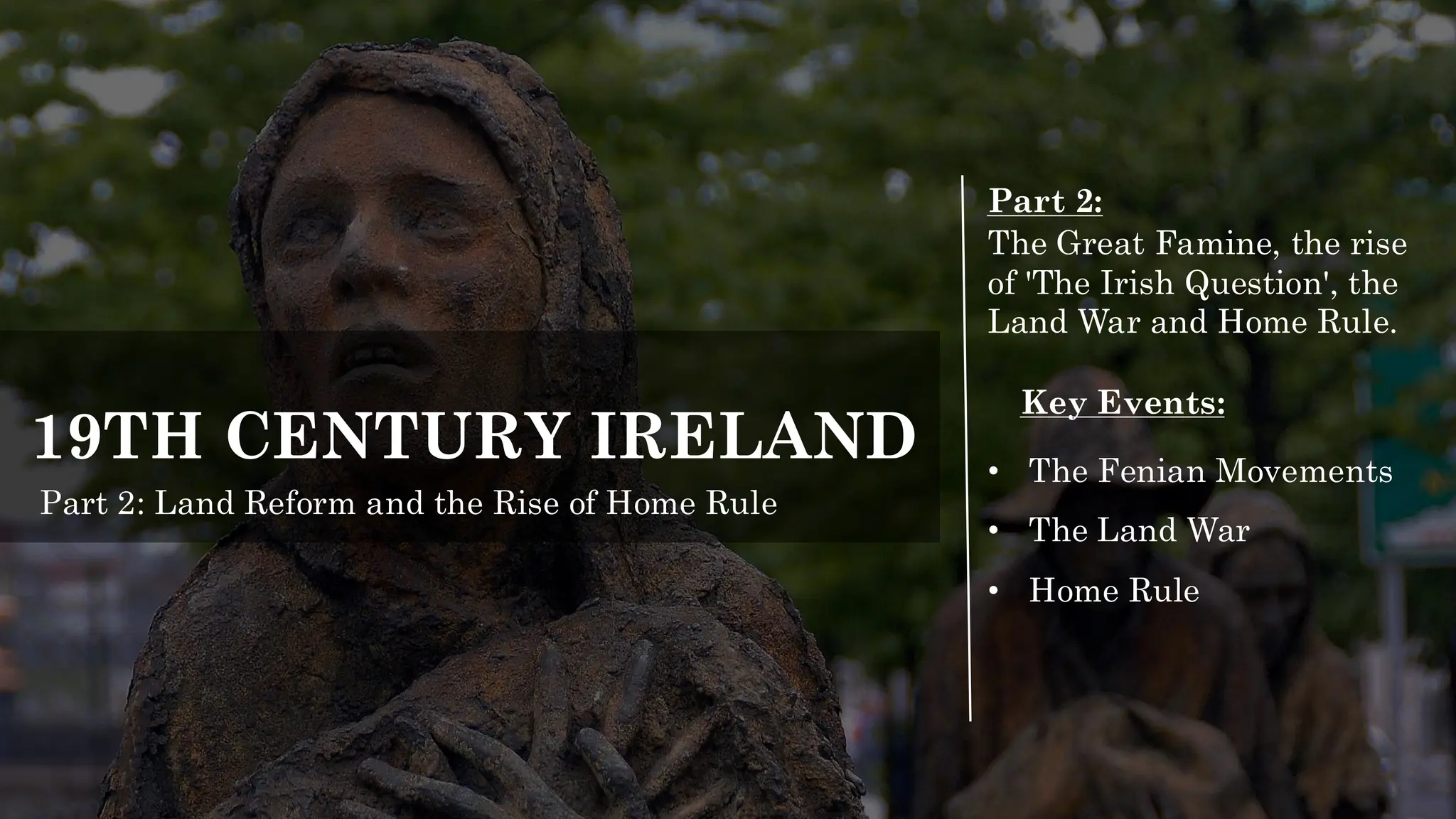
19TH CENTURY IRELAND
Part 2:
The Great Famine, the rise
of 'The Irish Question', the
Land War and Home Rule.
Key Events:
• The Fenian Movements
• The Land War
• Home Rule
Part 2: Land Reform and the Rise of Home Rule
Overview
"The Almighty, indeed, sent the potato blight, but the English
created the Famine" - (John Dillon).
Whether through gross negligence, indifference or callousness, the Great Famine
would come to exemplify the worst consequence of British rule in Ireland.
In response, resentment against British rule would evolve into new even more
radical republican groups in the form of the Fenians. Now backed by a powerful
diaspora in America, they would continue the tradition of radical republicanism.
The most effective political movement to emerge, would be the successors to Daniel
O'Connell's repeal movement. The Home Rule Movement, led by Charles Stewart
Parnell would combine constitutional nationalism with the popular movement of
land reform. Through political tact and overwhelming support Parnell would see
Home Rule become a major player in the politics of the Westminster Parliament.
However, Parnell's spectacular rise would have an equally spectacular fall as
revelations of his relationship with a married woman would divide the Home Rule
movement from 1890 until its unification again under John Redmond in 1900.
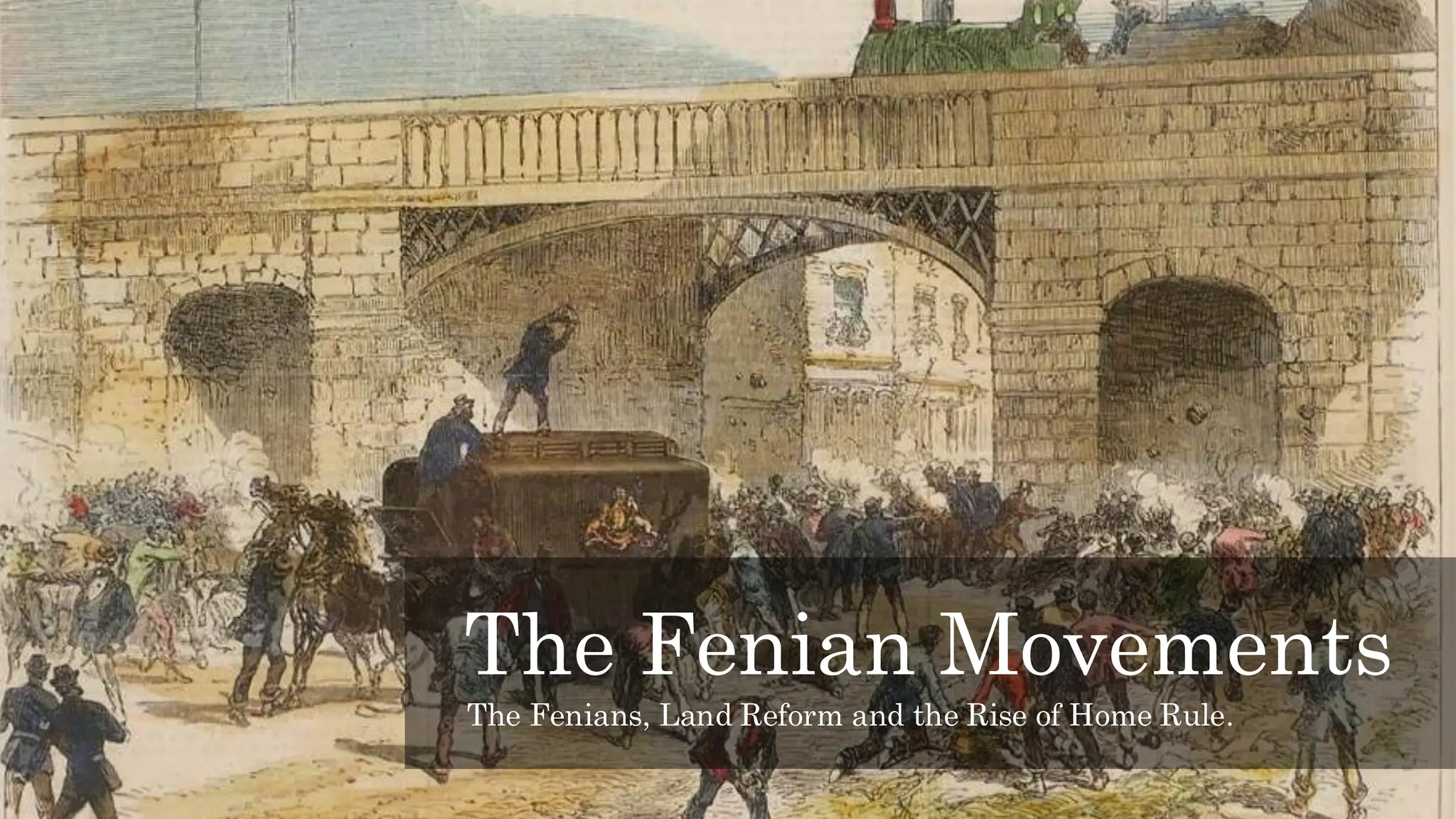
The Fenian Movements
The Fenians, Land Reform and the Rise of Home Rule.
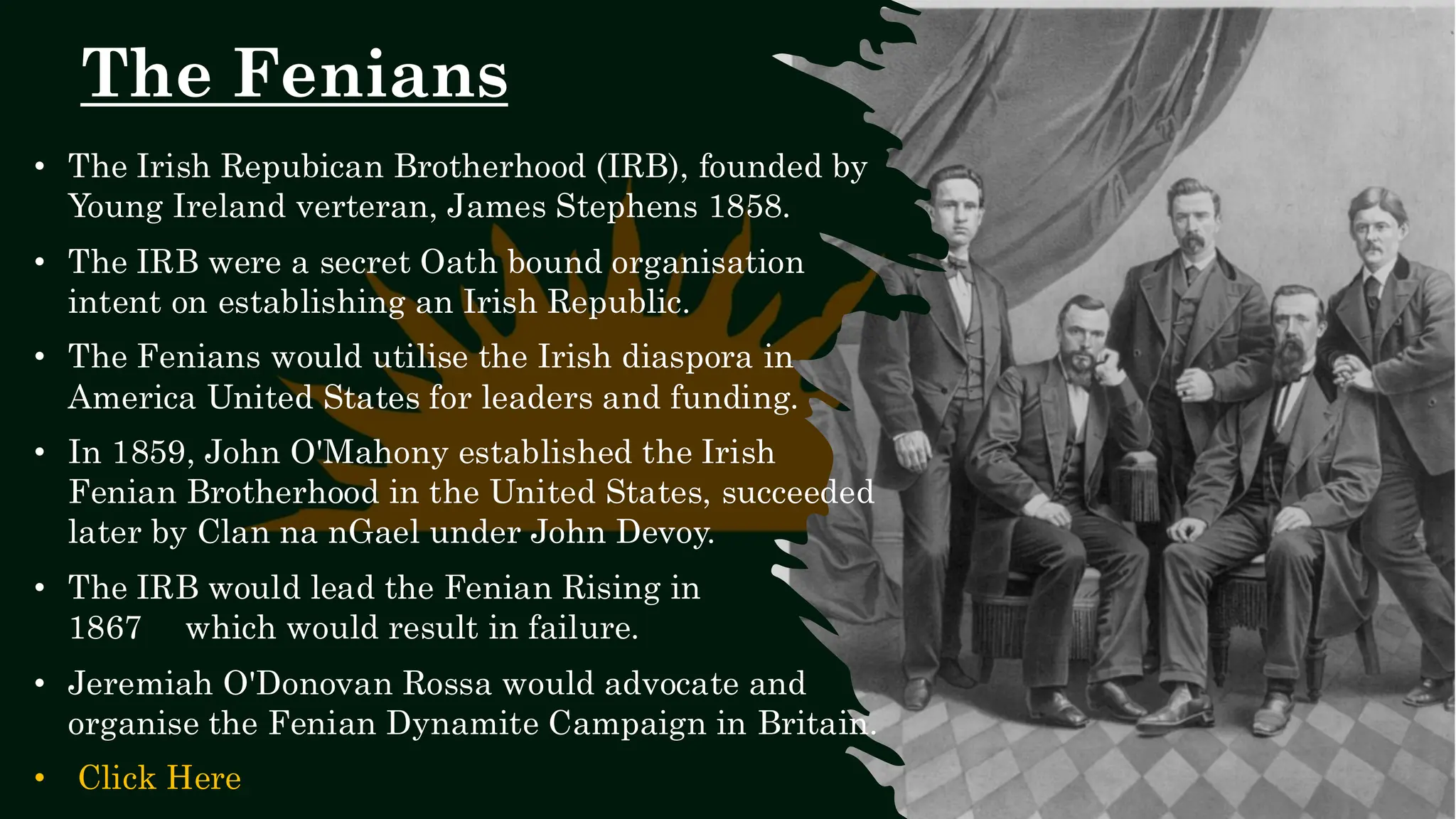
The Fenians
• The Irish Repubican Brotherhood (IRB), founded by
Young Ireland verteran, James Stephens 1858.
• The IRB were a secret Oath bound organisation
intent on establishing an Irish Republic.
• The Fenians would utilise the Irish diaspora in
America United States for leaders and funding.
• In 1859, John O'Mahony established the Irish
Fenian Brotherhood in the United States, succeeded
later by Clan na nGael under John Devoy.
• The IRB would lead the Fenian Rising in
1867 which would result in failure.
• Jeremiah O'Donovan Rossa would advocate and
organise the Fenian Dynamite Campaign in Britain.
• Click Here
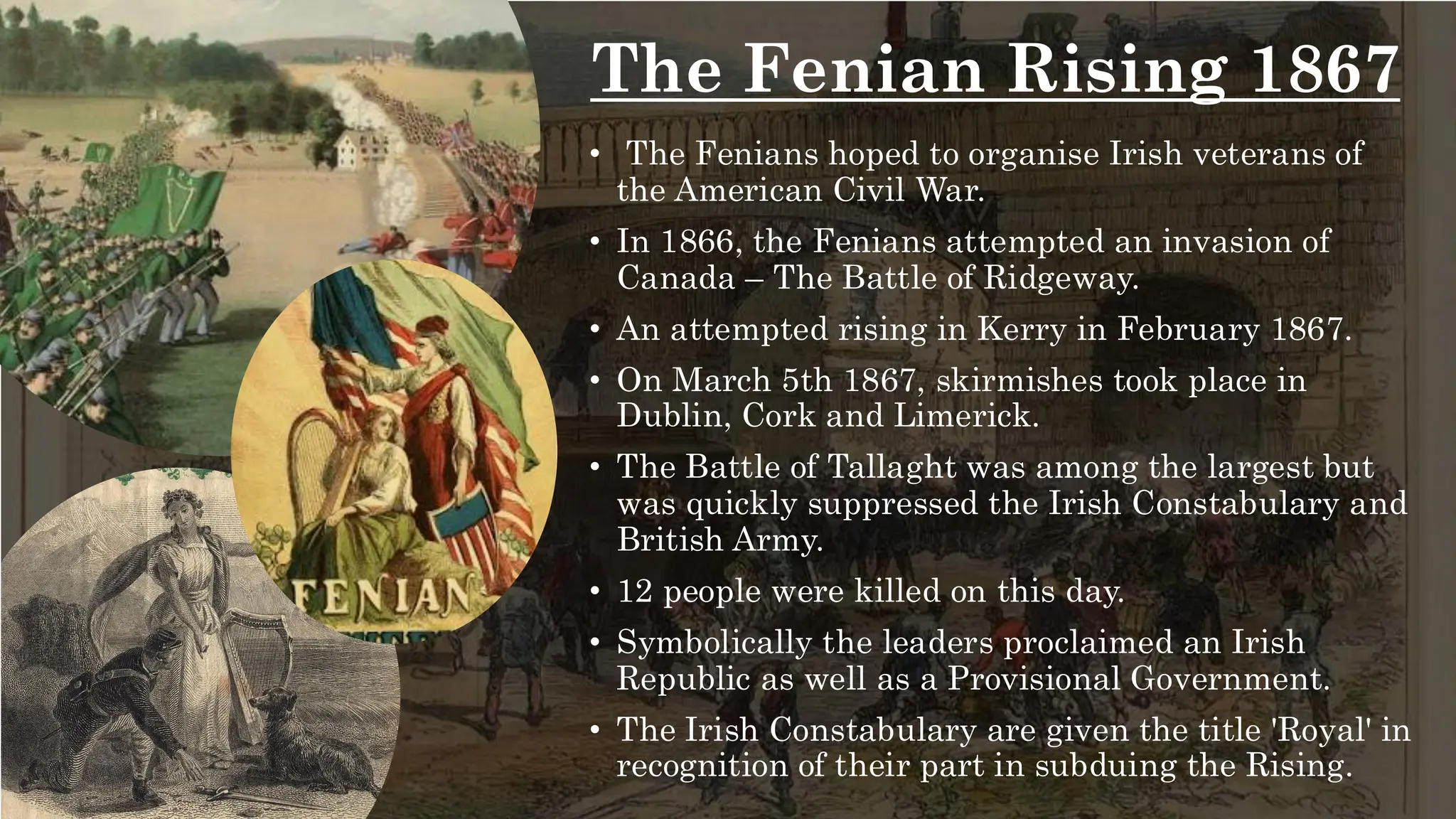
The Fenian Rising 1867
• The Fenians hoped to organise Irish veterans of
the American Civil War.
• In 1866, the Fenians attempted an invasion of
Canada – The Battle of Ridgeway.
• An attempted rising in Kerry in February 1867.
• On March 5th 1867, skirmishes took place in
Dublin, Cork and Limerick.
• The Battle of Tallaght was among the largest but
was quickly suppressed the Irish Constabulary and
British Army.
• 12 people were killed on this day.
• Symbolically the leaders proclaimed an Irish
Republic as well as a Provisional Government.
• The Irish Constabulary are given the title 'Royal' in
recognition of their part in subduing the Rising.
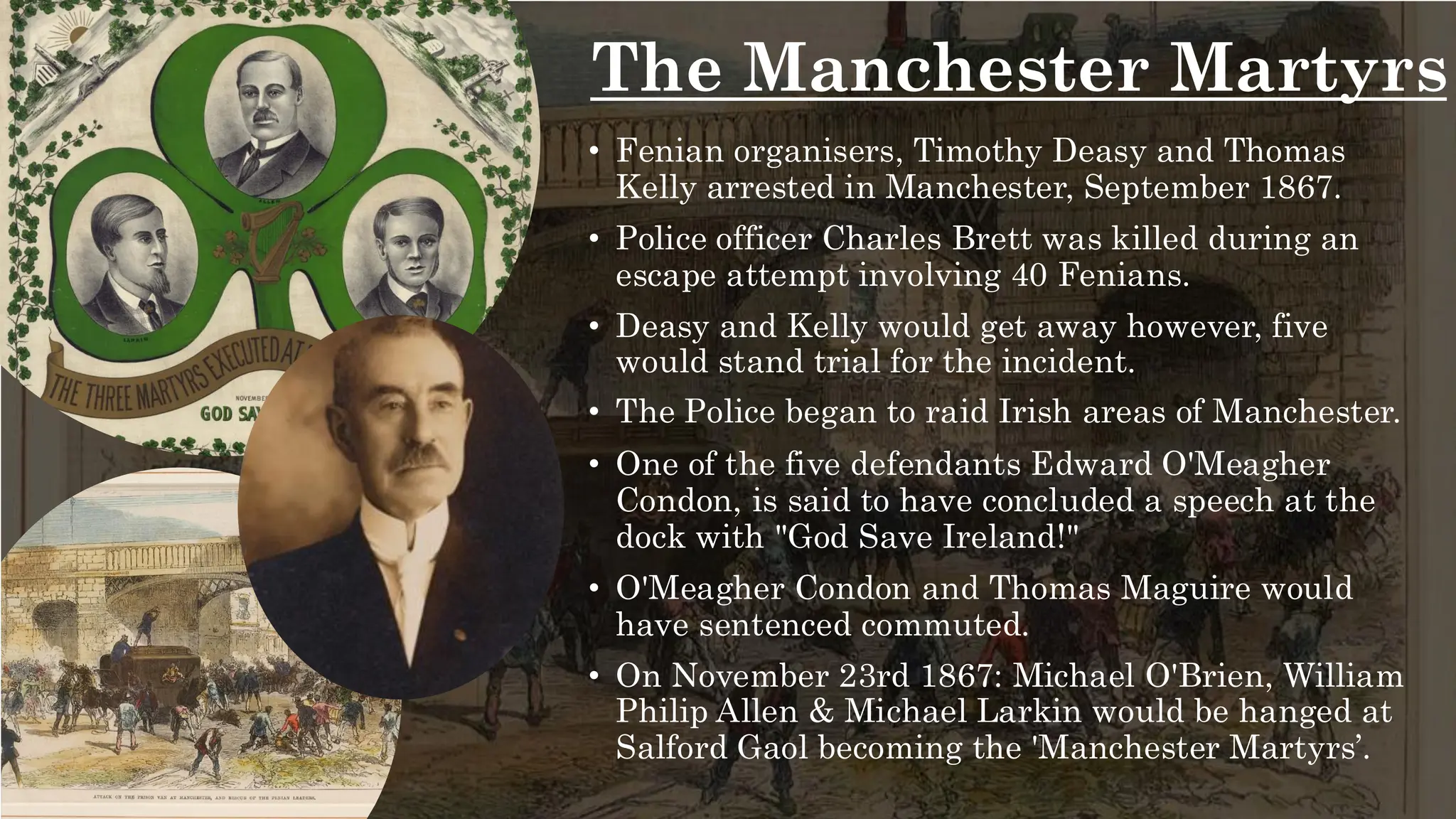
The Manchester Martyrs
• Fenian organisers, Timothy Deasy and Thomas
Kelly arrested in Manchester, September 1867.
• Police officer Charles Brett was killed during an
escape attempt involving 40 Fenians.
• Deasy and Kelly would get away however, five
would stand trial for the incident.
• The Police began to raid Irish areas of Manchester.
• One of the five defendants Edward O'Meagher
Condon, is said to have concluded a speech at the
dock with "God Save Ireland!"
• O'Meagher Condon and Thomas Maguire would
have sentenced commuted.
• On November 23rd 1867: Michael O'Brien, William
Philip Allen & Michael Larkin would be hanged at
Salford Gaol becoming the 'Manchester Martyrs’.
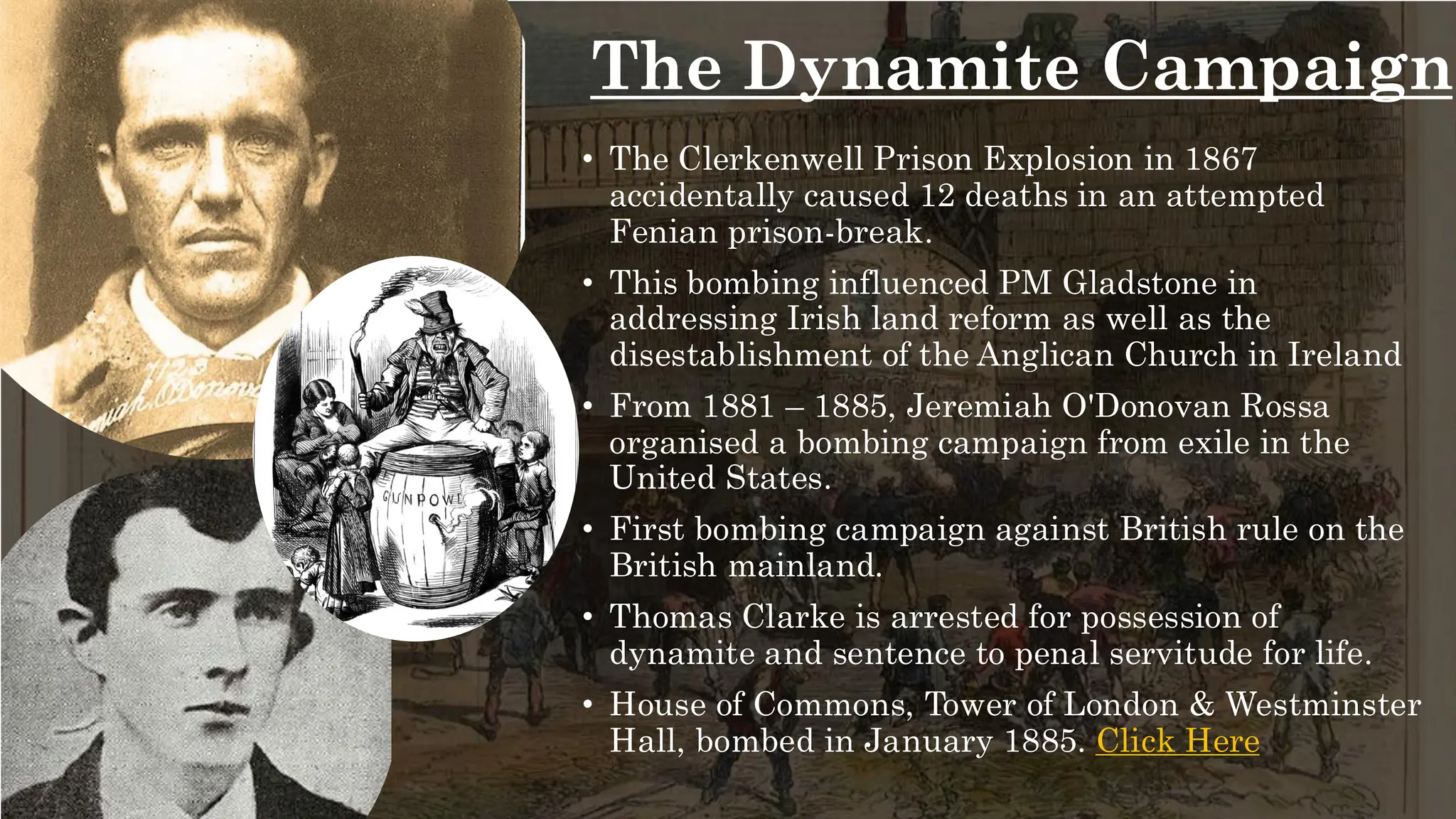
The Dynamite Campaign
• The Clerkenwell Prison Explosion in 1867
accidentally caused 12 deaths in an attempted
Fenian prison-break.
• This bombing influenced PM Gladstone in
addressing Irish land reform as well as the
disestablishment of the Anglican Church in Ireland
• From 1881 – 1885, Jeremiah O'Donovan Rossa
organised a bombing campaign from exile in the
United States.
• First bombing campaign against British rule on the
British mainland.
• Thomas Clarke is arrested for possession of
dynamite and sentence to penal servitude for life.
• House of Commons, Tower of London & Westminster
Hall, bombed in January 1885. Click Here
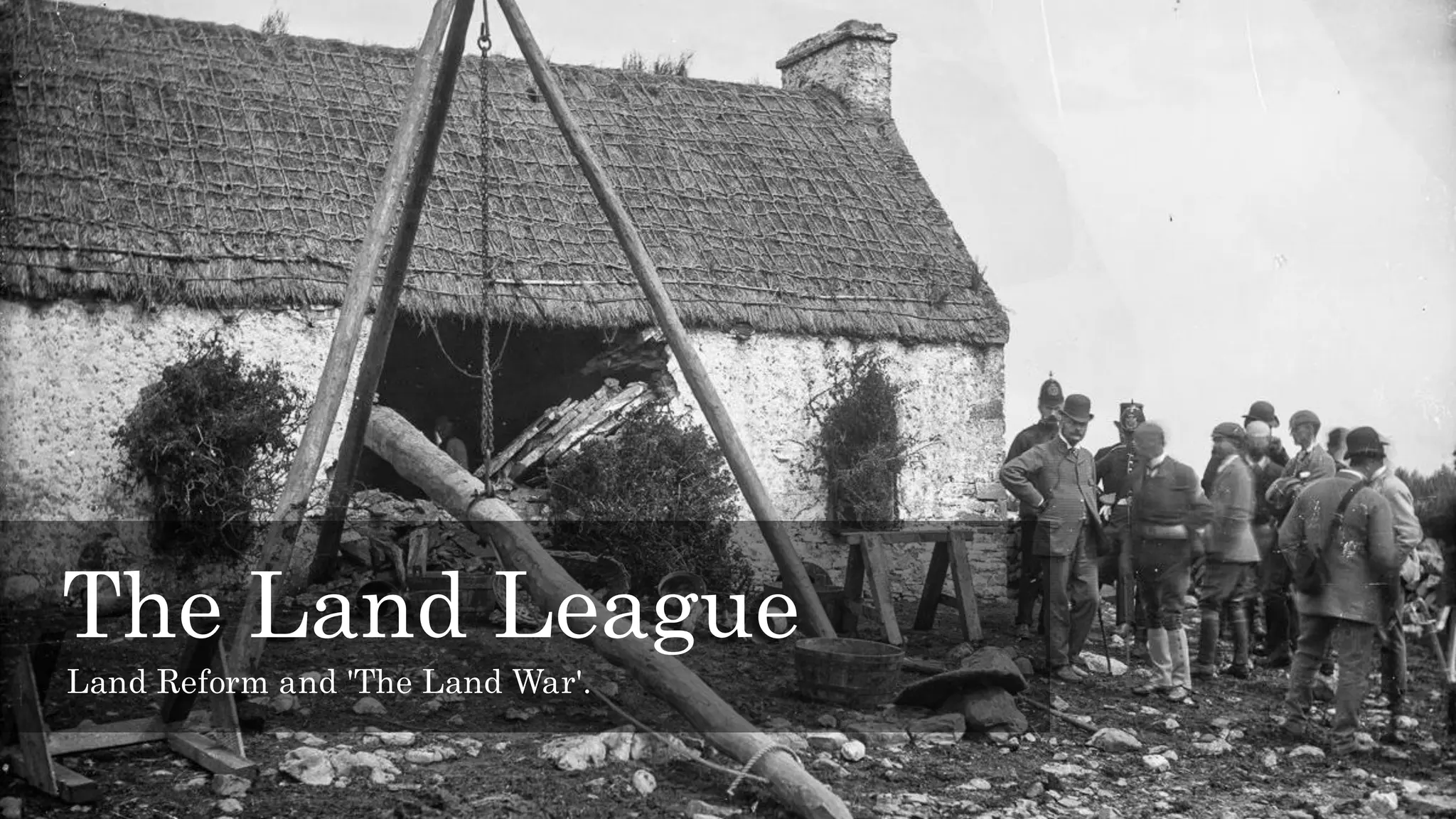
The Land League
Land Reform and 'The Land War'.
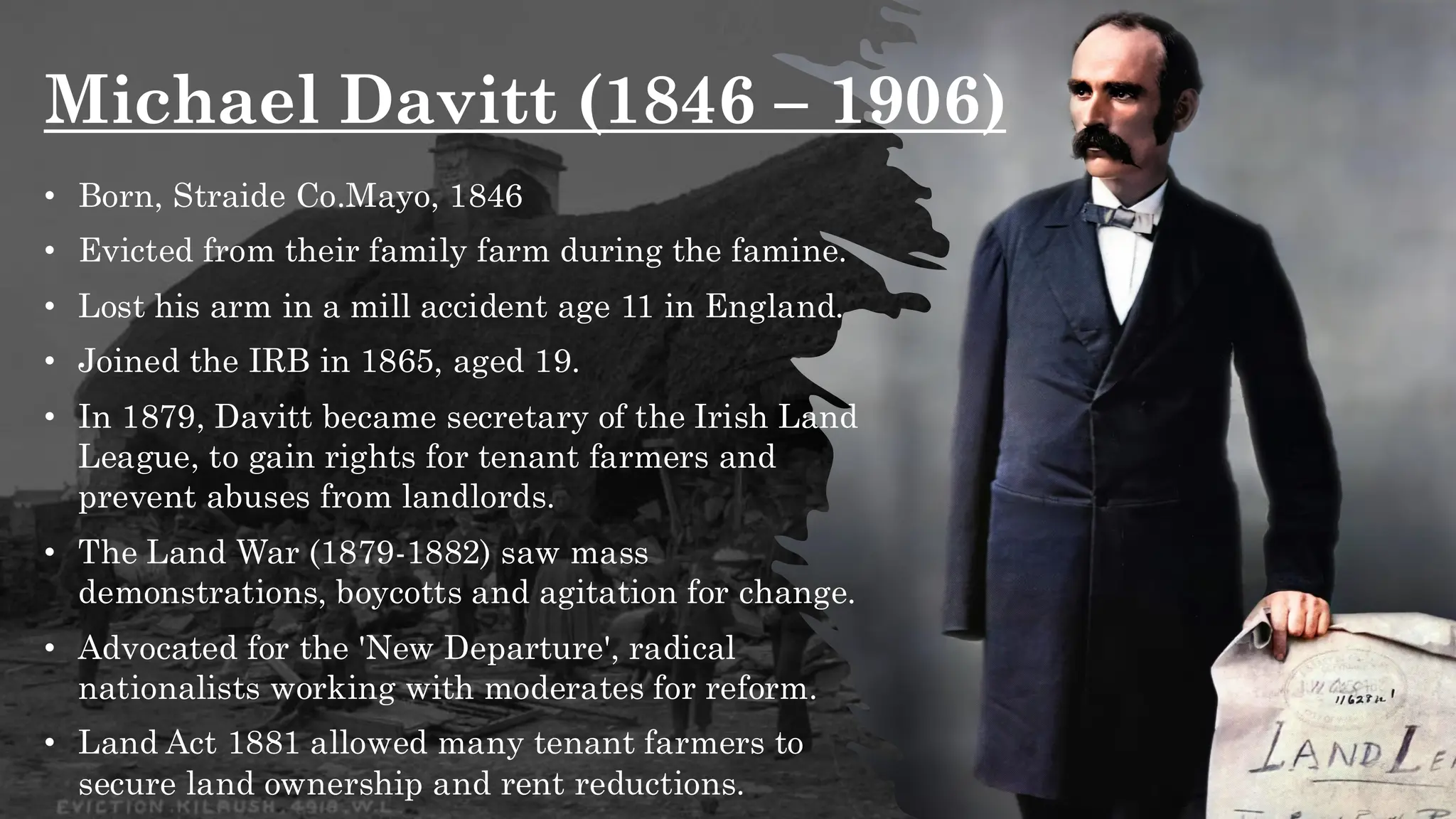
Michael Davitt (1846 – 1906)
• Born, Straide Co.Mayo, 1846
• Evicted from their family farm during the famine.
• Lost his arm in a mill accident age 11 in England.
• Joined the IRB in 1865, aged 19.
• In 1879, Davitt became secretary of the Irish Land
League, to gain rights for tenant farmers and
prevent abuses from landlords.
• The Land War (1879-1882) saw mass
demonstrations, boycotts and agitation for change.
• Advocated for the 'New Departure', radical
nationalists working with moderates for reform.
• Land Act 1881 allowed many tenant farmers to
secure land ownership and rent reductions.
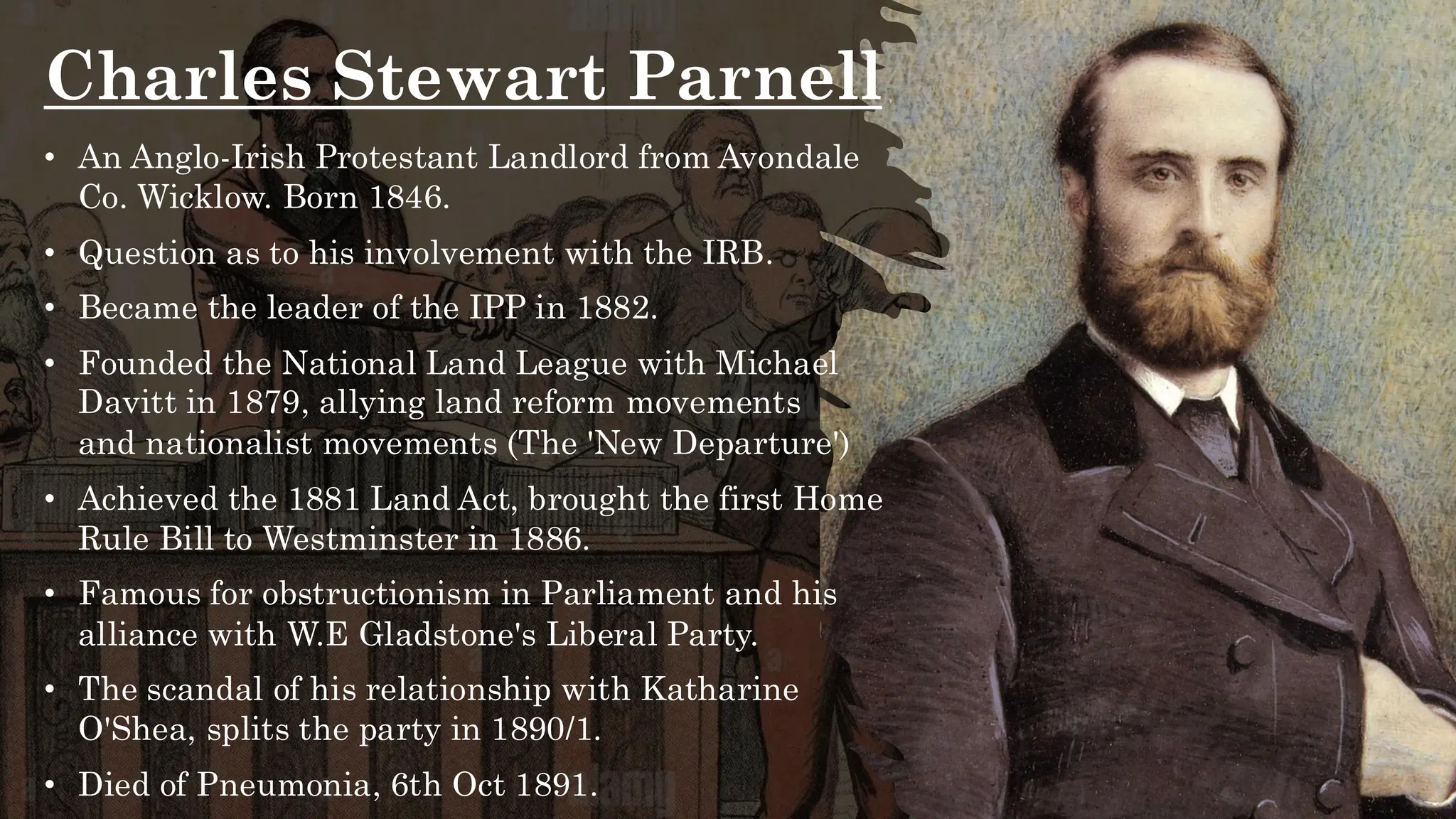
Charles Stewart Parnell
• An Anglo-Irish Protestant Landlord from Avondale
Co. Wicklow. Born 1846.
• Question as to his involvement with the IRB.
• Became the leader of the IPP in 1882.
• Founded the National Land League with Michael
Davitt in 1879, allying land reform movements
and nationalist movements (The 'New Departure')
• Achieved the 1881 Land Act, brought the first Home
Rule Bill to Westminster in 1886.
• Famous for obstructionism in Parliament and his
alliance with W.E Gladstone's Liberal Party.
• The scandal of his relationship with Katharine
O'Shea, splits the party in 1890/1.
• Died of Pneumonia, 6th Oct 1891.
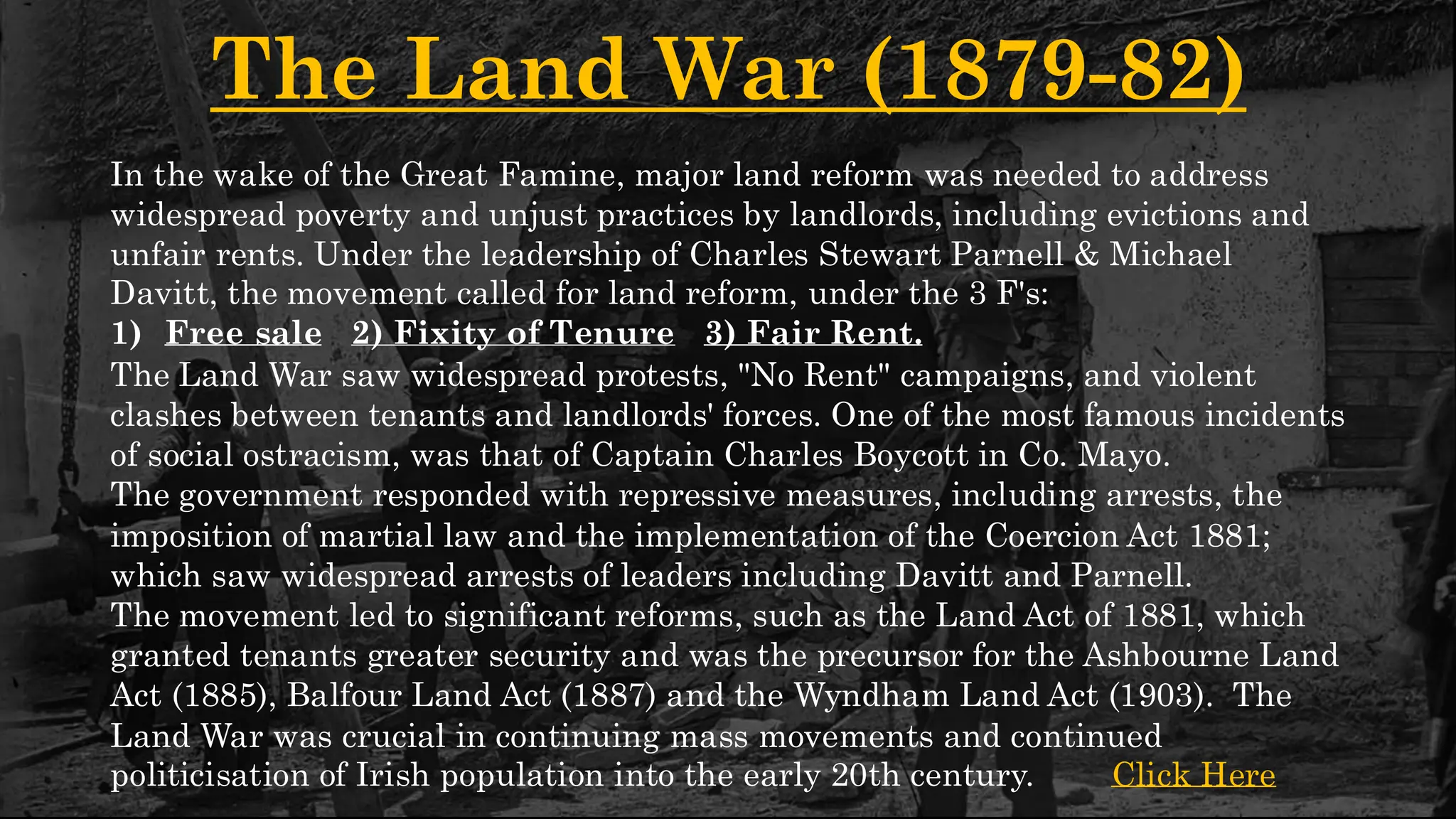
The Land War (1879-82)
In the wake of the Great Famine, major land reform was needed to address
widespread poverty and unjust practices by landlords, including evictions and
unfair rents. Under the leadership of Charles Stewart Parnell & Michael
Davitt, the movement called for land reform, under the 3 F's:
1) Free sale 2) Fixity of Tenure 3) Fair Rent.
The Land War saw widespread protests, "No Rent" campaigns, and violent
clashes between tenants and landlords' forces. One of the most famous incidents
of social ostracism, was that of Captain Charles Boycott in Co. Mayo.
The government responded with repressive measures, including arrests, the
imposition of martial law and the implementation of the Coercion Act 1881;
which saw widespread arrests of leaders including Davitt and Parnell.
The movement led to significant reforms, such as the Land Act of 1881, which
granted tenants greater security and was the precursor for the Ashbourne Land
Act (1885), Balfour Land Act (1887) and the Wyndham Land Act (1903). The
Land War was crucial in continuing mass movements and continued
politicisation of Irish population into the early 20th century. Click Here
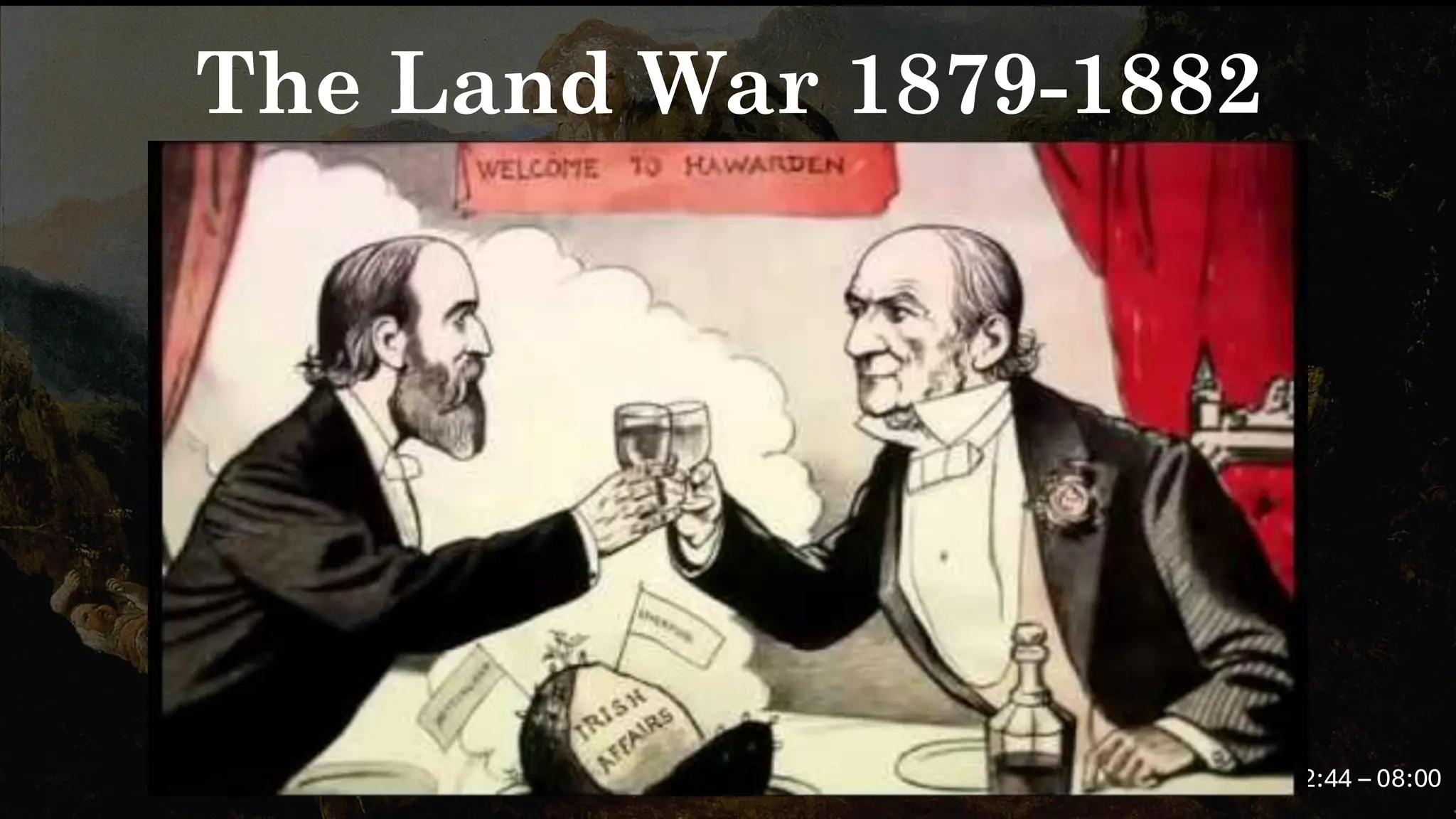
The Land War 1879-1882
02:44 – 08:00
Home Rule
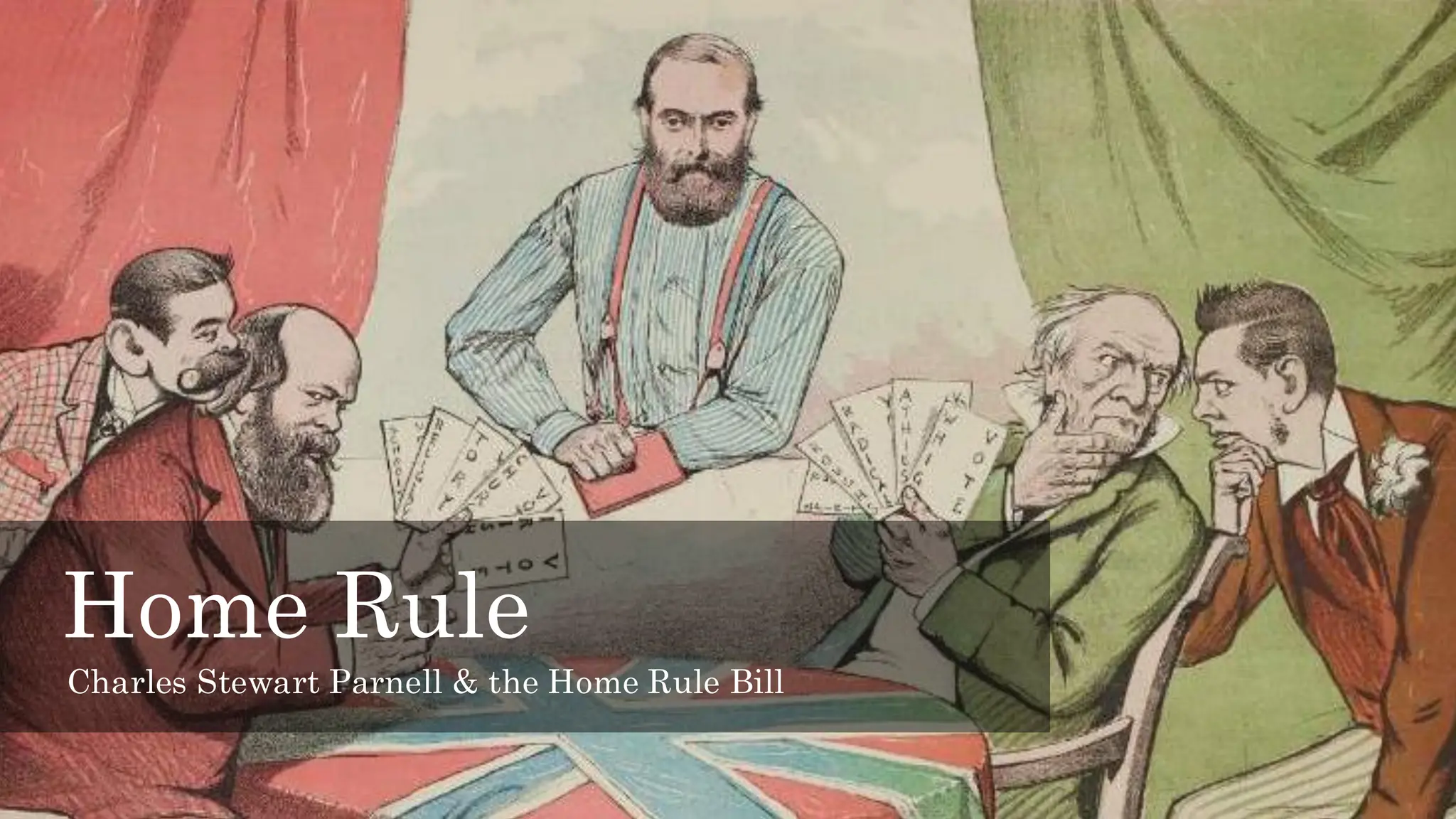
Charles Stewart Parnell & the Home Rule Bill
The Rise of Home Rule
Founded by Isaac Butt in 1870, the concept of 'Home Rule' would advocate for
Irish self-governance within the United Kingdom. Butt's approach was
moderate, seeking gradual constitutional reforms, but his leadership lacked the
momentum to achieve significant progress. The movement gained traction
under Charles Stewart Parnell, who emerged as the party leader in 1880, later
renaming it as the Irish Parliamentary Party (IPP) in 1882.
Parnell brought a more assertive and strategic approach, focusing on aggressive
parliamentary tactics, such as obstructionism, to force British attention on Irish
issues. His leadership inspired mass support for Home Rule, especially through
successful campaigns like the land agitation movement, which advocated for
tenant rights and fair rents. Parnell's political acumen and charisma allowed
the IPP to gain significant influence in the British Parliament, securing the
first Home Rule Bill in 1886 and paving the way for the second in 1893.
The party would split in 1890 with the scandal over Parnell's relationship with
Katherine O'Shea, damaging the movement into the 1900's. Click Here
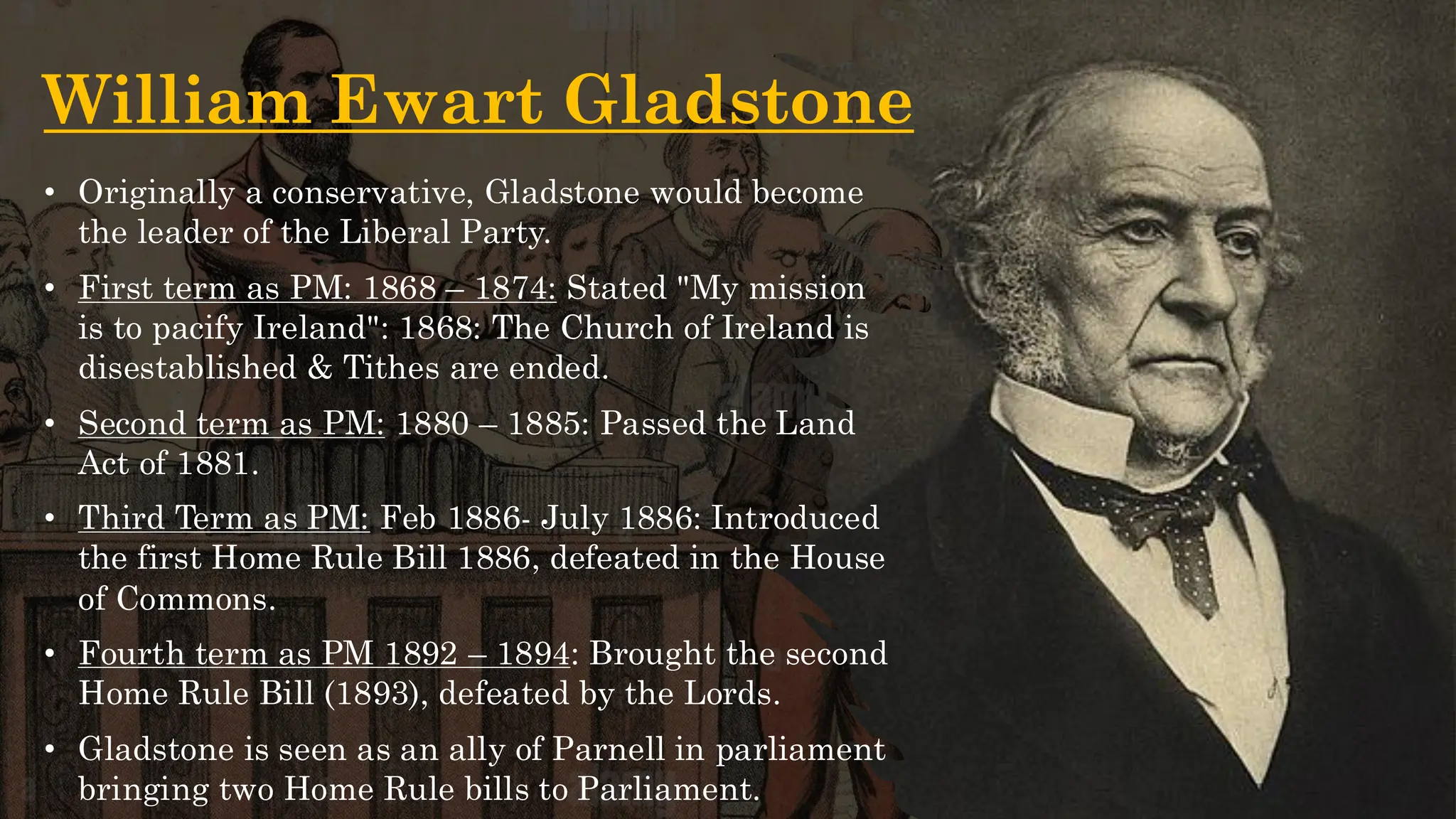
William Ewart Gladstone
• Originally a conservative, Gladstone would become
the leader of the Liberal Party.
• First term as PM: 1868 – 1874: Stated "My mission
is to pacify Ireland": 1868: The Church of Ireland is
disestablished & Tithes are ended.
• Second term as PM: 1880 – 1885: Passed the Land
Act of 1881.
• Third Term as PM: Feb 1886- July 1886: Introduced
the first Home Rule Bill 1886, defeated in the House
of Commons.
• Fourth term as PM 1892 – 1894: Brought the second
Home Rule Bill (1893), defeated by the Lords.
• Gladstone is seen as an ally of Parnell in parliament
bringing two Home Rule bills to Parliament.
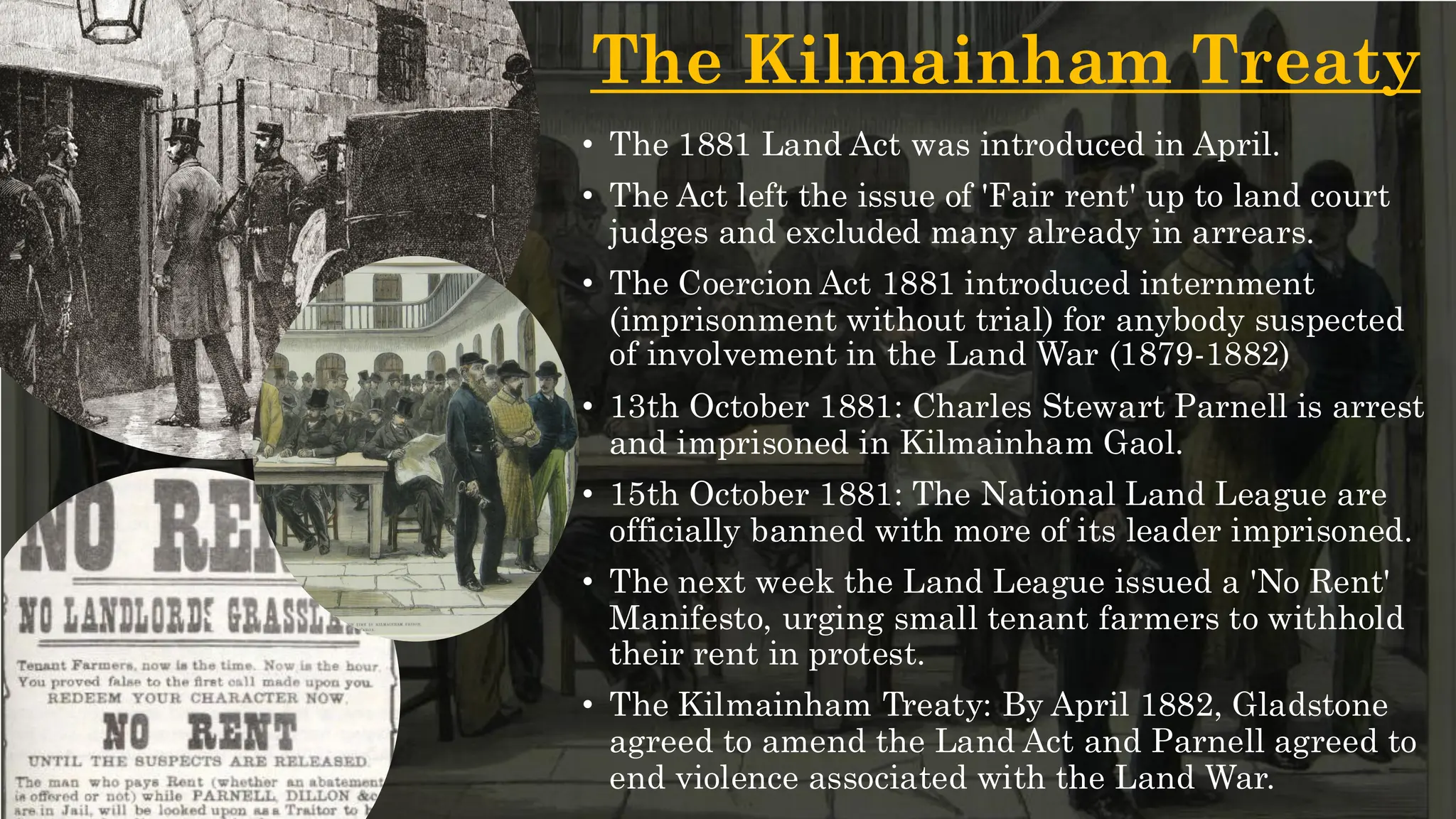
The Kilmainham Treaty
• The 1881 Land Act was introduced in April.
• The Act left the issue of 'Fair rent' up to land court
judges and excluded many already in arrears.
• The Coercion Act 1881 introduced internment
(imprisonment without trial) for anybody suspected
of involvement in the Land War (1879-1882)
• 13th October 1881: Charles Stewart Parnell is arrest
and imprisoned in Kilmainham Gaol.
• 15th October 1881: The National Land League are
officially banned with more of its leader imprisoned.
• The next week the Land League issued a 'No Rent'
Manifesto, urging small tenant farmers to withhold
their rent in protest.
• The Kilmainham Treaty: By April 1882, Gladstone
agreed to amend the Land Act and Parnell agreed to
end violence associated with the Land War.
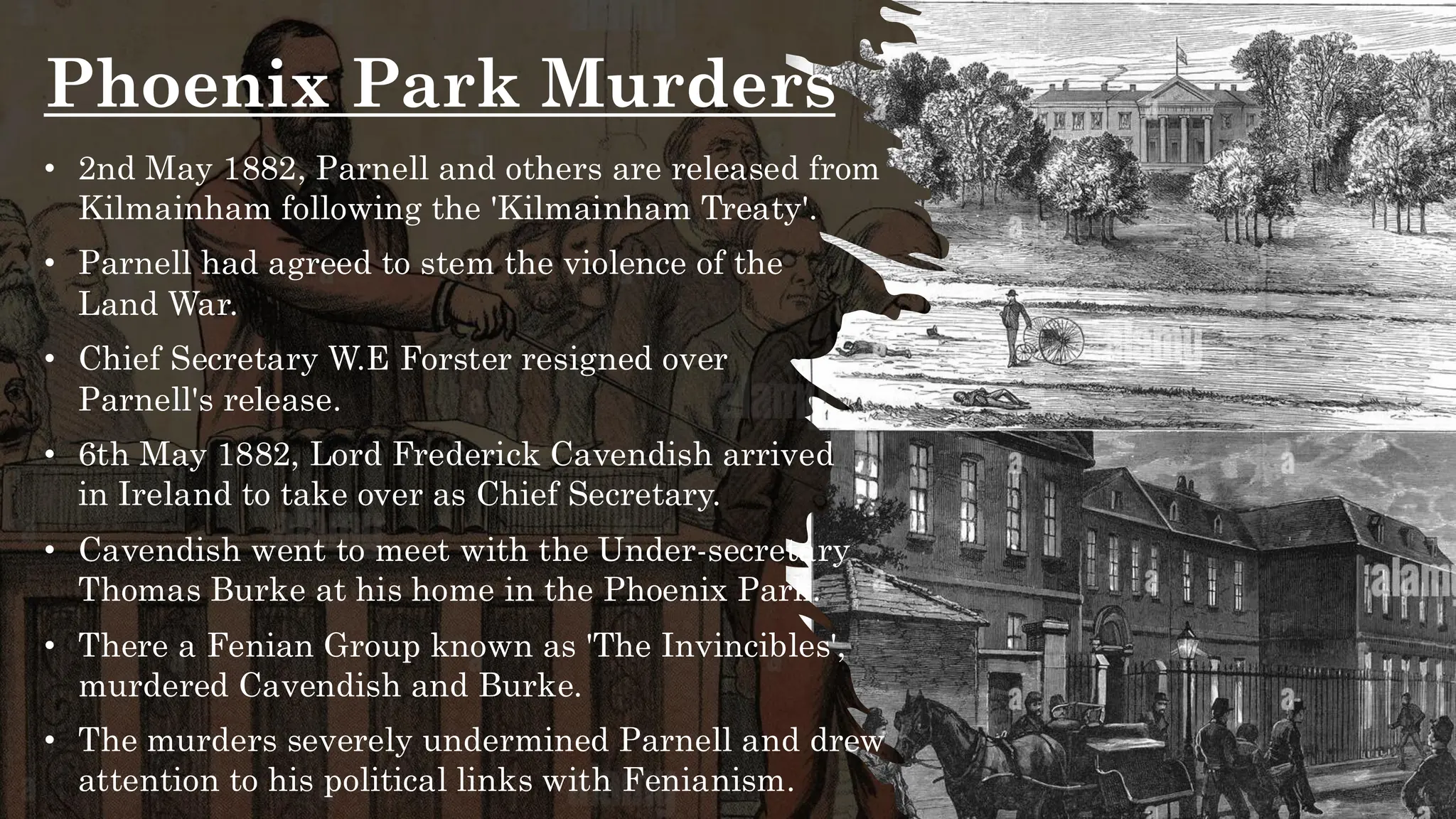
Phoenix Park Murders
• 2nd May 1882, Parnell and others are released from
Kilmainham following the 'Kilmainham Treaty'.
• Parnell had agreed to stem the violence of the
Land War.
• Chief Secretary W.E Forster resigned over
Parnell's release.
• 6th May 1882, Lord Frederick Cavendish arrived
in Ireland to take over as Chief Secretary.
• Cavendish went to meet with the Under-secretary
Thomas Burke at his home in the Phoenix Park.
• There a Fenian Group known as 'The Invincibles',
murdered Cavendish and Burke.
• The murders severely undermined Parnell and drew
attention to his political links with Fenianism.
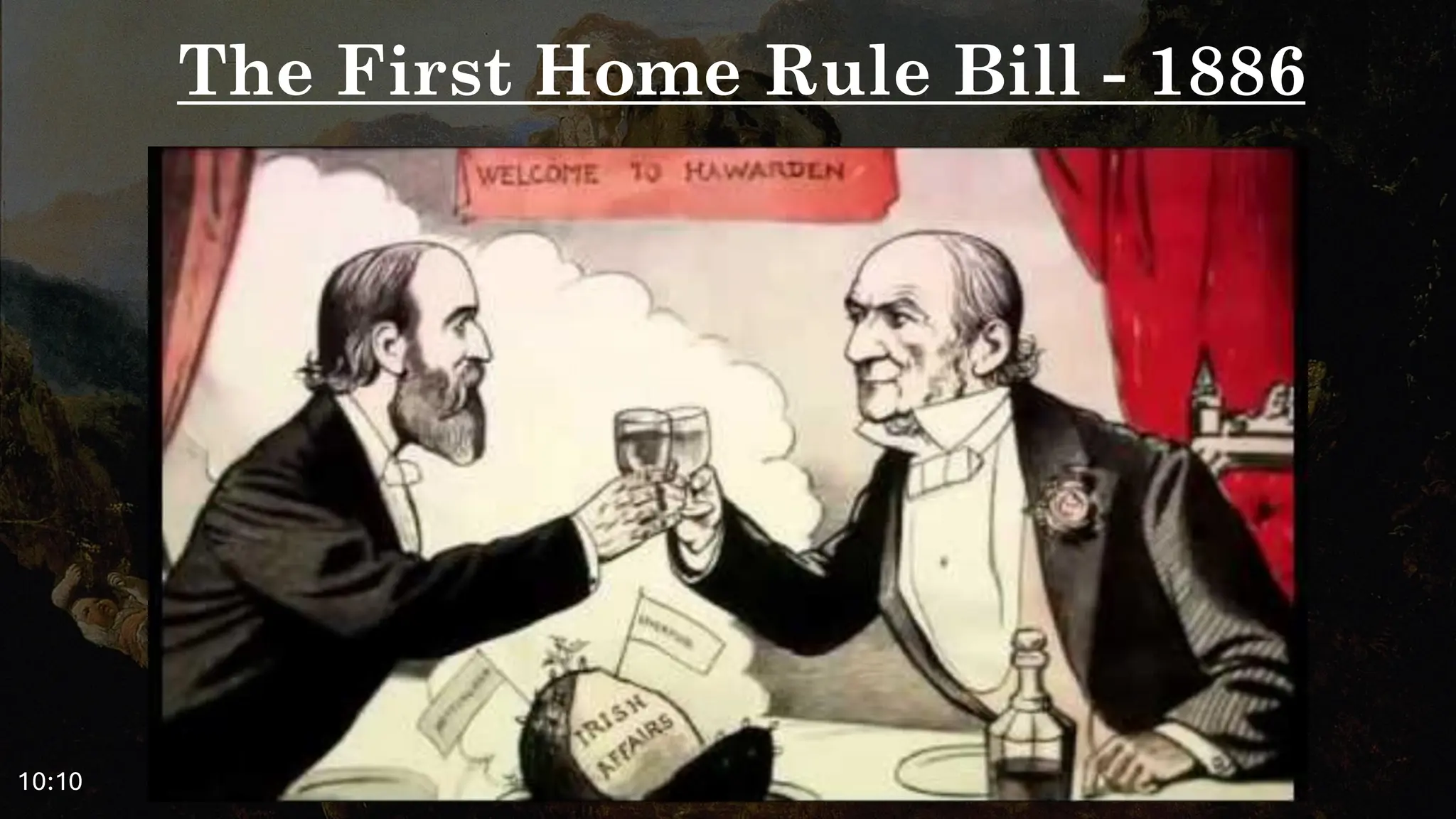
The First Home Rule Bill - 1886
10:10
The Fall of Home Rule
The release of Parnell in 1882 has been partially negotiated by Home Rule MP
William O'Shea, the 'Kilmainham Treaty' was agreed and Parnell was released
in 1882. Upon his release, Parnell would found the Irish National League, the
successor to the Land League and although unsuccessful, Parnell's alliance
with Gladstone, would finally bring about the First Home Rule Bill of 1886.
In 1889, the IPP and Parnell were hit by political scandal. In that year
William O'Shea filed for divorce from his estranged wife Katharine, exposing
her relationship with Charles Stewart Parnell to the public. In reality, O'Shea
and Katharine had been estranged for many years, and he had known about
the relationship and Parnell and Katharine even had two children together at
this point. Either way, the scandal in the press caused the Liberal Party in
Westminster to abandon the IPP and the party would split between those loyal
to Parnell and those against, known as Parnellites and Anti-Parnellites. The
fallout from the affair would last until 1900 when the two factions would join
again under the leadership of John Redmond.
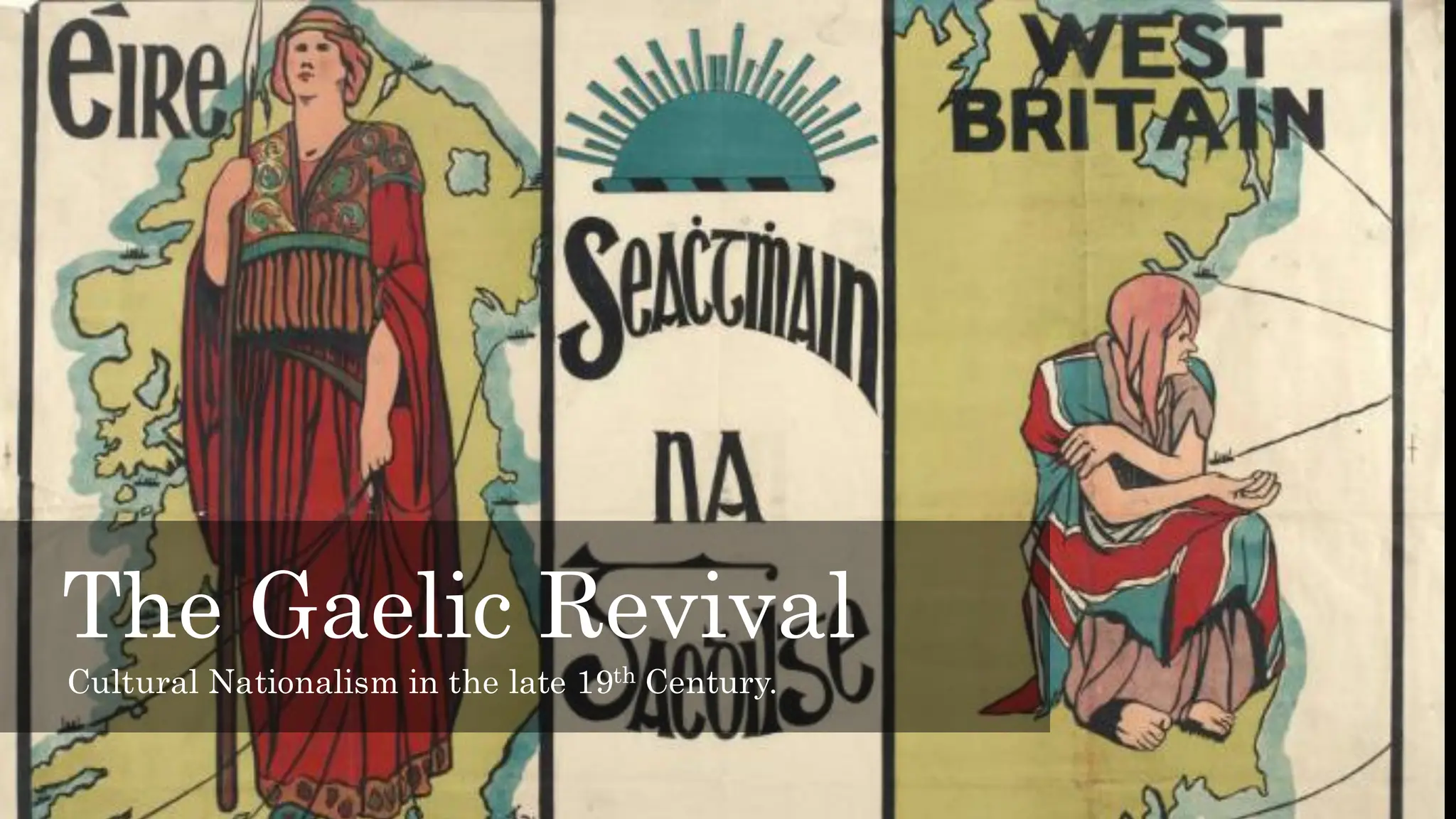
The Gaelic Revival
Cultural Nationalism in the late 19th Century.
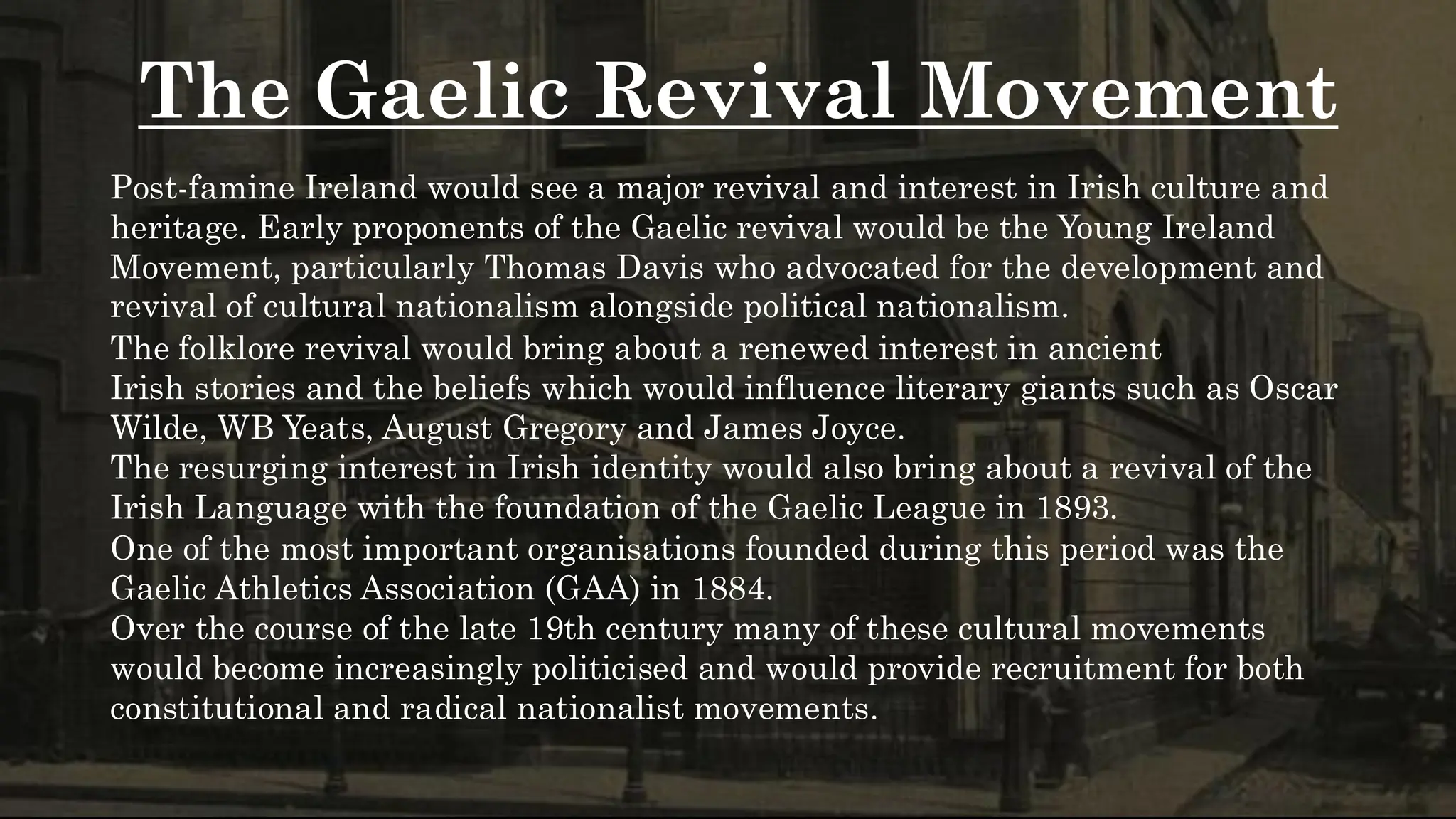
The Gaelic Revival Movement
Post-famine Ireland would see a major revival and interest in Irish culture and
heritage. Early proponents of the Gaelic revival would be the Young Ireland
Movement, particularly Thomas Davis who advocated for the development and
revival of cultural nationalism alongside political nationalism.
The folklore revival would bring about a renewed interest in ancient
Irish stories and the beliefs which would influence literary giants such as Oscar
Wilde, WB Yeats, August Gregory and James Joyce.
The resurging interest in Irish identity would also bring about a revival of the
Irish Language with the foundation of the Gaelic League in 1893.
One of the most important organisations founded during this period was the
Gaelic Athletics Association (GAA) in 1884.
Over the course of the late 19th century many of these cultural movements
would become increasingly politicised and would provide recruitment for both
constitutional and radical nationalist movements.
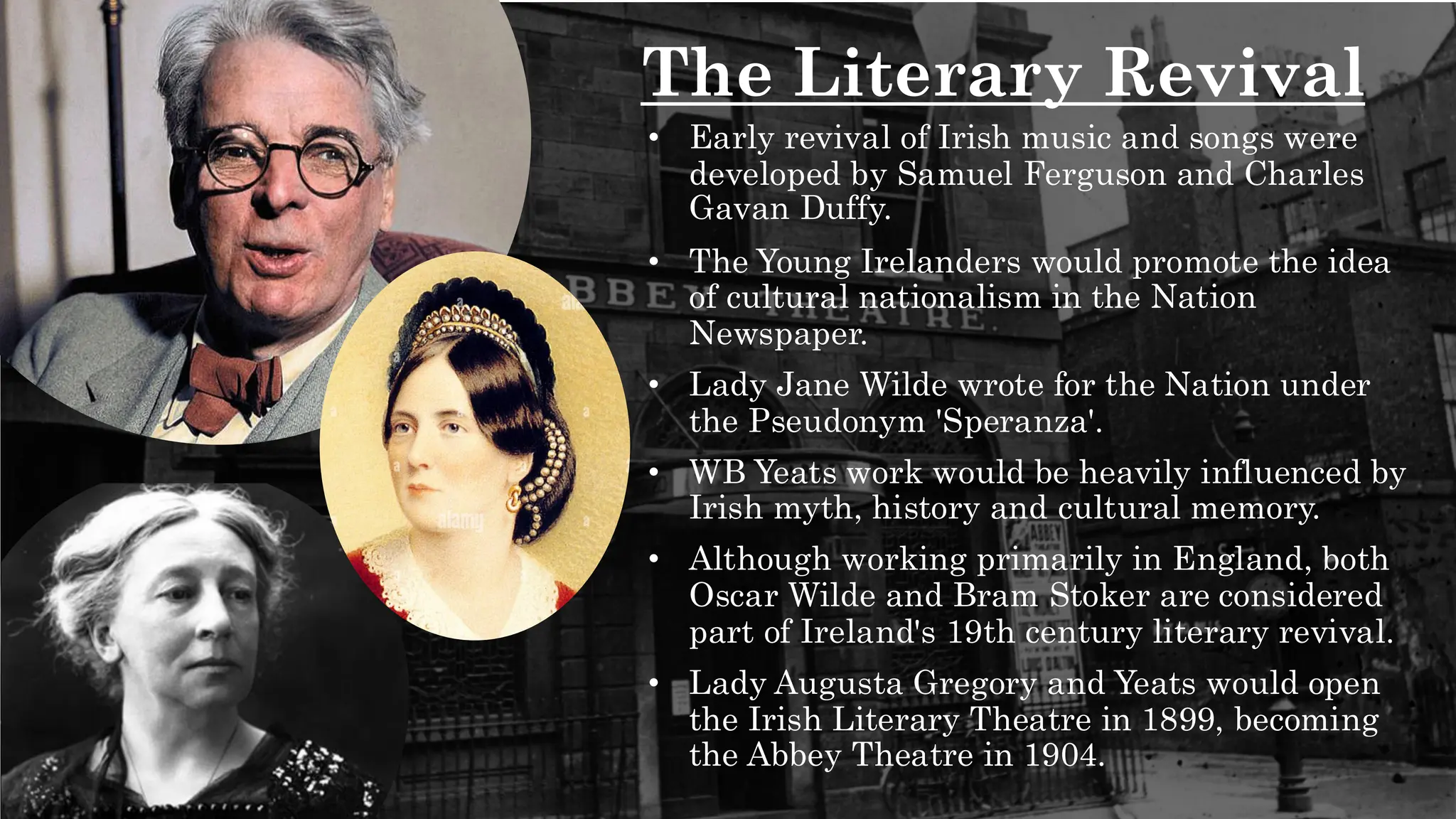
The Literary Revival
• Early revival of Irish music and songs were
developed by Samuel Ferguson and Charles
Gavan Duffy.
• The Young Irelanders would promote the idea
of cultural nationalism in the Nation
Newspaper.
• Lady Jane Wilde wrote for the Nation under
the Pseudonym 'Speranza'.
• WB Yeats work would be heavily influenced by
Irish myth, history and cultural memory.
• Although working primarily in England, both
Oscar Wilde and Bram Stoker are considered
part of Ireland's 19th century literary revival.
• Lady Augusta Gregory and Yeats would open
the Irish Literary Theatre in 1899, becoming
the Abbey Theatre in 1904.
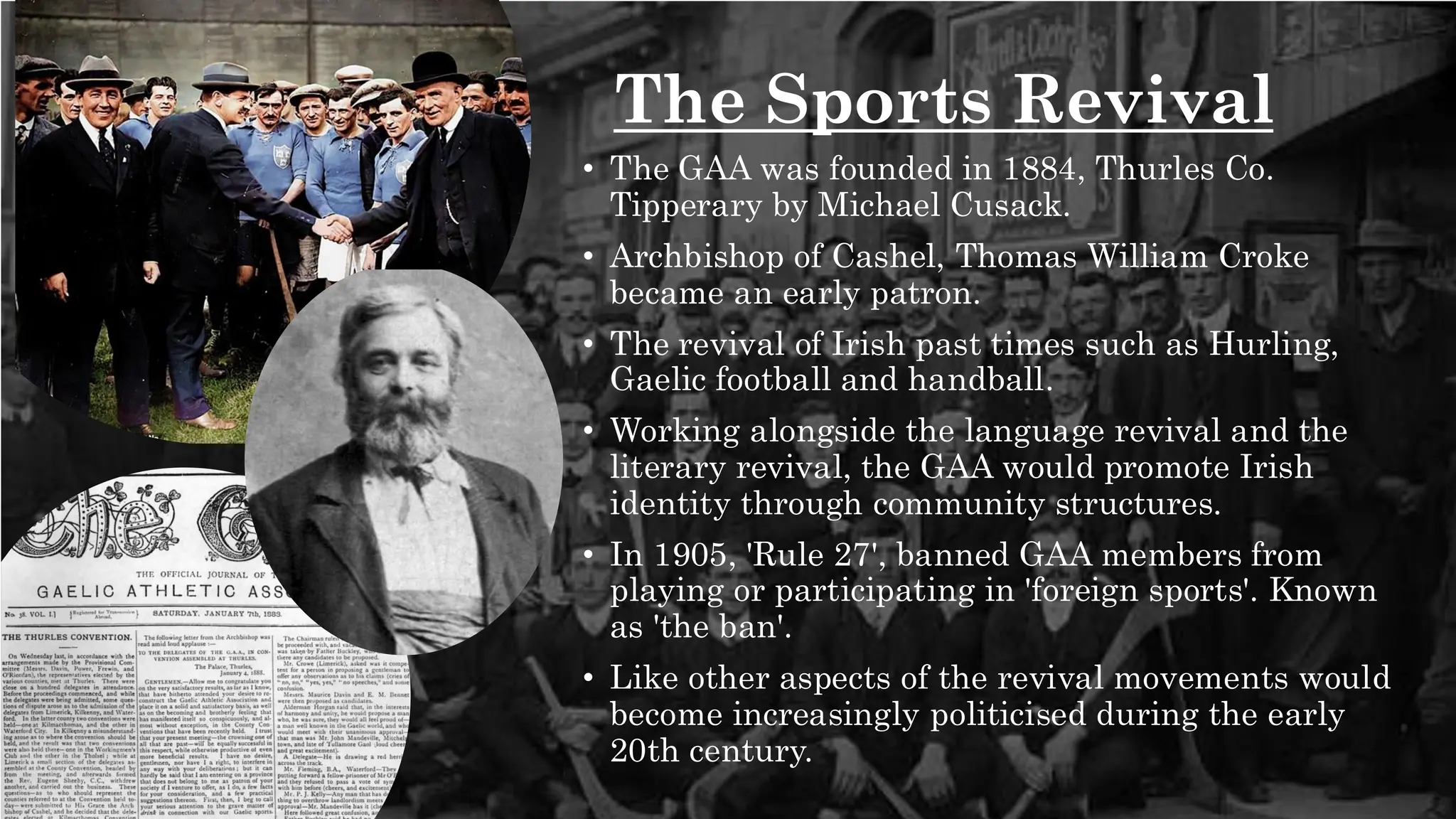
The Sports Revival
• The GAA was founded in 1884, Thurles Co.
Tipperary by Michael Cusack.
• Archbishop of Cashel, Thomas William Croke
became an early patron.
• The revival of Irish past times such as Hurling,
Gaelic football and handball.
• Working alongside the language revival and the
literary revival, the GAA would promote Irish
identity through community structures.
• In 1905, 'Rule 27', banned GAA members from
playing or participating in 'foreign sports'. Known
as 'the ban'.
• Like other aspects of the revival movements would
become increasingly politicised during the early
20th century.
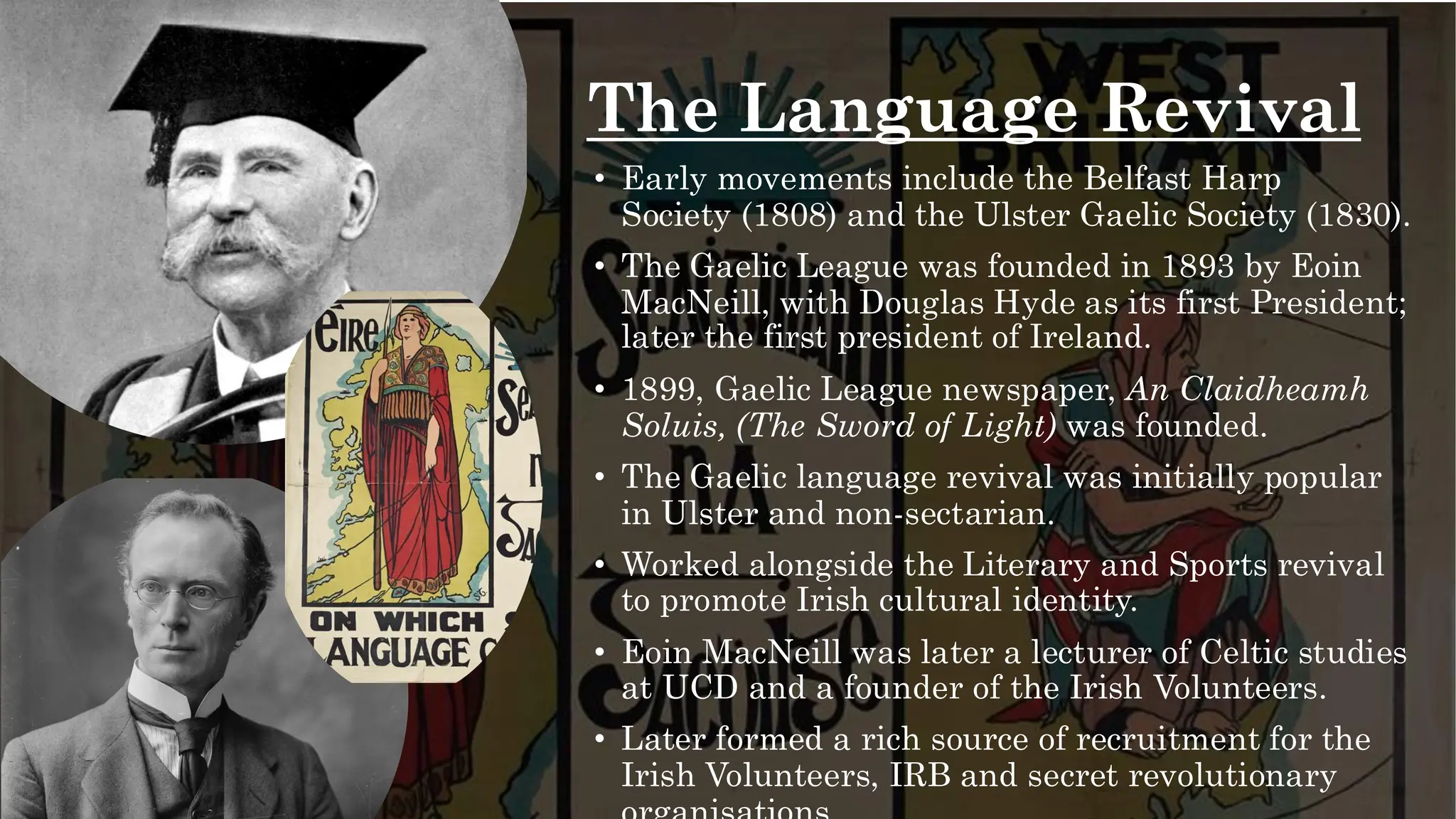
The Language Revival
• Early movements include the Belfast Harp
Society (1808) and the Ulster Gaelic Society (1830).
• The Gaelic League was founded in 1893 by Eoin
MacNeill, with Douglas Hyde as its first President;
later the first president of Ireland.
• 1899, Gaelic League newspaper, An Claidheamh
Soluis, (The Sword of Light) was founded.
• The Gaelic language revival was initially popular
in Ulster and non-sectarian.
• Worked alongside the Literary and Sports revival
to promote Irish cultural identity.
• Eoin MacNeill was later a lecturer of Celtic studies
at UCD and a founder of the Irish Volunteers.
• Later formed a rich source of recruitment for the
Irish Volunteers, IRB and secret revolutionary
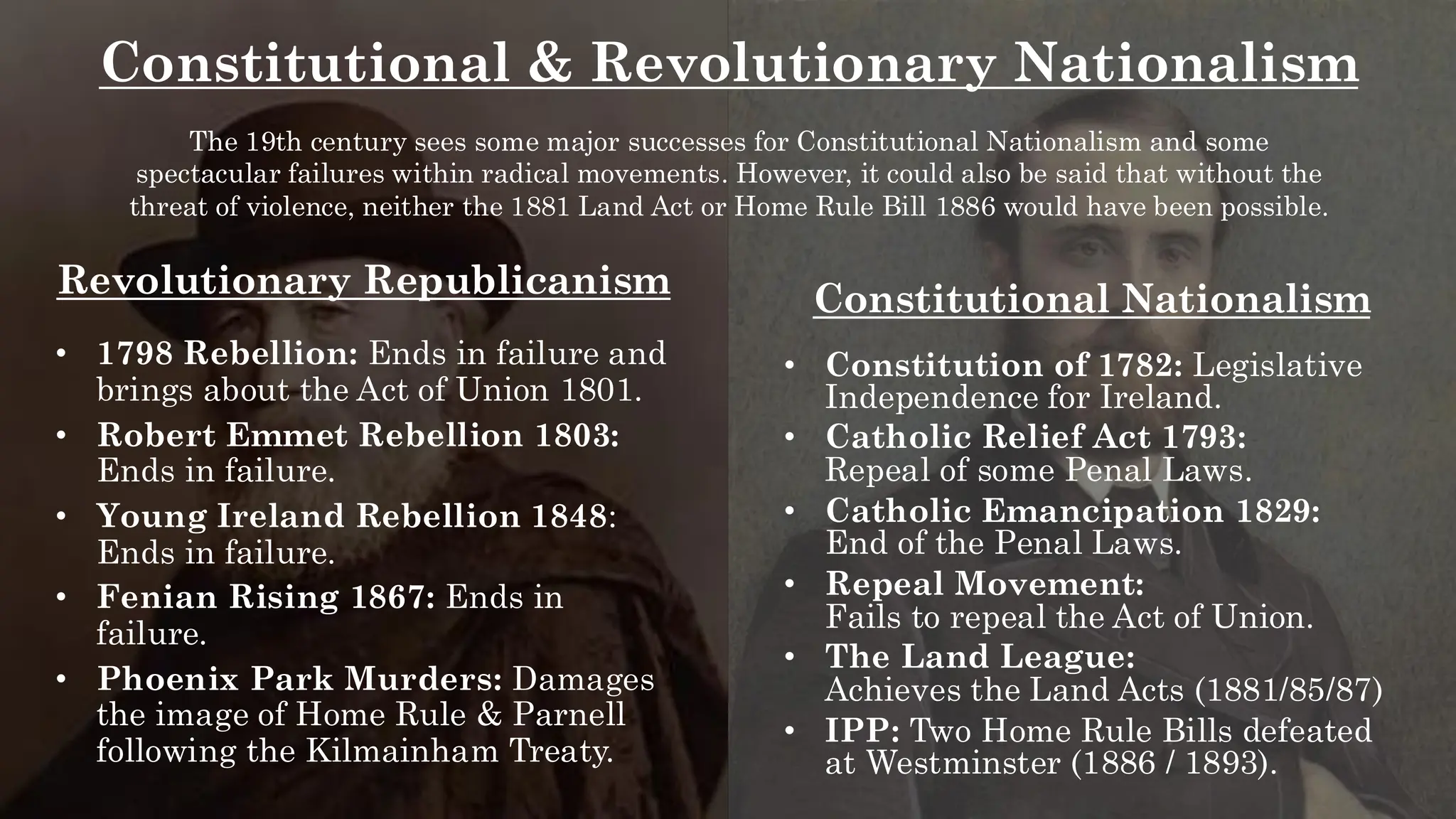
Constitutional & Revolutionary Nationalism
The 19th century sees some major successes for Constitutional Nationalism and some
spectacular failures within radical movements. However, it could also be said that without the
threat of violence, neither the 1881 Land Act or Home Rule Bill 1886 would have been possible.
Constitutional Nationalism
• Constitution of 1782: Legislative
Independence for Ireland.
• Catholic Relief Act 1793:
Repeal of some Penal Laws.
• Catholic Emancipation 1829:
End of the Penal Laws.
• Repeal Movement:
Fails to repeal the Act of Union.
• The Land League:
Achieves the Land Acts (1881/85/87)
• IPP: Two Home Rule Bills defeated
at Westminster (1886 / 1893).
Revolutionary Republicanism
• 1798 Rebellion: Ends in failure and
brings about the Act of Union 1801.
• Robert Emmet Rebellion 1803:
Ends in failure.
• Young Ireland Rebellion 1848:
Ends in failure.
• Fenian Rising 1867: Ends in
failure.
• Phoenix Park Murders: Damages
the image of Home Rule & Parnell
following the Kilmainham Treaty.
Conclusion
The events of the late 18th century would leave Ireland with two emerging political
traditions and while they never remain mutually exclusive, Ireland would see the
rise of constitutional nationalism, in the vein of Henry Grattan and radical
revolutionary republicanism, in the vein of Theobald Wolfe Tone.
As the successor to Henry Grattan, Daniel O'Connell would finally achieve Catholic
Emancipation and an end of the Penal Laws in 1829. However, his failure to repeal
the Act of Union and the tragedy of the Great Famine of the 1840's would lead again
to a call for an Irish Republic through Revolution. This would come first with the
Young Ireland Rebellion of 1848 and later with the rise of the Fenians in the 1850's
and 60's.
Constitutional reform would rise again under Charles Stewart Parnell, whose true
talent lay in his ability to merge constitutional nationalism with radical land reform.
With the victories of Catholic Emancipation (1829), The Land Acts and the near
prospect of Home Rule; compared with the failures of Republicanism in 1848 and
1867; constitutional Nationalism looked set to dominate the politics of Irelands early
20th century.

Week 12 - 19th Century Part 2 (1845 - 1900).pdf

  • 1.
    19TH CENTURY IRELAND Part2: The Great Famine, the rise of 'The Irish Question', the Land War and Home Rule. Key Events: • The Fenian Movements • The Land War • Home Rule Part 2: Land Reform and the Rise of Home Rule
  • 2.
    Overview "The Almighty, indeed,sent the potato blight, but the English created the Famine" - (John Dillon). Whether through gross negligence, indifference or callousness, the Great Famine would come to exemplify the worst consequence of British rule in Ireland. In response, resentment against British rule would evolve into new even more radical republican groups in the form of the Fenians. Now backed by a powerful diaspora in America, they would continue the tradition of radical republicanism. The most effective political movement to emerge, would be the successors to Daniel O'Connell's repeal movement. The Home Rule Movement, led by Charles Stewart Parnell would combine constitutional nationalism with the popular movement of land reform. Through political tact and overwhelming support Parnell would see Home Rule become a major player in the politics of the Westminster Parliament. However, Parnell's spectacular rise would have an equally spectacular fall as revelations of his relationship with a married woman would divide the Home Rule movement from 1890 until its unification again under John Redmond in 1900.
  • 3.
    The Fenian Movements TheFenians, Land Reform and the Rise of Home Rule.
  • 4.
    The Fenians • TheIrish Repubican Brotherhood (IRB), founded by Young Ireland verteran, James Stephens 1858. • The IRB were a secret Oath bound organisation intent on establishing an Irish Republic. • The Fenians would utilise the Irish diaspora in America United States for leaders and funding. • In 1859, John O'Mahony established the Irish Fenian Brotherhood in the United States, succeeded later by Clan na nGael under John Devoy. • The IRB would lead the Fenian Rising in 1867 which would result in failure. • Jeremiah O'Donovan Rossa would advocate and organise the Fenian Dynamite Campaign in Britain. • Click Here
  • 5.
    The Fenian Rising1867 • The Fenians hoped to organise Irish veterans of the American Civil War. • In 1866, the Fenians attempted an invasion of Canada – The Battle of Ridgeway. • An attempted rising in Kerry in February 1867. • On March 5th 1867, skirmishes took place in Dublin, Cork and Limerick. • The Battle of Tallaght was among the largest but was quickly suppressed the Irish Constabulary and British Army. • 12 people were killed on this day. • Symbolically the leaders proclaimed an Irish Republic as well as a Provisional Government. • The Irish Constabulary are given the title 'Royal' in recognition of their part in subduing the Rising.
  • 6.
    The Manchester Martyrs •Fenian organisers, Timothy Deasy and Thomas Kelly arrested in Manchester, September 1867. • Police officer Charles Brett was killed during an escape attempt involving 40 Fenians. • Deasy and Kelly would get away however, five would stand trial for the incident. • The Police began to raid Irish areas of Manchester. • One of the five defendants Edward O'Meagher Condon, is said to have concluded a speech at the dock with "God Save Ireland!" • O'Meagher Condon and Thomas Maguire would have sentenced commuted. • On November 23rd 1867: Michael O'Brien, William Philip Allen & Michael Larkin would be hanged at Salford Gaol becoming the 'Manchester Martyrs’.
  • 7.
    The Dynamite Campaign •The Clerkenwell Prison Explosion in 1867 accidentally caused 12 deaths in an attempted Fenian prison-break. • This bombing influenced PM Gladstone in addressing Irish land reform as well as the disestablishment of the Anglican Church in Ireland • From 1881 – 1885, Jeremiah O'Donovan Rossa organised a bombing campaign from exile in the United States. • First bombing campaign against British rule on the British mainland. • Thomas Clarke is arrested for possession of dynamite and sentence to penal servitude for life. • House of Commons, Tower of London & Westminster Hall, bombed in January 1885. Click Here
  • 8.
    The Land League LandReform and 'The Land War'.
  • 9.
    Michael Davitt (1846– 1906) • Born, Straide Co.Mayo, 1846 • Evicted from their family farm during the famine. • Lost his arm in a mill accident age 11 in England. • Joined the IRB in 1865, aged 19. • In 1879, Davitt became secretary of the Irish Land League, to gain rights for tenant farmers and prevent abuses from landlords. • The Land War (1879-1882) saw mass demonstrations, boycotts and agitation for change. • Advocated for the 'New Departure', radical nationalists working with moderates for reform. • Land Act 1881 allowed many tenant farmers to secure land ownership and rent reductions.
  • 10.
    Charles Stewart Parnell •An Anglo-Irish Protestant Landlord from Avondale Co. Wicklow. Born 1846. • Question as to his involvement with the IRB. • Became the leader of the IPP in 1882. • Founded the National Land League with Michael Davitt in 1879, allying land reform movements and nationalist movements (The 'New Departure') • Achieved the 1881 Land Act, brought the first Home Rule Bill to Westminster in 1886. • Famous for obstructionism in Parliament and his alliance with W.E Gladstone's Liberal Party. • The scandal of his relationship with Katharine O'Shea, splits the party in 1890/1. • Died of Pneumonia, 6th Oct 1891.
  • 11.
    The Land War(1879-82) In the wake of the Great Famine, major land reform was needed to address widespread poverty and unjust practices by landlords, including evictions and unfair rents. Under the leadership of Charles Stewart Parnell & Michael Davitt, the movement called for land reform, under the 3 F's: 1) Free sale 2) Fixity of Tenure 3) Fair Rent. The Land War saw widespread protests, "No Rent" campaigns, and violent clashes between tenants and landlords' forces. One of the most famous incidents of social ostracism, was that of Captain Charles Boycott in Co. Mayo. The government responded with repressive measures, including arrests, the imposition of martial law and the implementation of the Coercion Act 1881; which saw widespread arrests of leaders including Davitt and Parnell. The movement led to significant reforms, such as the Land Act of 1881, which granted tenants greater security and was the precursor for the Ashbourne Land Act (1885), Balfour Land Act (1887) and the Wyndham Land Act (1903). The Land War was crucial in continuing mass movements and continued politicisation of Irish population into the early 20th century. Click Here
  • 12.
    The Land War1879-1882 02:44 – 08:00
  • 13.
    Home Rule Charles StewartParnell & the Home Rule Bill
  • 14.
    The Rise ofHome Rule Founded by Isaac Butt in 1870, the concept of 'Home Rule' would advocate for Irish self-governance within the United Kingdom. Butt's approach was moderate, seeking gradual constitutional reforms, but his leadership lacked the momentum to achieve significant progress. The movement gained traction under Charles Stewart Parnell, who emerged as the party leader in 1880, later renaming it as the Irish Parliamentary Party (IPP) in 1882. Parnell brought a more assertive and strategic approach, focusing on aggressive parliamentary tactics, such as obstructionism, to force British attention on Irish issues. His leadership inspired mass support for Home Rule, especially through successful campaigns like the land agitation movement, which advocated for tenant rights and fair rents. Parnell's political acumen and charisma allowed the IPP to gain significant influence in the British Parliament, securing the first Home Rule Bill in 1886 and paving the way for the second in 1893. The party would split in 1890 with the scandal over Parnell's relationship with Katherine O'Shea, damaging the movement into the 1900's. Click Here
  • 16.
    William Ewart Gladstone •Originally a conservative, Gladstone would become the leader of the Liberal Party. • First term as PM: 1868 – 1874: Stated "My mission is to pacify Ireland": 1868: The Church of Ireland is disestablished & Tithes are ended. • Second term as PM: 1880 – 1885: Passed the Land Act of 1881. • Third Term as PM: Feb 1886- July 1886: Introduced the first Home Rule Bill 1886, defeated in the House of Commons. • Fourth term as PM 1892 – 1894: Brought the second Home Rule Bill (1893), defeated by the Lords. • Gladstone is seen as an ally of Parnell in parliament bringing two Home Rule bills to Parliament.
  • 17.
    The Kilmainham Treaty •The 1881 Land Act was introduced in April. • The Act left the issue of 'Fair rent' up to land court judges and excluded many already in arrears. • The Coercion Act 1881 introduced internment (imprisonment without trial) for anybody suspected of involvement in the Land War (1879-1882) • 13th October 1881: Charles Stewart Parnell is arrest and imprisoned in Kilmainham Gaol. • 15th October 1881: The National Land League are officially banned with more of its leader imprisoned. • The next week the Land League issued a 'No Rent' Manifesto, urging small tenant farmers to withhold their rent in protest. • The Kilmainham Treaty: By April 1882, Gladstone agreed to amend the Land Act and Parnell agreed to end violence associated with the Land War.
  • 18.
    Phoenix Park Murders •2nd May 1882, Parnell and others are released from Kilmainham following the 'Kilmainham Treaty'. • Parnell had agreed to stem the violence of the Land War. • Chief Secretary W.E Forster resigned over Parnell's release. • 6th May 1882, Lord Frederick Cavendish arrived in Ireland to take over as Chief Secretary. • Cavendish went to meet with the Under-secretary Thomas Burke at his home in the Phoenix Park. • There a Fenian Group known as 'The Invincibles', murdered Cavendish and Burke. • The murders severely undermined Parnell and drew attention to his political links with Fenianism.
  • 19.
    The First HomeRule Bill - 1886 10:10
  • 20.
    The Fall ofHome Rule The release of Parnell in 1882 has been partially negotiated by Home Rule MP William O'Shea, the 'Kilmainham Treaty' was agreed and Parnell was released in 1882. Upon his release, Parnell would found the Irish National League, the successor to the Land League and although unsuccessful, Parnell's alliance with Gladstone, would finally bring about the First Home Rule Bill of 1886. In 1889, the IPP and Parnell were hit by political scandal. In that year William O'Shea filed for divorce from his estranged wife Katharine, exposing her relationship with Charles Stewart Parnell to the public. In reality, O'Shea and Katharine had been estranged for many years, and he had known about the relationship and Parnell and Katharine even had two children together at this point. Either way, the scandal in the press caused the Liberal Party in Westminster to abandon the IPP and the party would split between those loyal to Parnell and those against, known as Parnellites and Anti-Parnellites. The fallout from the affair would last until 1900 when the two factions would join again under the leadership of John Redmond.
  • 21.
    The Gaelic Revival CulturalNationalism in the late 19th Century.
  • 22.
    The Gaelic RevivalMovement Post-famine Ireland would see a major revival and interest in Irish culture and heritage. Early proponents of the Gaelic revival would be the Young Ireland Movement, particularly Thomas Davis who advocated for the development and revival of cultural nationalism alongside political nationalism. The folklore revival would bring about a renewed interest in ancient Irish stories and the beliefs which would influence literary giants such as Oscar Wilde, WB Yeats, August Gregory and James Joyce. The resurging interest in Irish identity would also bring about a revival of the Irish Language with the foundation of the Gaelic League in 1893. One of the most important organisations founded during this period was the Gaelic Athletics Association (GAA) in 1884. Over the course of the late 19th century many of these cultural movements would become increasingly politicised and would provide recruitment for both constitutional and radical nationalist movements.
  • 23.
    The Literary Revival •Early revival of Irish music and songs were developed by Samuel Ferguson and Charles Gavan Duffy. • The Young Irelanders would promote the idea of cultural nationalism in the Nation Newspaper. • Lady Jane Wilde wrote for the Nation under the Pseudonym 'Speranza'. • WB Yeats work would be heavily influenced by Irish myth, history and cultural memory. • Although working primarily in England, both Oscar Wilde and Bram Stoker are considered part of Ireland's 19th century literary revival. • Lady Augusta Gregory and Yeats would open the Irish Literary Theatre in 1899, becoming the Abbey Theatre in 1904.
  • 24.
    The Sports Revival •The GAA was founded in 1884, Thurles Co. Tipperary by Michael Cusack. • Archbishop of Cashel, Thomas William Croke became an early patron. • The revival of Irish past times such as Hurling, Gaelic football and handball. • Working alongside the language revival and the literary revival, the GAA would promote Irish identity through community structures. • In 1905, 'Rule 27', banned GAA members from playing or participating in 'foreign sports'. Known as 'the ban'. • Like other aspects of the revival movements would become increasingly politicised during the early 20th century.
  • 25.
    The Language Revival •Early movements include the Belfast Harp Society (1808) and the Ulster Gaelic Society (1830). • The Gaelic League was founded in 1893 by Eoin MacNeill, with Douglas Hyde as its first President; later the first president of Ireland. • 1899, Gaelic League newspaper, An Claidheamh Soluis, (The Sword of Light) was founded. • The Gaelic language revival was initially popular in Ulster and non-sectarian. • Worked alongside the Literary and Sports revival to promote Irish cultural identity. • Eoin MacNeill was later a lecturer of Celtic studies at UCD and a founder of the Irish Volunteers. • Later formed a rich source of recruitment for the Irish Volunteers, IRB and secret revolutionary
  • 26.
    Constitutional & RevolutionaryNationalism The 19th century sees some major successes for Constitutional Nationalism and some spectacular failures within radical movements. However, it could also be said that without the threat of violence, neither the 1881 Land Act or Home Rule Bill 1886 would have been possible. Constitutional Nationalism • Constitution of 1782: Legislative Independence for Ireland. • Catholic Relief Act 1793: Repeal of some Penal Laws. • Catholic Emancipation 1829: End of the Penal Laws. • Repeal Movement: Fails to repeal the Act of Union. • The Land League: Achieves the Land Acts (1881/85/87) • IPP: Two Home Rule Bills defeated at Westminster (1886 / 1893). Revolutionary Republicanism • 1798 Rebellion: Ends in failure and brings about the Act of Union 1801. • Robert Emmet Rebellion 1803: Ends in failure. • Young Ireland Rebellion 1848: Ends in failure. • Fenian Rising 1867: Ends in failure. • Phoenix Park Murders: Damages the image of Home Rule & Parnell following the Kilmainham Treaty.
  • 27.
    Conclusion The events ofthe late 18th century would leave Ireland with two emerging political traditions and while they never remain mutually exclusive, Ireland would see the rise of constitutional nationalism, in the vein of Henry Grattan and radical revolutionary republicanism, in the vein of Theobald Wolfe Tone. As the successor to Henry Grattan, Daniel O'Connell would finally achieve Catholic Emancipation and an end of the Penal Laws in 1829. However, his failure to repeal the Act of Union and the tragedy of the Great Famine of the 1840's would lead again to a call for an Irish Republic through Revolution. This would come first with the Young Ireland Rebellion of 1848 and later with the rise of the Fenians in the 1850's and 60's. Constitutional reform would rise again under Charles Stewart Parnell, whose true talent lay in his ability to merge constitutional nationalism with radical land reform. With the victories of Catholic Emancipation (1829), The Land Acts and the near prospect of Home Rule; compared with the failures of Republicanism in 1848 and 1867; constitutional Nationalism looked set to dominate the politics of Irelands early 20th century.