Chapter 22
Next
Generation
IP
Copyright © The McGraw-Hill Companies, Inc. Permission required for reproduction or display.
22.2
22-1 IPv6 Addressing
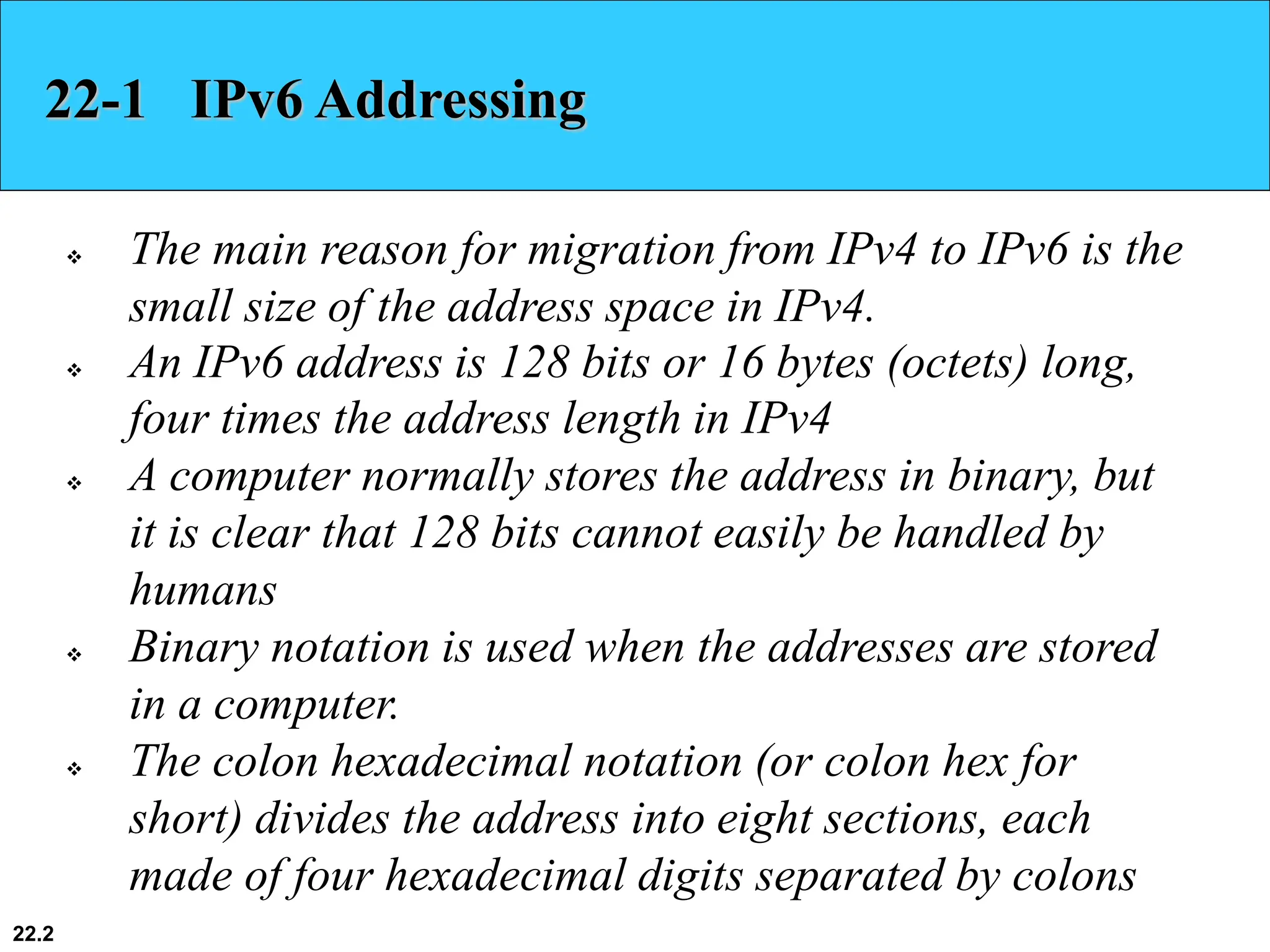
 The main reason for migration from IPv4 to IPv6 is the
small size of the address space in IPv4.
 An IPv6 address is 128 bits or 16 bytes (octets) long,
four times the address length in IPv4
 A computer normally stores the address in binary, but
it is clear that 128 bits cannot easily be handled by
humans
 Binary notation is used when the addresses are stored
in a computer.
 The colon hexadecimal notation (or colon hex for
short) divides the address into eight sections, each
made of four hexadecimal digits separated by colons
22.3
22.22.1 Representation
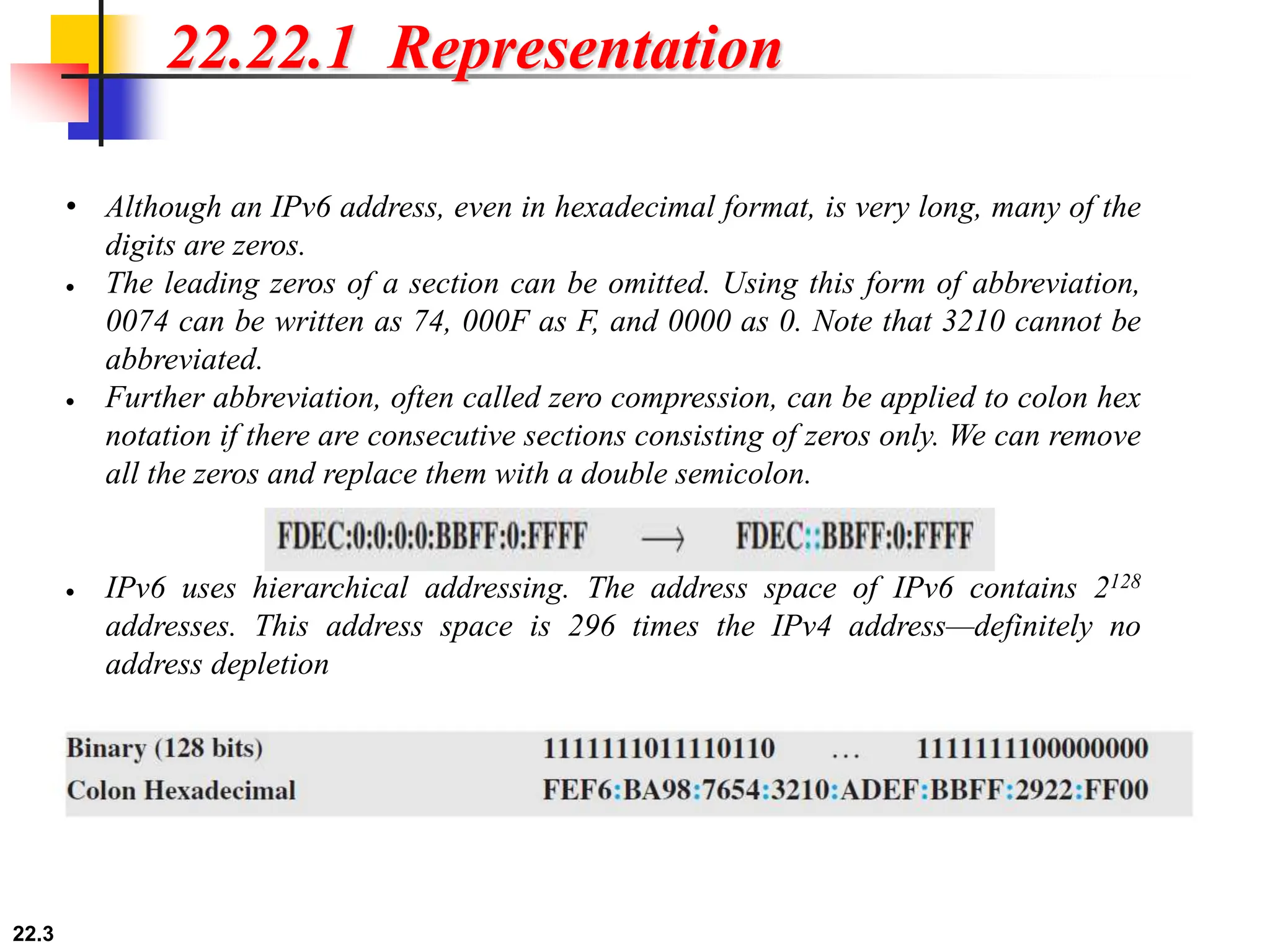
• Although an IPv6 address, even in hexadecimal format, is very long, many of the
digits are zeros.
 The leading zeros of a section can be omitted. Using this form of abbreviation,
0074 can be written as 74, 000F as F, and 0000 as 0. Note that 3210 cannot be
abbreviated.
 Further abbreviation, often called zero compression, can be applied to colon hex
notation if there are consecutive sections consisting of zeros only. We can remove
all the zeros and replace them with a double semicolon.
 IPv6 uses hierarchical addressing. The address space of IPv6 contains 2128
addresses. This address space is 296 times the IPv4 address—definitely no
address depletion
Address Types
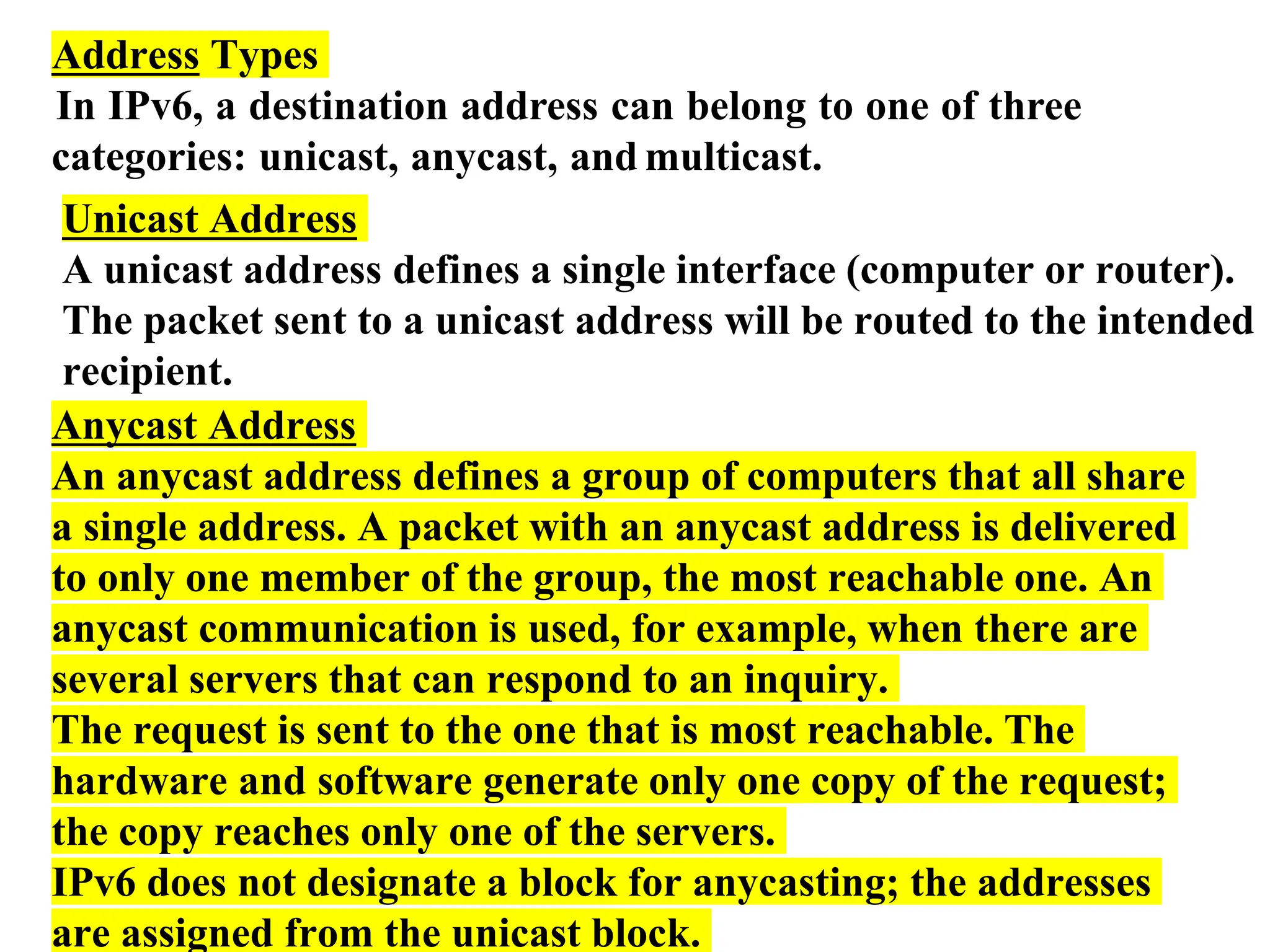
In IPv6, a destination address can belong to one of three
categories: unicast, anycast, and multicast.
Unicast Address
A unicast address defines a single interface (computer or router).
The packet sent to a unicast address will be routed to the intended
recipient.
Anycast Address
An anycast address defines a group of computers that all share
a single address. A packet with an anycast address is delivered
to only one member of the group, the most reachable one. An
anycast communication is used, for example, when there are
several servers that can respond to an inquiry.
The request is sent to the one that is most reachable. The
hardware and software generate only one copy of the request;
the copy reaches only one of the servers.
IPv6 does not designate a block for anycasting; the addresses
are assigned from the unicast block.
Multicast Address
 A multicast address also defines a group of computers. However,
there is a differencebetween anycasting and multicasting.
 In anycasting, only one copy of the packet is sent to one of the
members of the group; in multicasting each member of the group
receives a copy.
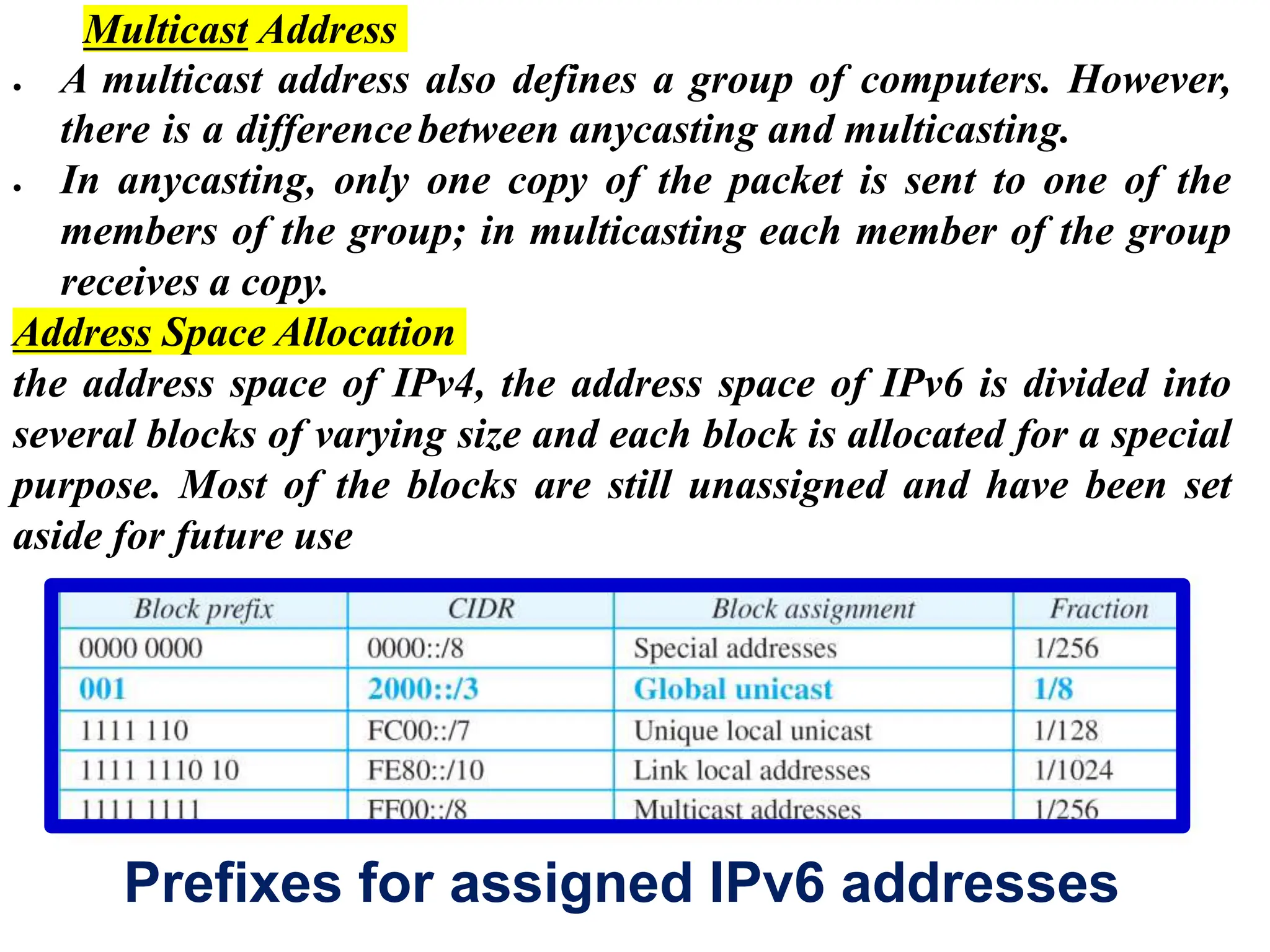
Address Space Allocation
the address space of IPv4, the address space of IPv6 is divided into
several blocks of varying size and each block is allocated for a special
purpose. Most of the blocks are still unassigned and have been set
aside for future use
Prefixes for assigned IPv6 addresses
22.6
Global Unicast Addresses
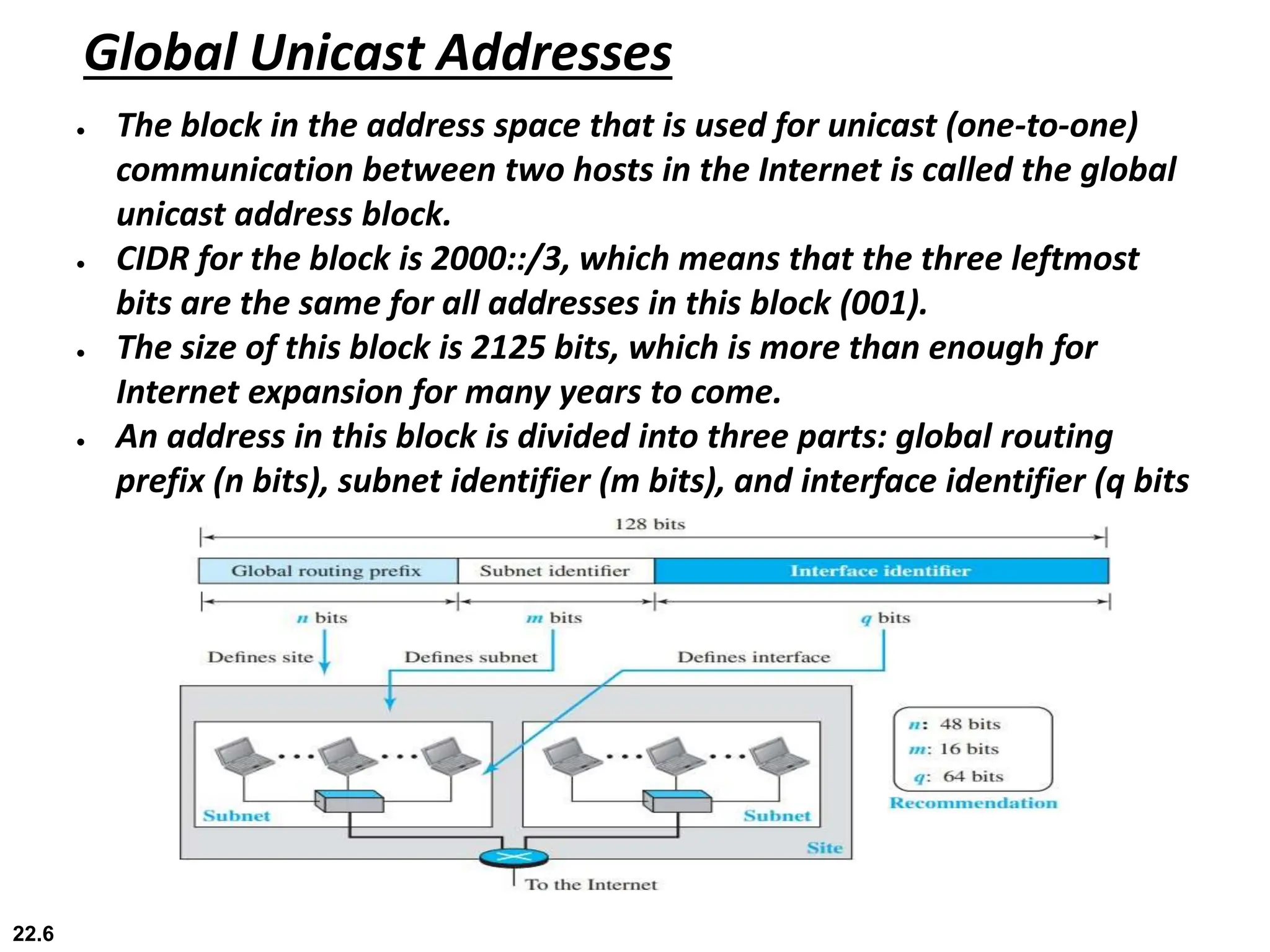
 The block in the address space that is used for unicast (one-to-one)
communication between two hosts in the Internet is called the global
unicast address block.
 CIDR for the block is 2000::/3, which means that the three leftmost
bits are the same for all addresses in this block (001).
 The size of this block is 2125 bits, which is more than enough for
Internet expansion for many years to come.
 An address in this block is divided into three parts: global routing
prefix (n bits), subnet identifier (m bits), and interface identifier (q bits
22.7
• Better header format. IPv6 uses a new header format in
which options are separated from the base header and
inserted, when needed, between the base header and
the data.
• New options. IPv6 has new options to allow for
additional functionalities.
• Allowance for extension. IPv6 is designed to allow the
extension of the protocol if required by new
technologies or applications.
• Support for resource allocation. In IPv6, the type-of-
service field has been removed, but two new fields,
traffic class and flow label, have been added to enable
the source to request special handling of the packet.
This mechanism can be used to support traffic such as
real-time audio and video.
• Support for more security. The encryption and
THE IPv6 PROTOCOL
22.8
Packet Format
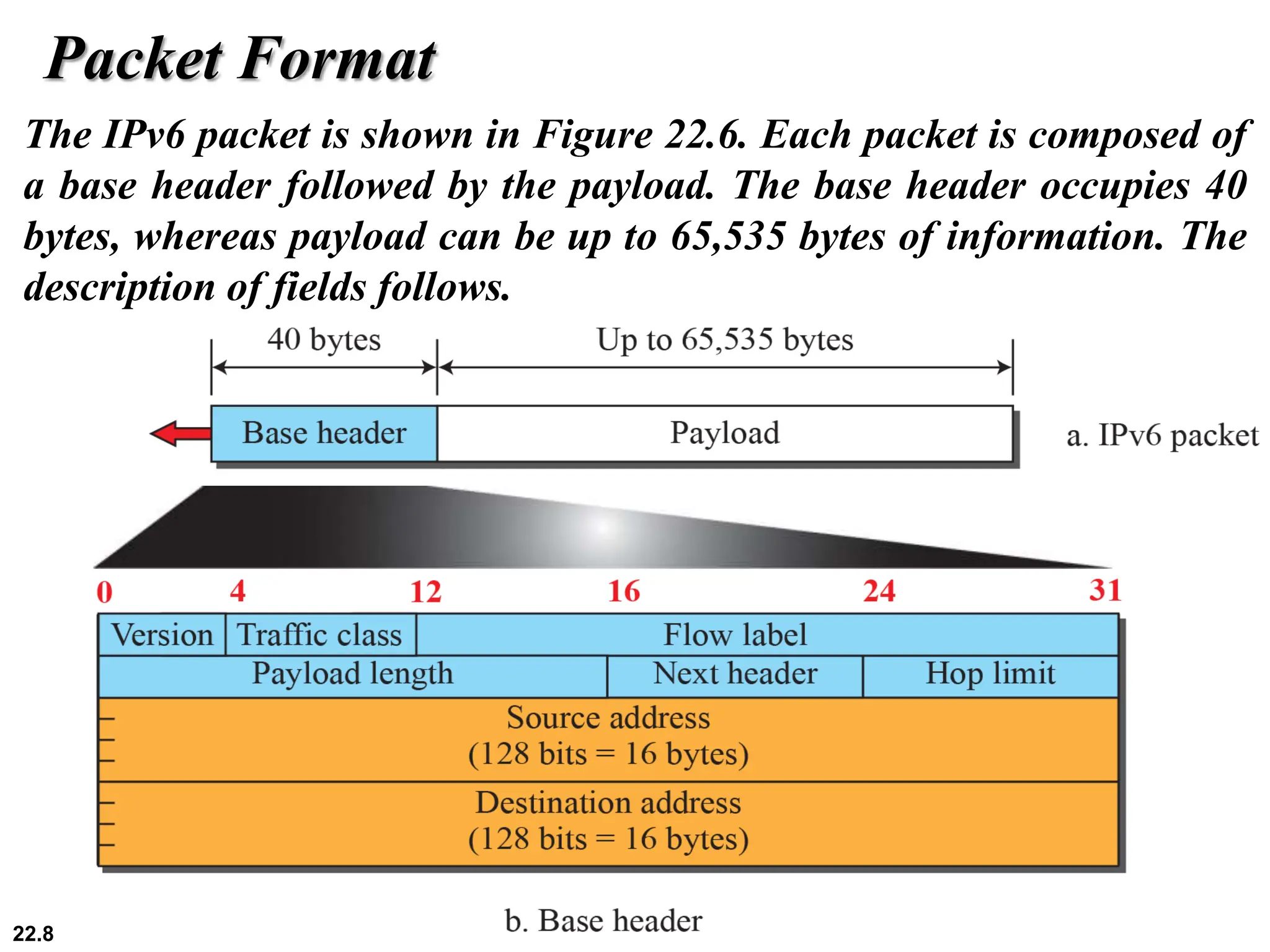
The IPv6 packet is shown in Figure 22.6. Each packet is composed of
a base header followed by the payload. The base header occupies 40
bytes, whereas payload can be up to 65,535 bytes of information. The
description of fields follows.
22.9
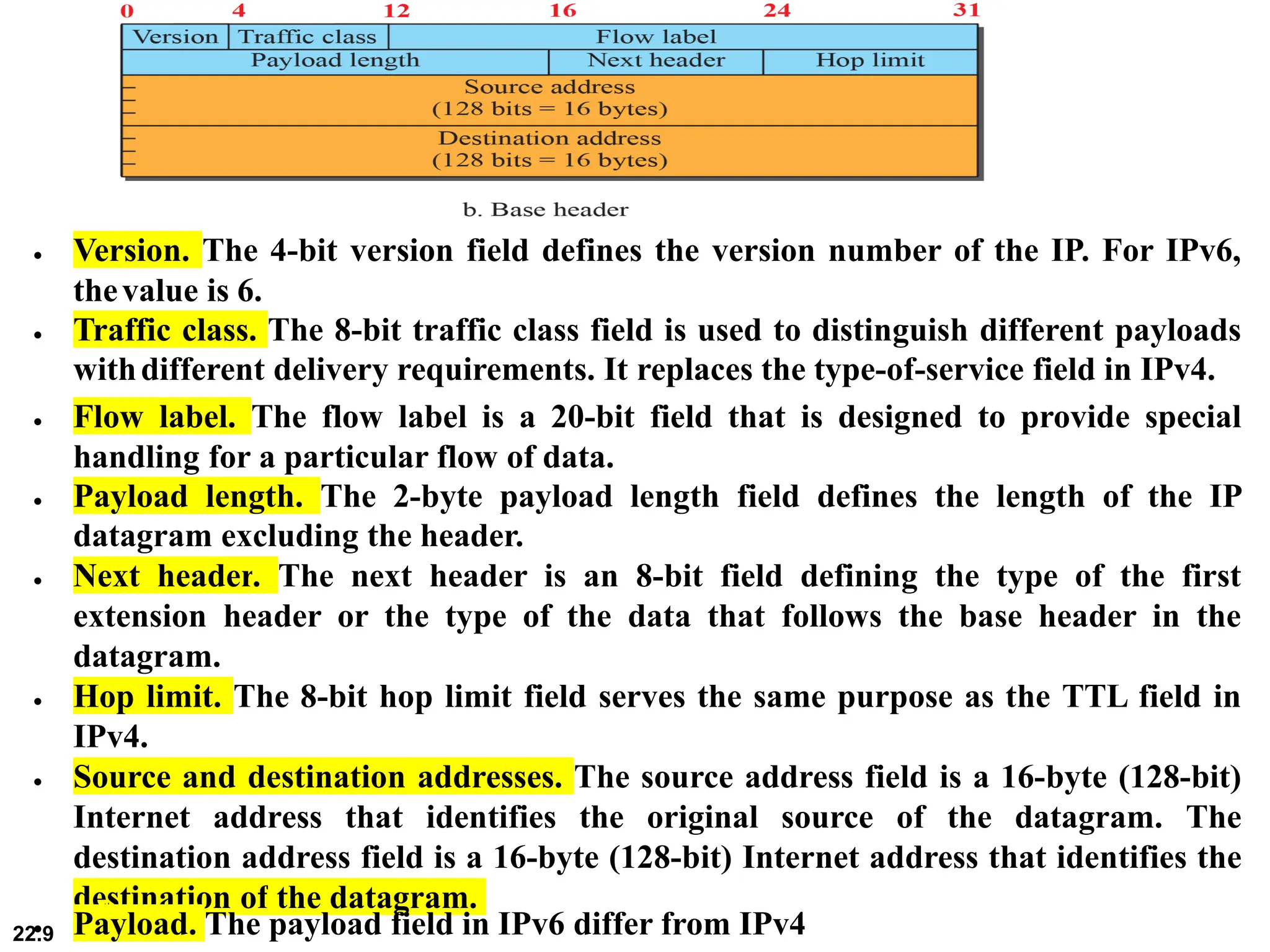
 Version. The 4-bit version field defines the version number of the IP. For IPv6,
thevalue is 6.
 Traffic class. The 8-bit traffic class field is used to distinguish different payloads
withdifferent delivery requirements. It replaces the type-of-service field in IPv4.
 Flow label. The flow label is a 20-bit field that is designed to provide special
handling for a particular flow of data.
 Payload length. The 2-byte payload length field defines the length of the IP
datagram excluding the header.
 Next header. The next header is an 8-bit field defining the type of the first
extension header or the type of the data that follows the base header in the
datagram.
 Hop limit. The 8-bit hop limit field serves the same purpose as the TTL field in
IPv4.
 Source and destination addresses. The source address field is a 16-byte (128-bit)
Internet address that identifies the original source of the datagram. The
destination address field is a 16-byte (128-bit) Internet address that identifies the
destination of the datagram.
 Payload. The payload field in IPv6 differ from IPv4
22.10
Figure 22.7: Payload in an IPv6 datagram
The payload in IPv6 means a combination of
zero or more extension headers (options)
followed by the data from other protocols.
22.11
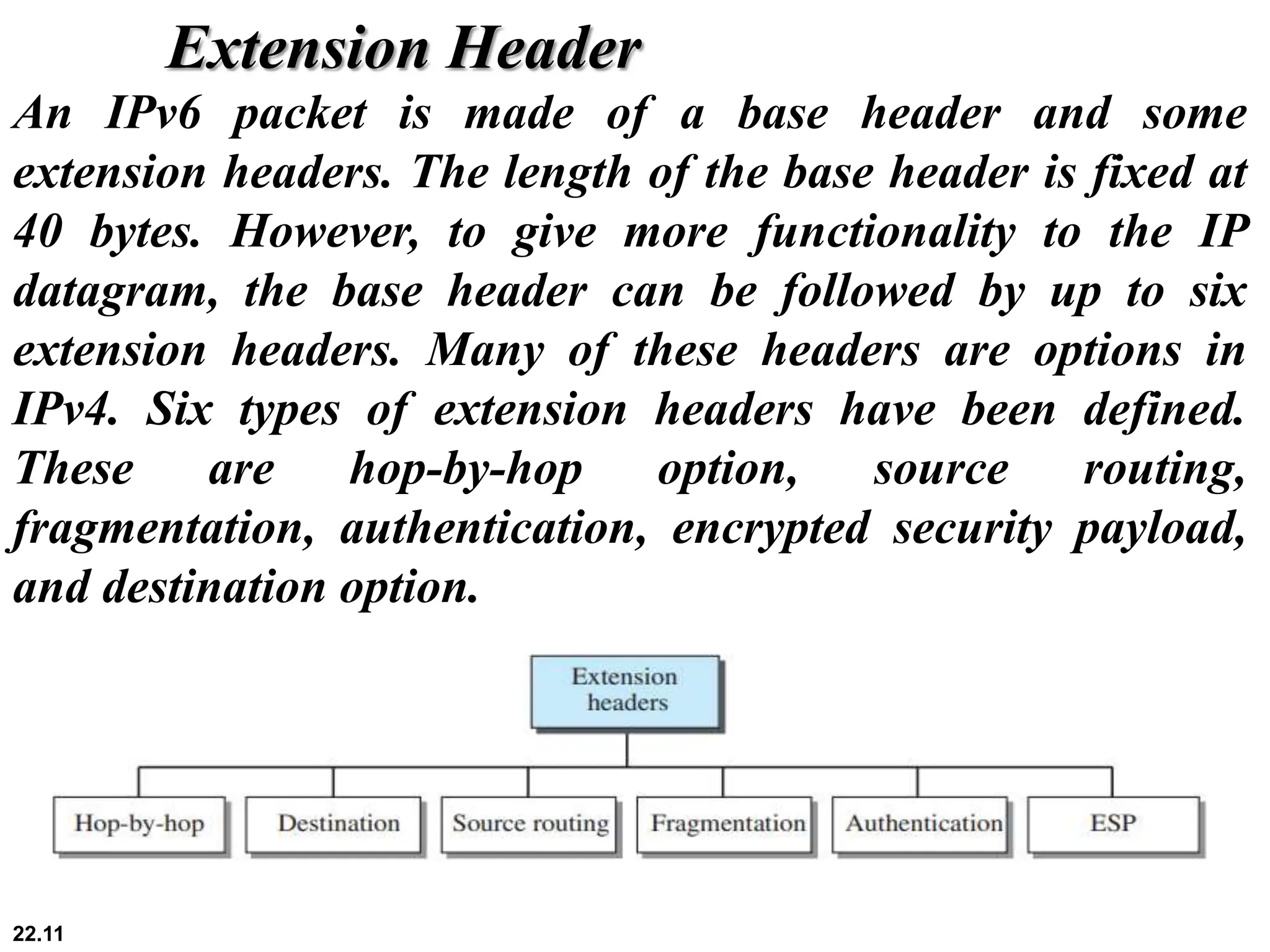
Extension Header
An IPv6 packet is made of a base header and some
extension headers. The length of the base header is fixed at
40 bytes. However, to give more functionality to the IP
datagram, the base header can be followed by up to six
extension headers. Many of these headers are options in
IPv4. Six types of extension headers have been defined.
These are hop-by-hop option, source routing,
fragmentation, authentication, encrypted security payload,
and destination option.
22.12
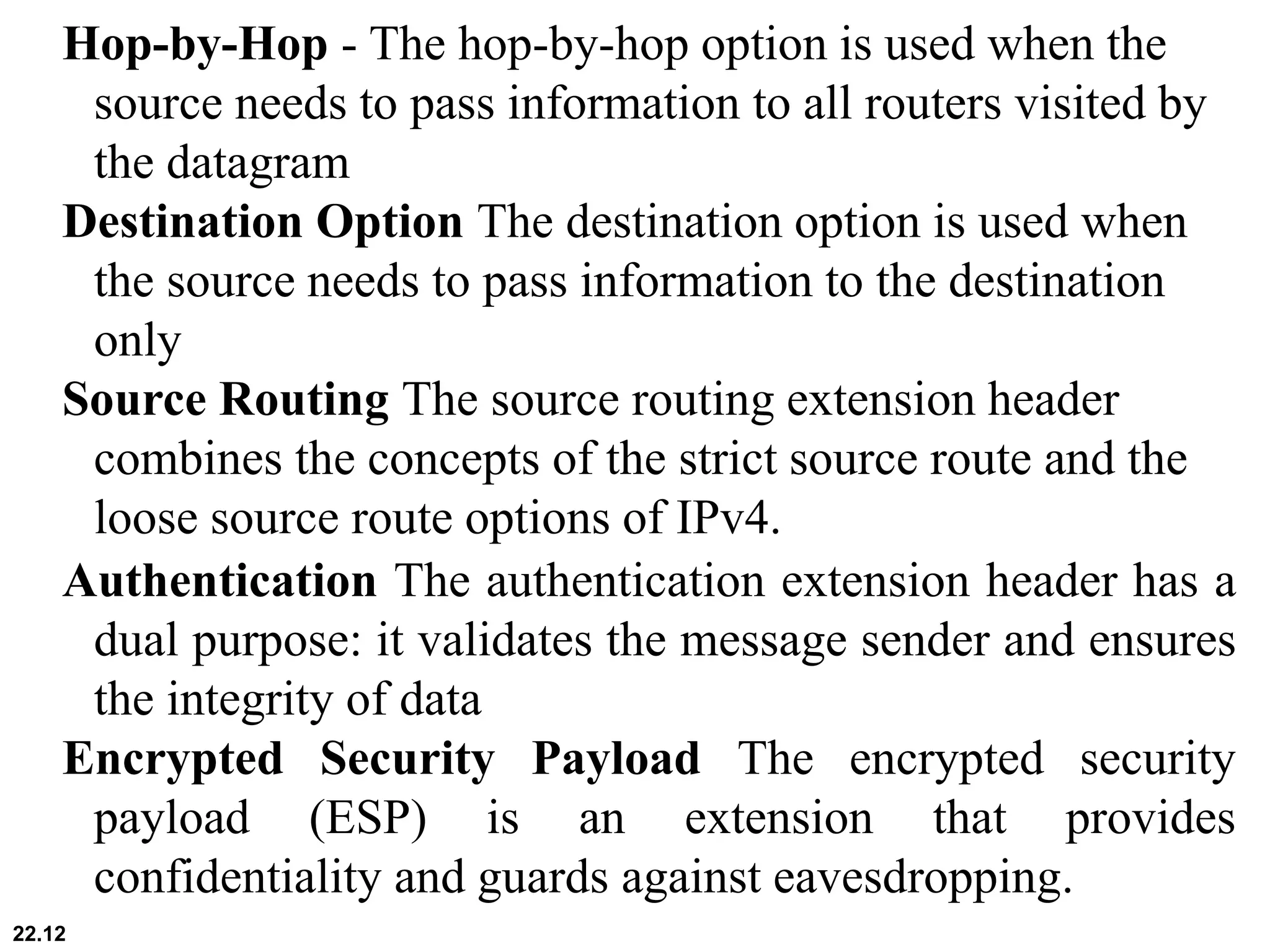
Hop-by-Hop - The hop-by-hop option is used when the
source needs to pass information to all routers visited by
the datagram
Destination Option The destination option is used when
the source needs to pass information to the destination
only
Source Routing The source routing extension header
combines the concepts of the strict source route and the
loose source route options of IPv4.
Authentication The authentication extension header has a
dual purpose: it validates the message sender and ensures
the integrity of data
Encrypted Security Payload The encrypted security
payload (ESP) is an extension that provides
confidentiality and guards against eavesdropping.
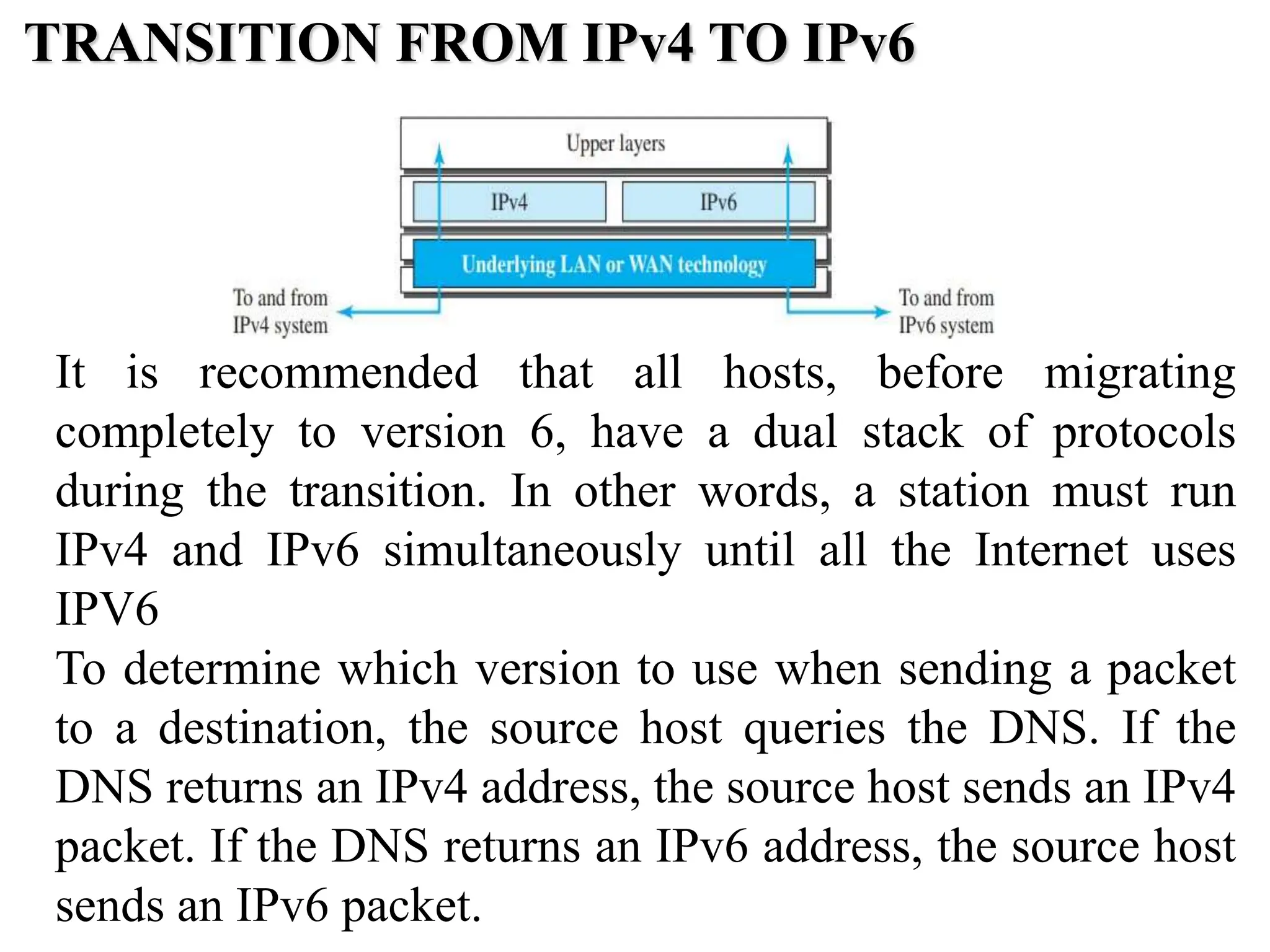
TRANSITION FROM IPv4 TO IPv6
It is recommended that all hosts, before migrating
completely to version 6, have a dual stack of protocols
during the transition. In other words, a station must run
IPv4 and IPv6 simultaneously until all the Internet uses
IPV6
To determine which version to use when sending a packet
to a destination, the source host queries the DNS. If the
DNS returns an IPv4 address, the source host sends an IPv4
packet. If the DNS returns an IPv6 address, the source host
sends an IPv6 packet.
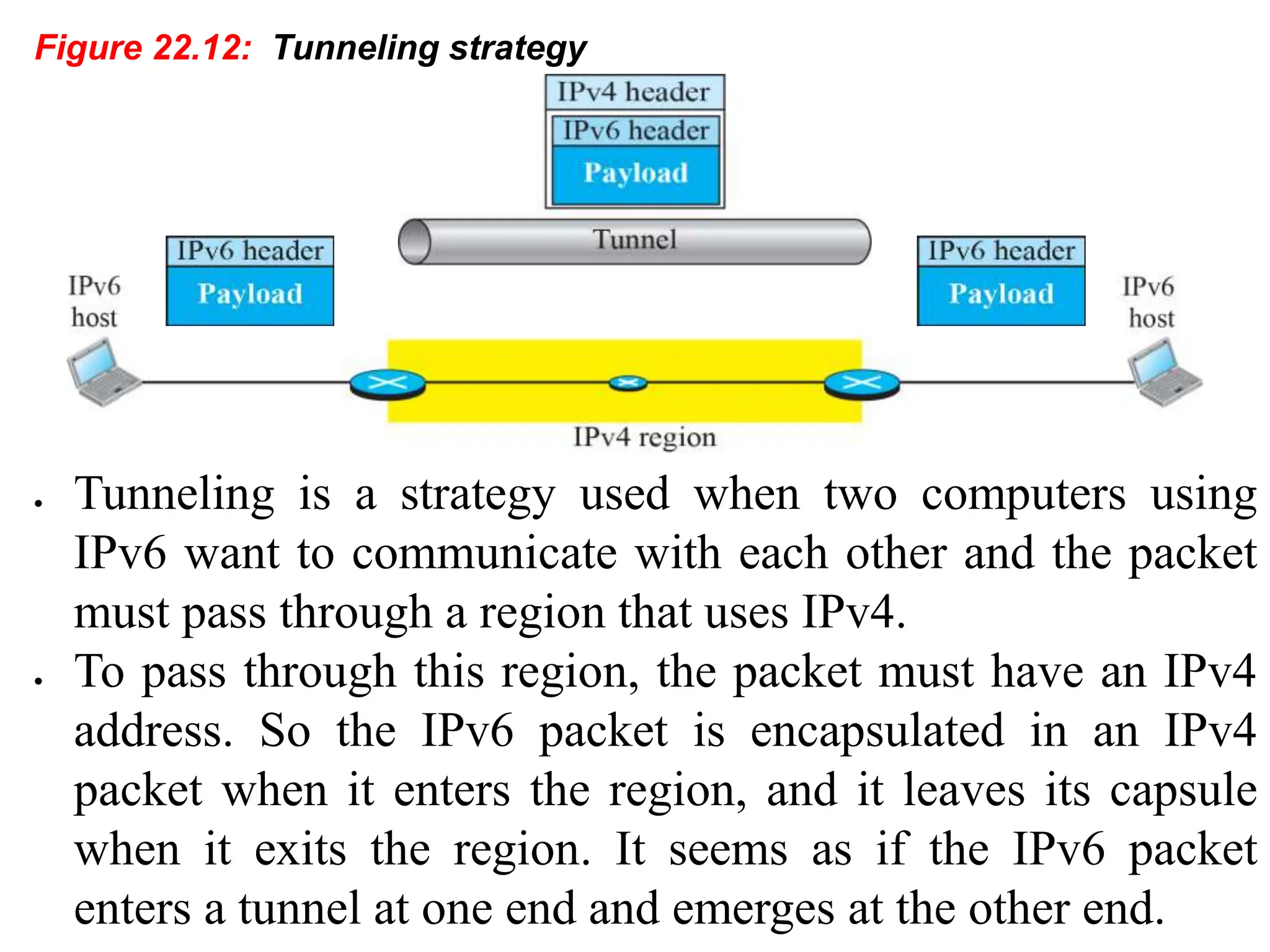
Figure 22.12: Tunneling strategy
 Tunneling is a strategy used when two computers using
IPv6 want to communicate with each other and the packet
must pass through a region that uses IPv4.
 To pass through this region, the packet must have an IPv4
address. So the IPv6 packet is encapsulated in an IPv4
packet when it enters the region, and it leaves its capsule
when it exits the region. It seems as if the IPv6 packet
enters a tunnel at one end and emerges at the other end.
22.15
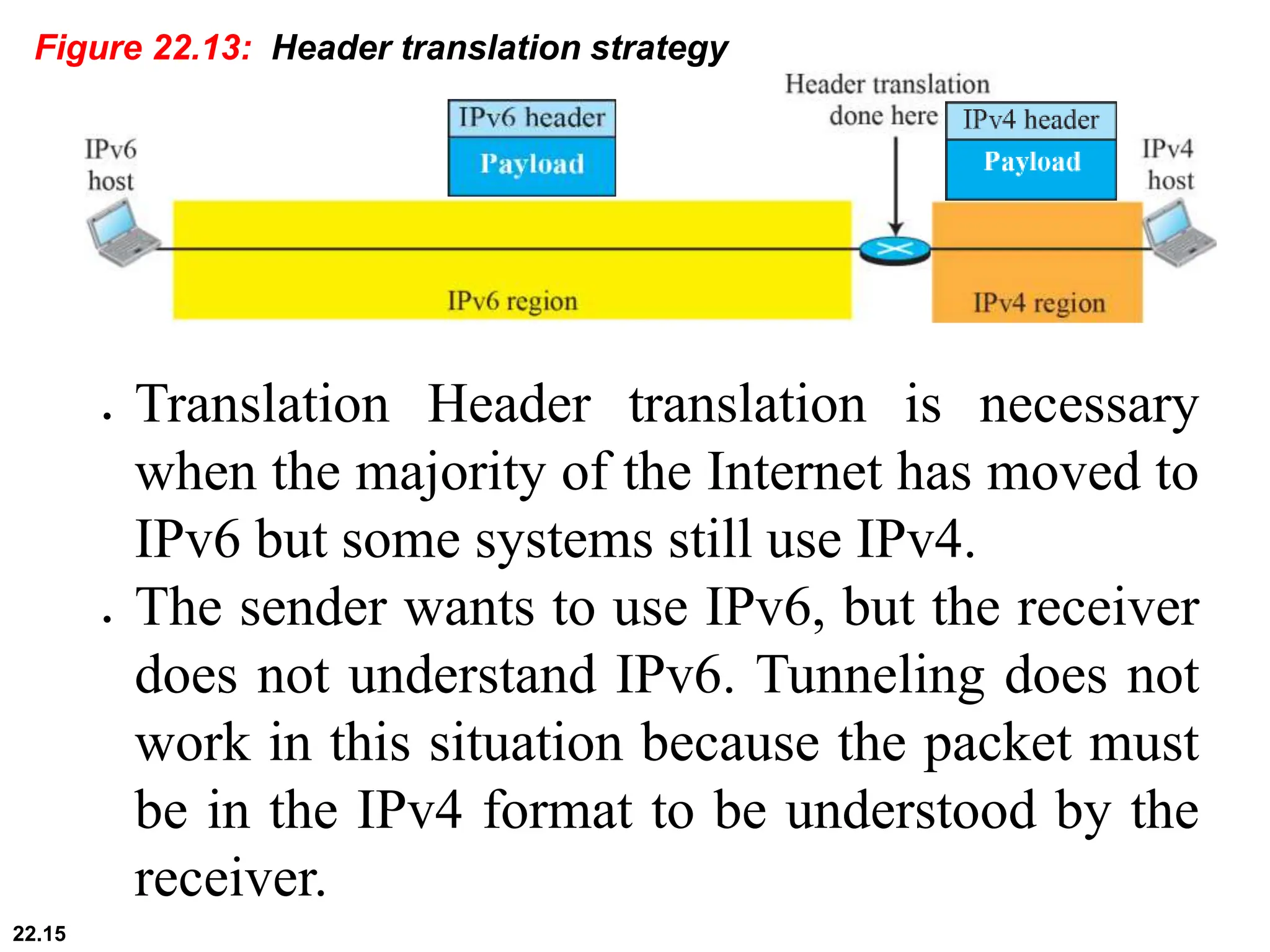
Figure 22.13: Header translation strategy
 Translation Header translation is necessary
when the majority of the Internet has moved to
IPv6 but some systems still use IPv4.
 The sender wants to use IPv6, but the receiver
does not understand IPv6. Tunneling does not
work in this situation because the packet must
be in the IPv4 format to be understood by the
receiver.

IPV6 EXPLANATION BY FOROUZANN DATA COMMUNICATION

  • 1.
    Chapter 22 Next Generation IP Copyright ©The McGraw-Hill Companies, Inc. Permission required for reproduction or display.
  • 2.
    22.2 22-1 IPv6 Addressing The main reason for migration from IPv4 to IPv6 is the small size of the address space in IPv4.  An IPv6 address is 128 bits or 16 bytes (octets) long, four times the address length in IPv4  A computer normally stores the address in binary, but it is clear that 128 bits cannot easily be handled by humans  Binary notation is used when the addresses are stored in a computer.  The colon hexadecimal notation (or colon hex for short) divides the address into eight sections, each made of four hexadecimal digits separated by colons
  • 3.
    22.3 22.22.1 Representation • Althoughan IPv6 address, even in hexadecimal format, is very long, many of the digits are zeros.  The leading zeros of a section can be omitted. Using this form of abbreviation, 0074 can be written as 74, 000F as F, and 0000 as 0. Note that 3210 cannot be abbreviated.  Further abbreviation, often called zero compression, can be applied to colon hex notation if there are consecutive sections consisting of zeros only. We can remove all the zeros and replace them with a double semicolon.  IPv6 uses hierarchical addressing. The address space of IPv6 contains 2128 addresses. This address space is 296 times the IPv4 address—definitely no address depletion
  • 4.
    Address Types In IPv6,a destination address can belong to one of three categories: unicast, anycast, and multicast. Unicast Address A unicast address defines a single interface (computer or router). The packet sent to a unicast address will be routed to the intended recipient. Anycast Address An anycast address defines a group of computers that all share a single address. A packet with an anycast address is delivered to only one member of the group, the most reachable one. An anycast communication is used, for example, when there are several servers that can respond to an inquiry. The request is sent to the one that is most reachable. The hardware and software generate only one copy of the request; the copy reaches only one of the servers. IPv6 does not designate a block for anycasting; the addresses are assigned from the unicast block.
  • 5.
    Multicast Address  Amulticast address also defines a group of computers. However, there is a differencebetween anycasting and multicasting.  In anycasting, only one copy of the packet is sent to one of the members of the group; in multicasting each member of the group receives a copy. Address Space Allocation the address space of IPv4, the address space of IPv6 is divided into several blocks of varying size and each block is allocated for a special purpose. Most of the blocks are still unassigned and have been set aside for future use Prefixes for assigned IPv6 addresses
  • 6.
    22.6 Global Unicast Addresses The block in the address space that is used for unicast (one-to-one) communication between two hosts in the Internet is called the global unicast address block.  CIDR for the block is 2000::/3, which means that the three leftmost bits are the same for all addresses in this block (001).  The size of this block is 2125 bits, which is more than enough for Internet expansion for many years to come.  An address in this block is divided into three parts: global routing prefix (n bits), subnet identifier (m bits), and interface identifier (q bits
  • 7.
    22.7 • Better headerformat. IPv6 uses a new header format in which options are separated from the base header and inserted, when needed, between the base header and the data. • New options. IPv6 has new options to allow for additional functionalities. • Allowance for extension. IPv6 is designed to allow the extension of the protocol if required by new technologies or applications. • Support for resource allocation. In IPv6, the type-of- service field has been removed, but two new fields, traffic class and flow label, have been added to enable the source to request special handling of the packet. This mechanism can be used to support traffic such as real-time audio and video. • Support for more security. The encryption and THE IPv6 PROTOCOL
  • 8.
    22.8 Packet Format The IPv6packet is shown in Figure 22.6. Each packet is composed of a base header followed by the payload. The base header occupies 40 bytes, whereas payload can be up to 65,535 bytes of information. The description of fields follows.
  • 9.
    22.9  Version. The4-bit version field defines the version number of the IP. For IPv6, thevalue is 6.  Traffic class. The 8-bit traffic class field is used to distinguish different payloads withdifferent delivery requirements. It replaces the type-of-service field in IPv4.  Flow label. The flow label is a 20-bit field that is designed to provide special handling for a particular flow of data.  Payload length. The 2-byte payload length field defines the length of the IP datagram excluding the header.  Next header. The next header is an 8-bit field defining the type of the first extension header or the type of the data that follows the base header in the datagram.  Hop limit. The 8-bit hop limit field serves the same purpose as the TTL field in IPv4.  Source and destination addresses. The source address field is a 16-byte (128-bit) Internet address that identifies the original source of the datagram. The destination address field is a 16-byte (128-bit) Internet address that identifies the destination of the datagram.  Payload. The payload field in IPv6 differ from IPv4
  • 10.
    22.10 Figure 22.7: Payloadin an IPv6 datagram The payload in IPv6 means a combination of zero or more extension headers (options) followed by the data from other protocols.
  • 11.
    22.11 Extension Header An IPv6packet is made of a base header and some extension headers. The length of the base header is fixed at 40 bytes. However, to give more functionality to the IP datagram, the base header can be followed by up to six extension headers. Many of these headers are options in IPv4. Six types of extension headers have been defined. These are hop-by-hop option, source routing, fragmentation, authentication, encrypted security payload, and destination option.
  • 12.
    22.12 Hop-by-Hop - Thehop-by-hop option is used when the source needs to pass information to all routers visited by the datagram Destination Option The destination option is used when the source needs to pass information to the destination only Source Routing The source routing extension header combines the concepts of the strict source route and the loose source route options of IPv4. Authentication The authentication extension header has a dual purpose: it validates the message sender and ensures the integrity of data Encrypted Security Payload The encrypted security payload (ESP) is an extension that provides confidentiality and guards against eavesdropping.
  • 13.
    TRANSITION FROM IPv4TO IPv6 It is recommended that all hosts, before migrating completely to version 6, have a dual stack of protocols during the transition. In other words, a station must run IPv4 and IPv6 simultaneously until all the Internet uses IPV6 To determine which version to use when sending a packet to a destination, the source host queries the DNS. If the DNS returns an IPv4 address, the source host sends an IPv4 packet. If the DNS returns an IPv6 address, the source host sends an IPv6 packet.
  • 14.
    Figure 22.12: Tunnelingstrategy  Tunneling is a strategy used when two computers using IPv6 want to communicate with each other and the packet must pass through a region that uses IPv4.  To pass through this region, the packet must have an IPv4 address. So the IPv6 packet is encapsulated in an IPv4 packet when it enters the region, and it leaves its capsule when it exits the region. It seems as if the IPv6 packet enters a tunnel at one end and emerges at the other end.
  • 15.
    22.15 Figure 22.13: Headertranslation strategy  Translation Header translation is necessary when the majority of the Internet has moved to IPv6 but some systems still use IPv4.  The sender wants to use IPv6, but the receiver does not understand IPv6. Tunneling does not work in this situation because the packet must be in the IPv4 format to be understood by the receiver.