The document discusses various types of intellectual property rights (IPRs), categorizing them into industrial property rights and copyright, and highlighting their importance in encouraging innovation and protecting creators' rights. Key types of IPR include patents, trademarks, industrial designs, geographical indications, and trade secrets, each with distinct definitions and examples. Additionally, it elaborates on the significance of these rights in commercial contexts and provides specific instances from fields like pharmaceuticals, art, and agriculture.
INTELLECTUAL PROPERTY RIGHTS
Typesof IPR with Examples
Topic
By
E. GIREESH KUMAR
Associate Professor
Annamacharya College of Pharmacy
Rajampet – 516126, A.P., India
2.
Introduction
• Intellectual property(IP) is a category of property that
includes intangible creations of the human intellect.
• Intellectual property encompasses two types of rights;
– industrial property rights (trademarks, patents, designations
of origin (GI), industrial designs and models) and
– copyright
3.
Introduction
• IPRs arefundamental to encouraging investment in
research as without some form of protection,
investors and inventors would not be able to benefit
from their creative efforts.
• rights of Owners can
– prevent unauthorised use of their IP,
– stop copying of their IP,
– control distribution of their IP, and
– retain, license or sell their IP
4.
Definition
• Intellectual propertyRights are generic terms of exclusive
rights given to the results gained by human’s original intellect
activities and to the intellectual property signs used to for the
business activities. They signifies the intangible rights that on
economic value.
• Article 2 WIPO:
• Intellectual property shall include the rights relating to:
literary, artistic and scientific works, inventions in fields of human
endeavor, scientific discoveries, industrial designs, trademarks,
service marks, and commercial names and designations,
protection against unfair competition, and all other rights resulting
from intellectual activity in the industrial, scientific, literary or
artistic works.
5.
Definition
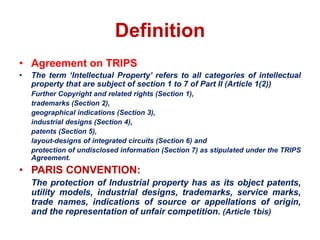
• Agreement onTRIPS
• The term ‘Intellectual Property’ refers to all categories of intellectual
property that are subject of section 1 to 7 of Part II (Article 1(2))
Further Copyright and related rights (Section 1),
trademarks (Section 2),
geographical indications (Section 3),
industrial designs (Section 4),
patents (Section 5),
layout-designs of integrated circuits (Section 6) and
protection of undisclosed information (Section 7) as stipulated under the TRIPS
Agreement.
• PARIS CONVENTION:
The protection of Industrial property has as its object patents,
utility models, industrial designs, trademarks, service marks,
trade names, indications of source or appellations of origin,
and the representation of unfair competition. (Article 1bis)
6.
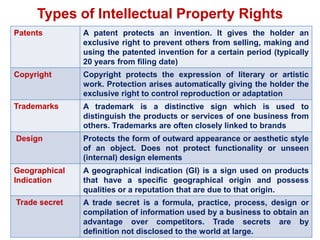
Patents A patentprotects an invention. It gives the holder an
exclusive right to prevent others from selling, making and
using the patented invention for a certain period (typically
20 years from filing date)
Copyright Copyright protects the expression of literary or artistic
work. Protection arises automatically giving the holder the
exclusive right to control reproduction or adaptation
Trademarks A trademark is a distinctive sign which is used to
distinguish the products or services of one business from
others. Trademarks are often closely linked to brands
Design Protects the form of outward appearance or aesthetic style
of an object. Does not protect functionality or unseen
(internal) design elements
Geographical
Indication
A geographical indication (GI) is a sign used on products
that have a specific geographical origin and possess
qualities or a reputation that are due to that origin.
Trade secret A trade secret is a formula, practice, process, design or
compilation of information used by a business to obtain an
advantage over competitors. Trade secrets are by
definition not disclosed to the world at large.
Types of Intellectual Property Rights
8.
Patents
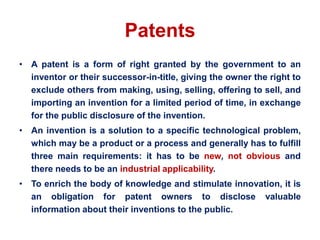
• A patentis a form of right granted by the government to an
inventor or their successor-in-title, giving the owner the right to
exclude others from making, using, selling, offering to sell, and
importing an invention for a limited period of time, in exchange
for the public disclosure of the invention.
• An invention is a solution to a specific technological problem,
which may be a product or a process and generally has to fulfill
three main requirements: it has to be new, not obvious and
there needs to be an industrial applicability.
• To enrich the body of knowledge and stimulate innovation, it is
an obligation for patent owners to disclose valuable
information about their inventions to the public.
9.
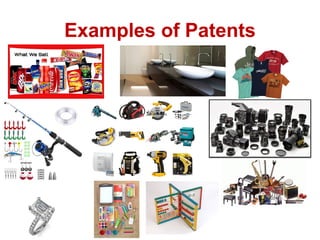
Examples of Patents
•There are three types of patents:
1. Utility patents:
2. Plant patents
3. Design patents
10.
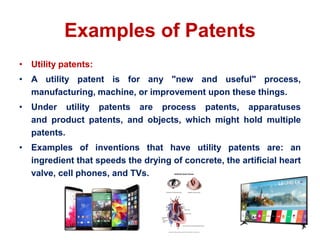
Examples of Patents
•Utility patents:
• A utility patent is for any "new and useful" process,
manufacturing, machine, or improvement upon these things.
• Under utility patents are process patents, apparatuses
and product patents, and objects, which might hold multiple
patents.
• Examples of inventions that have utility patents are: an
ingredient that speeds the drying of concrete, the artificial heart
valve, cell phones, and TVs.
11.
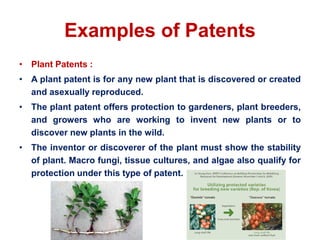
Examples of Patents
•Plant Patents :
• A plant patent is for any new plant that is discovered or created
and asexually reproduced.
• The plant patent offers protection to gardeners, plant breeders,
and growers who are working to invent new plants or to
discover new plants in the wild.
• The inventor or discoverer of the plant must show the stability
of plant. Macro fungi, tissue cultures, and algae also qualify for
protection under this type of patent.
12.
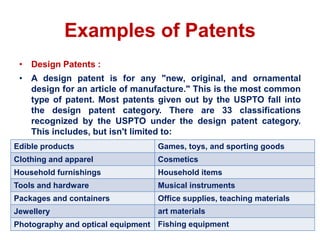
Examples of Patents
•Design Patents :
• A design patent is for any "new, original, and ornamental
design for an article of manufacture." This is the most common
type of patent. Most patents given out by the USPTO fall into
the design patent category. There are 33 classifications
recognized by the USPTO under the design patent category.
This includes, but isn't limited to:
Edible products Games, toys, and sporting goods
Clothing and apparel Cosmetics
Household furnishings Household items
Tools and hardware Musical instruments
Packages and containers Office supplies, teaching materials
Jewellery art materials
Photography and optical equipment Fishing equipment
Examples of Patents
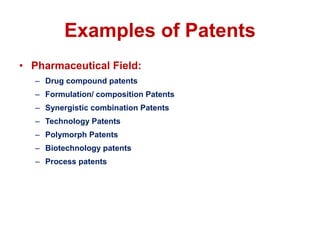
•Pharmaceutical Field:
– Drug compound patents
– Formulation/ composition Patents
– Synergistic combination Patents
– Technology Patents
– Polymorph Patents
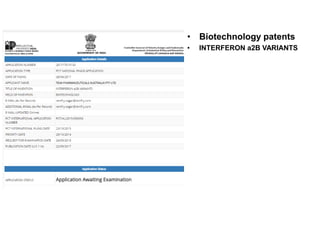
– Biotechnology patents
– Process patents
15.
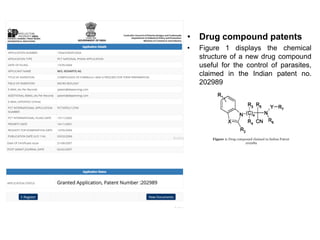
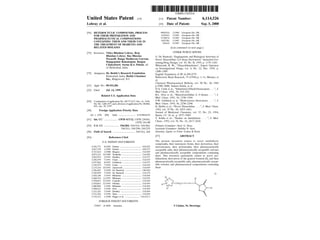
• Drug compoundpatents
• Figure 1 displays the chemical
structure of a new drug compound
useful for the control of parasites,
claimed in the Indian patent no.
202989
16.
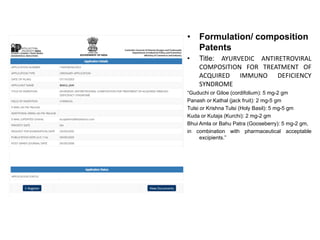
• Formulation/ composition
Patents
•Title: AYURVEDIC ANTIRETROVIRAL
COMPOSITION FOR TREATMENT OF
ACQUIRED IMMUNO DEFICIENCY
SYNDROME
“Guduchi or Giloe (cordifolium): 5 mg-2 gm
Panash or Kathal (jack fruit): 2 mg-5 gm
Tulsi or Krishna Tulsi (Holy Basil): 5 mg-5 gm
Kuda or Kutaja (Kurchi): 2 mg-2 gm
Bhui Amla or Bahu Patra (Gooseberry): 5 mg-2 gm,
in combination with pharmaceutical acceptable
excipients.”
17.
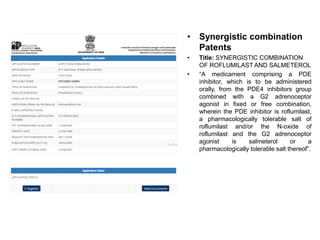
• Synergistic combination
Patents
•Title: SYNERGISTIC COMBINATION
OF ROFLUMILAST AND SALMETEROL
• “A medicament comprising a PDE
inhibitor, which is to be administered
orally, from the PDE4 inhibitors group
combined with a G2 adrenoceptor
agonist in fixed or free combination,
wherein the PDE inhibitor is roflumilast,
a pharmacologically tolerable salt of
roflumilast and/or the N-oxide of
roflumilast and the G2 adrenoceptor
agonist is salmeterol or a
pharmacologically tolerable salt thereof”.
18.
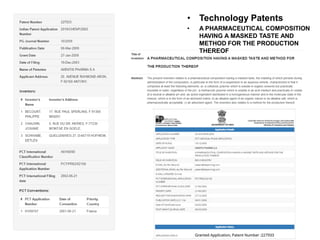
• Technology Patents
•A PHARMACEUTICAL COMPOSITION
HAVING A MASKED TASTE AND
METHOD FOR THE PRODUCTION
THEREOF
19.
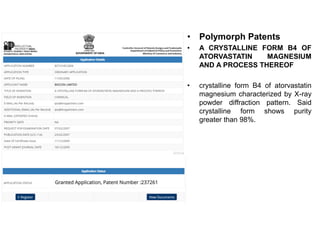
• Polymorph Patents
•A CRYSTALLINE FORM B4 OF
ATORVASTATIN MAGNESIUM
AND A PROCESS THEREOF
• crystalline form B4 of atorvastatin
magnesium characterized by X-ray
powder diffraction pattern. Said
crystalline form shows purity
greater than 98%.
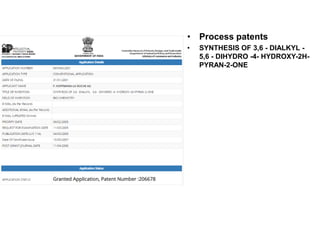
• Process patents
•SYNTHESIS OF 3,6 - DIALKYL -
5,6 - DIHYDRO -4- HYDROXY-2H-
PYRAN-2-ONE
25.
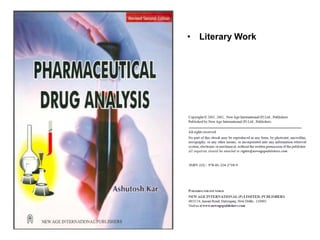
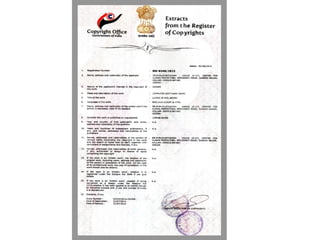
Copyright
• Copyright isa legal term describing rights given to creators for
their original literary, musical or artistic works which allow
them to control their subsequent use.
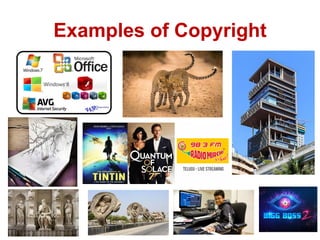
• These include for example:
– computer software
– drawings, maps, charts or plans
– photographs and films
– architectural works
– sculptures
– sound recordings
– TV and radio broadcasts
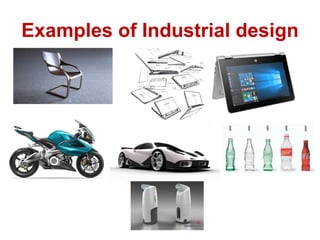
Industrial design rights
•An industrial design right (sometimes called "design right"
or design patent) protects the visual design of objects that are
not purely utilitarian.
• An industrial design consists of the creation of a shape,
configuration or composition of pattern or colour, or
combination of pattern and colour in three-dimensional form
containing aesthetic value.
• An industrial design can be a two- or three-dimensional pattern
used to produce a product, industrial commodity or handicraft.
Generally speaking, it is what makes a product look appealing,
and as such, it increases the commercial value of goods.
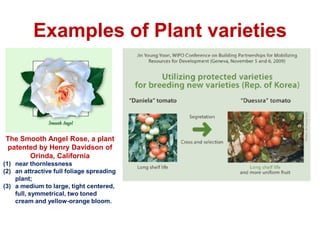
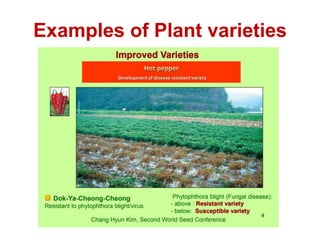
Plant varieties
• Plantbreeders' rights or plant variety rights are the rights to
commercially use a new variety of a plant.
• The variety must amongst others be novel and distinct and for
registration the evaluation of propagating material of the
variety is considered.
• A variety is:
– new if it has not been commercialized for more than one year in the
country of protection;
– distinct if it differs from all other known varieties by one or more important
botanical characteristics, such as height, maturity, colour, etc.;
– uniform if the plant characteristics are consistent from plant to plant within
the variety;
– stable if the plant characteristics are genetically fixed and therefore remain
the same from generation to generation, or after a cycle of reproduction in
the case of hybrid varieties.
33.
Examples of Plantvarieties
The Smooth Angel Rose, a plant
patented by Henry Davidson of
Orinda, California
(1) near thornlessness
(2) an attractive full foliage spreading
plant;
(3) a medium to large, tight centered,
full, symmetrical, two toned
cream and yellow-orange bloom.
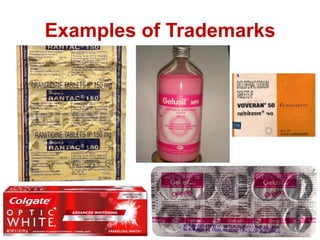
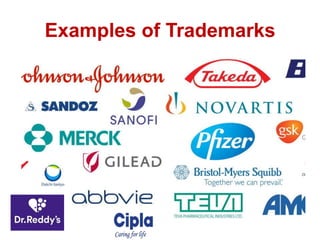
Trademarks
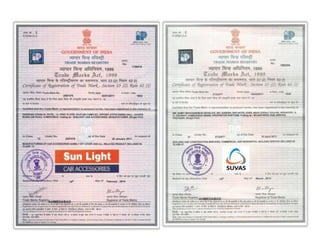
• A trademarkis a recognizable sign, design or expression which
distinguishes products or services of a particular trader from
the similar products or services of other traders.
or
• “A trademark is any name, symbol, figure, letter, word, or mark
adopted and used by a manufacturer or merchant in order to
designate his or her goods and to distinguish them from those
manufactured or sold by others.”
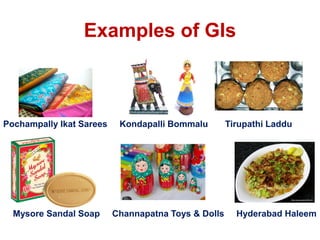
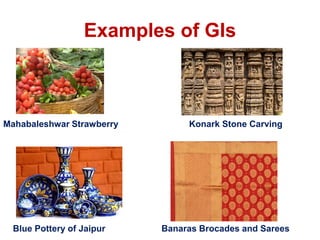
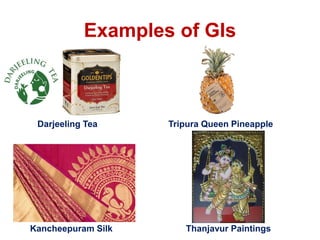
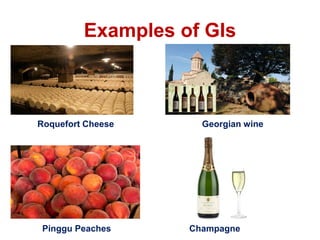
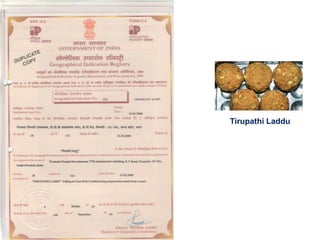
Geographical Indications
• Ageographical indication (GI) is a sign used on products that
have a specific geographical origin and possess qualities or a
reputation that are due to that origin.
• In order to function as a GI, a sign must identify a product as
originating in a given place.
• In addition, the qualities, characteristics or reputation of the
product should be essentially due to the place of origin.
• Since the qualities depend on the geographical place of
production, there is a clear link between the product and its
original place of production.
Trade secrets
• Atrade secret is a formula, practice, process, design,
instrument, pattern, or compilation of information which is not
generally known or reasonably ascertainable, by which
a business can obtain an economic advantage over
competitors and customers.
• There is no formal government protection granted; each
business must take measures to guard its own trade secrets
• (e.g., Formula of its soft drinks is a trade secret for Coca-Cola.)
• Anything that gives you an advantage against a competitor is
highly valuable and worth protecting.
50.
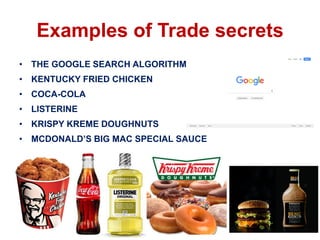
Examples of Tradesecrets
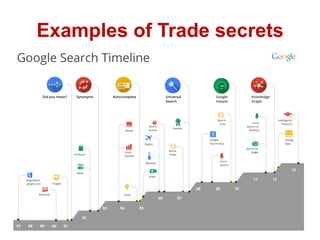
• THE GOOGLE SEARCH ALGORITHM
• KENTUCKY FRIED CHICKEN
• COCA-COLA
• LISTERINE
• KRISPY KREME DOUGHNUTS
• MCDONALD’S BIG MAC SPECIAL SAUCE