1
Anil Kumar , Lecturer (Textile Design)
Pandit Lakhmichand State University of Performing & Visual Arts , Rohtak
E-mail-anilvns143@gmail.com
Mobile no. +919729138649
2
What is a TM ?
 Sign capable of distinguishing the goods or services. TM can be any distinctive
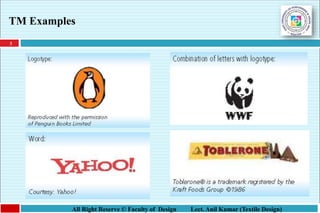
 Words, Letters
 Numbers
 Drawings, pictures, shapes, colors,
 Logo,
 Labels
 Calligraphy
 Combinations of the above
❑ Some countries allow registration of the following as TM.
❑ Advertising slogans
❑ Single colors
❑ 3D signs (shapes of products or packaging)
❑ Audible signs (sounds)
All Right Reserve © Faculty of Design Lect. Anil Kumar (Textile Design)
3
TM Examples
All Right Reserve © Faculty of Design Lect. Anil Kumar (Textile Design)
4
Value of TM
 A carefully selected and nurtured TM is a
VALUABLE BUSINESS ASSET.
 TM Value is based on
 consumer value
 Reputation of TM
 Image and Qualities associated
 Marks that meet expectations
All Right Reserve © Faculty of Design Lect. Anil Kumar (Textile Design)
Brand Value
Google $44.3 billion
Microsoft $42.8 billion
Walmart $36.2 billion
IBM $36.2 billion
Vodafone $30.7 billion
Bank of America $30.6 billion
GE $30.5 billion
Apple $29.5 billion
https://www.forbes.com
5
Trade Marks
 Ensure that consumers can distinguish between products.
 Enable companies to differentiate their products.
 A marketing tool and the basis for building a brand image and reputation.
 May be licensed to provide a direct source of revenue through royalties.
 A crucial component of franchising agreements
 A valuable business asset
 Encourage companies to invest in maintaining or improving product quality
 Useful for obtaining financing
All Right Reserve © Faculty of Design Lect. Anil Kumar (Textile Design)
6
Protecting TM
 How can your company protect its trademark(s)?
 Trademark protection can be obtained through registration or, in some countries,
also through use
 Is the registration of the trade name of your company sufficient?
 No. It is important to understand the difference between trade names and trade
marks.
 A trade name is the full name of your business, such as: “IndTex International Ltd”
and it identifies your company.
 It often ends with Ltd, Inc. or other similar abbreviations that denote the legal
character of the company.
 A trademark, however, is the sign that distinguishes the product(s) of your
company
All Right Reserve © Faculty of Design Lect. Anil Kumar (Textile Design)
7
All Right Reserve © Faculty of Design Lect. Anil Kumar (Textile Design)
 A company may have various trademarks.
 Companies may use a specific trademark to identify all their products, a particular
range of products or one specific type of product
 Some companies may also use their trade name, or a part of it, as a trademark.
 They should, in that case, register it as a trademark.
 Who is authorized to apply for trademark registration?
 Any person who intends to use a trademark or to have it used by third parties can
apply for registration
 It can be either an individual or a legal entity.
 Is it compulsory to register a company's trademarks?
 While it is not compulsory, it is highly advisable, as registration provides the
exclusive right to prevent unauthorized use of the trademark
8
All Right Reserve © Faculty of Design Lect. Anil Kumar (Textile Design)
Check List for Selecting TM
 Do a trademark search to make sure that it is not identical or confusingly similar to
existing trademarks
 TM must be easy to read, write, spell and remember and is suitable to all types of
advertising media
 TM must not have any undesired connotations in your own language or in any of the
languages of potential export markets
 Check that the corresponding domain name (i.e. Internet address) is available for
registration.
 Selecting one or more words as your TM:
 Coined or “fanciful” words - invented words without any intrinsic or real meaning
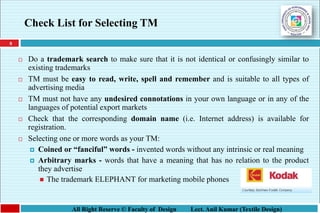
 Arbitrary marks - words that have a meaning that has no relation to the product
they advertise
◼ The trademark ELEPHANT for marketing mobile phones
9
All Right Reserve © Faculty of Design Lect. Anil Kumar (Textile Design)
TM Registration
 Registering a Trademark - Step by Step
 The Applicant – Apply for the TM at trade mark registry office Mumbai (HO)/Delhi /
Kolkata /Chennai / Ahmadabad
◼ Formal examination
◼ Substantive examination
◼ Publication and opposition
◼ Registration
◼ Renewal
TM Validity
 The term of protection may vary In a large number of countries, registered trademarks
are protected for 10 years .
 Registration may be renewed indefinitely (usually, for consecutive periods of 10
years) provided renewal fees are paid in time.
10
All Right Reserve © Faculty of Design Lect. Anil Kumar (Textile Design)
Types of TM
Marks used to distinguish certain goods as those produced by a
specific enterprise.
Marks used to distinguish certain services as those provided by
a specific enterprise.
Marks used to distinguish goods or services produced or
provided by members of an association.
Marks used to distinguish goods or services that comply with a
set of standards and have been certified by a certifying authority.
Marks that are considered to be well-known in the market and
as a result benefit from stronger protection.
11
All Right Reserve © Faculty of Design Lect. Anil Kumar (Textile Design)
Types of TM
 What are Service marks?
 Similar to a trademark.
 Distinctive signs to distinguish the service offered by one enterprise from those of
others
 Example of Services: financial, banking, travel, advertising or catering.
 Service marks can be registered, renewed, cancelled, assigned and licensed under the
same conditions as trademarks.
 What are collective marks?
 Generally owned by an association or cooperative whose members may use the
collective mark to market their products.
 The association generally establishes a set of criteria for using the collective mark
(e.g., quality standards)
 Permits individual companies to use the mark if they comply with such standards
12
All Right Reserve © Faculty of Design Lect. Anil Kumar (Textile Design)
 What are Certification marks?
 Certification marks are given for compliance with defined standards,
but are not confined to any membership
 They may be used by anyone whose products meet certain established
standards.
 May be used by anybody who complies with the standards defined by
the owner of the certification mark.
Types of TM
13
All Right Reserve © Faculty of Design Lect. Anil Kumar (Textile Design)
 What are well-known marks?
 Marks that are considered to be well-known by the competent authority
of the country where protection for the mark is sought
 Well-known marks generally benefit from stronger protection
 May be protected even if they are not registered (or have not even
been used) in a given territory.
Types of TM
14
All Right Reserve © Faculty of Design Lect. Anil Kumar (Textile Design)
TM or ®?
 The use of ®, TM, SM or equivalent symbols is not a requirement
 Generally provides no further legal protection
 A convenient way of informing others that a sign is a trademark
 Warns possible infringers and counterfeiters
 ® symbol is used once the trademark has been registered
 TM denotes that a given sign is a trademark
 SM is sometimes used for service marks.

Intellectual Property Rights [Trademark]

  • 1.
    1 Anil Kumar ,Lecturer (Textile Design) Pandit Lakhmichand State University of Performing & Visual Arts , Rohtak E-mail-anilvns143@gmail.com Mobile no. +919729138649
  • 2.
    2 What is aTM ?  Sign capable of distinguishing the goods or services. TM can be any distinctive  Words, Letters  Numbers  Drawings, pictures, shapes, colors,  Logo,  Labels  Calligraphy  Combinations of the above ❑ Some countries allow registration of the following as TM. ❑ Advertising slogans ❑ Single colors ❑ 3D signs (shapes of products or packaging) ❑ Audible signs (sounds) All Right Reserve © Faculty of Design Lect. Anil Kumar (Textile Design)
  • 3.
    3 TM Examples All RightReserve © Faculty of Design Lect. Anil Kumar (Textile Design)
  • 4.
    4 Value of TM A carefully selected and nurtured TM is a VALUABLE BUSINESS ASSET.  TM Value is based on  consumer value  Reputation of TM  Image and Qualities associated  Marks that meet expectations All Right Reserve © Faculty of Design Lect. Anil Kumar (Textile Design) Brand Value Google $44.3 billion Microsoft $42.8 billion Walmart $36.2 billion IBM $36.2 billion Vodafone $30.7 billion Bank of America $30.6 billion GE $30.5 billion Apple $29.5 billion https://www.forbes.com
  • 5.
    5 Trade Marks  Ensurethat consumers can distinguish between products.  Enable companies to differentiate their products.  A marketing tool and the basis for building a brand image and reputation.  May be licensed to provide a direct source of revenue through royalties.  A crucial component of franchising agreements  A valuable business asset  Encourage companies to invest in maintaining or improving product quality  Useful for obtaining financing All Right Reserve © Faculty of Design Lect. Anil Kumar (Textile Design)
  • 6.
    6 Protecting TM  Howcan your company protect its trademark(s)?  Trademark protection can be obtained through registration or, in some countries, also through use  Is the registration of the trade name of your company sufficient?  No. It is important to understand the difference between trade names and trade marks.  A trade name is the full name of your business, such as: “IndTex International Ltd” and it identifies your company.  It often ends with Ltd, Inc. or other similar abbreviations that denote the legal character of the company.  A trademark, however, is the sign that distinguishes the product(s) of your company All Right Reserve © Faculty of Design Lect. Anil Kumar (Textile Design)
  • 7.
    7 All Right Reserve© Faculty of Design Lect. Anil Kumar (Textile Design)  A company may have various trademarks.  Companies may use a specific trademark to identify all their products, a particular range of products or one specific type of product  Some companies may also use their trade name, or a part of it, as a trademark.  They should, in that case, register it as a trademark.  Who is authorized to apply for trademark registration?  Any person who intends to use a trademark or to have it used by third parties can apply for registration  It can be either an individual or a legal entity.  Is it compulsory to register a company's trademarks?  While it is not compulsory, it is highly advisable, as registration provides the exclusive right to prevent unauthorized use of the trademark
  • 8.
    8 All Right Reserve© Faculty of Design Lect. Anil Kumar (Textile Design) Check List for Selecting TM  Do a trademark search to make sure that it is not identical or confusingly similar to existing trademarks  TM must be easy to read, write, spell and remember and is suitable to all types of advertising media  TM must not have any undesired connotations in your own language or in any of the languages of potential export markets  Check that the corresponding domain name (i.e. Internet address) is available for registration.  Selecting one or more words as your TM:  Coined or “fanciful” words - invented words without any intrinsic or real meaning  Arbitrary marks - words that have a meaning that has no relation to the product they advertise ◼ The trademark ELEPHANT for marketing mobile phones
  • 9.
    9 All Right Reserve© Faculty of Design Lect. Anil Kumar (Textile Design) TM Registration  Registering a Trademark - Step by Step  The Applicant – Apply for the TM at trade mark registry office Mumbai (HO)/Delhi / Kolkata /Chennai / Ahmadabad ◼ Formal examination ◼ Substantive examination ◼ Publication and opposition ◼ Registration ◼ Renewal TM Validity  The term of protection may vary In a large number of countries, registered trademarks are protected for 10 years .  Registration may be renewed indefinitely (usually, for consecutive periods of 10 years) provided renewal fees are paid in time.
  • 10.
    10 All Right Reserve© Faculty of Design Lect. Anil Kumar (Textile Design) Types of TM Marks used to distinguish certain goods as those produced by a specific enterprise. Marks used to distinguish certain services as those provided by a specific enterprise. Marks used to distinguish goods or services produced or provided by members of an association. Marks used to distinguish goods or services that comply with a set of standards and have been certified by a certifying authority. Marks that are considered to be well-known in the market and as a result benefit from stronger protection.
  • 11.
    11 All Right Reserve© Faculty of Design Lect. Anil Kumar (Textile Design) Types of TM  What are Service marks?  Similar to a trademark.  Distinctive signs to distinguish the service offered by one enterprise from those of others  Example of Services: financial, banking, travel, advertising or catering.  Service marks can be registered, renewed, cancelled, assigned and licensed under the same conditions as trademarks.  What are collective marks?  Generally owned by an association or cooperative whose members may use the collective mark to market their products.  The association generally establishes a set of criteria for using the collective mark (e.g., quality standards)  Permits individual companies to use the mark if they comply with such standards
  • 12.
    12 All Right Reserve© Faculty of Design Lect. Anil Kumar (Textile Design)  What are Certification marks?  Certification marks are given for compliance with defined standards, but are not confined to any membership  They may be used by anyone whose products meet certain established standards.  May be used by anybody who complies with the standards defined by the owner of the certification mark. Types of TM
  • 13.
    13 All Right Reserve© Faculty of Design Lect. Anil Kumar (Textile Design)  What are well-known marks?  Marks that are considered to be well-known by the competent authority of the country where protection for the mark is sought  Well-known marks generally benefit from stronger protection  May be protected even if they are not registered (or have not even been used) in a given territory. Types of TM
  • 14.
    14 All Right Reserve© Faculty of Design Lect. Anil Kumar (Textile Design) TM or ®?  The use of ®, TM, SM or equivalent symbols is not a requirement  Generally provides no further legal protection  A convenient way of informing others that a sign is a trademark  Warns possible infringers and counterfeiters  ® symbol is used once the trademark has been registered  TM denotes that a given sign is a trademark  SM is sometimes used for service marks.