Anil Kumar ,
Lecturer (Textile Design)
Pandit Lakhmichand State University of
Performing & Visual Arts , Rohtak
E-mail-anilvns143@gmail.com
Mobile no. +919729138649
Basic concept
of
Entrepreneurship
Objectives
1. DEFINITION,NATURE AND CHARACTERISTICS OF AN
ENTREPRENEUR
2. WORKING PROFILE OF AN INTREPRENEUR
3. TYPES OF ENTREPRENEUR
4. INTRAPRENEUR
5. FUNCTIONS OF AN ENTREPRENEUR
6. ENTREPRENEUR AND MANAGER----DISTINCTION
Entrepreneurship Development
Entrepreneur
•E.E.HAGEN: The entrepreneur is an economic man, who tries to
maximize his profits by innovations.
•GALBRAITH: ‘People are poor because they prefer in that way’. An
entrepreneur must accept the challenge and should be willing hard to
achieve something.
•J.B.SAY: Is another Frenchman, expanded Cantillon’s ideas and
conceptualized the entrepreneur as an organizer of the business firm,
central to its distributive and productive functions.
Entrepreneurship Development
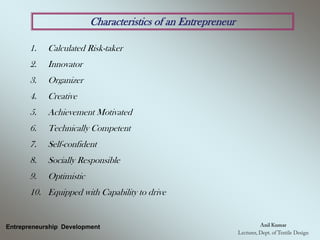
Characteristics of an Entrepreneur
1. Calculated Risk-taker
2. Innovator
3. Organizer
4. Creative
5. Achievement Motivated
6. Technically Competent
7. Self-confident
8. Socially Responsible
9. Optimistic
10. Equipped with Capability to drive
Entrepreneurship Development
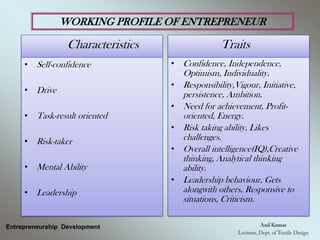
WORKING PROFILE OF ENTREPRENEUR
Entrepreneurship Development
Characteristics
• Self-confidence
• Drive
• Task-result oriented
• Risk-taker
• Mental Ability
• Leadership
Traits
• Confidence, Independence,
Optimism, Individuality.
• Responsibility,Vigour, Initiative,
persistence, Ambition.
• Need for achievement, Profit-
oriented, Energy.
• Risk taking ability, Likes
challenges.
• Overall intelligence(IQ),Creative
thinking, Analytical thinking
ability.
• Leadership behaviour, Gets
alongwith others, Responsive to
situations, Criticism.
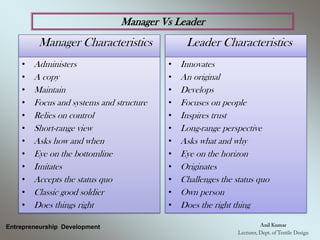
Manager Vs Leader
Entrepreneurship Development
Manager Characteristics
• Administers
• A copy
• Maintain
• Focus and systems and structure
• Relies on control
• Short-range view
• Asks how and when
• Eye on the bottomline
• Imitates
• Accepts the status quo
• Classic good soldier
• Does things right
Leader Characteristics
• Innovates
• An original
• Develops
• Focuses on people
• Inspires trust
• Long-range perspective
• Asks what and why
• Eye on the horizon
• Originates
• Challenges the status quo
• Own person
• Does the right thing
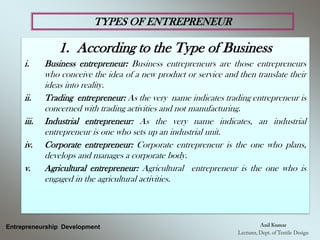
TYPES OF ENTREPRENEUR
Entrepreneurship Development
1. According to the Type of Business
i. Business entrepreneur: Business entrepreneurs are those entrepreneurs
who conceive the idea of a new product or service and then translate their
ideas into reality.
ii. Trading entrepreneur: As the very name indicates trading entrepreneur is
concerned with trading activities and not manufacturing.
iii. Industrial entrepreneur: As the very name indicates, an industrial
entrepreneur is one who sets up an industrial unit.
iv. Corporate entrepreneur: Corporate entrepreneur is the one who plans,
develops and manages a corporate body.
v. Agricultural entrepreneur: Agricultural entrepreneur is the one who is
engaged in the agricultural activities.
According to Technology
Entrepreneurship Development
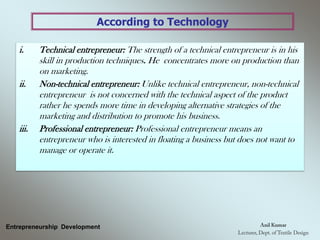
i. Technical entrepreneur: The strength of a technical entrepreneur is in his
skill in production techniques. He concentrates more on production than
on marketing.
ii. Non-technical entrepreneur: Unlike technical entrepreneur, non-technical
entrepreneur is not concerned with the technical aspect of the product
rather he spends more time in developing alternative strategies of the
marketing and distribution to promote his business.
iii. Professional entrepreneur: Professional entrepreneur means an
entrepreneur who is interested in floating a business but does not want to
manage or operate it.
According to Development
Entrepreneurship Development
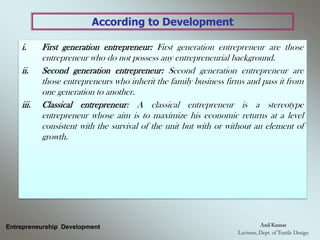
i. First generation entrepreneur: First generation entrepreneur are those
entrepreneur who do not possess any entrepreneurial background.
ii. Second generation entrepreneur: Second generation entrepreneur are
those entrepreneurs who inherit the family business firms and pass it from
one generation to another.
iii. Classical entrepreneur: A classical entrepreneur is a stereotype
entrepreneur whose aim is to maximize his economic returns at a level
consistent with the survival of the unit but with or without an element of
growth.
According to Capital ownership
Entrepreneurship Development
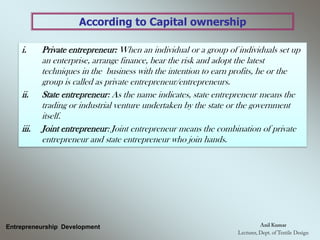
i. Private entrepreneur: When an individual or a group of individuals set up
an enterprise, arrange finance, bear the risk and adopt the latest
techniques in the business with the intention to earn profits, he or the
group is called as private entrepreneur/entrepreneurs.
ii. State entrepreneur: As the name indicates, state entrepreneur means the
trading or industrial venture undertaken by the state or the government
itself.
iii. Joint entrepreneur: Joint entrepreneur means the combination of private
entrepreneur and state entrepreneur who join hands.
According to Gender & Age
Entrepreneurship Development
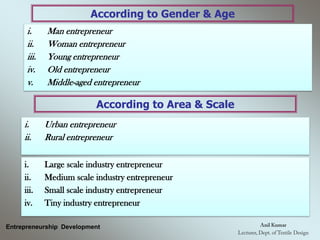
i. Man entrepreneur
ii. Woman entrepreneur
iii. Young entrepreneur
iv. Old entrepreneur
v. Middle-aged entrepreneur
According to Area & Scale
i. Urban entrepreneur
ii. Rural entrepreneur
i. Large scale industry entrepreneur
ii. Medium scale industry entrepreneur
iii. Small scale industry entrepreneur
iv. Tiny industry entrepreneur
INTRAPRENEUR
Entrepreneurship Development
The term ‘intrapreneur’ was coined in the United States of America in the late
seventies.
Gifford Pinchot defined intrapreneurs as the persons who resigned from their
well paid executive positions to launch their own ventures. Gifford devised the
way by which such executives could be retained in the industry and their
entrepreneurial urge was also satisfied by their bosses.
So a system was devised whereby such executives would operate as
entrepreneurs with full independence and autonomy
but with
in the organisation.
Difference between entrepreneur and intrapreneur
1. An entrepreneur is an independence person who starts his venture
and bears full risk of his failure and enjoys the fruit of his success
whereas intrapreneur is partially independent and is sponsored by the
corporation in which he is working. He is also not liable to bear the
losses in case of his failure.
2. An entrepreneur raises the finance from various sources and also
guarantees their return whereas an intrapreneur does not own
responsibility to raise the capital or to return it.
3. An entrepreneur has no relation with any organisation whereas an
intrapreneur operates within the organisation where he is working.
Entrepreneurship Development
FUNCTIONS OF AN ENTREPRENEUR
There has been a great deal of confusion and contradiction in literature on
the functions of an entrepreneur.
FUNCTIONS
1. Innovations: J.Schumpeter has made substantial contribution to the
literature of entrepreneurship. The process of innovations may be in
the form of:
a) Introduction of a new product.
b) Use of new methods of production.
c) Opening of a new market.
d) The conquest of new source of supply of raw material.
e) A new form of organisation.
Entrepreneurship Development
2. Risk-taking: Richard cantillon states that entrepreneur is an agent who buys means of
production at certain prices and sells them at uncertain prices.
The entrepreneur performs the function of reducing uncertainty in his plan of investment
and expansion of the enterprise.
J. B. Say also stresses risk-taking as the specific function of an entrepreneur.
3. Decision Maker: Entrepreneur as a decision maker describes the following functions of
an entrepreneur.
a) The determination of objectives of an enterprise and the change of those objectives as
conditions required or made advantageous,
b) The development of an organization including efficient relations with subordinates
and all employees,
c) Securing adequate financial resources, the relations with existing and potential
Investors,
d) The acquisition of efficient technological equipment and the revision of it as new
machinery appears,
e)The development of a market for the products and the devising of new products to meet
or anticipate consumer’s demand,
f) The maintenance of good relations with public authorities and with society at large.
Contd…
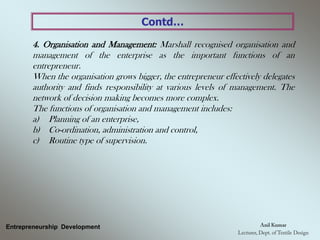
4. Organisation and Management: Marshall recognised organisation and
management of the enterprise as the important functions of an
entrepreneur.
When the organisation grows bigger, the entrepreneur effectively delegates
authority and finds responsibility at various levels of management. The
network of decision making becomes more complex.
The functions of organisation and management includes:
a) Planning of an enterprise,
b) Co-ordination, administration and control,
c) Routine type of supervision.
Entrepreneurship Development
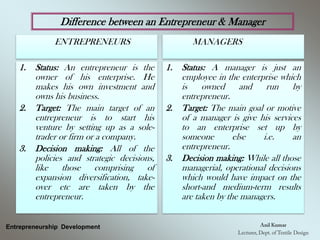
Difference between an Entrepreneur & Manager
Entrepreneurship Development
ENTREPRENEURS
1. Status: An entrepreneur is the
owner of his enterprise. He
makes his own investment and
owns his business.
2. Target: The main target of an
entrepreneur is to start his
venture by setting up as a sole-
trader or firm or a company.
3. Decision making: All of the
policies and strategic decisions,
like those comprising of
expansion diversification, take-
over etc are taken by the
entrepreneur.
MANAGERS
1. Status: A manager is just an
employee in the enterprise which
is owned and run by
entrepreneur.
2. Target: The main goal or motive
of a manager is give his services
to an enterprise set up by
someone else i.e. an
entrepreneur.
3. Decision making: While all those
managerial, operational decisions
which would have impact on the
short-and medium-term results
are taken by the managers.
Contd…
Entrepreneurship Development
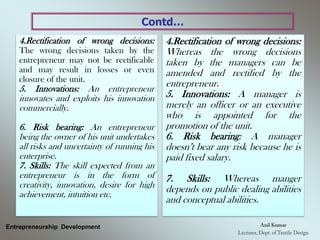
4.Rectification of wrong decisions:
The wrong decisions taken by the
entrepreneur may not be rectificable
and may result in losses or even
closure of the unit.
5. Innovations: An entrepreneur
innovates and exploits his innovation
commercially.
6. Risk bearing: An entrepreneur
being the owner of his unit undertakes
all risks and uncertainty of running his
enterprise.
7. Skills: The skill expected from an
entrepreneur is in the form of
creativity, innovation, desire for high
achievement, intuition etc.
4.Rectification of wrong decisions:
Whereas the wrong decisions
taken by the managers can be
amended and rectified by the
entrepreneur.
5. Innovations: A manager is
merely an officer or an executive
who is appointed for the
promotion of the unit.
6. Risk bearing: A manager
doesn’t bear any risk because he is
paid fixed salary.
7. Skills: Whereas manger
depends on public dealing abilities
and conceptual abilities.
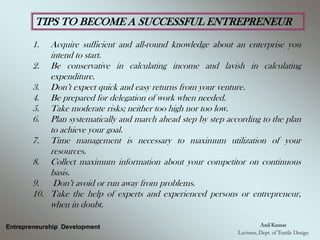
TIPS TO BECOME A SUCCESSFUL ENTREPRENEUR
1. Acquire sufficient and all-round knowledge about an enterprise you
intend to start.
2. Be conservative in calculating income and lavish in calculating
expenditure.
3. Don’t expect quick and easy returns from your venture.
4. Be prepared for delegation of work when needed.
5. Take moderate risks; neither too high nor too low.
6. Plan systematically and march ahead step by step according to the plan
to achieve your goal.
7. Time management is necessary to maximum utilization of your
resources.
8. Collect maximum information about your competitor on continuous
basis.
9. Don’t avoid or run away from problems.
10. Take the help of experts and experienced persons or entrepreneur,
when in doubt.
Entrepreneurship Development

Entrepreneurship Development [ Basic Concept ]

  • 1.
    Anil Kumar , Lecturer(Textile Design) Pandit Lakhmichand State University of Performing & Visual Arts , Rohtak E-mail-anilvns143@gmail.com Mobile no. +919729138649 Basic concept of Entrepreneurship
  • 2.
    Objectives 1. DEFINITION,NATURE ANDCHARACTERISTICS OF AN ENTREPRENEUR 2. WORKING PROFILE OF AN INTREPRENEUR 3. TYPES OF ENTREPRENEUR 4. INTRAPRENEUR 5. FUNCTIONS OF AN ENTREPRENEUR 6. ENTREPRENEUR AND MANAGER----DISTINCTION Entrepreneurship Development
  • 3.
    Entrepreneur •E.E.HAGEN: The entrepreneuris an economic man, who tries to maximize his profits by innovations. •GALBRAITH: ‘People are poor because they prefer in that way’. An entrepreneur must accept the challenge and should be willing hard to achieve something. •J.B.SAY: Is another Frenchman, expanded Cantillon’s ideas and conceptualized the entrepreneur as an organizer of the business firm, central to its distributive and productive functions. Entrepreneurship Development
  • 4.
    Characteristics of anEntrepreneur 1. Calculated Risk-taker 2. Innovator 3. Organizer 4. Creative 5. Achievement Motivated 6. Technically Competent 7. Self-confident 8. Socially Responsible 9. Optimistic 10. Equipped with Capability to drive Entrepreneurship Development
  • 5.
    WORKING PROFILE OFENTREPRENEUR Entrepreneurship Development Characteristics • Self-confidence • Drive • Task-result oriented • Risk-taker • Mental Ability • Leadership Traits • Confidence, Independence, Optimism, Individuality. • Responsibility,Vigour, Initiative, persistence, Ambition. • Need for achievement, Profit- oriented, Energy. • Risk taking ability, Likes challenges. • Overall intelligence(IQ),Creative thinking, Analytical thinking ability. • Leadership behaviour, Gets alongwith others, Responsive to situations, Criticism.
  • 6.
    Manager Vs Leader EntrepreneurshipDevelopment Manager Characteristics • Administers • A copy • Maintain • Focus and systems and structure • Relies on control • Short-range view • Asks how and when • Eye on the bottomline • Imitates • Accepts the status quo • Classic good soldier • Does things right Leader Characteristics • Innovates • An original • Develops • Focuses on people • Inspires trust • Long-range perspective • Asks what and why • Eye on the horizon • Originates • Challenges the status quo • Own person • Does the right thing
  • 7.
    TYPES OF ENTREPRENEUR EntrepreneurshipDevelopment 1. According to the Type of Business i. Business entrepreneur: Business entrepreneurs are those entrepreneurs who conceive the idea of a new product or service and then translate their ideas into reality. ii. Trading entrepreneur: As the very name indicates trading entrepreneur is concerned with trading activities and not manufacturing. iii. Industrial entrepreneur: As the very name indicates, an industrial entrepreneur is one who sets up an industrial unit. iv. Corporate entrepreneur: Corporate entrepreneur is the one who plans, develops and manages a corporate body. v. Agricultural entrepreneur: Agricultural entrepreneur is the one who is engaged in the agricultural activities.
  • 8.
    According to Technology EntrepreneurshipDevelopment i. Technical entrepreneur: The strength of a technical entrepreneur is in his skill in production techniques. He concentrates more on production than on marketing. ii. Non-technical entrepreneur: Unlike technical entrepreneur, non-technical entrepreneur is not concerned with the technical aspect of the product rather he spends more time in developing alternative strategies of the marketing and distribution to promote his business. iii. Professional entrepreneur: Professional entrepreneur means an entrepreneur who is interested in floating a business but does not want to manage or operate it.
  • 9.
    According to Development EntrepreneurshipDevelopment i. First generation entrepreneur: First generation entrepreneur are those entrepreneur who do not possess any entrepreneurial background. ii. Second generation entrepreneur: Second generation entrepreneur are those entrepreneurs who inherit the family business firms and pass it from one generation to another. iii. Classical entrepreneur: A classical entrepreneur is a stereotype entrepreneur whose aim is to maximize his economic returns at a level consistent with the survival of the unit but with or without an element of growth.
  • 10.
    According to Capitalownership Entrepreneurship Development i. Private entrepreneur: When an individual or a group of individuals set up an enterprise, arrange finance, bear the risk and adopt the latest techniques in the business with the intention to earn profits, he or the group is called as private entrepreneur/entrepreneurs. ii. State entrepreneur: As the name indicates, state entrepreneur means the trading or industrial venture undertaken by the state or the government itself. iii. Joint entrepreneur: Joint entrepreneur means the combination of private entrepreneur and state entrepreneur who join hands.
  • 11.
    According to Gender& Age Entrepreneurship Development i. Man entrepreneur ii. Woman entrepreneur iii. Young entrepreneur iv. Old entrepreneur v. Middle-aged entrepreneur According to Area & Scale i. Urban entrepreneur ii. Rural entrepreneur i. Large scale industry entrepreneur ii. Medium scale industry entrepreneur iii. Small scale industry entrepreneur iv. Tiny industry entrepreneur
  • 12.
    INTRAPRENEUR Entrepreneurship Development The term‘intrapreneur’ was coined in the United States of America in the late seventies. Gifford Pinchot defined intrapreneurs as the persons who resigned from their well paid executive positions to launch their own ventures. Gifford devised the way by which such executives could be retained in the industry and their entrepreneurial urge was also satisfied by their bosses. So a system was devised whereby such executives would operate as entrepreneurs with full independence and autonomy but with in the organisation.
  • 13.
    Difference between entrepreneurand intrapreneur 1. An entrepreneur is an independence person who starts his venture and bears full risk of his failure and enjoys the fruit of his success whereas intrapreneur is partially independent and is sponsored by the corporation in which he is working. He is also not liable to bear the losses in case of his failure. 2. An entrepreneur raises the finance from various sources and also guarantees their return whereas an intrapreneur does not own responsibility to raise the capital or to return it. 3. An entrepreneur has no relation with any organisation whereas an intrapreneur operates within the organisation where he is working. Entrepreneurship Development
  • 14.
    FUNCTIONS OF ANENTREPRENEUR There has been a great deal of confusion and contradiction in literature on the functions of an entrepreneur. FUNCTIONS 1. Innovations: J.Schumpeter has made substantial contribution to the literature of entrepreneurship. The process of innovations may be in the form of: a) Introduction of a new product. b) Use of new methods of production. c) Opening of a new market. d) The conquest of new source of supply of raw material. e) A new form of organisation. Entrepreneurship Development
  • 15.
    Entrepreneurship Development 2. Risk-taking:Richard cantillon states that entrepreneur is an agent who buys means of production at certain prices and sells them at uncertain prices. The entrepreneur performs the function of reducing uncertainty in his plan of investment and expansion of the enterprise. J. B. Say also stresses risk-taking as the specific function of an entrepreneur. 3. Decision Maker: Entrepreneur as a decision maker describes the following functions of an entrepreneur. a) The determination of objectives of an enterprise and the change of those objectives as conditions required or made advantageous, b) The development of an organization including efficient relations with subordinates and all employees, c) Securing adequate financial resources, the relations with existing and potential Investors, d) The acquisition of efficient technological equipment and the revision of it as new machinery appears, e)The development of a market for the products and the devising of new products to meet or anticipate consumer’s demand, f) The maintenance of good relations with public authorities and with society at large.
  • 16.
    Contd… 4. Organisation andManagement: Marshall recognised organisation and management of the enterprise as the important functions of an entrepreneur. When the organisation grows bigger, the entrepreneur effectively delegates authority and finds responsibility at various levels of management. The network of decision making becomes more complex. The functions of organisation and management includes: a) Planning of an enterprise, b) Co-ordination, administration and control, c) Routine type of supervision. Entrepreneurship Development
  • 17.
    Difference between anEntrepreneur & Manager Entrepreneurship Development ENTREPRENEURS 1. Status: An entrepreneur is the owner of his enterprise. He makes his own investment and owns his business. 2. Target: The main target of an entrepreneur is to start his venture by setting up as a sole- trader or firm or a company. 3. Decision making: All of the policies and strategic decisions, like those comprising of expansion diversification, take- over etc are taken by the entrepreneur. MANAGERS 1. Status: A manager is just an employee in the enterprise which is owned and run by entrepreneur. 2. Target: The main goal or motive of a manager is give his services to an enterprise set up by someone else i.e. an entrepreneur. 3. Decision making: While all those managerial, operational decisions which would have impact on the short-and medium-term results are taken by the managers.
  • 18.
    Contd… Entrepreneurship Development 4.Rectification ofwrong decisions: The wrong decisions taken by the entrepreneur may not be rectificable and may result in losses or even closure of the unit. 5. Innovations: An entrepreneur innovates and exploits his innovation commercially. 6. Risk bearing: An entrepreneur being the owner of his unit undertakes all risks and uncertainty of running his enterprise. 7. Skills: The skill expected from an entrepreneur is in the form of creativity, innovation, desire for high achievement, intuition etc. 4.Rectification of wrong decisions: Whereas the wrong decisions taken by the managers can be amended and rectified by the entrepreneur. 5. Innovations: A manager is merely an officer or an executive who is appointed for the promotion of the unit. 6. Risk bearing: A manager doesn’t bear any risk because he is paid fixed salary. 7. Skills: Whereas manger depends on public dealing abilities and conceptual abilities.
  • 19.
    TIPS TO BECOMEA SUCCESSFUL ENTREPRENEUR 1. Acquire sufficient and all-round knowledge about an enterprise you intend to start. 2. Be conservative in calculating income and lavish in calculating expenditure. 3. Don’t expect quick and easy returns from your venture. 4. Be prepared for delegation of work when needed. 5. Take moderate risks; neither too high nor too low. 6. Plan systematically and march ahead step by step according to the plan to achieve your goal. 7. Time management is necessary to maximum utilization of your resources. 8. Collect maximum information about your competitor on continuous basis. 9. Don’t avoid or run away from problems. 10. Take the help of experts and experienced persons or entrepreneur, when in doubt. Entrepreneurship Development