


IPR PROTECTION
OF
COMPUTER GENERATED
WORKS
THROUGH
COPYRIGHT AND PATENTS:
A COMPARATIVE STUDY
INTRODUCTION
 As John Locke has suggested, an author’s
right to the exclusive exploitation of his work
exists partly because the author takes things
available to all and applies his labor to those
things to create something new
 Several recent cases have refocused
attention on authorship as an essential
criterion of copyright subsistence and these
cases suggest that much computer-produced
output may be authorless and thus lack
copyright protection
 How can web-sites their layouts, E-Books,
softwares, Databases etc. be protected under
the law?
INTERNATIONAL SCENARIO
 TRIPs
Three different forms of protection for
software:
1. Article 10 provides Copyright
Protection
2. Article 27.1 recognizes patent
protection
3. Article 39 offers a trade secret
regime
 Berne Convention
Article 2 are mere illustrations of the kinds
of works of applied art to which copyright
might extend.
These illustrations are not exhaustive.
Cont.
 The Universal Copyright Convention (“UCC”)
Geneva, Switzerland, 1952
National Treatment Provisions - software created
by an author is protected in other UCC member
countries to the extent that the member country’s
copyright laws protect software
 World Intellectual Property Organization
Copyright Treaty (WCT) and WPPT, 1996
WIPO Copyright Treaty (“WCT”) and the WIPO
Performances and Phonograms Treaty
(“WPPT”). The WCT of 1996 is a special
agreement to the Berne Convention and requires
compliance with Berne Convention.
PROTECTION
OF
COMPUTER GENERATED
WORK:
INDIAN PERSPECTIVE
PROTECTION IN FORM OF
COPYRIGHT
 Copyright was usually associated with
artistic products, but today is also now
an important tool in protecting computer
software
 The Copyright Act, 1957 provides
copyright protection for original works
 Computer software which does not have
a technical effect is protected under
copyright law.
 Section 13 provides the categories of
work in which the copyright subsists
which includes original literary work.
Cont.
 The Act was amended in 1999 so as to
make the Act compatible with the
provisions of TRIPS.
◦ Section 2(ffc) - “Computer Program” means
a set of instructions expressed in words,
codes, schemes or in any other form,
including a machine readable medium,
capable of causing a computer to perform a
particular task or achieve a particular result.
◦ Section 2(o) - “Literary work” is defined as
that which includes computer programs,
tables and compilations including computer
databases.
Cont.
 The government of India passed the
International Copyright Order, 1958
whereby any work first published in any
country which is a member of the Berne
Convention or the UCC will be accorded the
same treatment as if it was first published in
India.
 In Tata Consultancy Services v. State of
Andhra Pradesh, the Supreme Court
considered computer software is intellectual
property, whether it is conveyed in diskettes,
floppy, magnetic tapes or CD ROMs, whether
canned or uncanned, whether it comes as
part of computer or independently, whether it
is branded or unbranded, tangible or
intangible
CONDITIONS FOR
COPYRIGHT
 computer software needs to be
1. original and;
2. sufficient effort and skill must be put into impart
it originality
 program which only generates multiplication
tables or algorithms may not suffice the
degree of effort required for protection.
 the work should be first published in India or;
 if the work is published outside India the
author on the date of publication or if the
author is dead at the time of his death should
be a citizen of India.
INFRINGEMENT UNDER
COPYRIGHT ACT
 Section 51 states that a person infringes
copyright of another if he unauthorized
commits any act which only the copyright
folder has exclusive rights to do
 Section 63B - Any person who
knowingly makes use of an infringing
copy of a computer program is liable to
be punished with imprisonment for a
term of at least seven days and can be
extended to three years and with fine of
at least Rs. 50,000
Cont.
 Both Civil and Criminal remedies to
copyright infringement are provided in
Chapter XII granting:
1. Section 62 - injunction and damages
2. Section 63 - abetment of infringement
punishable with imprisonment of up to
three years and a fine up to Rs. 2 Lacs
Cont.
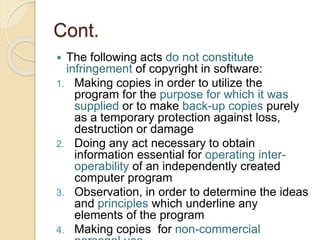
 The following acts do not constitute
infringement of copyright in software:
1. Making copies in order to utilize the
program for the purpose for which it was
supplied or to make back-up copies purely
as a temporary protection against loss,
destruction or damage
2. Doing any act necessary to obtain
information essential for operating inter-
operability of an independently created
computer program
3. Observation, in order to determine the ideas
and principles which underline any
elements of the program
4. Making copies for non-commercial
PROTECTION IN FORM OF
PATENT
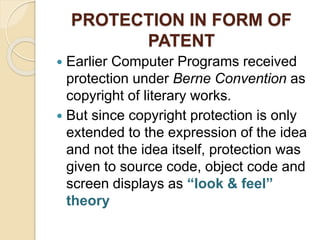
 Earlier Computer Programs received
protection under Berne Convention as
copyright of literary works.
 But since copyright protection is only
extended to the expression of the idea
and not the idea itself, protection was
given to source code, object code and
screen displays as “look & feel”
theory
Cont.
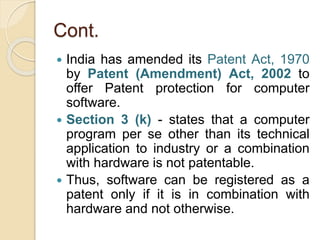
 India has amended its Patent Act, 1970
by Patent (Amendment) Act, 2002 to
offer Patent protection for computer
software.
 Section 3 (k) - states that a computer
program per se other than its technical
application to industry or a combination
with hardware is not patentable.
 Thus, software can be registered as a
patent only if it is in combination with
hardware and not otherwise.
THANK
YOU!
IPR protection to computer softwares

IPR protection to computer softwares

  • 1.
  • 2.
    INTRODUCTION  As JohnLocke has suggested, an author’s right to the exclusive exploitation of his work exists partly because the author takes things available to all and applies his labor to those things to create something new  Several recent cases have refocused attention on authorship as an essential criterion of copyright subsistence and these cases suggest that much computer-produced output may be authorless and thus lack copyright protection  How can web-sites their layouts, E-Books, softwares, Databases etc. be protected under the law?
  • 3.
    INTERNATIONAL SCENARIO  TRIPs Threedifferent forms of protection for software: 1. Article 10 provides Copyright Protection 2. Article 27.1 recognizes patent protection 3. Article 39 offers a trade secret regime  Berne Convention Article 2 are mere illustrations of the kinds of works of applied art to which copyright might extend. These illustrations are not exhaustive.
  • 4.
    Cont.  The UniversalCopyright Convention (“UCC”) Geneva, Switzerland, 1952 National Treatment Provisions - software created by an author is protected in other UCC member countries to the extent that the member country’s copyright laws protect software  World Intellectual Property Organization Copyright Treaty (WCT) and WPPT, 1996 WIPO Copyright Treaty (“WCT”) and the WIPO Performances and Phonograms Treaty (“WPPT”). The WCT of 1996 is a special agreement to the Berne Convention and requires compliance with Berne Convention.
  • 5.
  • 6.
    PROTECTION IN FORMOF COPYRIGHT  Copyright was usually associated with artistic products, but today is also now an important tool in protecting computer software  The Copyright Act, 1957 provides copyright protection for original works  Computer software which does not have a technical effect is protected under copyright law.  Section 13 provides the categories of work in which the copyright subsists which includes original literary work.
  • 7.
    Cont.  The Actwas amended in 1999 so as to make the Act compatible with the provisions of TRIPS. ◦ Section 2(ffc) - “Computer Program” means a set of instructions expressed in words, codes, schemes or in any other form, including a machine readable medium, capable of causing a computer to perform a particular task or achieve a particular result. ◦ Section 2(o) - “Literary work” is defined as that which includes computer programs, tables and compilations including computer databases.
  • 8.
    Cont.  The governmentof India passed the International Copyright Order, 1958 whereby any work first published in any country which is a member of the Berne Convention or the UCC will be accorded the same treatment as if it was first published in India.  In Tata Consultancy Services v. State of Andhra Pradesh, the Supreme Court considered computer software is intellectual property, whether it is conveyed in diskettes, floppy, magnetic tapes or CD ROMs, whether canned or uncanned, whether it comes as part of computer or independently, whether it is branded or unbranded, tangible or intangible
  • 9.
    CONDITIONS FOR COPYRIGHT  computersoftware needs to be 1. original and; 2. sufficient effort and skill must be put into impart it originality  program which only generates multiplication tables or algorithms may not suffice the degree of effort required for protection.  the work should be first published in India or;  if the work is published outside India the author on the date of publication or if the author is dead at the time of his death should be a citizen of India.
  • 10.
    INFRINGEMENT UNDER COPYRIGHT ACT Section 51 states that a person infringes copyright of another if he unauthorized commits any act which only the copyright folder has exclusive rights to do  Section 63B - Any person who knowingly makes use of an infringing copy of a computer program is liable to be punished with imprisonment for a term of at least seven days and can be extended to three years and with fine of at least Rs. 50,000
  • 11.
    Cont.  Both Civiland Criminal remedies to copyright infringement are provided in Chapter XII granting: 1. Section 62 - injunction and damages 2. Section 63 - abetment of infringement punishable with imprisonment of up to three years and a fine up to Rs. 2 Lacs
  • 12.
    Cont.  The followingacts do not constitute infringement of copyright in software: 1. Making copies in order to utilize the program for the purpose for which it was supplied or to make back-up copies purely as a temporary protection against loss, destruction or damage 2. Doing any act necessary to obtain information essential for operating inter- operability of an independently created computer program 3. Observation, in order to determine the ideas and principles which underline any elements of the program 4. Making copies for non-commercial
  • 13.
    PROTECTION IN FORMOF PATENT  Earlier Computer Programs received protection under Berne Convention as copyright of literary works.  But since copyright protection is only extended to the expression of the idea and not the idea itself, protection was given to source code, object code and screen displays as “look & feel” theory
  • 14.
    Cont.  India hasamended its Patent Act, 1970 by Patent (Amendment) Act, 2002 to offer Patent protection for computer software.  Section 3 (k) - states that a computer program per se other than its technical application to industry or a combination with hardware is not patentable.  Thus, software can be registered as a patent only if it is in combination with hardware and not otherwise.
  • 15.