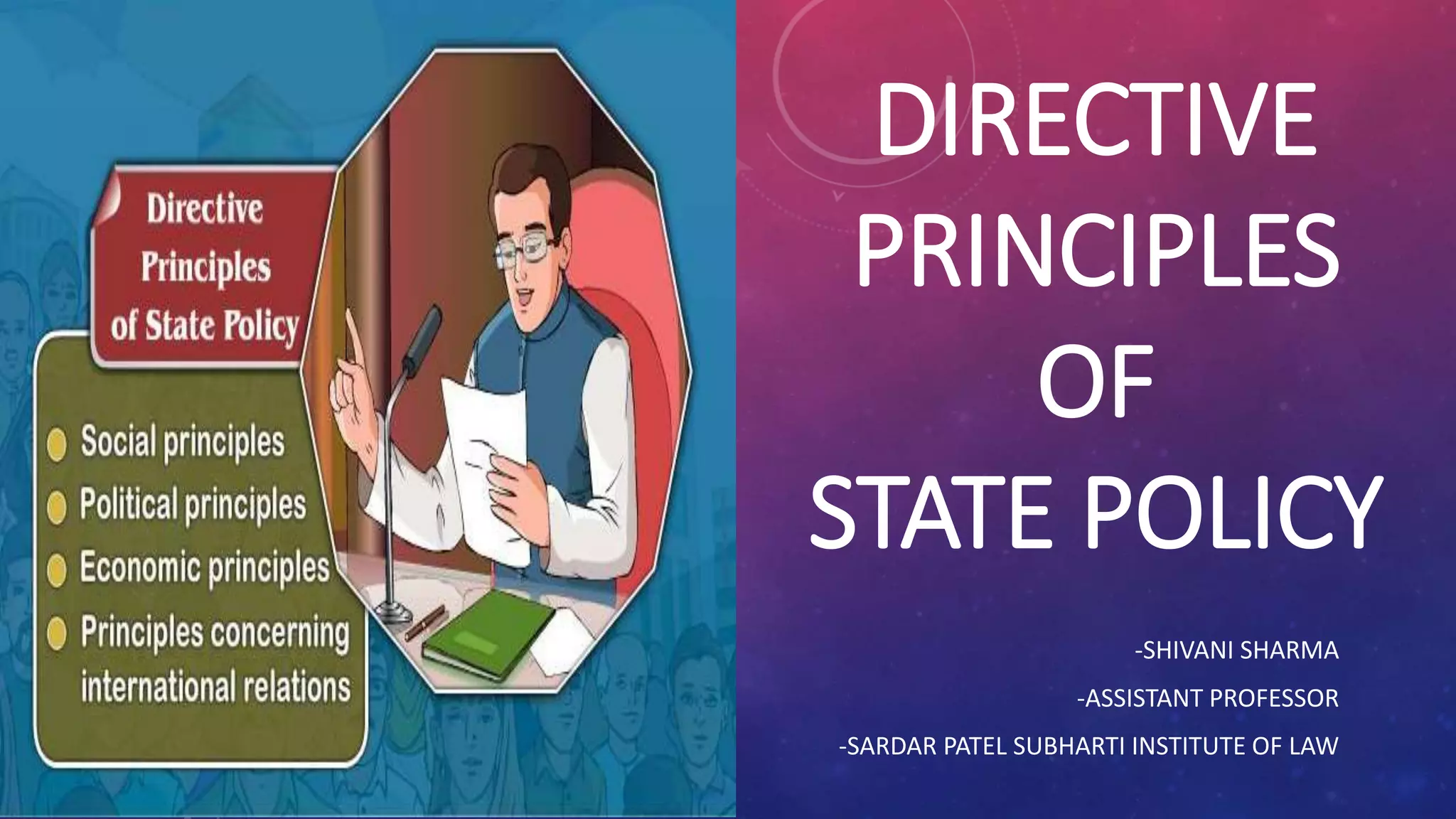
DIRECTIVE
PRINCIPLES
OF
STATE POLICY
-SHIVANI SHARMA
-ASSISTANT PROFESSOR
-SARDAR PATEL SUBHARTI INSTITUTE OF LAW
“SOCIAL JUSTICE IS AN ATTRIBUTE OF GOD …. EVERY ACT, EVERY
THOUGHT IS WEIGHED IN THE INVISIBLE BUT UNIVERSAL BALANCE-SCALES OF
JUSTICE. THE DAY OF JUDGMENT IS NOT IN SOME REMOTE FUTURE BUT HERE AND
NOW, AND NONE CAN ESCAPE IT. DIVINE LAWS CANNOT BE EVADED. THEY ARE
NOT SO MUCH IMPOSED FROM WITHOUT AS WROUGHT INTO OUR
NATURE” -RADHAKRISHNAN
• The term, ‘justice’ has been used since the time immemorial in
different languages, in different religions, varying from region to
region. In epics and Puran ‘justice’ was interpreted differently from
what today’s social scientists mean by it.
• Justice is the evolution of the basic social and political institutions,
particularly with respect to the consequent distributions of benefits
and burdens, which are standardly expressed in terms of justice or
injustice. On its most general sense the concept of justice requires
that each individual has what is due to him or her.
THEORY OF SOCIAL JUSTICE
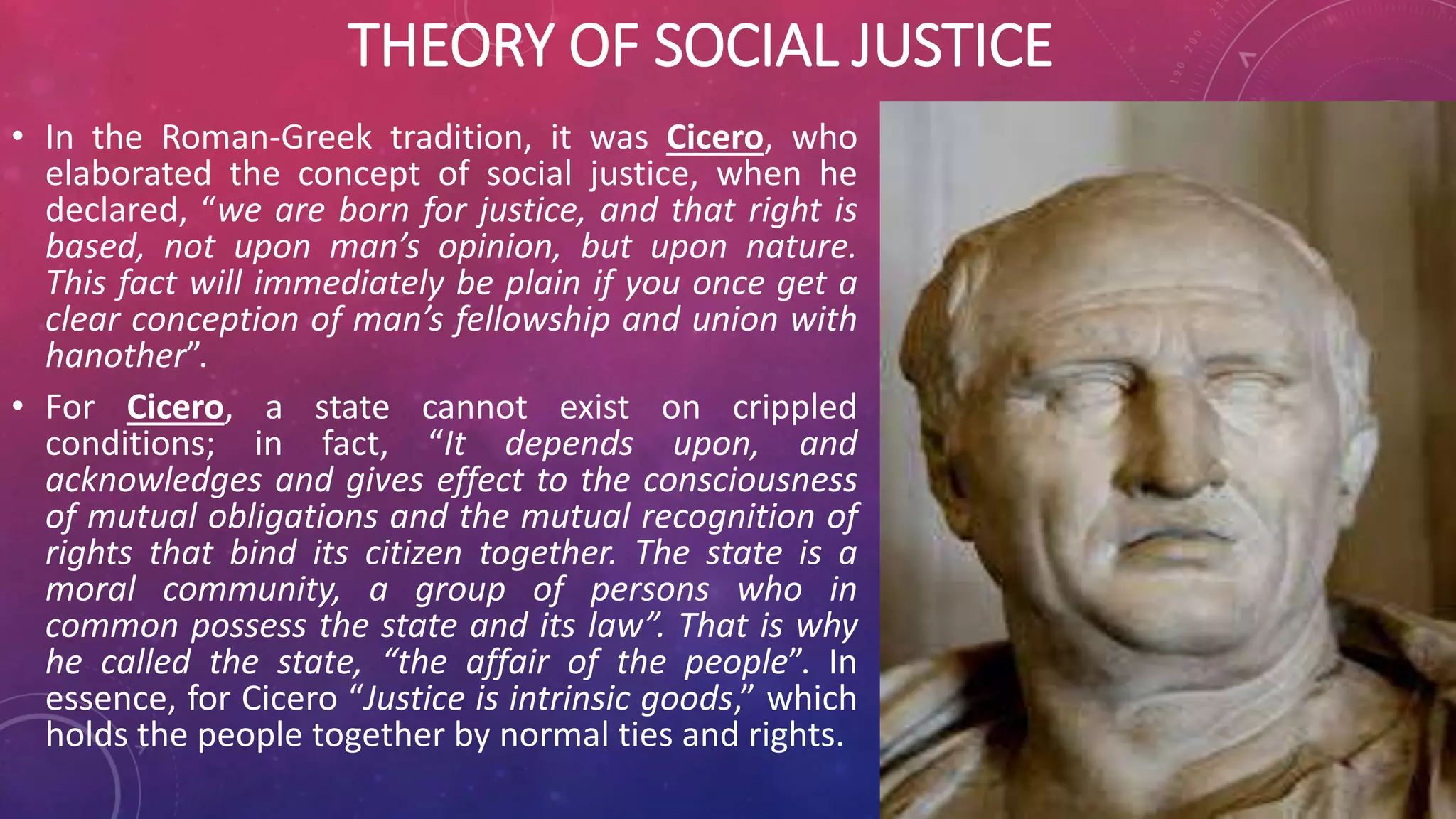
• In the Roman-Greek tradition, it was Cicero, who
elaborated the concept of social justice, when he
declared, “we are born for justice, and that right is
based, not upon man’s opinion, but upon nature.
This fact will immediately be plain if you once get a
clear conception of man’s fellowship and union with
hanother”.
• For Cicero, a state cannot exist on crippled
conditions; in fact, “It depends upon, and
acknowledges and gives effect to the consciousness
of mutual obligations and the mutual recognition of
rights that bind its citizen together. The state is a
moral community, a group of persons who in
common possess the state and its law”. That is why
he called the state, “the affair of the people”. In
essence, for Cicero “Justice is intrinsic goods,” which
holds the people together by normal ties and rights.
• The most ancient social organization through
which the idea of social justice was sought to
be implemented is the theory of
Chaturvarnya (Varna Vyavastha), that is, the
Vedic concept of society in which the people
were classified into four Varnas: Brahmin,
Kshatriya, Vaishya and Sudra. Though its
original existence is nowhere now, and if it is,
it exists in its most degenerated form, i.e.,
caste system; yet it was envisaged as an
organization based on human nature, i.e.,
Guna-Karma theory, and it was meant for
social harmony and justice, which also leads
man to the path of Moksha – liberation from
pain of birth and death.
• Plato sought social justice through a social order based on human
nature consisting of three main faculties: the rational, spiritual and
appetitive. The rational faculty is wise and its main function is to rule
and command; the function of spiritual faculty is to maintain law and
order in society; the appetitive faculty of human nature drives itself
to the satisfaction of bodily appetites. The special qualities of a
person having rational faculty are wisdom, respect, tolerance,
reasoning, discipline.
• Plato interlinked individual and social justice together. The individual
form of justice manifests itself, when man succeeds in establishing
harmony and unity among all the three qualities of wisdom, courage
and appetite as inherent in his conscience. In case, the balance is
upset or disturbed, the individual rushes towards lust and injustice.
In a similar way, the well ordered balance of three classes of citizens
in society is the basic idea of social justice
• There is, some resemblance between Varna Vyavastha and Plato’s
view on justice as both assigns duties to its citizen on the basis of
class. In both of these social orders the state is a part and parcel of
society. The idea of social justice in Varna Vyvastha leads one
towards the goal of moksha and in Plato’s social order towards
‘Supreme Happiness’. In each scheme, a just man is entitled to
achieve the highest goal of human life. That is Moksha or supreme
happiness.
• Aristotle, who is the main author of this conception (Justice),
says, “Injustice arises when equals are treated unequally, and
also when unequal’s are treated equally.” Justice is an equality
of proportion between ‘persons’ and ‘things’ assigned to them.
The ‘thing’ here may be office, honour, rank, money or any of
the objects of human desire. These should be distributed, not
equally, but in proportion to some quality, character or
achievement of the persons concerned.
• It may be birth, rank, office or wealth. It may be simply a status
of a free man (as in a Greek democracy) and then the rule of
proportion fails, and absolute or ‘arithmetic equality’ is
substituted. Lastly it may ought to be merit.
• Unlike Plato, for Aristotle, justice is inherent in morality, scientific
insight and constitutional rule. He puts it into ‘general justice’,
and ‘particular justice’. The former is the whole good of society;
it is moral conduct, it is public good; it is virtue. This justice asks
man to think not of himself but of other people. The latter is a
part of the whole justice. Distributive justice, then is for Aristotle
an equality in the proportion of merit to rights.
• Hob house, in his monumental work, Elements of Social Justice has outlined following points as
elements of social justice:
(1) Institutions are not ends but means. Politics are subordinate to ethics.
(2) One of the principles of harmony is that common goods cannot be opposed to individual
goods nor individual set-up against the common goods. A right improves duties and is one term
of a moral relation.
(3) Moral freedom.
(4) Social and political freedom.
(5) Equality.
(6) Personal justice.
(7) Equal payment for equal service.
(8) The assignment of property should be so conceived as to secure freedom for the individual
and power for the community.
(9) Social and personal factors in wealth.
(10) Individual organization.
(11) Democracy (Hob-house, 1922).
INDIAN CONTITUTION AND SOCIAL JUSTICE
• In the context of the Constitution of India, P.B. Gajendragadkar,
former Chief Justice of India, said:
“The concept of social justice is (thus) a revolutionary concept
which gives meaning and significance to the democratic way of life
and makes the rule of law dynamic. It is this concept of social
justice which creates in the minds of the masses of this country a
sense of participation in the glory of India’s political freedom”
• He further adds,
“Social justice must be achieved by adopting necessary and
reasonable measures with courage, wisdom, foresight, sense of
balance and fairplay to all the interests concerned. That shortly
stated, is the concept of social justice and its implications. If eternal
vigilance is the price for national liberty, it is equally the price for
sustaining individual freedom and liberty in welfare state”. Now but
us discuss various theories of social justice.
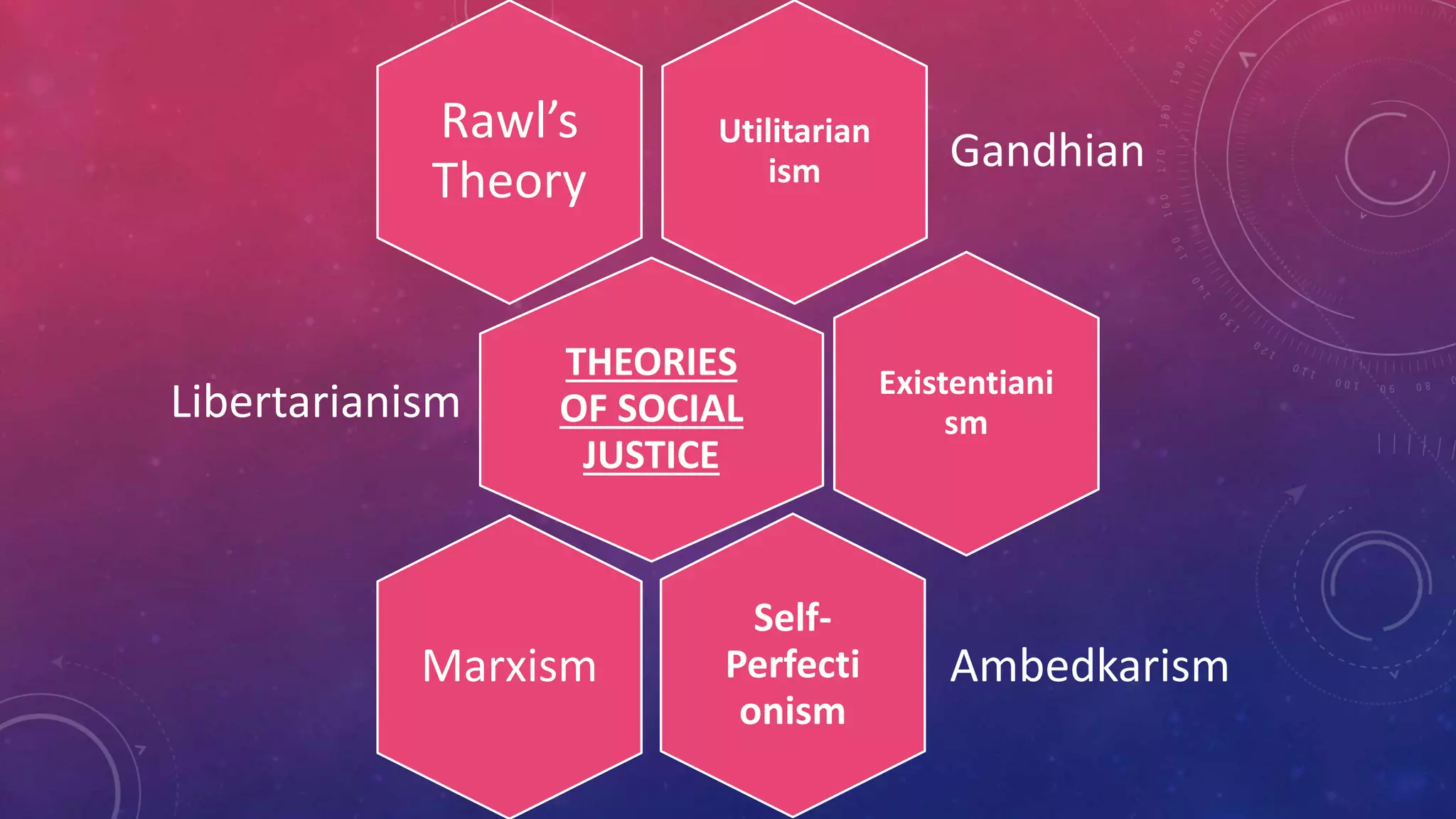
Utilitarian
ism Gandhian
Rawl’s
Theory
THEORIES
OF SOCIAL
JUSTICE
Libertarianism Existentiani
sm
Self-
Perfecti
onism
AmbedkarismMarxism
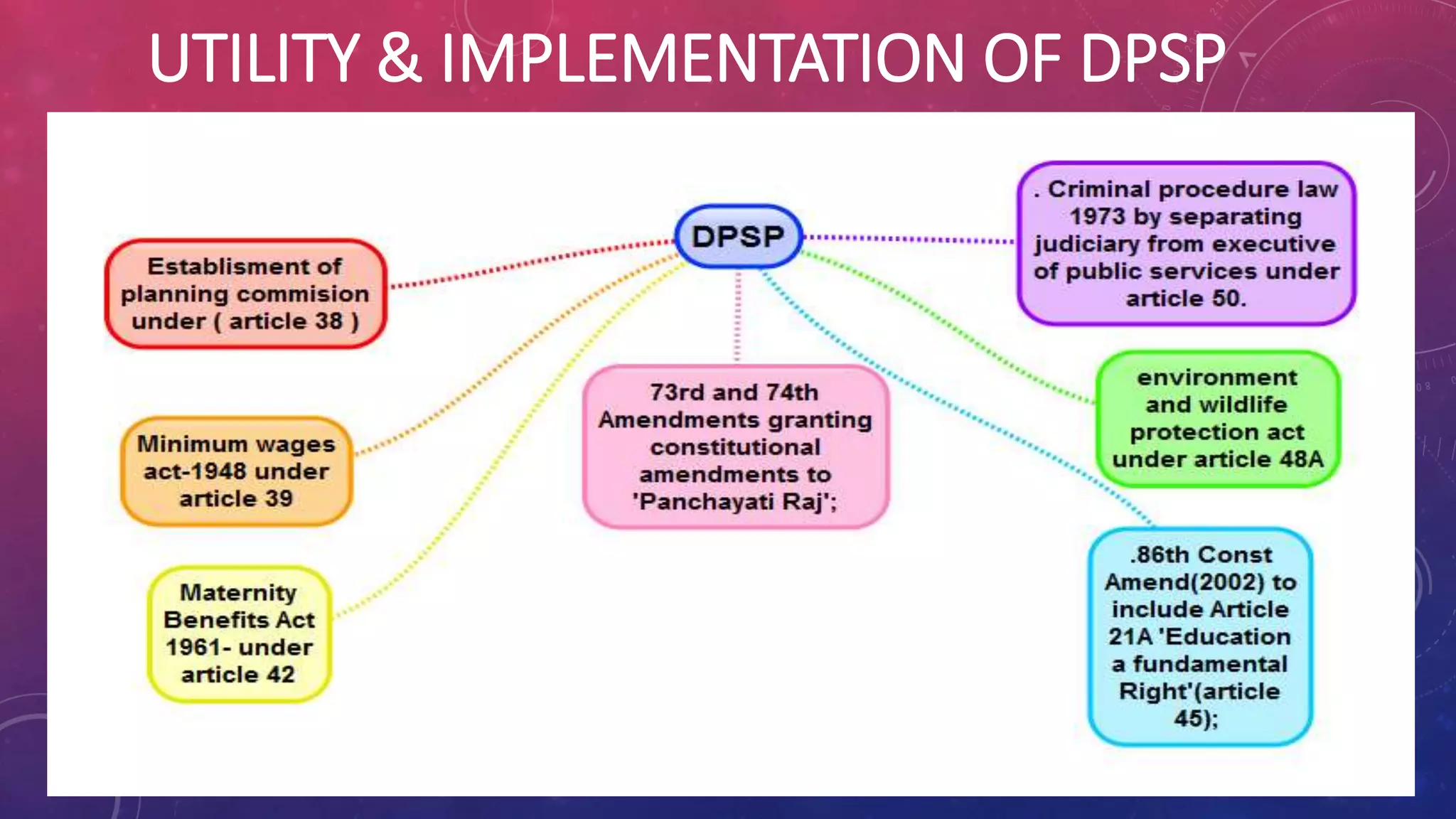
UTILITY & IMPLEMENTATION OF DPSP
ARTICLE-36
• 36. Definition In this Part, unless the context otherwise requires, the State has the same meaning
as in Part III
• 37. Application of the principles contained in this Part- The provisions contained in this Part shall
not be enforceable by any court, but the principles therein laid down are nevertheless
fundamental in the governance of the country and it shall be the duty of the State to apply these
principles in making laws
• 38. State to secure a social order for the promotion of welfare of the people-
(1) The State shall strive to promote the welfare of the people by securing and protecting as
effectively as it may a social order in which justice, social, economic and political, shall inform all
the institutions of the national life
(2) The State shall, in particular, strive to minimize the inequalities in income, and endeavor to
eliminate inequalities in status, facilities and opportunities, not only amongst individuals but also
amongst groups of people residing in different areas or engaged in different vocations
ARTICLE-37
ARTICLE-38
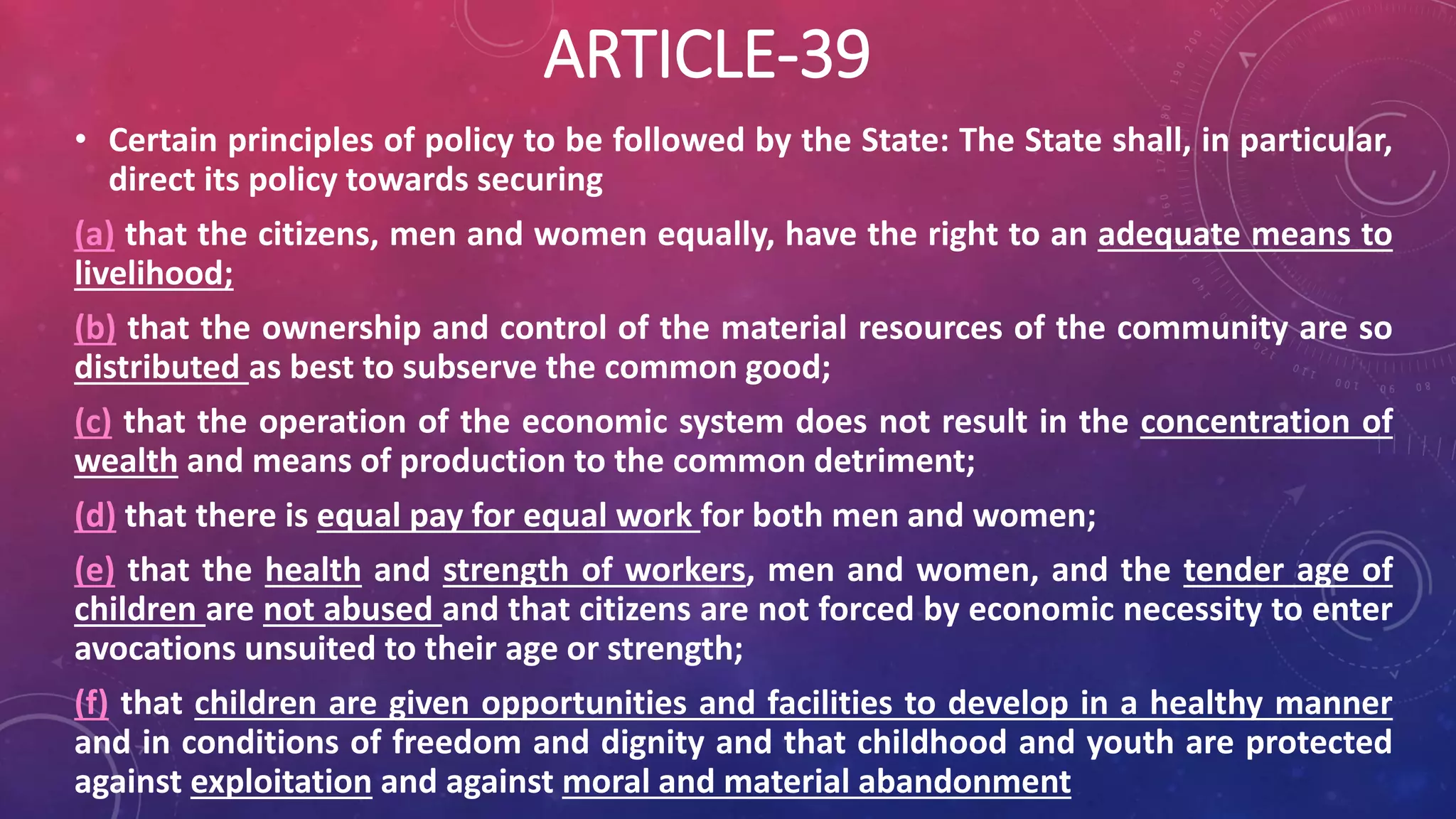
ARTICLE-39
• Certain principles of policy to be followed by the State: The State shall, in particular,
direct its policy towards securing
(a) that the citizens, men and women equally, have the right to an adequate means to
livelihood;
(b) that the ownership and control of the material resources of the community are so
distributed as best to subserve the common good;
(c) that the operation of the economic system does not result in the concentration of
wealth and means of production to the common detriment;
(d) that there is equal pay for equal work for both men and women;
(e) that the health and strength of workers, men and women, and the tender age of
children are not abused and that citizens are not forced by economic necessity to enter
avocations unsuited to their age or strength;
(f) that children are given opportunities and facilities to develop in a healthy manner
and in conditions of freedom and dignity and that childhood and youth are protected
against exploitation and against moral and material abandonment
ARTICLE-40
• Organization of village panchayats -The State shall take steps to organize
village panchayats and endow them with such powers and authority as may be
necessary to enable them to function as units of self government
• Right to work, to education and to public assistance in certain cases- The State
shall, within the limits of its economic capacity and development, make
effective provision for securing the right to work, to education and to public
assistance in cases of unemployment, old age, sickness and disablement, and
in other cases of undeserved want
• Provision for just and humane conditions of work and maternity relief- The
State shall make provision for securing just and humane conditions of work
and for maternity relief
ARTICLE-42
ARTICLE-41
ARTICLE-43
• Living wage, etc, for workers- The State shall endeavour to secure, by suitable
legislation or economic organisation or in any other way, to all workers, agricultural,
industrial or otherwise, work, a living wage, conditions of work ensuring a decent
standard of life and full enjoyment of leisure and social and cultural opportunities
and, in particular, the State shall endeavour to promote cottage industries on an
individual or co operative basis in rural areas
• 43A. Participation of workers in management of industries.—The State shall take
steps, by suitable legislation or in any other way, to secure the participation of
workers in the management of undertakings, establishments or other organisations
engaged in any industry.
• 43B. Promotion of co-operative societies.—The State shall endeavour to promote
voluntary formation, autonomous functioning, democratic control and professional
management of co-operative societies.
ARTICLE-43A
ARTICLE-43B
ARTICLE-46
• The State shall endeavor to secure for the citizens a Uniform Civil Code
throughout the territory of India.
• Provision for early childhood care and education to children below the age
of six years.— The State shall endeavour to provide early childhood care and
education for all children until they complete the age of six years.
• Promotion of educational and economic interests of Scheduled Castes,
Scheduled Tribes and other weaker sections.—The State shall promote with
special care the educational and economic interests of the weaker sections
of the people, and, in particular, of the Scheduled Castes and the Scheduled
Tribes, and shall protect them from social injustice and all forms of
exploitation.
ARTICLE-44
ARTICLE-45
• ARTICLE-47
Duty of the State to raise the level of nutrition and the standard of living and to improve
public health.—The State shall regard the raising of the level of nutrition and the
standard of living of its people and the improvement of public health as among its
primary duties and, in particular, the State shall endeavour to bring about prohibition of
the consumption except for medicinal purposes of intoxicating drinks and of drugs which
are injurious to health.
• ARTICLE-48
Organisation of agriculture and animal husbandry.—The State shall endeavour to
organise agriculture and animal husbandry on modern and scientific lines and shall, in
particular, take steps for preserving and improving the breeds, and prohibiting the
slaughter of cows and calves and other milch and draught cattle.
• ARTICLE-48A
Protection and improvement of environment and safeguarding of forests and wild life.—
The State shall endeavour to protect and improve the environment and to safeguard the
forests and wild life of the country
• ARTICLE-49
It shall be the obligation of the State to protect every monument or place or
object of artistic or historic interest, [declared by or under law made by
Parliament] to be of national importance, from spoliation, disfigurement,
destruction, removal, disposal or export, as the case may be.
• ARTICLE-50
The State shall take steps to separate the judiciary from the executive in the
public services of the State.
• ARTICLE-51
The State shall endeavour to—
(a) promote international peace and security;
(b) maintain just and honourable relations between nations;
(c) foster respect for international law and treaty obligations in the dealings of
organised peoples with one another; and
(d) encourage settlement of international disputes by arbitration.
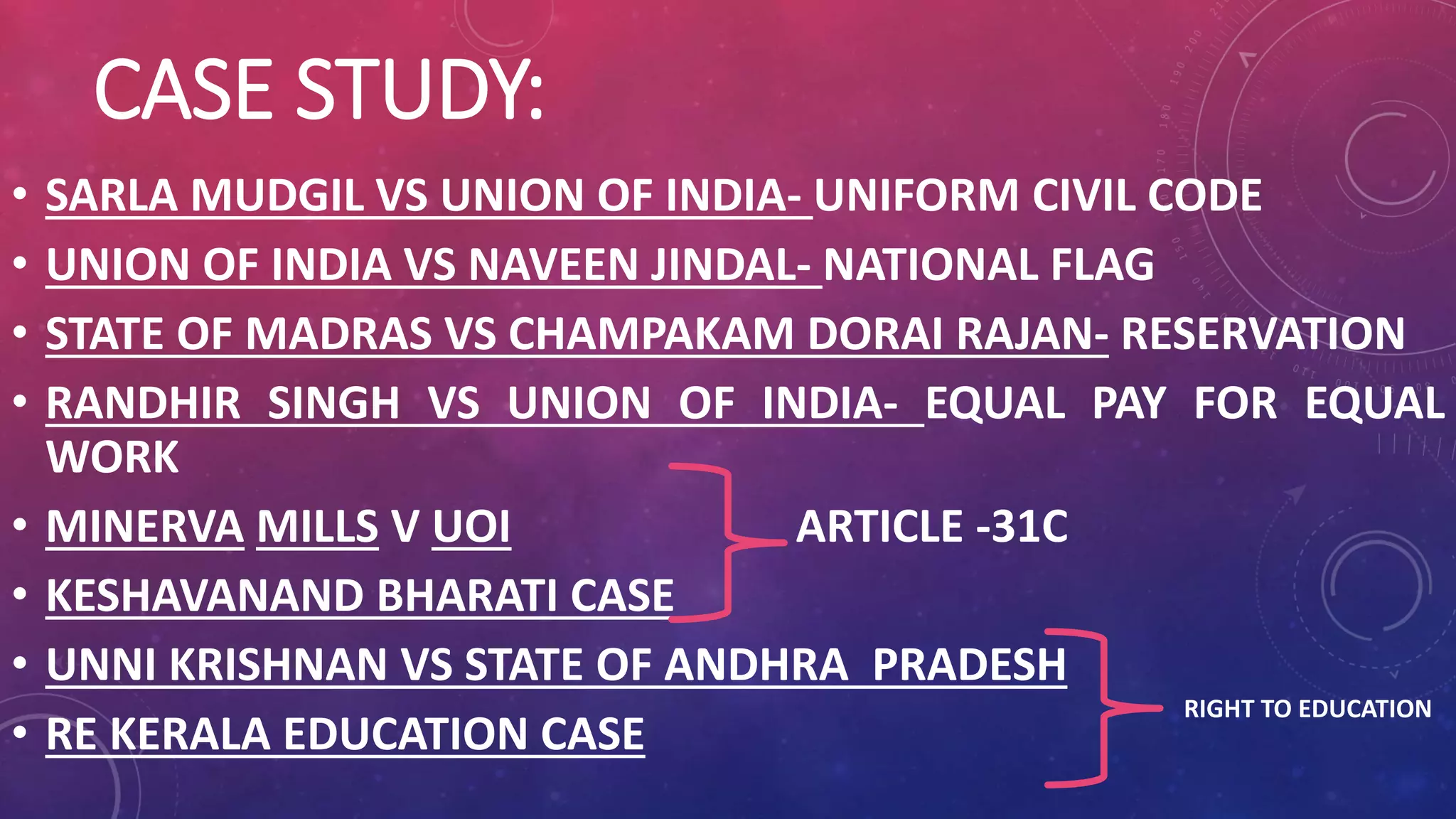
CASE STUDY:
• SARLA MUDGIL VS UNION OF INDIA- UNIFORM CIVIL CODE
• UNION OF INDIA VS NAVEEN JINDAL- NATIONAL FLAG
• STATE OF MADRAS VS CHAMPAKAM DORAI RAJAN- RESERVATION
• RANDHIR SINGH VS UNION OF INDIA- EQUAL PAY FOR EQUAL
WORK
• MINERVA MILLS V UOI ARTICLE -31C
• KESHAVANAND BHARATI CASE
• UNNI KRISHNAN VS STATE OF ANDHRA PRADESH
• RE KERALA EDUCATION CASE
RIGHT TO EDUCATION
ARTICLE-31C
4 [31C. Saving of laws giving effect to certain directive principles.—Notwithstanding
anything contained in article 13, no law giving effect to the policy of the State towards
securing 5 [all or any of the principles laid down in Part IV] shall be deemed to be void on
the ground that it is inconsistent with, or takes away or abridges any of the rights
conferred by 6 [article 14 or article 19]; 7 [and no law containing a declaration that it is for
giving effect to such policy shall be called in question in any court on the ground that it
does not give effect to such policy]:
Provided that where such law is made by the Legislature of a State, the provisions of this
article shall not apply thereto unless such law, having been reserved for the consideration
of the President, has received his assent.]
4. Ins. by the Constitution (Twenty-fifth Amendment) Act, 1971, s. 3. (w.e.f. 20-4-1972).
5. Subs. by the Constitution (Forty-second Amendment) Act, 1976, s. 4, for “the principles specified in clause (b) or clause (c) of
article 39” (w.e.f. 3-1-1977). Section 4 has been declared invalid by the Supreme Court in Minerva Mills Ltd. and others Vs. Union of
India and others (1980) s. 2, AIR 1980 SC 1789.
6. Subs. by the Constitution (Forty-fourth Amendment) Act, 1978, s. 8 for “article 14, article 19 or article 31” (w.e.f. 20-6-1979).
7. In Kesavananda Bharati Vs. the State of Kerala (1973). AIR 1973 SC 1461, the Supreme Court had held the provisions in italics to
be invalid
FUNDAMENTAL
DUTIES
ARTICLE-51A- FUNDAMENTAL DUTIES
It shall be the duty of every citizen of India—
• (a) to abide by the Constitution and respect its ideals and
institutions, the National Flag and the National Anthem;
• (b) to cherish and follow the noble ideals which inspired our
national struggle for freedom;
• (c) to uphold and protect the sovereignty, unity and integrity of
India;
• (d) to defend the country and render national service when called
upon to do so;
• (e) to promote harmony and the spirit of common brotherhood
amongst all the people of India transcending religious, linguistic
and regional or sectional diversities; to renounce practices
derogatory to the dignity of women;
• (f) to value and preserve the rich heritage of our composite
culture;
• (g) to protect and improve the natural environment including
forests, lakes, rivers and wild life, and to have compassion for
living creatures;
• (h) to develop the scientific temper, humanism and the spirit of
inquiry and reform;
• (i) to safeguard public property and to abjure violence;
• (j) to strive towards excellence in all spheres of individual and
collective activity so that the nation constantly rises to higher
levels of endeavour and achievement;
• [(k) who is a parent or guardian to provide opportunities for
education to his child or, as the case may be, ward between the
age of six and fourteen years.] – 86TH Amendment Act

Article 36- 51 A

  • 1.
    DIRECTIVE PRINCIPLES OF STATE POLICY -SHIVANI SHARMA -ASSISTANTPROFESSOR -SARDAR PATEL SUBHARTI INSTITUTE OF LAW
  • 2.
    “SOCIAL JUSTICE ISAN ATTRIBUTE OF GOD …. EVERY ACT, EVERY THOUGHT IS WEIGHED IN THE INVISIBLE BUT UNIVERSAL BALANCE-SCALES OF JUSTICE. THE DAY OF JUDGMENT IS NOT IN SOME REMOTE FUTURE BUT HERE AND NOW, AND NONE CAN ESCAPE IT. DIVINE LAWS CANNOT BE EVADED. THEY ARE NOT SO MUCH IMPOSED FROM WITHOUT AS WROUGHT INTO OUR NATURE” -RADHAKRISHNAN • The term, ‘justice’ has been used since the time immemorial in different languages, in different religions, varying from region to region. In epics and Puran ‘justice’ was interpreted differently from what today’s social scientists mean by it. • Justice is the evolution of the basic social and political institutions, particularly with respect to the consequent distributions of benefits and burdens, which are standardly expressed in terms of justice or injustice. On its most general sense the concept of justice requires that each individual has what is due to him or her.
  • 3.
    THEORY OF SOCIALJUSTICE • In the Roman-Greek tradition, it was Cicero, who elaborated the concept of social justice, when he declared, “we are born for justice, and that right is based, not upon man’s opinion, but upon nature. This fact will immediately be plain if you once get a clear conception of man’s fellowship and union with hanother”. • For Cicero, a state cannot exist on crippled conditions; in fact, “It depends upon, and acknowledges and gives effect to the consciousness of mutual obligations and the mutual recognition of rights that bind its citizen together. The state is a moral community, a group of persons who in common possess the state and its law”. That is why he called the state, “the affair of the people”. In essence, for Cicero “Justice is intrinsic goods,” which holds the people together by normal ties and rights.
  • 4.
    • The mostancient social organization through which the idea of social justice was sought to be implemented is the theory of Chaturvarnya (Varna Vyavastha), that is, the Vedic concept of society in which the people were classified into four Varnas: Brahmin, Kshatriya, Vaishya and Sudra. Though its original existence is nowhere now, and if it is, it exists in its most degenerated form, i.e., caste system; yet it was envisaged as an organization based on human nature, i.e., Guna-Karma theory, and it was meant for social harmony and justice, which also leads man to the path of Moksha – liberation from pain of birth and death.
  • 5.
    • Plato soughtsocial justice through a social order based on human nature consisting of three main faculties: the rational, spiritual and appetitive. The rational faculty is wise and its main function is to rule and command; the function of spiritual faculty is to maintain law and order in society; the appetitive faculty of human nature drives itself to the satisfaction of bodily appetites. The special qualities of a person having rational faculty are wisdom, respect, tolerance, reasoning, discipline. • Plato interlinked individual and social justice together. The individual form of justice manifests itself, when man succeeds in establishing harmony and unity among all the three qualities of wisdom, courage and appetite as inherent in his conscience. In case, the balance is upset or disturbed, the individual rushes towards lust and injustice. In a similar way, the well ordered balance of three classes of citizens in society is the basic idea of social justice • There is, some resemblance between Varna Vyavastha and Plato’s view on justice as both assigns duties to its citizen on the basis of class. In both of these social orders the state is a part and parcel of society. The idea of social justice in Varna Vyvastha leads one towards the goal of moksha and in Plato’s social order towards ‘Supreme Happiness’. In each scheme, a just man is entitled to achieve the highest goal of human life. That is Moksha or supreme happiness.
  • 6.
    • Aristotle, whois the main author of this conception (Justice), says, “Injustice arises when equals are treated unequally, and also when unequal’s are treated equally.” Justice is an equality of proportion between ‘persons’ and ‘things’ assigned to them. The ‘thing’ here may be office, honour, rank, money or any of the objects of human desire. These should be distributed, not equally, but in proportion to some quality, character or achievement of the persons concerned. • It may be birth, rank, office or wealth. It may be simply a status of a free man (as in a Greek democracy) and then the rule of proportion fails, and absolute or ‘arithmetic equality’ is substituted. Lastly it may ought to be merit. • Unlike Plato, for Aristotle, justice is inherent in morality, scientific insight and constitutional rule. He puts it into ‘general justice’, and ‘particular justice’. The former is the whole good of society; it is moral conduct, it is public good; it is virtue. This justice asks man to think not of himself but of other people. The latter is a part of the whole justice. Distributive justice, then is for Aristotle an equality in the proportion of merit to rights.
  • 7.
    • Hob house,in his monumental work, Elements of Social Justice has outlined following points as elements of social justice: (1) Institutions are not ends but means. Politics are subordinate to ethics. (2) One of the principles of harmony is that common goods cannot be opposed to individual goods nor individual set-up against the common goods. A right improves duties and is one term of a moral relation. (3) Moral freedom. (4) Social and political freedom. (5) Equality. (6) Personal justice. (7) Equal payment for equal service. (8) The assignment of property should be so conceived as to secure freedom for the individual and power for the community. (9) Social and personal factors in wealth. (10) Individual organization. (11) Democracy (Hob-house, 1922).
  • 8.
    INDIAN CONTITUTION ANDSOCIAL JUSTICE • In the context of the Constitution of India, P.B. Gajendragadkar, former Chief Justice of India, said: “The concept of social justice is (thus) a revolutionary concept which gives meaning and significance to the democratic way of life and makes the rule of law dynamic. It is this concept of social justice which creates in the minds of the masses of this country a sense of participation in the glory of India’s political freedom” • He further adds, “Social justice must be achieved by adopting necessary and reasonable measures with courage, wisdom, foresight, sense of balance and fairplay to all the interests concerned. That shortly stated, is the concept of social justice and its implications. If eternal vigilance is the price for national liberty, it is equally the price for sustaining individual freedom and liberty in welfare state”. Now but us discuss various theories of social justice.
  • 9.
    Utilitarian ism Gandhian Rawl’s Theory THEORIES OF SOCIAL JUSTICE LibertarianismExistentiani sm Self- Perfecti onism AmbedkarismMarxism
  • 11.
  • 13.
    ARTICLE-36 • 36. DefinitionIn this Part, unless the context otherwise requires, the State has the same meaning as in Part III • 37. Application of the principles contained in this Part- The provisions contained in this Part shall not be enforceable by any court, but the principles therein laid down are nevertheless fundamental in the governance of the country and it shall be the duty of the State to apply these principles in making laws • 38. State to secure a social order for the promotion of welfare of the people- (1) The State shall strive to promote the welfare of the people by securing and protecting as effectively as it may a social order in which justice, social, economic and political, shall inform all the institutions of the national life (2) The State shall, in particular, strive to minimize the inequalities in income, and endeavor to eliminate inequalities in status, facilities and opportunities, not only amongst individuals but also amongst groups of people residing in different areas or engaged in different vocations ARTICLE-37 ARTICLE-38
  • 14.
    ARTICLE-39 • Certain principlesof policy to be followed by the State: The State shall, in particular, direct its policy towards securing (a) that the citizens, men and women equally, have the right to an adequate means to livelihood; (b) that the ownership and control of the material resources of the community are so distributed as best to subserve the common good; (c) that the operation of the economic system does not result in the concentration of wealth and means of production to the common detriment; (d) that there is equal pay for equal work for both men and women; (e) that the health and strength of workers, men and women, and the tender age of children are not abused and that citizens are not forced by economic necessity to enter avocations unsuited to their age or strength; (f) that children are given opportunities and facilities to develop in a healthy manner and in conditions of freedom and dignity and that childhood and youth are protected against exploitation and against moral and material abandonment
  • 15.
    ARTICLE-40 • Organization ofvillage panchayats -The State shall take steps to organize village panchayats and endow them with such powers and authority as may be necessary to enable them to function as units of self government • Right to work, to education and to public assistance in certain cases- The State shall, within the limits of its economic capacity and development, make effective provision for securing the right to work, to education and to public assistance in cases of unemployment, old age, sickness and disablement, and in other cases of undeserved want • Provision for just and humane conditions of work and maternity relief- The State shall make provision for securing just and humane conditions of work and for maternity relief ARTICLE-42 ARTICLE-41
  • 16.
    ARTICLE-43 • Living wage,etc, for workers- The State shall endeavour to secure, by suitable legislation or economic organisation or in any other way, to all workers, agricultural, industrial or otherwise, work, a living wage, conditions of work ensuring a decent standard of life and full enjoyment of leisure and social and cultural opportunities and, in particular, the State shall endeavour to promote cottage industries on an individual or co operative basis in rural areas • 43A. Participation of workers in management of industries.—The State shall take steps, by suitable legislation or in any other way, to secure the participation of workers in the management of undertakings, establishments or other organisations engaged in any industry. • 43B. Promotion of co-operative societies.—The State shall endeavour to promote voluntary formation, autonomous functioning, democratic control and professional management of co-operative societies. ARTICLE-43A ARTICLE-43B
  • 17.
    ARTICLE-46 • The Stateshall endeavor to secure for the citizens a Uniform Civil Code throughout the territory of India. • Provision for early childhood care and education to children below the age of six years.— The State shall endeavour to provide early childhood care and education for all children until they complete the age of six years. • Promotion of educational and economic interests of Scheduled Castes, Scheduled Tribes and other weaker sections.—The State shall promote with special care the educational and economic interests of the weaker sections of the people, and, in particular, of the Scheduled Castes and the Scheduled Tribes, and shall protect them from social injustice and all forms of exploitation. ARTICLE-44 ARTICLE-45
  • 18.
    • ARTICLE-47 Duty ofthe State to raise the level of nutrition and the standard of living and to improve public health.—The State shall regard the raising of the level of nutrition and the standard of living of its people and the improvement of public health as among its primary duties and, in particular, the State shall endeavour to bring about prohibition of the consumption except for medicinal purposes of intoxicating drinks and of drugs which are injurious to health. • ARTICLE-48 Organisation of agriculture and animal husbandry.—The State shall endeavour to organise agriculture and animal husbandry on modern and scientific lines and shall, in particular, take steps for preserving and improving the breeds, and prohibiting the slaughter of cows and calves and other milch and draught cattle. • ARTICLE-48A Protection and improvement of environment and safeguarding of forests and wild life.— The State shall endeavour to protect and improve the environment and to safeguard the forests and wild life of the country
  • 19.
    • ARTICLE-49 It shallbe the obligation of the State to protect every monument or place or object of artistic or historic interest, [declared by or under law made by Parliament] to be of national importance, from spoliation, disfigurement, destruction, removal, disposal or export, as the case may be. • ARTICLE-50 The State shall take steps to separate the judiciary from the executive in the public services of the State. • ARTICLE-51 The State shall endeavour to— (a) promote international peace and security; (b) maintain just and honourable relations between nations; (c) foster respect for international law and treaty obligations in the dealings of organised peoples with one another; and (d) encourage settlement of international disputes by arbitration.
  • 20.
    CASE STUDY: • SARLAMUDGIL VS UNION OF INDIA- UNIFORM CIVIL CODE • UNION OF INDIA VS NAVEEN JINDAL- NATIONAL FLAG • STATE OF MADRAS VS CHAMPAKAM DORAI RAJAN- RESERVATION • RANDHIR SINGH VS UNION OF INDIA- EQUAL PAY FOR EQUAL WORK • MINERVA MILLS V UOI ARTICLE -31C • KESHAVANAND BHARATI CASE • UNNI KRISHNAN VS STATE OF ANDHRA PRADESH • RE KERALA EDUCATION CASE RIGHT TO EDUCATION
  • 21.
    ARTICLE-31C 4 [31C. Savingof laws giving effect to certain directive principles.—Notwithstanding anything contained in article 13, no law giving effect to the policy of the State towards securing 5 [all or any of the principles laid down in Part IV] shall be deemed to be void on the ground that it is inconsistent with, or takes away or abridges any of the rights conferred by 6 [article 14 or article 19]; 7 [and no law containing a declaration that it is for giving effect to such policy shall be called in question in any court on the ground that it does not give effect to such policy]: Provided that where such law is made by the Legislature of a State, the provisions of this article shall not apply thereto unless such law, having been reserved for the consideration of the President, has received his assent.] 4. Ins. by the Constitution (Twenty-fifth Amendment) Act, 1971, s. 3. (w.e.f. 20-4-1972). 5. Subs. by the Constitution (Forty-second Amendment) Act, 1976, s. 4, for “the principles specified in clause (b) or clause (c) of article 39” (w.e.f. 3-1-1977). Section 4 has been declared invalid by the Supreme Court in Minerva Mills Ltd. and others Vs. Union of India and others (1980) s. 2, AIR 1980 SC 1789. 6. Subs. by the Constitution (Forty-fourth Amendment) Act, 1978, s. 8 for “article 14, article 19 or article 31” (w.e.f. 20-6-1979). 7. In Kesavananda Bharati Vs. the State of Kerala (1973). AIR 1973 SC 1461, the Supreme Court had held the provisions in italics to be invalid
  • 22.
  • 23.
    ARTICLE-51A- FUNDAMENTAL DUTIES Itshall be the duty of every citizen of India— • (a) to abide by the Constitution and respect its ideals and institutions, the National Flag and the National Anthem; • (b) to cherish and follow the noble ideals which inspired our national struggle for freedom; • (c) to uphold and protect the sovereignty, unity and integrity of India; • (d) to defend the country and render national service when called upon to do so; • (e) to promote harmony and the spirit of common brotherhood amongst all the people of India transcending religious, linguistic and regional or sectional diversities; to renounce practices derogatory to the dignity of women;
  • 24.
    • (f) tovalue and preserve the rich heritage of our composite culture; • (g) to protect and improve the natural environment including forests, lakes, rivers and wild life, and to have compassion for living creatures; • (h) to develop the scientific temper, humanism and the spirit of inquiry and reform; • (i) to safeguard public property and to abjure violence; • (j) to strive towards excellence in all spheres of individual and collective activity so that the nation constantly rises to higher levels of endeavour and achievement; • [(k) who is a parent or guardian to provide opportunities for education to his child or, as the case may be, ward between the age of six and fourteen years.] – 86TH Amendment Act