Introduction
        Dr. R.A. Mashelkar in his article
        published in Journal of Chartered
        Secretary felt that
          “Twenty   first century will be the
           century of Knowledge, indeed a
           century of mind;
          A nation’s ability to convert knowledge
           into wealth will determine its future”
        Human intellect is praised in the
         present society.
        Intellect only distinguishes humans
         from other animals.
Meaning
           New ideas, innovations are the out
            come of manipulation of human
            mental activity. The resulting human
            intelligence is known as Intellectual
            property.
           IP is created by human intelligence or
            mental labour
           It is in intangible form; it can be
            reproduced in tangible form.
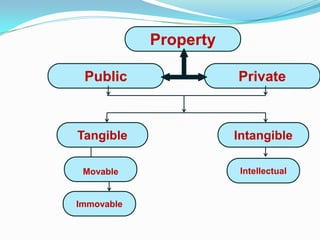
Property

 Public                Private


Tangible               Intangible

 Movable                Intellectual


Immovable
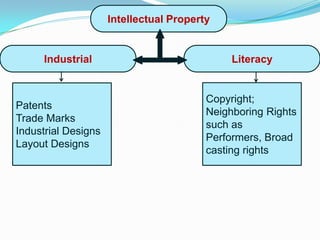
Intellectual Property


     Industrial                               Literacy


                                         Copyright;
Patents
                                         Neighboring Rights
Trade Marks
                                         such as
Industrial Designs
                                         Performers, Broad
Layout Designs
                                         casting rights
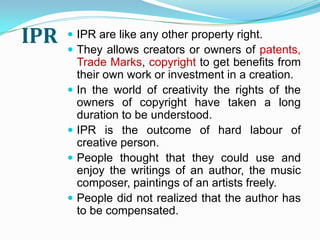
IPR    IPR are like any other property right.
       They allows creators or owners of patents,
          Trade Marks, copyright to get benefits from
          their own work or investment in a creation.
         In the world of creativity the rights of the
          owners of copyright have taken a long
          duration to be understood.
         IPR is the outcome of hard labour of
          creative person.
         People thought that they could use and
          enjoy the writings of an author, the music
          composer, paintings of an artists freely.
         People did not realized that the author has
          to be compensated.
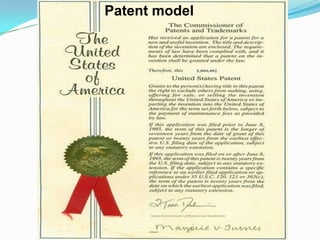
Patent model
Need for Protection of IP
      To protect the intellect property of the creator, so
       that no body can enjoy the fruits of other’s efforts.
             Patent rights to inventors
             Registration of designs
             New logos, marks as Trade marks
             Literature,    cinema,     musical records,    computer
              programs, can be registered for their legal protection –
              Copyright
      To achieve the progress of human beings
      Legal protection encourages creativity
      It spurs economic growth – nation’s growth
      Some intellectual thoughts need to be restricted
World Intellectual Property
Organization- WIPO
      In 1873, “International Exhibition of Inventions”
       in Vienna. Foreign exhibitors refused to
       participate.
      This felt the need for protect of IP
      1886 – Paris Convention was organized for
       the protection of Industrial property.
        It was the first treaty designed to help the people
         of one country to obtain protection in other
         country for their intellectual creations in the form
         of industrial property rights
 1886- Berne Convention, France
    It was aimed to obtain international protection of
     author’s right to control and receive payment for their
     creative work.
    This convention set up a Bureau called “Bureau for the
     Protection of Intellectual Property” (BIRPI- French
     acronym)
    The name changed as WIPO in 1970 and become
     specialized agency of UNO in 1974.
    WIPO has membership of more than 175 countries.
    WIPONET started in 1998, Jan 21 which provides
     network infrastructure & services for the information
     exchange. Derives practical benefits
Objectives of WIPO
     To harmonize IP legislations and procedures
     To provide services for international application for
        the industrial property rights
       To exchange IP information
       To provide legal and technical assistance to
        developing & underdeveloped countries.
       To facilitate the resolution of private intellectual
        property disputes
       To marshal information technology as a tool for
        storing, accessing and using valuable IP
        information
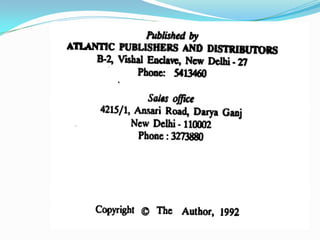
Copyright
   People enjoy literary works without compensating
      the original creator
     1886 Berne convention was held to protect the
      literary work.
     USA (1952), USSR (1973)
     Some countries are not aware of Copyright
     In India, law is weak
     Copyright is an exclusive right given by the law for a
      certain term of years to an author, who can be a
      writer, composer, designer.
Meaning
     According to Copyright Act, 1957 of India,
          “the exclusive right subject to the provision of
     this act, to do or authorise the doing of any of the
     following acts in respect of a work or any
     substantial       part     there     of      namely
     literary,      dramatic,   musical        work     to
     reproduce, copy, perform, communicate, making
     cinematographic films, translations, make adaption
     of the work”
 Copyright provides the following rights
   The right to copy
   Derivative work
   Distribution
   Right     to   perform    the    work   publicly   –
    drama, painting, sound recording
 It is not the idea that the copyright protects
 Idea should fixed in a particular form
   Author thoughts on story
   Idea of painting a sunrise
 Copyright   commences      since   the
 completion of the work as an expression
 of the idea.
Particulars under Copyright
     Literary works
        Novels, short stories, poems
        Irrespective of the content (fiction & non-
         fiction),             length,           purpose
         (amusement, education, information, advertisemen
         t,         propaganda          etc),         form
         (published, unpublished, oral)
     Musical works
       Serious                                       or
        light, songs, choruses, operas, solos, with few
        instruments, many (bands, orchestras)
     Artistic works
        2D (drawings, paintings, lithographs, etchings,, 3D
         (sculptures, architectural works)
 Photographic works
    Irrespective        of       subject      matter
     (portraits, landscapes, current events etc) and
     purposes
 Motion pictures
    Whether silent or sound tracks, irrespective of purposes
     (theatrical exhibition, TV broadcasting) their genre
     (film, documentaries, newsreels, serials etc), techniques
     (filming live, cartoons, 3D) technical process used (video
     tapes, DVD etc)
 Dramatic work – plays
 Choreographic works –
    ballet, classical or modern
 Computer programs
 Works of applied art
    Artistic, Jewellary, wallpapers etc. some related to
     phonograph records etc
Copyright Infringement
 Copyright infringement is the unauthorized use of
 works under copyright, infringing the copyright
 holder's "exclusive rights"
Copyright infringement
    Downloading and sharing MP3 files of music, videos and
       games without permission of the copyright owner.
      Using corporate logos without permission.
      Scanning a photograph that has been published and using it
       without permission or attribution.
      Placing a number of full-text articles on a course web page
       and allowing the web page to be accessible to anyone who
       can access the Internet.
      Downloading licensed software from non-authorized sites
       without the permission of the copyright or license holder.
      Making a movie file or a large segment of a movie available
       on a web site without permission of the copyright owner
Plagiarism
 The practice of taking someone else's work or ideas
  and passing them off as one's own.
 This     is   the    major     issue   in   scientific
  publications/scholarly publication.
 How to avoid it?
Geographical Indications
       It is a sign used on goods that have a specific
          geographical origin and possess qualities or a
          reputation that are due solely to the place of
          origin.
         Exp:          goods        from        specific
          climate, soil, methods of production
         Such goods enjoys an advantage over
          competing goods.
         GI is becomes a kind of IP and is protected.
         GI is different from Trademark
         GI merely tells about product and its origin
GI    Paris convention for the protection of
       GI uses two terms
        Designation of origin
        Indication of the source
            The product originates in the place
             indicated.
            It not only indicates the origin of the
             product but also the quality link between
             the product and place
            GI can be registered
Other IP instruments
 Trademarks
 Patents
 Layout design – new area of IP.
    Design of IC chip circuits – Programming instruction
     can be protected
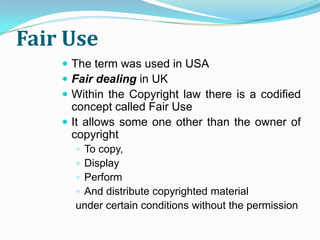
Fair Use
     The term was used in USA
     Fair dealing in UK
     Within the Copyright law there is a codified
      concept called Fair Use
     It allows some one other than the owner of
      copyright
       To copy,
       Display
       Perform
       And distribute copyrighted material
      under certain conditions without the permission
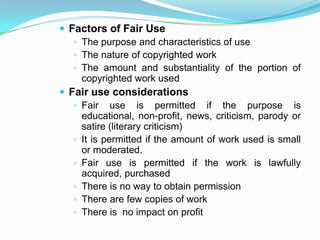
 Factors of Fair Use
    The purpose and characteristics of use
    The nature of copyrighted work
    The amount and substantiality of the portion of
     copyrighted work used
 Fair use considerations
    Fair use is permitted if the purpose is
     educational, non-profit, news, criticism, parody or
     satire (literary criticism)
    It is permitted if the amount of work used is small
     or moderated.
    Fair use is permitted if the work is lawfully
     acquired, purchased
    There is no way to obtain permission
    There are few copies of work
    There is no impact on profit
IPR Issues

IPR Issues

  • 2.
    Introduction  Dr. R.A. Mashelkar in his article published in Journal of Chartered Secretary felt that  “Twenty first century will be the century of Knowledge, indeed a century of mind;  A nation’s ability to convert knowledge into wealth will determine its future”  Human intellect is praised in the present society.  Intellect only distinguishes humans from other animals.
  • 3.
    Meaning  New ideas, innovations are the out come of manipulation of human mental activity. The resulting human intelligence is known as Intellectual property.  IP is created by human intelligence or mental labour  It is in intangible form; it can be reproduced in tangible form.
  • 4.
    Property Public Private Tangible Intangible Movable Intellectual Immovable
  • 5.
    Intellectual Property Industrial Literacy Copyright; Patents Neighboring Rights Trade Marks such as Industrial Designs Performers, Broad Layout Designs casting rights
  • 6.
    IPR  IPR are like any other property right.  They allows creators or owners of patents, Trade Marks, copyright to get benefits from their own work or investment in a creation.  In the world of creativity the rights of the owners of copyright have taken a long duration to be understood.  IPR is the outcome of hard labour of creative person.  People thought that they could use and enjoy the writings of an author, the music composer, paintings of an artists freely.  People did not realized that the author has to be compensated.
  • 10.
  • 11.
    Need for Protectionof IP  To protect the intellect property of the creator, so that no body can enjoy the fruits of other’s efforts.  Patent rights to inventors  Registration of designs  New logos, marks as Trade marks  Literature, cinema, musical records, computer programs, can be registered for their legal protection – Copyright  To achieve the progress of human beings  Legal protection encourages creativity  It spurs economic growth – nation’s growth  Some intellectual thoughts need to be restricted
  • 12.
    World Intellectual Property Organization-WIPO  In 1873, “International Exhibition of Inventions” in Vienna. Foreign exhibitors refused to participate.  This felt the need for protect of IP  1886 – Paris Convention was organized for the protection of Industrial property.  It was the first treaty designed to help the people of one country to obtain protection in other country for their intellectual creations in the form of industrial property rights
  • 13.
     1886- BerneConvention, France  It was aimed to obtain international protection of author’s right to control and receive payment for their creative work.  This convention set up a Bureau called “Bureau for the Protection of Intellectual Property” (BIRPI- French acronym)  The name changed as WIPO in 1970 and become specialized agency of UNO in 1974.  WIPO has membership of more than 175 countries.  WIPONET started in 1998, Jan 21 which provides network infrastructure & services for the information exchange. Derives practical benefits
  • 14.
    Objectives of WIPO  To harmonize IP legislations and procedures  To provide services for international application for the industrial property rights  To exchange IP information  To provide legal and technical assistance to developing & underdeveloped countries.  To facilitate the resolution of private intellectual property disputes  To marshal information technology as a tool for storing, accessing and using valuable IP information
  • 15.
    Copyright People enjoy literary works without compensating the original creator  1886 Berne convention was held to protect the literary work.  USA (1952), USSR (1973)  Some countries are not aware of Copyright  In India, law is weak  Copyright is an exclusive right given by the law for a certain term of years to an author, who can be a writer, composer, designer.
  • 16.
    Meaning  According to Copyright Act, 1957 of India, “the exclusive right subject to the provision of this act, to do or authorise the doing of any of the following acts in respect of a work or any substantial part there of namely literary, dramatic, musical work to reproduce, copy, perform, communicate, making cinematographic films, translations, make adaption of the work”
  • 17.
     Copyright providesthe following rights  The right to copy  Derivative work  Distribution  Right to perform the work publicly – drama, painting, sound recording
  • 18.
     It isnot the idea that the copyright protects  Idea should fixed in a particular form  Author thoughts on story  Idea of painting a sunrise  Copyright commences since the completion of the work as an expression of the idea.
  • 19.
    Particulars under Copyright  Literary works  Novels, short stories, poems  Irrespective of the content (fiction & non- fiction), length, purpose (amusement, education, information, advertisemen t, propaganda etc), form (published, unpublished, oral)  Musical works  Serious or light, songs, choruses, operas, solos, with few instruments, many (bands, orchestras)  Artistic works  2D (drawings, paintings, lithographs, etchings,, 3D (sculptures, architectural works)
  • 20.
     Photographic works  Irrespective of subject matter (portraits, landscapes, current events etc) and purposes  Motion pictures  Whether silent or sound tracks, irrespective of purposes (theatrical exhibition, TV broadcasting) their genre (film, documentaries, newsreels, serials etc), techniques (filming live, cartoons, 3D) technical process used (video tapes, DVD etc)  Dramatic work – plays  Choreographic works –  ballet, classical or modern  Computer programs  Works of applied art  Artistic, Jewellary, wallpapers etc. some related to phonograph records etc
  • 21.
    Copyright Infringement  Copyrightinfringement is the unauthorized use of works under copyright, infringing the copyright holder's "exclusive rights"
  • 22.
    Copyright infringement  Downloading and sharing MP3 files of music, videos and games without permission of the copyright owner.  Using corporate logos without permission.  Scanning a photograph that has been published and using it without permission or attribution.  Placing a number of full-text articles on a course web page and allowing the web page to be accessible to anyone who can access the Internet.  Downloading licensed software from non-authorized sites without the permission of the copyright or license holder.  Making a movie file or a large segment of a movie available on a web site without permission of the copyright owner
  • 23.
    Plagiarism  The practiceof taking someone else's work or ideas and passing them off as one's own.  This is the major issue in scientific publications/scholarly publication.  How to avoid it?
  • 24.
    Geographical Indications  It is a sign used on goods that have a specific geographical origin and possess qualities or a reputation that are due solely to the place of origin.  Exp: goods from specific climate, soil, methods of production  Such goods enjoys an advantage over competing goods.  GI is becomes a kind of IP and is protected.  GI is different from Trademark  GI merely tells about product and its origin
  • 25.
    GI  Paris convention for the protection of GI uses two terms  Designation of origin  Indication of the source  The product originates in the place indicated.  It not only indicates the origin of the product but also the quality link between the product and place  GI can be registered
  • 26.
    Other IP instruments Trademarks  Patents  Layout design – new area of IP.  Design of IC chip circuits – Programming instruction can be protected
  • 27.
    Fair Use  The term was used in USA  Fair dealing in UK  Within the Copyright law there is a codified concept called Fair Use  It allows some one other than the owner of copyright  To copy,  Display  Perform  And distribute copyrighted material under certain conditions without the permission
  • 28.
     Factors ofFair Use  The purpose and characteristics of use  The nature of copyrighted work  The amount and substantiality of the portion of copyrighted work used  Fair use considerations  Fair use is permitted if the purpose is educational, non-profit, news, criticism, parody or satire (literary criticism)  It is permitted if the amount of work used is small or moderated.  Fair use is permitted if the work is lawfully acquired, purchased  There is no way to obtain permission  There are few copies of work  There is no impact on profit