
Cervical Radicular Pain
IN THE NAME OF GOD
DR Mohsen Abad
Pain fellowship
Introduction
pain perceived in the upper
limb, shooting or electric in
quality, caused by irritation
and or injury of a cervical
spinal nerve
DR Mohsen Abad
International
Association for the Study of Pain
cervical radicular pain is
defined as pain perceived as
arising in the upper limb
caused by ectopic activation
of nociceptive afferent fibers
in a spinal nerve or its roots
or other neuropathic
mechanisms
DR Mohsen Abad
Definition
• Cervical radicular pain must be
distinguished from cervical
radiculopathy.
• In the latter disorder there is
an objective loss of sensory
and/or motor function
• Radicular pain and
radiculopathy are not
synonymous
DR Mohsen Abad
Definition
• Radicular pain is a symptom
that is caused by ectopic
impulse formation, while
radiculopathy also includes
neurologic signs such as
sensory or motor changes
• These two disorders may occur
simultaneously.
DR Mohsen Abad
Diagnosis
• characterized by pain in the neck that
radiates over the posterior shoulder
into the arm and sometimes into the
hand
• The radiation follows a segment –
specific pattern.
• Pain from various dermatomes can
overlap and there is no specific region
of the arm
DR Mohsen Abad
Diagnosis
• Pain originating from C4 is confined to
the neck and suprascapular region
• C5 radiates up to the upper arm
• C6 and C7 radiates from the neck to
the shoulder, the forearm, and the
hand
DR Mohsen Abad
Diagnosis
• Radicular pain is not limited to a
particular dermatome and can be
perceived in all structures that are
innervated by the affected nerve
roots such as muscles, joints,
ligaments, and the skin
DR Mohsen Abad
Physical examination
• there is no gold standard for the
diagnosis of cervical radicular pain
• Diagnosis is made based on a
combination of history, clinical
examination, and additional test
• Sensation, strength, and tendon reflexes.
DR Mohsen Abad
Specific clinical tests
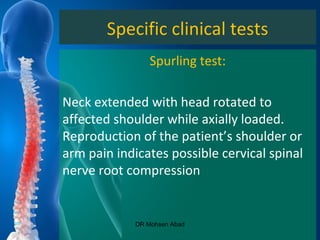
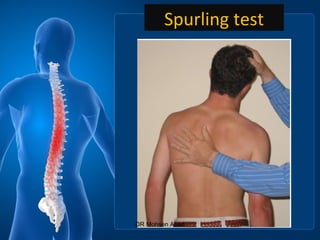
Spurling test:
Neck extended with head rotated to
affected shoulder while axially loaded.
Reproduction of the patient’s shoulder or
arm pain indicates possible cervical spinal
nerve root compression
DR Mohsen Abad
Spurling test
DR Mohsen Abad
Specific clinical tests
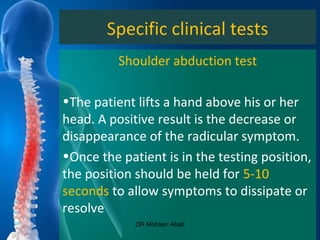
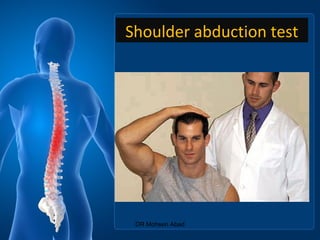
Shoulder abduction test
•The patient lifts a hand above his or her
head. A positive result is the decrease or
disappearance of the radicular symptom.
•Once the patient is in the testing position,
the position should be held for 5-10
seconds to allow symptoms to dissipate or
resolve
DR Mohsen Abad
Shoulder abduction test
DR Mohsen Abad
Specific clinical tests
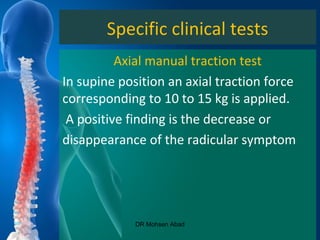
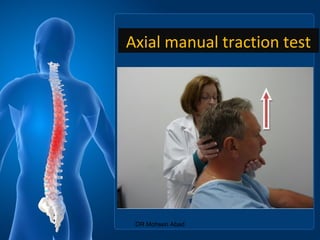
Axial manual traction test
In supine position an axial traction force
corresponding to 10 to 15 kg is applied.
A positive finding is the decrease or
disappearance of the radicular symptom
DR Mohsen Abad
Axial manual traction test
DR Mohsen Abad
Specific clinical tests
• All of these tests have a high specifi city
(81% to 100%) but a low sensitivity.
• The Spurling test was similarly evaluated
using electromyography as the reference
test
• These three examinations are
considered valuable aids in the clinical
diagnosis of a patient with neck and arm
pain.
DR Mohsen Abad
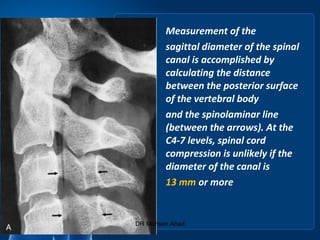
Measurement of the
sagittal diameter of the spinal
canal is accomplished by
calculating the distance
between the posterior surface
of the vertebral body
and the spinolaminar line
(between the arrows). At the
C4-7 levels, spinal cord
compression is unlikely if the
diameter of the canal is
13 mm or more
DR Mohsen Abad
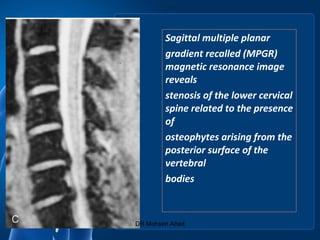
Sagittal multiple planar
gradient recalled (MPGR)
magnetic resonance image
reveals
stenosis of the lower cervical
spine related to the presence
of
osteophytes arising from the
posterior surface of the
vertebral
bodies
DR Mohsen Abad
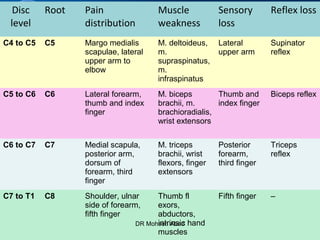
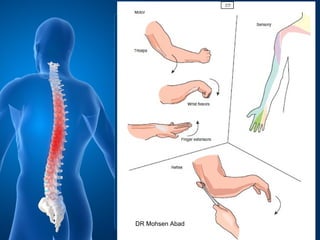
Disc
level
Root Pain
distribution
Muscle
weakness
Sensory
loss
Reflex loss
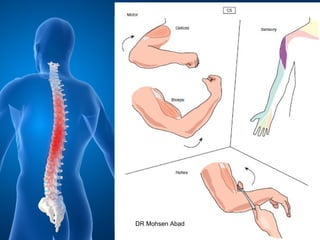
C4 to C5 C5 Margo medialis
scapulae, lateral
upper arm to
elbow
M. deltoideus,
m.
supraspinatus,
m.
infraspinatus
Lateral
upper arm
Supinator
reflex
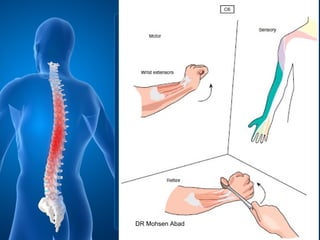
C5 to C6 C6 Lateral forearm,
thumb and index
finger
M. biceps
brachii, m.
brachioradialis,
wrist extensors
Thumb and
index finger
Biceps reflex
C6 to C7 C7 Medial scapula,
posterior arm,
dorsum of
forearm, third
finger
M. triceps
brachii, wrist
flexors, finger
extensors
Posterior
forearm,
third finger
Triceps
reflex
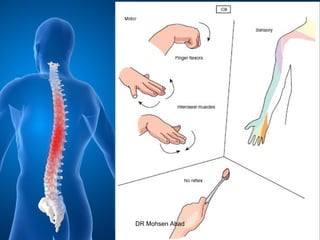
C7 to T1 C8 Shoulder, ulnar
side of forearm,
fifth finger
Thumb fl
exors,
abductors,
intrinsic hand
muscles
Fifth finger –
DR Mohsen Abad
DR Mohsen Abad
DR Mohsen Abad
DR Mohsen Abad
DR Mohsen Abad
Medical imaging
• used to exclude primary pathologies, the
so - called “ red flags ”
• tumor, infection, and fractures
• CT scans are able to reproduce the
changes in bone structure more
sensitively than MRI.
• MRI is currently regarded as the most
suitable medical imaging technique for
patients with cervical radicular pain
DR Mohsen Abad
Medical imaging
• no data available regarding the
sensitivity and specificity of the various
imaging techniques
• A direct link between the pain syndrome
and the results of medical imaging does
not exist
DR Mohsen Abad
Electrophysiologic tests
• can be requested when nerve damage is
suspected but will not provide any
information about the pain
• Quantitative Sensory Testing (QST) has
been recommended in the literature as
an electrophysiologic test that can
provide more specific information about
pain
DR Mohsen Abad
Diagnostic selective nerve root
blocks
• The diagnostic blocks are applied in
separate sessions per level
• Under radiological visualization using a
contrast dye (fluoroscopy), a small
amount of local anesthetic is injected
(0.5 mL)
• During a period of 30 to 60 minutes after
injection, the pain score is evaluated at
regular time intervals. When there is at
least a 50% decrease in pain,DR Mohsen Abad
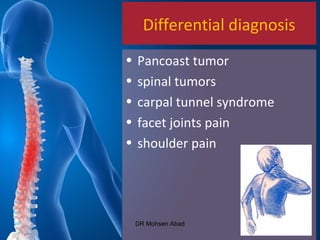
Differential diagnosis
• Pancoast tumor
• spinal tumors
• carpal tunnel syndrome
• facet joints pain
• shoulder pain
DR Mohsen Abad
Treatment options
Conservative management
•NSAIDS medications are primarily
recommended for short - term treatment
•Anticonvulsants: such as carbamazepine,
oxcarbamazepine , gabapentin, and
pregabalin
•Cochrane review: patient education for
neck pain: does not show effectiveness
•Cochrane review: mechanical traction for
neck pain: no evidence to supportDR Mohsen Abad
Treatment options
Conservative management
Multidisciplinary rehabilitation with
physiotherapy is recommended
DR Mohsen Abad
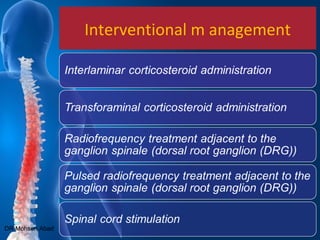
Interventional m anagement
DR Mohsen Abad
Epidural corticosteroid administration
• Rely on the anti - inflammatory
response induced by inhibition
of the phospholipase A2 -
initiated arachidonic acid
cascade
• There are no direct
comparisons available between
interlaminar and
transforaminal administration
at a cervical level.DR Mohsen Abad
Epidural corticosteroid administration
• randomized study comparing
interlaminar and intramuscular
corticosteroid administration
found that 68% significant pain
relief lasting at least 1 year
compared to 12% in the group
treated intramuscularly.
DR Mohsen Abad
Interlaminar administration:
complications
• Minor complications that
spontaneously disappeared,
often within 24 hours :
increasing axial neck pain,
• posture - independent
headache,
• facial flushing,
• vasovagal episodes
DR Mohsen Abad
Interlaminar administration:
complications
Major complications included:
•epidural hematoma
•accidental subdural injection
with, as a result, hypoventilation
and hypotension
•Root damge.
DR Mohsen Abad
Practical recommendations
• The positive RCT for interlaminar
administration
• There are no studies which have
investigated the effectiveness of
the various depot corticosteroids
• The particle size of the depot
corticosteroid is possibly related to
the reported neurologic
complications
• Currently there is no evidence that
a higher dose of corticosteroids will
result in a better clinical effect.
DR Mohsen Abad
(Pulsed) radiofrequency treatment
Complications:
•transient neuritis
•burning sensation
•a slight loss of muscular
strength in the hand and arm of
the treated side was reported
DR Mohsen Abad
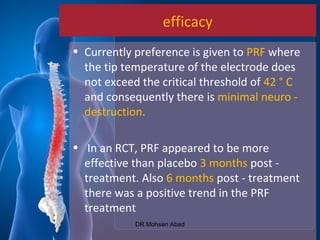
efficacy
• Currently preference is given to PRF where
the tip temperature of the electrode does
not exceed the critical threshold of 42 ° C
and consequently there is minimal neuro -
destruction.
• In an RCT, PRF appeared to be more
effective than placebo 3 months post -
treatment. Also 6 months post - treatment
there was a positive trend in the PRF
treatment
DR Mohsen Abad
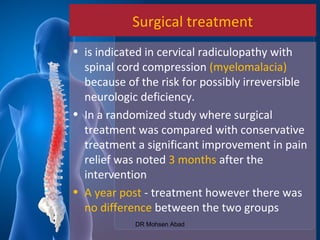
Surgical treatment
• is indicated in cervical radiculopathy with
spinal cord compression (myelomalacia)
because of the risk for possibly irreversible
neurologic deficiency.
• In a randomized study where surgical
treatment was compared with conservative
treatment a significant improvement in pain
relief was noted 3 months after the
intervention
• A year post - treatment however there was
no difference between the two groups
DR Mohsen Abad
Spinal cord stimulation
• Up until now there is no literature on the
outcome of SCS in the treatment of cervical
radicular pain.
• SCS can be considered in clinical practice for
chronic cervical radicular pain in well -
selected patients when other types of
treatment have failed, given that the efficacy
has been demonstrated in other comparable
neuropathic pain syndromes
DR Mohsen Abad
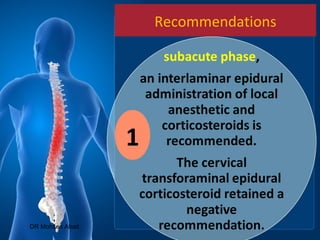
Recommendations
1
DR Mohsen Abad
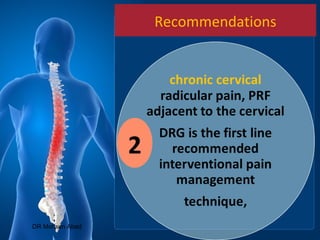
Recommendations
2
DR Mohsen Abad
Recommendations
3
DR Mohsen Abad
references
• Evidence-Based Interventional Pain
Medicine (2012)
• Third Edition (Third Edition)
DR Mohsen Abad
DR Mohsen Abad

Cervical radicular pain

  • 1.
    Cervical Radicular Pain INTHE NAME OF GOD DR Mohsen Abad Pain fellowship
  • 2.
    Introduction pain perceived inthe upper limb, shooting or electric in quality, caused by irritation and or injury of a cervical spinal nerve DR Mohsen Abad
  • 3.
    International Association for theStudy of Pain cervical radicular pain is defined as pain perceived as arising in the upper limb caused by ectopic activation of nociceptive afferent fibers in a spinal nerve or its roots or other neuropathic mechanisms DR Mohsen Abad
  • 4.
    Definition • Cervical radicularpain must be distinguished from cervical radiculopathy. • In the latter disorder there is an objective loss of sensory and/or motor function • Radicular pain and radiculopathy are not synonymous DR Mohsen Abad
  • 5.
    Definition • Radicular painis a symptom that is caused by ectopic impulse formation, while radiculopathy also includes neurologic signs such as sensory or motor changes • These two disorders may occur simultaneously. DR Mohsen Abad
  • 6.
    Diagnosis • characterized bypain in the neck that radiates over the posterior shoulder into the arm and sometimes into the hand • The radiation follows a segment – specific pattern. • Pain from various dermatomes can overlap and there is no specific region of the arm DR Mohsen Abad
  • 7.
    Diagnosis • Pain originatingfrom C4 is confined to the neck and suprascapular region • C5 radiates up to the upper arm • C6 and C7 radiates from the neck to the shoulder, the forearm, and the hand DR Mohsen Abad
  • 8.
    Diagnosis • Radicular painis not limited to a particular dermatome and can be perceived in all structures that are innervated by the affected nerve roots such as muscles, joints, ligaments, and the skin DR Mohsen Abad
  • 9.
    Physical examination • thereis no gold standard for the diagnosis of cervical radicular pain • Diagnosis is made based on a combination of history, clinical examination, and additional test • Sensation, strength, and tendon reflexes. DR Mohsen Abad
  • 10.
    Specific clinical tests Spurlingtest: Neck extended with head rotated to affected shoulder while axially loaded. Reproduction of the patient’s shoulder or arm pain indicates possible cervical spinal nerve root compression DR Mohsen Abad
  • 11.
  • 12.
    Specific clinical tests Shoulderabduction test •The patient lifts a hand above his or her head. A positive result is the decrease or disappearance of the radicular symptom. •Once the patient is in the testing position, the position should be held for 5-10 seconds to allow symptoms to dissipate or resolve DR Mohsen Abad
  • 13.
  • 14.
    Specific clinical tests Axialmanual traction test In supine position an axial traction force corresponding to 10 to 15 kg is applied. A positive finding is the decrease or disappearance of the radicular symptom DR Mohsen Abad
  • 15.
    Axial manual tractiontest DR Mohsen Abad
  • 16.
    Specific clinical tests •All of these tests have a high specifi city (81% to 100%) but a low sensitivity. • The Spurling test was similarly evaluated using electromyography as the reference test • These three examinations are considered valuable aids in the clinical diagnosis of a patient with neck and arm pain. DR Mohsen Abad
  • 17.
    Measurement of the sagittaldiameter of the spinal canal is accomplished by calculating the distance between the posterior surface of the vertebral body and the spinolaminar line (between the arrows). At the C4-7 levels, spinal cord compression is unlikely if the diameter of the canal is 13 mm or more DR Mohsen Abad
  • 18.
    Sagittal multiple planar gradientrecalled (MPGR) magnetic resonance image reveals stenosis of the lower cervical spine related to the presence of osteophytes arising from the posterior surface of the vertebral bodies DR Mohsen Abad
  • 19.
    Disc level Root Pain distribution Muscle weakness Sensory loss Reflex loss C4to C5 C5 Margo medialis scapulae, lateral upper arm to elbow M. deltoideus, m. supraspinatus, m. infraspinatus Lateral upper arm Supinator reflex C5 to C6 C6 Lateral forearm, thumb and index finger M. biceps brachii, m. brachioradialis, wrist extensors Thumb and index finger Biceps reflex C6 to C7 C7 Medial scapula, posterior arm, dorsum of forearm, third finger M. triceps brachii, wrist flexors, finger extensors Posterior forearm, third finger Triceps reflex C7 to T1 C8 Shoulder, ulnar side of forearm, fifth finger Thumb fl exors, abductors, intrinsic hand muscles Fifth finger – DR Mohsen Abad
  • 20.
  • 21.
  • 22.
  • 23.
  • 24.
    Medical imaging • usedto exclude primary pathologies, the so - called “ red flags ” • tumor, infection, and fractures • CT scans are able to reproduce the changes in bone structure more sensitively than MRI. • MRI is currently regarded as the most suitable medical imaging technique for patients with cervical radicular pain DR Mohsen Abad
  • 25.
    Medical imaging • nodata available regarding the sensitivity and specificity of the various imaging techniques • A direct link between the pain syndrome and the results of medical imaging does not exist DR Mohsen Abad
  • 26.
    Electrophysiologic tests • canbe requested when nerve damage is suspected but will not provide any information about the pain • Quantitative Sensory Testing (QST) has been recommended in the literature as an electrophysiologic test that can provide more specific information about pain DR Mohsen Abad
  • 27.
    Diagnostic selective nerveroot blocks • The diagnostic blocks are applied in separate sessions per level • Under radiological visualization using a contrast dye (fluoroscopy), a small amount of local anesthetic is injected (0.5 mL) • During a period of 30 to 60 minutes after injection, the pain score is evaluated at regular time intervals. When there is at least a 50% decrease in pain,DR Mohsen Abad
  • 28.
    Differential diagnosis • Pancoasttumor • spinal tumors • carpal tunnel syndrome • facet joints pain • shoulder pain DR Mohsen Abad
  • 29.
    Treatment options Conservative management •NSAIDSmedications are primarily recommended for short - term treatment •Anticonvulsants: such as carbamazepine, oxcarbamazepine , gabapentin, and pregabalin •Cochrane review: patient education for neck pain: does not show effectiveness •Cochrane review: mechanical traction for neck pain: no evidence to supportDR Mohsen Abad
  • 30.
    Treatment options Conservative management Multidisciplinaryrehabilitation with physiotherapy is recommended DR Mohsen Abad
  • 31.
  • 32.
    Epidural corticosteroid administration •Rely on the anti - inflammatory response induced by inhibition of the phospholipase A2 - initiated arachidonic acid cascade • There are no direct comparisons available between interlaminar and transforaminal administration at a cervical level.DR Mohsen Abad
  • 33.
    Epidural corticosteroid administration •randomized study comparing interlaminar and intramuscular corticosteroid administration found that 68% significant pain relief lasting at least 1 year compared to 12% in the group treated intramuscularly. DR Mohsen Abad
  • 34.
    Interlaminar administration: complications • Minorcomplications that spontaneously disappeared, often within 24 hours : increasing axial neck pain, • posture - independent headache, • facial flushing, • vasovagal episodes DR Mohsen Abad
  • 35.
    Interlaminar administration: complications Major complicationsincluded: •epidural hematoma •accidental subdural injection with, as a result, hypoventilation and hypotension •Root damge. DR Mohsen Abad
  • 36.
    Practical recommendations • Thepositive RCT for interlaminar administration • There are no studies which have investigated the effectiveness of the various depot corticosteroids • The particle size of the depot corticosteroid is possibly related to the reported neurologic complications • Currently there is no evidence that a higher dose of corticosteroids will result in a better clinical effect. DR Mohsen Abad
  • 37.
    (Pulsed) radiofrequency treatment Complications: •transientneuritis •burning sensation •a slight loss of muscular strength in the hand and arm of the treated side was reported DR Mohsen Abad
  • 38.
    efficacy • Currently preferenceis given to PRF where the tip temperature of the electrode does not exceed the critical threshold of 42 ° C and consequently there is minimal neuro - destruction. • In an RCT, PRF appeared to be more effective than placebo 3 months post - treatment. Also 6 months post - treatment there was a positive trend in the PRF treatment DR Mohsen Abad
  • 39.
    Surgical treatment • isindicated in cervical radiculopathy with spinal cord compression (myelomalacia) because of the risk for possibly irreversible neurologic deficiency. • In a randomized study where surgical treatment was compared with conservative treatment a significant improvement in pain relief was noted 3 months after the intervention • A year post - treatment however there was no difference between the two groups DR Mohsen Abad
  • 40.
    Spinal cord stimulation •Up until now there is no literature on the outcome of SCS in the treatment of cervical radicular pain. • SCS can be considered in clinical practice for chronic cervical radicular pain in well - selected patients when other types of treatment have failed, given that the efficacy has been demonstrated in other comparable neuropathic pain syndromes DR Mohsen Abad
  • 41.
  • 42.
  • 43.
  • 44.
    references • Evidence-Based InterventionalPain Medicine (2012) • Third Edition (Third Edition) DR Mohsen Abad
  • 45.