Proving Your Value:
Action and Results Measurement
Strategies
A Webinar Presented to:

Illinois Partners for Human Service
& Additional Chicago-Area Change Agents
December 16, 2013
Welcome and introductions
Suzanne Strassberger
Associate Vice President
State Government and Community Partnerships
Jewish Federation of Metropolitan Chicago
Co-Chair Policy Committee
Illinois Partners for Human Service
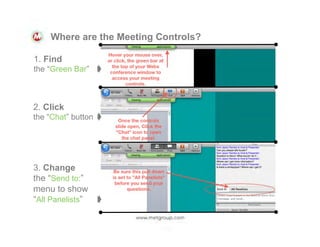
Where are the Meeting Controls?
1. Find
the “Green Bar”

➧

2. Click
the “Chat” button

➧

3. Change
the “Send to:”
menu to show
“All Panelists”

➧
why!

?
Why Measure What Matters?
•  Continuing shift toward accountability here in Illinois

and across the country
–  Growing demand by funders, partners, others
•  Strengthens social purpose program and service
delivery
–  Allows for mid-course corrections
•  Enables you to measure progress toward
accomplishment of your mission
A way of thinking about evaluation that has been specifically
designed to help social purpose organizations quantify the
change they create
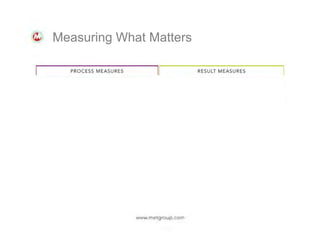
Measuring What Matters

What we put in

What we create

What happens

What difference it makes
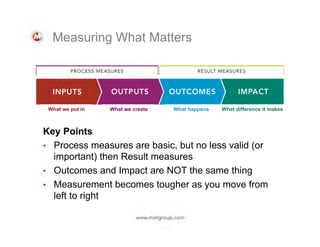
Measuring What Matters

What we put in

What we create

What happens

What difference it makes

Key Points
•  Process measures are basic, but no less valid (or
important) then Result measures
•  Outcomes and Impact are NOT the same thing
•  Measurement becomes tougher as you move from
left to right
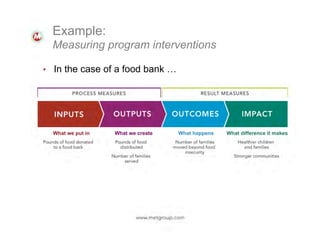
Example:
Measuring program interventions
•  In the case of a food bank …

What we put in

What we create

What happens

What difference it makes
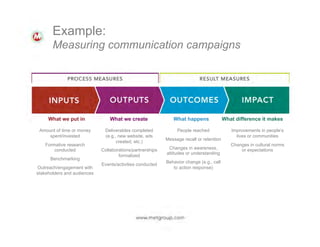
Example:
Measuring communication campaigns

What we put in
Amount of time or money
spent/invested
Formative research
conducted
Benchmarking
Outreach/engagement with
stakeholders and audiences

What we create
Deliverables completed
(e.g., new website, ads
created, etc.)

What happens

What difference it makes

People reached

Improvements in people’s
lives or communities

Message recall or retention

Collaborations/partnerships
formalized

Changes in awareness,
attitudes or understanding

Events/activities conducted

Behavior change (e.g., call
to action response)

Changes in cultural norms
or expectations
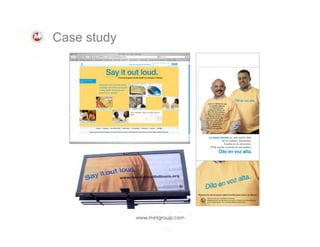
Case study
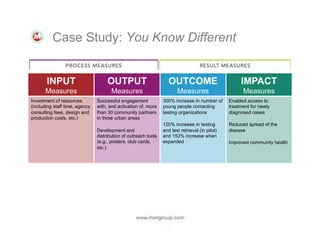
Case Study: You Know Different
INPUT

OUTPUT

OUTCOME

IMPACT

Measures

Measures

Measures

Measures

Investment of resources
(including staff time, agency
consulting fees, design and
production costs, etc.)

Successful engagement
with, and activation of, more
than 30 community partners
in three urban areas

300% increase in number of
young people contacting
testing organizations

Enabled access to
treatment for newly
diagnosed cases

120% increase in testing
and test retrieval (in pilot)
and 153% increase when
expanded

Reduced spread of the
disease

Development and
distribution of outreach tools
(e.g., posters, club cards,
etc.)

Improved community health
Case study
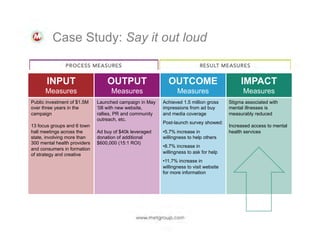
Case Study: Say it out loud
INPUT

OUTPUT

OUTCOME

IMPACT

Measures

Measures

Measures

Measures

Public investment of $1.5M
over three years in the
campaign

Launched campaign in May
‘08 with new website,
rallies, PR and community
outreach, etc.

13 focus groups and 6 town
hall meetings across the
state, involving more than
300 mental health providers
and consumers in formation
of strategy and creative

Ad buy of $40k leveraged
donation of additional
$600,000 (15:1 ROI)

Achieved 1.5 million gross
impressions from ad buy
and media coverage
Post-launch survey showed:
• 5.7% increase in
willingness to help others
• 8.7% increase in
willingness to ask for help
• 11.7% increase in
willingness to visit website
for more information

Stigma associated with
mental illnesses is
measurably reduced
Increased access to mental
health services
10 Tips for Measuring What Matters
1.  Start with “the end in mind”
–  Define success before you design the intervention
–  Involve evaluators in program/campaign planning
2.  Ask yourself probing questions
–  What level of measurement do you need? (sometimes measuring
outputs is enough)
–  How will you know when you’ve achieved the outcomes or impact
you want to create? What measurement methodologies already (or
need to) exist?
10 Tips for Measuring What Matters
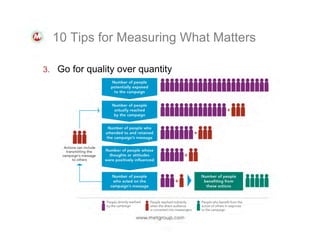
3.  Go for quality over quantity
10 Tips for Measuring What Matters
4.  Walk before you run
–  What level of measurement can you really handle?
5.  Remember, “garbage in” often results in “garbage out”
6.  Don’t assume measurement has to be expensive
7.  But remember, you get what you pay for
–  For bigger projects, consider at least 10% of budget for formative
research, pre-testing, monitoring and evaluation, etc.

8.  Don’t oversell
–  Don’t present process measures as if they were the same thing
as result measures
–  Don’t promise what you can’t deliver and/or can’t measure
10 Tips for Measuring What Matters
9.  Stay focused
–  Beware of pressure to try to reach “the general public”
–  Better to focus more intensively and increase likelihood of success
than reach too broadly and spread resources too thin to make a
difference

10.  Remember this mantra: Do what you can measure,

and measure what you do!
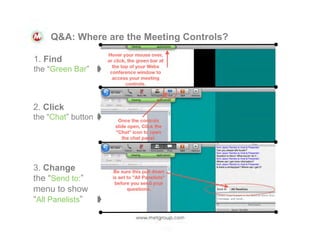
Q&A: Where are the Meeting Controls?
1. Find
the “Green Bar”

➧

2. Click
the “Chat” button

➧

3. Change
the “Send to:”
menu to show
“All Panelists”

➧
A way of thinking about evaluation that has been specifically
designed to help social purpose organizations quantify the
change they create
Thank you & please complete the survey!
•  Kevin Kirkpatrick

kkirkpatrick@metgroup.com
•  Vicky Nurre

vnurre@metgroup.com
1.312.628.1447

Happy Holidays!!
Proving Your Value

Proving Your Value

  • 1.
    Proving Your Value: Actionand Results Measurement Strategies A Webinar Presented to: Illinois Partners for Human Service & Additional Chicago-Area Change Agents December 16, 2013
  • 2.
    Welcome and introductions SuzanneStrassberger Associate Vice President State Government and Community Partnerships Jewish Federation of Metropolitan Chicago Co-Chair Policy Committee Illinois Partners for Human Service
  • 3.
    Where are theMeeting Controls? 1. Find the “Green Bar” ➧ 2. Click the “Chat” button ➧ 3. Change the “Send to:” menu to show “All Panelists” ➧
  • 4.
  • 5.
    Why Measure WhatMatters? •  Continuing shift toward accountability here in Illinois and across the country –  Growing demand by funders, partners, others •  Strengthens social purpose program and service delivery –  Allows for mid-course corrections •  Enables you to measure progress toward accomplishment of your mission
  • 6.
    A way ofthinking about evaluation that has been specifically designed to help social purpose organizations quantify the change they create
  • 7.
    Measuring What Matters Whatwe put in What we create What happens What difference it makes
  • 8.
    Measuring What Matters Whatwe put in What we create What happens What difference it makes Key Points •  Process measures are basic, but no less valid (or important) then Result measures •  Outcomes and Impact are NOT the same thing •  Measurement becomes tougher as you move from left to right
  • 9.
    Example: Measuring program interventions • In the case of a food bank … What we put in What we create What happens What difference it makes
  • 10.
    Example: Measuring communication campaigns Whatwe put in Amount of time or money spent/invested Formative research conducted Benchmarking Outreach/engagement with stakeholders and audiences What we create Deliverables completed (e.g., new website, ads created, etc.) What happens What difference it makes People reached Improvements in people’s lives or communities Message recall or retention Collaborations/partnerships formalized Changes in awareness, attitudes or understanding Events/activities conducted Behavior change (e.g., call to action response) Changes in cultural norms or expectations
  • 11.
  • 12.
    Case Study: YouKnow Different INPUT OUTPUT OUTCOME IMPACT Measures Measures Measures Measures Investment of resources (including staff time, agency consulting fees, design and production costs, etc.) Successful engagement with, and activation of, more than 30 community partners in three urban areas 300% increase in number of young people contacting testing organizations Enabled access to treatment for newly diagnosed cases 120% increase in testing and test retrieval (in pilot) and 153% increase when expanded Reduced spread of the disease Development and distribution of outreach tools (e.g., posters, club cards, etc.) Improved community health
  • 13.
  • 14.
    Case Study: Sayit out loud INPUT OUTPUT OUTCOME IMPACT Measures Measures Measures Measures Public investment of $1.5M over three years in the campaign Launched campaign in May ‘08 with new website, rallies, PR and community outreach, etc. 13 focus groups and 6 town hall meetings across the state, involving more than 300 mental health providers and consumers in formation of strategy and creative Ad buy of $40k leveraged donation of additional $600,000 (15:1 ROI) Achieved 1.5 million gross impressions from ad buy and media coverage Post-launch survey showed: • 5.7% increase in willingness to help others • 8.7% increase in willingness to ask for help • 11.7% increase in willingness to visit website for more information Stigma associated with mental illnesses is measurably reduced Increased access to mental health services
  • 15.
    10 Tips forMeasuring What Matters 1.  Start with “the end in mind” –  Define success before you design the intervention –  Involve evaluators in program/campaign planning 2.  Ask yourself probing questions –  What level of measurement do you need? (sometimes measuring outputs is enough) –  How will you know when you’ve achieved the outcomes or impact you want to create? What measurement methodologies already (or need to) exist?
  • 16.
    10 Tips forMeasuring What Matters 3.  Go for quality over quantity
  • 17.
    10 Tips forMeasuring What Matters 4.  Walk before you run –  What level of measurement can you really handle? 5.  Remember, “garbage in” often results in “garbage out” 6.  Don’t assume measurement has to be expensive 7.  But remember, you get what you pay for –  For bigger projects, consider at least 10% of budget for formative research, pre-testing, monitoring and evaluation, etc. 8.  Don’t oversell –  Don’t present process measures as if they were the same thing as result measures –  Don’t promise what you can’t deliver and/or can’t measure
  • 18.
    10 Tips forMeasuring What Matters 9.  Stay focused –  Beware of pressure to try to reach “the general public” –  Better to focus more intensively and increase likelihood of success than reach too broadly and spread resources too thin to make a difference 10.  Remember this mantra: Do what you can measure, and measure what you do!
  • 19.
    Q&A: Where arethe Meeting Controls? 1. Find the “Green Bar” ➧ 2. Click the “Chat” button ➧ 3. Change the “Send to:” menu to show “All Panelists” ➧
  • 21.
    A way ofthinking about evaluation that has been specifically designed to help social purpose organizations quantify the change they create
  • 22.
    Thank you &please complete the survey! •  Kevin Kirkpatrick kkirkpatrick@metgroup.com •  Vicky Nurre vnurre@metgroup.com 1.312.628.1447 Happy Holidays!!