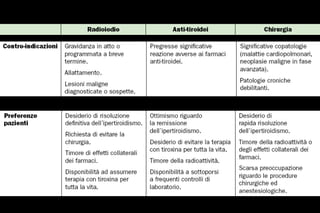
IPERTIROIDISMO: TERAPIA DEFINITIVA.
COME E QUANDO
Michele Zini
Servizio di Endocrinologia - Arcispedale S. Maria
Nuova, IRCCS Reggio Emilia
michele.zini@asmn.re.it
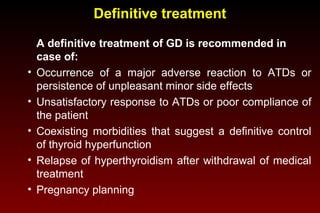
Definitive treatment

•
•
•
•
•

A definitive treatment of GD is recommended in
case of:
Occurrence of a major adverse reaction to ATDs or
persistence of unpleasant minor side effects
Unsatisfactory response to ATDs or poor compliance of
the patient
Coexisting morbidities that suggest a definitive control
of thyroid hyperfunction
Relapse of hyperthyroidism after withdrawal of medical
treatment
Pregnancy planning
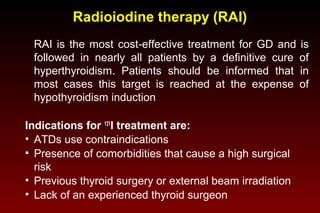
Radioiodine therapy (RAI)
RAI is the most cost-effective treatment for GD and is
followed in nearly all patients by a definitive cure of
hyperthyroidism. Patients should be informed that in
most cases this target is reached at the expense of
hypothyroidism induction
Indications for 131I treatment are:
• ATDs use contraindications
• Presence of comorbidities that cause a high surgical
risk
• Previous thyroid surgery or external beam irradiation
• Lack of an experienced thyroid surgeon
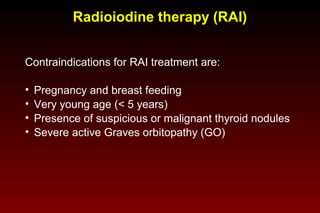
Radioiodine therapy (RAI)
Contraindications for RAI treatment are:
•
•
•
•

Pregnancy and breast feeding
Very young age (< 5 years)
Presence of suspicious or malignant thyroid nodules
Severe active Graves orbitopathy (GO)
Surgical treatment
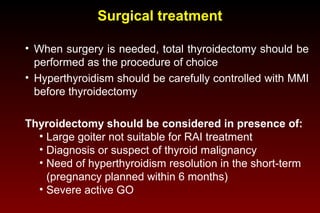
• When surgery is needed, total thyroidectomy should be
performed as the procedure of choice
• Hyperthyroidism should be carefully controlled with MMI
before thyroidectomy
Thyroidectomy should be considered in presence of:
• Large goiter not suitable for RAI treatment
• Diagnosis or suspect of thyroid malignancy
• Need of hyperthyroidism resolution in the short-term
(pregnancy planned within 6 months)
• Severe active GO
Surgical treatment
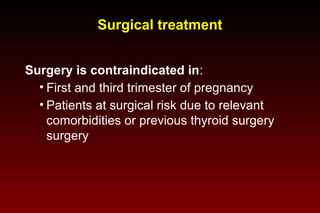
Surgery is contraindicated in:
• First and third trimester of pregnancy
• Patients at surgical risk due to relevant
comorbidities or previous thyroid surgery
surgery
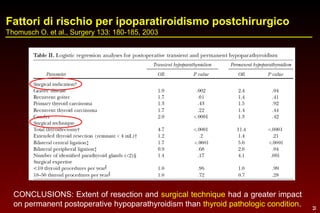
Fattori di rischio per ipoparatiroidismo postchirurgico

CONCLUSIONS: Extent of resection and surgical technique had a greater impact
on permanent postoperative hypoparathyroidism than thyroid pathologic condition.

M

Thomusch O. et al., Surgery 133: 180-185, 2003
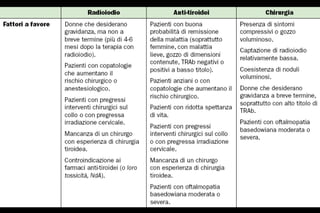
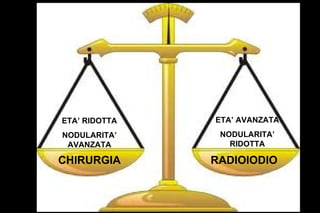
ETA’ RIDOTTA

ETA’ AVANZATA

NODULARITA’
AVANZATA

NODULARITA’
RIDOTTA

CHIRURGIA

RADIOIODIO
CONCLUSIONI (1)
• Pazienti stabilmente eutiroidei con
basse dosi di metimazolo possono
proseguire in sicurezza la terapia per un
tempo indefinito
• Per molti pazienti potrebbe essere
preferibile mantenere uno steady state
con i farmaci rispetto al cambio di
strategia che comportano i trattamenti
definitivi
CONCLUSIONI (2)
• Prima di passare ad un trattamento
definitivo:
• il corso di terapia con metimazolo deve
essere di durata sufficientemente lunga
per
rendere
ragionevolmente
improbabile che il m. di Basedow vada
in remissione
• ogni volta che è possibile, si deve
tentare la sospensione della terapia
CONCLUSIONI (3)
Se si decide per un trattamento
definitivo:
• informare il paziente sul carattere
irreversibile
del
trattamento
ablativo
• informare il paziente sul probabile
sviluppo di ipotiroidismo
CONCLUSIONI (4)
Nel decidere sul tipo di trattamento
definitivo:
• valutare il rischio anestesiologico
• valutare l’aspetto ecografico della
tiroide
• tenere nella dovuta considerazione i
values del paziente

Ipertiroidismo - Terapia definitiva

  • 1.
    IPERTIROIDISMO: TERAPIA DEFINITIVA. COMEE QUANDO Michele Zini Servizio di Endocrinologia - Arcispedale S. Maria Nuova, IRCCS Reggio Emilia michele.zini@asmn.re.it
  • 5.
    Definitive treatment • • • • • A definitivetreatment of GD is recommended in case of: Occurrence of a major adverse reaction to ATDs or persistence of unpleasant minor side effects Unsatisfactory response to ATDs or poor compliance of the patient Coexisting morbidities that suggest a definitive control of thyroid hyperfunction Relapse of hyperthyroidism after withdrawal of medical treatment Pregnancy planning
  • 6.
    Radioiodine therapy (RAI) RAIis the most cost-effective treatment for GD and is followed in nearly all patients by a definitive cure of hyperthyroidism. Patients should be informed that in most cases this target is reached at the expense of hypothyroidism induction Indications for 131I treatment are: • ATDs use contraindications • Presence of comorbidities that cause a high surgical risk • Previous thyroid surgery or external beam irradiation • Lack of an experienced thyroid surgeon
  • 7.
    Radioiodine therapy (RAI) Contraindicationsfor RAI treatment are: • • • • Pregnancy and breast feeding Very young age (< 5 years) Presence of suspicious or malignant thyroid nodules Severe active Graves orbitopathy (GO)
  • 8.
    Surgical treatment • Whensurgery is needed, total thyroidectomy should be performed as the procedure of choice • Hyperthyroidism should be carefully controlled with MMI before thyroidectomy Thyroidectomy should be considered in presence of: • Large goiter not suitable for RAI treatment • Diagnosis or suspect of thyroid malignancy • Need of hyperthyroidism resolution in the short-term (pregnancy planned within 6 months) • Severe active GO
  • 9.
    Surgical treatment Surgery iscontraindicated in: • First and third trimester of pregnancy • Patients at surgical risk due to relevant comorbidities or previous thyroid surgery surgery
  • 10.
    Fattori di rischioper ipoparatiroidismo postchirurgico CONCLUSIONS: Extent of resection and surgical technique had a greater impact on permanent postoperative hypoparathyroidism than thyroid pathologic condition. M Thomusch O. et al., Surgery 133: 180-185, 2003
  • 11.
  • 12.
    CONCLUSIONI (1) • Pazientistabilmente eutiroidei con basse dosi di metimazolo possono proseguire in sicurezza la terapia per un tempo indefinito • Per molti pazienti potrebbe essere preferibile mantenere uno steady state con i farmaci rispetto al cambio di strategia che comportano i trattamenti definitivi
  • 13.
    CONCLUSIONI (2) • Primadi passare ad un trattamento definitivo: • il corso di terapia con metimazolo deve essere di durata sufficientemente lunga per rendere ragionevolmente improbabile che il m. di Basedow vada in remissione • ogni volta che è possibile, si deve tentare la sospensione della terapia
  • 14.
    CONCLUSIONI (3) Se sidecide per un trattamento definitivo: • informare il paziente sul carattere irreversibile del trattamento ablativo • informare il paziente sul probabile sviluppo di ipotiroidismo
  • 15.
    CONCLUSIONI (4) Nel decideresul tipo di trattamento definitivo: • valutare il rischio anestesiologico • valutare l’aspetto ecografico della tiroide • tenere nella dovuta considerazione i values del paziente