Concept-Map Oriented Technical Writing
                   Approach for Comp. Sc Majors in an EFL
                   Context: Understanding Text Applications

                                  Debopriyo Roy
                                 Univ. of Aizu, Japan


                         IPCC 2010 - Enschede, Netherlands


                                          1
Friday, July 2, 2010
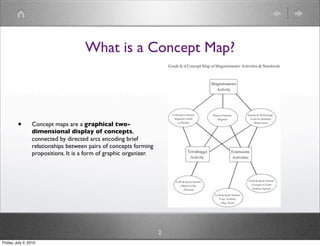
What is a Concept Map?


         •       Concept maps are a graphical two-
                 dimensional display of concepts,
                 connected by directed arcs encoding brief
                 relationships between pairs of concepts forming
                 propositions. It is a form of graphic organizer.


                                                                    2
Friday, July 2, 2010
Concept Maps in Computer Science
              Concept maps in CS often emphasize modeling of concepts and procedures for documentation purposes.

              Modeling concept and procedures with concept maps for procedures (declarative, structural,
              functional, logical, conditional connections)

              Brainstorming: Where known concepts and relationships are suggested by individuals for conforming a
              meaningful workgroup knowledge structure.

              Decision making: Where current variables are identified on existent knowledge structures, leading to logical
                       •
              inferences that, ultimately, will help for decision making.

              Information navigation: Where concept maps are used as hypermedia organizers. In this case, information
              can be encapsulated on different levels of abstraction for easy comprehension, while allowing expansion to
              reveal details when required.

              Presentation planning: Where concept maps are used as tools for outlining presentations' content in a
              non-linear manner. This technique allows a quick interpretation of related material and their relationship
              with the subject of the presentation.


                                                                 3
Friday, July 2, 2010
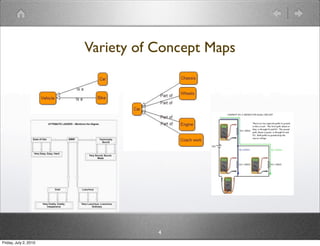
Variety of Concept Maps


                                  4
Friday, July 2, 2010
Major Research Question


                •      Conceptual: Whether students can comprehend the concept behind the specific CM types?

                •      Application in Documents: Whether students can understand the possible application of
                       the CM types in various documents?

                •      Application with Technical Sentences: Whether readers can identify technical sentences
                       and headings, and major questions that can be represented as CM?

                •      Practice Effect: Whether student performance improves as they move on from one CM to
                       another.


                                                               5
Friday, July 2, 2010
Survey Design
                       •      This study tested 22 participants in the age group of 20-23 from a technical thesis writing
                              class.

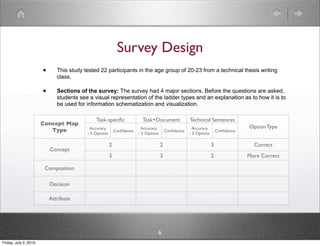
                       •      Sections of the survey: The survey had 4 major sections. Before the questions are asked,
                              students see a visual representation of the ladder types and an explanation as to how it is to
                              be used for information schematization and visualization.

                                              Task-specific                Task+Document               Technical Sentences
                       Concept Map
                                            Accuracy                      Accuracy                      Accuracy                    Option Type
                          Type                              Confidence                     Confidence                     Confidence
                                          - 5 Options                   - 5 Options                   - 5 Options

                                                        2                             2                             3                 Correct
                           Concept
                                                        3                             3                             2               More Correct

                        Composition

                           Decision

                           Attribute


                                                                                  6
Friday, July 2, 2010
Test Instruments

                       •   Task specific: As part of the task-specific sentences, readers were given an overall idea of what
                           the task is, for e.g., to explain definitions in your thesis. The students are provided with options
                           like “different chapters and types of information in the thesis”, “explaining structures and
                           functions of computer, digital camera, different ways to assemble” etc.

                       •   Task + Document: As part of this task, the focus was both on the specific task and the type of
                           document where it is to be shown. For example, options used were “pages in user manual,
                           laboratory reports showing definitions, structures, functions, procedures”,
                           “recommendations made in reports”, “reporting degree of anxiety, stress in
                           specific types of documents” etc.

                       •   Domain-specific Sentences: The students were provided with examples of sentences that strictly
                           deal with processes in the area of Computer Science or general science and in few cases, more
                           general sentences. Ex: The iPod retrieves the file or the playlist.


                                                                       7
Friday, July 2, 2010
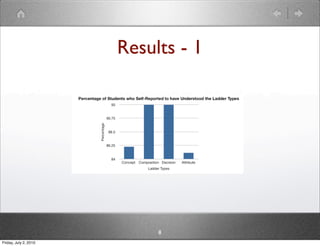
Results - 1


                            8
Friday, July 2, 2010
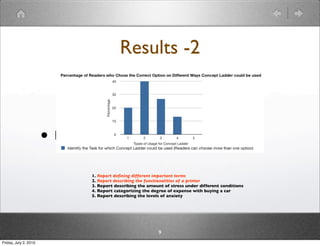
Results -2


                       • Re
                              1. Report defining different important terms
                              2. Report describing the functionalities of a printer
                              3. Report describing the amount of stress under different conditions
                              4. Report categorizing the degree of expense with buying a car
                              5. Report describing the levels of anxiety


                                                           9
Friday, July 2, 2010
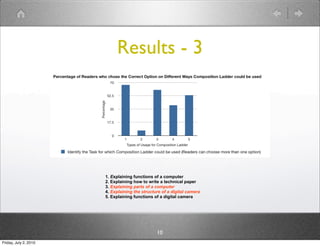
Results - 3


                       1. Explaining functions of a computer
                       2. Explaining how to write a technical paper
                       3. Explaining parts of a computer
                       4. Explaining the structure of a digital camera
                       5. Explaining functions of a digital camera


                                                10
Friday, July 2, 2010
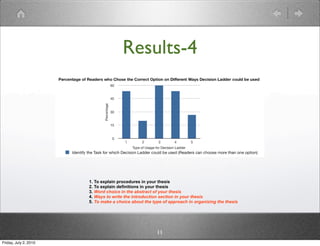
Results-4


                       1. To explain procedures in your thesis
                       2. To explain definitions in your thesis
                       3. Word choice in the abstract of your thesis
                       4. Ways to write the introduction section in your thesis
                       5. To make a choice about the type of approach in organizing the thesis


                                                       11
Friday, July 2, 2010
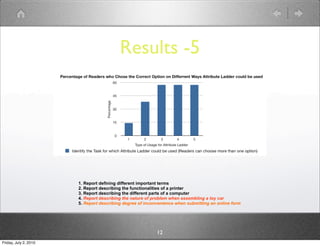
Results -5


                       1. Report defining different important terms
                       2. Report describing the functionalities of a printer
                       3. Report describing the different parts of a computer
                       4. Report describing the nature of problem when assembling a toy car
                       5. Report describing degree of inconvenience when submitting an online form


                                                           12
Friday, July 2, 2010
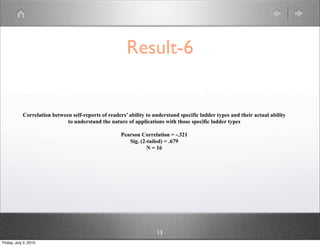
Result-6


            Correlation between self-reports of readers’ ability to understand specific ladder types and their actual ability
                              to understand the nature of applications with those specific ladder types

                                                      Pearson Correlation = -.321
                                                         Sig. (2-tailed) = .679
                                                                 N = 16


                                                                     13
Friday, July 2, 2010
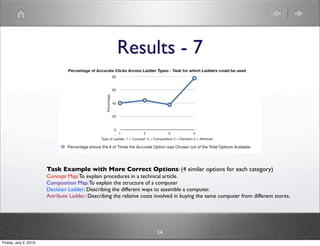
Results - 7


                       Task Example with More Correct Options: (4 similar options for each category)
                       Concept Map: To explain procedures in a technical article.
                       Composition Map: To explain the structure of a computer
                       Decision Ladder: Describing the different ways to assemble a computer.
                       Attribute Ladder: Describing the relative costs involved in buying the same computer from different stores.


                                                                       14
Friday, July 2, 2010
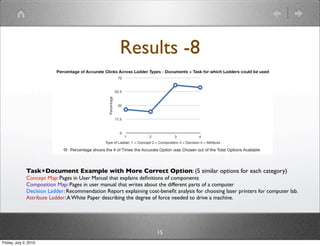
Results -8


              Task+Document Example with More Correct Option: (5 similar options for each category)
              Concept Map: Pages in User Manual that explains definitions of components
              Composition Map: Pages in user manual that writes about the different parts of a computer
              Decision Ladder: Recommendation Report explaining cost-benefit analysis for choosing laser printers for computer lab.
              Attribute Ladder: A White Paper describing the degree of force needed to drive a machine.


                                                                     15
Friday, July 2, 2010
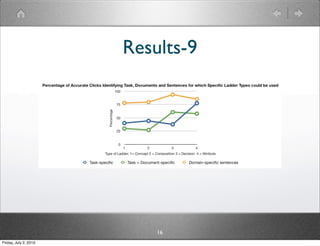
Results-9


                           16
Friday, July 2, 2010
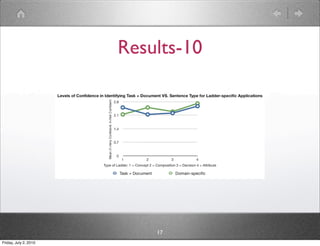
Results-10


                           17
Friday, July 2, 2010
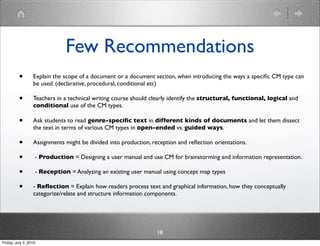
Few Recommendations
          •       Explain the scope of a document or a document section, when introducing the ways a specific CM type can
                  be used. (declarative, procedural, conditional etc)

          •       Teachers in a technical writing course should clearly identify the structural, functional, logical and
                  conditional use of the CM types.

          •       Ask students to read genre-specific text in different kinds of documents and let them dissect
                  the text in terms of various CM types in open-ended vs. guided ways.

          •       Assignments might be divided into production, reception and reflection orientations.

          •        - Production = Designing a user manual and use CM for brainstorming and information representation.

          •        - Reception = Analyzing an existing user manual using concept map types

          •       - Reflection = Explain how readers process text and graphical information, how they conceptually
                  categorize/relate and structure information components.


                                                                  18
Friday, July 2, 2010
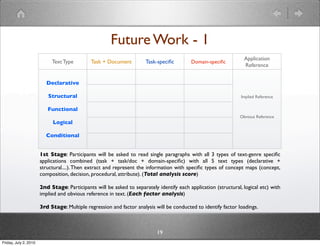
Future Work - 1
                                                                                                                  Application
                            Text Type         Task + Document         Task-specific        Domain-specific
                                                                                                                  Reference


                          Declarative

                          Structural                                                                             Implied Reference

                          Functional
                                                                                                                Obvious Reference
                            Logical

                         Conditional


                       1st Stage: Participants will be asked to read single paragraphs with all 3 types of text-genre specific
                       applications combined (task + task/doc + domain-specific) with all 5 text types (declarative +
                       structural....). Then extract and represent the information with specific types of concept maps (concept,
                       composition, decision, procedural, attribute). (Total analysis score)

                       2nd Stage: Participants will be asked to separately identify each application (structural, logical etc) with
                       implied and obvious reference in text. (Each factor analysis)

                       3rd Stage: Multiple regression and factor analysis will be conducted to identify factor loadings.


                                                                           19
Friday, July 2, 2010
Future Work - 2
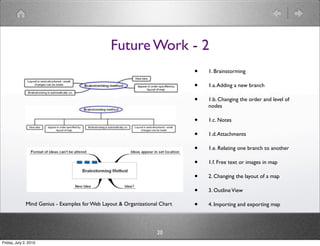
                                                                             •   1. Brainstorming

                                                                             •   1.a. Adding a new branch

                                                                             •   1.b. Changing the order and level of
                                                                                 nodes

                                                                             •   1.c. Notes

                                                                             •   1.d. Attachments

                                                                             •   1.e. Relating one branch to another

                                                                             •   1.f. Free text or images in map

                                                                             •   2. Changing the layout of a map

                                                                             •   3. Outline View

              Mind Genius - Examples for Web Layout & Organizational Chart   •   4. Importing and exporting map


                                                                   20
Friday, July 2, 2010
Future Work - 3

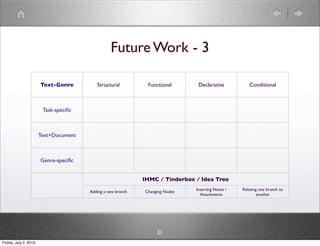
                       Text-Genre         Structural          Functional       Declarative           Conditional


                        Task-specific


                       Text+Document


                       Genre-specific


                                                             IHMC / Tinderbox / Idea Tree
                                                                              Inserting Notes /   Relating one branch to
                                       Adding a new branch   Changing Nodes
                                                                                Attachments               another


                                                                  21
Friday, July 2, 2010
Future Work 4 - Finance and CM
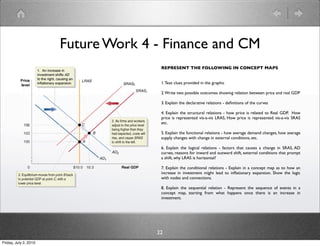
                                      REPRESENT THE FOLLOWING IN CONCEPT MAPS


                                      1. Text clues provided in the graphic

                                      2. Write two possible outcomes showing relation between price and real GDP

                                      3. Explain the declarative relations - definitions of the curves

                                      4. Explain the structural relations - how price is related to Real GDP, How
                                      price is represented vis-a-vis LRAS, How price is represented vis-a-vis SRAS
                                      etc.

                                      5. Explain the functional relations - how average demand changes, how average
                                      supply changes with change in external conditions, etc.

                                      6. Explain the logical relations - factors that causes a change in SRAS, AD
                                      curves, reasons for inward and outward shift, external conditions that prompt
                                      a shift, why LRAS is horizontal?

                                      7. Explain the conditional relations - Explain in a concept map as to how an
                                      increase in investment might lead to inflationary expansion. Show the logic
                                      with nodes and connections.

                                      8. Explain the sequential relation - Represent the sequence of events in a
                                      concept map, starting from what happens once there is an increase in
                                      investment.


                                     22
Friday, July 2, 2010
Thank You !


                           23
Friday, July 2, 2010

IPCC2010-1

  • 1.
    Concept-Map Oriented TechnicalWriting Approach for Comp. Sc Majors in an EFL Context: Understanding Text Applications Debopriyo Roy Univ. of Aizu, Japan IPCC 2010 - Enschede, Netherlands 1 Friday, July 2, 2010
  • 2.
    What is aConcept Map? • Concept maps are a graphical two- dimensional display of concepts, connected by directed arcs encoding brief relationships between pairs of concepts forming propositions. It is a form of graphic organizer. 2 Friday, July 2, 2010
  • 3.
    Concept Maps inComputer Science Concept maps in CS often emphasize modeling of concepts and procedures for documentation purposes. Modeling concept and procedures with concept maps for procedures (declarative, structural, functional, logical, conditional connections) Brainstorming: Where known concepts and relationships are suggested by individuals for conforming a meaningful workgroup knowledge structure. Decision making: Where current variables are identified on existent knowledge structures, leading to logical • inferences that, ultimately, will help for decision making. Information navigation: Where concept maps are used as hypermedia organizers. In this case, information can be encapsulated on different levels of abstraction for easy comprehension, while allowing expansion to reveal details when required. Presentation planning: Where concept maps are used as tools for outlining presentations' content in a non-linear manner. This technique allows a quick interpretation of related material and their relationship with the subject of the presentation. 3 Friday, July 2, 2010
  • 4.
    Variety of ConceptMaps 4 Friday, July 2, 2010
  • 5.
    Major Research Question • Conceptual: Whether students can comprehend the concept behind the specific CM types? • Application in Documents: Whether students can understand the possible application of the CM types in various documents? • Application with Technical Sentences: Whether readers can identify technical sentences and headings, and major questions that can be represented as CM? • Practice Effect: Whether student performance improves as they move on from one CM to another. 5 Friday, July 2, 2010
  • 6.
    Survey Design • This study tested 22 participants in the age group of 20-23 from a technical thesis writing class. • Sections of the survey: The survey had 4 major sections. Before the questions are asked, students see a visual representation of the ladder types and an explanation as to how it is to be used for information schematization and visualization. Task-specific Task+Document Technical Sentences Concept Map Accuracy Accuracy Accuracy Option Type Type Confidence Confidence Confidence - 5 Options - 5 Options - 5 Options 2 2 3 Correct Concept 3 3 2 More Correct Composition Decision Attribute 6 Friday, July 2, 2010
  • 7.
    Test Instruments • Task specific: As part of the task-specific sentences, readers were given an overall idea of what the task is, for e.g., to explain definitions in your thesis. The students are provided with options like “different chapters and types of information in the thesis”, “explaining structures and functions of computer, digital camera, different ways to assemble” etc. • Task + Document: As part of this task, the focus was both on the specific task and the type of document where it is to be shown. For example, options used were “pages in user manual, laboratory reports showing definitions, structures, functions, procedures”, “recommendations made in reports”, “reporting degree of anxiety, stress in specific types of documents” etc. • Domain-specific Sentences: The students were provided with examples of sentences that strictly deal with processes in the area of Computer Science or general science and in few cases, more general sentences. Ex: The iPod retrieves the file or the playlist. 7 Friday, July 2, 2010
  • 8.
    Results - 1 8 Friday, July 2, 2010
  • 9.
    Results -2 • Re 1. Report defining different important terms 2. Report describing the functionalities of a printer 3. Report describing the amount of stress under different conditions 4. Report categorizing the degree of expense with buying a car 5. Report describing the levels of anxiety 9 Friday, July 2, 2010
  • 10.
    Results - 3 1. Explaining functions of a computer 2. Explaining how to write a technical paper 3. Explaining parts of a computer 4. Explaining the structure of a digital camera 5. Explaining functions of a digital camera 10 Friday, July 2, 2010
  • 11.
    Results-4 1. To explain procedures in your thesis 2. To explain definitions in your thesis 3. Word choice in the abstract of your thesis 4. Ways to write the introduction section in your thesis 5. To make a choice about the type of approach in organizing the thesis 11 Friday, July 2, 2010
  • 12.
    Results -5 1. Report defining different important terms 2. Report describing the functionalities of a printer 3. Report describing the different parts of a computer 4. Report describing the nature of problem when assembling a toy car 5. Report describing degree of inconvenience when submitting an online form 12 Friday, July 2, 2010
  • 13.
    Result-6 Correlation between self-reports of readers’ ability to understand specific ladder types and their actual ability to understand the nature of applications with those specific ladder types Pearson Correlation = -.321 Sig. (2-tailed) = .679 N = 16 13 Friday, July 2, 2010
  • 14.
    Results - 7 Task Example with More Correct Options: (4 similar options for each category) Concept Map: To explain procedures in a technical article. Composition Map: To explain the structure of a computer Decision Ladder: Describing the different ways to assemble a computer. Attribute Ladder: Describing the relative costs involved in buying the same computer from different stores. 14 Friday, July 2, 2010
  • 15.
    Results -8 Task+Document Example with More Correct Option: (5 similar options for each category) Concept Map: Pages in User Manual that explains definitions of components Composition Map: Pages in user manual that writes about the different parts of a computer Decision Ladder: Recommendation Report explaining cost-benefit analysis for choosing laser printers for computer lab. Attribute Ladder: A White Paper describing the degree of force needed to drive a machine. 15 Friday, July 2, 2010
  • 16.
    Results-9 16 Friday, July 2, 2010
  • 17.
    Results-10 17 Friday, July 2, 2010
  • 18.
    Few Recommendations • Explain the scope of a document or a document section, when introducing the ways a specific CM type can be used. (declarative, procedural, conditional etc) • Teachers in a technical writing course should clearly identify the structural, functional, logical and conditional use of the CM types. • Ask students to read genre-specific text in different kinds of documents and let them dissect the text in terms of various CM types in open-ended vs. guided ways. • Assignments might be divided into production, reception and reflection orientations. • - Production = Designing a user manual and use CM for brainstorming and information representation. • - Reception = Analyzing an existing user manual using concept map types • - Reflection = Explain how readers process text and graphical information, how they conceptually categorize/relate and structure information components. 18 Friday, July 2, 2010
  • 19.
    Future Work -1 Application Text Type Task + Document Task-specific Domain-specific Reference Declarative Structural Implied Reference Functional Obvious Reference Logical Conditional 1st Stage: Participants will be asked to read single paragraphs with all 3 types of text-genre specific applications combined (task + task/doc + domain-specific) with all 5 text types (declarative + structural....). Then extract and represent the information with specific types of concept maps (concept, composition, decision, procedural, attribute). (Total analysis score) 2nd Stage: Participants will be asked to separately identify each application (structural, logical etc) with implied and obvious reference in text. (Each factor analysis) 3rd Stage: Multiple regression and factor analysis will be conducted to identify factor loadings. 19 Friday, July 2, 2010
  • 20.
    Future Work -2 • 1. Brainstorming • 1.a. Adding a new branch • 1.b. Changing the order and level of nodes • 1.c. Notes • 1.d. Attachments • 1.e. Relating one branch to another • 1.f. Free text or images in map • 2. Changing the layout of a map • 3. Outline View Mind Genius - Examples for Web Layout & Organizational Chart • 4. Importing and exporting map 20 Friday, July 2, 2010
  • 21.
    Future Work -3 Text-Genre Structural Functional Declarative Conditional Task-specific Text+Document Genre-specific IHMC / Tinderbox / Idea Tree Inserting Notes / Relating one branch to Adding a new branch Changing Nodes Attachments another 21 Friday, July 2, 2010
  • 22.
    Future Work 4- Finance and CM REPRESENT THE FOLLOWING IN CONCEPT MAPS 1. Text clues provided in the graphic 2. Write two possible outcomes showing relation between price and real GDP 3. Explain the declarative relations - definitions of the curves 4. Explain the structural relations - how price is related to Real GDP, How price is represented vis-a-vis LRAS, How price is represented vis-a-vis SRAS etc. 5. Explain the functional relations - how average demand changes, how average supply changes with change in external conditions, etc. 6. Explain the logical relations - factors that causes a change in SRAS, AD curves, reasons for inward and outward shift, external conditions that prompt a shift, why LRAS is horizontal? 7. Explain the conditional relations - Explain in a concept map as to how an increase in investment might lead to inflationary expansion. Show the logic with nodes and connections. 8. Explain the sequential relation - Represent the sequence of events in a concept map, starting from what happens once there is an increase in investment. 22 Friday, July 2, 2010
  • 23.
    Thank You ! 23 Friday, July 2, 2010