Basics of
Intellectual Property Law
    Jim Chester, J.D. / LL.M.


                 1
                                © J F. C hester 201 2
                                   .
Why does IP matter?


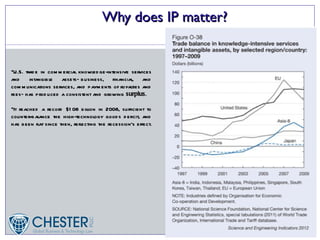
•U.S. trad e in com m ercial knowled ge-intensive services
and     intangible assets— business, financial and,
com m unications services, and paym ents of royalties and
fees— has prod uced a consistent and growing surplus.

•It reached a record $1 08 bill in 2008, sufficient to
                               ion
counter-balance the high-technology good s d eficit, and
has been fl since then, reflecting the recession's effect.
           at
Top IP “Myths”
1.   Only large “high-tech” companies have IP
             - EVERY business has IP Assets.
     - A significant am ount of innovation com es from
                ind ivid ual inventors & SM E’s

-    Securing your IP rights in the US will give you
     protection in other countries, as well
     In m ost cases, US IP rights m ean not
                                          hing outsid e US
Types of IP

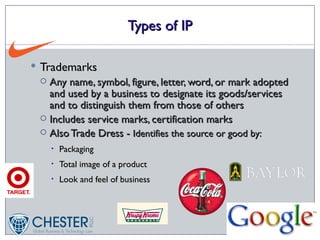
 Trademarks
   Any name, symbol, figure, letter, word, or mark adopted
    and used by a business to designate its goods/services
    and to distinguish them from those of others
   Includes service marks, certification marks
   Also Trade Dress - Identifies the source or good by:

    •   Packaging
    •   Total image of a product
    •   Look and feel of business
Trademarks (Cont)

   US is a “first to use” jurisdiction –common law
   Can also register TMs with state & USPTO
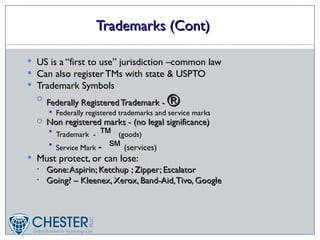
   Trademark Symbols
    
        Federally Registered Trademark -       ®
           Federally registered trademarks and service marks
       Non registered marks - (no legal significance)
        
            Trademark -™ (goods)
        
          Service Mark - ℠ (services)
 Must protect, or can lose:
    •   Gone: Aspirin; Ketchup ; Zipper; Escalator
    •   Going? – Kleenex, Xerox, Band-Aid, Tivo, Google
Trademarks (Cont)

Trade Names - A name used to identify a commercial
   product or service
      Ex. General Electric, Inc. – legal name
      GE – Trade name (i.e., “d/b/a”)
                                - Trademark
IP ISSUE SPOTTING


Trademarks – Situations that might give rise to legal
   work for a typical company include:
•   Formation of new company or spin-off
•   New products/marketing campaign
•   Enter new markets (incl. overseas)
•   Notice a similar mark used by other company
•   Merger/Acquisition or Financing
Other Types of IP

Patents- the exclusive right to an inventor to manufacture,
   use, or sell an invention.
   - Can only come from the US govt.
   - Must meet statutory requirements
        novel, useful, non-obvious, etc.
   - Expire after 20 years after filing – NO renewal
       (Design patents – 14yrs. From issue of patent)
IP ISSUE SPOTTING


Patents– Situations that might give rise to legal work for a
   typical company include:
•   Company invents a new product
•   Company develops a new business method
•   Start-up wants to raise money by pitching its new
    invention/method to potential investors
•   Learn of a competitor’s use of a patented product
•   Merger/Acquisition or Financing
Other Types of IP

Trade Secrets- Secrets secrets kept from the world by
   that relate to how to manufacture, use, or sell something
   (i.e., give a competitive advantage)
   - No registration required
   - Does not expire
   - Must be protected (e.g., limited access, NDAs, etc.)
IP ISSUE SPOTTING


Trade Secrets – Situations that might give rise to legal
   work for a typical company include:
•   Same as “Patent” Issues
•   Hire new employees or get new partner
•   Learn that former Employee sent company materials to
    new employer while still working for company
Other Types of IP

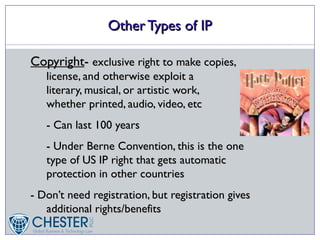
Copyright- exclusive right to make copies,
   license, and otherwise exploit a
   literary, musical, or artistic work,
   whether printed, audio, video, etc
   - Can last 100 years
   - Under Berne Convention, this is the one
   type of US IP right that gets automatic
   protection in other countries
- Don’t need registration, but registration gives
   additional rights/benefits
IP ISSUE SPOTTING


Copyright – Situations that might give rise to legal work for
  a typical company include:
•   Creation of web site
•   Hire software company to develop proprietary contact
    management program
•   Create training materials/PPTs
•   Advertisements
•    Develop Firm newsletter or fact sheets to distribute to
    clients/post on web, etc.
Intellectual Property Law

Three Main Elements:
  n   Securing IP Rights (directly & indirectly)
  h   Licensing IP
  h   Enforcing IP
Securing IP Rights - Directly


-NDA’s/Confidentiality Agreements
-Partner/JV Agreements
-Assignments/Transfers
-“ Work for Hire” and development agreements
Securing IP Rights - Indirectly

-State
    - TM/SM – Sec. of State
    -Trade Secrets (no registration)
-Nationwide
    -TM, SM, trade dress – USPTO
    -Patents – USPTO
    - Copyrights – US Library of Congress
-International
    -WIPO (Patent); Madrid Protocol (TMs)
    -Foreign Gov’ts
Licensing IP

 No “cookie-cutter”
    Type of agreement will depend on type of IP, value, etc.
    Often start with prior agreements, but each transaction will need to
     be evaluated individually
    Key concerns
      Timing & calculation of payments
      Scope of license
      Rights in future developments & goodwill
      Ensure against “transfer”
      Be wary of franchise characteristics
      Don’t want to imply partnership
Enforcing IP

 Investigating claims/potential infringement
 Drafting letters of inquiry & “Cease & desist” letters
 Negotiating settlements & consent agreements
 Prosecuting & defending infringement lawsuits
More IP ISSUE SPOTTING
 International IP – Protecting US-created IP abroad continues to be a huge issue for
    American companies. Counterfeiting is a multi-billion dollar annual industry
   Get Some Help at the Border - Although IP owners must typically self-police against
    infringement, US Customs will seize potential infringements of US IP rights, provided
    the rights are recorded with Customs
   Design Patents. Relatively new to US law, these types of patents protect the design
    elements of a useful device. They can be renewed. In some cases, a given item may be
    protected by a ©, a trade dress registration, and a design patent
   Computer software – can be protected by © or patent. Copyright is easier but afford
    protection only against exact copies. Patent is greater protection, but harder to get
    because program’s “utility” must be novel.
   Co-Developed works – each owner will own 100% of the IP
   Internet – Google terms, domain names, Adwords, Metatags, etc.
Questions to Ask
 Do you have any registered trademarks, copyrights or patents?
 Do you sell products/services using a unique name?
 Do you have a logo?
 Do you have a web site? Have you developed business strategies or methods
    that give your company an advantage in the marketplace?
   Have you ever been sued or otherwise confronted by anyone claiming you had
    infringed on a mark, name, copyright or invention?
   Have you ever noticed someone using a mark or product similar to yours?
   Have you hired 3rd parties to develop logos, web sites, brochures,
    advertisements, software, or other materials for your company?
   Do employees/contractors sign agreements regarding company IP, trade secrets,
    or confidential information?
   Do you (or do you plan to) sell products/services or outsource production
    outside the US?
Concluding Thoughts


Every com pany has IP assets – though m any d on’t
    ad equately protect theirs.


A “Proactive” strategy with regard to IP assets is generall
                                                          y
    m uch less expensive than a “Reactive” strategy
Questions?


     Em ail jim@chester-law.com
     D irect 214.988.9248

     Toll Free 1 .877.34.Worl
                            d

Ip practice overview pres 2012

  • 1.
    Basics of Intellectual PropertyLaw Jim Chester, J.D. / LL.M. 1 © J F. C hester 201 2 .
  • 2.
    Why does IPmatter? •U.S. trad e in com m ercial knowled ge-intensive services and intangible assets— business, financial and, com m unications services, and paym ents of royalties and fees— has prod uced a consistent and growing surplus. •It reached a record $1 08 bill in 2008, sufficient to ion counter-balance the high-technology good s d eficit, and has been fl since then, reflecting the recession's effect. at
  • 3.
    Top IP “Myths” 1. Only large “high-tech” companies have IP - EVERY business has IP Assets. - A significant am ount of innovation com es from ind ivid ual inventors & SM E’s - Securing your IP rights in the US will give you protection in other countries, as well In m ost cases, US IP rights m ean not hing outsid e US
  • 4.
    Types of IP Trademarks  Any name, symbol, figure, letter, word, or mark adopted and used by a business to designate its goods/services and to distinguish them from those of others  Includes service marks, certification marks  Also Trade Dress - Identifies the source or good by: • Packaging • Total image of a product • Look and feel of business
  • 5.
    Trademarks (Cont)  US is a “first to use” jurisdiction –common law  Can also register TMs with state & USPTO  Trademark Symbols  Federally Registered Trademark - ®  Federally registered trademarks and service marks  Non registered marks - (no legal significance)  Trademark -™ (goods)  Service Mark - ℠ (services)  Must protect, or can lose: • Gone: Aspirin; Ketchup ; Zipper; Escalator • Going? – Kleenex, Xerox, Band-Aid, Tivo, Google
  • 6.
    Trademarks (Cont) Trade Names- A name used to identify a commercial product or service Ex. General Electric, Inc. – legal name GE – Trade name (i.e., “d/b/a”) - Trademark
  • 7.
    IP ISSUE SPOTTING Trademarks– Situations that might give rise to legal work for a typical company include: • Formation of new company or spin-off • New products/marketing campaign • Enter new markets (incl. overseas) • Notice a similar mark used by other company • Merger/Acquisition or Financing
  • 8.
    Other Types ofIP Patents- the exclusive right to an inventor to manufacture, use, or sell an invention. - Can only come from the US govt. - Must meet statutory requirements novel, useful, non-obvious, etc. - Expire after 20 years after filing – NO renewal  (Design patents – 14yrs. From issue of patent)
  • 9.
    IP ISSUE SPOTTING Patents–Situations that might give rise to legal work for a typical company include: • Company invents a new product • Company develops a new business method • Start-up wants to raise money by pitching its new invention/method to potential investors • Learn of a competitor’s use of a patented product • Merger/Acquisition or Financing
  • 10.
    Other Types ofIP Trade Secrets- Secrets secrets kept from the world by that relate to how to manufacture, use, or sell something (i.e., give a competitive advantage) - No registration required - Does not expire - Must be protected (e.g., limited access, NDAs, etc.)
  • 11.
    IP ISSUE SPOTTING TradeSecrets – Situations that might give rise to legal work for a typical company include: • Same as “Patent” Issues • Hire new employees or get new partner • Learn that former Employee sent company materials to new employer while still working for company
  • 12.
    Other Types ofIP Copyright- exclusive right to make copies, license, and otherwise exploit a literary, musical, or artistic work, whether printed, audio, video, etc - Can last 100 years - Under Berne Convention, this is the one type of US IP right that gets automatic protection in other countries - Don’t need registration, but registration gives additional rights/benefits
  • 13.
    IP ISSUE SPOTTING Copyright– Situations that might give rise to legal work for a typical company include: • Creation of web site • Hire software company to develop proprietary contact management program • Create training materials/PPTs • Advertisements • Develop Firm newsletter or fact sheets to distribute to clients/post on web, etc.
  • 14.
    Intellectual Property Law ThreeMain Elements: n Securing IP Rights (directly & indirectly) h Licensing IP h Enforcing IP
  • 15.
    Securing IP Rights- Directly -NDA’s/Confidentiality Agreements -Partner/JV Agreements -Assignments/Transfers -“ Work for Hire” and development agreements
  • 16.
    Securing IP Rights- Indirectly -State - TM/SM – Sec. of State -Trade Secrets (no registration) -Nationwide -TM, SM, trade dress – USPTO -Patents – USPTO - Copyrights – US Library of Congress -International -WIPO (Patent); Madrid Protocol (TMs) -Foreign Gov’ts
  • 17.
    Licensing IP  No“cookie-cutter”  Type of agreement will depend on type of IP, value, etc.  Often start with prior agreements, but each transaction will need to be evaluated individually  Key concerns  Timing & calculation of payments  Scope of license  Rights in future developments & goodwill  Ensure against “transfer”  Be wary of franchise characteristics  Don’t want to imply partnership
  • 18.
    Enforcing IP  Investigatingclaims/potential infringement  Drafting letters of inquiry & “Cease & desist” letters  Negotiating settlements & consent agreements  Prosecuting & defending infringement lawsuits
  • 19.
    More IP ISSUESPOTTING  International IP – Protecting US-created IP abroad continues to be a huge issue for American companies. Counterfeiting is a multi-billion dollar annual industry  Get Some Help at the Border - Although IP owners must typically self-police against infringement, US Customs will seize potential infringements of US IP rights, provided the rights are recorded with Customs  Design Patents. Relatively new to US law, these types of patents protect the design elements of a useful device. They can be renewed. In some cases, a given item may be protected by a ©, a trade dress registration, and a design patent  Computer software – can be protected by © or patent. Copyright is easier but afford protection only against exact copies. Patent is greater protection, but harder to get because program’s “utility” must be novel.  Co-Developed works – each owner will own 100% of the IP  Internet – Google terms, domain names, Adwords, Metatags, etc.
  • 20.
    Questions to Ask Do you have any registered trademarks, copyrights or patents?  Do you sell products/services using a unique name?  Do you have a logo?  Do you have a web site? Have you developed business strategies or methods that give your company an advantage in the marketplace?  Have you ever been sued or otherwise confronted by anyone claiming you had infringed on a mark, name, copyright or invention?  Have you ever noticed someone using a mark or product similar to yours?  Have you hired 3rd parties to develop logos, web sites, brochures, advertisements, software, or other materials for your company?  Do employees/contractors sign agreements regarding company IP, trade secrets, or confidential information?  Do you (or do you plan to) sell products/services or outsource production outside the US?
  • 21.
    Concluding Thoughts Every company has IP assets – though m any d on’t ad equately protect theirs. A “Proactive” strategy with regard to IP assets is generall y m uch less expensive than a “Reactive” strategy
  • 22.
    Questions? Em ail jim@chester-law.com D irect 214.988.9248 Toll Free 1 .877.34.Worl d