Ip Multimedia Subsystem Ims Handbook Mohammad Ilyas Syed A Ahson
Ip Multimedia Subsystem Ims Handbook Mohammad Ilyas Syed A Ahson
Ip Multimedia Subsystem Ims Handbook Mohammad Ilyas Syed A Ahson
Ip Multimedia Subsystem Ims Handbook Mohammad Ilyas Syed A Ahson
Ip Multimedia Subsystem Ims Handbook Mohammad Ilyas Syed A Ahson
1.
Ip Multimedia SubsystemIms Handbook Mohammad
Ilyas Syed A Ahson download
https://ebookbell.com/product/ip-multimedia-subsystem-ims-
handbook-mohammad-ilyas-syed-a-ahson-4748014
Explore and download more ebooks at ebookbell.com
2.
Here are somerecommended products that we believe you will be
interested in. You can click the link to download.
The Ip Multimedia Subsystem Ims Travis Russell
https://ebookbell.com/product/the-ip-multimedia-subsystem-ims-travis-
russell-1267788
The 3g Ip Multimedia Subsystem Ims Merging The Internet And The
Cellular Worlds Second Edition 2nd Gonzalo Camarillo
https://ebookbell.com/product/the-3g-ip-multimedia-subsystem-ims-
merging-the-internet-and-the-cellular-worlds-second-edition-2nd-
gonzalo-camarillo-2199554
The 3g Ip Multimedia Subsystem Ims Merging The Internet And The
Cellular Worlds Third Edition Gonzalo Camarillo
https://ebookbell.com/product/the-3g-ip-multimedia-subsystem-ims-
merging-the-internet-and-the-cellular-worlds-third-edition-gonzalo-
camarillo-4298356
The 3g Ip Multimedia Subsystem Ims Merging The Internet And The
Cellular Worlds Gonzalo Camarillo
https://ebookbell.com/product/the-3g-ip-multimedia-subsystem-ims-
merging-the-internet-and-the-cellular-worlds-gonzalo-camarillo-5073720
3.
The Ims IpMultimedia Concepts And Services 2nd Edition Miikka
Poikselka Aki Niemi Hisham Khartabil Georg Mayer
https://ebookbell.com/product/the-ims-ip-multimedia-concepts-and-
services-2nd-edition-miikka-poikselka-aki-niemi-hisham-khartabil-
georg-mayer-2161616
The Ims Ip Multimedia Concepts And Services In The Mobile Domain
Miikka Poikselka
https://ebookbell.com/product/the-ims-ip-multimedia-concepts-and-
services-in-the-mobile-domain-miikka-poikselka-928634
The Ims Ip Multimedia Concepts And Services 3rd Miikka Poikselka
https://ebookbell.com/product/the-ims-ip-multimedia-concepts-and-
services-3rd-miikka-poikselka-1365328
Intrusion Detection For Ipbased Multimedia Communications Over
Wireless Networks 1st Edition Jin Tang
https://ebookbell.com/product/intrusion-detection-for-ipbased-
multimedia-communications-over-wireless-networks-1st-edition-jin-
tang-4345370
Handbook On Sdp For Multimedia Session Negotiations Sip And Webrtc Ip
Telephony First Edition Roy
https://ebookbell.com/product/handbook-on-sdp-for-multimedia-session-
negotiations-sip-and-webrtc-ip-telephony-first-edition-roy-10503984
CRC Press isan imprint of the
Taylor & Francis Group, an informa business
Boca Raton London New York
Edited by
Syed A. Ahson
Mohammad Ilyas
IP Multimedia
Subsystem
Handbook
(IMS)
Contents
Preface...........................................................................................................ix
The Editors....................................................................................................xi
Contributors............................................................................................... xiii
Section1 Concepts
1 IMS Service, Models, and Concepts.
...................................................3
Emmanuel Bertin and Noël Crespi
2 IMS—A Secure Architecture for All IP Networks.
......................... 27
Muhammad Sher and Thomas Magedanz
3 Peer-to-Peer Features in the IP Multimedia Subsystem.
................ 73
Adetola Oredope and Antonio Liotta
4 On the Support of Media Functions within the IMS..................... 87
Jean-Charles Grégoire and Admela Jukan
Section 2 Technologies
5 The FOKUS Open IMS Core—A Global IMS Reference
Implementation.
............................................................................... 113
Peter Weik, Dragos Vingarzan, and Thomas Magedanz
6 Next-Generation Grid Support over the SIP/IMS Platform........ 133
Vicente Olmedo, Antonio Cuevas, Victor Villagrá, and José I. Moreno
7 Policy-Based QoS Control for a Convergence Network............... 157
Younghan Kim and Youngsuk Lee
8 OSA Service Capability Server—Parlay/Parlay X......................... 169
Moo Wan Kim and Ryozo Ito
9 Internetworking of 3GPP and WLAN and Wimax Networks..... 191
Fangmin Xu, Luyong Zhang, Zheng Zhou, and Wei Zhong
11.
vi Contents
10 IM-SSFApplication Server—Interworking with CAMEL.
........ 215
Moo Wan Kim and Ryozo Ito
11 Distributed IMS............................................................................... 243
Marcin Matuszewski
Section 3 Services
12 Service Delivery Platforms and Multimedia Service Design... 265
Christopher J. Pavlovski
13 The Integration of IMS into Service Delivery Platforms
Based on Service-Oriented Architectures.
................................... 307
Niklas Blum, Peter Weik, and Thomas Magedanz
14 Service Orchestration in IMS.
........................................................ 329
Anahita Gouya and Noël Crespi
15 Instant Messaging and Presence Service (IMPS)........................ 345
Whai-En Chen
16 Multiparty Services in the IP Multimedia Subsystem............... 363
Iván Vidal, Ignacio Soto, Francisco Valera, Jaime García, and Arturo Azcorra
17 IMS-Based Conferencing Services: An Engineering
Approach.
.......................................................................................... 383
Alessandro Amirante, Tobia Castaldi, Lorenzo Miniero,
and Simon Pietro Romano
18 IMS-Based IPTV.............................................................................. 411
Oliver Friedrich, Stefan Arbanowski, Adel Al-Hezmi, and Robert Seeliger
19 IPTV Modeling and Architecture over IMS................................ 443
David López, Eugen Mikoczy, José Ignacio Moreno, Antonio Cuevas, and
Enrique Vázquez
20 SIP-Based Prepaid Application Server......................................... 473
Mario Weber
21 JAIN SLEE Platforms for IMS Application Servers.................... 493
Igor Vukomanović
12.
Contents vii
22 Roleof OSS/BSS in the Success of IMS....................................... 509
Jithesh Sathyan
Index.
.......................................................................................................... 531
14.
ix
Preface
Fixed-mobile convergence andvoice-data networks have merged next-gen-
eration, value-added applications and integrated multimedia services, com-
bining Web browsing, instant messaging, presence, voice over IP, video
conferencing, application sharing, telephony, unified messaging, multi-
media content delivery, etc. on top of different network technologies. The
convergence of the communications networks is motivated by the need to
support many forms of digital traffic as well as to amortize implementation
and operational costs of the underlying networks. Historically, the approach
to build and deploy multimedia services has focused upon single-point
solutions. These solutions worked well to address the specific needs of the
intended service or related set of services; however, they possess shortcom-
ings in extensibility to cater to the newer and emerging multimedia services.
A more pragmatic approach is to develop a single consolidated platform that
is capable of supporting a wide variety of multimedia services over several
communication networks.
The IP multimedia subsystem (IMS) is a standardized next-generation net-
working architecture that has been conceived for telecom operators willing
to provide advanced services on top of both mobile and fixed networks. The
IMS is a service-oriented architectural framework that aims to provide exist-
ing and future Internet services to both fixed and mobile end users over a
multi-access, all-IP platform. The 3rd Generation Partnership Project (3GPP)
and 3GPP2 have developed the IMS to provide service delivery platforms for
a converged communication paradigm. The IMS provides ways for integrat-
ing existing Internet services with future ones. It is a well-designed service
platform, using open and standardized Internet protocols and respecting the
Internet paradigm of data transport and application separation with links
between these two layers. The IMS offers telecom operators the possibility to
build an open IP-based service infrastructure that will enable easy deploy-
ment of new, rich multimedia communication services mixing telecom and
data services.
The IP multimedia subsystem grants the network operator the role of ser-
vice broker. Multimedia calls are a service inherent to the IMS, but many
more services are being developed on top of the IMS service platform to
build a rich service environment enticing the users to employ it. The IMS is
an IP-based architecture designed to provide a set of essential functionalities
that support the delivery of the next-generation multimedia services that are
envisioned in the future of third-generation networks.
The IMS architecture has been defined to provide the user with access to
a wide range of services, which are implemented by means of application
servers. The IMS has resulted in an environment that introduces new ser-
vices more quickly than ever before as well as exciting new concepts such as
15.
Preface
reusable service componentsand real-time integration. The IMS fills the gap
between the existing traditional telecommunications technology and Inter-
net technology, allowing operators to offer new, innovative, and compelling
services; it represents a standardized, reusable platform that provides a better
way to roll in, roll out, deploy, integrate, and expand consumer and enterprise
voice and data services. There is increased interest in the IMS due to its ability
to revolutionize the end-user experience with new and innovative services.
The IP Multimedia Subsystem (IMS) Handbook provides technical informa-
tion about all aspects of the IMS. The areas covered in the handbook range
from basic concepts to research-grade material, including future directions.
The handbook captures the current state of IMS technology and serves as a
source of comprehensive reference material on this subject. There are three
sections in the handbook: Concepts, Technologies, and Services. It has a
total of 22 chapters authored by 50 experts from around the world. The tar-
geted audience for the handbook includes professionals who are designers
or planners for IMS systems, researchers (faculty members and graduate stu-
dents), and those who would like to learn about this field.
This handbook has the following specific salient features:
to serve as a single comprehensive source of information and as ref-
erence material on IMS technology;
to deal with an important and timely topic of emerging technology
of today, tomorrow, and beyond;
to present accurate, up-to-date information on a broad range of top-
ics related to IMS technology;
to present material authored by the experts in the field; and
to present the information in an organized and well-structured
manner.
Although the handbook is not precisely a textbook, it can certainly be used
as a textbook for graduate courses and research-oriented courses that deal
with the IMS. Any comments from readers will be highly appreciated.
Many people have contributed to this handbook in their unique ways. The
first and the foremost group that deserves immense gratitude is the group
of highly talented and skilled researchers who have contributed 22 chapters
to this handbook. All of them have been extremely cooperative and profes-
sional. It has also been a pleasure to work with Nora Konopka, Jessica Vakili,
and Judith Simon of CRC Press and we are extremely grateful for their sup-
port and professionalism. Our families have extended their unconditional
love and strong support throughout this project and they all deserve very
special thanks.
Syed Ahson
Plantation, Florida
Mohammad Ilyas
Boca Raton, Florida
•
•
•
•
•
16.
xi
The Editors
Syed Ahsonis a senior staff software engineer with Motorola, Inc. He has
played a leading role in and contributed significantly to the creation of several
advanced and exciting cellular phones at Motorola. He has extensive expe-
rience with wireless data protocols (TCP/IP, UDP, HTTP, VoIP, SIP, H.323),
wireless data applications (Internet browsing, multimedia messaging, wire-
less e-mail, firmware over-the-air update), and cellular telephony proto-
cols (GSM, CDMA, 3G, UMTS, HSDPA). Prior to joining Motorola, he was
a senior software design engineer with NetSpeak Corporation (now part of
Net2Phone), a pioneer in voice over IP telephony software.
Ahson is a co-editor of the three-volume WiMAX Handbook (CRC Press) and
has authored “Smartphones,” a research report that reflects on the smart-
phone market and technologies for the International Engineering Consor-
tium (IEC). He has published several research articles and teaches computer
engineering courses as adjunct faculty at Florida Atlantic University in Boca
Raton, Florida, where he introduced a course on smartphone technology and
applications. He received his MS degree in computer engineering in 1998 at
Florida Atlantic University and his BSc degree in electrical engineering from
Aligarh University, India, in 1995.
Mohammad Ilyas received his BSc degree in electrical engineering from the
University of Engineering and Technology, Lahore, Pakistan, in 1976. From
March 1977 to September 1978, he worked for the Water and Power Develop-
ment Authority in Pakistan. In 1978, he was awarded a scholarship for his
graduate studies and completed his MS degree in electrical and electronic
engineering in June 1980 at Shiraz University, Shiraz, Iran. In September 1980,
he joined the doctoral program at Queen’s University in Kingston, Ontario,
Canada. He completed his PhD degree in 1983. His doctoral research was
about switching and flow control techniques in computer communication
networks. Since September 1983, he has been with the College of Engineer-
ing and Computer Science at Florida Atlantic University, Boca Raton, Flor-
ida, where he is currently associate dean for research and industry relations.
From 1994 to 2000, he was chair of the Department of Computer Science and
Engineering. From July 2004 to September 2005, he served as interim associ-
ate vice president for research and graduate studies. During the 1993–1994
academic year, he was on sabbatical leave with the Department of Computer
Engineering, King Saud University, Riyadh, Saudi Arabia.
Dr. Ilyas has conducted successful research in various areas, including
traffic management and congestion control in broadband/high-speed com-
munication networks, traffic characterization, wireless communication net-
works, performance modeling, and simulation. He has published one book,
eight handbooks, and more than 150 research articles. He has supervised 11
17.
xii The Editors
PhDdissertations and more than 37 MS theses to completion. He has been
a consultant to several national and international organizations. Dr. Ilyas is
an active participant in several IEEE technical committees and activities, a
senior member of IEEE, and a member of ASEE.
18.
xiii
Contributors
Adel Al-Hezmi FraunhoferFOKUS Research Institute for Open Com-
munication Systems, Berlin, Germany
Alessandro Amirante Università di Napoli Federico II, Napoli, Italy
Stefan Arbanowski Fraunhofer FOKUS Research Institute for Open Com-
munication Systems, Berlin, Germany
Arturo Azcorra IMDEA Networks, Madrid, Spain Universidad Carlos III
de Madrid, Madrid, Spain
Emmanuel Bertin Orange Labs, France Telecom, Caen, France
Niklas Blum Fraunhofer FOKUS Research Institute for Open Commu-
nication Systems, Berlin, Germany
Tobia Castaldi Università di Napoli Federico II, Napoli, Italy
Whai-En Chen National I-Lan University, Taiwan, Republic of China
Noël Crespi GET-INT—Institut National des Télécommunications, Evry,.
France
Antonio Cuevas Universität Stuttgart, Stuttgart, Germany
Oliver Friedrich Fraunhofer FOKUS Research Institute for Open Com-
munication Systems, Berlin, Germany
Jaime García Universidad Carlos III de Madrid, Madrid, Spain
Anahita Gouya Institut National des Télécommunications, Evry, France
Jean-Charles Grégoire EMT-INRS University of Quebec, Quebec, Canada
Ryozo Ito Hewlett-Packard, Tokyo, Japan
Admela Jukan EMT-INRS University of Quebec, Quebec, Canada
Moo Wan Kim Tokyo University of Information Sciences, Tokyo, Japan
19.
xiv Contributors
Younghan KimSoongsil University, Seoul, South Korea
Youngsuk Lee Soongsil University, Seoul, South Korea
Antonio Liotta University of Essex, Colchester, United Kingdom
David López Universidad Carlos III de Madrid, Madrid, Spain
Thomas Magedanz Fraunhofer Institute FOKUS, Berlin, Germany
Marcin Matuszewski Nokia, Espoo, Finland
Eugen Mikoczy Slovak University of Technology, Bratislava, Slovakia
Lorenzo Miniero Università di Napoli Federico II, Napoli, Italy
José Ignacio Moreno Universidad Carlos III de Madrid, Madrid, Spain
Vicente Olmedo Universidad Politécnica de Madrid, Madrid, Spain
Adetola Oredope University of Essex, Colchester, United Kingdom
Christopher J. Pavlovski IBM, St. Leonards, New South Wales, Australia
Simon Pietro Romano Università di Napoli Federico II, Napoli, Italy
Jithesh Sathyan Infosys Technologies Limited, Bangalore, India
Robert Seeliger Fraunhofer FOKUS Research Institute for Open Commu-
nication Systems, Berlin, Germany
Muhammad Sher Technical University of Berlin, Berlin, Germany
Ignacio Soto Universidad Carlos III de Madrid, Madrid, Spain
Francisco Valera Universidad Carlos III de Madrid, Madrid, Spain
Enrique Vázquez Universidad Carlos III de Madrid, Madrid, Spain
Iván Vidal Universidad Carlos III de Madrid, Madrid, Spain
Victor Villagrá Universidad Politécnica de Madrid, Madrid, Spain
Dragos Vingarzan Fraunhofer FOKUS Research Institute for Open Com-
munication Systems, Berlin, Germany
20.
Contributors xv
Igor VukomanoviĆKATE-KOM, Zagreb, Croatia
Mario Weber KATE-KOM, Zagreb, Croatia
Peter Weik Technical University of Berlin, Berlin, Germany
Fangmin Xu Beijing University of Posts and Telecommunications, Beijing,
Republic of China
Luyong Zhang Beijing University of Posts and Telecommunications, Beijing,
Republic of China
Wei Zhong Duke University, Chapel Hill, North Carolina
Zheng Zhou Beijing University of Posts and Telecommunications, Beijing,
Republic of China
1
IMS Service, Models,and Concepts
Emmanuel Bertin and Noël Crespi
contents
Introduction..............................................................................................................3
The Foundations of IMS Services..........................................................................4
From IN to NGN.............................................................................................4
From NGN to IMS.
..........................................................................................7
IMS Service Capabilities and OMA Enablers.............................................9
IMS Service Model.................................................................................................12
IMS Brings New Types of Services............................................................12
The Link between Services Seen by the User...........................................13
Technical Functions...................................................................................... 14
Relationship between Service and Technical Function.......................... 16
Example of the Push-to-Talk over Cellular........................................................17
PoC Service Seen from the User’s Perspective.........................................18
PoC Service and Service Enablers..............................................................19
Technical Functions for PoC Service.
.........................................................19
A Comprehensive View of IMS Services...................................................22
Conclusion.
..............................................................................................................22
Glossary...................................................................................................................24
References...............................................................................................................24
Introduction
NGN (next-generation network) is a concept that has been introduced to take
into account the new situation and changes in the telecommunications fields.
This new situation is characterized by a number of aspects: the deregulation
of markets, the new demand from users for innovative services to meet their
needs, and the explosion of digital traffic (increase of Internet usage). The
introduction of NGN comprises economic and technical aspects. Economi-
cally, it allows increasing productivity by creating new usage [1] based on
user preferences and related to voice and data services (e.g., voice over IP,
25.
IP Multimedia Subsystem(IMS) Handbook
instant messaging, presence, streaming, and push to talk). It also permits
reducing costs for infrastructure maintenance, with only one type of trans-
port network instead of specific ones for each access network. Technically,
NGN makes the network architecture flexible in order to define and intro-
duce new services easily.
The cornerstone of the service architecture for next-generation networks
is the IMS (IP multimedia subsystem) architecture, standardized by 3GPP
(3rd Generation Partnership Project). The IMS offers telecom operators the
possibility to build an open IP-based service infrastructure that will enable
easy deployment of new, rich multimedia communication services mixing
telecom and data services.
The conception of IMS services is a key challenge for the telecom mar-
ket. IMS services are fundamentally tailored to user preferences, rely seam-
lessly on multiple access networks, and bundle multiple service features (e.g.,
voice/video connectivity, community tools, presence, conferencing, gaming,
and TV broadcasting).
The architecture and technical aspects of the IMS architecture are well
addressed by the standardization bodies. However, a clear model of what
an IMS service is (and what it is not) is not proposed by these bodies. The
objective of this chapter is to detail the concepts behind IMS services and
to propose a way to link IMS service, service building blocks, and technical
functions.
This chapter is divided into three sections. In the first section, we present
a survey of IMS services, starting by briefly introducing NGN architecture
and then describing IMS service architecture and the OMA (Open Mobile
Alliance) achievements. In the second section, we present how IMS services
can be linked with service building blocks and with technical functions. In
the third section, we illustrate the previous section with the case study of the
push-to-talk over cellular service (PoC), specified by the OMA.
The Foundations of IMS Services
From IN to NGN
The concept of intelligent networks (INs) developed in the 1980s was a pre-
cursor of the NGN. The principle of INs is to separate clearly the switching
functions from the service data and logic located in an external entity: the
service control point (SCP). A new functional entity is added to the TDM
(Time Division Mutiplexing) switch, the service switching point (SSP), which
interfaces between the service logic and the switch itself. An interface based
on the intelligent network application part (INAP) protocol family is intro-
duced between the SSP and the SCP. The services are no longer developed
in the TDM switch—as with the concept of global system for mobile com-
26.
IMS Service, Models,and Concepts
munications (GSM) and integrated services digital network (ISDN) supple-
mentary services—but rather are implemented in the SCP. The INAP and
associated procedures allow the SCP to control and monitor the switch.
The intelligent network introduced the concept of a service independent
building block (SIB) for reusable service functions. A service could thus
be thought of as a composition of various SIBs. But this goal was not fully
achieved because of a lack of independence with INAP protocol, a lack of
software reusability, and a lack of openness by manufacturers and operators.
As a consequence, INs deployed today rely on a monolithic architecture and
service platforms do not offer flexible services. In addition, as the service
logic is executed in external entities, triggering multiple services for one call
requires having service interaction management mechanisms. This issue,
known as feature interaction, is one of the most complex problems encoun-
tered in IN and considerable work has been done on it. However, this work
cannot be directly applied to the NGN because of the service and architec-
tural differences between IN and NGN.
The promise of the NGN, as defined in the late 1990s, was to offset these
shortcomings by moving from a vertical approach (where access, control,
and services are closely tied) to a horizontal approach (where each layer
provides reusable elements to other layers). Specification work is ongoing at
the International Telecommunication Union (ITU)-T (as described in Knight-
son, Morita, and Towle [2]) to formalize the separation (e.g., through stan-
dard protocols or application programming interfaces [APIs]) between
the transport stratum that is composed of transfer functions from
various access networks (UMTS terrestrial radio access network
[UTRAN], wireless local area network [WLAN], xDSL) and from the
core networks, control functions for these transfer functions (e.g.,
network attachment control or resource and admission control),
the transport user profiles (e.g., to store the data linked to network
attachment), and the media handling functions (e.g., for playing
announcements or for transcoding); and
the service stratum composed of access-independent service control
functions (e.g., session establishment control or service triggering
control), application functions, and service user profiles. Application
functions should be independent from the service control functions
and should offer flexibility (e.g., by using open software mecha-
nisms) to answer user needs.
This NGN architecture with two strata is defined at the International Tele-
communication Union Telecommunication Standardization Sector (ITU-T)
(Figure 1.1). The NGN architecture may also be represented with three layers
instead of two strata (this is, for instance, the case at the European Telecom-
munications Standards Institute [ETSI]). In this case, service control func-
tions and transport control functions are grouped into a control layer. The
•
•
27.
IP Multimedia Subsystem(IMS) Handbook
separation thus involves a transfer layer (with transfer functions), a control
layer (with transport control functions and service control functions), and an
application layer (with application functions).
We can draw a parallel between IN and NGN architectures: The service
control function (usually implemented with a session initiation protocol
[SIP] proxy) is the NGN counterpart of the TDM switch/SSF (service selec-
tion function) and the application function (for example, implemented with
a SIP application server) is the NGN counterpart of the service control func-
tion (SCF). In both architectures, the triggering criteria have been defined in
order not to invoke services systematically but only when required. How-
ever, there is a key difference between those architectures regarding the
triggering mechanisms. In IN, the SCF controls the SSF using INAP, which
is independent of the call control protocols. In the NGN architectures, the
application function is inserted in the signaling path; therefore, all SIP sig-
naling requests and responses can be intercepted by the entity controlling
the services. Indeed, the IN concept of “point of control” (i.e., an entity that
can control the SSP and modify the signaling at any time) does not exist in
the NGN context. This concept is replaced by the notion of application func-
tion present in the signaling path, which can modify SIP messages to execute
a service logic. The consequence of this fundamental difference in signaling
and architecture is that mechanisms defined in IN for feature interaction are
mostly not applicable for SIP.
Service
User Profiles
Service Stratum
Application
Functions
Service Control
Functions
Transport Control
Functions
Transfer
Functions
Control flows Media flows
Media Handling
Functions
Transport
User Profiles
Transport Stratum
End-User
Functions
Figure 1.1
NGN technical architecture [2].
28.
IMS Service, Models,and Concepts
From NGN to IMS
The IMS architecture is a realization of NGN principles, relying on the SIP
protocol for the session control. The IMS specifications [3] define the whole
multimediasessioncontrolarchitectureontopoftheuniversalmodetelecom-
munications system (UMTS) packet-switched domain. With IMS, operators
provide both reliable session control and better integrated services. Because
IMS is solving architectural issues for SIP deployments (as detailed in Bertin,
Bury, and Lesieur [4]), it is now seen as a guideline for all SIP deployment
using the client/server paradigm. While the IETF (Internet Engineering Task
Force) has standardized the SIP protocol but not the associated architectures
[5], the 3GPP has defined with precision the architectures and the proce-
dures to ensure roaming, scalability, security, and reliability. Moreover, the
IMS specifications are not intrinsically linked to mobile networks [6]. IMS
was, for the most part, conceived independently from the UMTS packet-
switched domain and can be adapted to other types of access networks.
3GPP has specified the interface between IMS and WLAN access networks
(IMS release 6) [7]. The ETSI TISPAN (Telecommunications and Internet Con-
verged Services and Protocols for Advanced Networking) project specifies
the adaptations controlling xDSL access networks with IMS [8]. In addition
to IMS, TISPAN is also defining other subsystems such as public switched
telephone network (PSTN)/ISDN emulation for PSTN replacement (which
will be needed in Europe between 2008 and 2012).
The major elements related to service architecture are the following:
S-CSCFs (serving call state control functions) implement service
control functions (session control and service triggering).
HSS (home subscriber server) is the central service and network
database. It implements the service user profiles (as well as the trans-
port user profiles).
ASs (application servers) implement the application functions, pro-
viding session-related services to users. The ASs offer APIs like
OSA/Parlay or SIP servlet for application execution.
Concerning user identity, the user is represented in IMS by several identi-
fiers. Public identities are routable addresses that can be communicated to
the contacts of the user and can be used to reach this user (e.g., sip:alice@pro-
vider.com or tel:+33123456789). Private identities belong to the IMS operator
and are stored in the SIM (subscriber identity module) card. The same user
may have several private user identities and several public user identities,
but only one private identity is stored per SIM card (Figure 1.2).
Concerning service triggering, IMS provides an application triggering
architecture based on filter criteria and service points triggers (SPTs) [9]. Ini-
tial filtering criteria (iFC) allow the S-CSCF to decide which services should
be invoked during a SIP session or transaction and in which order they
should apply. The SPTs are the points in the SIP signaling on which filter
•
•
•
29.
IP Multimedia Subsystem(IMS) Handbook
criteria can be set. The filter criteria are distributed among the S-CSCF, HSS,
and IMS application server, as shown in the Figure 1.3.
iFCs are stored in the HSS as a part of the service profile. They are down-
loaded to the S-CSCF upon user registration or upon a terminating initial
request for an unregistered user. They are active during the registration life-
time or until the service profile is changed. Filter criteria should contain the
following information, structured in an XML format:
the address of the AS to be contacted;
the priority of the filter criteria providing the sequence in which the
criteria will be applied;
•
•
IMS
Subscription
Private
User Identity
Public
User Identity
Public
User Identity
Public
User Identity
Service
Profile
Service
Profile
Figure 1.2
IMS user identities in IMS release 5 [3].
SIP SIP
SIP
Filter Criteria
S
P
T
HSS
iFC
S-CSCF
Application Server
Service Logic
Service Platform Trigger Points
SIP Interface
Figure 1.3
Application server triggering architecture [9].
30.
IMS Service, Models,and Concepts
the SPTs, which may contain the following information: SIP method,
presence or absence of any header, content of any header, session
description information, etc.;
default handling if the AS is not reachable; and
optional service information, added to the message body before it is
sent to the AS.
During the registration phase, an S-CSCF is assigned to control user ser-
vices. The service profile (containing iFCs) of the user is downloaded from
the HSS to the S-CSCF. When the S-CSCF receives a SIP request matching
the iFC, it invokes the associated service by forwarding this SIP request to
the AS indicated in the iFC. iFCs are only applied to initial SIP requests (i.e.,
the requests initiating a SIP session or transaction: INVITE, SUBSCRIBE,
REGISTER, OPTION, etc.); consequently, the service invocation can be done
only statically in the SIP session or transaction initiation phase.
A user may subscribe to several services, and as a consequence several
iFCs may be present in the service profile. When the S-CSCF receives an
initial SIP request, it checks whether it matches the iFC that has the highest
priority for this user. If it does not match, the S-CSCF checks the next iFC, in
the predefined priority order. If it matches, the S-CSCF forwards the request
to the indicated AS. This AS executes the service logic, eventually modifies
the request, and sends it back to the S-CSCF. The S-CSCF performs the same
processing with the next unexecuted iFC. The S-CSCF continues this process
until all the iFCs are checked. The AS may also suppress the information
required to trigger the iFC (e.g., replacement of public identity by a globally
routable user agent [UA] uniform resource identifier [URI]) or locally end the
request as a part of the service logic (e.g., a prepaid account without remain-
ing credit). These mechanisms will be used to build future communication
services with the IMS.
3GPP had specified a SIP AS called service capability interaction manager
(SCIM) for managing the interactions between application servers, but nei-
ther “the service invocation functionalities over ISC” nor “the service interac-
tion management functionalities of SCIM” are specified in the standards [14].
These points are detailed in Chapter 14, “Service Orchestration in IMS.”
IMS Service Capabilities and OMA Enablers
The business purpose of the IMS is to enable the building of innovative ser-
vices in a flexible way. IMS services will include multiple service features like
chat, instant messaging, voice, video, presence, address book, and TV broad-
casting [10,11]. If all these features are deployed in an uncoordinated way by
a service provider, the user will have to handle the interaction between the
services (e.g., by entering the same personal preferences several times). In
addition, advanced services that combine many service features (like routing
voice calls according to the originating community and the availability state)
•
•
•
31.
10 IP MultimediaSubsystem (IMS) Handbook
are not possible if there is no coordination between features. The answer to
improving user experience is to build a coherent service environment by
standardizing the applications functions.
Standardization of application functions is today mainly driven by ITU-T,
3GPP, and OMA. Telecom and IT companies regroup within OMA to specify
interoperable advanced mobility services. OMA was created in June 2002 as
a combination of the WAP forum, the SyncML Initiative, the MMS Interoper-
ability Group, the Wireless Village Initiative, the Mobile Wireless Internet
Forum, and the Mobile Games Interoperability Forum. The goal of ITU-T,
3GPP, and OMA is not to standardize complete services but, rather, to stan-
dardize functional service building blocks that are reusable at runtime by
various services, as defined in Bertin, Bury, and Lesieur [13]. This approach
enables the building of innovative and evolving services mostly indepen-
dently of network considerations. These service building blocks provide key
capabilities to ensure interoperability of devices, operators, and service pro-
viders. As seen before, ITU-T and 3GPP are standardizing the mechanisms
that trigger these building blocks, either separately or in a coordinated way,
including the management of interactions between these capabilities, as
shown in Gouya, Crespi, and Bertin [14]. These service building blocks are
called service capabilities at 3GPP, service support capabilities at ITU-T, and
service enablers at OMA. Service support capabilities studied at ITU-T [15]
typically include presence, location, group management, message handling,
broadcast/multicast, push and session handling, or device management. Ser-
vice enablers at OMA [16] include, for example, data synchronization, device
management, digital rights management, downloading, e-mail notification,
instant messaging, presence and mobile location, or multimedia messaging.
Service capabilities defined at 3GPP typically include presence [17] and mes-
saging [18] or conferencing [19].
The OMA specifications for service enablers are the most advanced and
complete. According to the OMA,
“An enabler is defined as] a technology intended for use in the devel-
opment, deployment or operation of a service; defined in a specifica-
tion, or group of specifications, published as a package by OMA”
[20].
“An enabler should specify one or more public interfaces. Examples
of OMA enablers include location or device management” [16].
These definitions highlight the normative character of an enabler. A com-
ponent or a technology is an enabler because it has been defined as an enabler.
Moreover, when individual enablers are defined independently, each enabler
has to define all functions required to fulfill its requirements. This implies
several issues for the service provider—especially the difficulty of providing
user-centric services: “Integration and deployment of services is complicated
and expensive; high implementation efforts for applications wanting to use
•
•
32.
IMS Service, Models,and Concepts 11
several capabilities; there is no common integration of the different services
from the point of view of the end user (e.g., no common group management
or user profile across multiple services)” [16]. An OMA enabler should thus
contain only intrinsic functions that can interact with other functions from
the service architecture or from underlying network architecture. Intrinsic
functions are defined as “those functions that are essential in fulfilling the
intended task of the specified enabler. For example, the position calculation
function is intrinsic to secure user plane location; authentication is intrinsic
to single sign on; encryption is an intrinsic function of digital rights manage-
ment” [16].
This separation into intrinsic and nonintrinsic functions is a way of ensur-
ing that various enablers will not include the same function (e.g., authentica-
tion function in each enabler). As specified in reference 16, “any requirements
or features that are not intrinsic to an enabler should not be specified within
the enabler’s specification. An enabler’s specification should only specify the
intrinsic functionality required to fulfill its actual function.” This specifica-
tion of service functions with enablers that are responsible only for their
intrinsic functions enhances the ability of service providers to offer a con-
sistent user experience (i.e., reuse of user information, service continuity,
etc.). However, the separation into intrinsic and nonintrinsic functions is not
obvious but remains subjective, as recognized in reference 16 (“the classifi-
cation of intrinsic and non-intrinsic is subjective and needs to be done on a
per enabler basis”). This implies again that the definition of enablers should
result from a normative process.
The OMA has specified the OMA service environment (OSE) [16] that
provides a common architecture for the integration of enablers and service
creation. As shown in Figure 1.4, the OSE architecture consists of enablers
that run on an execution environment and are accessible to applications and
other enablers through a policy enforcer.
Enablers are intended for use in the development, deployment, or opera-
tion of a service. They provide their intrinsic functionality through one or
more public interfaces called I0 interfaces and may use underlying network
resources through I2 interfaces (such as IMS interfaces) The execution envi-
ronmentlogicallyencompassesvariousfunctionssuchasprocessmonitoring,
software life cycle management, system support (e.g., thread management,
load balancing, and caching), operation, management, and administration.
The interface between the execution environment and enablers is called an I1
interface. The policy enforcer provides a policy-based management mecha-
nism to protect resources from unauthorized requests and to manage the
use of these requests—for instance, through appropriate charging, logging,
and enforcement of user privacy or preferences. The policy enforcer function
allows the domain owner to extract and separate policy rules from architec-
tural elements. This element exposes I0 + P interfaces to applications and
enablers, where P is additional parameters that must be provided along with
a request to an enabler’s I0 interface, when the policies that are to be enforced
33.
12 IP MultimediaSubsystem (IMS) Handbook
require additional parameters. Applications can be located inside or outside
the service delivery environment.
IMS Service Model
IMS Brings New Types of Services
Traditionally, telecommunications services are divided into bearer services,
teleservices, and supplementary services. “A bearer service is a type of tele-
communication service that provides the capability for the transmission of
signals between user-network interface” and “a teleservice is a type of ser-
vice that provides the complete capability, including terminal equipment
functions, for communication between users” and “supplementary service
modifies or supplements a basic teleservice” [26]. Examples of basic teleser-
vice are telephony, facsimile, or emergency calls.
These notions are still in use in some 3GPP or TISPAN standards but can
no longer be used by a service provider to design services. Indeed, the added
value of IMS for service providers is the ability to build user-centric services
that flexibly combine several features and enable the sharing of user infor-
mation between these features to form a coherent service environment for
the user [12]. As explained in the previous section, the OMA enabler or the
3GPP service capabilities are the necessary building blocks for such services.
However, a model for IMS services, linking the services from users, enablers,
and technical functions, is not defined in standards.
Applications
Service Provider
I0+P
I0 I0
I2
I2
I2
I0
Enabler
I1
Policy Enforcer
Enabler
Enabler
Execution
Environment
Figure 1.4
The OMA service environment architecture [16].
34.
IMS Service, Models,and Concepts 13
Transfer and control functions are extensively addressed by IMS and NGN
studies. Application functions are partially addressed by the OMA concern-
ing the service delivery aspects (with the OSE). The foreseen services for
IMS will require a coherent integration of multiple loosely coupled features.
The integration between these features should be considered not only at the
technical level (i.e., the integration within a service delivery environment like
OSE) but also at a service level (i.e., how the composition of various technical
functions and enablers will provide a coherent service experience to the user).
If the integration at the technical level is well addressed by the OMA and
ETSI studies, the integration at the service level has not been investigated.
To answer these needs, we should describe the relationships between a
service perceived by the user and the technical functions and enablers used
to implement it.
The modeling approach is organized as follows:
modeling the link between services that is seen by the users (e.g., a
user is aware that his or her personal information is shared between
his services);
modeling the technical functions that are the foundation of IMS;
technical functions are those carried out by the systems (e.g., service
platforms, terminals) controlled by the service providers; and
modeling IMS service architecture based on service enablers. Service
enablers are designed for the reuse of the user information between
services and for easy integration of new services. As seen before, ser-
vice enablers contain and wrap technical functions (intrinsic func-
tions). We propose to characterize an enabler by the information it
handles and by the technical functions it wraps. For instance, only
one service enabler can produce the presence information and can
wrap the technical functions linked to presence, or only one service
enabler can produce the location information and can wrap the tech-
nical functions linked to location.
The Link between Services Seen by the User
The first step is to define clearly what a service is. There is a lot of research
on the notion of service—not that much in the IT area but, rather, in the eco-
nomic and business sciences, as surveyed in Ben Yahia et al. [21]. In a generic
way, a service can be defined as any business actions or business activities
that have a value-added result for a user (a person or a system). This action
or activity is offered by a service provider (another person, entity, or system),
which profits from providing this action [22,23].
In the telecommunications field, a telecom service is defined by 3GPP as “a
component of the portfolio of choices offered by service providers to a user,
functionality offered to a user” [24].
The focus area of this study is service usage; hence, we concentrate on the
user while the customer is outside the scope of IMS services. The customer is
•
•
•
35.
14 IP MultimediaSubsystem (IMS) Handbook
a person or organization that purchases products and services [25]; the user
is the person (or system) who uses the service and can be different from the
customer. For example, in a family, the customer may be one of the parents,
and a child may be the user of the purchased service. The customer usually
assigns rights to users to use the services he or she has obtained, and the
customer can be a user. Although the user is typically a person, it may also
be another actor (e.g., another service provider).
Relying on the preceding service definition, we propose a definition for
IMS services as follows:
IMS services are activities that take place in interactions between a user
(i.e., IMS user) and systems controlled by service providers (e.g., IMS
user equipment, IMS platforms). These activities have a value-added
result for the user; and the service providers profit from providing these
activities.
In this definition we highlight two parties: the user and the systems con-
trolled by the service providers.
From a user perspective, the purpose of IMS services is to establish a com-
munication session between users that is adapted to user preferences and
context. The session manipulated by IMS services may be voice sessions but
can also be video sessions, instant messaging sessions, or collaboration ses-
sions. The term session here means only an interactive exchange between
two or more persons in order to communicate. From a user perspective, an
IMS service is linked to his or her identity and not to his or her access device
because the user may access the same services from several IMS devices.
When using IMS services, the user is aware that applications within his or
her user equipment or within service platforms are sharing and reusing his
or her personal information such as presence information, availability rules,
personal profile, contact list, or location information. A given service will be
responsible for the creation and the modification of each type of information
(e.g., presence service for presence information, location service for location
information). An IMS service can thus consult a user’s personal informa-
tion (according to privacy policies) and may be responsible for defined user
information.
Figure 1.5 proposes relationships of an IMS service, an IMS public user
identity, and the user’s personal information. The terms of IMS service in
this figure do not name a service in a general way (e.g., presence service) but
name the service instance of one specific user (e.g., Bob’s presence service).
Technical Functions
From a service provider technical perspective, a service is implemented with
technical functions. Technical functions are the functions carried out by sys-
tems controlled by the service providers (e.g., service platforms, terminals).
As seen before, the IMS service architecture may be divided into several
technical functions. The first division is among service stratum functions,
36.
IMS Service, Models,and Concepts 15
transport stratum functions, and end-user functions. As we are not dealing
here with networking issues, we will focus only on the service stratum. As
seen in the first section, this service stratum is divided among service control
functions, service user profiles, and application functions [2]. In addition,
end-user functions have to be considered. They are not part of the service
stratum but are closely related for the delivery of the services through the
user interface.
Figure 1.6 classifies the IMS (or NGN) technical functions, according to the
NGN standards presented in the first section. The service stratum functions
are a particular type of technical function. A service stratum function may be:
-is linked to
-is responsible for
*
*
IMS Public User Identity
1
1
1
*
*
*
User Personal Information
IMS Service
-consult
Figure 1.5
Links seen by the user.
Transport Stratum Function
Technical Function
Service Stratum Function
Service Control Function Service User Profile
End-user Function
Application Function
Figure 1.6
IMS technical functions.
37.
16 IP MultimediaSubsystem (IMS) Handbook
a service control function that handles common control functions
like session establishment control or service triggering control;
an application function that contains the service logic and the
manipulation rules for session establishments (e.g., transfers, call-
back, reachability, call log);
a service user profile that stores the information on user identities
and on service triggering; and
an end-user function that includes not only the connection to the IMS
(using SIP and bearer protocols) but also the service interface part
that resides in the client device. This interface performs the trans-
formation of the technical messages from the application functions
into something usable by the user (and vice versa) and thus provides
the end user with the ability to initiate and participate in a session.
For example, an interface for presence will transform the presence
protocols messages into a user interface displaying the presence of
the user’s contacts.
Relationship between Service and Technical Function
An IMS service is the junction between user personal information and tech-
nical functions. To illustrate this in Figure 1.7, we can consider the example
of an IMS presence service. The presence service is seen by the user as the
notification of presence information between a consumer of presence infor-
mation and sources of presence information, where the presence information
is a set of attributes characterizing current properties of the sources (such as
status or communication address) [17]. The presence service is performed
with technical functions such as end-user presence clients (a presence source
client and a presence watcher client), service control mechanisms to route
•
•
•
•
*
*
1
*
*
*
-consult
Technical Function
User Personal Information
-is responsible for
-utilizes
IMS Service
Figure 1.7
IMS service.
38.
IMS Service, Models,and Concepts 17
presence messages (the SIP SUBSCRIBE, PUBLISH, and NOTIFY messages),
and presence application servers (to process the presence state from the pres-
ence sources and to store and send it to the watchers that have subscribed to
this presence event).
The services are directly responsible for the user’s personal information
and are utilizing the technical functions directly. As mentioned, this may
lead to building silo architecture, where each service relies on its own tech-
nical functions. Service enablers (or service support capabilities or service
capabilities) are designed to address this issue by focusing only on their
intrinsic functions. This means that there should be no overlap between the
service enablers, both from the user perspective and from the technical func-
tions perspective.
No overlap from the user perspective implies that different service enablers
should not be responsible for the same type of user’s personal information.
For example, only one service enabler can produce the presence information
and only one service enabler can produce the location information.
No overlap from the technical functions perspective implies that the differ-
ent service enablers should not use the same IMS functions in an incoherent
way. For example, only the presence service enabler can process the presence
messages and store the presence state and only the location service enabler
can process and aggregate user location from various location sources.
In IMS service architecture, the IMS services have to rely as much as pos-
sible on IMS service enablers. These IMS service enablers wrap a set of tech-
nical functions and provide a consistent service interface to IMS services.
An IMS service might also use some technical functions directly (e.g., an
application server dedicated to a specific service). In addition, only IMS
service enablers should be responsible for the user’s personal information
(Figure 1.8).
Example of the Push-to-Talk over Cellular
In order to illustrate this model, we apply it here to the push-to-talk over
cellular (PoC) described in the OMA release program and specifications [27].
The PoC service is a walkie-talkie type of service that allows rapid, short,
and spontaneous communications. It is a half duplex voice service that
allows person-to-person and person-to-group communications. This service
is considered an early example of IMS application in the market. Because
PoC is specified as both a service and an enabler, we show the distinction
between the service perceived by the user and the functional service build-
ing blocks.
This illustrates the separation of concern from what is seen by the user, the
service enabler, and the technical functions that implement these enablers.
39.
18 IP MultimediaSubsystem (IMS) Handbook
This separation will benefit service providers for the whole service life cycle—
especially service composition, service interaction, and service management.
PoC Service Seen from the User’s Perspective
From a user perspective, a typical PoC session is as follows:
The PoC user opens his contact list, where presence features indicate
whether contacts or groups of contacts are available or not. The user
selects one or more contacts in his contact list, creates a PoC group with
these contacts, starts the PoC service, and then talks simultaneously to
all the contacts of his PoC group.
This basic session shows that the PoC service is based on the user identity,
which is necessary to access the contact list and invite other PoC users to
participate in a session. Besides identity, from a user perspective, the PoC
service uses:
presence information to be aware of contact availability and
reachability;
contact lists to create groups for PoC sessions; and
user profiles.
Figure 1.9 shows the PoC service as seen by user “Bob Smith.” This view
contains the information that the user owns and that is reused in the PoC ser-
vice. His personal information could be reused as in another IMS service.
•
•
•
IMS Service
User Personal Information
IMS Service Enabler
Technical Function
-utilizes
-wrap
1
-is responsible for
-consult
-consult
-utilizes
*
*
*
*
*
*
*
*
*
*
*
*
1
-requires
Figure 1.8
IMS services and service enablers.
40.
IMS Service, Models,and Concepts 19
PoC Service and Service Enablers
As described in the OMA specifications, the PoC service requires several
service enablers that perform specific actions and are responsible for spe-
cific information:
push-to-talk over cellular enabler [27] that manages the service logic
of the PoC service;
XDM (XML document management) enabler [28] to handle the con-
tact groups in particular;
presence enabler [29];
IMS enabler [30] to support the service; and
device management enabler [31].
ThedependenciesbetweenthePoCserviceandtheserviceenablersandalso
between the service enablers are described in Figure 1.10 with dotted arrows.
Each service enabler is responsible for some type of personal information.
Technical Functions for PoC Service
As mentioned before, each service enabler is implemented and carried out
via a set of technical functions that are shown in Figure 1.11. In this section
we split each enabler into its corresponding technical functions.
The XML document management (XDM) enabler is implemented with an
XDM client (XDMC), a shared XDM server (shared XDMS), and an aggrega-
tion proxy. The XDMC is an XCAP (XML configuration access protocol) client
•
•
•
•
•
Another Service of Bob : IMS Service
Bob Identity : IMS Public User Identity
Bob Presence Information : User Personal Information
PoC Service of Bob : IMS Service
Bob Profile : User Personal Information Bob Contact List : User Personal Information
Figure 1.9
PoC service as seen by “Bob Smith.”
41.
20 IP MultimediaSubsystem (IMS) Handbook
Bob
Profile
:
User
Personal
Information
PoC
Service
of
Bob
:
IMS
Service
Bob
Presence
Simple
:
IMS
Service
Enabler
OMA
PoC
:
IMS
Service
Enabler
OMA
XDM
:
IMS
Service
Enabler
IMS
in
OMA
:
IMS
Service
Enabler
OMA
Device
Management
:
IMS
Service
Enabler
Bob
Presence
Information
:
User
Personal
Information
Bob
Contact
List
:
User
Personal
Information
Figure
1.10
Service
enablers
for
PoC
service.
42.
IMS Service, Models,and Concepts 21
that gives access to XML documents stored in the network (e.g., PoC-specific
documents in the PoC XDMS, contact lists in the shared XDMS). The aggrega-
tion proxy acts as the single contact point for the XDMC. It performs authenti-
cation of the XDMC and routes individual XCAP requests to the correct XDMS.
The shared XDMS is an XCAP server that manages XML documents (e.g., con-
tact lists) that are shared with other service enablers (e.g., presence).
The PoC enabler is implemented into a client part, a server part, and a PoC-
specific XDM server. The PoC client resides on the terminal and is used to
access the PoC service. The PoC server implements the application logic for
the PoC service. The PoC-specific XDM server is an XCAP server, which man-
ages XML documents that are specific to the PoC service (e.g., PoC groups).
The presence enabler is implemented on a presence server, a presence
source, and a watcher. A presence server is an entity that accepts, stores, and
distributes presence information about PoC clients. A presence source is an
entity that provides (publishes) presence information, and a watcher is an
entity that is notified from presence information.
The IMS enabler includes a number of SIP proxies and SIP registrars. It
performs functions such as authentication, authorization of PoC user, or
maintaining of the registration state.
The device management enabler is implemented with a device manage-
ment client that receives the initial parameters needed by the service pro-
vider for the PoC client and a device management server that initializes the
entire configuration and updates necessary for the PoC client.
DM Client
DM Server
Presence
Source
PoC Subscriber/User
Watcher
XDMC
PoC Client
UE
Presence
Server
Shared
XDMS
Aggregation
Proxy
PoC XDMs
PoC
Server
SIP/IP
Core
Figure 1.11
Technical functions of the PoC service (simplified).
43.
22 IP MultimediaSubsystem (IMS) Handbook
All technical functions described here belong to the service stratum.
They are thus end-user functions, service control functions, or application
functions. PoC client, XML document management client, presence source,
watcher, and device management client are end-user functions. IMS core is
a service control function. PoC server, PoC XML document management
server, aggregation proxy, shared XML document server, presence server,
and device management server are application functions.
A Comprehensive View of IMS Services
Figure 1.12 is an example of the three enablers OMA XDM, IMS in OMA, and
OMA presence simple. It defines the suitable dependencies of these three
enablers and with the services that make use of these enablers. We take here
the examples of the PoC service and of an instant messaging service. All the
enablers used by these services are not represented in order to simplify the
figure.
Conclusion
IMS services cannot be considered independently from the whole service
environment of the user [32]. This environment includes at least features such
as identity management, community management, availability management,
or context management. This service environment should be able to integrate
third-party service elements. The service value will reside in the quality of
the interactions between all the service elements and in seamless accessibil-
ity in a user-centric way. A service control framework handling these interac-
tions is therefore needed for the interactions between the operator services
and for intermediation with other service providers. This framework should
rely on a common modeling for services, service enablers, and resources.
The main interest of the proposed approach lies in the identification of
the dependencies between the services and the service enablers. This allows
better design of the IMS services by defining clearly which service enabler
is involved in which service and how a service enabler is linked to techni-
cal functions. This approach optimizes the treatment of service interaction
between IMS service enablers by tracing the impact on the user perception
of the service. It will also enhance service management aspects by detect-
ing how the failure of one or many technical functions can affect service
enablers and the use of the IMS service. It is a tool to identify the user per-
sonal information that should be shared between services, to define which
service enabler is responsible for which information, and then to design ser-
vices that reuse this personal information through these service enablers.
44.
IMS Service, Models,and Concepts 23
Instant
Messaging
Service
of
Bob
:
IMS
Service
Shared
XML
Document
Management
Server
:
Application
Function
XML
Document
Management
Client
:
End-user
Function
Aggregation
Proxy
:
Application
Function
IMS
Core
:
Service
Control
Function
Presence
Server
:
Application
Function
Presence
Source
:
End-user
Function
Watcher
:
End-user
Function
IMS
in
OMA
:
IMS
Service
Enabler
OMA
XDM
:
IMS
Service
Enabler
PoC
Service
of
Bob
:
IMS
Service
Bob
Presence
Information
:
User
Personal
Information
OMA
Presence
SIMPLE
:
IMS
Service
Enabler
Figure
1.12
Relationship
and
dependencies
of
XDM,
IMS,
and
presence
simple
service
enablers.
45.
24 IP MultimediaSubsystem (IMS) Handbook
Glossary
3GPP 3rd Generation Partnership Project
API application programming interface
AS application server
CSCF call state control functions
DSL digital subscriber line
GSM global system for mobile communications
GUI graphical user interface
HSS home subscriber server
IETF Internet Engineering Task Force
iFC initial filter criteria
IMS IP multimedia subsystem
IN intelligent network
INAP intelligent network application protocol
ISDN integrated services digital network
ISUP ISDN user part
IT information technology
ITU International Telecommunication Union
NGN Next-generation networks
OMA Open Mobile Alliance
OSE OMA service environment
PSTN public switched telephone network
S-CSCF serving call state control functions
SIB service independent building block
SIP session initiation protocol
SIM subscriber identity module
SPT service point trigger
TISPAN telecommunication and Internet converged services and
protocols for advanced networking
UMTS universal mobile telecommunications system
WLAN wireless local area network
XML extensible markup language
TMF TeleManagement Forum
References
1. Arbanowski, S. et al. 2004. I-centric communications: Personalization, ambient
awareness, and adaptability for future mobile services. IEEE Communications
Magazine 42(9):63–69.
46.
IMS Service, Models,and Concepts 25
2. Knightson, K., N. Morita, and T. Towle. 2005. NGN architecture: Generic prin-
ciples, functional architecture, and implementation. IEEE Communications Mag-
azine 43(10):49–56.
3. 3GPP. IP multimedia subsystem (IMS), TS 23.228.
4. Bertin, E., E. Bury, and P. Lesieur. 2003. Operator services deployment with SIP:
Wireline feedback and 3GPP perspectives. ICIN 2003, Bordeaux, April 2003.
5. Schulzrinne, H., and J. Rosenberg. 1999. Internet telephony: Architecture
and protocols—An IETF perspective. Computer Networks and ISDN Systems
31(3):237–255.
6. Tang, B. Y. C. 2005. Evolving to wireless and wireline convergence—An over-
view of IMS. Wireless and Optical Communications, 2005. 14th Annual WOCC
2005, 27, April 22–23.
7. Marquez, F. G., M. G. Rodriguez, T. R. Valladares, T. de Miguel, and L. A.
Galindo. 2005. Interworking of IP multimedia core networks between 3GPP
and WLAN. IEEE Wireless Communications 12(3):58–65.
8. Lin, F. J. 2005. A survey on wireless/wireline integration. Wireless and Optical
Communications, 2005. 14th Annual WOCC 2005, 26, April 22–23.
9. 3GPP. IP multimedia session handling; IM call model, TS 23.218.
10. Schilit, B. N., D. M. Hilbert, and J. Trevor. 2002. Context-aware communication.
IEEE Wireless Communications 9(5):46–54.
11. Raento, M., A. Oulasvirta, R. Petit, and H. Toivonen, H. 2005. ContextPhone:
A prototyping platform for context-aware mobile applications. IEEE Pervasive
Computing 4(2):51–59.
12. Bertin, E., E. Bury, and P. Lesieur. 2002. Next-generation architectures: Which
roles for an incumbent operator? Proceedings of the Eurescom Summit 2002.
13. Bertin, E., E. Bury, and P. Lesieur. 2004. Intelligence distribution in next-gen-
eration networks, an architectural framework for multimedia services. IEEE
International Conference on Communications, ICC 2004, Paris.
14. Gouya, A., N. Crespi, and E. Bertin. 2006. SCIM (service capability interaction
manager). Implementation issues in IMS service architecture. IEEE International
Conference on Communications, Istanbul.
15. Carugi, M., B. Hirschman, and A. Narita. 2005. Introduction to the ITU-T NGN
focus group release 1: Target environment, services, and capabilities. IEEE
Communications Magazine 43(10):42–48.
16. OMA. OMA service environment. Approved version 1.0.4, 01 Feb 2007,
OMA-AD-Service-Environment-V1_0_4-20070201-A.
17. 3GPP. Presence service using the IP multimedia (IM) core network (CN) sub-
system; TS 24.141.
18. 3GPP. Messaging using the IP multimedia (IM) core network (CN) subsystem;
TS 24.247.
19. 3GPP. Conferencing using the IP multimedia (IM) core network (CN) subsys-
tem; TS 24.147.
20. OMA. Dictionary for OMA specifications. Approved version 2.6, June 2007,
OMA-ORG-Dictionary-V2_6-20070614-A.
21. Ben Yahia, I., E. Bertin, N. Crespi, and J. P. Deschrevel. 2006. Service definition
for next-generation networks. International Conference on Networking. ICN
2006, Mauritius.
22. Lovelock, C. 2001. Services marketing, people, technology, strategy, 4th ed. Engle-
wood Cliffs, NJ: Prentice Hall.
47.
26 IP MultimediaSubsystem (IMS) Handbook
23. Grönroos, C. 2000. Service management and marketing: A customer relationship
management approach, 2nd ed. Chichester, UK: John Wiley Sons.
24. 3GPP. 2005. 3GPP definition, TR 21.905, V6.7.0.
25. TMF Forum. Shared information and data (SID) model. GB922 and addenda,
release 7, January 2007.
26. Keck, D. O., and P. J. Kuehn. 1998. The feature and service interaction problem
in telecommunications systems: A survey. IEEE Transactions on Software Engi-
neering 24(10):779–796.
27. OMA. OMA push to talk over cellular (PoC). Approved enabler version 1.0.2,
September 2007.
28. OMA. OMA XML document management. Approved enabler version 1.0.1,
November 2006.
29. OMA. OMA presence simple. Approved enabler version 1.0.1, November 2006.
30. OMA. IMS in OMA. Approved enabler version 1.0, September 2005.
31. OMA. OMA device management. Approved enabler version 1.2, February 2007.
32. Ryu, S. et al. 2005. Research activities on next-generation mobile communica-
tions and services in Korea. IEEE Communications Magazine 43(9):122–131.
48.
27
2
IMS—A Secure Architecture
forAll IP Networks
Muhammad Sher and Thomas Magedanz
contents
Introduction............................................................................................................28
IMS Architectural Overview................................................................................29
IMS Security Challenges and Potential Attacks.
...............................................32
IMS Security Mechanisms and Security Associations.
....................................35
IMS Authentication, Key Management, and Secrecy.......................................39
IMS Authentication and Key Management..............................................39
Encryption and Secrecy...............................................................................41
Use of IPsec ESP for SIP Confidentiality and Integrity
Protection............................................................................43
SIP Integrity and Confidentiality Procedure................................44
Interdomain Security............................................................................................45
Network Domain Security (NDS) Architecture.
......................................47
Use of IPsec in an NDS/IP Environment..................................................50
Public Key Infrastructure (PKI)..................................................................53
PKI-Based NDS Authentication Framework.
............................................55
Security Management for HTTP-Based Services..............................................59
Generic Bootstrapping Architecture (GBA)..............................................59
Bootstrapping Authentication Procedure.................................................62
Bootstrapping Usage Procedure.................................................................64
Authentication Proxy Usage for Multimedia Services............................64
References...............................................................................................................67
49.
28 IP MultimediaSubsystem (IMS) Handbook
Introduction
The fixed-mobile convergence (FMC) and voice-data networks have merged
next-generation, value-added applications and integrated multimedia ser-
vices, combining Web browsing, instant messaging, presence, voice over
Internet protocol (VoIP), video conferencing, application sharing, telephony,
unified messaging, multimedia content delivery, etc. on top of different net-
work technologies. The 3GPP (3rd Generation Partnership Project) [1] and
3GPP2 [2] have developed the IP multimedia subsystem (IMS) [3] to provide
a service delivery platform (SDP) for a converged communication paradigm.
No doubt, the convergence of voice and data networks is a great achieve-
ment to maintain a single communication platform for all, but the greatest
challenge is to maintain an adequate level of security in the heterogeneous
network environment to protect multiple technologies and protocols and to
provide data confidentiality and protection.
Another important development in the converged networks paradigm is
the introduction of IP as the network layer in the GPRS (general packet radio
service) and in the UMTS (universal mobile telecommunication system) net-
work domain. The IP-based network architecture provides open and flexible
interfaces to deploy innovative services. In terms of security, this implies an
array of new threats and risks inherited from the Internet world.
The IMS is also vulnerable to different peer-to-peer attacks because users
are always connected and online. The possible reasons for passive and active
attacks in IMS are that an attacker could easily access a wireless link, launch
a falsely based station, and redirect attacks to intercept and redirect a user’s
confidential information somewhere else.
IMS utilizes SIP (session initiation protocol) [4] for signaling, which is open
architecture and vulnerable to different attacks, as discussed in Calhoun et
al. [5]. The IMS core threats include flooding attacks, which ultimately keep
the network resources busy, and, as a result, these sources are not available to
legitimate users. The IMS application servers (ASs) are also valuable targets
for intruders because they provide value-added services. Due to the text-
based nature of SIP, the IMS and AS are vulnerable to attacks like spoofing,
hijacking, and message tampering. Moreover, the AS may suffer from HTTP-
based threats. Finally, intruders may launch denial of service (DoS) attacks
against applications installed on the AS.
In order to minimize the risk of theft of information and data from hackers,
we have to focus on an independent security framework for IMS. According
to 3GPP technical specifications and standards, IMS security provides two
solutions at different levels of protection:
1. The early IMS security solution standardized in 3GPP release 5 pro-
vides limited security functionality and aims to protect early IMS
deployment and offers less security. It provides authentication of
50.
IMS—A Secure Architecturefor All IP Networks 29
subscribers for services access and identity confidentiality on the
radio interface. It also provides radio interface encryption.
2. The complete IMS security solution is standardized in 3GPP release
6 with full security functionality and builds on the early security
solutions with the objective to improve them. It offers new security
features and secures new services to protect networks and terminals
with data protection.
This chapter presents an IMS overview and addresses IMS potential
attacks. It presents an overview of IMS security architecture and security
associations, as well as key authentication, key generation, and use of keys to
provide confidentiality and integrity. Later, it discusses interdomain security
and presents IMS HTTP-based services security. Finally, it presents security
extension for new threats.
IMS Architectural Overview
The IMS [3] provides SDP for mobile multimedia services provisioning,
such as VoIP, video-telephony, multimedia conferencing, mobile content,
and push-to-talk. It is based on Internet Engineering Task Force (IETF) pro-
tocols like SIP [4], DIAMETER [8], SDP, real-time transport protocol (RTP),
and transfer control protocol (TCP)/IP protocol stack. The IMS is considered
as the next-generation service delivery platform framework. It consists of a
modular design with open interfaces and enables the flexibility for provid-
ing multimedia services over IP technology. The IMS does not standardize
specific services but, rather, uses standard service enablers (e.g., presence)
and inherently supports multimedia and VoIP.
In the IMS architecture, the SIP protocol [4] is used as the standard signal-
ing protocol that establishes, controls, modifies, and terminates voice, video,
and messaging sessions between two or more participants. The related sig-
naling servers in the architecture are referred to as call state control functions
(CSCFs) and are distinguished by their specific functionalities. The function-
ality related to authentication, authorization, and accounting (AAA) within
the IMS is based on the IETF DIAMETER protocol [6] and is implemented
in the home subscriber system (HSS), CSCFs, and various other IMS com-
ponents in order to allow charging functionality within the IMS. Instead of
developing the protocol from scratch, DIAMETER is based on the Remote
Authentication Dial-in-User Service (RADIUS) [7], which has previously
been used to provide AAA services for dial-up and terminal servers across
environments.
The other protocol that is important for multimedia contents is real-time
transport protocol (RTP) [8], which provides end-to-end delivery for real-time
data. It also contains end-to-end delivery services like payload-type (codec)
51.
30 IP MultimediaSubsystem (IMS) Handbook
identification, sequence numbering, time stamping, and delivering monitor-
ing for real-time data. The RTP provides quality of service (QoS) monitoring
using the RTP control protocol (RTCP) [9], which conveys information about
media session participants.
The IMS entities and key functionalities can be classified in six catego-
ries [10]: session management and routing family (CSCFs), databases (HSS,
SLF), interworking elements (BGCF, MGCF, etc.), services (application server,
MRCF, MRFP), support entities (THIG, security gateway [SEG], PDF), and
charging. The most important components and parts of IMS architecture
(shown in Figure 2.1) are described as follows:
Proxy call state control function (P-CSCF) is the first contact point within
the IP multimedia core network; all SIP signaling traffic from or to
the user equipment (UE) traverse via the P-CSCF. Its address is dis-
covered by the UE following the packet data protocol (PDP) context
activation. The P-CSCF behaves like a proxy, accepting and forward-
IMS Core
HSS
Cx
Cx
Sh
Mw
IMS Clients
Mw Mw
ISC
Mw
Media Server
Media GW
Legacy
networks
GSM, PSTN
Signalling GW
IMS Application Platform
XDMS
Parlay X
GW
SIP AS
Presence Charging
P-CSCF
S-CSCF
Mw
I-CSCF
Gm
Figure 2.1
IMS architecture.
52.
IMS—A Secure Architecturefor All IP Networks 31
ing requests and responses. It performs functions like authorizing
the bearer resources for the appropriate QoS level, emergency calls,
monitoring, header (de)compression, and identification of I-CSCF.
Interrogatingcallstatecontrolfunction(I-CSCF)isthefirstcontactpointwithin
an operator’s network. It contacts the HSS to get the address of S-CSCF
to serve the user for registration. It forwards SIP requests and responses
to S-CSCF. It also performs network topology hiding functionality.
Serving call state control function (S-CSCF) performs the session control
services for the end point and maintains session state as needed by
the network operator for support of the services. Within an oper-
ator’s network, different S-CSCFs may have different functional-
ities. The important functions performed by S-CSCF include user
registration/interaction with service platforms for the support of
services. The S-CSCF decides whether an AS is required to receive
information related to an incoming SIP session request to ensure
appropriate service handling. The decision at the S-CSCF is based
on filter information received from the HSS [10]. This filter infor-
mation is stored and conveyed on a per-application-server basis for
each user.
Home subscriber server (HSS) is the equivalent of the HLR (home location
register) in 2G systems but extended with two DIAMETER-based
reference points. It is the master database of an IMS that stores IMS
user profiles, including individual filtering information, user status
information, and application server profiles.
Application server (AS) provides service platforms in IMS environments.
It does not address how multimedia/value-added applications are
programmed; only well defined signaling and administration inter-
faces (IMS service control [ISC] and Sh) and SIP and DIAMETER
protocols are supported. This enables developers to use almost any
programming paradigm within a SIP AS, such as legacy intelligent
network servers (i.e., CAMEL support environments); open service
access (OSA)/Parlay servers/gateways; or any proven VoIP SIP pro-
gramming paradigm like SIP servlets, call programming language
(CPL), and common gateway interface (CGI) scripts [11]. The SIP AS
is triggered by the S-CSCF, which redirects certain sessions to the
SIP AS based on the downloaded filter criteria or by requesting filter
information from the HSS in a user-based paradigm. The SIP AS
comprises filter rules to decide which of the applications deployed
on the server should be selected for handling the session. During
execution of service logic, it is also possible for the SIP AS to commu-
nicate with the HSS to get additional information about a subscriber
or to be notified about changes in the profile of the subscriber [12].
Media resource function (MRF) can be split into media resource function
controller (MRFC) and media resource function processor (MRFP).
53.
32 IP MultimediaSubsystem (IMS) Handbook
It provides media stream processing resources like media mixing,
media announcements, media analysis, and media transcoding as
well as speech [10]. The other three components are border gateway
control function (BGCF), media gate control function (MGCF), and
media gate (MG), which perform the bearer interworking between
RTP/IP and the bearers used in the legacy networks.
IMS end-user system provides the necessary IMS protocol support,
namely SIP, and the service-related media codecs for the multimedia
applications in addition to the basic connectivity support (e.g., GPRS,
wireless local area network [WLAN]).
IMS Security Challenges and Potential Attacks
The security challenges facing IMS are threats from different domain proto-
cols—for example, SIP signaling attacks, RTP media attacks, and IP domain
attacks. Some of the potential IMS attacks are identified in reference 13.
The IMS security challenges are DoS attacks, threats from open-based IP
infrastructure, and SIP signaling and media flow attacks, as depicted in Fig-
ure 2.2. These threats are summarized as follows:
Denial-of-service (DoS) attack: This jams radio signals and floods by
authentication requests to P-CSCF and other devices. For example,
in a REGISTER flooding attack, the attacker sends many REGIS-
TER requests to the P-CSCF with fake or spoofed source addresses
(e.g., SIP URI [uniform resource identifier]). In the case of distrib-
uted REGISTER flooding, the attacker generates multiple REGISTER
requests with different spoofed and faked source addresses to over-
whelm the IMS resources. It causes downfall of IMS resources and
the legitimate users cannot get the services.
Spoofing attack: The malicious node hides its presence in the network
and intercepts traffic, and attackers tamper with messages. These
nodes become trusted nodes in IMS.
Man-in-the-middle attack: Hackers search the breaches and break the
authentication process and integrity protection process in order to
get IMS services for free.
Impersonation: Impersonating a server causes misrouting of messages.
The existing authentication processes are unable to differentiate
between the intruder and the legitimate user. This way the attacker
has free access to IMS services and the victim is charged for the
attacker’s usage of services.
54.
IMS—A Secure Architecturefor All IP Networks 33
Eavesdropping: Hackers get session information if messages are sent in
clear text and can easily launch a variety of hijacking attacks from
session information.
Password guessing attack: This is like a session hijacking attack with the
objective to get user session information. Even if an intruder is not
able to break the IMS authentication process, he or she can launch a
password-guessing attack in order to misuse the legitimate accounts
of users. The intruder launches this attack by sending many REG-
ISTER requests to P-CSCF and receives 401-unauthorized messages
from the IMS core. The attacker could get 200 OK responses in a
successful attack.
SQL injection: This is a type of message-tampering attack; the text-based
nature of SIP messages provides an opportunity for message-tam-
pering attacks in IMS. This attack not only targets data modification
but also causes DoS by collapse of database services. The utilization
of a Web interface for the provision of value-added services makes
IMS more vulnerable to this kind of attack. The SQL injection could
be launched simply by inserting an SQL statement when UE and
P-CSCF start authentication procedures. The UE’s initial REGIS-
TER request utilizes the HTTP digest [14] authorization header to
transport users’ identities. When a malicious user tries to launch
SQL injection in IMS, he or she spoofs the SIP message and inserts
SIP Attacks
Invite Flooding
Register Flooding
I/R Response Flooding
SQL Injection
Cancel Attack
Refer Attack
Open IP Multimedia
Subsystem (IMS)
Core
Transport IP Layers Attacks
RTP Attacks
Jitter Attack
Session Tear Down
Session Modification
Session Hijacking
TCP SYN Flooding
ACK Flooding
Smurf Attack
Figure 2.2
IMS potential threats.
Now just putback that silver knife, with the bit of peach-skin
upon it: and leave the stone as it was.
To my surprise she began to suck the stone, which her mother
perhaps had sucked, eighteen years ago. Inside the paper was
written, Knife and peach-stone found in my Lily's pocket. The stone
was meant for me to set. I will plant it, when I have found her
children. E.V., January, 1834.
Now, you foolish child, you are really too bad. And with that I
gave her a little push. In her heedless way, she fell almost into the
box, and her light form lay amongst her mother's dresses. A sudden
thought flashed across me.
Isola, off with that nasty dark frock!
Nasty, indeed, Clara! Why you said this morning how very
pretty it was.
What has that to do with it? Pull it off, or I'll tear it. Now, out
with the other arm.
In a moment or two, I had all her beauty gleaming in white
before me; and carefully taking from the box a frock of pale blue
silk, I lifted it over her head, and drew her dimpled arms through the
sleeves; then I fixed it in front with the turquoise buttons, and
buckled the slender zone. Her blue eyes looked on in amazement,
like violets at a snow-storm. Then I led her to the mirror, and proud
as we both had always been of her beauty, the same thought struck
us now. I saw it in the mirror, by the toss of her pointed chin and the
coy bend of her neck: she saw it there as clearly, by the flash of my
tear-bright eyes. Neither of us had ever seen that loveliest of all girls
look half so lovely before. The glow of pride and beauty's glory
mantled in her cheeks; and her eyes were softly beaming down the
57.
avenue of lashes,from clearest depths of azure. I never saw such
eyes as she had, among all our English beauties. Some perhaps are
as fine of colour, and as liquid, though not so lustrous: but the
exquisite arch of the upper lid, and the rich short fringe of the lower,
cast a tremulous light and shade, which dull Anglo-Saxons feel not.
Like moonbeams playing through a mantled bridge.
The dress fitted her exactly. It had been made for a slender,
buoyant figure, as graceful and pure as a snow-wreath, yet full of
warm motion and richness. Indeed, I must confess, that, although
correct enough for the time and clime of the owner, it showed too
much of the lifting snow for our conceptions of maidenhood: so I
drew a gauzy scarf--perhaps a true fazoletto--over the velvet slope
of the shoulders, and imprisoned it in the valley. This being nicely
arranged, I hung her chalcedony charm from her neck, and fastened
it to her waist-band. Then I caught up her clustering hair, nearly as
thick and long as my own, after the Corsican fashion, snooded it
close in ripples with a pink and white-striped mandile, and told her
to love herself in the glass, while I ran off to the hot-house for a
truss of Stephanotis. This, with a glossy sprig of Gardenia leaves to
back it, I fastened cleverly into the clear mandile, on the curve of
her elegant head, and my darling was complete. Then I kissed her
sweet lips, and admired her, more than she admired herself.
Clara, it does not matter how much trouble you take; you can't
make me look a quarter so well as you do.
Not quite so tall, my darling, nor anything like so naughty; but
a thousand times more lovely.
Well, I wish I could think so. I am always longing to change
with you.
58.
Don't talk nonsense,my pretty; if I were a man I should die for
you. Now I glory in you as a Vaughan. Come along.
I led her through the gallery and to the door of her father's
room, before she had time to think. She did not know but what I
was taking her back to my own rooms, along another passage. At
the sick man's door I left her, while I went in to see how much might
be safely ventured.
My Uncle was leaning back in his deep reclining chair, with his
weak eyes fixed most eagerly on the door. In vain he strove to hide
his disappointment, and to look at me with gratitude. The wandering
mind too plainly hoped for something dearer than a brother's child.
Dismissing Jane through the other room, that she might not
encounter Isola, I sat down to examine him. The brandy and water
had rallied his vital power, but made him hot and feverish. He kissed
my hand to atone for some sharp and impatient expressions, and I
saw that the moment was favourable.
Uncle dear, what will you say to me? I have brought you
another new visitor, the loveliest girl in London. You know her well
by name. You have often longed to see my sweet darling Isola. And
she wants to see you so much. Only you must promise me one thing
honourably. Be gay and sprightly with her; she is timid in this old
house.
My dear, I can't see her to-night. You don't mean that of
course. Give her my best apologies. You say she is very sweet-
tempered; I am sure she will excuse me.
If she would, I will not. Nor would you excuse her, if you knew
whom she resembles.
What do you mean? Have you locked my box again?
59.
Yes, and hereis the key. I found a portrait of a lady--I had not
shown this to my cousin--very like beautiful Isola.
He began to tremble again, so I thought the quicker the better.
Placing the lamp-shade so that a dim light fell on the door, I ran out
to fetch his daughter.
Now, don't be a baby, Isola. Remember how ill he is. Keep as
much in the shadow as possible; and if he should guess who you
are, pretend not to care a bit for him.
I will try my very best, Clara. But I don't think I can do that.
She shook so much that I was obliged to support her, as she
had supported me that evening when first we met. Stiffly I brought
her in, and began to introduce her, holding her back all the time.
Uncle Edgar, this is my dearest friend, of whom you have heard
so often, Miss Isola--Ross I could not say. Why, Uncle--why, Idols,
darling--
It was all in vain; I might as well have spared my devices. From
the moment she crossed the threshold, his eyes had been leaping
towards her. The paralysed man bounded forward, as if with galvanic
life. His daughter met him as wildly. My Lily, my Lily, was all he
could sob, my own Lily come from the grave! With a father's
strength he clasped her, and her dark locks were showered with
silver. As for tears--but I left them together when I had seen both
safe on the sofa.
CHAPTER VI.
60.
To our surpriseand delight, the genuine Papa, instead of being
worse the next day, looked more like himself than he had done at
any time since the fever. But in spite of added importance, and the
sense of parental dignity, he sat hand in hand with his beautiful
daughter by the hour together, playing with her cheeks and hair, as
little girls do with dollies. And all the time he was talking to her
about her darling mother, and made her answer him in Italian, and
made her kiss him every other minute; and found out a thousand
times, as a novelty every time, that she was the very image and
model of her mother, and yet he was not sure that her smile was
quite so sweet; then to make up for depreciation he needs must kiss
her again, and say, yes, he thought it was, though it was quite
impossible for any other to be so--and thus they went on, till I
thought there never would be an end of it; albeit I did my utmost to
keep away from them both.
Knowing that I was in their way, and feeling rather out of spirits,
I went my old accustomed round of places, sacred in my memory to
a certain father and mother of my own. How long I wept at their
simple graves, how I knelt to their God and mine, thanking Him from
my desolate heart for the light now shed upon me, and how I
prayed that they might both be looking down on me now and
craving heavenly guidance for me through the peril yet to come--
these, and the rest of my doings there, cannot well be told except to
the ears of orphans. The clouds of an overcast existence seemed to
be opening rapidly, and though they could never disclose my sun
and moon again, some happiness it was to know even how those
had set. And more than all, the foul aspersion upon my father's
memory, which all the while I scorned it so, had lain heavily on my
61.
thoughts, this wasnow proved liar's spittle, and my sweet darling
father had offended not even a villain. A thousand times I implored
his pardon for the splash having ever descended upon the hem of
my garment, though shaken off straight-way with loathing.
In the midst of my dreamy thoughts, and while I sat between
the two low headstones, upon the very spot where I hope my own
head may lie, the tremulous beauty of the Golden Thuja, which I
had planted there, was pushed aside too carelessly, and something
far more beautiful planted itself in front. It was my cousin Lily. I
have been strictly forbidden ever to call her Isola, or even Idols,
again, as savouring of the evil one. Lily Vaughan was beaming with
young delight and happiness: the fresh west country air, sweet from
the tropic gulf-stream, had crowned the April of her cheeks with a
June of roses.
Oh, Donna, I am so glad I have found you at last. What makes
you run away from me and my Papa? I have lost my way all over the
world. What a lovely world it is, Donna!
Don't call me that name here. Do you not see where you
stand?
She glanced at the headstones engraved with initials and dates,
and at once understood it all. For a long time she was silent, a long
time I mean for her; and her soft eyes glistened at once with awe
and pity. At last, she crept close to me, looked at the ground, and
whispered with a deep sigh:
How you must hate me, Clara.
Hate you, my darling! What for?
Oh, because I have got such a dear Papa, and you have none
at all. And much worse than that, because--because--oh, I don't
62.
know how totell you.
Tell me all you mean. Let there be no misunderstanding
between us.
Because my mother and my father seem somehow to have
killed--though I am sure they would rather have killed themselves--
your poor papa and mamma. And she leaned on my mother's
headstone, and sobbed till I feared for her heart.
I put my arm around her waist, drew her towards me, and sat
on my father's grave, with his niece upon my lap.
Dearest, I could not be the child of those who sleep beneath
us, if it were in my nature now to feel as you imagine. Years ago, I
might have done so; though I hope not even then. Orphan as I am
and helpless, already I perceive that I have not lived for nothing. My
father, I believe, my mother, I am sure, would have laid down life
with pleasure to see me led from wayward childhood even to what I
am. Oh, Lily, you can't think how they loved me. And at the tender
memory, came tears, the voice of silence.
Lily said not a word, but gathered and plaited a wreath of
flowers, wherewith, as in a nuptial tie, she bound the white
headstones together--anything so as not to disturb me just then.
Even that trifle, a graceful idea born of her Southern origin, even
that for the moment touched me deeply. Times there are when our
souls seem to have taken hot baths in the springs of memory, and
every pore of them is open.
Darling Lily, come--how proud they would have been of you--
come and kiss me in this presence, and promise that, whatever
happens, none shall ever thrust cold hands between your heart and
mine. That we will bear, and trust, and love; nor, if a shadow steals
63.
between us, blinkit till the substance follows, but be frank and
open--the very breath of friendship--and when doubt begins to grow,
for the devil is sure to sow it, have it plucked away at once, each by
the other's hand. Kiss me, dear; your weakness is that you are not
so outspoken as I am. Never let me vex you, without knowing it.
The innocent creature kissed me, and promised solemnly.
Oh, Clara, she cried, how on earth did you find it out?
Sometimes you have vexed me dreadfully, for you don't care much
what you say; but I always thought it was my fault, and I never told
you of it. But it never made me love you a single bit the less.
Yes, it did for the moment, though you may soon have forgiven
it. But a love which is always undergoing forgiveness, is like glass
steeped in water, you may cut it in two with a pair of common
scissors.
Well, I should like to see the scissors that would cut me away
from you. I'll have a great piece off your hair, Clara, if you talk such
nonsense. Now come; my father wants you.
Have you told him?
Yes, everything about dear Conny and you; and he says you
are a noble girl, but uncommonly thick-headed about your own
concerns, though as quick as lightning for others. Now, I won't have
you look so pale; let us run and get some colour. See, I'll get first to
that tree.
Will you indeed? I won the race by a yard, and was glad that
the exercise made excuse for the quick rise of my bosom. After all
that had happened, I would not have her imagine that I still cared
for her brother. Like a girl all over, she said not another word,
determined that I should begin it.
64.
Let us walkfaster, Lily, if my Uncle wishes to see me.
No, there is plenty of time. It will do him good to sleep a little.
Oh, then it is nothing important. I rather feared that it might
be.
Don't be at all afraid, darling. He wants to show you how nicely
he made the Chalcedony Spalla that used to be round my neck. He
made it for my mother, in remembrance of something.
Oh, nothing more than that. I thought you spoke of something-
-at least you seemed to imply--
Nothing that you need blush about, nor stammer either, proud
Donna. You know you proved to me yesterday, when we were in the
cab, that you did not care for Conny any more than you did for a
flake of London soot, which happened to come in at the window,
and fall upon your glove. And you were kind enough to compare him
to that individual smut.
Oh, Judy, Judy, I cried, as the dog came bounding to meet us-
-darling Judy, you love Clara, if nobody else has sense enough.
And half an hour ago, Lily and I in dramatic language, vowed
eternal affection!
Oh, Clara, darling Clara, don't you know that I was in fun? I
thought you were so clever. And now to see you sobbing over that
great muff of a dog! Judy, I hate you, get out of the way--the
judicious would not stir--take your great hulking paws from cousin
Clara's neck. There then, make the most of that! Oh, I have hurt my
hand so, and he is only wagging his tail. But I am so delighted, my
own pet, that you love poor Conny still.
And pray, who said I did?
65.
Nobody, only me.All dear Papa said was this, that there was a
great mistake, and he soon perceived what it was; and I asked him
to take my opinion about it, because I was a senior sophist. And he
pretended not to know what a senior sophist was. And I told him it
was my degree, not from that man, you know, but fairly earned at
the College; though they did have the impudence to say that the
Professors were going to pluck me, until I gave them a smile.
True enough, no doubt. But I know all that long ago. What
more did my Uncle say?
That he would tell you his opinion, but he would rather not talk
about it to me. And he could not bear me to go out, for fear I should
be stolen again. And I do believe he has had me watched all the
way. Here I come, Pappy; large as life you see, and three times as
natural.
Yes, my own treasure, three times as natural to me, as my life
has been without you. But wheel me indoors, young maidens. No
other man in the world has such a pair of horses. I want to talk to
Clara, in my own room alone. Lily, go to Mrs. Fletcher, I can't have
you roving about so. Lily obeyed him instantly.
Wait one minute, Uncle dear; I want to go and fetch
something.
I ran to my own rooms, and found the deed of gift, which had
not been returned to the lawyers. This I took to his study and placed
it in his hands.
What is the matter, Clara? Have you turned conveyancer, and
detected some informality?
No, dearest Uncle. But I want you to cancel this. I cannot allow
you so to rob your children.
66.
I will notsay what he called me in his surprise and delight. It
seemed to me quite uncalled for; I had only done what my
conscience told me was just. But as for accepting my offer--he would
not hear of it twice. Darling, it would be wrong. It would be
downright robbery; and no plea whatever for it, on the score of
paternal duty. You are the proper heir, the child of the elder son, the
true representative of our ancient family. All the rest is a quibble and
quirk, of which, even without your countless benefits, I never
intended to take advantage. And my children are, by the mother's
side, of a family older even than ours--so far as that nonsense goes-
-and are heirs to wealth compared to which--if it only be rightly
worked--these Vaughan estates are nothing. All I ask you is to do a
thing which I am sure you would do without asking--to assist them,
if what I have left them is spent before they prove their claims. Here
is a letter to Count Gaffori; that excellent man is still alive; and here
are the certificates, and my own brief deposition, which I have
begged a neighbouring magistrate to come to-day and attest; here is
my Lily's Spalla, and perhaps other relics are in my son's possession.
Lastly, here are two more letters, one to my old friend Peter Green,
who has now much influence in that part of Corsica, the other to
James McGregor, once my messmate at Lincoln's Inn, now an acute
and rising Counsel, and a leading authority upon municipal law. Take
all these, my darling, if you will so far oblige me; for I fear my lovely
daughter--isn't she lovely, Clara?
The loveliest girl in all the world; and what is far more
important, the sweetest, and the best.
Yes, if you had searched the kingdom, you could not have
brought me such another love. But ah! you should have seen her
67.
mother! However, Ifear the sweet pet is a little careless and
random, as her father used to be. At any rate, I prefer entrusting
this great budget to your brave and honest hands; at least until my
son comes here to claim it. The deposition you shall have, when
attested.
But, Uncle, surely you had better keep it all yourself. No fear of
Mrs. Daldy now.
No, my darling; but these things must not be buried with me.
There was something in his eyes which made me start with
terror. But he smiled so sweetly that my terror fled.
And now, my child, about yourself. Though you have found me
another daughter, I look upon you as the eldest; and I venture to
speak to you, as a father would. Is it as my Lily tells me? Is it true--
God grant it may be--that you love my son, my Lily's son, Henry
Conrad? Why don't you answer me, darling? Tell the truth like a real
Vaughan. Surely you are not ashamed of him. And he laid his hand
on my head. My tears fell fast; and my heart was in a tempest.
Yes, Uncle, at last I answered, frightened for his suspense,
and looking him full in the face, Yes, Uncle, I do--I mean at least I
did--love him very much at one time.
With all your heart, as we Vaughans love; with all your heart,
poor darling?
Yes, Uncle, I sobbed, in bitter humiliation; none of my heart
is left me.
Thank God! what blest news for his mother! My Harry is the
happiest fellow alive.
But, Uncle, he does not think so, he--he--doesn't perceive his
blessedness. A flash of my old self-irony came even through my
68.
anguish.
Oh, I haveheard all that. But surely you know the absurd
mistake he made.
Indeed, I cannot guess it. Is it my place to do that?
Of course it is; when you are in the light, and he is all in the
dark. Whom did that kidnapper believe himself to have murdered?
You, Uncle, of course.
And whose child then does he suppose you to be; if he heard
of your existence, as he is sure to have done?
Merciful God, I see it all! And how bitterly I have wronged him,
my own noble Conrad!
My poor weak Uncle had to manage me, all by himself, in my
terrible hysterics. Frightened as he was, for he never before had to
deal in that way with a nature resembling mine, he would not even
ring for help, lest I should betray my secret to other ears than his
own. When at last I came to myself, he kissed me tenderly, and said:
My poor dear child, remember--when you may be glad to think
of it--that whether I see my noble boy or not, I shall die now in
perfect happiness. Noble he must be, or Clara could not love him. It
would have been the pet scheme of my heart, if I could have had a
voice in it. And here it is done without me! How often have I longed
and yearned that he could only see you, as you waited day and night
by my pestilential bed, that he could only know the tale of your
troubles and devotion. At my death, the generation so visited from
heaven expires; and you three darlings start anew, with all things in
your favour. Now mind that the good old Signor's directions are
complied with, and that Harry, if he lives here, abandons the
Corsican property to his sister Lily. Promise me this, my Clara.
69.
Of course Iwill, dear Uncle--I mean, so far as my influence
goes. And he will then be bound to do so under the deed-poll, if I
understood you aright. But perhaps he has quite forgotten me now.
Of course he thinks himself bound to avoid you. But I have
written to set him right, and to bring him as soon as possible. And
now about--about that horrible--
Ah, yes. If I had the right, I would even let him go. My feeling
has changed from fierce hatred to utter contempt. And surely his
vengeance is satisfied now.
No, Clara. It will flame more wildly than ever the moment he
learns his mistake, and my final triumph over him. Has he any idea
where our Lily is?
As yet, he can have none. If old Cora went to Albert Street last
evening, she would learn nothing from Mrs. Shelfer, I took care of
that, except that Lily had been there, and was gone again. The old
woman does not speak English enough to attempt to cross-examine.
She loves poor Lily, I know, but will be satisfied with the belief that
the child had gone to her brother's. And as for that monster, even if
he relents, he will be too proud to inquire.
What had my poor child done, that the brute turned her out,
and struck her?
Nothing, I believe, beyond defending her brother Conrad, as
she always did. I suppose I may call him 'Conrad,' Uncle?
Yes, my dear, it is his true name, chosen by his mother. Where
are you going so hastily?
To London at once. For your sake, Uncle dear, I must not think
of sparing him. I must have him in custody to-night. I would have
70.
avoided it, ifI could for a thousand reasons; but there is no
alternative.
Yes there is. In two days I shall be beyond his reach. Don't ask
me what I mean. To-day is Thursday. Promise only to let him go free
till Saturday.
I will. But I must go to London. I cannot rest quiet here.
My Uncle's face brightened beautifully. And he took my hand in
his.
I know what you mean, my darling. You intend to discover my
Harry, for fear of any mishap. I will let you go, dear; though the
house seems empty without you, its truthful and graceful mistress.
But you must not go alone. It is not right for a beautiful girl,
however self-possessed and dignified, especially one of your station,
to rove about unattended.
Only one man ever insulted me, Uncle, I mean in a serious
way, and he never did it again.
It does not matter. The example is bad, and all men are not
gentlemen. Mrs. Fletcher shall go with you, and our pretty Lily keep
house. But I have an especial reason, and a most powerful one, for
wishing that you should be here. Don't go till to-morrow, my darling;
I am so well to-day, and I must see you once at your own table, with
my daughter and me for your guests.
Oh, Uncle, I hope so a thousand times. I will stop till the
morning, if you have set your heart upon it.
I have indeed. You may go in the morning by the first train,
and be back to-morrow night. Will you promise?
Though I could not understand his motive, and he was pleased
to conceal it, I promised all he asked. Then I told him all the story of
71.
Conrad and theaccident, how he saved my mother's life and mine,
with the courage and skill of a true-born mountaineer. My Uncle was
moved to tears, not only at the gallantry of his son, but also by the
joy of discovering that all the obligations lay not upon one side. I
also wept at finding that Lily had never heard of it. Conrad's lofty
nature scorned to narrate its own achievements. When, after that
adventure, he discovered who we were, he avoided us because he
believed that his father had slain mine. It was not till a later date,
when he became of age--as the Corsicans reckon manhood[#]--that
Lepardo Della Croce told him all he knew of his history, dwelt on the
foul shame wrought to the Della Croce by his bigamist father, and
tried in vain to force on him the awful oath of Vendetta. The youth
had too much English blood in his heart to accept the black
inheritance. Thenceforth he could not bear the sight of the man who
had killed, as they both supposed, his father, although, in his wrath
for his mother's wrongs and his own, he would not resent the deed.
What marvel then that he spurned me, and was maddened with
himself, at finding that he, the illegitimate, was in love with me, his
legitimate sister? But now, we are only half-cousins, and nature has
never misled us.
[#] i.e. the age of twenty.
All that evening, my Uncle was in the most glorious spirits, and I am
not sure that Lily and I were very far behind him. He played us all
sorts of boyish tricks, and we made reprisals with girlish ones, till
Lily's joyous laughter rang halfway clown the corridor. I had dressed
her with especial care, and she did look such a love! But it was all
72.
too sudden, andfar too sweet to last. My Uncle indeed seemed quite
beside himself, more gladsome than nature allows us to be with
impunity. Then the vein dried all of a sudden, and the mind flowed
the opposite way. He made his beautiful daughter, who, though not
much of a sophist, had a soul that thrilled to music, he made her
play the soft Corsican airs, that seem to weep as they breathe, and
which she had learned from old Cora. He knew them all; how well he
knew them, his face turned from the light betrayed. The depth of
melodious sadness, the touch of some nervine chord, which knew
not its own existence, and starts to be known and appreciated, as
might an unconscious poet, and more than all the trembling spread
of the feelers of the heart, these are the proofs of nature's presence
in music or in poetry.
Then he begged me to play some of the sweet and simple
melodies of Wales. These he declared, and I had already perceived
it, these were born of the self-same spirit, though not so highly
intensified, as the Corsican romances.
Finally, he told us many a moving tale of his Lily; tales a man is
loth to tell to those with whom he expects to live. How she was
loved, and how she seemed to love everybody, and pretty answers
she made to those who praised her beauty, and more than words or
kisses, the loving things she did, the elegance of self-denial, and the
innocence of merit.
That night, that memorable night, we stayed up more than two
hours over his proper time for going to bed. He seemed so sad to
part, that I could not bear to hurry him. One thing he told me which
I was glad to hear.
73.
Clara, darling, Ihave taken a liberty with your house. This
afternoon, I wrote by the London post, for Annie Franks to come
back again to-morrow, if she will, as an especial favour to me.
I was rather surprised; but answered him warmly, and in all
truth:
Dear Uncle, you know that I love her; and I cannot see too
much of the few whom I really love.
Then, as I was to start at six o'clock in the morning, he wished
me Good bye, in a solemn manner, which seemed to me quite
uncalled for. He drew my young face to his own, so marked by
sorrow and illness, looked into my eyes as if I were to remember
something, then held me in his trembling embrace, and kissed me
long and fondly.
God in heaven bless you, darling, for all you have done to me
and mine.
Mine, you should say, dear Uncle. I count them now my own.
His daughter took him away, with her white arms thrown around
him. For now she slept in the closet next to his room, where I had
so long been quartered.
CHAPTER VII.
In the early morning, I was off for London, taking Mrs. Fletcher with
me, much against my will, because she seemed to cumber me both
in thought and action. Between the door and the avenue, I looked
from the open carriage--I hate to be shut up in summer--at the dear
74.
old house. Lilyhad got up to breakfast with me, in spite of my
prohibition; and she was going with us as far as the lodge, to have a
nice walk back. To my great surprise I saw my poor Uncle, standing
at his open window, wrapped in a dressing-gown. He kissed his hand
and waved me his last farewell. I leaped on the seat to reply, and
then scolded him with my glove. Half in play and half in sorrow, he
mocked my lively gestures, and the morning breeze lifted his silver
hair, as he wafted me the last kiss. I told Lily to scold him well, with
my very best love, and she asked me in the most ladylike manner, if
I saw any green in her eye. The girl had picked up a great deal of
slang among the fair collegians. Mrs. Fletcher looked sadly shocked;
so I said, to reassure her: You know, Mrs. Fletcher, we must make
allowances for young ladies who come from college.
To be sure, Miss Vaughan, to be sure we must, she replied
with her most sagacious air: and at Gloucester she whispered to the
coachman, John, the villain that stole Miss Lily sent her to Oxford,
in a young gentleman's clothes, and she took a very high degree:
but don't say a word about it. Not by any means, ma'am,
answered John, with a grin. Nevertheless, it found its way over the
house, and the result was that all the girls came to Lily about their
sweethearts.
I mention this trifling incident only to show how little I thought
that I then saw the last of my Uncle.
At Paddington we met Annie Franks taking her ticket for
Gloucester, and looking most bright and blooming, with a grand
pocket in her cloak, made to hold a three-volumed novel. I had only
time for a few words with her, in which I commended my Uncle to
her especial attention, as she had ten times my cousin's experience.
75.
Then I wentwith her to the down-platform, and saw her get into the
carriage, and gave her the last of my sandwiches, while a cruel
guard made her turn out her new pocket, insisting that she must
have a little dog concealed there. I laughed at the poor little dear, as
crimson with mortification she showed before all the gentlemen the
triple fluted bulk, and the guard read out, more in amazement than
rudeness, Sir Ingomar of the Red Hand; or, The Knight of St.
Valentine, and the Paynim Lady. The gentlemen were gentlemen,
and tried very hard not to smile; but the way the guard scratched his
head was a great deal too much for them. Dog's ears, anyhow,
cried he, trying to escape with a joke. I drew her out of the carriage,
with tears in her soft gray eyes, and put her into another, where Sir
Ingomar was unknown, and might spur on at pleasure. Then the
smiles returned to her shy and innocent face, and she put her head
to the window, and whispered gently to me:
Any strawberries left, dear?
I should think so, Annie. The best of them all, the British
Queens, are just coming in. And such a crop of grapes!
Annie's conception of perfect bliss was to sit upon a shady bank,
the breeze just fanning her delicate cheek, with a cabbage-leaf full
of strawberries by her, and a cut-and-thrust novel upon her lap. Off
she went with a lovely smile, foreseeing all these delights.
From Paddington we drove straightway to the lodgings of
Conrad Vaughan. As we jolted along the New-road, which always
has more holes in it than any other street in London, I lost my wits
in a tumult of thick tempestuous thought. What would Conny say to
see me, me the haughty Clara, coming all impatiently even in quest
of him? Would it not have been far better, far more like an English
76.
maiden, to wait,and wait, and wear the soul out, rather than to run
the risk of mis-interpretation? True, it was for his father's sake, to
save him from deadly peril, and to make his happiness complete; but
might not all have been done by messenger, as well as by me in
person? So at least might fancy those who did not know our enemy.
Worst of all, and cloudiest thought, that filled the eyes every time it
came,--would he love me still? Would not the strong revulsion, that
must have torn him in two, when he dashed his hand on his
forehead, and forgot even man's forbearance, would not, must not
this have snapped all the delicate roots of love? I could not tell. Of
man's heart I know nothing; but I felt that with me, a woman, such
a horrible thing would create only longing to make amends.
Mrs. Fletcher, how is my hair?
Lovely, my pretty child--she always called me so from habit
when no one else was present--you look your very best; and I'd like
to see them that could--talk to me of Lilies indeed, when our Miss
Clara--
No smuts on my nose, Mrs. Fletcher, I hope? I never feel sure,
in London. You don't know London, you see.
No, my pretty, as clean as a whistle, and as clear as the voice
of a May-bird, every atom of you. There's no such complexion
nowhere out of Gloshire or in it: and its all along of the brimstone
and treacle I give you, when you was small. Talk to me of Lilies--why
I see three great butter spots, as big as the point of a needle, and I
know by the make of her boot that her little toe turn over; and
what's more than that--
Mrs. Fletcher, I won't hear a word of it. As to her little toe, I
can most solemnly declare that you are wrong altogether; for I have
77.
seen her nakedfoot, and a lovelier one never was--
Take yours out of the way, Miss. But--
But-- here we are; and you have made my cheeks quite red! I
shall be ashamed to be seen.
However, it did not matter; for there was no one there to see
me. Conrad was gone to Paris; he had quitted London quite
suddenly, and there was a letter left for his sister, which the girl
forgot to post, till she thought it was too late. And he said very likely
he should go on to Italy; and they were not to keep the rooms, if
they had a chance of letting them, only to put away the things he
had left, in the cupboard. So I took the letter, directed Miss Isola
Ross, but I did not dare to open it, much as I longed to do so.
Having enclosed it in a new envelope, and posted it in the nearest
letter-box, with a heavy heart I re-entered the cab, and went on to
Mrs. Shelfer's.
Mrs. Shelfer was of course surprised to see me so soon again.
Nevertheless she was all kindness and hospitality, as usual. The
residue of her little debt had been long ago released, and now I paid
full rent, for I could easily afford it. In answer to my eager inquiries
as to what had occurred since Wednesday, the little woman said
shortly:
Nothing at all, Miss, of any account, I thank you. Only Charley
threw double size, three times running, and won--
I don't mean that, Mrs. Shelfer; I mean, what has happened
for me?
Nothing, Miss Vaughan; no, nothing to concern a great lady like
you: only such a queer lot come, and they seemed to be friends of
yours. They ain't gone from here more than half an hour ago.
78.
Tell me allabout them.
They come and ringed the bell, as modest as could be; and
when I went to the door, says they, 'If you please, where be Miss
Clara, ma'am?' 'Miss Clara!' says I, 'a set of dressed up trollops like
you, come and ask for Miss Clara! She'd Miss Clara you, pretty quick
time, I doubt, if she was only here.' 'Us humbly hopes no offence,
ma'am,' says the great big man, the biggest man as ever I see
without paying, 'only us has come up from the country, ma'am.' 'Up
from the country!' says I, 'needn't tell me that, my good giant; any
fool can see that. And if you take my advice, you'll clap your hat on,
and go down again, and thank God for it.' You see, Miss, he had got
his hat off, and he standing out of doors, on the shady side of the
street! So what I said seemed to stop him altogether, and he looked
as if he wanted to think about it; and I was just a slapping the door
in their faces, when the other man, the queerest guy I ever see, a
hanging in his clothes like a skiver in a dish-clout, he look full in my
face as grave as a heretic parson, and stretch out his skinny arm,
and keep time with one foot, while he say or sing,
'Ma'am, us be here now in this Lunnon town,
And it bain't likely as we be going down,
Till us see every mortal thing as there be for to see,
And take all the change out in a thorough-going
spree.'
Then the big man laugh and clap him on the back; and the little one
wink both his eyes, and look to see what I think of it. Then when he
79.
Welcome to ourwebsite – the perfect destination for book lovers and
knowledge seekers. We believe that every book holds a new world,
offering opportunities for learning, discovery, and personal growth.
That’s why we are dedicated to bringing you a diverse collection of
books, ranging from classic literature and specialized publications to
self-development guides and children's books.
More than just a book-buying platform, we strive to be a bridge
connecting you with timeless cultural and intellectual values. With an
elegant, user-friendly interface and a smart search system, you can
quickly find the books that best suit your interests. Additionally,
our special promotions and home delivery services help you save time
and fully enjoy the joy of reading.
Join us on a journey of knowledge exploration, passion nurturing, and
personal growth every day!
ebookbell.com














![1
IMS Service, Models, and Concepts
Emmanuel Bertin and Noël Crespi
contents
Introduction..............................................................................................................3
The Foundations of IMS Services..........................................................................4
From IN to NGN.............................................................................................4
From NGN to IMS.
..........................................................................................7
IMS Service Capabilities and OMA Enablers.............................................9
IMS Service Model.................................................................................................12
IMS Brings New Types of Services............................................................12
The Link between Services Seen by the User...........................................13
Technical Functions...................................................................................... 14
Relationship between Service and Technical Function.......................... 16
Example of the Push-to-Talk over Cellular........................................................17
PoC Service Seen from the User’s Perspective.........................................18
PoC Service and Service Enablers..............................................................19
Technical Functions for PoC Service.
.........................................................19
A Comprehensive View of IMS Services...................................................22
Conclusion.
..............................................................................................................22
Glossary...................................................................................................................24
References...............................................................................................................24
Introduction
NGN (next-generation network) is a concept that has been introduced to take
into account the new situation and changes in the telecommunications fields.
This new situation is characterized by a number of aspects: the deregulation
of markets, the new demand from users for innovative services to meet their
needs, and the explosion of digital traffic (increase of Internet usage). The
introduction of NGN comprises economic and technical aspects. Economi-
cally, it allows increasing productivity by creating new usage [1] based on
user preferences and related to voice and data services (e.g., voice over IP,](https://image.slidesharecdn.com/2374007-250603043134-462355d2/75/Ip-Multimedia-Subsystem-Ims-Handbook-Mohammad-Ilyas-Syed-A-Ahson-24-2048.jpg)
![IMS Service, Models, and Concepts
munications (GSM) and integrated services digital network (ISDN) supple-
mentary services—but rather are implemented in the SCP. The INAP and
associated procedures allow the SCP to control and monitor the switch.
The intelligent network introduced the concept of a service independent
building block (SIB) for reusable service functions. A service could thus
be thought of as a composition of various SIBs. But this goal was not fully
achieved because of a lack of independence with INAP protocol, a lack of
software reusability, and a lack of openness by manufacturers and operators.
As a consequence, INs deployed today rely on a monolithic architecture and
service platforms do not offer flexible services. In addition, as the service
logic is executed in external entities, triggering multiple services for one call
requires having service interaction management mechanisms. This issue,
known as feature interaction, is one of the most complex problems encoun-
tered in IN and considerable work has been done on it. However, this work
cannot be directly applied to the NGN because of the service and architec-
tural differences between IN and NGN.
The promise of the NGN, as defined in the late 1990s, was to offset these
shortcomings by moving from a vertical approach (where access, control,
and services are closely tied) to a horizontal approach (where each layer
provides reusable elements to other layers). Specification work is ongoing at
the International Telecommunication Union (ITU)-T (as described in Knight-
son, Morita, and Towle [2]) to formalize the separation (e.g., through stan-
dard protocols or application programming interfaces [APIs]) between
the transport stratum that is composed of transfer functions from
various access networks (UMTS terrestrial radio access network
[UTRAN], wireless local area network [WLAN], xDSL) and from the
core networks, control functions for these transfer functions (e.g.,
network attachment control or resource and admission control),
the transport user profiles (e.g., to store the data linked to network
attachment), and the media handling functions (e.g., for playing
announcements or for transcoding); and
the service stratum composed of access-independent service control
functions (e.g., session establishment control or service triggering
control), application functions, and service user profiles. Application
functions should be independent from the service control functions
and should offer flexibility (e.g., by using open software mecha-
nisms) to answer user needs.
This NGN architecture with two strata is defined at the International Tele-
communication Union Telecommunication Standardization Sector (ITU-T)
(Figure 1.1). The NGN architecture may also be represented with three layers
instead of two strata (this is, for instance, the case at the European Telecom-
munications Standards Institute [ETSI]). In this case, service control func-
tions and transport control functions are grouped into a control layer. The
•
•](https://image.slidesharecdn.com/2374007-250603043134-462355d2/75/Ip-Multimedia-Subsystem-Ims-Handbook-Mohammad-Ilyas-Syed-A-Ahson-26-2048.jpg)
![IP Multimedia Subsystem (IMS) Handbook
separation thus involves a transfer layer (with transfer functions), a control
layer (with transport control functions and service control functions), and an
application layer (with application functions).
We can draw a parallel between IN and NGN architectures: The service
control function (usually implemented with a session initiation protocol
[SIP] proxy) is the NGN counterpart of the TDM switch/SSF (service selec-
tion function) and the application function (for example, implemented with
a SIP application server) is the NGN counterpart of the service control func-
tion (SCF). In both architectures, the triggering criteria have been defined in
order not to invoke services systematically but only when required. How-
ever, there is a key difference between those architectures regarding the
triggering mechanisms. In IN, the SCF controls the SSF using INAP, which
is independent of the call control protocols. In the NGN architectures, the
application function is inserted in the signaling path; therefore, all SIP sig-
naling requests and responses can be intercepted by the entity controlling
the services. Indeed, the IN concept of “point of control” (i.e., an entity that
can control the SSP and modify the signaling at any time) does not exist in
the NGN context. This concept is replaced by the notion of application func-
tion present in the signaling path, which can modify SIP messages to execute
a service logic. The consequence of this fundamental difference in signaling
and architecture is that mechanisms defined in IN for feature interaction are
mostly not applicable for SIP.
Service
User Profiles
Service Stratum
Application
Functions
Service Control
Functions
Transport Control
Functions
Transfer
Functions
Control flows Media flows
Media Handling
Functions
Transport
User Profiles
Transport Stratum
End-User
Functions
Figure 1.1
NGN technical architecture [2].](https://image.slidesharecdn.com/2374007-250603043134-462355d2/75/Ip-Multimedia-Subsystem-Ims-Handbook-Mohammad-Ilyas-Syed-A-Ahson-27-2048.jpg)
![IMS Service, Models, and Concepts
From NGN to IMS
The IMS architecture is a realization of NGN principles, relying on the SIP
protocol for the session control. The IMS specifications [3] define the whole
multimediasessioncontrolarchitectureontopoftheuniversalmodetelecom-
munications system (UMTS) packet-switched domain. With IMS, operators
provide both reliable session control and better integrated services. Because
IMS is solving architectural issues for SIP deployments (as detailed in Bertin,
Bury, and Lesieur [4]), it is now seen as a guideline for all SIP deployment
using the client/server paradigm. While the IETF (Internet Engineering Task
Force) has standardized the SIP protocol but not the associated architectures
[5], the 3GPP has defined with precision the architectures and the proce-
dures to ensure roaming, scalability, security, and reliability. Moreover, the
IMS specifications are not intrinsically linked to mobile networks [6]. IMS
was, for the most part, conceived independently from the UMTS packet-
switched domain and can be adapted to other types of access networks.
3GPP has specified the interface between IMS and WLAN access networks
(IMS release 6) [7]. The ETSI TISPAN (Telecommunications and Internet Con-
verged Services and Protocols for Advanced Networking) project specifies
the adaptations controlling xDSL access networks with IMS [8]. In addition
to IMS, TISPAN is also defining other subsystems such as public switched
telephone network (PSTN)/ISDN emulation for PSTN replacement (which
will be needed in Europe between 2008 and 2012).
The major elements related to service architecture are the following:
S-CSCFs (serving call state control functions) implement service
control functions (session control and service triggering).
HSS (home subscriber server) is the central service and network
database. It implements the service user profiles (as well as the trans-
port user profiles).
ASs (application servers) implement the application functions, pro-
viding session-related services to users. The ASs offer APIs like
OSA/Parlay or SIP servlet for application execution.
Concerning user identity, the user is represented in IMS by several identi-
fiers. Public identities are routable addresses that can be communicated to
the contacts of the user and can be used to reach this user (e.g., sip:alice@pro-
vider.com or tel:+33123456789). Private identities belong to the IMS operator
and are stored in the SIM (subscriber identity module) card. The same user
may have several private user identities and several public user identities,
but only one private identity is stored per SIM card (Figure 1.2).
Concerning service triggering, IMS provides an application triggering
architecture based on filter criteria and service points triggers (SPTs) [9]. Ini-
tial filtering criteria (iFC) allow the S-CSCF to decide which services should
be invoked during a SIP session or transaction and in which order they
should apply. The SPTs are the points in the SIP signaling on which filter
•
•
•](https://image.slidesharecdn.com/2374007-250603043134-462355d2/75/Ip-Multimedia-Subsystem-Ims-Handbook-Mohammad-Ilyas-Syed-A-Ahson-28-2048.jpg)
![IP Multimedia Subsystem (IMS) Handbook
criteria can be set. The filter criteria are distributed among the S-CSCF, HSS,
and IMS application server, as shown in the Figure 1.3.
iFCs are stored in the HSS as a part of the service profile. They are down-
loaded to the S-CSCF upon user registration or upon a terminating initial
request for an unregistered user. They are active during the registration life-
time or until the service profile is changed. Filter criteria should contain the
following information, structured in an XML format:
the address of the AS to be contacted;
the priority of the filter criteria providing the sequence in which the
criteria will be applied;
•
•
IMS
Subscription
Private
User Identity
Public
User Identity
Public
User Identity
Public
User Identity
Service
Profile
Service
Profile
Figure 1.2
IMS user identities in IMS release 5 [3].
SIP SIP
SIP
Filter Criteria
S
P
T
HSS
iFC
S-CSCF
Application Server
Service Logic
Service Platform Trigger Points
SIP Interface
Figure 1.3
Application server triggering architecture [9].](https://image.slidesharecdn.com/2374007-250603043134-462355d2/75/Ip-Multimedia-Subsystem-Ims-Handbook-Mohammad-Ilyas-Syed-A-Ahson-29-2048.jpg)
![IMS Service, Models, and Concepts
the SPTs, which may contain the following information: SIP method,
presence or absence of any header, content of any header, session
description information, etc.;
default handling if the AS is not reachable; and
optional service information, added to the message body before it is
sent to the AS.
During the registration phase, an S-CSCF is assigned to control user ser-
vices. The service profile (containing iFCs) of the user is downloaded from
the HSS to the S-CSCF. When the S-CSCF receives a SIP request matching
the iFC, it invokes the associated service by forwarding this SIP request to
the AS indicated in the iFC. iFCs are only applied to initial SIP requests (i.e.,
the requests initiating a SIP session or transaction: INVITE, SUBSCRIBE,
REGISTER, OPTION, etc.); consequently, the service invocation can be done
only statically in the SIP session or transaction initiation phase.
A user may subscribe to several services, and as a consequence several
iFCs may be present in the service profile. When the S-CSCF receives an
initial SIP request, it checks whether it matches the iFC that has the highest
priority for this user. If it does not match, the S-CSCF checks the next iFC, in
the predefined priority order. If it matches, the S-CSCF forwards the request
to the indicated AS. This AS executes the service logic, eventually modifies
the request, and sends it back to the S-CSCF. The S-CSCF performs the same
processing with the next unexecuted iFC. The S-CSCF continues this process
until all the iFCs are checked. The AS may also suppress the information
required to trigger the iFC (e.g., replacement of public identity by a globally
routable user agent [UA] uniform resource identifier [URI]) or locally end the
request as a part of the service logic (e.g., a prepaid account without remain-
ing credit). These mechanisms will be used to build future communication
services with the IMS.
3GPP had specified a SIP AS called service capability interaction manager
(SCIM) for managing the interactions between application servers, but nei-
ther “the service invocation functionalities over ISC” nor “the service interac-
tion management functionalities of SCIM” are specified in the standards [14].
These points are detailed in Chapter 14, “Service Orchestration in IMS.”
IMS Service Capabilities and OMA Enablers
The business purpose of the IMS is to enable the building of innovative ser-
vices in a flexible way. IMS services will include multiple service features like
chat, instant messaging, voice, video, presence, address book, and TV broad-
casting [10,11]. If all these features are deployed in an uncoordinated way by
a service provider, the user will have to handle the interaction between the
services (e.g., by entering the same personal preferences several times). In
addition, advanced services that combine many service features (like routing
voice calls according to the originating community and the availability state)
•
•
•](https://image.slidesharecdn.com/2374007-250603043134-462355d2/75/Ip-Multimedia-Subsystem-Ims-Handbook-Mohammad-Ilyas-Syed-A-Ahson-30-2048.jpg)
![10 IP Multimedia Subsystem (IMS) Handbook
are not possible if there is no coordination between features. The answer to
improving user experience is to build a coherent service environment by
standardizing the applications functions.
Standardization of application functions is today mainly driven by ITU-T,
3GPP, and OMA. Telecom and IT companies regroup within OMA to specify
interoperable advanced mobility services. OMA was created in June 2002 as
a combination of the WAP forum, the SyncML Initiative, the MMS Interoper-
ability Group, the Wireless Village Initiative, the Mobile Wireless Internet
Forum, and the Mobile Games Interoperability Forum. The goal of ITU-T,
3GPP, and OMA is not to standardize complete services but, rather, to stan-
dardize functional service building blocks that are reusable at runtime by
various services, as defined in Bertin, Bury, and Lesieur [13]. This approach
enables the building of innovative and evolving services mostly indepen-
dently of network considerations. These service building blocks provide key
capabilities to ensure interoperability of devices, operators, and service pro-
viders. As seen before, ITU-T and 3GPP are standardizing the mechanisms
that trigger these building blocks, either separately or in a coordinated way,
including the management of interactions between these capabilities, as
shown in Gouya, Crespi, and Bertin [14]. These service building blocks are
called service capabilities at 3GPP, service support capabilities at ITU-T, and
service enablers at OMA. Service support capabilities studied at ITU-T [15]
typically include presence, location, group management, message handling,
broadcast/multicast, push and session handling, or device management. Ser-
vice enablers at OMA [16] include, for example, data synchronization, device
management, digital rights management, downloading, e-mail notification,
instant messaging, presence and mobile location, or multimedia messaging.
Service capabilities defined at 3GPP typically include presence [17] and mes-
saging [18] or conferencing [19].
The OMA specifications for service enablers are the most advanced and
complete. According to the OMA,
“An enabler is defined as] a technology intended for use in the devel-
opment, deployment or operation of a service; defined in a specifica-
tion, or group of specifications, published as a package by OMA”
[20].
“An enabler should specify one or more public interfaces. Examples
of OMA enablers include location or device management” [16].
These definitions highlight the normative character of an enabler. A com-
ponent or a technology is an enabler because it has been defined as an enabler.
Moreover, when individual enablers are defined independently, each enabler
has to define all functions required to fulfill its requirements. This implies
several issues for the service provider—especially the difficulty of providing
user-centric services: “Integration and deployment of services is complicated
and expensive; high implementation efforts for applications wanting to use
•
•](https://image.slidesharecdn.com/2374007-250603043134-462355d2/75/Ip-Multimedia-Subsystem-Ims-Handbook-Mohammad-Ilyas-Syed-A-Ahson-31-2048.jpg)
![IMS Service, Models, and Concepts 11
several capabilities; there is no common integration of the different services
from the point of view of the end user (e.g., no common group management
or user profile across multiple services)” [16]. An OMA enabler should thus
contain only intrinsic functions that can interact with other functions from
the service architecture or from underlying network architecture. Intrinsic
functions are defined as “those functions that are essential in fulfilling the
intended task of the specified enabler. For example, the position calculation
function is intrinsic to secure user plane location; authentication is intrinsic
to single sign on; encryption is an intrinsic function of digital rights manage-
ment” [16].
This separation into intrinsic and nonintrinsic functions is a way of ensur-
ing that various enablers will not include the same function (e.g., authentica-
tion function in each enabler). As specified in reference 16, “any requirements
or features that are not intrinsic to an enabler should not be specified within
the enabler’s specification. An enabler’s specification should only specify the
intrinsic functionality required to fulfill its actual function.” This specifica-
tion of service functions with enablers that are responsible only for their
intrinsic functions enhances the ability of service providers to offer a con-
sistent user experience (i.e., reuse of user information, service continuity,
etc.). However, the separation into intrinsic and nonintrinsic functions is not
obvious but remains subjective, as recognized in reference 16 (“the classifi-
cation of intrinsic and non-intrinsic is subjective and needs to be done on a
per enabler basis”). This implies again that the definition of enablers should
result from a normative process.
The OMA has specified the OMA service environment (OSE) [16] that
provides a common architecture for the integration of enablers and service
creation. As shown in Figure 1.4, the OSE architecture consists of enablers
that run on an execution environment and are accessible to applications and
other enablers through a policy enforcer.
Enablers are intended for use in the development, deployment, or opera-
tion of a service. They provide their intrinsic functionality through one or
more public interfaces called I0 interfaces and may use underlying network
resources through I2 interfaces (such as IMS interfaces) The execution envi-
ronmentlogicallyencompassesvariousfunctionssuchasprocessmonitoring,
software life cycle management, system support (e.g., thread management,
load balancing, and caching), operation, management, and administration.
The interface between the execution environment and enablers is called an I1
interface. The policy enforcer provides a policy-based management mecha-
nism to protect resources from unauthorized requests and to manage the
use of these requests—for instance, through appropriate charging, logging,
and enforcement of user privacy or preferences. The policy enforcer function
allows the domain owner to extract and separate policy rules from architec-
tural elements. This element exposes I0 + P interfaces to applications and
enablers, where P is additional parameters that must be provided along with
a request to an enabler’s I0 interface, when the policies that are to be enforced](https://image.slidesharecdn.com/2374007-250603043134-462355d2/75/Ip-Multimedia-Subsystem-Ims-Handbook-Mohammad-Ilyas-Syed-A-Ahson-32-2048.jpg)
![12 IP Multimedia Subsystem (IMS) Handbook
require additional parameters. Applications can be located inside or outside
the service delivery environment.
IMS Service Model
IMS Brings New Types of Services
Traditionally, telecommunications services are divided into bearer services,
teleservices, and supplementary services. “A bearer service is a type of tele-
communication service that provides the capability for the transmission of
signals between user-network interface” and “a teleservice is a type of ser-
vice that provides the complete capability, including terminal equipment
functions, for communication between users” and “supplementary service
modifies or supplements a basic teleservice” [26]. Examples of basic teleser-
vice are telephony, facsimile, or emergency calls.
These notions are still in use in some 3GPP or TISPAN standards but can
no longer be used by a service provider to design services. Indeed, the added
value of IMS for service providers is the ability to build user-centric services
that flexibly combine several features and enable the sharing of user infor-
mation between these features to form a coherent service environment for
the user [12]. As explained in the previous section, the OMA enabler or the
3GPP service capabilities are the necessary building blocks for such services.
However, a model for IMS services, linking the services from users, enablers,
and technical functions, is not defined in standards.
Applications
Service Provider
I0+P
I0 I0
I2
I2
I2
I0
Enabler
I1
Policy Enforcer
Enabler
Enabler
Execution
Environment
Figure 1.4
The OMA service environment architecture [16].](https://image.slidesharecdn.com/2374007-250603043134-462355d2/75/Ip-Multimedia-Subsystem-Ims-Handbook-Mohammad-Ilyas-Syed-A-Ahson-33-2048.jpg)
![IMS Service, Models, and Concepts 13
Transfer and control functions are extensively addressed by IMS and NGN
studies. Application functions are partially addressed by the OMA concern-
ing the service delivery aspects (with the OSE). The foreseen services for
IMS will require a coherent integration of multiple loosely coupled features.
The integration between these features should be considered not only at the
technical level (i.e., the integration within a service delivery environment like
OSE) but also at a service level (i.e., how the composition of various technical
functions and enablers will provide a coherent service experience to the user).
If the integration at the technical level is well addressed by the OMA and
ETSI studies, the integration at the service level has not been investigated.
To answer these needs, we should describe the relationships between a
service perceived by the user and the technical functions and enablers used
to implement it.
The modeling approach is organized as follows:
modeling the link between services that is seen by the users (e.g., a
user is aware that his or her personal information is shared between
his services);
modeling the technical functions that are the foundation of IMS;
technical functions are those carried out by the systems (e.g., service
platforms, terminals) controlled by the service providers; and
modeling IMS service architecture based on service enablers. Service
enablers are designed for the reuse of the user information between
services and for easy integration of new services. As seen before, ser-
vice enablers contain and wrap technical functions (intrinsic func-
tions). We propose to characterize an enabler by the information it
handles and by the technical functions it wraps. For instance, only
one service enabler can produce the presence information and can
wrap the technical functions linked to presence, or only one service
enabler can produce the location information and can wrap the tech-
nical functions linked to location.
The Link between Services Seen by the User
The first step is to define clearly what a service is. There is a lot of research
on the notion of service—not that much in the IT area but, rather, in the eco-
nomic and business sciences, as surveyed in Ben Yahia et al. [21]. In a generic
way, a service can be defined as any business actions or business activities
that have a value-added result for a user (a person or a system). This action
or activity is offered by a service provider (another person, entity, or system),
which profits from providing this action [22,23].
In the telecommunications field, a telecom service is defined by 3GPP as “a
component of the portfolio of choices offered by service providers to a user,
functionality offered to a user” [24].
The focus area of this study is service usage; hence, we concentrate on the
user while the customer is outside the scope of IMS services. The customer is
•
•
•](https://image.slidesharecdn.com/2374007-250603043134-462355d2/75/Ip-Multimedia-Subsystem-Ims-Handbook-Mohammad-Ilyas-Syed-A-Ahson-34-2048.jpg)
![14 IP Multimedia Subsystem (IMS) Handbook
a person or organization that purchases products and services [25]; the user
is the person (or system) who uses the service and can be different from the
customer. For example, in a family, the customer may be one of the parents,
and a child may be the user of the purchased service. The customer usually
assigns rights to users to use the services he or she has obtained, and the
customer can be a user. Although the user is typically a person, it may also
be another actor (e.g., another service provider).
Relying on the preceding service definition, we propose a definition for
IMS services as follows:
IMS services are activities that take place in interactions between a user
(i.e., IMS user) and systems controlled by service providers (e.g., IMS
user equipment, IMS platforms). These activities have a value-added
result for the user; and the service providers profit from providing these
activities.
In this definition we highlight two parties: the user and the systems con-
trolled by the service providers.
From a user perspective, the purpose of IMS services is to establish a com-
munication session between users that is adapted to user preferences and
context. The session manipulated by IMS services may be voice sessions but
can also be video sessions, instant messaging sessions, or collaboration ses-
sions. The term session here means only an interactive exchange between
two or more persons in order to communicate. From a user perspective, an
IMS service is linked to his or her identity and not to his or her access device
because the user may access the same services from several IMS devices.
When using IMS services, the user is aware that applications within his or
her user equipment or within service platforms are sharing and reusing his
or her personal information such as presence information, availability rules,
personal profile, contact list, or location information. A given service will be
responsible for the creation and the modification of each type of information
(e.g., presence service for presence information, location service for location
information). An IMS service can thus consult a user’s personal informa-
tion (according to privacy policies) and may be responsible for defined user
information.
Figure 1.5 proposes relationships of an IMS service, an IMS public user
identity, and the user’s personal information. The terms of IMS service in
this figure do not name a service in a general way (e.g., presence service) but
name the service instance of one specific user (e.g., Bob’s presence service).
Technical Functions
From a service provider technical perspective, a service is implemented with
technical functions. Technical functions are the functions carried out by sys-
tems controlled by the service providers (e.g., service platforms, terminals).
As seen before, the IMS service architecture may be divided into several
technical functions. The first division is among service stratum functions,](https://image.slidesharecdn.com/2374007-250603043134-462355d2/75/Ip-Multimedia-Subsystem-Ims-Handbook-Mohammad-Ilyas-Syed-A-Ahson-35-2048.jpg)
![IMS Service, Models, and Concepts 15
transport stratum functions, and end-user functions. As we are not dealing
here with networking issues, we will focus only on the service stratum. As
seen in the first section, this service stratum is divided among service control
functions, service user profiles, and application functions [2]. In addition,
end-user functions have to be considered. They are not part of the service
stratum but are closely related for the delivery of the services through the
user interface.
Figure 1.6 classifies the IMS (or NGN) technical functions, according to the
NGN standards presented in the first section. The service stratum functions
are a particular type of technical function. A service stratum function may be:
-is linked to
-is responsible for
*
*
IMS Public User Identity
1
1
1
*
*
*
User Personal Information
IMS Service
-consult
Figure 1.5
Links seen by the user.
Transport Stratum Function
Technical Function
Service Stratum Function
Service Control Function Service User Profile
End-user Function
Application Function
Figure 1.6
IMS technical functions.](https://image.slidesharecdn.com/2374007-250603043134-462355d2/75/Ip-Multimedia-Subsystem-Ims-Handbook-Mohammad-Ilyas-Syed-A-Ahson-36-2048.jpg)
![16 IP Multimedia Subsystem (IMS) Handbook
a service control function that handles common control functions
like session establishment control or service triggering control;
an application function that contains the service logic and the
manipulation rules for session establishments (e.g., transfers, call-
back, reachability, call log);
a service user profile that stores the information on user identities
and on service triggering; and
an end-user function that includes not only the connection to the IMS
(using SIP and bearer protocols) but also the service interface part
that resides in the client device. This interface performs the trans-
formation of the technical messages from the application functions
into something usable by the user (and vice versa) and thus provides
the end user with the ability to initiate and participate in a session.
For example, an interface for presence will transform the presence
protocols messages into a user interface displaying the presence of
the user’s contacts.
Relationship between Service and Technical Function
An IMS service is the junction between user personal information and tech-
nical functions. To illustrate this in Figure 1.7, we can consider the example
of an IMS presence service. The presence service is seen by the user as the
notification of presence information between a consumer of presence infor-
mation and sources of presence information, where the presence information
is a set of attributes characterizing current properties of the sources (such as
status or communication address) [17]. The presence service is performed
with technical functions such as end-user presence clients (a presence source
client and a presence watcher client), service control mechanisms to route
•
•
•
•
*
*
1
*
*
*
-consult
Technical Function
User Personal Information
-is responsible for
-utilizes
IMS Service
Figure 1.7
IMS service.](https://image.slidesharecdn.com/2374007-250603043134-462355d2/75/Ip-Multimedia-Subsystem-Ims-Handbook-Mohammad-Ilyas-Syed-A-Ahson-37-2048.jpg)
![IMS Service, Models, and Concepts 17
presence messages (the SIP SUBSCRIBE, PUBLISH, and NOTIFY messages),
and presence application servers (to process the presence state from the pres-
ence sources and to store and send it to the watchers that have subscribed to
this presence event).
The services are directly responsible for the user’s personal information
and are utilizing the technical functions directly. As mentioned, this may
lead to building silo architecture, where each service relies on its own tech-
nical functions. Service enablers (or service support capabilities or service
capabilities) are designed to address this issue by focusing only on their
intrinsic functions. This means that there should be no overlap between the
service enablers, both from the user perspective and from the technical func-
tions perspective.
No overlap from the user perspective implies that different service enablers
should not be responsible for the same type of user’s personal information.
For example, only one service enabler can produce the presence information
and only one service enabler can produce the location information.
No overlap from the technical functions perspective implies that the differ-
ent service enablers should not use the same IMS functions in an incoherent
way. For example, only the presence service enabler can process the presence
messages and store the presence state and only the location service enabler
can process and aggregate user location from various location sources.
In IMS service architecture, the IMS services have to rely as much as pos-
sible on IMS service enablers. These IMS service enablers wrap a set of tech-
nical functions and provide a consistent service interface to IMS services.
An IMS service might also use some technical functions directly (e.g., an
application server dedicated to a specific service). In addition, only IMS
service enablers should be responsible for the user’s personal information
(Figure 1.8).
Example of the Push-to-Talk over Cellular
In order to illustrate this model, we apply it here to the push-to-talk over
cellular (PoC) described in the OMA release program and specifications [27].
The PoC service is a walkie-talkie type of service that allows rapid, short,
and spontaneous communications. It is a half duplex voice service that
allows person-to-person and person-to-group communications. This service
is considered an early example of IMS application in the market. Because
PoC is specified as both a service and an enabler, we show the distinction
between the service perceived by the user and the functional service build-
ing blocks.
This illustrates the separation of concern from what is seen by the user, the
service enabler, and the technical functions that implement these enablers.](https://image.slidesharecdn.com/2374007-250603043134-462355d2/75/Ip-Multimedia-Subsystem-Ims-Handbook-Mohammad-Ilyas-Syed-A-Ahson-38-2048.jpg)
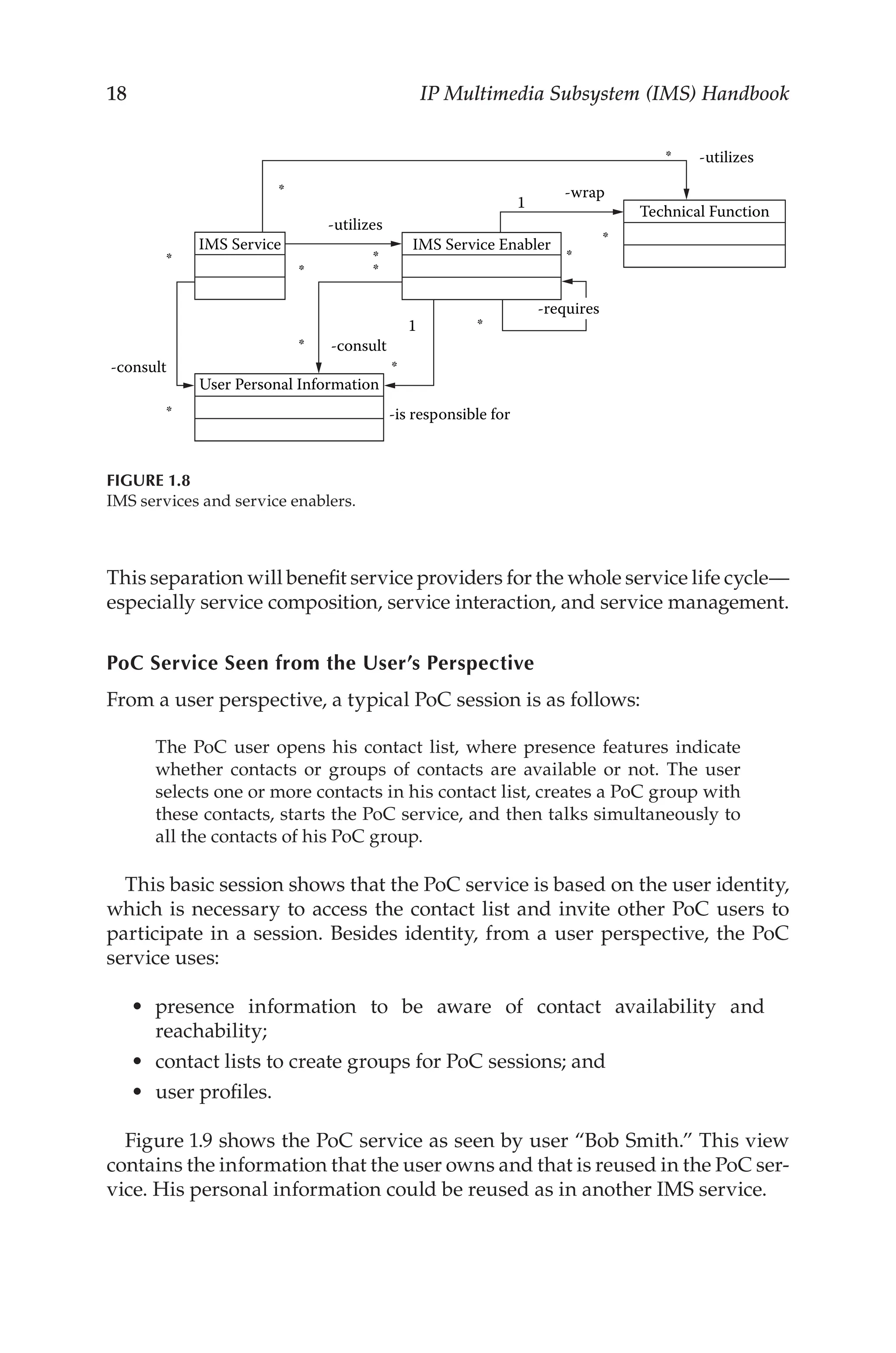
![IMS Service, Models, and Concepts 19
PoC Service and Service Enablers
As described in the OMA specifications, the PoC service requires several
service enablers that perform specific actions and are responsible for spe-
cific information:
push-to-talk over cellular enabler [27] that manages the service logic
of the PoC service;
XDM (XML document management) enabler [28] to handle the con-
tact groups in particular;
presence enabler [29];
IMS enabler [30] to support the service; and
device management enabler [31].
ThedependenciesbetweenthePoCserviceandtheserviceenablersandalso
between the service enablers are described in Figure 1.10 with dotted arrows.
Each service enabler is responsible for some type of personal information.
Technical Functions for PoC Service
As mentioned before, each service enabler is implemented and carried out
via a set of technical functions that are shown in Figure 1.11. In this section
we split each enabler into its corresponding technical functions.
The XML document management (XDM) enabler is implemented with an
XDM client (XDMC), a shared XDM server (shared XDMS), and an aggrega-
tion proxy. The XDMC is an XCAP (XML configuration access protocol) client
•
•
•
•
•
Another Service of Bob : IMS Service
Bob Identity : IMS Public User Identity
Bob Presence Information : User Personal Information
PoC Service of Bob : IMS Service
Bob Profile : User Personal Information Bob Contact List : User Personal Information
Figure 1.9
PoC service as seen by “Bob Smith.”](https://image.slidesharecdn.com/2374007-250603043134-462355d2/75/Ip-Multimedia-Subsystem-Ims-Handbook-Mohammad-Ilyas-Syed-A-Ahson-40-2048.jpg)
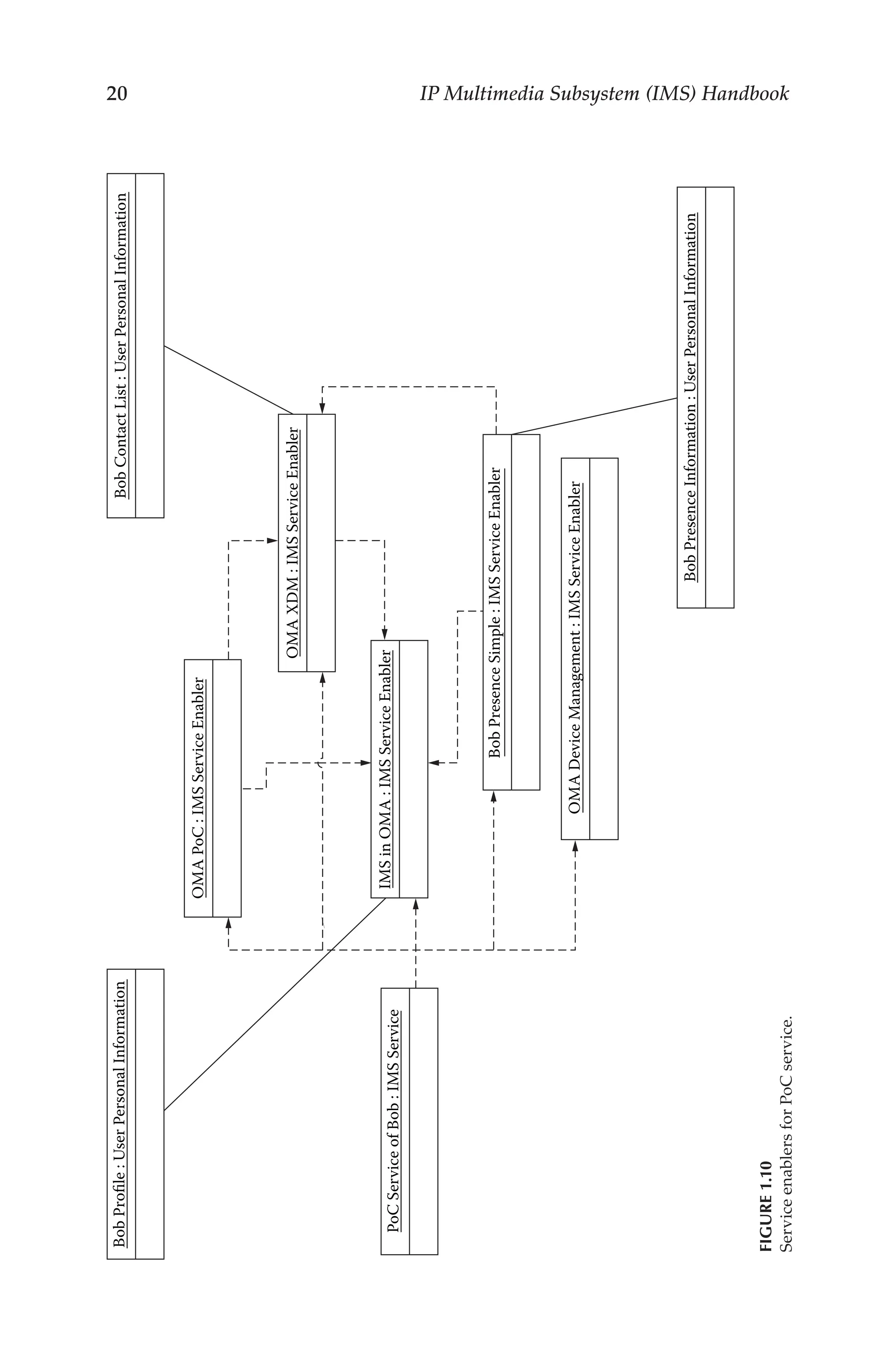
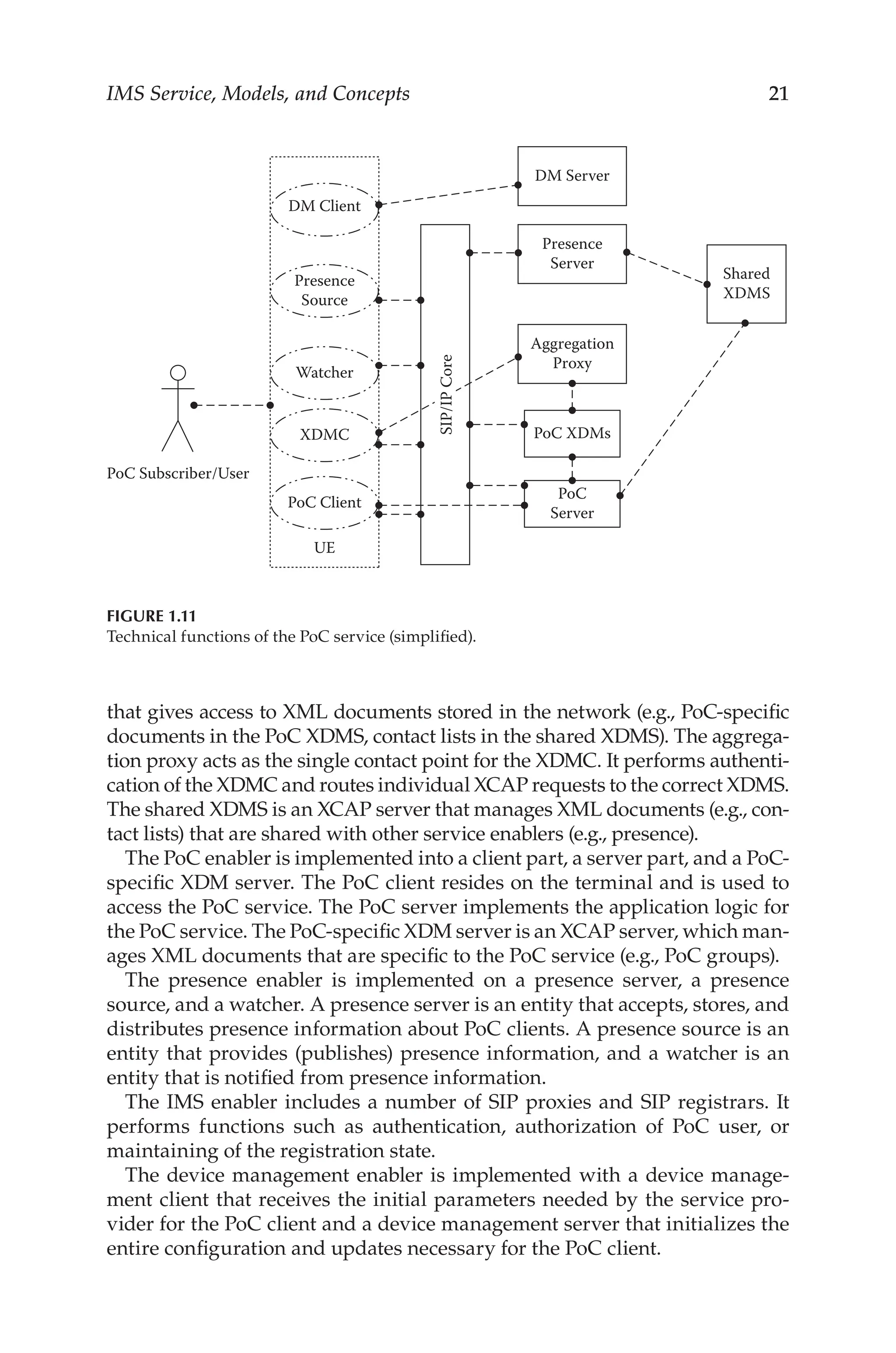
![22 IP Multimedia Subsystem (IMS) Handbook
All technical functions described here belong to the service stratum.
They are thus end-user functions, service control functions, or application
functions. PoC client, XML document management client, presence source,
watcher, and device management client are end-user functions. IMS core is
a service control function. PoC server, PoC XML document management
server, aggregation proxy, shared XML document server, presence server,
and device management server are application functions.
A Comprehensive View of IMS Services
Figure 1.12 is an example of the three enablers OMA XDM, IMS in OMA, and
OMA presence simple. It defines the suitable dependencies of these three
enablers and with the services that make use of these enablers. We take here
the examples of the PoC service and of an instant messaging service. All the
enablers used by these services are not represented in order to simplify the
figure.
Conclusion
IMS services cannot be considered independently from the whole service
environment of the user [32]. This environment includes at least features such
as identity management, community management, availability management,
or context management. This service environment should be able to integrate
third-party service elements. The service value will reside in the quality of
the interactions between all the service elements and in seamless accessibil-
ity in a user-centric way. A service control framework handling these interac-
tions is therefore needed for the interactions between the operator services
and for intermediation with other service providers. This framework should
rely on a common modeling for services, service enablers, and resources.
The main interest of the proposed approach lies in the identification of
the dependencies between the services and the service enablers. This allows
better design of the IMS services by defining clearly which service enabler
is involved in which service and how a service enabler is linked to techni-
cal functions. This approach optimizes the treatment of service interaction
between IMS service enablers by tracing the impact on the user perception
of the service. It will also enhance service management aspects by detect-
ing how the failure of one or many technical functions can affect service
enablers and the use of the IMS service. It is a tool to identify the user per-
sonal information that should be shared between services, to define which
service enabler is responsible for which information, and then to design ser-
vices that reuse this personal information through these service enablers.](https://image.slidesharecdn.com/2374007-250603043134-462355d2/75/Ip-Multimedia-Subsystem-Ims-Handbook-Mohammad-Ilyas-Syed-A-Ahson-43-2048.jpg)
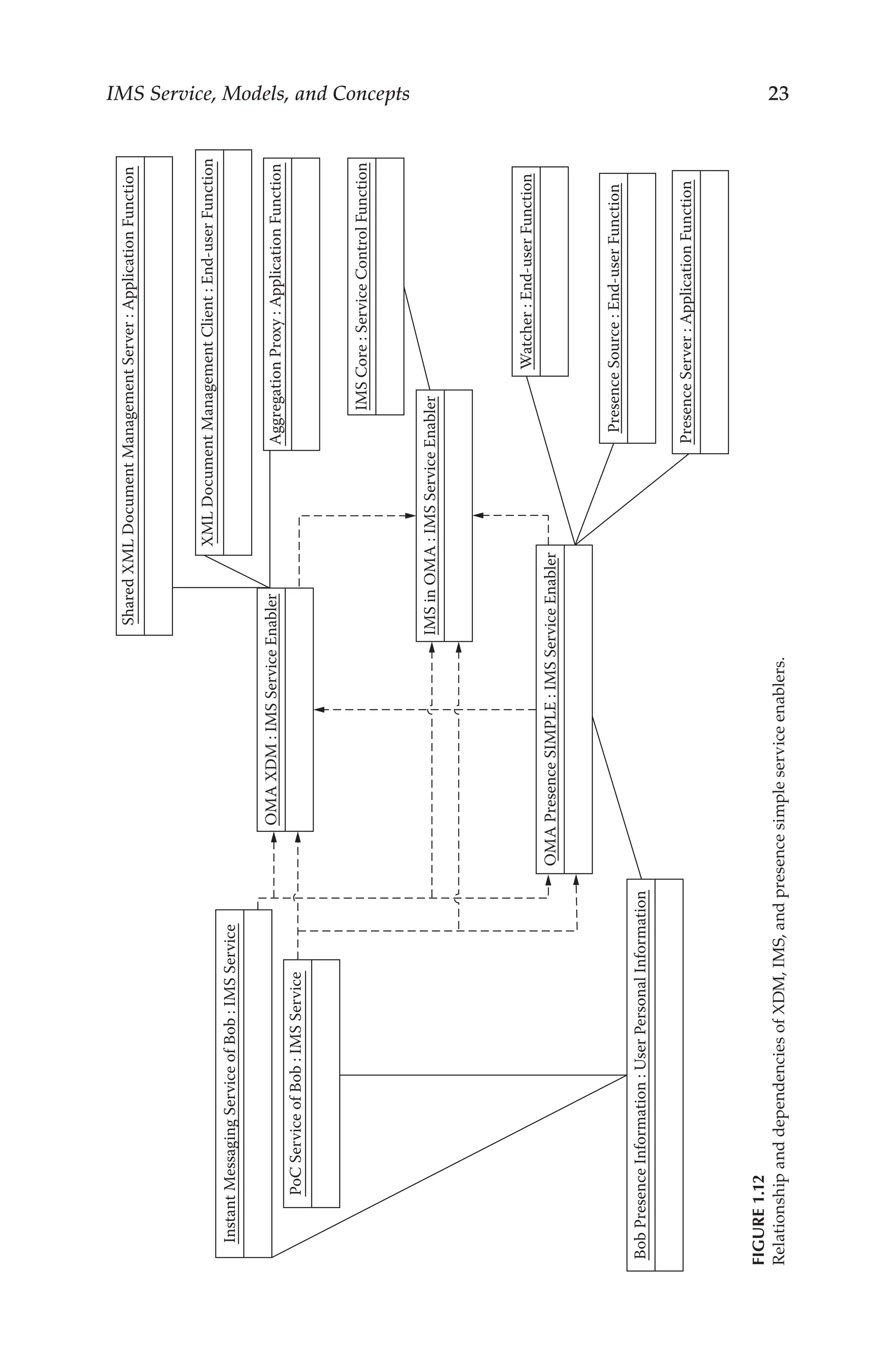
![28 IP Multimedia Subsystem (IMS) Handbook
Introduction
The fixed-mobile convergence (FMC) and voice-data networks have merged
next-generation, value-added applications and integrated multimedia ser-
vices, combining Web browsing, instant messaging, presence, voice over
Internet protocol (VoIP), video conferencing, application sharing, telephony,
unified messaging, multimedia content delivery, etc. on top of different net-
work technologies. The 3GPP (3rd Generation Partnership Project) [1] and
3GPP2 [2] have developed the IP multimedia subsystem (IMS) [3] to provide
a service delivery platform (SDP) for a converged communication paradigm.
No doubt, the convergence of voice and data networks is a great achieve-
ment to maintain a single communication platform for all, but the greatest
challenge is to maintain an adequate level of security in the heterogeneous
network environment to protect multiple technologies and protocols and to
provide data confidentiality and protection.
Another important development in the converged networks paradigm is
the introduction of IP as the network layer in the GPRS (general packet radio
service) and in the UMTS (universal mobile telecommunication system) net-
work domain. The IP-based network architecture provides open and flexible
interfaces to deploy innovative services. In terms of security, this implies an
array of new threats and risks inherited from the Internet world.
The IMS is also vulnerable to different peer-to-peer attacks because users
are always connected and online. The possible reasons for passive and active
attacks in IMS are that an attacker could easily access a wireless link, launch
a falsely based station, and redirect attacks to intercept and redirect a user’s
confidential information somewhere else.
IMS utilizes SIP (session initiation protocol) [4] for signaling, which is open
architecture and vulnerable to different attacks, as discussed in Calhoun et
al. [5]. The IMS core threats include flooding attacks, which ultimately keep
the network resources busy, and, as a result, these sources are not available to
legitimate users. The IMS application servers (ASs) are also valuable targets
for intruders because they provide value-added services. Due to the text-
based nature of SIP, the IMS and AS are vulnerable to attacks like spoofing,
hijacking, and message tampering. Moreover, the AS may suffer from HTTP-
based threats. Finally, intruders may launch denial of service (DoS) attacks
against applications installed on the AS.
In order to minimize the risk of theft of information and data from hackers,
we have to focus on an independent security framework for IMS. According
to 3GPP technical specifications and standards, IMS security provides two
solutions at different levels of protection:
1. The early IMS security solution standardized in 3GPP release 5 pro-
vides limited security functionality and aims to protect early IMS
deployment and offers less security. It provides authentication of](https://image.slidesharecdn.com/2374007-250603043134-462355d2/75/Ip-Multimedia-Subsystem-Ims-Handbook-Mohammad-Ilyas-Syed-A-Ahson-49-2048.jpg)
![IMS—A Secure Architecture for All IP Networks 29
subscribers for services access and identity confidentiality on the
radio interface. It also provides radio interface encryption.
2. The complete IMS security solution is standardized in 3GPP release
6 with full security functionality and builds on the early security
solutions with the objective to improve them. It offers new security
features and secures new services to protect networks and terminals
with data protection.
This chapter presents an IMS overview and addresses IMS potential
attacks. It presents an overview of IMS security architecture and security
associations, as well as key authentication, key generation, and use of keys to
provide confidentiality and integrity. Later, it discusses interdomain security
and presents IMS HTTP-based services security. Finally, it presents security
extension for new threats.
IMS Architectural Overview
The IMS [3] provides SDP for mobile multimedia services provisioning,
such as VoIP, video-telephony, multimedia conferencing, mobile content,
and push-to-talk. It is based on Internet Engineering Task Force (IETF) pro-
tocols like SIP [4], DIAMETER [8], SDP, real-time transport protocol (RTP),
and transfer control protocol (TCP)/IP protocol stack. The IMS is considered
as the next-generation service delivery platform framework. It consists of a
modular design with open interfaces and enables the flexibility for provid-
ing multimedia services over IP technology. The IMS does not standardize
specific services but, rather, uses standard service enablers (e.g., presence)
and inherently supports multimedia and VoIP.
In the IMS architecture, the SIP protocol [4] is used as the standard signal-
ing protocol that establishes, controls, modifies, and terminates voice, video,
and messaging sessions between two or more participants. The related sig-
naling servers in the architecture are referred to as call state control functions
(CSCFs) and are distinguished by their specific functionalities. The function-
ality related to authentication, authorization, and accounting (AAA) within
the IMS is based on the IETF DIAMETER protocol [6] and is implemented
in the home subscriber system (HSS), CSCFs, and various other IMS com-
ponents in order to allow charging functionality within the IMS. Instead of
developing the protocol from scratch, DIAMETER is based on the Remote
Authentication Dial-in-User Service (RADIUS) [7], which has previously
been used to provide AAA services for dial-up and terminal servers across
environments.
The other protocol that is important for multimedia contents is real-time
transport protocol (RTP) [8], which provides end-to-end delivery for real-time
data. It also contains end-to-end delivery services like payload-type (codec)](https://image.slidesharecdn.com/2374007-250603043134-462355d2/75/Ip-Multimedia-Subsystem-Ims-Handbook-Mohammad-Ilyas-Syed-A-Ahson-50-2048.jpg)
![30 IP Multimedia Subsystem (IMS) Handbook
identification, sequence numbering, time stamping, and delivering monitor-
ing for real-time data. The RTP provides quality of service (QoS) monitoring
using the RTP control protocol (RTCP) [9], which conveys information about
media session participants.
The IMS entities and key functionalities can be classified in six catego-
ries [10]: session management and routing family (CSCFs), databases (HSS,
SLF), interworking elements (BGCF, MGCF, etc.), services (application server,
MRCF, MRFP), support entities (THIG, security gateway [SEG], PDF), and
charging. The most important components and parts of IMS architecture
(shown in Figure 2.1) are described as follows:
Proxy call state control function (P-CSCF) is the first contact point within
the IP multimedia core network; all SIP signaling traffic from or to
the user equipment (UE) traverse via the P-CSCF. Its address is dis-
covered by the UE following the packet data protocol (PDP) context
activation. The P-CSCF behaves like a proxy, accepting and forward-
IMS Core
HSS
Cx
Cx
Sh
Mw
IMS Clients
Mw Mw
ISC
Mw
Media Server
Media GW
Legacy
networks
GSM, PSTN
Signalling GW
IMS Application Platform
XDMS
Parlay X
GW
SIP AS
Presence Charging
P-CSCF
S-CSCF
Mw
I-CSCF
Gm
Figure 2.1
IMS architecture.](https://image.slidesharecdn.com/2374007-250603043134-462355d2/75/Ip-Multimedia-Subsystem-Ims-Handbook-Mohammad-Ilyas-Syed-A-Ahson-51-2048.jpg)
![IMS—A Secure Architecture for All IP Networks 31
ing requests and responses. It performs functions like authorizing
the bearer resources for the appropriate QoS level, emergency calls,
monitoring, header (de)compression, and identification of I-CSCF.
Interrogatingcallstatecontrolfunction(I-CSCF)isthefirstcontactpointwithin
an operator’s network. It contacts the HSS to get the address of S-CSCF
to serve the user for registration. It forwards SIP requests and responses
to S-CSCF. It also performs network topology hiding functionality.
Serving call state control function (S-CSCF) performs the session control
services for the end point and maintains session state as needed by
the network operator for support of the services. Within an oper-
ator’s network, different S-CSCFs may have different functional-
ities. The important functions performed by S-CSCF include user
registration/interaction with service platforms for the support of
services. The S-CSCF decides whether an AS is required to receive
information related to an incoming SIP session request to ensure
appropriate service handling. The decision at the S-CSCF is based
on filter information received from the HSS [10]. This filter infor-
mation is stored and conveyed on a per-application-server basis for
each user.
Home subscriber server (HSS) is the equivalent of the HLR (home location
register) in 2G systems but extended with two DIAMETER-based
reference points. It is the master database of an IMS that stores IMS
user profiles, including individual filtering information, user status
information, and application server profiles.
Application server (AS) provides service platforms in IMS environments.
It does not address how multimedia/value-added applications are
programmed; only well defined signaling and administration inter-
faces (IMS service control [ISC] and Sh) and SIP and DIAMETER
protocols are supported. This enables developers to use almost any
programming paradigm within a SIP AS, such as legacy intelligent
network servers (i.e., CAMEL support environments); open service
access (OSA)/Parlay servers/gateways; or any proven VoIP SIP pro-
gramming paradigm like SIP servlets, call programming language
(CPL), and common gateway interface (CGI) scripts [11]. The SIP AS
is triggered by the S-CSCF, which redirects certain sessions to the
SIP AS based on the downloaded filter criteria or by requesting filter
information from the HSS in a user-based paradigm. The SIP AS
comprises filter rules to decide which of the applications deployed
on the server should be selected for handling the session. During
execution of service logic, it is also possible for the SIP AS to commu-
nicate with the HSS to get additional information about a subscriber
or to be notified about changes in the profile of the subscriber [12].
Media resource function (MRF) can be split into media resource function
controller (MRFC) and media resource function processor (MRFP).](https://image.slidesharecdn.com/2374007-250603043134-462355d2/75/Ip-Multimedia-Subsystem-Ims-Handbook-Mohammad-Ilyas-Syed-A-Ahson-52-2048.jpg)
![32 IP Multimedia Subsystem (IMS) Handbook
It provides media stream processing resources like media mixing,
media announcements, media analysis, and media transcoding as
well as speech [10]. The other three components are border gateway
control function (BGCF), media gate control function (MGCF), and
media gate (MG), which perform the bearer interworking between
RTP/IP and the bearers used in the legacy networks.
IMS end-user system provides the necessary IMS protocol support,
namely SIP, and the service-related media codecs for the multimedia
applications in addition to the basic connectivity support (e.g., GPRS,
wireless local area network [WLAN]).
IMS Security Challenges and Potential Attacks
The security challenges facing IMS are threats from different domain proto-
cols—for example, SIP signaling attacks, RTP media attacks, and IP domain
attacks. Some of the potential IMS attacks are identified in reference 13.
The IMS security challenges are DoS attacks, threats from open-based IP
infrastructure, and SIP signaling and media flow attacks, as depicted in Fig-
ure 2.2. These threats are summarized as follows:
Denial-of-service (DoS) attack: This jams radio signals and floods by
authentication requests to P-CSCF and other devices. For example,
in a REGISTER flooding attack, the attacker sends many REGIS-
TER requests to the P-CSCF with fake or spoofed source addresses
(e.g., SIP URI [uniform resource identifier]). In the case of distrib-
uted REGISTER flooding, the attacker generates multiple REGISTER
requests with different spoofed and faked source addresses to over-
whelm the IMS resources. It causes downfall of IMS resources and
the legitimate users cannot get the services.
Spoofing attack: The malicious node hides its presence in the network
and intercepts traffic, and attackers tamper with messages. These
nodes become trusted nodes in IMS.
Man-in-the-middle attack: Hackers search the breaches and break the
authentication process and integrity protection process in order to
get IMS services for free.
Impersonation: Impersonating a server causes misrouting of messages.
The existing authentication processes are unable to differentiate
between the intruder and the legitimate user. This way the attacker
has free access to IMS services and the victim is charged for the
attacker’s usage of services.](https://image.slidesharecdn.com/2374007-250603043134-462355d2/75/Ip-Multimedia-Subsystem-Ims-Handbook-Mohammad-Ilyas-Syed-A-Ahson-53-2048.jpg)
![IMS—A Secure Architecture for All IP Networks 33
Eavesdropping: Hackers get session information if messages are sent in
clear text and can easily launch a variety of hijacking attacks from
session information.
Password guessing attack: This is like a session hijacking attack with the
objective to get user session information. Even if an intruder is not
able to break the IMS authentication process, he or she can launch a
password-guessing attack in order to misuse the legitimate accounts
of users. The intruder launches this attack by sending many REG-
ISTER requests to P-CSCF and receives 401-unauthorized messages
from the IMS core. The attacker could get 200 OK responses in a
successful attack.
SQL injection: This is a type of message-tampering attack; the text-based
nature of SIP messages provides an opportunity for message-tam-
pering attacks in IMS. This attack not only targets data modification
but also causes DoS by collapse of database services. The utilization
of a Web interface for the provision of value-added services makes
IMS more vulnerable to this kind of attack. The SQL injection could
be launched simply by inserting an SQL statement when UE and
P-CSCF start authentication procedures. The UE’s initial REGIS-
TER request utilizes the HTTP digest [14] authorization header to
transport users’ identities. When a malicious user tries to launch
SQL injection in IMS, he or she spoofs the SIP message and inserts
SIP Attacks
Invite Flooding
Register Flooding
I/R Response Flooding
SQL Injection
Cancel Attack
Refer Attack
Open IP Multimedia
Subsystem (IMS)
Core
Transport IP Layers Attacks
RTP Attacks
Jitter Attack
Session Tear Down
Session Modification
Session Hijacking
TCP SYN Flooding
ACK Flooding
Smurf Attack
Figure 2.2
IMS potential threats.](https://image.slidesharecdn.com/2374007-250603043134-462355d2/75/Ip-Multimedia-Subsystem-Ims-Handbook-Mohammad-Ilyas-Syed-A-Ahson-54-2048.jpg)
















![Conrad and the accident, how he saved my mother's life and mine,
with the courage and skill of a true-born mountaineer. My Uncle was
moved to tears, not only at the gallantry of his son, but also by the
joy of discovering that all the obligations lay not upon one side. I
also wept at finding that Lily had never heard of it. Conrad's lofty
nature scorned to narrate its own achievements. When, after that
adventure, he discovered who we were, he avoided us because he
believed that his father had slain mine. It was not till a later date,
when he became of age--as the Corsicans reckon manhood[#]--that
Lepardo Della Croce told him all he knew of his history, dwelt on the
foul shame wrought to the Della Croce by his bigamist father, and
tried in vain to force on him the awful oath of Vendetta. The youth
had too much English blood in his heart to accept the black
inheritance. Thenceforth he could not bear the sight of the man who
had killed, as they both supposed, his father, although, in his wrath
for his mother's wrongs and his own, he would not resent the deed.
What marvel then that he spurned me, and was maddened with
himself, at finding that he, the illegitimate, was in love with me, his
legitimate sister? But now, we are only half-cousins, and nature has
never misled us.
[#] i.e. the age of twenty.
All that evening, my Uncle was in the most glorious spirits, and I am
not sure that Lily and I were very far behind him. He played us all
sorts of boyish tricks, and we made reprisals with girlish ones, till
Lily's joyous laughter rang halfway clown the corridor. I had dressed
her with especial care, and she did look such a love! But it was all](https://image.slidesharecdn.com/2374007-250603043134-462355d2/75/Ip-Multimedia-Subsystem-Ims-Handbook-Mohammad-Ilyas-Syed-A-Ahson-71-2048.jpg)