PROJECT OVERVIEW
Sjaak Wolfert, Scientific Project Coordinator
(Wageningen University & Research)
European Policy Perspectives on Data-intensive Agriculture & Food
2nd joint workshop of Big Data Europe & GODAN
31 March 2017, Brussels, Belgium
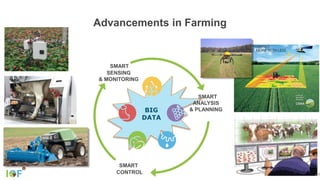
Advancements in Farming
JANUARY 1 2017
BIG
DATA
CONTROL
SENSING
& MONITORING
ANALYSIS
& PLANNING
SMART
SMART
SMART
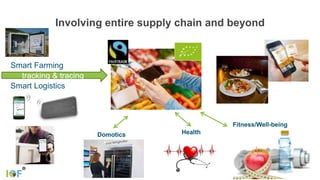
Involving entire supply chain and beyond
Smart Farming
Smart Logistics
tracking & tracing
Domotics Health
Fitness/Well-being
OBJECTIVE
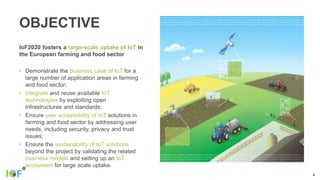
IoF2020 fosters a large-scale uptake of IoT in
the European farming and food sector
• Demonstrate the business case of IoT for a
large number of application areas in farming
and food sector;
• Integrate and reuse available IoT
technologies by exploiting open
infrastructures and standards;
• Ensure user acceptability of IoT solutions in
farming and food sector by addressing user
needs, including security, privacy and trust
issues;
• Ensure the sustainability of IoT solutions
beyond the project by validating the related
business models and setting up an IoT
ecosystem for large scale uptake.
4
IOF2020 IN BRIEF
5
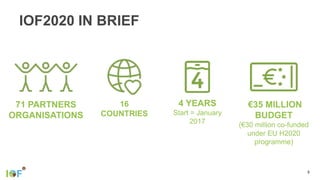
16
COUNTRIES
4 YEARS
Start = January
2017
€35 MILLION
BUDGET
(€30 million co-funded
under EU H2020
programme)
71 PARTNERS
ORGANISATIONS
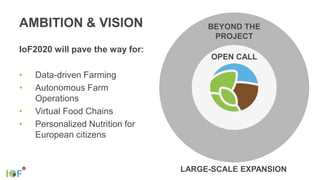
BEYOND THE
PROJECT
OPEN CALL
IoF2020 will pave the way for:
• Data-driven Farming
• Autonomous Farm
Operations
• Virtual Food Chains
• Personalized Nutrition for
European citizens
AMBITION & VISION
LARGE-SCALE EXPANSION
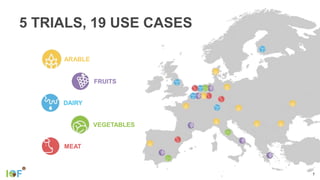
5 TRIALS, 19 USE CASES
7
MEAT
ARABLE
VEGETABLES
FRUITS
DAIRY
Optimizing cultivation and processing of wine by sensor-actuator networks and big data
analysis within a cloud framework
BIG WINE OPTIMIZATION
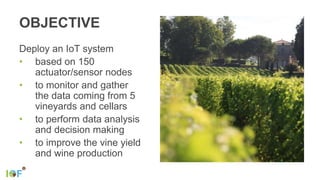
OBJECTIVE
Deploy an IoT system
• based on 150
actuator/sensor nodes
• to monitor and gather
the data coming from 5
vineyards and cellars
• to perform data analysis
and decision making
• to improve the vine yield
and wine production
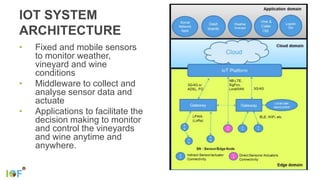
IOT SYSTEM
ARCHITECTURE
• Fixed and mobile sensors
to monitor weather,
vineyard and wine
conditions
• Middleware to collect and
analyse sensor data and
actuate
• Applications to facilitate the
decision making to monitor
and control the vineyards
and wine anytime and
anywhere.
JANUARY 1 2017
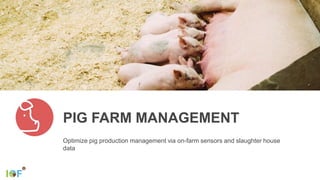
Optimize pig production management via on-farm sensors and slaughter house
data
PIG FARM MANAGEMENT
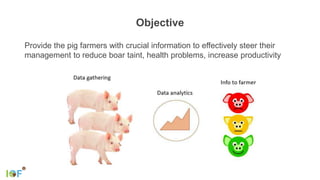
Objective
Provide the pig farmers with crucial information to effectively steer their
management to reduce boar taint, health problems, increase productivity
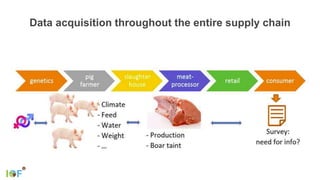
Data acquisition throughout the entire supply chain
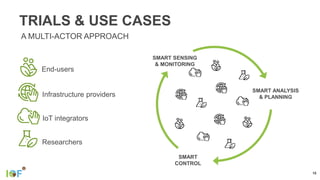
TRIALS & USE CASES
16
A MULTI-ACTOR APPROACH
SMART
CONTROL
SMART SENSING
& MONITORING
SMART ANALYSIS
& PLANNING
Researchers
Infrastructure providers
IoT integrators
End-users
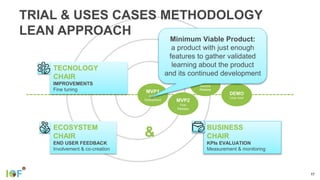
TRIAL & USES CASES METHODOLOGY
LEAN APPROACH
17
MVP1
Initial
Deployment MVP2
First
Release
DEMO
Large scale
MVP3
Second
Release
TECNOLOGY
CHAIR
IMPROVEMENTS
Fine tuning
BUSINESS
CHAIR
KPIs EVALUATION
Measurement & monitoring
ECOSYSTEM
CHAIR
END USER FEEDBACK
Involvement & co-creation
&
Minimum Viable Product:
a product with just enough
features to gather validated
learning about the product
and its continued development
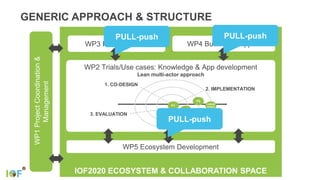
IOF2020 ECOSYSTEM & COLLABORATION SPACE
WP1ProjectCoordination&
Management
GENERIC APPROACH & STRUCTURE
WP2 Trials/Use cases: Knowledge & App development
Lean multi-actor approach
3. EVALUATION
1. CO-DESIGN
2. IMPLEMENTATION
P1
P2
LARGE
SCALE
P3
WP3 IoT Integration WP4 Business Support
WP5 Ecosystem Development
PULL-push PULL-push
PULL-push
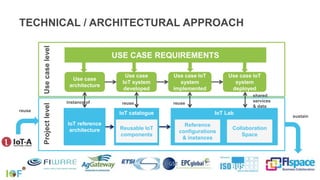
TECHNICAL / ARCHITECTURAL APPROACH
Use case
architecture
Use case
IoT system
developed
Use case IoT
system
implemented
Use case IoT
system
deployed
USE CASE REQUIREMENTS
IoT reference
architecture
instance of
IoT catalogue
Reusable IoT
components
reuse
IoT Lab
Reference
configurations
& instances
reuse
Collaboration
Space
shared
services
& data
ProjectlevelUsecaselevel
sustain
reuse
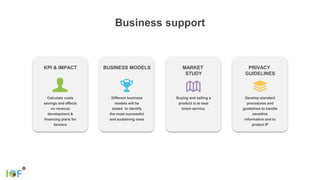
Business support
Different business
models will be
tested to identify
the most successful
and sustaining ones
BUSINESS MODELS
Buying and selling a
product is te best
lorem service.
MARKET
STUDY
Develop standard
procedures and
guidelines to handle
sensitive
information and to
protect IP
PRIVACY
GUIDELINES
Calculate costs
savings and effects
on revenue
development &
financing plans for
farmers
KPI & IMPACT
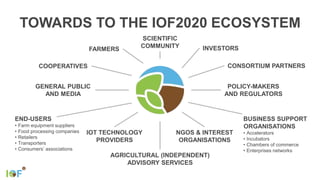
TOWARDS TO THE IOF2020 ECOSYSTEM
GENERAL PUBLIC
AND MEDIA
POLICY-MAKERS
AND REGULATORS
SCIENTIFIC
COMMUNITY
AGRICULTURAL (INDEPENDENT)
ADVISORY SERVICES
NGOS & INTEREST
ORGANISATIONS
IOT TECHNOLOGY
PROVIDERS
BUSINESS SUPPORT
ORGANISATIONS
• Accelerators
• Incubators
• Chambers of commerce
• Enterprises networks
END-USERS
• Farm equipment suppliers
• Food processing companies
• Retailers
• Transporters
• Consumers’ associations
INVESTORSFARMERS
COOPERATIVES CONSORTIUM PARTNERS
STAY-TUNED VIA
• Website: www.iof2020.eu
• Twitter: https://twitter.com/IoF2020
• Newsletter subscription & contact: communications@iof2020.eu
IoF2020 is funded by the Horizon 2020 Framework Programme of the European Union.
Grant Agreement no. 731884. Visit iof2020.eu for more information about the project.
CONTACT INFORMATION
Sjaak Wolfert
sjaak.wolfert@wur.nl
+31 317 485 939
THANK YOU FOR YOUR ATTENTION!

IoF2020 project overview for BDE/eRosa/GODAN

  • 1.
    PROJECT OVERVIEW Sjaak Wolfert,Scientific Project Coordinator (Wageningen University & Research) European Policy Perspectives on Data-intensive Agriculture & Food 2nd joint workshop of Big Data Europe & GODAN 31 March 2017, Brussels, Belgium
  • 2.
    Advancements in Farming JANUARY1 2017 BIG DATA CONTROL SENSING & MONITORING ANALYSIS & PLANNING SMART SMART SMART
  • 3.
    Involving entire supplychain and beyond Smart Farming Smart Logistics tracking & tracing Domotics Health Fitness/Well-being
  • 4.
    OBJECTIVE IoF2020 fosters alarge-scale uptake of IoT in the European farming and food sector • Demonstrate the business case of IoT for a large number of application areas in farming and food sector; • Integrate and reuse available IoT technologies by exploiting open infrastructures and standards; • Ensure user acceptability of IoT solutions in farming and food sector by addressing user needs, including security, privacy and trust issues; • Ensure the sustainability of IoT solutions beyond the project by validating the related business models and setting up an IoT ecosystem for large scale uptake. 4
  • 5.
    IOF2020 IN BRIEF 5 16 COUNTRIES 4YEARS Start = January 2017 €35 MILLION BUDGET (€30 million co-funded under EU H2020 programme) 71 PARTNERS ORGANISATIONS
  • 6.
    BEYOND THE PROJECT OPEN CALL IoF2020will pave the way for: • Data-driven Farming • Autonomous Farm Operations • Virtual Food Chains • Personalized Nutrition for European citizens AMBITION & VISION LARGE-SCALE EXPANSION
  • 7.
    5 TRIALS, 19USE CASES 7 MEAT ARABLE VEGETABLES FRUITS DAIRY
  • 8.
    Optimizing cultivation andprocessing of wine by sensor-actuator networks and big data analysis within a cloud framework BIG WINE OPTIMIZATION
  • 9.
    OBJECTIVE Deploy an IoTsystem • based on 150 actuator/sensor nodes • to monitor and gather the data coming from 5 vineyards and cellars • to perform data analysis and decision making • to improve the vine yield and wine production
  • 10.
    IOT SYSTEM ARCHITECTURE • Fixedand mobile sensors to monitor weather, vineyard and wine conditions • Middleware to collect and analyse sensor data and actuate • Applications to facilitate the decision making to monitor and control the vineyards and wine anytime and anywhere.
  • 11.
  • 12.
    Optimize pig productionmanagement via on-farm sensors and slaughter house data PIG FARM MANAGEMENT
  • 13.
    Objective Provide the pigfarmers with crucial information to effectively steer their management to reduce boar taint, health problems, increase productivity
  • 14.
    Data acquisition throughoutthe entire supply chain
  • 16.
    TRIALS & USECASES 16 A MULTI-ACTOR APPROACH SMART CONTROL SMART SENSING & MONITORING SMART ANALYSIS & PLANNING Researchers Infrastructure providers IoT integrators End-users
  • 17.
    TRIAL & USESCASES METHODOLOGY LEAN APPROACH 17 MVP1 Initial Deployment MVP2 First Release DEMO Large scale MVP3 Second Release TECNOLOGY CHAIR IMPROVEMENTS Fine tuning BUSINESS CHAIR KPIs EVALUATION Measurement & monitoring ECOSYSTEM CHAIR END USER FEEDBACK Involvement & co-creation & Minimum Viable Product: a product with just enough features to gather validated learning about the product and its continued development
  • 18.
    IOF2020 ECOSYSTEM &COLLABORATION SPACE WP1ProjectCoordination& Management GENERIC APPROACH & STRUCTURE WP2 Trials/Use cases: Knowledge & App development Lean multi-actor approach 3. EVALUATION 1. CO-DESIGN 2. IMPLEMENTATION P1 P2 LARGE SCALE P3 WP3 IoT Integration WP4 Business Support WP5 Ecosystem Development PULL-push PULL-push PULL-push
  • 19.
    TECHNICAL / ARCHITECTURALAPPROACH Use case architecture Use case IoT system developed Use case IoT system implemented Use case IoT system deployed USE CASE REQUIREMENTS IoT reference architecture instance of IoT catalogue Reusable IoT components reuse IoT Lab Reference configurations & instances reuse Collaboration Space shared services & data ProjectlevelUsecaselevel sustain reuse
  • 20.
    Business support Different business modelswill be tested to identify the most successful and sustaining ones BUSINESS MODELS Buying and selling a product is te best lorem service. MARKET STUDY Develop standard procedures and guidelines to handle sensitive information and to protect IP PRIVACY GUIDELINES Calculate costs savings and effects on revenue development & financing plans for farmers KPI & IMPACT
  • 21.
    TOWARDS TO THEIOF2020 ECOSYSTEM GENERAL PUBLIC AND MEDIA POLICY-MAKERS AND REGULATORS SCIENTIFIC COMMUNITY AGRICULTURAL (INDEPENDENT) ADVISORY SERVICES NGOS & INTEREST ORGANISATIONS IOT TECHNOLOGY PROVIDERS BUSINESS SUPPORT ORGANISATIONS • Accelerators • Incubators • Chambers of commerce • Enterprises networks END-USERS • Farm equipment suppliers • Food processing companies • Retailers • Transporters • Consumers’ associations INVESTORSFARMERS COOPERATIVES CONSORTIUM PARTNERS
  • 22.
    STAY-TUNED VIA • Website:www.iof2020.eu • Twitter: https://twitter.com/IoF2020 • Newsletter subscription & contact: communications@iof2020.eu
  • 23.
    IoF2020 is fundedby the Horizon 2020 Framework Programme of the European Union. Grant Agreement no. 731884. Visit iof2020.eu for more information about the project. CONTACT INFORMATION Sjaak Wolfert sjaak.wolfert@wur.nl +31 317 485 939 THANK YOU FOR YOUR ATTENTION!

Editor's Notes

  • #5 This slide provides an overview of the project aim and objectives.
  • #6 Some key figures about the project: The Consortium comprises 71 partners from 16 countries. The project duration is 4 years (Start in January 2017 and end in December 2020) The total budget is €35 million (of which €30 million co-funded by the EU under the Horizon 2020 Framework Programme for Research and Innovation)
  • #7 IoF2020 will organize an open call around mid‐term for being able to involve new users in the use cases, develop additional and specifically more innovative applications, as well as to replicate the use cases through new sites or new connected devices, and complementary assessment of the acceptability of the use cases. IoF2020 will pave the way for: Data-driven Farming: IoF2020 will help farmers to change from ‘management by gut feeling’ towards ‘management by facts’, which is of crucial importance to survive its increasingly demanding business environment. Autonomous Farm Operations: IoF2020 will improve the connectedness and intelligence of farm automation. As such it will enable farm equipment to become autonomous, self‐adaptive systems that can operate, decide and even learn without on‐site or remote intervention by humans. Virtual Food Chains: IoF2020 will enable to virtualize food supply chain management which allows for advanced remote (re)planning, monitoring and control capabilities and for new business models. Personalized Nutrition: personalized nutrition monitoring and advices by using smartphones, that make use of connected sensors, wearables like smart watches, equipment at home (e.g. refrigerators, weighing machines) and outdoor equipment (e.g. in canteens, restaurants, super markets, fitness clubs).
  • #8 The core of the project lies within 5 trials. These cover 5 sectors (arable, dairy, fruits, vegetables and meat). To showcase each of the trials, the project is organized around 19 use cases.
  • #17 IoF2020 follows a multi-actor approach in which all the stakeholders in the food chain are involved : from farmers, cooperatives, equipment and logistic suppliers, food processing companies, to consumer organizations and it includes ICT developers. IoF2020 envisions a transformation of the food and farming sector thanks to smart webs of connected and context-sensitive objects. These objects can be easily identified, sensed and controlled remotely. As such, they will drastically improve productivity and sustainability of the sector.
  • #18 IoF2020’s innovative approach, the lean multi-actor approach allows to test the solutions with end-users in their operational environment and value chain stakeholders. Feedback is translated into technical improvements that better meet end-users needs and better fit into the production environment and the value chain. The figure shows that: The process starts with initial deployment of technologies into their operational environment at the beginning of the use case; It follows concurrent (i) measurement of use‐case performance and evaluation of KPIs coordinated by the business chair (ii) managing, facilitating and synthesizing feedback from end‐users and stakeholders along the value chain coordinated by the ecosystem chair; Translating key issues demanded by end‐users and stakeholders into improvement, inserting or removing of technical features, coordinated by the technology chair. By passing through this cycle, the technology is altered with a new set of features and a new minimum viable product (MVP) compared to the beginning of the process.
  • #19 Through these projects we have developed a success formula in approaching the challenge of ICT and Information Management in Agri-Food : Trials and use cases form the core, in which we jointly develop as research and business organisations, knowledge and application through a lean multi-actor approach This means that we quickly develop minimum viable products with involvement of all relevant stakeholders and upscale these through several cycles of development In parallel we create synergy by Technical integration: open architectures, standard that can be used as generic building blocks in the trials and use cases Governance and business modelling: solve issues that arise from the trials and use cases regarding ownership, privacy, trust, etc. and support the businesses in developing sustainable business plans for the apps, services and organization structures that are being developed Ecosystem Development – support the trials and use cases in embedding their solutions in global ecosystems and upgrading them to a large scale Project coordination and management is trivial, but we have shown that Wageningen University and Research is very capable to fulfil this role in large public-private projects This integrated approach will guarantee long-term, sustainable results from these projects.
  • #20 IoF2020 believes that it is important for a large scale take‐up to maximize synergies across multiple use case systems. As a consequence, much attention is paid to ensuring the interoperability of multiple use case systems and the reuse of IoT components across them. The figure shows the architectural approach to achieve this during design, development, implementation and deployment. To enable reuse of components, IoF2020 will provide a catalogue of reusable system components, which can be integrated in the IoT systems of multiple use cases of the project. It will include as much as possible existing components from previous and running projects and (open source) initiatives, including FIWARE, FIspace, etc.
  • #22 Consortium participants and partner organisations IoF2020 partners, other networks and initiatives with whom relations have already been established. Stakeholders, directly using produced services and/or benefiting from the project outcomes. Farmers Cooperatives End users IoF2020 includes end-users for the entire supply chain, from farm to the plate. IoT technology providers Companies or other entities developing, producing and selling IoT technologies. Agricultural (independent) advisory services Services that make new knowledge available to farmers and assist the farmers to develop their farming and management skills. Business support organisations Entities supporting the establishment of a business entity. Interest organisations / NGOs Interest organisations are the entities representing interests of a particular sector. NGOs are non-profit organizations, operating independently of government. Investors Entities committing capital for a financial return. Scientific community A diverse network of interacting scientists. Policy makers and regulators Individuals responsible for determining and applying policies and legislations. General public & media General public is the general community of people, regardless of their interests and/or occupations.  Media are the communication channels through which the IoF2020 key emssages can be disseminated.