SmartAgriHubs: connecting the dots
Digital Agriculture Forum Webinar, 6 Dec. 2020
Dr. Sjaak Wolfert - Sr. Scientist | Theme Ambassador Digital Innovation in Agri-Food
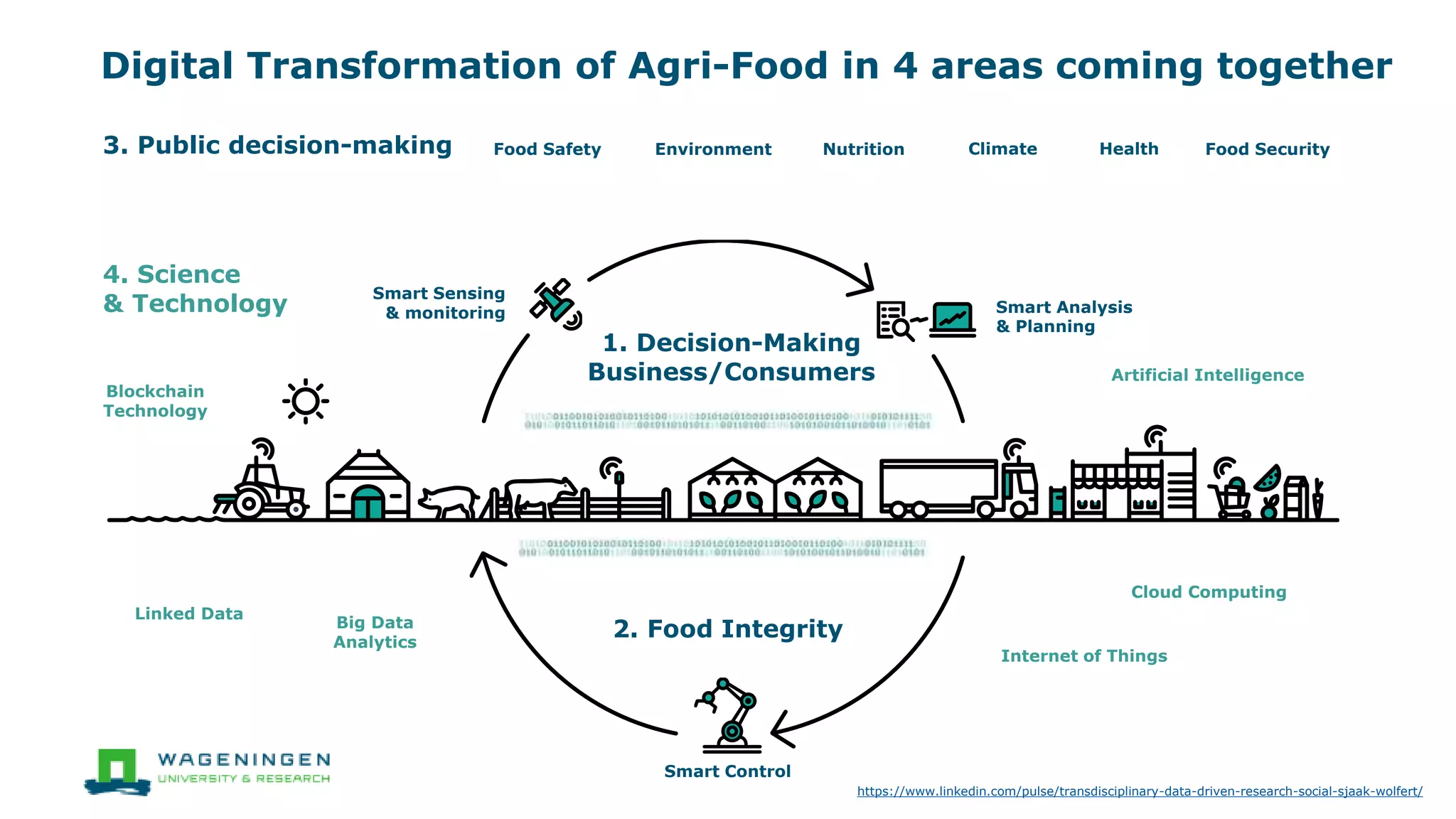
Digital Transformation of Agri-Food in 4 areas coming together
Cloud Computing
Big Data
Analytics
Internet of Things
Linked Data
Artificial Intelligence
Blockchain
Technology
HealthFood Safety Environment Nutrition Food SecurityClimate3. Public decision-making
Smart Sensing
& monitoring
Smart Control
Smart Analysis
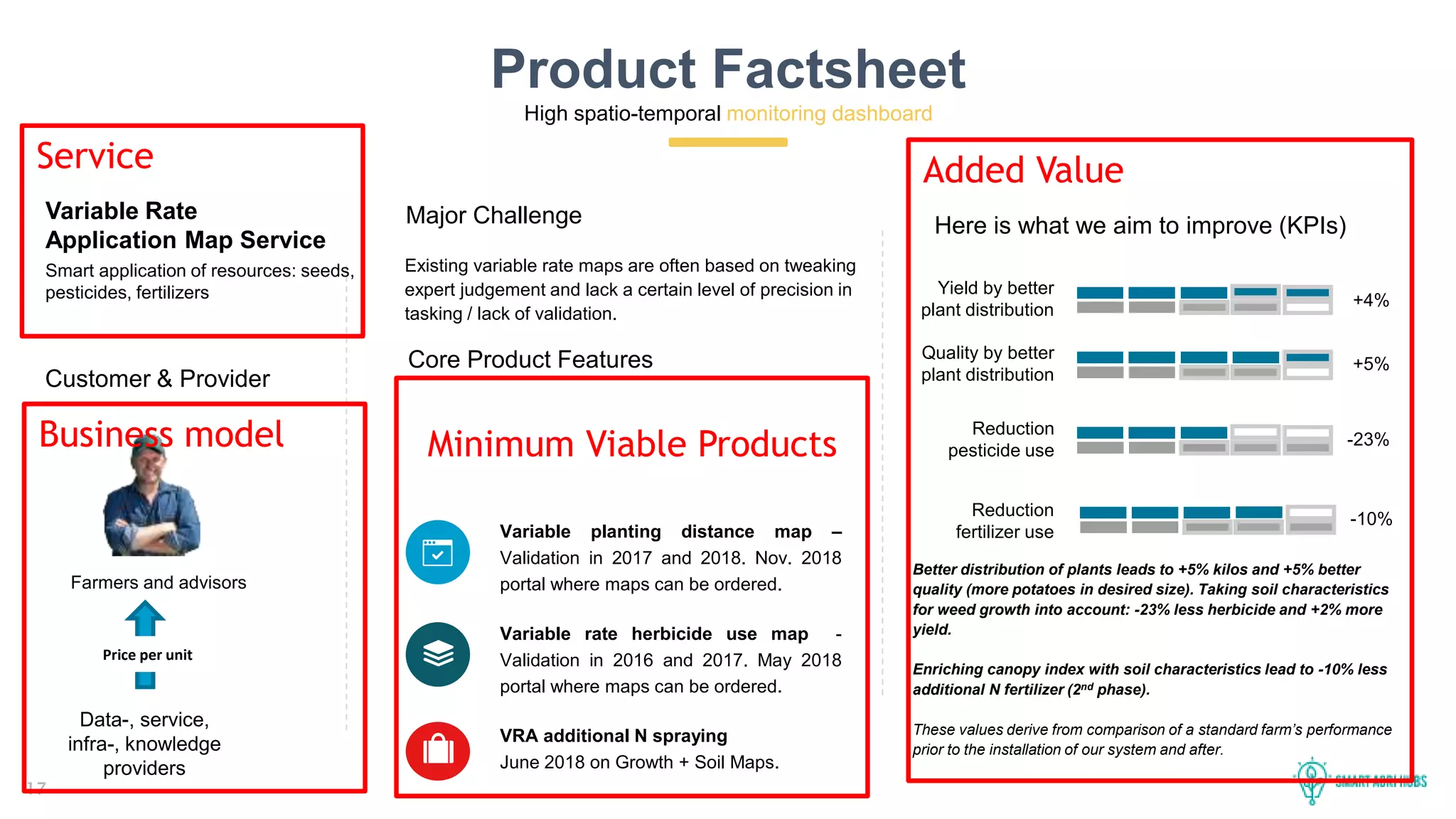
& Planning
1. Decision-Making
Business/Consumers
2. Food Integrity
4. Science
& Technology
https://www.linkedin.com/pulse/transdisciplinary-data-driven-research-social-sjaak-wolfert/
How to connect the dots through
infrastructures and business
ecosystems that utilize the potential
of digital data to address the grand
challenges of sustainable food
production?
However...developments are very fragmented!
3
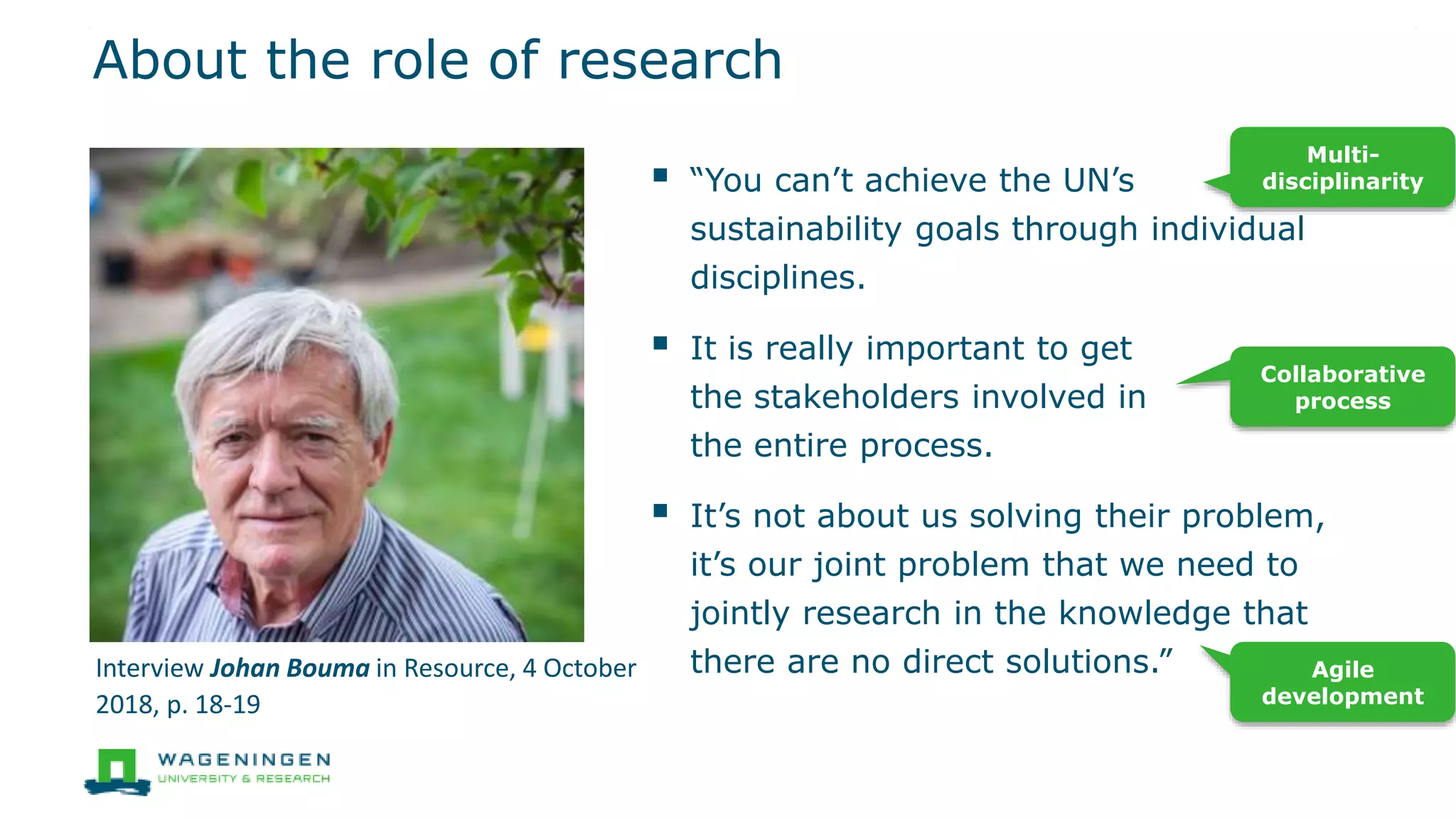
About the role of research
 “You can’t achieve the UN’s
sustainability goals through individual
disciplines.
 It is really important to get
the stakeholders involved in
the entire process.
 It’s not about us solving their problem,
it’s our joint problem that we need to
jointly research in the knowledge that
there are no direct solutions.”
Multi-
disciplinarity
Collaborative
process
Agile
development
Interview Johan Bouma in Resource, 4 October
2018, p. 18-19
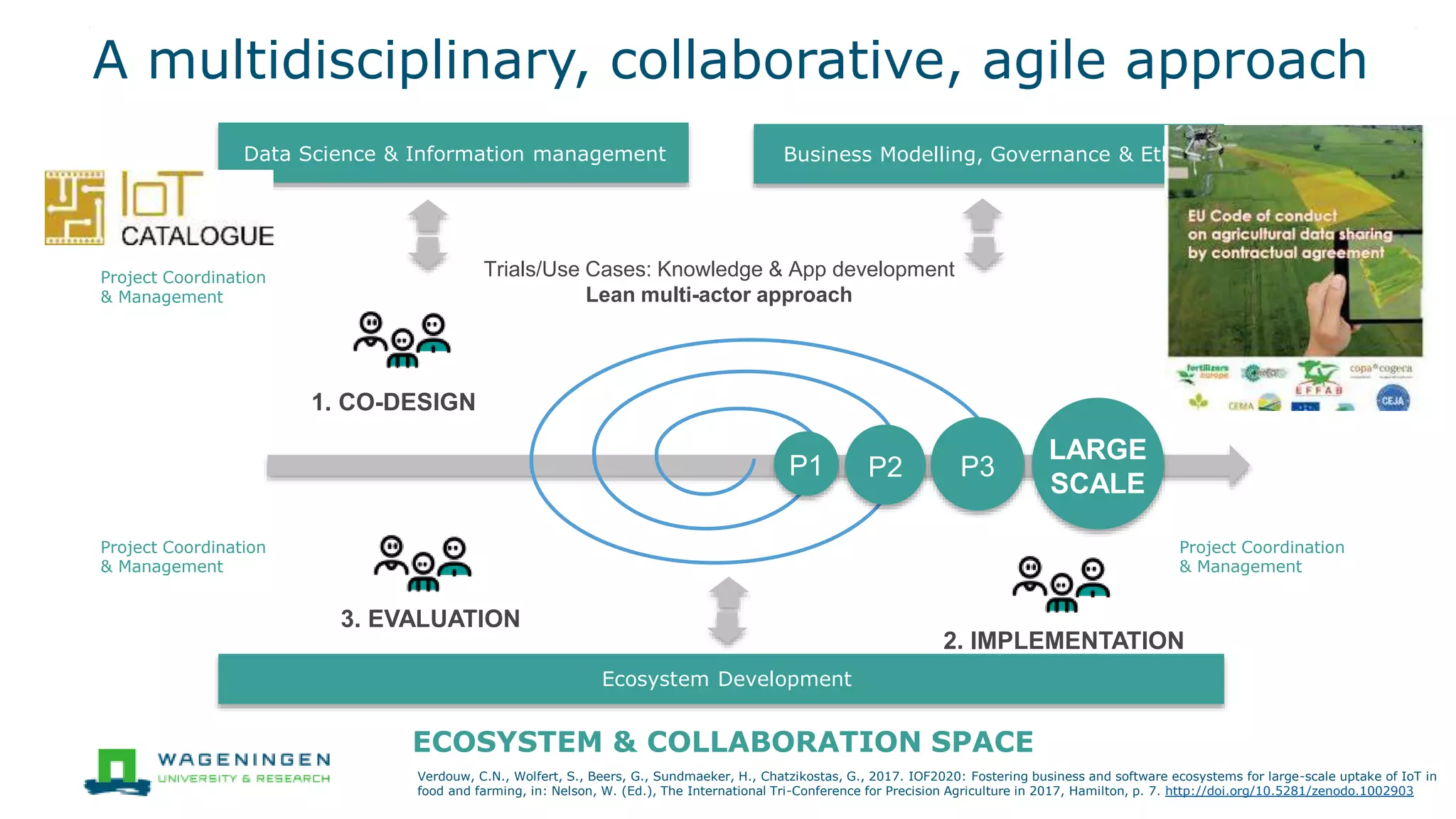
A multidisciplinary, collaborative, agile approach
Verdouw, C.N., Wolfert, S., Beers, G., Sundmaeker, H., Chatzikostas, G., 2017. IOF2020: Fostering business and software ecosystems for large-scale uptake of IoT in
food and farming, in: Nelson, W. (Ed.), The International Tri-Conference for Precision Agriculture in 2017, Hamilton, p. 7. http://doi.org/10.5281/zenodo.1002903
Trials/Use Cases: Knowledge & App development
Lean multi-actor approach
1. CO-DESIGN
3. EVALUATION
2. IMPLEMENTATION
LARGE
SCALE
ECOSYSTEM & COLLABORATION SPACE
Project Coordination
& Management
P2P1
Business Modelling, Governance & Ethics
P3
Data Science & Information management
Ecosystem Development
Project Coordination
& Management
Project Coordination
& Management
Project Coordination
& Management
6
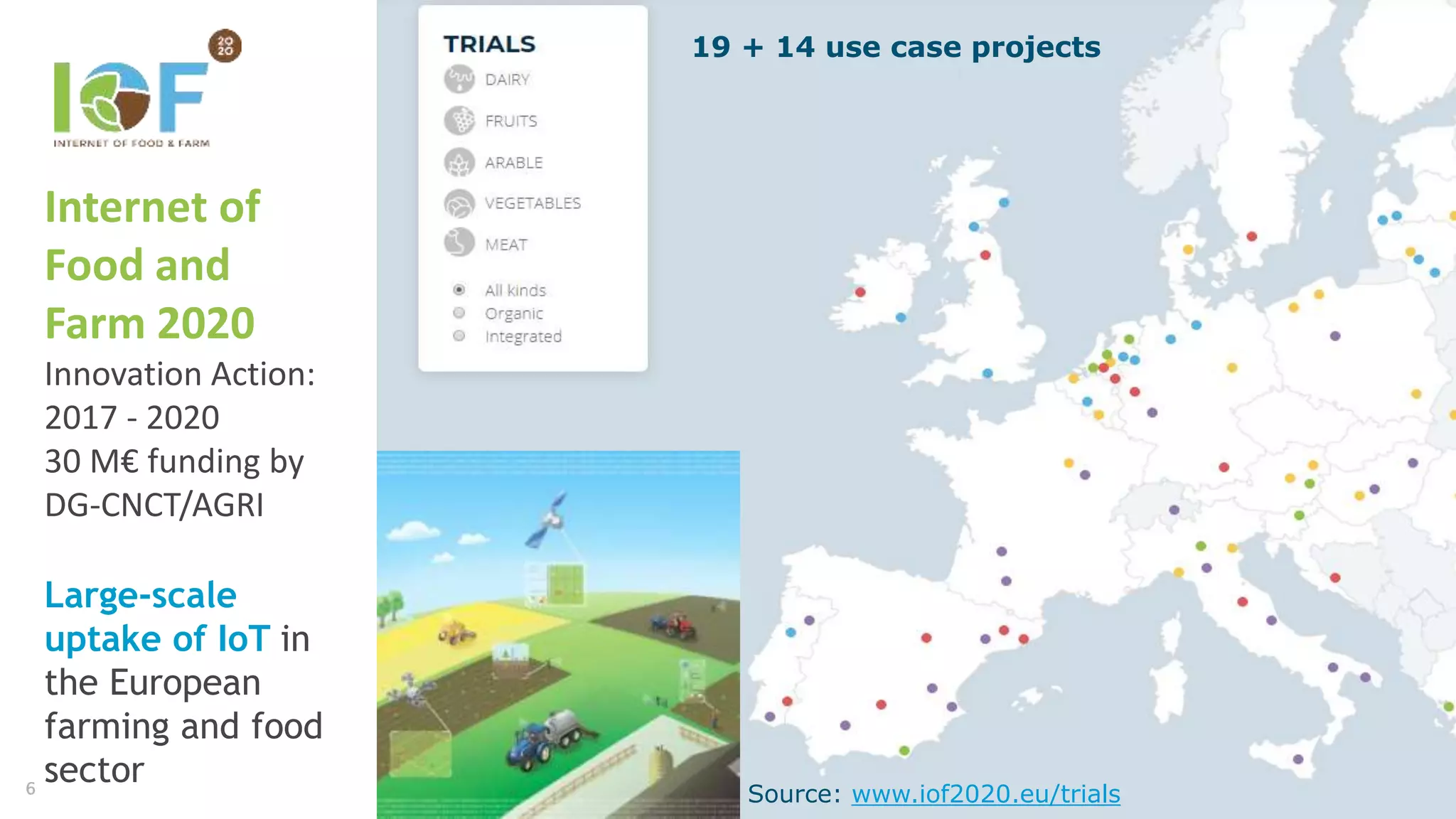
19 + 14 use case projects
Source: www.iof2020.eu/trials
Internet of
Food and
Farm 2020
Innovation Action:
2017 - 2020
30 M€ funding by
DG-CNCT/AGRI
Large-scale
uptake of IoT in
the European
farming and food
sector
7
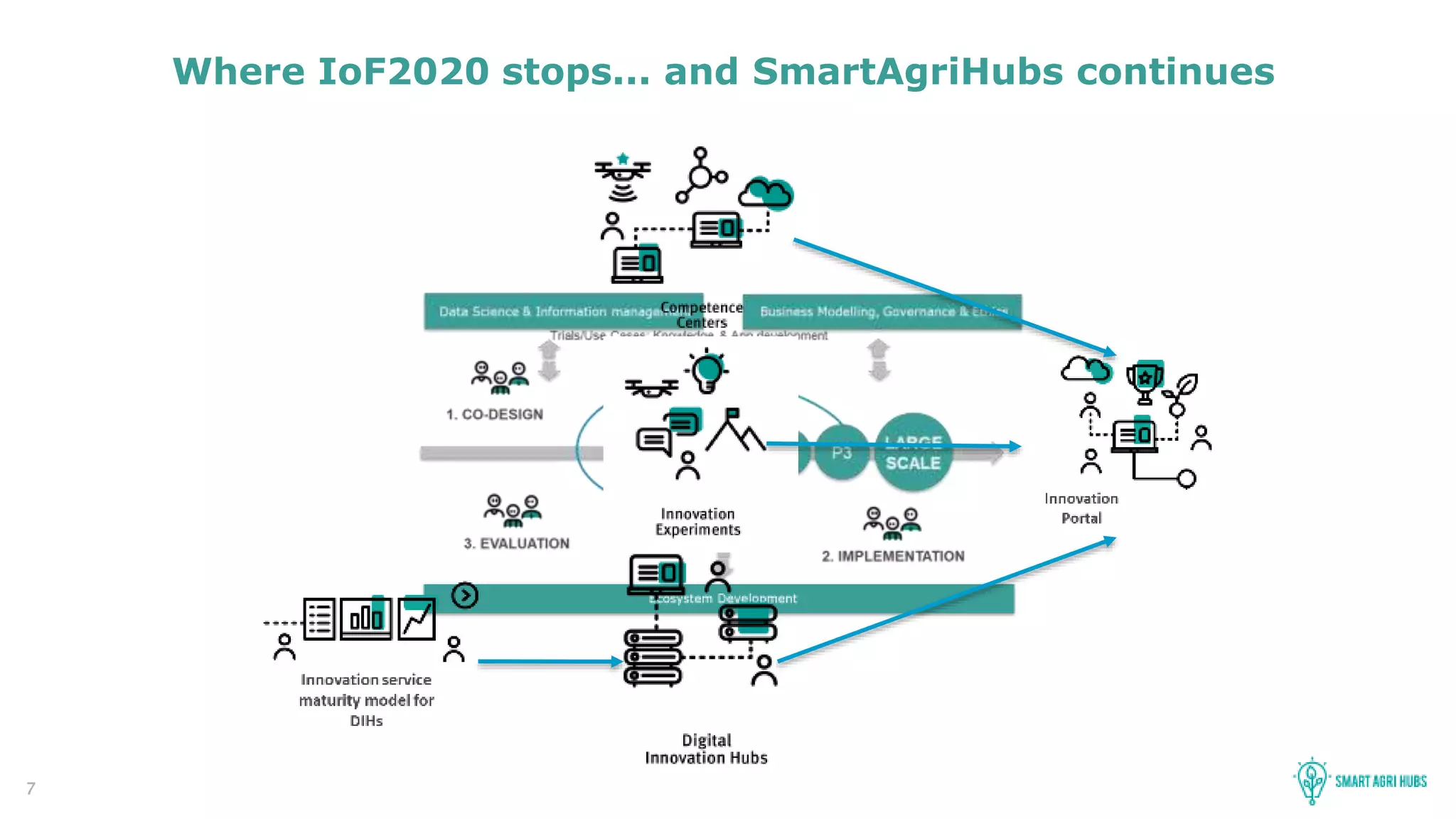
Where IoF2020 stops... and SmartAgriHubs continues
8
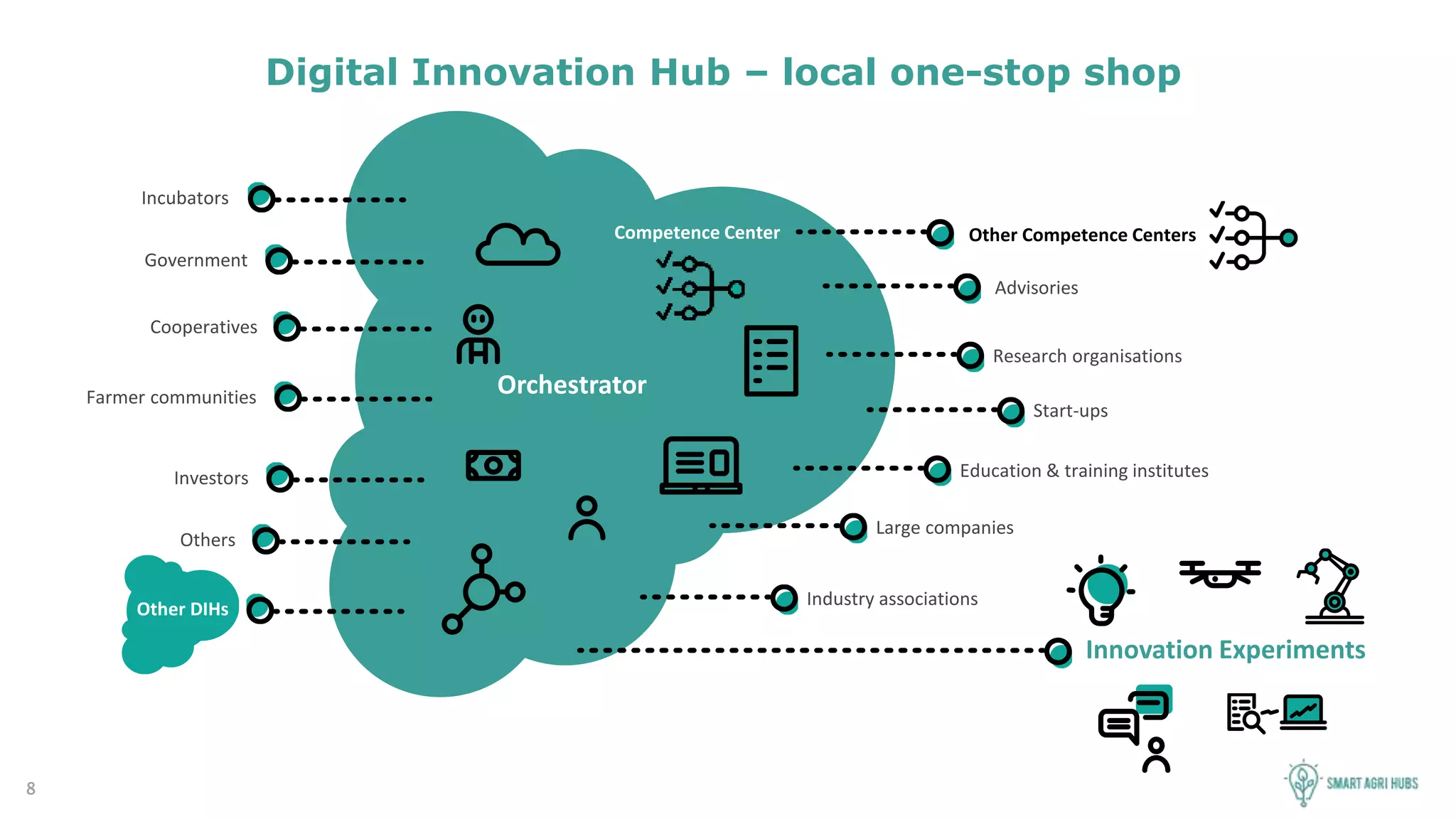
Digital Innovation Hub – local one-stop shop
Incubators
Government
Cooperatives
Farmer communities
Investors
Others
Advisories
Research organisations
Start-ups
Education & training institutes
Large companies
Industry associations
Other Competence CentersCompetence Center
Orchestrator
Other DIHs
Innovation Experiments
9
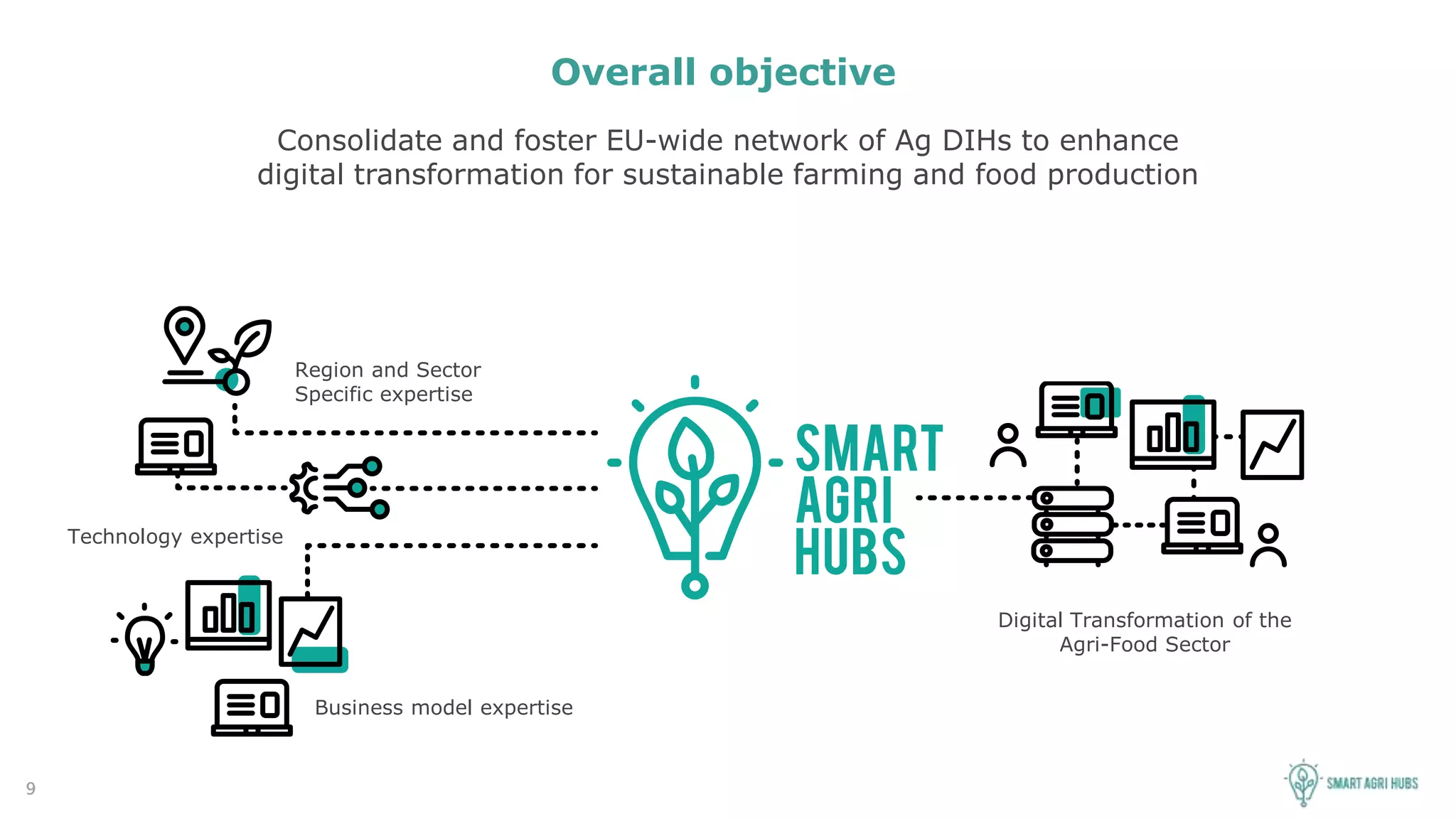
Consolidate and foster EU-wide network of Ag DIHs to enhance
digital transformation for sustainable farming and food production
Region and Sector
Specific expertise
Digital Transformation of the
Agri-Food Sector
Technology expertise
Business model expertise
Overall objective
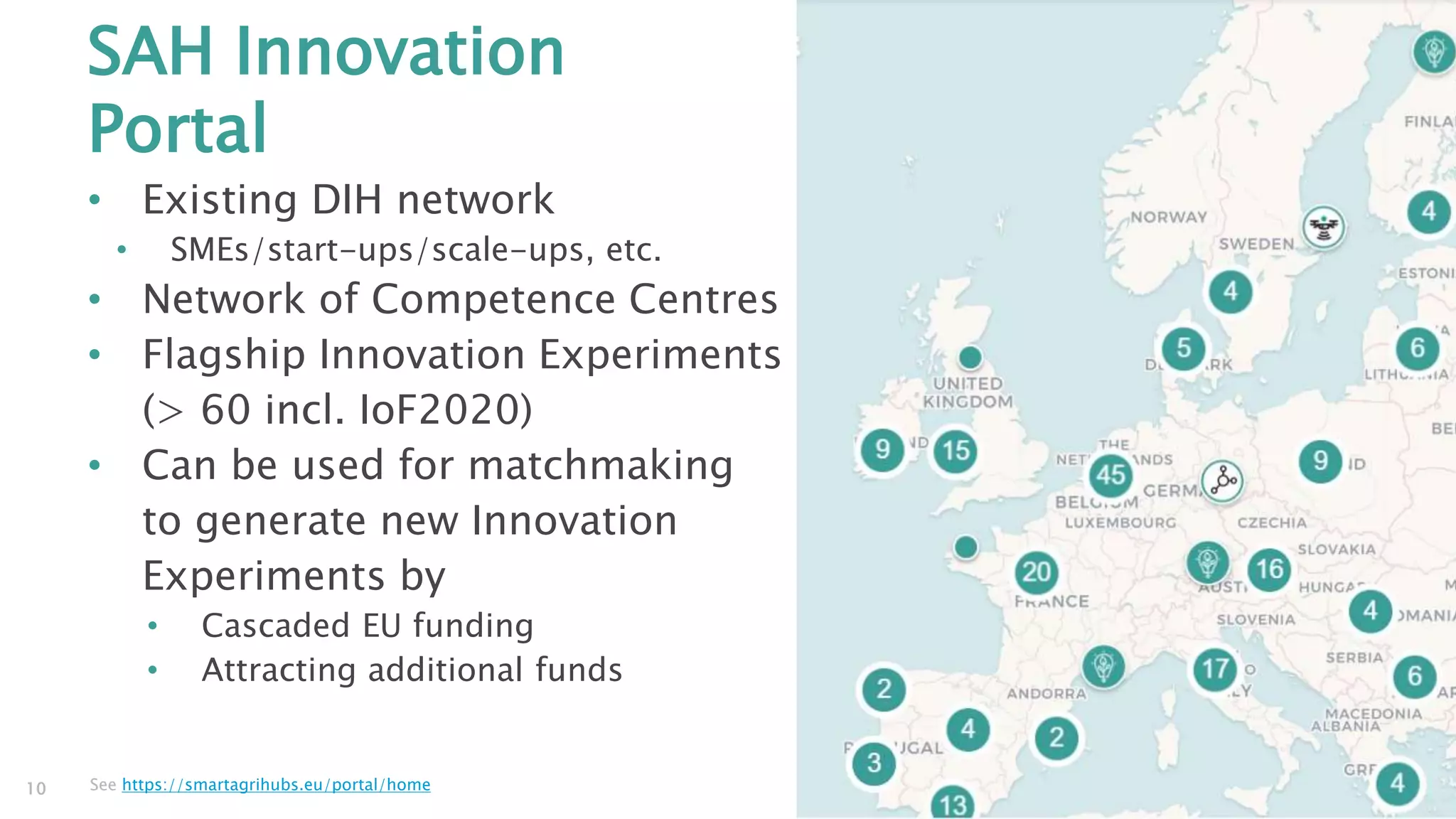
10 See https://smartagrihubs.eu/portal/home
• Existing DIH network
• SMEs/start-ups/scale-ups, etc.
• Network of Competence Centres
• Flagship Innovation Experiments
(> 60 incl. IoF2020)
• Can be used for matchmaking
to generate new Innovation
Experiments by
• Cascaded EU funding
• Attracting additional funds
SAH Innovation
Portal
11
Connecting the dots beyond Europe...
Thanks for your
attention!
12
Dr. J. (Sjaak) Wolfert
Strategic Sr. Scientist Digital Innovation in Agri-Food
Wageningen University & Research
P.O. Box 35
6700 AA Wageningen
The Netherlands
T +31 317 485 939
M +31 610 811 948
sjaak.wolfert@wur.nl
www.wur.nl
www.linkedin.com/in/sjaakwolfert
https://twitter.com/sjaakwolfert
https://www.slideshare.net/SjaakWolfert
www.researchgate.net/sjaak_wolfert
www.wur.eu/data
www.smartagrihubs.eu
www.IoF2020.eu
www.datafair.nl/en/datafair.htm
Background slides
13
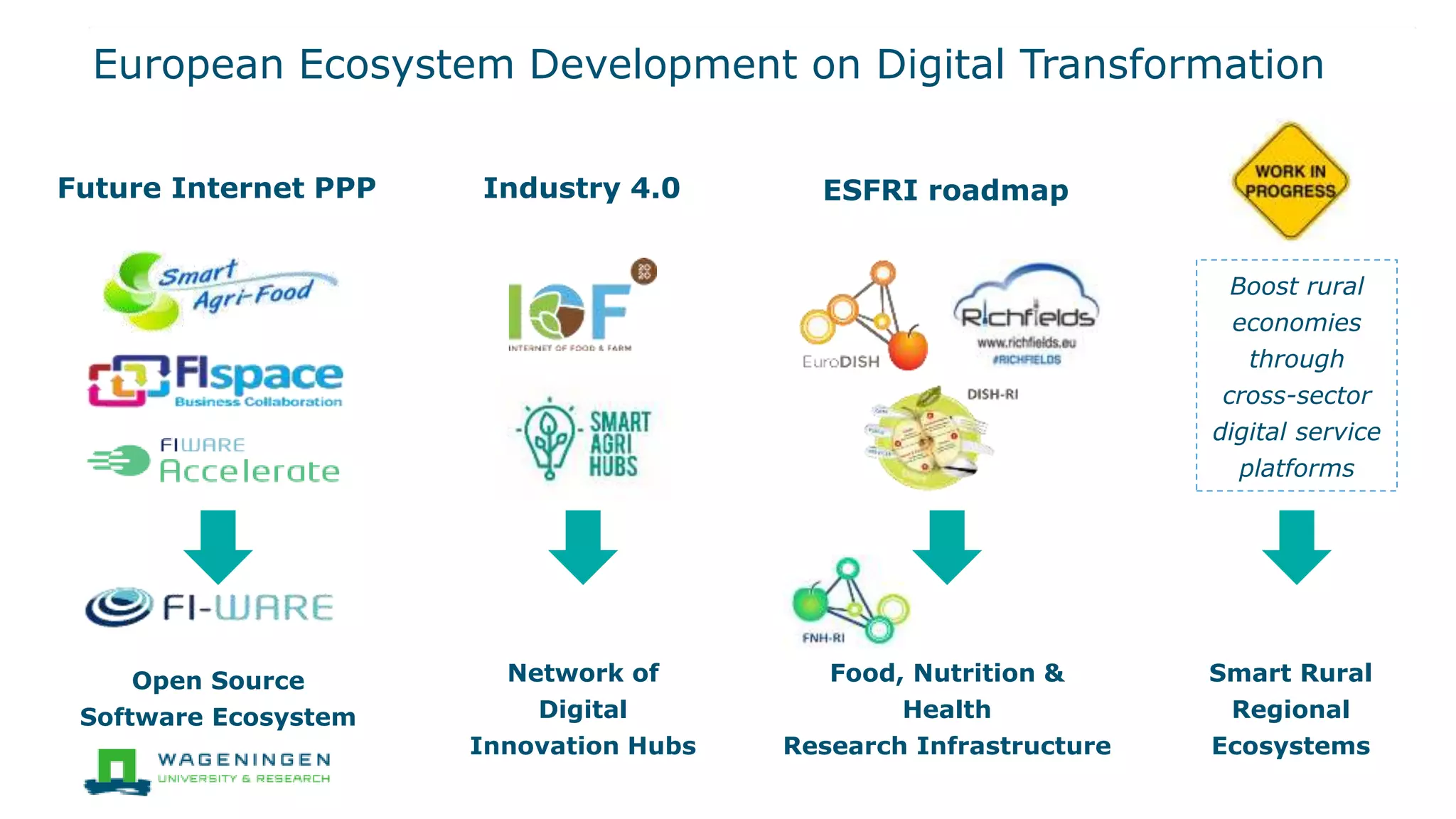
European Ecosystem Development on Digital Transformation
Industry 4.0
Network of
Digital
Innovation Hubs
Future Internet PPP
Open Source
Software Ecosystem
Food, Nutrition &
Health
Research Infrastructure
ESFRI roadmap
Boost rural
economies
through
cross-sector
digital service
platforms
Smart Rural
Regional
Ecosystems
15
Soil map based variable rate applications and machine automation in potato production
UC1.1. WITHIN-FIELD
MANAGEMENT ZONING
Coordinators: Peter Paree (ZLTO) & Corné Kempenaar (WUR)
16
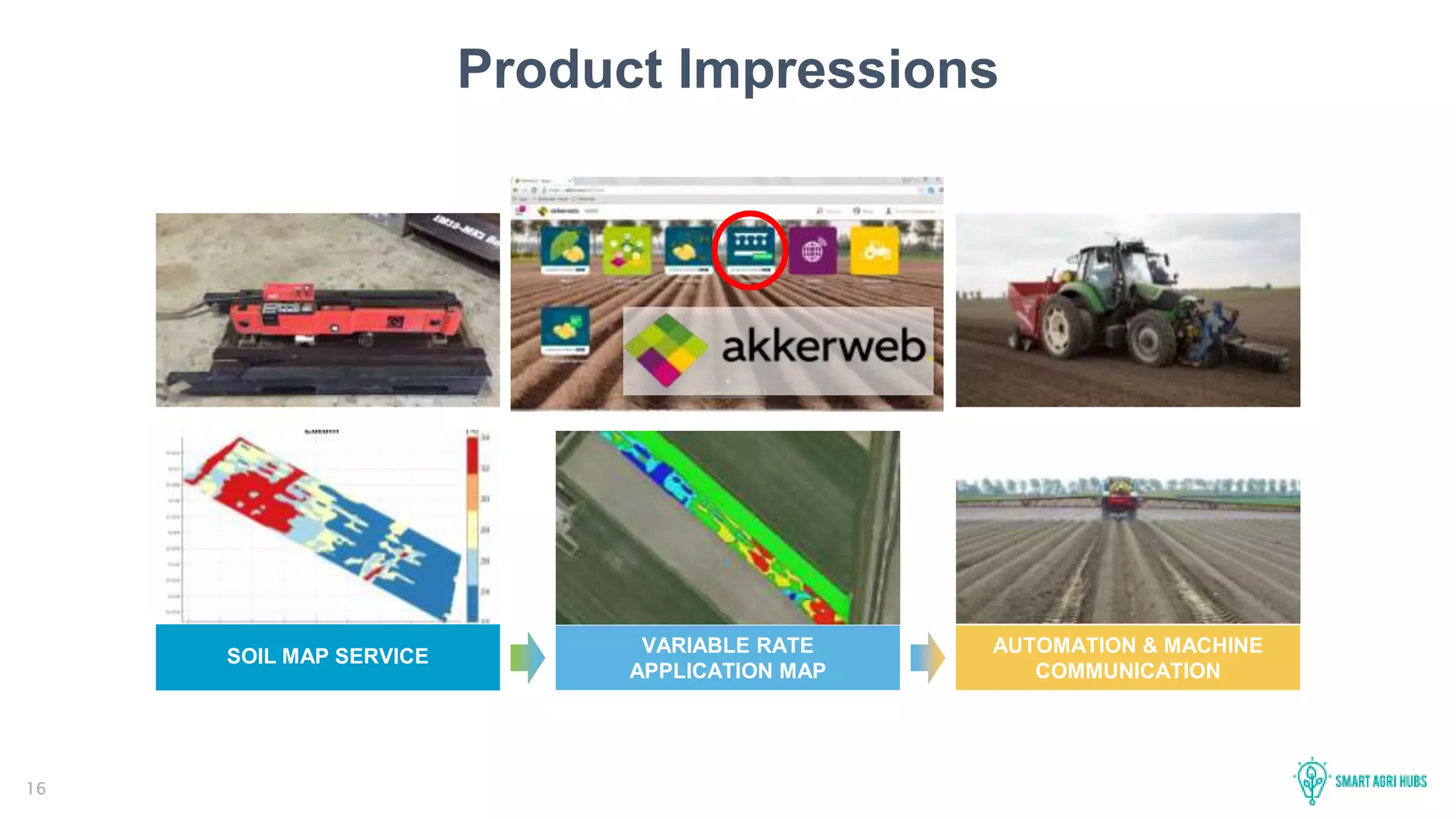
SOIL MAP SERVICE
VARIABLE RATE
APPLICATION MAP
AUTOMATION & MACHINE
COMMUNICATION
Product Impressions
17
Major Challenge Here is what we aim to improve (KPIs)
Yield by better
plant distribution
Variable planting distance map –
Validation in 2017 and 2018. Nov. 2018
portal where maps can be ordered.
Variable rate herbicide use map -
Validation in 2016 and 2017. May 2018
portal where maps can be ordered.
Quality by better
plant distribution
Reduction
pesticide use
Core Product Features
Variable Rate
Application Map Service
Customer & Provider
Uses soil maps and agronomic knowledge to create
crop management task map based on variability in
soil characteristics like organic matter and/or clay
content, water storage capacity, tramlines, shade,
etc..
Smart application of resources: seeds,
pesticides, fertilizers +4%
+5%
-23%
Better distribution of plants leads to +5% kilos and +5% better
quality (more potatoes in desired size). Taking soil characteristics
for weed growth into account: -23% less herbicide and +2% more
yield.
Enriching canopy index with soil characteristics lead to -10% less
additional N fertilizer (2nd phase).
These values derive from comparison of a standard farm’s performance
prior to the installation of our system and after.
Reduction
fertilizer use
-10%
Product Factsheet
Existing variable rate maps are often based on tweaking
expert judgement and lack a certain level of precision in
tasking / lack of validation.
Farmers and advisors
Price per unit
Data-, service,
infra-, knowledge
providers
VRA additional N spraying
June 2018 on Growth + Soil Maps.
High spatio-temporal monitoring dashboard
Service
Business model Minimum Viable Products
Added Value
18
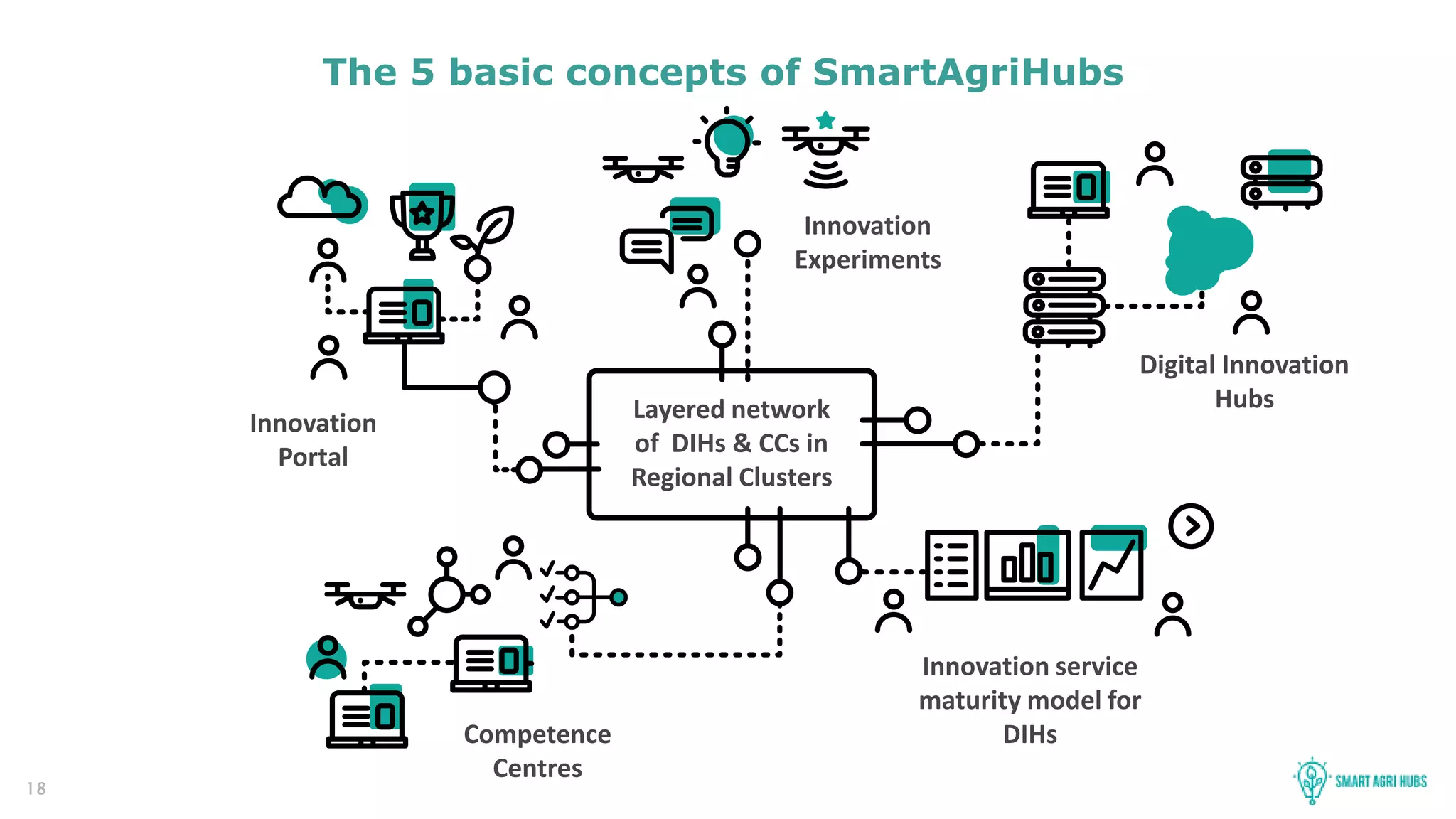
The 5 basic concepts of SmartAgriHubs
Innovation service
maturity model for
DIHs
Innovation
Portal
Innovation
Experiments
Layered network
of DIHs & CCs in
Regional Clusters
Digital Innovation
Hubs
Competence
Centres
19
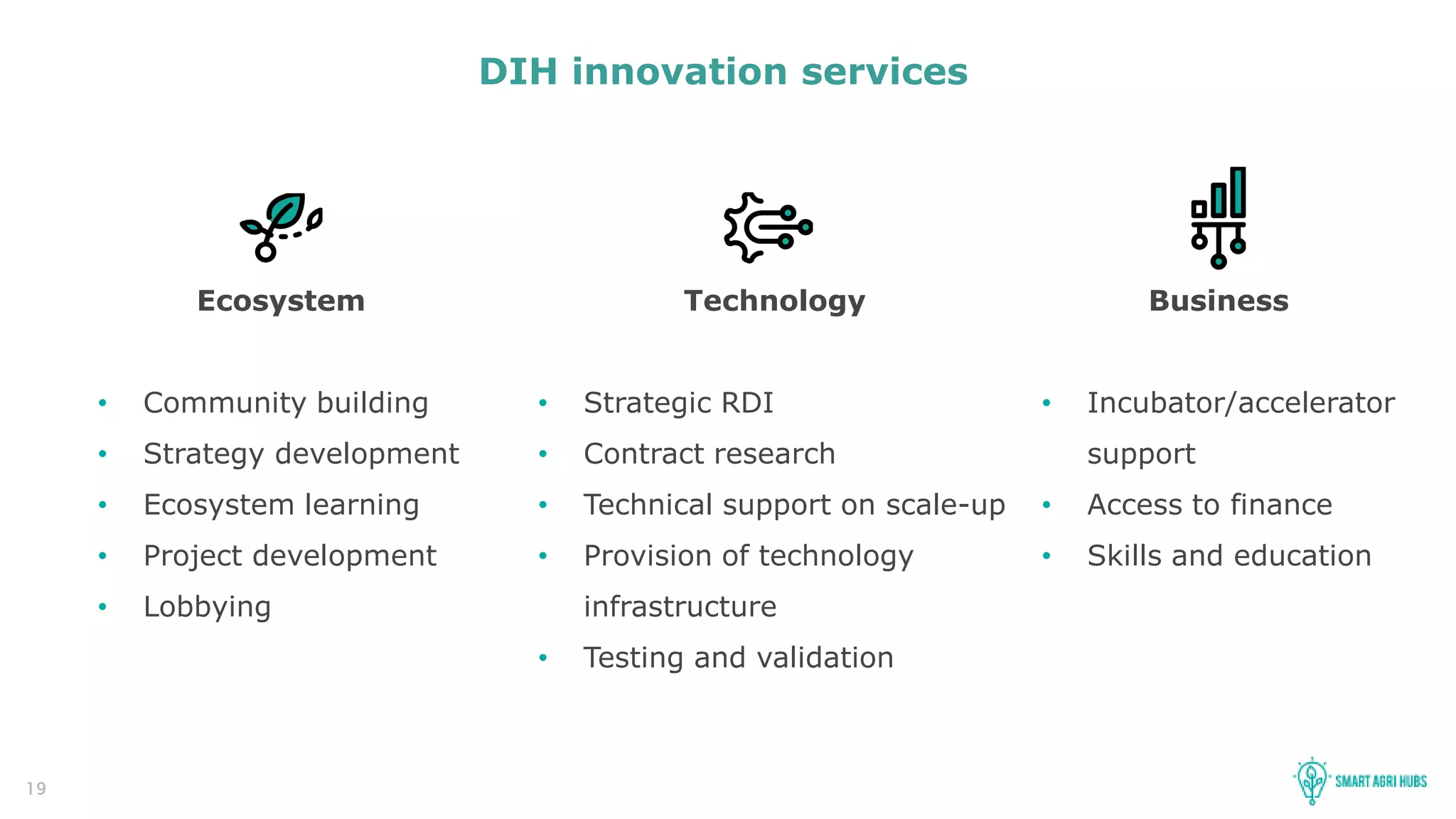
DIH innovation services
Ecosystem
• Community building
• Strategy development
• Ecosystem learning
• Project development
• Lobbying
Technology
• Strategic RDI
• Contract research
• Technical support on scale-up
• Provision of technology
infrastructure
• Testing and validation
Business
• Incubator/accelerator
support
• Access to finance
• Skills and education
20
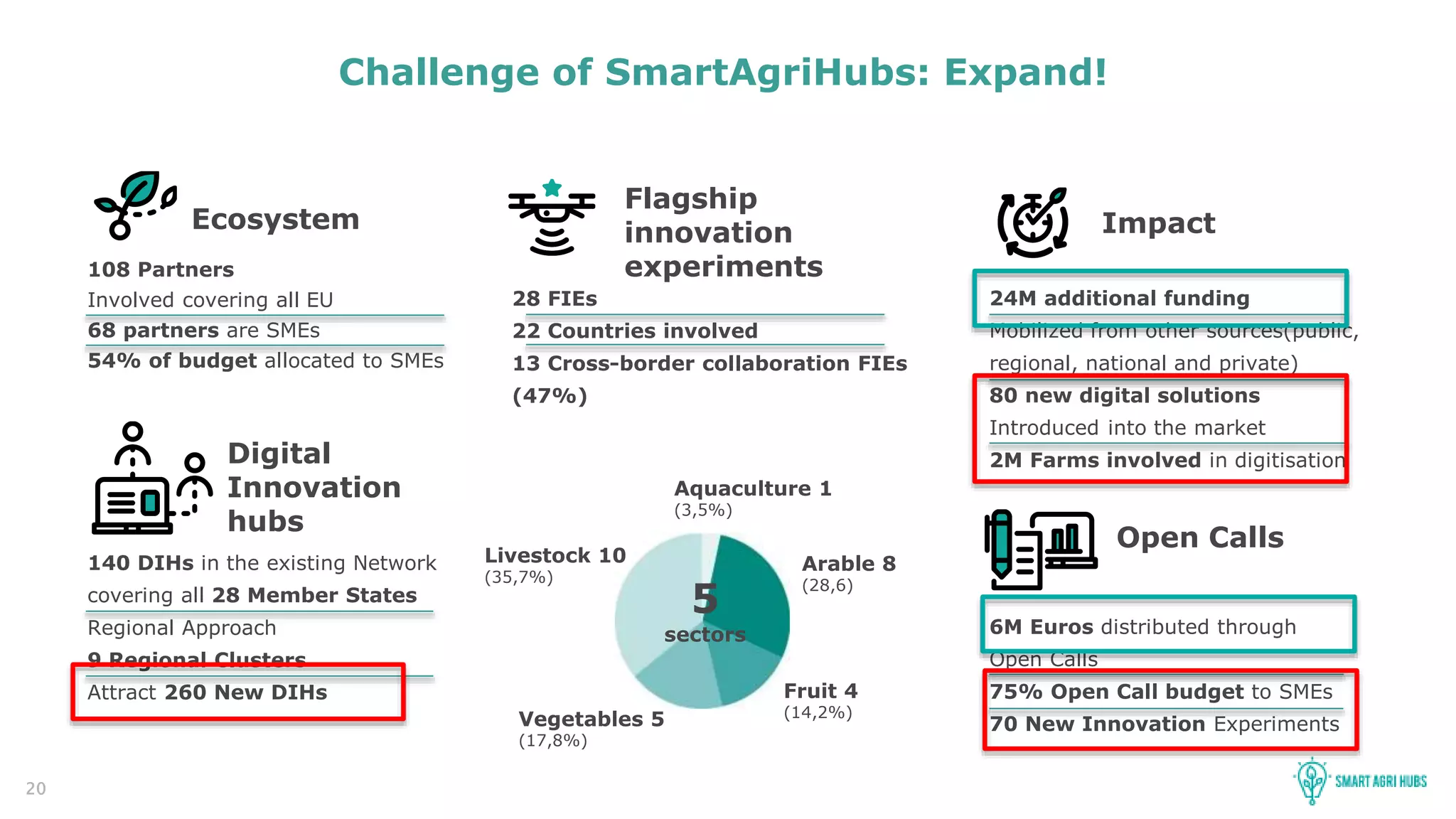
Challenge of SmartAgriHubs: Expand!
Ecosystem
108 Partners
Involved covering all EU
68 partners are SMEs
54% of budget allocated to SMEs
Digital
Innovation
hubs
140 DIHs in the existing Network
covering all 28 Member States
Regional Approach
9 Regional Clusters
Attract 260 New DIHs
Flagship
innovation
experiments
28 FIEs
22 Countries involved
13 Cross-border collaboration FIEs
(47%)
Impact
24M additional funding
Mobilized from other sources(public,
regional, national and private)
80 new digital solutions
Introduced into the market
2M Farms involved in digitisation
Open Calls
6M Euros distributed through
Open Calls
75% Open Call budget to SMEs
70 New Innovation Experiments
Arable 8
(28,6)
Fruit 4
(14,2%)Vegetables 5
(17,8%)
Livestock 10
(35,7%)
Aquaculture 1
(3,5%)
5
sectors

SmartAgriHubs: connecting the dots

  • 1.
    SmartAgriHubs: connecting thedots Digital Agriculture Forum Webinar, 6 Dec. 2020 Dr. Sjaak Wolfert - Sr. Scientist | Theme Ambassador Digital Innovation in Agri-Food
  • 2.
    Digital Transformation ofAgri-Food in 4 areas coming together Cloud Computing Big Data Analytics Internet of Things Linked Data Artificial Intelligence Blockchain Technology HealthFood Safety Environment Nutrition Food SecurityClimate3. Public decision-making Smart Sensing & monitoring Smart Control Smart Analysis & Planning 1. Decision-Making Business/Consumers 2. Food Integrity 4. Science & Technology https://www.linkedin.com/pulse/transdisciplinary-data-driven-research-social-sjaak-wolfert/
  • 3.
    How to connectthe dots through infrastructures and business ecosystems that utilize the potential of digital data to address the grand challenges of sustainable food production? However...developments are very fragmented! 3
  • 4.
    About the roleof research  “You can’t achieve the UN’s sustainability goals through individual disciplines.  It is really important to get the stakeholders involved in the entire process.  It’s not about us solving their problem, it’s our joint problem that we need to jointly research in the knowledge that there are no direct solutions.” Multi- disciplinarity Collaborative process Agile development Interview Johan Bouma in Resource, 4 October 2018, p. 18-19
  • 5.
    A multidisciplinary, collaborative,agile approach Verdouw, C.N., Wolfert, S., Beers, G., Sundmaeker, H., Chatzikostas, G., 2017. IOF2020: Fostering business and software ecosystems for large-scale uptake of IoT in food and farming, in: Nelson, W. (Ed.), The International Tri-Conference for Precision Agriculture in 2017, Hamilton, p. 7. http://doi.org/10.5281/zenodo.1002903 Trials/Use Cases: Knowledge & App development Lean multi-actor approach 1. CO-DESIGN 3. EVALUATION 2. IMPLEMENTATION LARGE SCALE ECOSYSTEM & COLLABORATION SPACE Project Coordination & Management P2P1 Business Modelling, Governance & Ethics P3 Data Science & Information management Ecosystem Development Project Coordination & Management Project Coordination & Management Project Coordination & Management
  • 6.
    6 19 + 14use case projects Source: www.iof2020.eu/trials Internet of Food and Farm 2020 Innovation Action: 2017 - 2020 30 M€ funding by DG-CNCT/AGRI Large-scale uptake of IoT in the European farming and food sector
  • 7.
    7 Where IoF2020 stops...and SmartAgriHubs continues
  • 8.
    8 Digital Innovation Hub– local one-stop shop Incubators Government Cooperatives Farmer communities Investors Others Advisories Research organisations Start-ups Education & training institutes Large companies Industry associations Other Competence CentersCompetence Center Orchestrator Other DIHs Innovation Experiments
  • 9.
    9 Consolidate and fosterEU-wide network of Ag DIHs to enhance digital transformation for sustainable farming and food production Region and Sector Specific expertise Digital Transformation of the Agri-Food Sector Technology expertise Business model expertise Overall objective
  • 10.
    10 See https://smartagrihubs.eu/portal/home •Existing DIH network • SMEs/start-ups/scale-ups, etc. • Network of Competence Centres • Flagship Innovation Experiments (> 60 incl. IoF2020) • Can be used for matchmaking to generate new Innovation Experiments by • Cascaded EU funding • Attracting additional funds SAH Innovation Portal
  • 11.
    11 Connecting the dotsbeyond Europe...
  • 12.
    Thanks for your attention! 12 Dr.J. (Sjaak) Wolfert Strategic Sr. Scientist Digital Innovation in Agri-Food Wageningen University & Research P.O. Box 35 6700 AA Wageningen The Netherlands T +31 317 485 939 M +31 610 811 948 sjaak.wolfert@wur.nl www.wur.nl www.linkedin.com/in/sjaakwolfert https://twitter.com/sjaakwolfert https://www.slideshare.net/SjaakWolfert www.researchgate.net/sjaak_wolfert www.wur.eu/data www.smartagrihubs.eu www.IoF2020.eu www.datafair.nl/en/datafair.htm
  • 13.
  • 14.
    European Ecosystem Developmenton Digital Transformation Industry 4.0 Network of Digital Innovation Hubs Future Internet PPP Open Source Software Ecosystem Food, Nutrition & Health Research Infrastructure ESFRI roadmap Boost rural economies through cross-sector digital service platforms Smart Rural Regional Ecosystems
  • 15.
    15 Soil map basedvariable rate applications and machine automation in potato production UC1.1. WITHIN-FIELD MANAGEMENT ZONING Coordinators: Peter Paree (ZLTO) & Corné Kempenaar (WUR)
  • 16.
    16 SOIL MAP SERVICE VARIABLERATE APPLICATION MAP AUTOMATION & MACHINE COMMUNICATION Product Impressions
  • 17.
    17 Major Challenge Hereis what we aim to improve (KPIs) Yield by better plant distribution Variable planting distance map – Validation in 2017 and 2018. Nov. 2018 portal where maps can be ordered. Variable rate herbicide use map - Validation in 2016 and 2017. May 2018 portal where maps can be ordered. Quality by better plant distribution Reduction pesticide use Core Product Features Variable Rate Application Map Service Customer & Provider Uses soil maps and agronomic knowledge to create crop management task map based on variability in soil characteristics like organic matter and/or clay content, water storage capacity, tramlines, shade, etc.. Smart application of resources: seeds, pesticides, fertilizers +4% +5% -23% Better distribution of plants leads to +5% kilos and +5% better quality (more potatoes in desired size). Taking soil characteristics for weed growth into account: -23% less herbicide and +2% more yield. Enriching canopy index with soil characteristics lead to -10% less additional N fertilizer (2nd phase). These values derive from comparison of a standard farm’s performance prior to the installation of our system and after. Reduction fertilizer use -10% Product Factsheet Existing variable rate maps are often based on tweaking expert judgement and lack a certain level of precision in tasking / lack of validation. Farmers and advisors Price per unit Data-, service, infra-, knowledge providers VRA additional N spraying June 2018 on Growth + Soil Maps. High spatio-temporal monitoring dashboard Service Business model Minimum Viable Products Added Value
  • 18.
    18 The 5 basicconcepts of SmartAgriHubs Innovation service maturity model for DIHs Innovation Portal Innovation Experiments Layered network of DIHs & CCs in Regional Clusters Digital Innovation Hubs Competence Centres
  • 19.
    19 DIH innovation services Ecosystem •Community building • Strategy development • Ecosystem learning • Project development • Lobbying Technology • Strategic RDI • Contract research • Technical support on scale-up • Provision of technology infrastructure • Testing and validation Business • Incubator/accelerator support • Access to finance • Skills and education
  • 20.
    20 Challenge of SmartAgriHubs:Expand! Ecosystem 108 Partners Involved covering all EU 68 partners are SMEs 54% of budget allocated to SMEs Digital Innovation hubs 140 DIHs in the existing Network covering all 28 Member States Regional Approach 9 Regional Clusters Attract 260 New DIHs Flagship innovation experiments 28 FIEs 22 Countries involved 13 Cross-border collaboration FIEs (47%) Impact 24M additional funding Mobilized from other sources(public, regional, national and private) 80 new digital solutions Introduced into the market 2M Farms involved in digitisation Open Calls 6M Euros distributed through Open Calls 75% Open Call budget to SMEs 70 New Innovation Experiments Arable 8 (28,6) Fruit 4 (14,2%)Vegetables 5 (17,8%) Livestock 10 (35,7%) Aquaculture 1 (3,5%) 5 sectors

Editor's Notes

  • #3 Current development of the digital transformation in agri-food
  • #4 The issues to be solved are very interrelated: choices on infrastructure are influencing governance, and vice versa, and so on...
  • #7 In total we work on 33 use case projects all over Europe. Next slides provide an illustrative example of one use case demonstrating the multi-actor approach.
  • #15 We have already worked on this in several main project lines, that are now also coming together, including a new area on rural economies
  • #16 In principle this is a precision agriculture use case. A balanced set of partners is involved ranging from end-users (farmers), technology providers and research institutes.
  • #17 Just gives a quick impression of what is happening in the use case. The soil is scanned with a device behind a tractor driving over the field resulting in a soil map, that reflects the variety in the soil An app within the platform Akkerweb is used to create an variable application map from the soil map, using knowledge models (algorithms). A machine is applying e.g. chemicals or fertilizer in a variable rate on the field accounting for the variability.
  • #18 Beside the technical development, the use case partners are supported in developing a viable business model of the use case. Added value must be convincingly demonstrated and in the end this should be translated into a price setting for the services that the farmer has to use.