Big Data and Policy Analysis
Krijn Poppe
Jack van der Vorst Wageningen Economic Research
Based on work with WUR team (Sjaak Wolfert, Cor Verdouw, Lan Ge, Marc
Jeroen Bogaardt, Jan Willem Kruize, Karin Zimmermann and others)
November 2017 Global Club, Paris
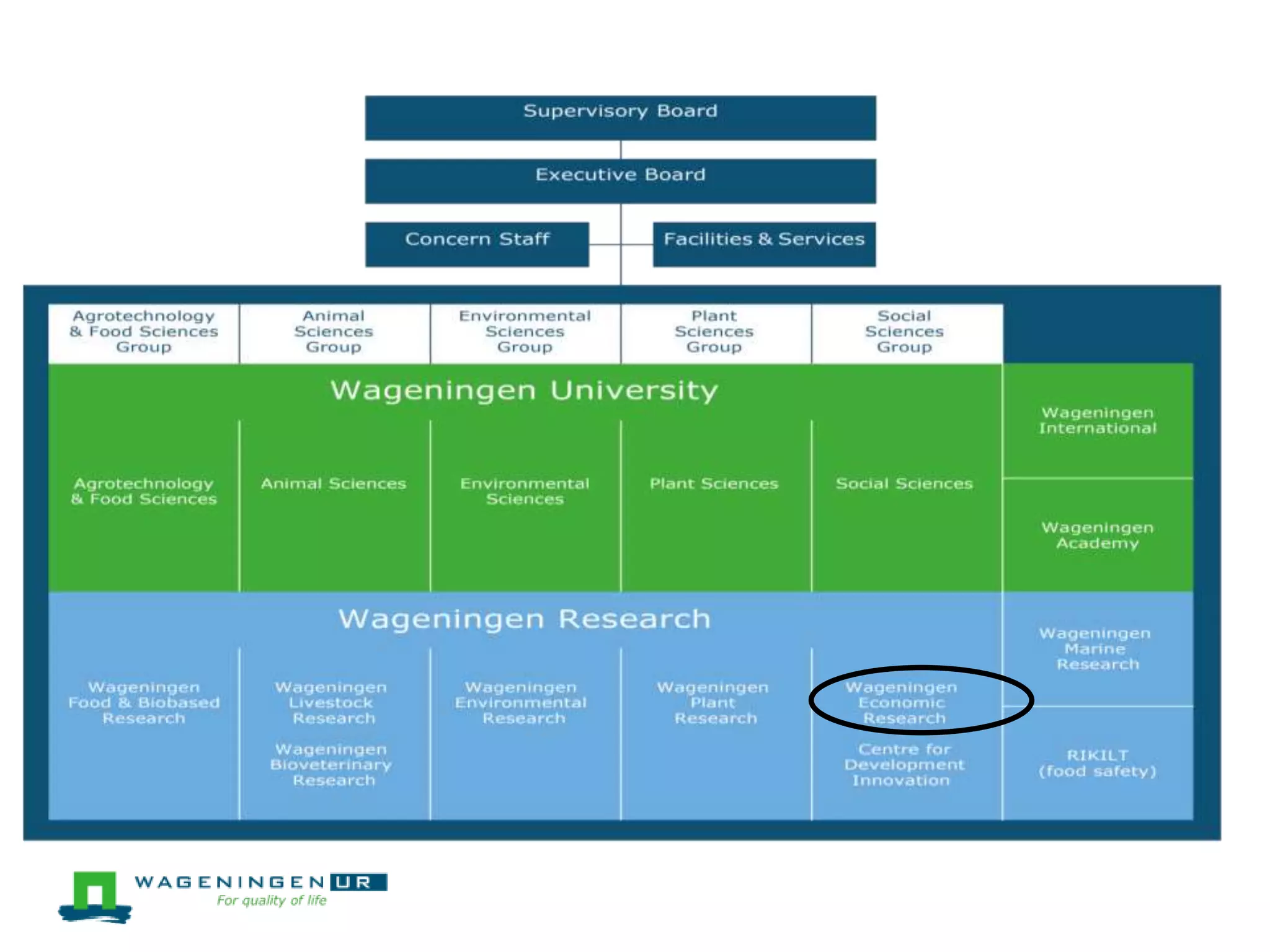
Wageningen University & Research
Wageningen University & Wageningen Research
Wageningen University & Research
 Academic research & education, and applied research
 5,800 employees (5,100 fte)
 >10,000 students (>125 countries)
 Several locations
 Turnover about € 650 million
 Number 1 Agricultural University for the 4th year in a row
(National Taiwan Ranking)
To explore the potential of nature to improve the quality of life
Natural resources
and living
environment
The Wageningen UR domain:
healthy food and living environment
Food, feed
and biobased
production
Healthy people
and society
Sustainable agriculture
Nutrition and health
Sustainable fishery
Biobased economy
Chains
Marine resource
management
Landscape and land use
Nature & Biodiversity
Water management
Competing claims
Behaviour and perception
Food security
Institutions
Consumer
Citizen
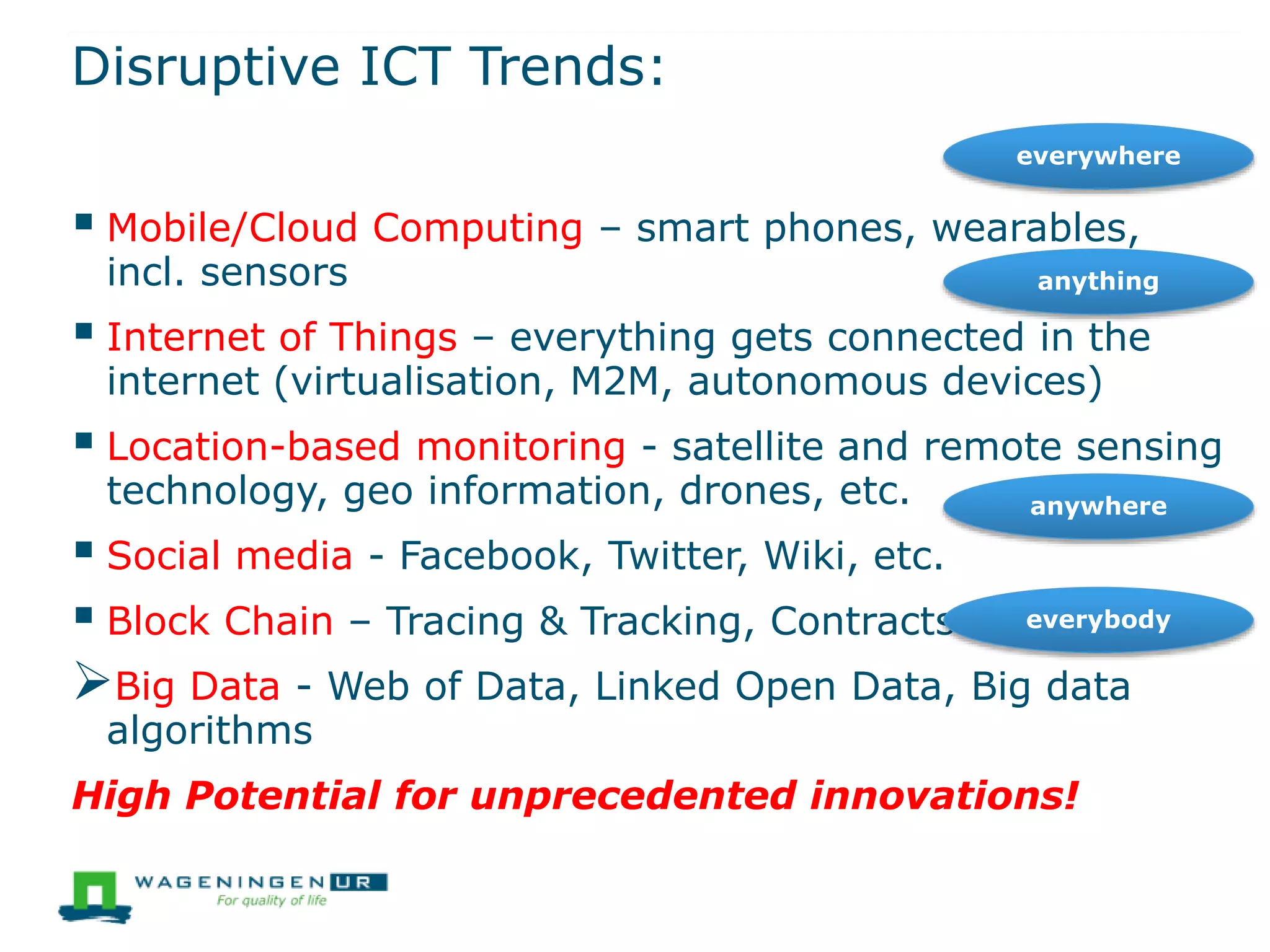
Disruptive ICT Trends:
 Mobile/Cloud Computing – smart phones, wearables,
incl. sensors
 Internet of Things – everything gets connected in the
internet (virtualisation, M2M, autonomous devices)
 Location-based monitoring - satellite and remote sensing
technology, geo information, drones, etc.
 Social media - Facebook, Twitter, Wiki, etc.
 Block Chain – Tracing & Tracking, Contracts.
Big Data - Web of Data, Linked Open Data, Big data
algorithms
High Potential for unprecedented innovations!
everywhere
anything
anywhere
everybody
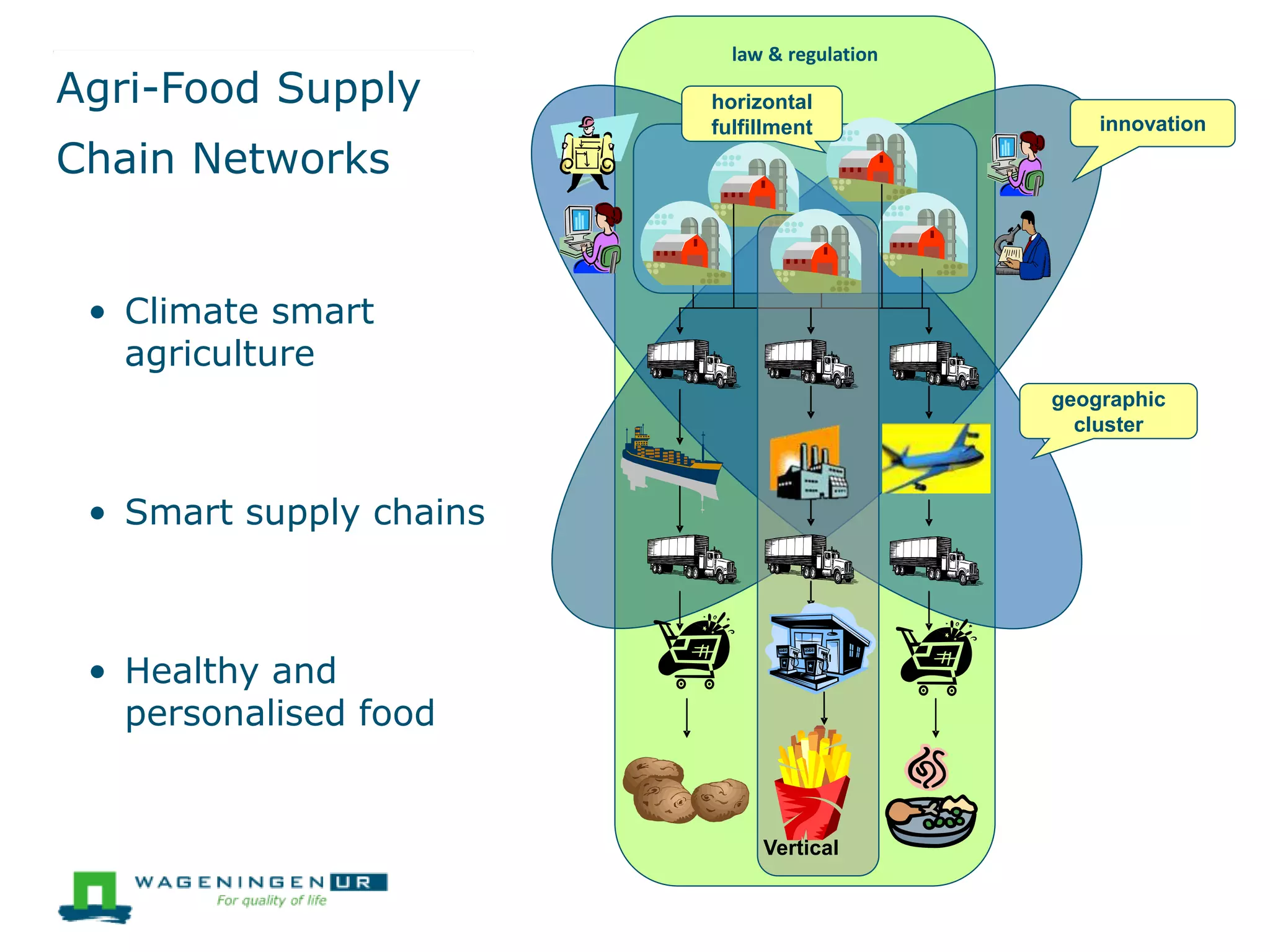
Agri-Food Supply
Chain Networks
• Climate smart
agriculture
• Smart supply chains
• Healthy and
personalised food
law & regulation
innovation
geographic
cluster
horizontal
fulfillment
Vertical
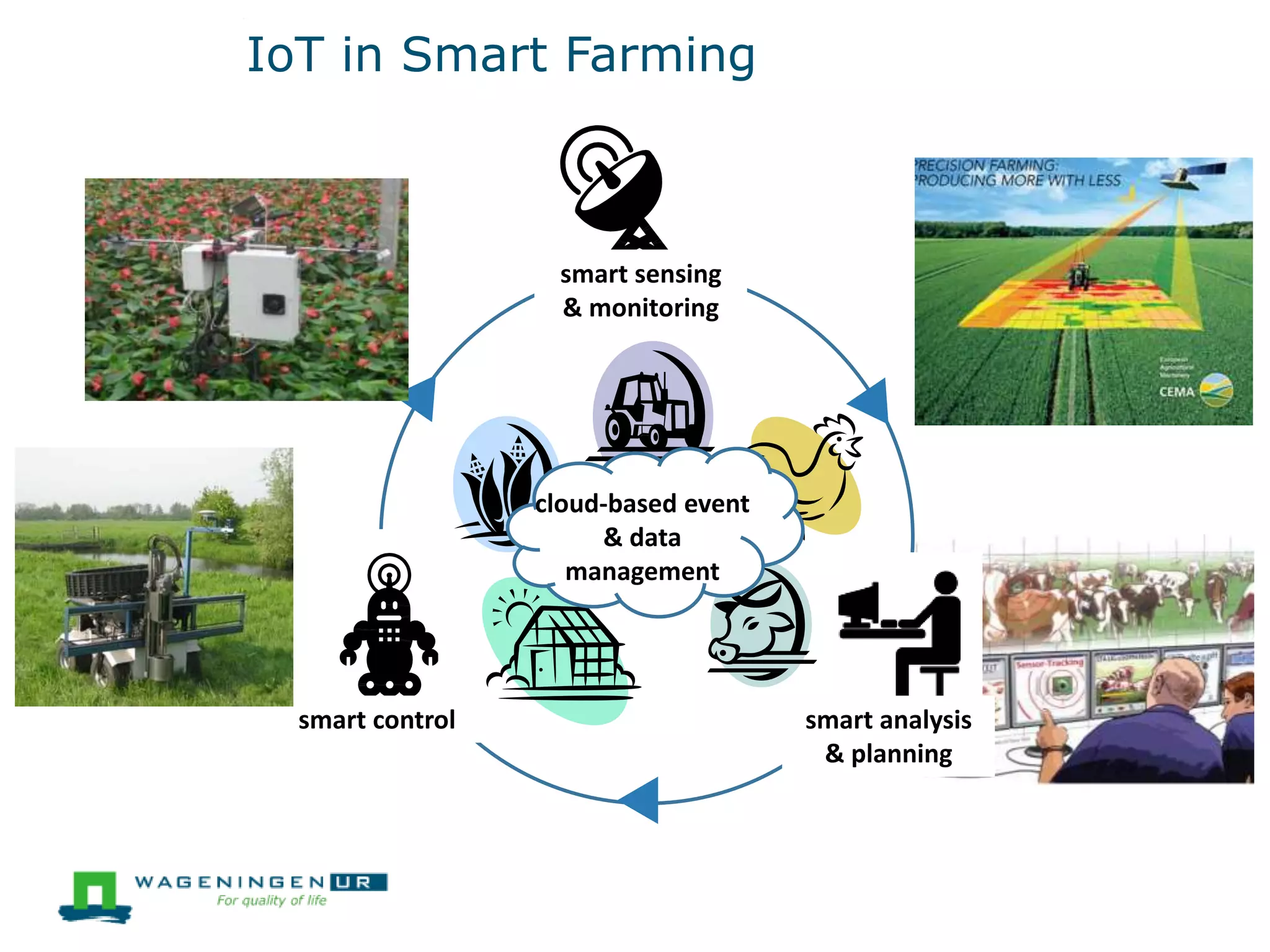
IoT in Smart Farming
cloud-based event
& data
management
smart sensing
& monitoring
smart analysis
& planning
smart control
Virtual Box
Location A Location B
Location
& State
update
Location &
State
update Location
& State
update
IoT in Agri-Food Supply Chains
IoT and the consumer
Source: Hisense.com
Smart Farming
Smart Logistics
tracking/& tracing
Domotics Health Fitness/Well-being
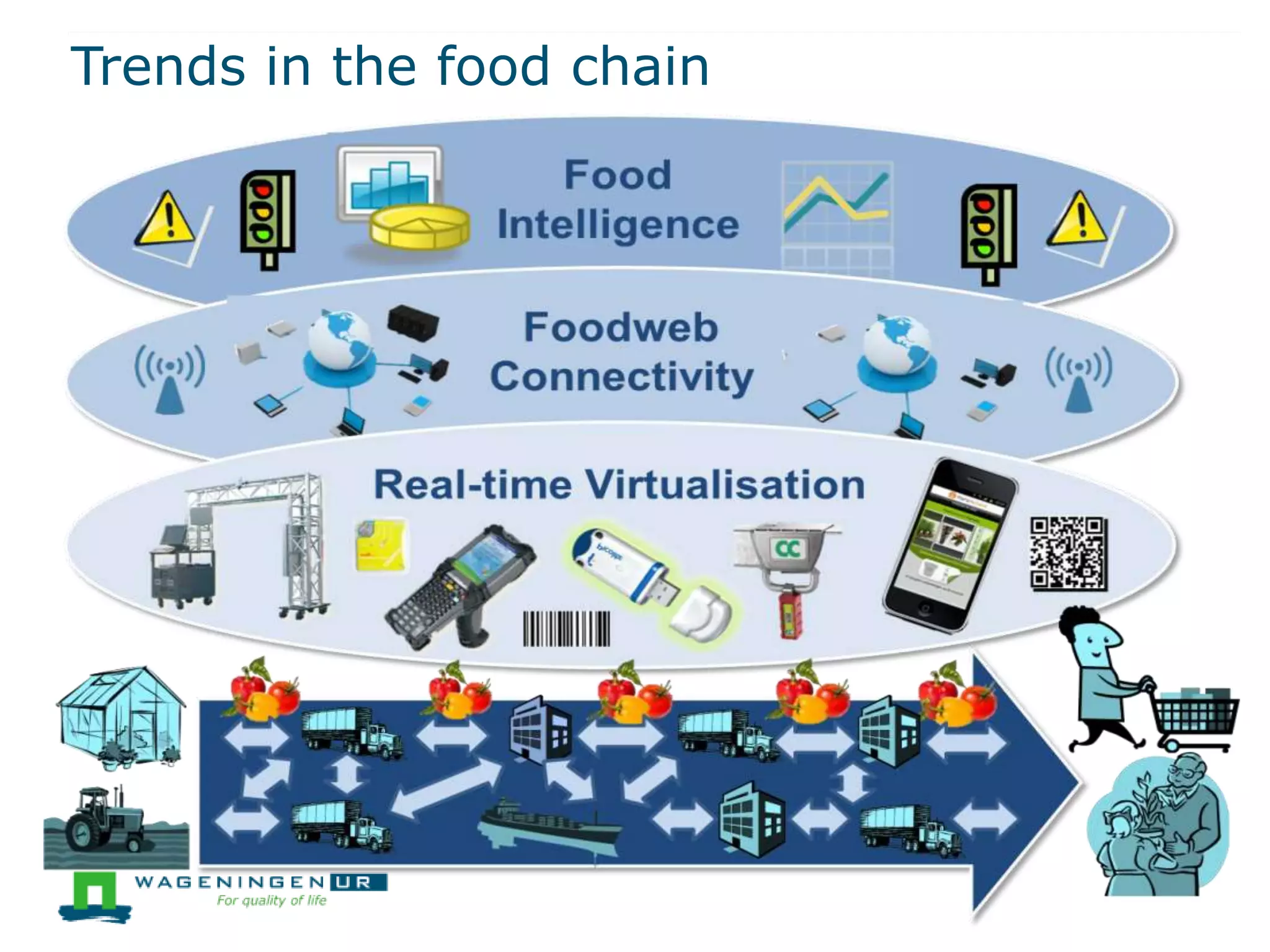
Trends in the food chain
1
Wageningen Data Competence Centre
 We conclude that we need to build up more competences
in data science and specifically big data analysis
● Combining data from different Science Groups
● Joint policy on data governance and ethics (GDPR,
Helsinki Declaration for Academic Research)
 Components:
● Research agenda
● Education
● Value creation
● Infrastructure and Data Management
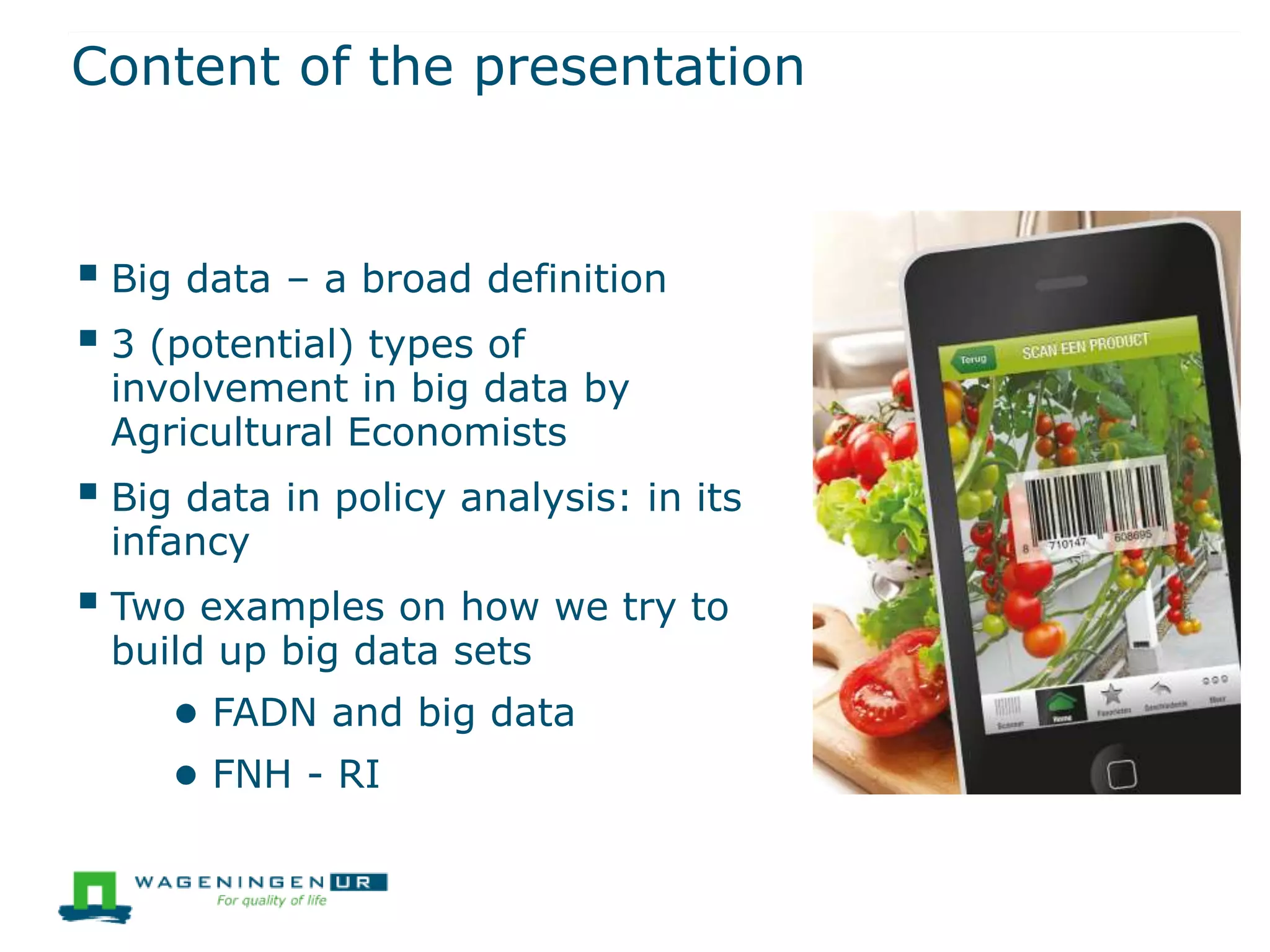
Content of the presentation
 Big data – a broad definition
 3 (potential) types of
involvement in big data by
Agricultural Economists
 Big data in policy analysis: in its
infancy
 Two examples on how we try to
build up big data sets
● FADN and big data
● FNH - RI
Big Data – the ‘official’ definition: 5 V’s
 Volume – vast amounts of data
 Velocity – different types, unstructured
 Veracity – speed of generation / transfer
 Veriaty – messiness / trustworthiness
 Value – generated by artificial intelligence
● Symbolic reasoning
● Connections modeled on the basis of
the brain's neurons
● Evolutionary algorithms that test
variation
● Bayesian inference
● Sytems that learn by analogy
Big Data in Agriculture?
 Big data has been recognized to have a pivotal role in
(Foresight, 2011):
● Increasing the efficiency of planning and operating
the global food system
● Supporting policy development and strategic
decision-making on the external factors driving its
change at national and global level
Source: Foresight, 2011. The future of food and farming: challenges and choices for global
sustainability (final project report). London: The Government Office for Science.
Big Data - Promises
 The idea is that we can learn from a large body of
information things that we could not comprehend when
we used only smaller amounts
 Big data (machine learning) helps answer what, not why
 The spark of invention
becomes what the
data do not say.
Source: Cukier, K. and Mayer-Schoenberger, V.,
2013. Rise of Big Data: How it's Changing the
Way We Think about the World, The. Foreign
Aff., 92, p.28.
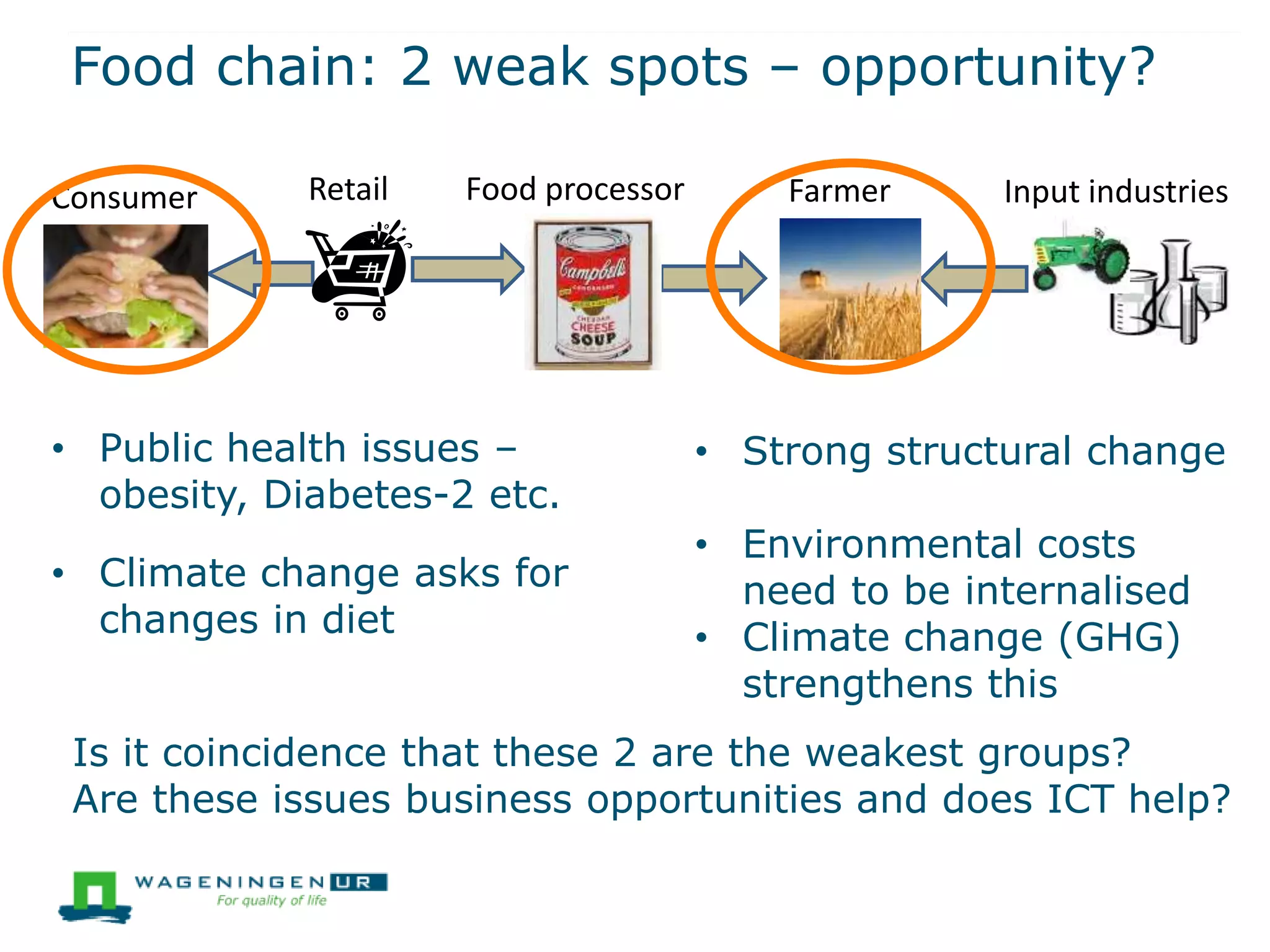
Food chain: 2 weak spots – opportunity?
Input industriesFarmerFood processorConsumer Retail
• Public health issues –
obesity, Diabetes-2 etc.
• Climate change asks for
changes in diet
• Strong structural change
• Environmental costs
need to be internalised
• Climate change (GHG)
strengthens this
Is it coincidence that these 2 are the weakest groups?
Are these issues business opportunities and does ICT help?
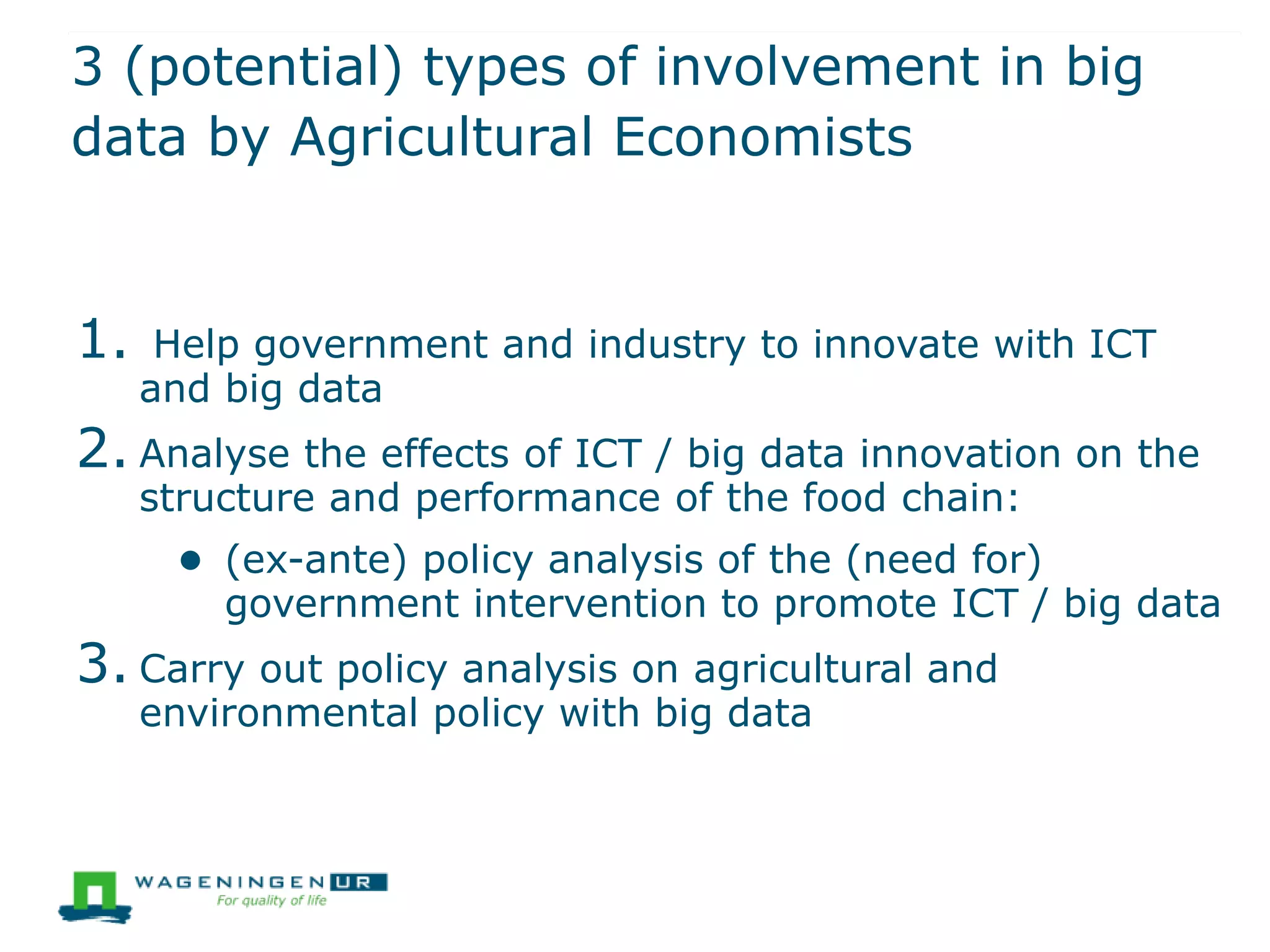
3 (potential) types of involvement in big
data by Agricultural Economists
1. Help government and industry to innovate with ICT
and big data
2. Analyse the effects of ICT / big data innovation on the
structure and performance of the food chain:
● (ex-ante) policy analysis of the (need for)
government intervention to promote ICT / big data
3. Carry out policy analysis on agricultural and
environmental policy with big data
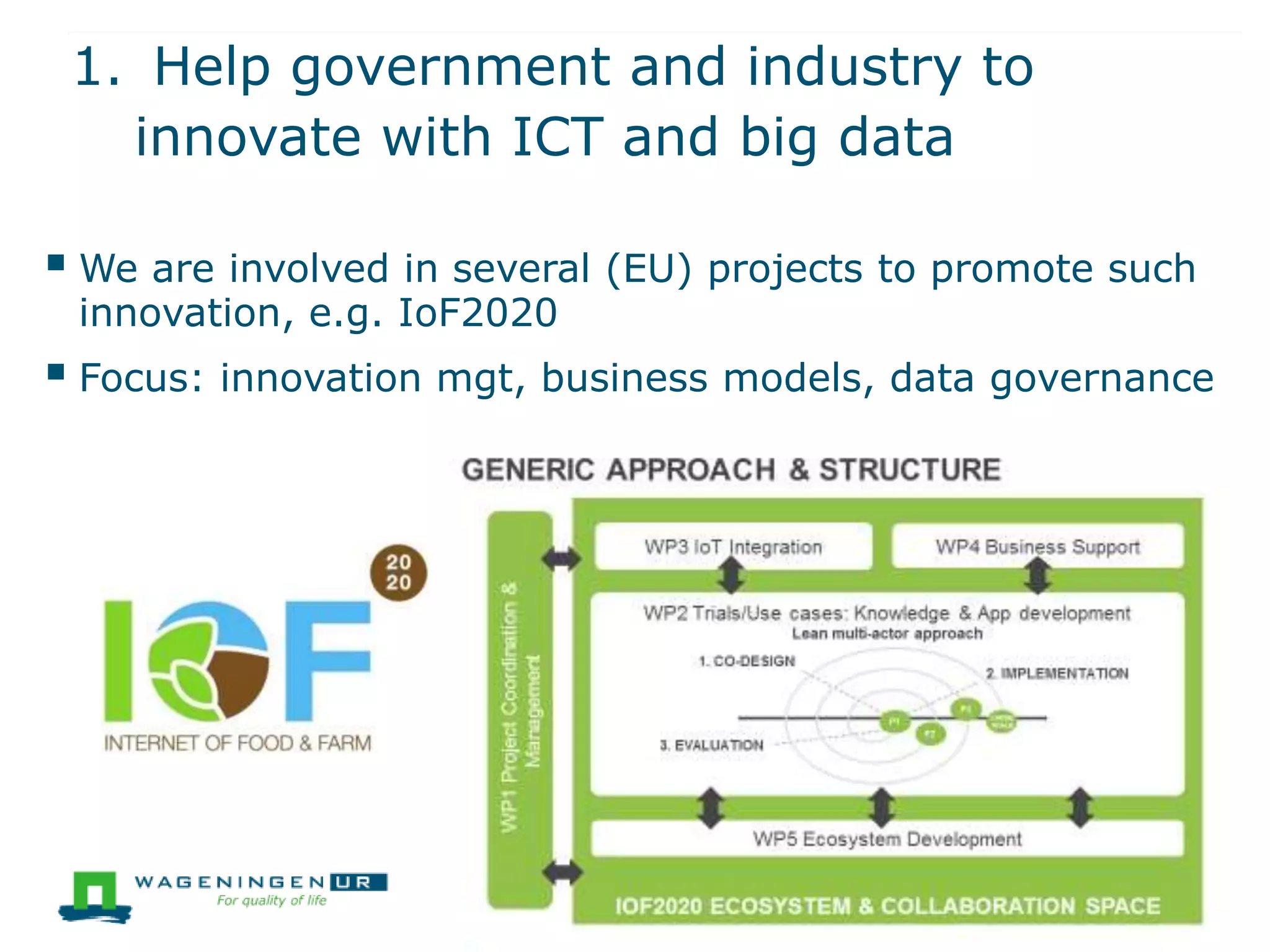
1. Help government and industry to
innovate with ICT and big data
 We are involved in several (EU) projects to promote such
innovation, e.g. IoF2020
 Focus: innovation mgt, business models, data governance
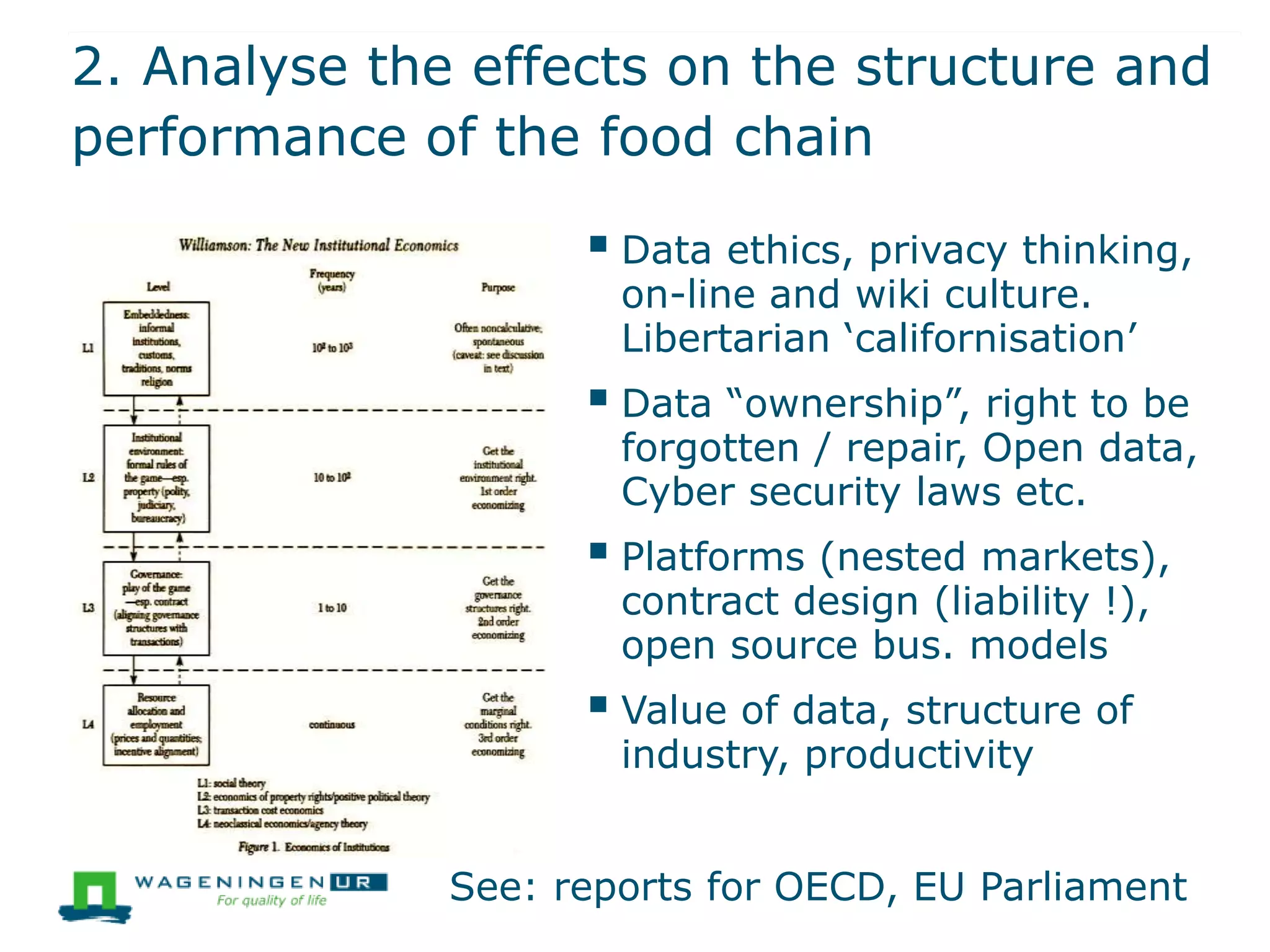
2. Analyse the effects on the structure and
performance of the food chain
See: reports for OECD, EU Parliament
 Data ethics, privacy thinking,
on-line and wiki culture.
Libertarian ‘californisation’
 Data “ownership”, right to be
forgotten / repair, Open data,
Cyber security laws etc.
 Platforms (nested markets),
contract design (liability !),
open source bus. models
 Value of data, structure of
industry, productivity
• Products change: the tractor with
ICT – from product to service
• New products: smart phones,
apps, drones: should markets be
created or regulated ?
New entrants:
• Designers on Etsy
• Landlords on AirBnb
• Drivers on Uber
New entrants:
• Direct international
sales by website
• Long tail: buyers for
rare products
• Due to ICT new options
to fine tune regulation /
monitor behaviour
• Regulation can be out of
date
• New types of pricing and contracts: on-line
auctions, dynamic pricing, risk profiling etc.
• Shorter supply chains (intermediaries as
travel agencies and book shops disappear)
• Strong network effects in on-line platforms
(rents and monopolies)
3. Carry out policy analysis with big data
 Are all the (real time) technical data on individual
animals and fields really useful for economists?
● Policy makers do not influence the environment or
food safety, animal welfare or income etc. directly
● They try to influence the decisions of farmers (and
others) to have a better outcome of those decisions
for the environment, food safety, income etc.
● Policy analysts are therefor interested in decisions
of farmers, less in individual animals or fields.
 Big data sets on decision making by farmers / the food
chain actors still have to be build up
 For which we have experience with census and FADN
data
Big data is nothing new ......
At Wageningen Economic Research we have for a long
time:
 Dutch Farm Structure Survey (Agricultural Census)
individual farm data, digitalised since 1975
 FADN data:
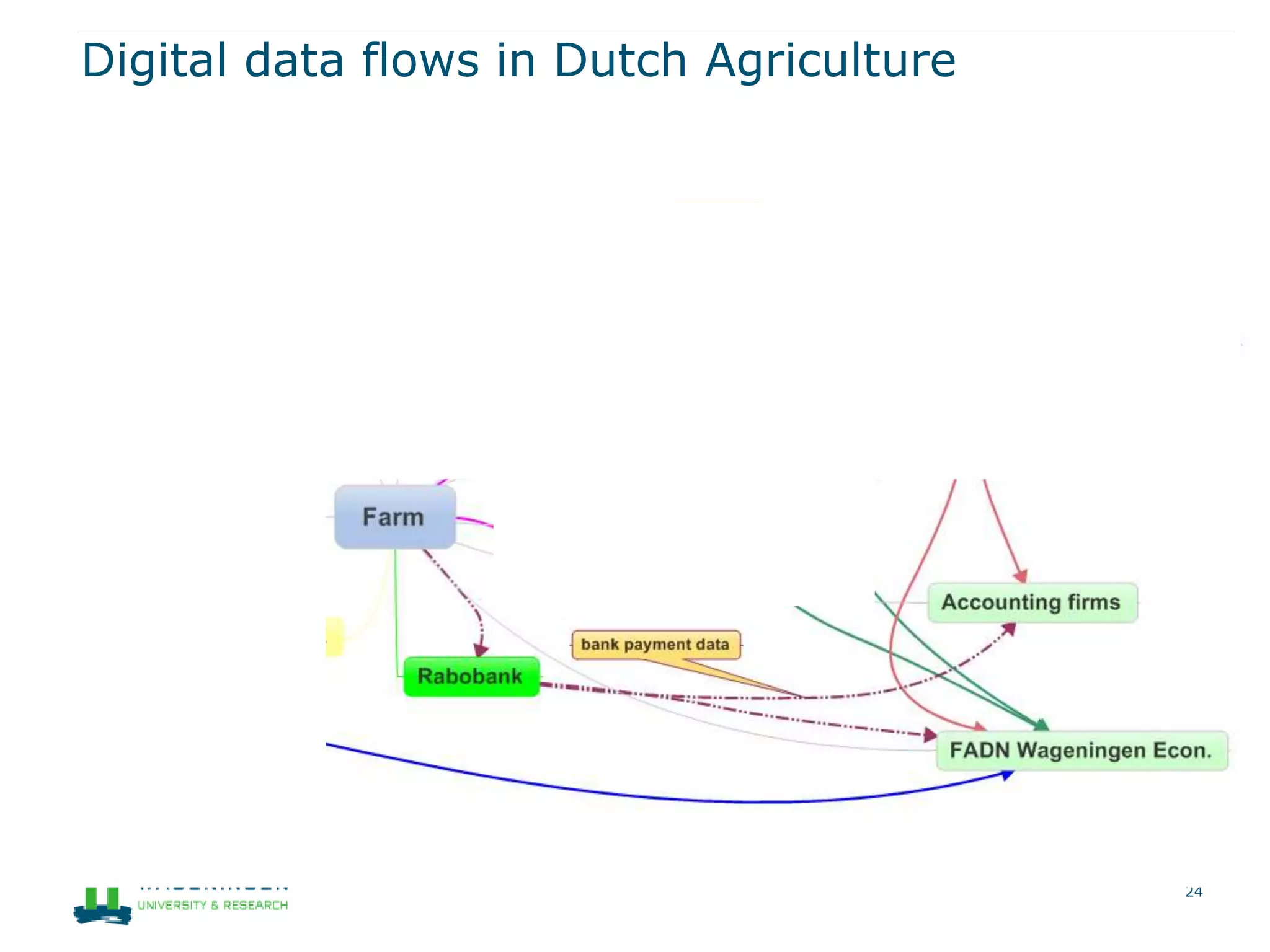
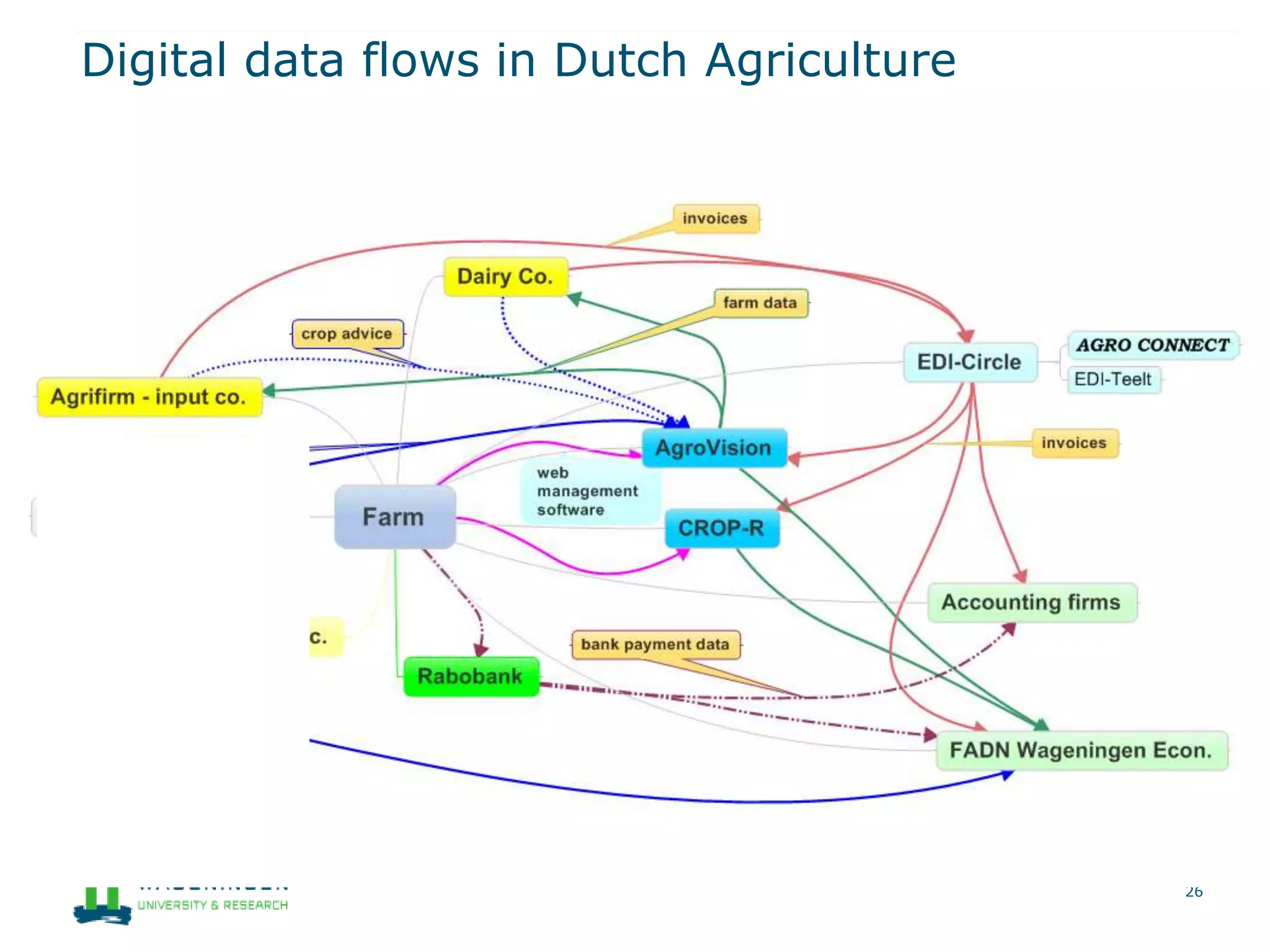
● For the Netherlands as much as possible collected
in digital form (bank statements, invoices, see next
slide)
● Which allows collection of physical / environmental
data (see presentation FLINT project, Rome
meeting)
● Access to 85.000 EU FADN Farms
Digital data flows in Dutch Agriculture
24
Digital data flows in Dutch Agriculture
25
Digital data flows in Dutch Agriculture
26
Digital data flows in Dutch Agriculture
27
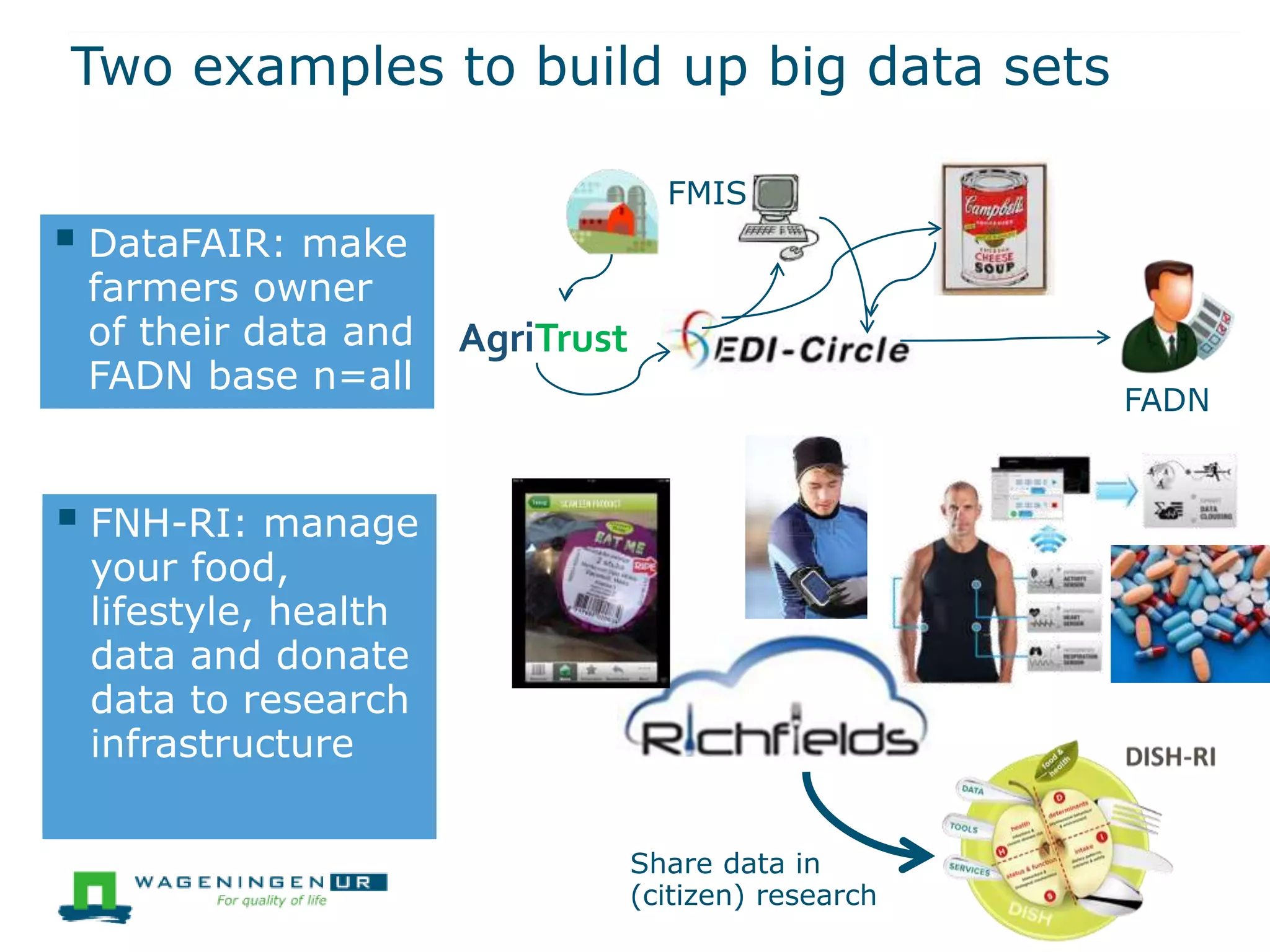
 DataFAIR: make
farmers owner
of their data and
FADN base n=all
Two examples to build up big data sets
Share data in
(citizen) research
 FNH-RI: manage
your food,
lifestyle, health
data and donate
data to research
infrastructure
FMIS
FADN
AgriTrust
Data gets value by combining them
Property rights on data needs to be designed
Farmers: where do my data travel ?
Need to exercise data property rights with
authorisations
Best situation for the farmer is that (s)he has one
portal for all authorizations (like a password
manager)
Question: who is going to manage this portal?
29
DataFAIR:AgriTrust authorization register
Functionalities
Use of AgriTrust in the web of data
exchange
Customize permission settings via
an APP
Synchronization with other
registers
Monitoring of the use (time, etc.)
for cost accounting (data receivers
pay)
Actively approaching users for
additional authorizations
M2M connections to authorized
machines (precision agriculture).
AgriTrust
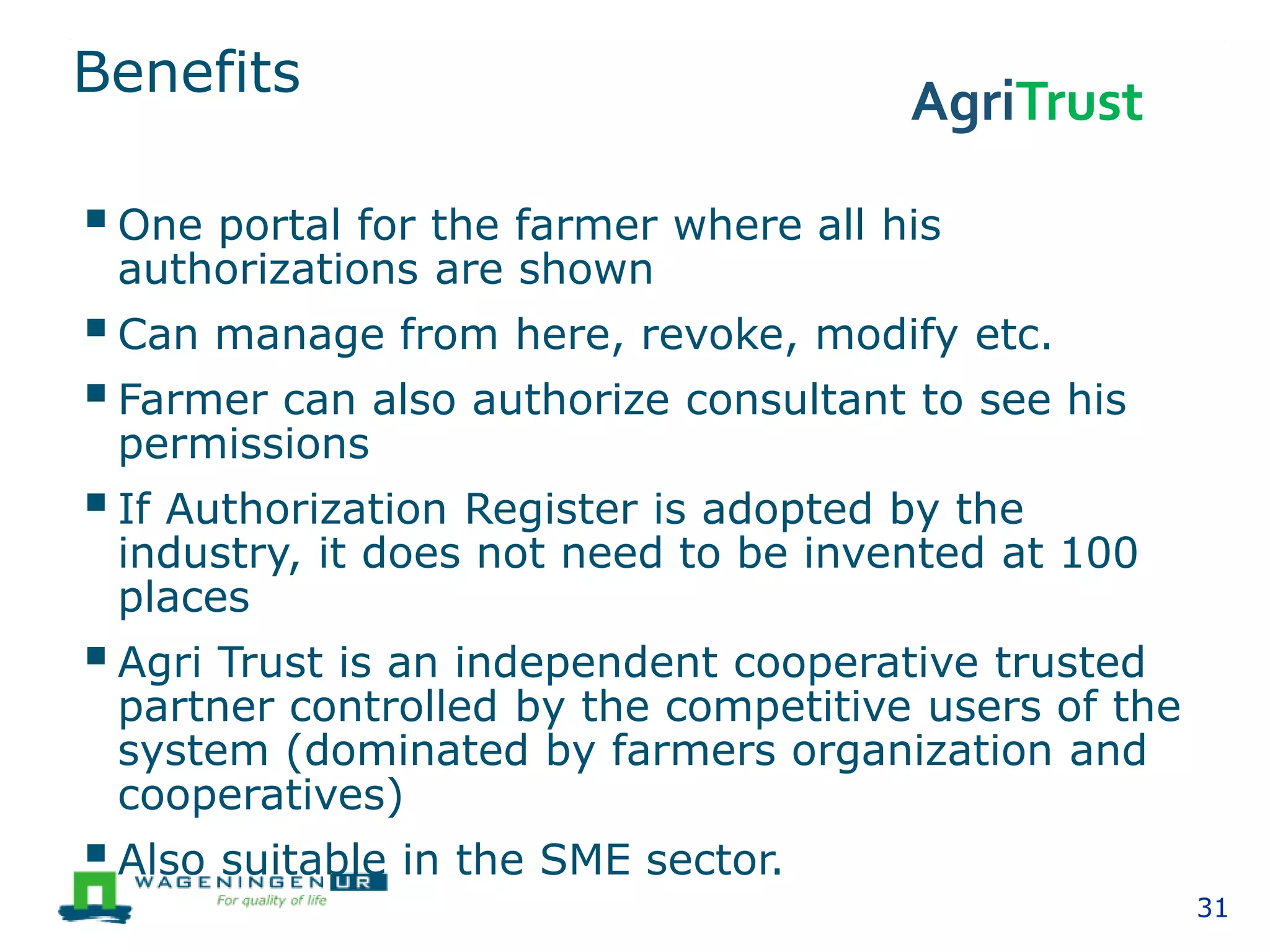
Benefits
One portal for the farmer where all his
authorizations are shown
Can manage from here, revoke, modify etc.
Farmer can also authorize consultant to see his
permissions
If Authorization Register is adopted by the
industry, it does not need to be invented at 100
places
Agri Trust is an independent cooperative trusted
partner controlled by the competitive users of the
system (dominated by farmers organization and
cooperatives)
Also suitable in the SME sector.
31
AgriTrust
 DataFAIR: make
farmers owner
of their data and
FADN base n=all
With AgriTrust to n = all ?
 Does AgriTrust create enough trust to move in FADN
from n=1500 to n=all (55.000) ?
 Can we interest farmers to share their data if we
provide them:
● Benchmark data
● Interdisciplinary policy analysis (citizen science) ?
FMIS
FADN
AgriTrust
IoT and the consumer: food and health
Smart Farming
Smart Logistics
tracking & tracing
Domotics Health
Fitness/Well-being
Agrofood
sector
Land use, FADN
micro economic
data, tracing &
tracking data,..
Health sector
Research
Infrastructures
like BBMRI,
ECRIN, EPIC
Consumer
D – I – S –
H
Determinants
of diet and
lifestyle
Intake of food
and nutrients
Status and
function of the
body
Health and
disease risk
Availability, price,
taste, cultural values
and beliefs, attitude,
PH-intervention
campaigns,
education, SES, age,
sex, life cycle, etc.
Foods, drinks,
frequency, amounts.
Lifestyle, e.g. physical
activity, smoking,
drinking,
sexual activity
Fitness, fatness, blood
pressure
vascular stiffness;
serum cholesterol,
carotid artery
thickness,
atherosclerosis,
cognitive function
Infection;
myocardial infarction;
cancer;
fractures; dementia.
Healthy life expectancy,
mortality.
Food, Nutrition, Health RI: data flows
 Are 100.000 consumers willing to download an FNH-app
to share data with us (good experiences with WUR’s
Food Profiler, now used in 4 countries)?
 Are app providers willing to share data with the FNH-app
based on an authorisation of the consumer?
 Are retailers willing to share data from their loyalty cards
with the FNH-app?
 And banks (see PSD2) and insurers?
 Is trust gained by basing this in citizen science and
digital commons ?
 Can we provide feed back – personalised nutrition? What
does this mean for the usefulness of the data for
research?
In conclusion
 There is a (big) data revolution going on
 Agricultural economists can be involved in three ways:
● Support innovation
● Investigate effects of this trend and ICT policies
● Use big data to analyse farm decision making
 Especially big data analysis is not new, n = all and
machine learning are still in its infancy
 It makes sense to move into this area
 And learn from each other in this Global Club of
Directors
Thanks for your
attention
and we welcome
collaboration in
your projects !
krijn.poppe@wur.nl
www.wur.nl

Big data for AERIAS

  • 1.
    Big Data andPolicy Analysis Krijn Poppe Jack van der Vorst Wageningen Economic Research Based on work with WUR team (Sjaak Wolfert, Cor Verdouw, Lan Ge, Marc Jeroen Bogaardt, Jan Willem Kruize, Karin Zimmermann and others) November 2017 Global Club, Paris
  • 2.
    Wageningen University &Research Wageningen University & Wageningen Research
  • 3.
    Wageningen University &Research  Academic research & education, and applied research  5,800 employees (5,100 fte)  >10,000 students (>125 countries)  Several locations  Turnover about € 650 million  Number 1 Agricultural University for the 4th year in a row (National Taiwan Ranking) To explore the potential of nature to improve the quality of life
  • 5.
    Natural resources and living environment TheWageningen UR domain: healthy food and living environment Food, feed and biobased production Healthy people and society Sustainable agriculture Nutrition and health Sustainable fishery Biobased economy Chains Marine resource management Landscape and land use Nature & Biodiversity Water management Competing claims Behaviour and perception Food security Institutions Consumer Citizen
  • 6.
    Disruptive ICT Trends: Mobile/Cloud Computing – smart phones, wearables, incl. sensors  Internet of Things – everything gets connected in the internet (virtualisation, M2M, autonomous devices)  Location-based monitoring - satellite and remote sensing technology, geo information, drones, etc.  Social media - Facebook, Twitter, Wiki, etc.  Block Chain – Tracing & Tracking, Contracts. Big Data - Web of Data, Linked Open Data, Big data algorithms High Potential for unprecedented innovations! everywhere anything anywhere everybody
  • 7.
    Agri-Food Supply Chain Networks •Climate smart agriculture • Smart supply chains • Healthy and personalised food law & regulation innovation geographic cluster horizontal fulfillment Vertical
  • 8.
    IoT in SmartFarming cloud-based event & data management smart sensing & monitoring smart analysis & planning smart control
  • 9.
    Virtual Box Location ALocation B Location & State update Location & State update Location & State update IoT in Agri-Food Supply Chains
  • 10.
    IoT and theconsumer Source: Hisense.com Smart Farming Smart Logistics tracking/& tracing Domotics Health Fitness/Well-being
  • 11.
    Trends in thefood chain 1
  • 12.
    Wageningen Data CompetenceCentre  We conclude that we need to build up more competences in data science and specifically big data analysis ● Combining data from different Science Groups ● Joint policy on data governance and ethics (GDPR, Helsinki Declaration for Academic Research)  Components: ● Research agenda ● Education ● Value creation ● Infrastructure and Data Management
  • 13.
    Content of thepresentation  Big data – a broad definition  3 (potential) types of involvement in big data by Agricultural Economists  Big data in policy analysis: in its infancy  Two examples on how we try to build up big data sets ● FADN and big data ● FNH - RI
  • 14.
    Big Data –the ‘official’ definition: 5 V’s  Volume – vast amounts of data  Velocity – different types, unstructured  Veracity – speed of generation / transfer  Veriaty – messiness / trustworthiness  Value – generated by artificial intelligence ● Symbolic reasoning ● Connections modeled on the basis of the brain's neurons ● Evolutionary algorithms that test variation ● Bayesian inference ● Sytems that learn by analogy
  • 15.
    Big Data inAgriculture?  Big data has been recognized to have a pivotal role in (Foresight, 2011): ● Increasing the efficiency of planning and operating the global food system ● Supporting policy development and strategic decision-making on the external factors driving its change at national and global level Source: Foresight, 2011. The future of food and farming: challenges and choices for global sustainability (final project report). London: The Government Office for Science.
  • 16.
    Big Data -Promises  The idea is that we can learn from a large body of information things that we could not comprehend when we used only smaller amounts  Big data (machine learning) helps answer what, not why  The spark of invention becomes what the data do not say. Source: Cukier, K. and Mayer-Schoenberger, V., 2013. Rise of Big Data: How it's Changing the Way We Think about the World, The. Foreign Aff., 92, p.28.
  • 17.
    Food chain: 2weak spots – opportunity? Input industriesFarmerFood processorConsumer Retail • Public health issues – obesity, Diabetes-2 etc. • Climate change asks for changes in diet • Strong structural change • Environmental costs need to be internalised • Climate change (GHG) strengthens this Is it coincidence that these 2 are the weakest groups? Are these issues business opportunities and does ICT help?
  • 18.
    3 (potential) typesof involvement in big data by Agricultural Economists 1. Help government and industry to innovate with ICT and big data 2. Analyse the effects of ICT / big data innovation on the structure and performance of the food chain: ● (ex-ante) policy analysis of the (need for) government intervention to promote ICT / big data 3. Carry out policy analysis on agricultural and environmental policy with big data
  • 19.
    1. Help governmentand industry to innovate with ICT and big data  We are involved in several (EU) projects to promote such innovation, e.g. IoF2020  Focus: innovation mgt, business models, data governance
  • 20.
    2. Analyse theeffects on the structure and performance of the food chain See: reports for OECD, EU Parliament  Data ethics, privacy thinking, on-line and wiki culture. Libertarian ‘californisation’  Data “ownership”, right to be forgotten / repair, Open data, Cyber security laws etc.  Platforms (nested markets), contract design (liability !), open source bus. models  Value of data, structure of industry, productivity
  • 21.
    • Products change:the tractor with ICT – from product to service • New products: smart phones, apps, drones: should markets be created or regulated ? New entrants: • Designers on Etsy • Landlords on AirBnb • Drivers on Uber New entrants: • Direct international sales by website • Long tail: buyers for rare products • Due to ICT new options to fine tune regulation / monitor behaviour • Regulation can be out of date • New types of pricing and contracts: on-line auctions, dynamic pricing, risk profiling etc. • Shorter supply chains (intermediaries as travel agencies and book shops disappear) • Strong network effects in on-line platforms (rents and monopolies)
  • 22.
    3. Carry outpolicy analysis with big data  Are all the (real time) technical data on individual animals and fields really useful for economists? ● Policy makers do not influence the environment or food safety, animal welfare or income etc. directly ● They try to influence the decisions of farmers (and others) to have a better outcome of those decisions for the environment, food safety, income etc. ● Policy analysts are therefor interested in decisions of farmers, less in individual animals or fields.  Big data sets on decision making by farmers / the food chain actors still have to be build up  For which we have experience with census and FADN data
  • 23.
    Big data isnothing new ...... At Wageningen Economic Research we have for a long time:  Dutch Farm Structure Survey (Agricultural Census) individual farm data, digitalised since 1975  FADN data: ● For the Netherlands as much as possible collected in digital form (bank statements, invoices, see next slide) ● Which allows collection of physical / environmental data (see presentation FLINT project, Rome meeting) ● Access to 85.000 EU FADN Farms
  • 24.
    Digital data flowsin Dutch Agriculture 24
  • 25.
    Digital data flowsin Dutch Agriculture 25
  • 26.
    Digital data flowsin Dutch Agriculture 26
  • 27.
    Digital data flowsin Dutch Agriculture 27
  • 28.
     DataFAIR: make farmersowner of their data and FADN base n=all Two examples to build up big data sets Share data in (citizen) research  FNH-RI: manage your food, lifestyle, health data and donate data to research infrastructure FMIS FADN AgriTrust
  • 29.
    Data gets valueby combining them Property rights on data needs to be designed Farmers: where do my data travel ? Need to exercise data property rights with authorisations Best situation for the farmer is that (s)he has one portal for all authorizations (like a password manager) Question: who is going to manage this portal? 29 DataFAIR:AgriTrust authorization register
  • 30.
    Functionalities Use of AgriTrustin the web of data exchange Customize permission settings via an APP Synchronization with other registers Monitoring of the use (time, etc.) for cost accounting (data receivers pay) Actively approaching users for additional authorizations M2M connections to authorized machines (precision agriculture). AgriTrust
  • 31.
    Benefits One portal forthe farmer where all his authorizations are shown Can manage from here, revoke, modify etc. Farmer can also authorize consultant to see his permissions If Authorization Register is adopted by the industry, it does not need to be invented at 100 places Agri Trust is an independent cooperative trusted partner controlled by the competitive users of the system (dominated by farmers organization and cooperatives) Also suitable in the SME sector. 31 AgriTrust
  • 32.
     DataFAIR: make farmersowner of their data and FADN base n=all With AgriTrust to n = all ?  Does AgriTrust create enough trust to move in FADN from n=1500 to n=all (55.000) ?  Can we interest farmers to share their data if we provide them: ● Benchmark data ● Interdisciplinary policy analysis (citizen science) ? FMIS FADN AgriTrust
  • 33.
    IoT and theconsumer: food and health Smart Farming Smart Logistics tracking & tracing Domotics Health Fitness/Well-being
  • 34.
    Agrofood sector Land use, FADN microeconomic data, tracing & tracking data,.. Health sector Research Infrastructures like BBMRI, ECRIN, EPIC Consumer D – I – S – H Determinants of diet and lifestyle Intake of food and nutrients Status and function of the body Health and disease risk Availability, price, taste, cultural values and beliefs, attitude, PH-intervention campaigns, education, SES, age, sex, life cycle, etc. Foods, drinks, frequency, amounts. Lifestyle, e.g. physical activity, smoking, drinking, sexual activity Fitness, fatness, blood pressure vascular stiffness; serum cholesterol, carotid artery thickness, atherosclerosis, cognitive function Infection; myocardial infarction; cancer; fractures; dementia. Healthy life expectancy, mortality.
  • 35.
    Food, Nutrition, HealthRI: data flows  Are 100.000 consumers willing to download an FNH-app to share data with us (good experiences with WUR’s Food Profiler, now used in 4 countries)?  Are app providers willing to share data with the FNH-app based on an authorisation of the consumer?  Are retailers willing to share data from their loyalty cards with the FNH-app?  And banks (see PSD2) and insurers?  Is trust gained by basing this in citizen science and digital commons ?  Can we provide feed back – personalised nutrition? What does this mean for the usefulness of the data for research?
  • 36.
    In conclusion  Thereis a (big) data revolution going on  Agricultural economists can be involved in three ways: ● Support innovation ● Investigate effects of this trend and ICT policies ● Use big data to analyse farm decision making  Especially big data analysis is not new, n = all and machine learning are still in its infancy  It makes sense to move into this area  And learn from each other in this Global Club of Directors
  • 37.
    Thanks for your attention andwe welcome collaboration in your projects ! krijn.poppe@wur.nl www.wur.nl

Editor's Notes

  • #6 Wageningen UR's domain of activity is "healthy diet and living environment." Within this domain, we can identify three sub-domains: Nutrition and food production, living environment, and health, lifestyle and livelihood. Much of our research takes place at the interface of two or three of these sub-domains. This research brings together academics from a number of different disciplines. This is the Wageningen approach. Jack: ik denk dat dit de kernboodschap is waarom WUR het belangrijk vindt dat DISH-RI/DISH-NL tot stand komt.
  • #8 7
  • #9 better monitoring of production (resource use, crop development, animal behaviour) better understanding of the specific farming conditions (e.g. weather and environmental conditions, emergence of pests, weeds and diseases) Those sensors, either wired or wireless, integrated into an IoT system gather all the individual data needed for monitoring, control and treatment on farms located in a particular region.
  • #10 Risk management, Compliance, Goods monitoring and control, Portfolio enrichment, Trade
  • #11 SW: through smart production (farming) and logistics food ends at the consumers plate Smart tracking and tracing is necessary to provide the right information about the product (contents, freshness, etc.) This information can be related to other (IoT) domains such as: Domotics (recipes, shopping, etc.) Health (allergies, obesitas, etc.) Fitness/Well-being (calorie-metering, healthy ingredients, etc.)