High-level objective of
4Growth– the next waves
Consortium Meeting
Thessaloniki, 17 February 2025
Sjaak Wolfert – Wageningen Research (WR)
This project has received funding from
the European Union’s Horizon Europe
research and innovation programme
under grant agreement No. 101134855.
2.
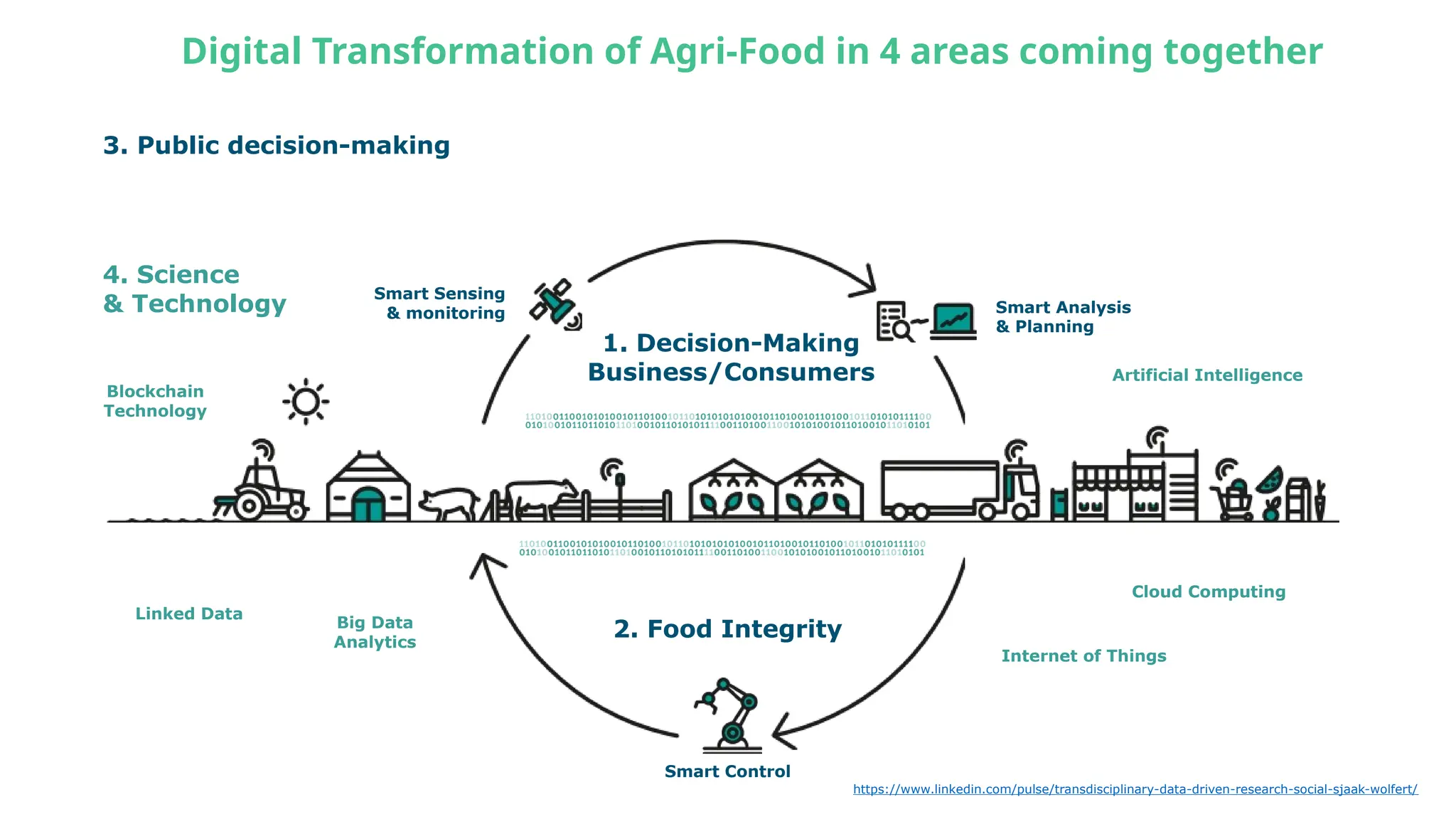
Digital Transformation ofAgri-Food in 4 areas coming together
Cloud Computing
Big Data
Analytics
Internet of Things
Linked Data
Artificial Intelligence
Blockchain
Technology
3. Public decision-making
Smart Sensing
& monitoring
Smart Control
Smart Analysis
& Planning
1. Decision-Making
Business/Consumers
2. Food Integrity
4. Science
& Technology
https://www.linkedin.com/pulse/transdisciplinary-data-driven-research-social-sjaak-wolfert/
3.
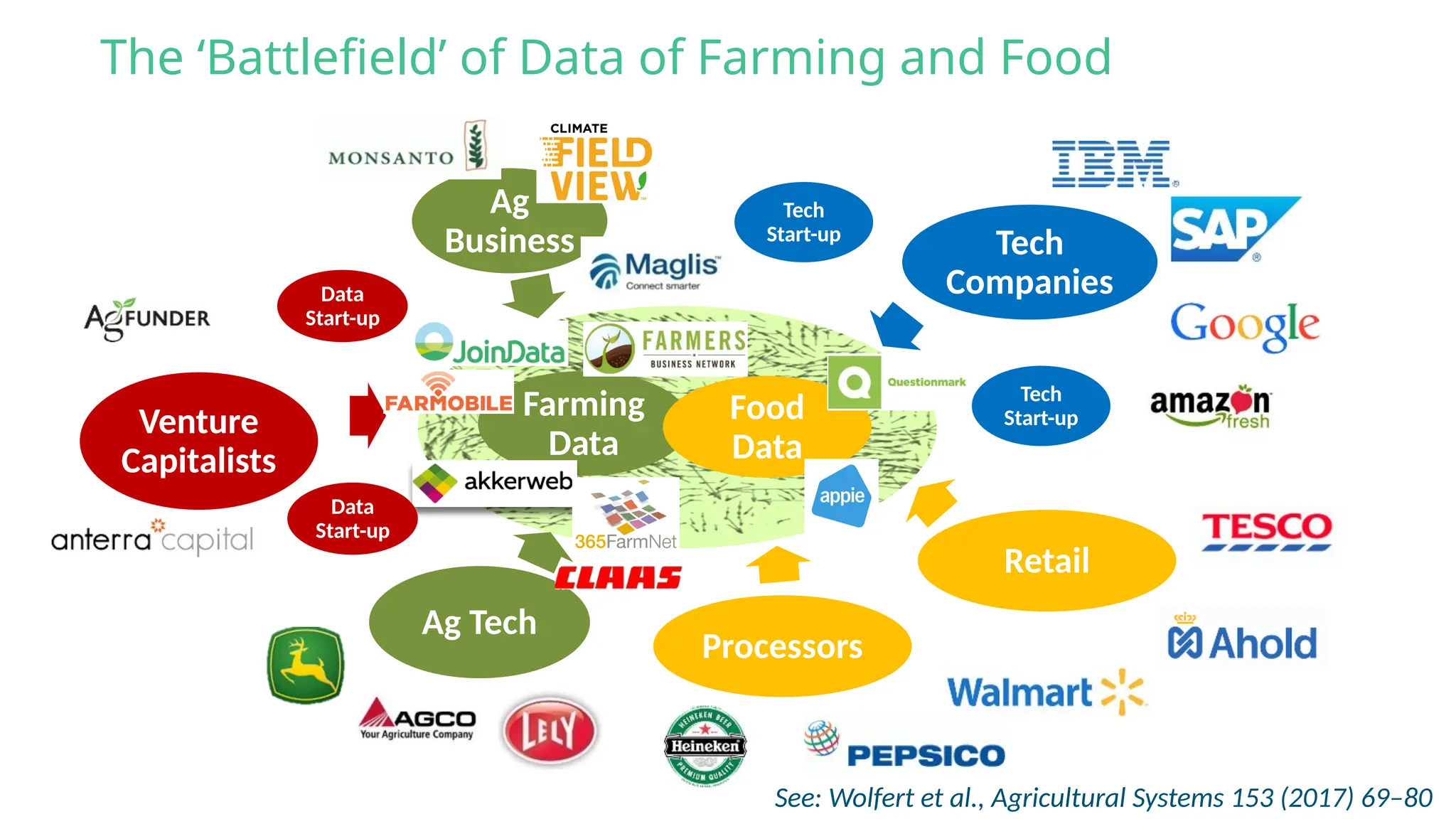
The ‘Battlefield’ ofData of Farming and Food
Farming
Data
Food
Data
See: Wolfert et al., Agricultural Systems 153 (2017) 69–80
Processors
Ag
Business Tech
Companies
Tech
Start-up
Tech
Start-up
Ag Tech
Retail
Venture
Capitalists
Data
Start-up
Data
Start-up
4.
current
interesting
area
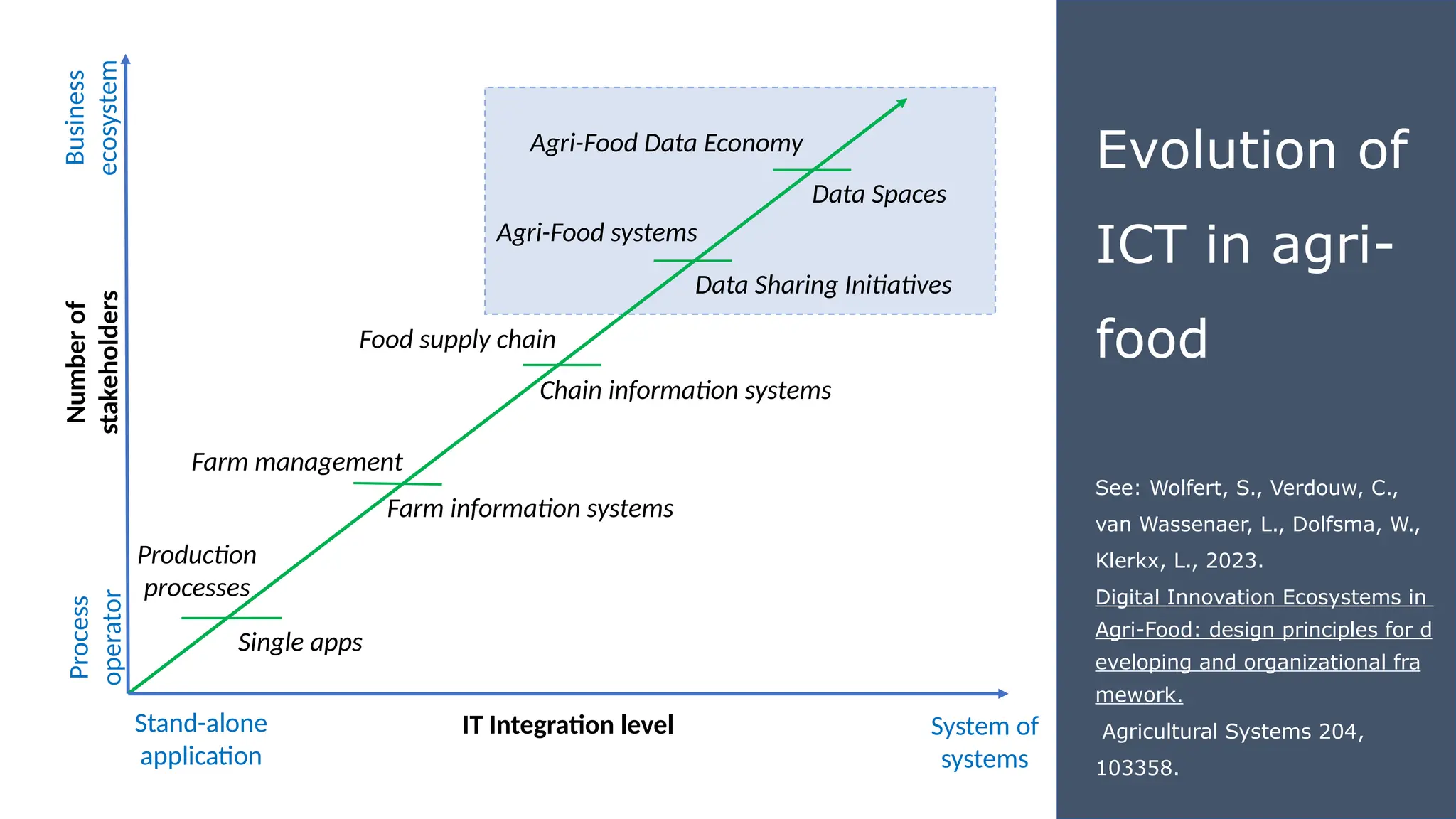
System of
systems
Stand-alone
application
IT Integrationlevel
Number
of
stakeholders
Process
operator
Business
ecosystem
Single apps
Production
processes
Farm information systems
Farm management
Chain information systems
Food supply chain
Data Sharing Initiatives
Agri-Food systems
Agri-Food Data Economy
Data Spaces
Evolution of
ICT in agri-
food
See: Wolfert, S., Verdouw, C.,
van Wassenaer, L., Dolfsma, W.,
Klerkx, L., 2023.
Digital Innovation Ecosystems in
Agri-Food: design principles for d
eveloping and organizational fra
mework.
Agricultural Systems 204,
103358.
€€€
where to
invest?
€€€
Artificial Intelligence
5.
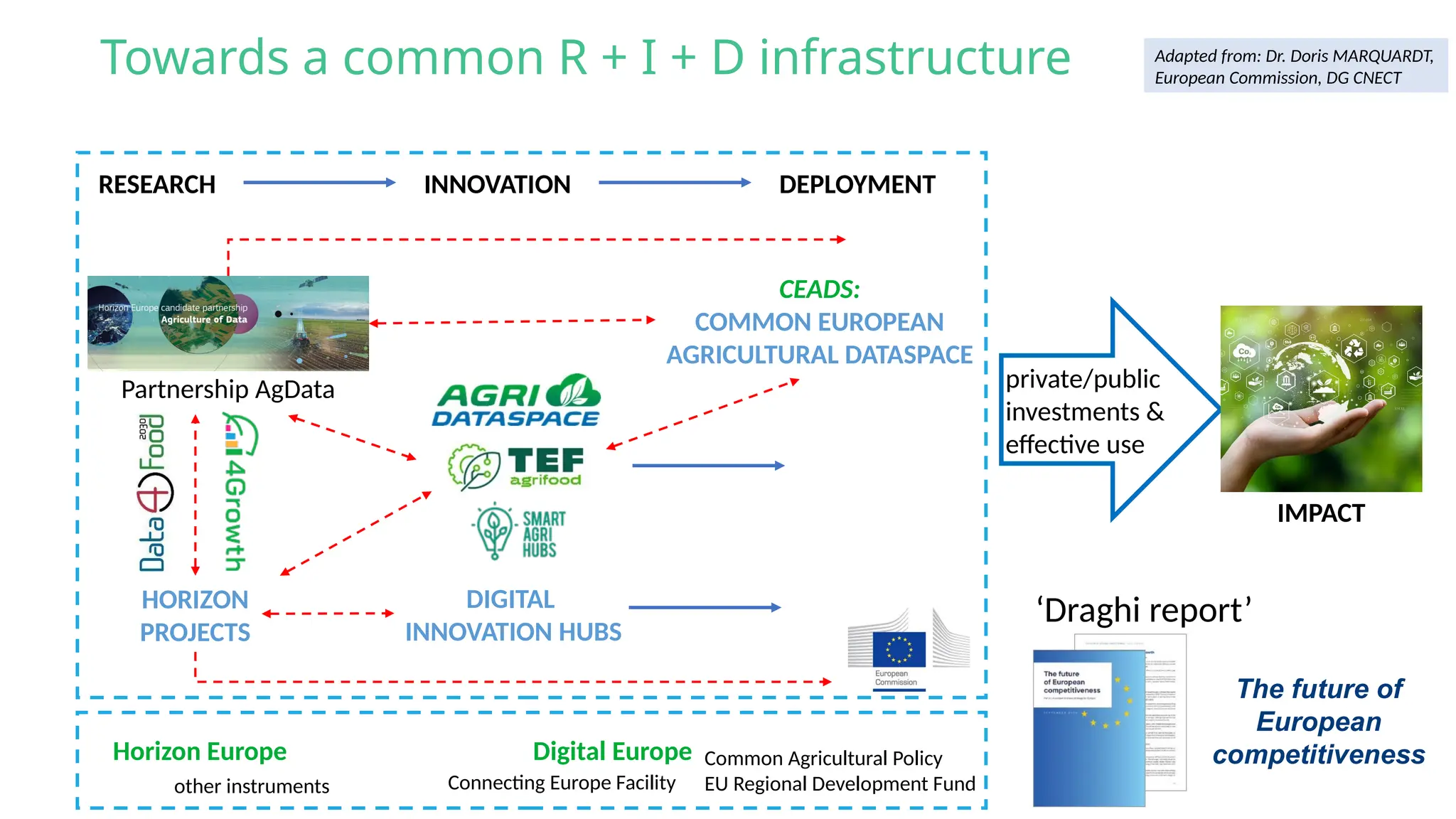
Towards a commonR + I + D infrastructure
RESEARCH INNOVATION DEPLOYMENT
Partnership AgData
CEADS:
COMMON EUROPEAN
AGRICULTURAL DATASPACE
DIGITAL
INNOVATION HUBS
HORIZON
PROJECTS
Adapted from: Dr. Doris MARQUARDT,
European Commission, DG CNECT
private/public
investments &
effective use
IMPACT
‘Draghi report’
The future of
European
competitiveness
Horizon Europe Digital Europe
other instruments
Common Agricultural Policy
EU Regional Development Fund
Connecting Europe Facility
6.
System of
systems
Stand-alone
application
IT Integrationlevel
Number
of
stakeholders
Process
operator
Business
ecosystem
Single apps
Production
processes
Farm information systems
Farm management
Chain information systems
Food supply chain
Data Sharing Initiatives
Agri-Food systems
Agri-Food Data Economy
Data Spaces
Evolution of
ICT in agri-
food
See: Wolfert, S., Verdouw, C.,
van Wassenaer, L., Dolfsma, W.,
Klerkx, L., 2023.
Digital Innovation Ecosystems in
Agri-Food: design principles for d
eveloping and organizational fra
mework.
Agricultural Systems 204,
103358.
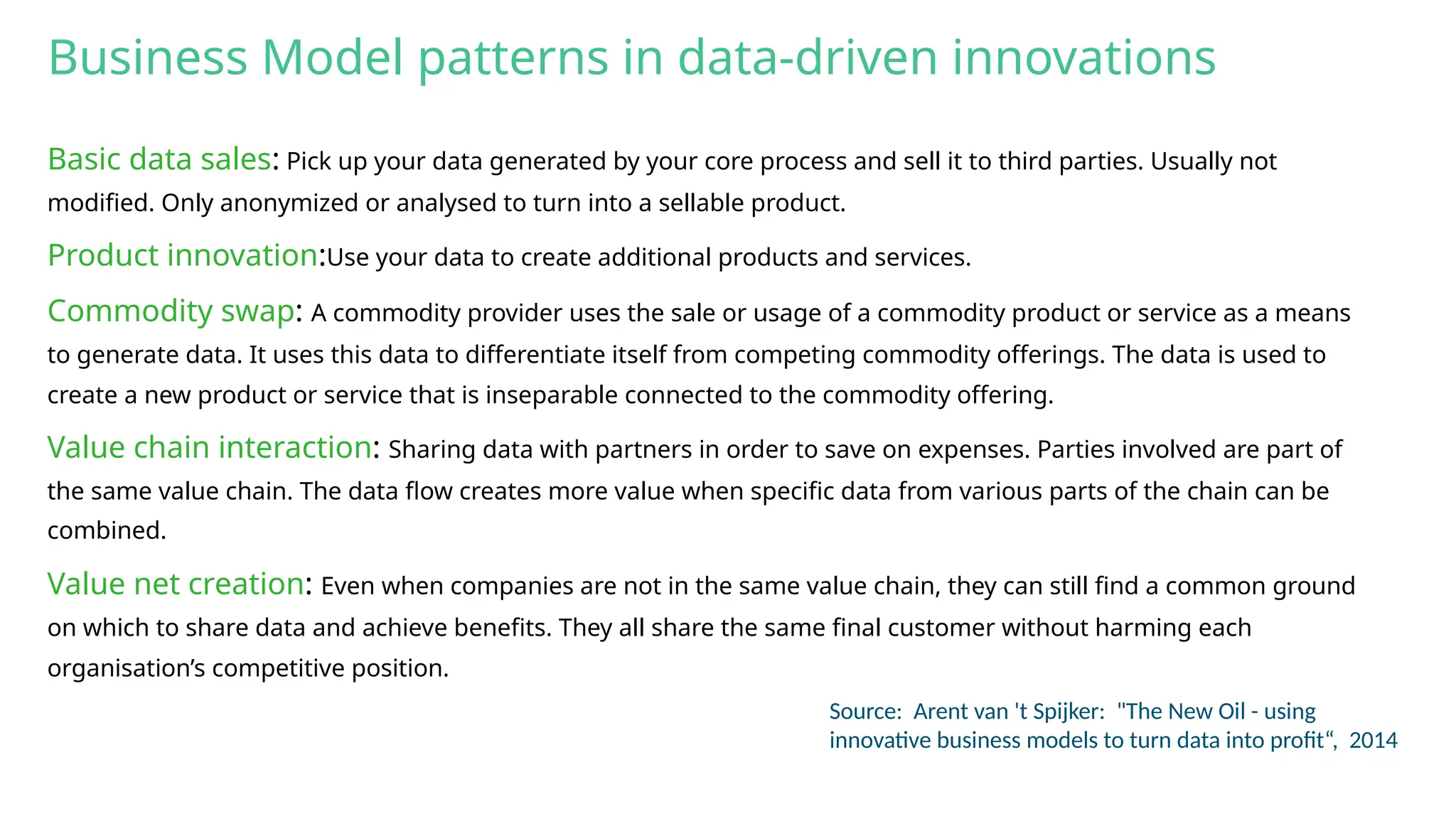
Business Model patternsin data-driven innovations
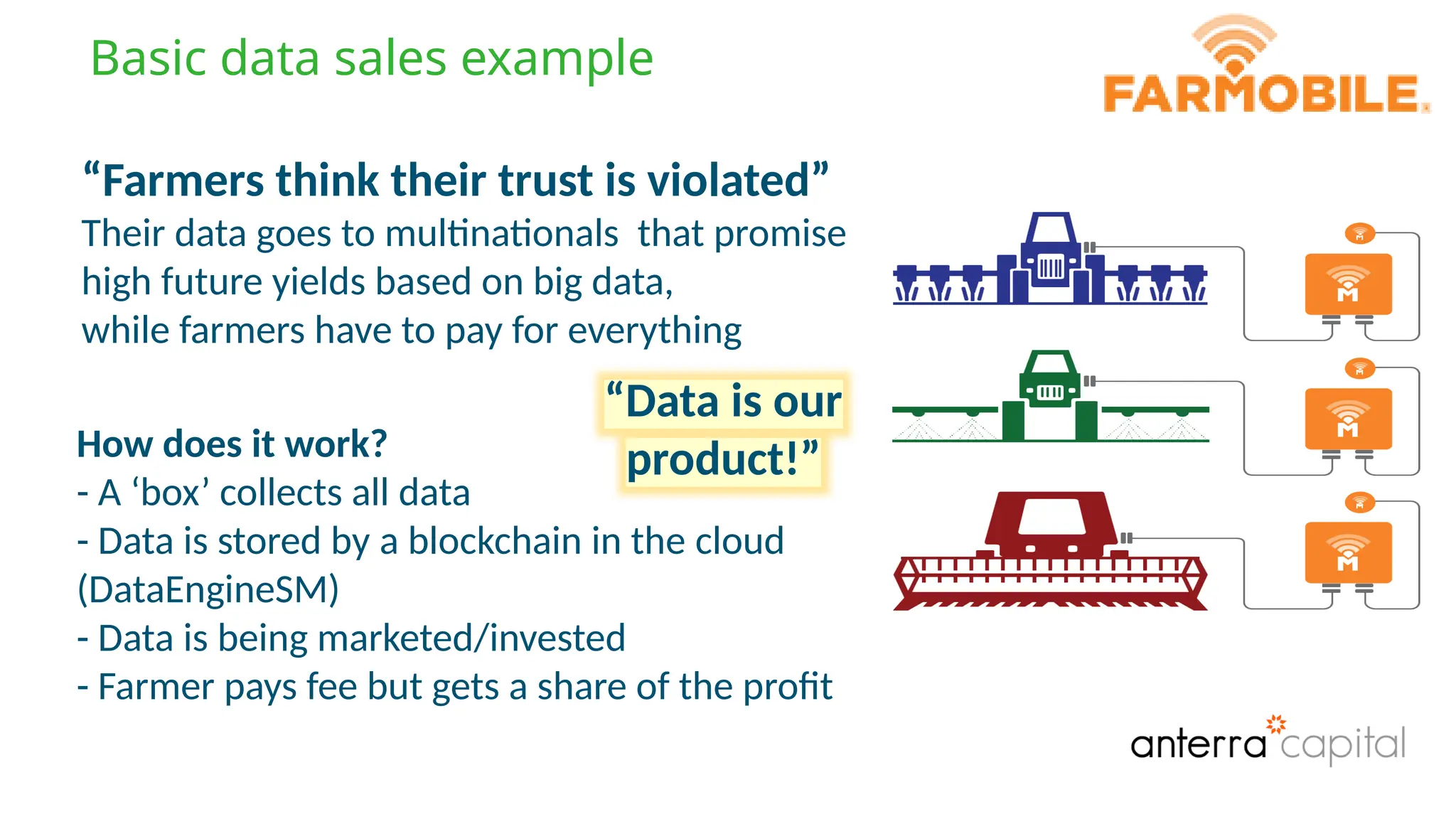
Basic data sales: Pick up your data generated by your core process and sell it to third parties. Usually not
modified. Only anonymized or analysed to turn into a sellable product.
Product innovation:Use your data to create additional products and services.
Commodity swap: A commodity provider uses the sale or usage of a commodity product or service as a means
to generate data. It uses this data to differentiate itself from competing commodity offerings. The data is used to
create a new product or service that is inseparable connected to the commodity offering.
Value chain interaction: Sharing data with partners in order to save on expenses. Parties involved are part of
the same value chain. The data flow creates more value when specific data from various parts of the chain can be
combined.
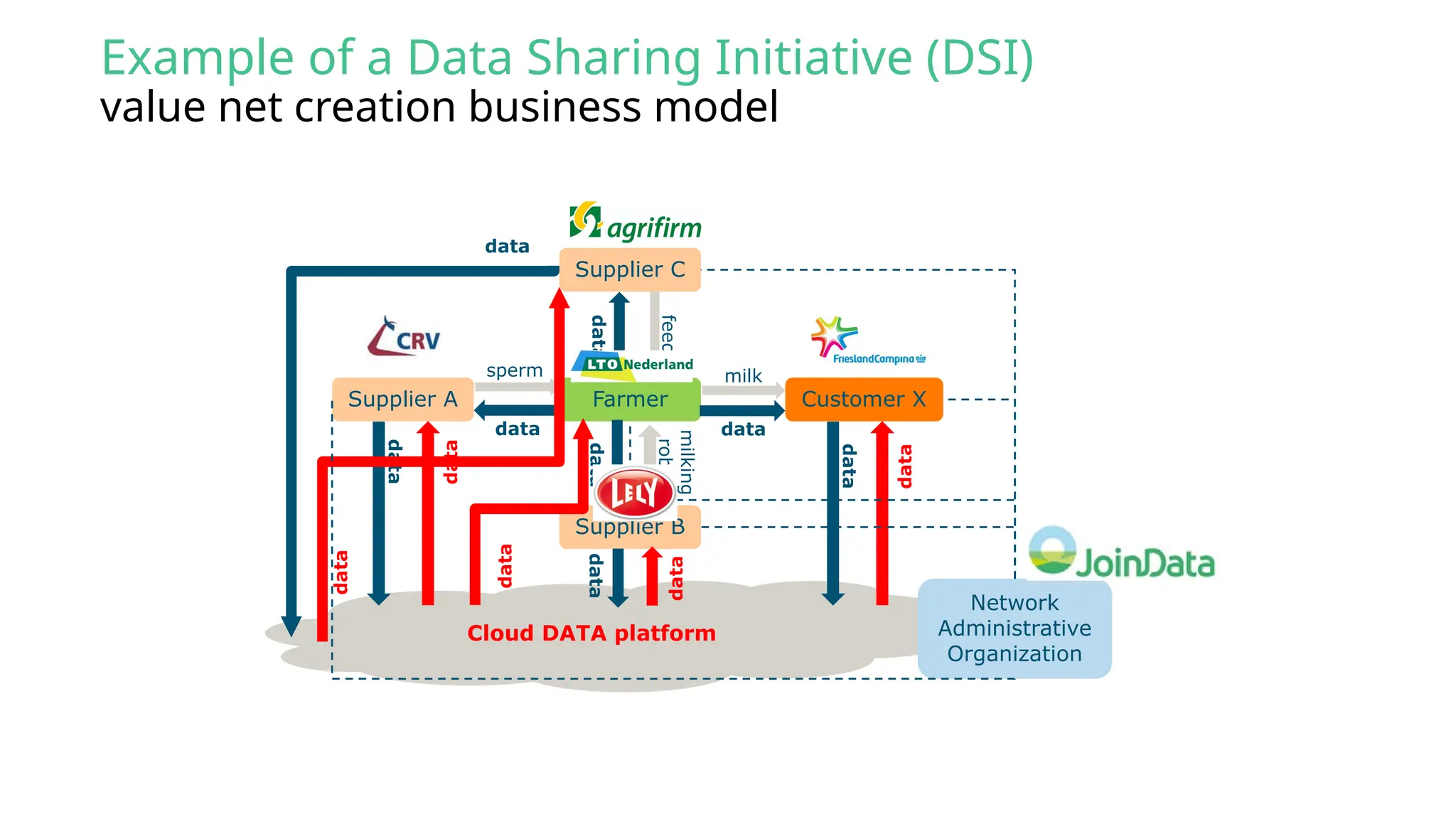
Value net creation: Even when companies are not in the same value chain, they can still find a common ground
on which to share data and achieve benefits. They all share the same final customer without harming each
organisation’s competitive position.
Source: Arent van 't Spijker: "The New Oil - using
innovative business models to turn data into profit“, 2014
9.
Basic data salesexample
How does it work?
- A ‘box’ collects all data
- Data is stored by a blockchain in the cloud
(DataEngineSM)
- Data is being marketed/invested
- Farmer pays fee but gets a share of the profit
“Farmers think their trust is violated”
Their data goes to multinationals that promise
high future yields based on big data,
while farmers have to pay for everything
“Data is our
product!”
10.
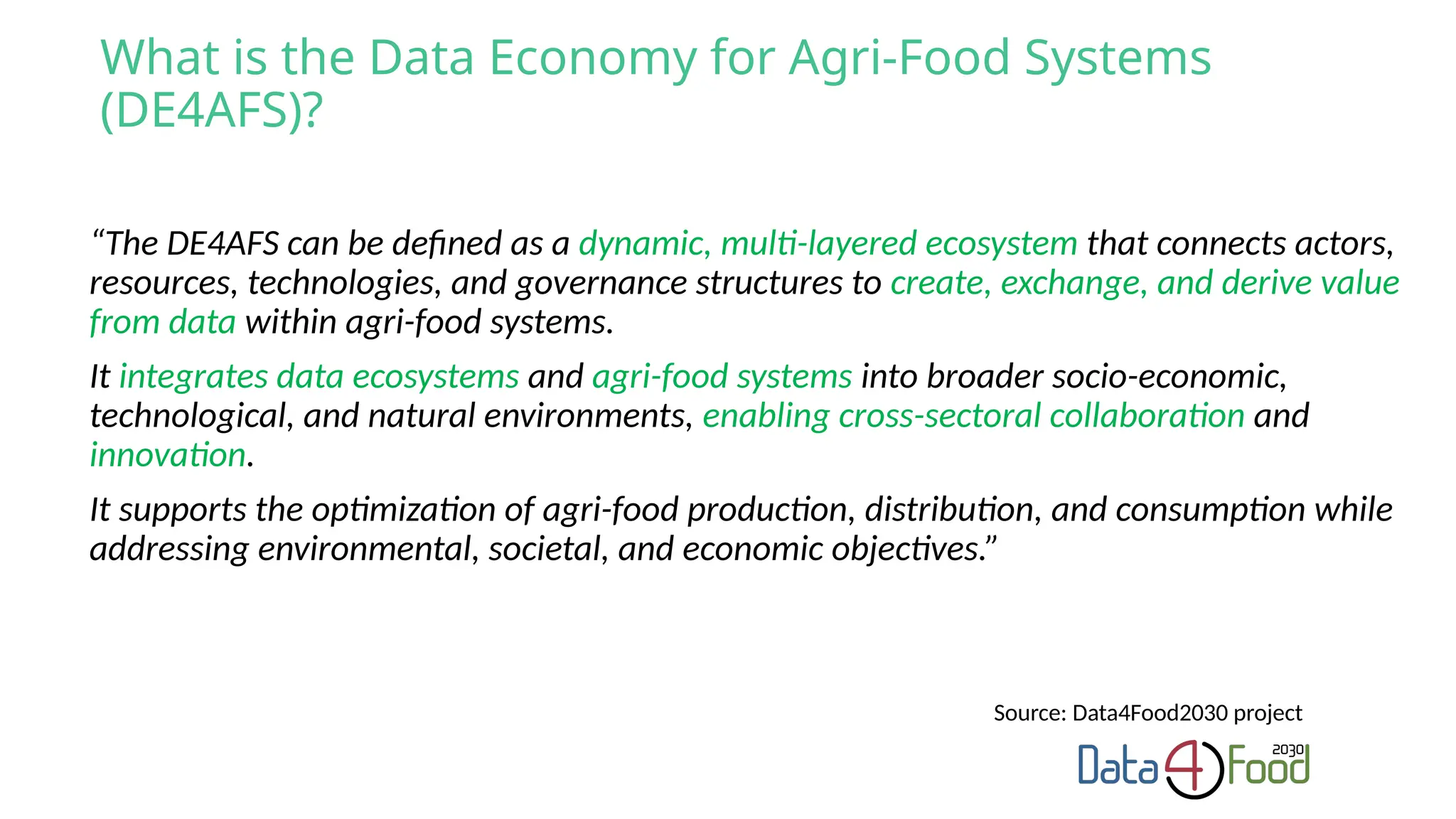
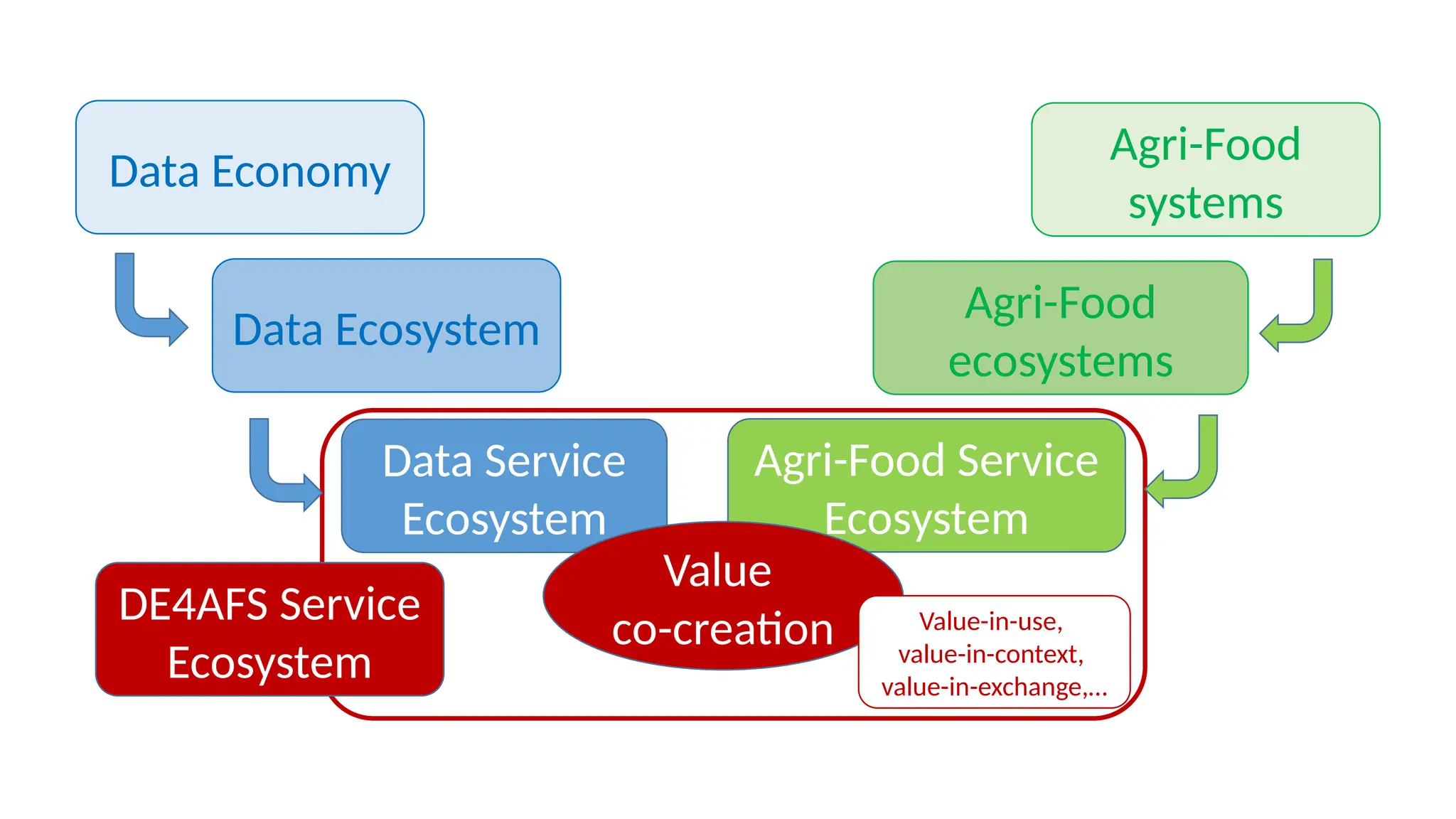
“The DE4AFS canbe defined as a dynamic, multi-layered ecosystem that connects actors,
resources, technologies, and governance structures to create, exchange, and derive value
from data within agri-food systems.
It integrates data ecosystems and agri-food systems into broader socio-economic,
technological, and natural environments, enabling cross-sectoral collaboration and
innovation.
It supports the optimization of agri-food production, distribution, and consumption while
addressing environmental, societal, and economic objectives.”
What is the Data Economy for Agri-Food Systems
(DE4AFS)?
Source: Data4Food2030 project
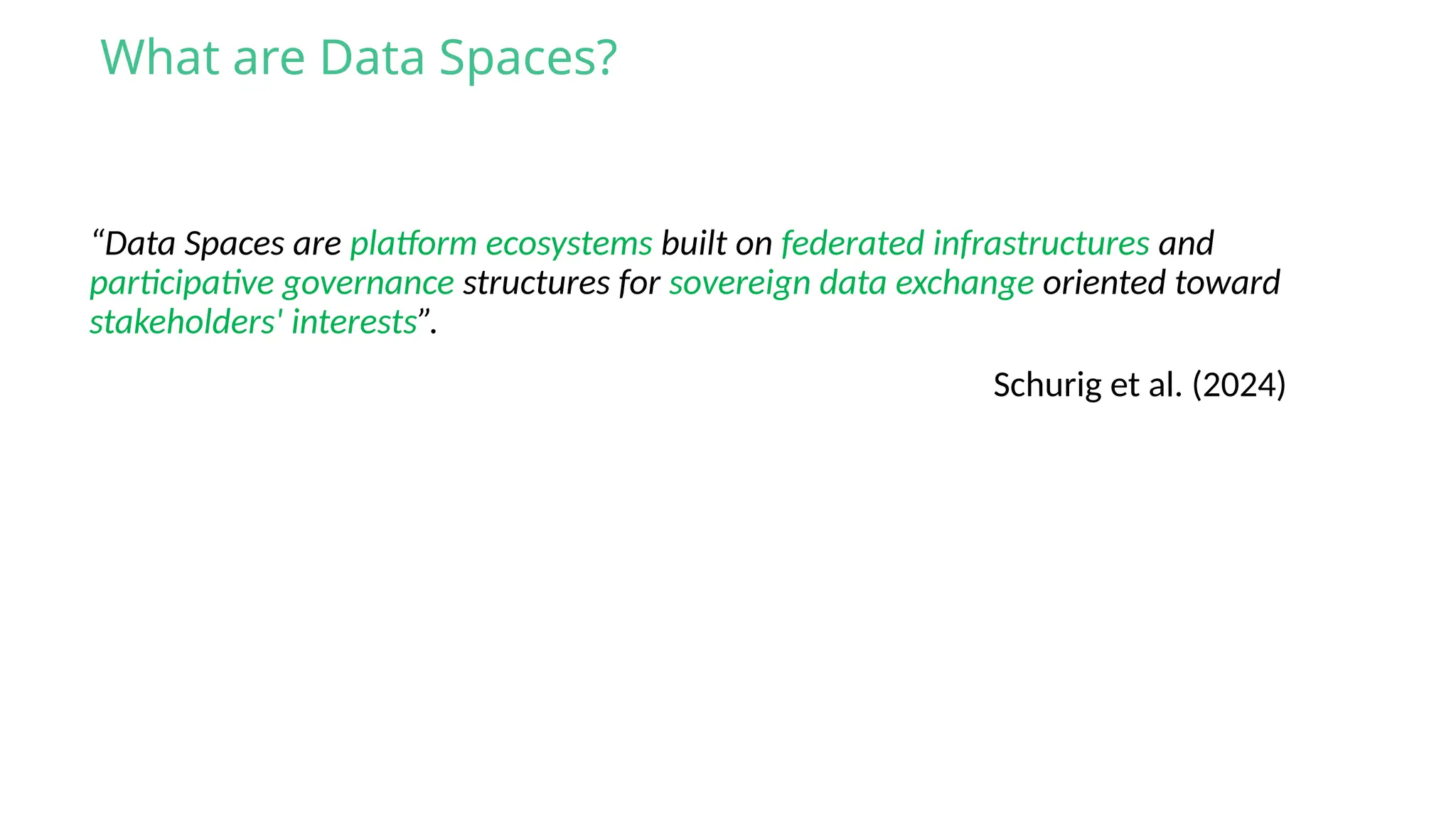
“Data Spaces areplatform ecosystems built on federated infrastructures and
participative governance structures for sovereign data exchange oriented toward
stakeholders' interests”.
What are Data Spaces?
Schurig et al. (2024)
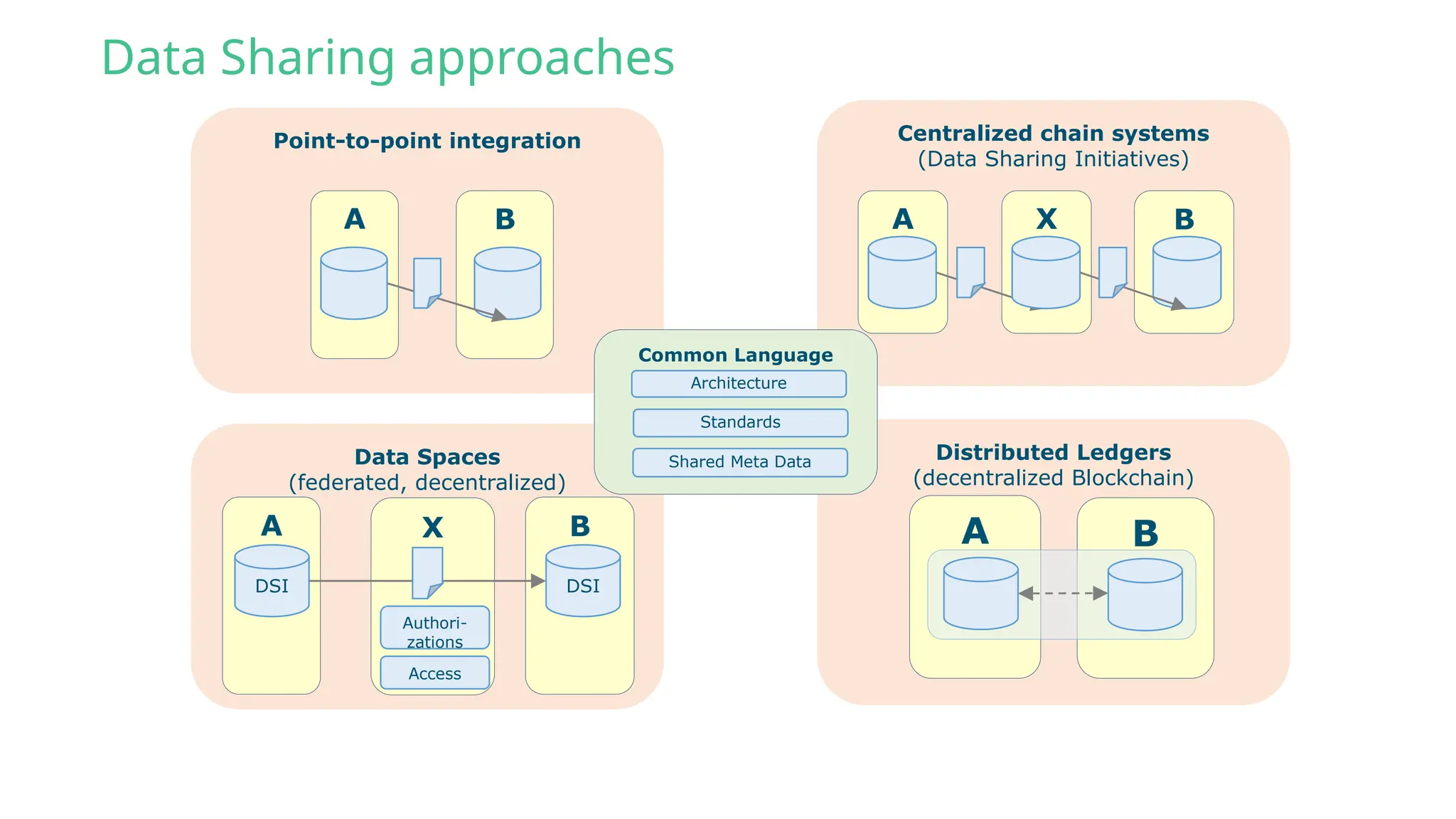
14.
Point-to-point integration
B
A
Centralized chainsystems
(Data Sharing Initiatives)
X B
A
Data Spaces
(federated, decentralized)
X B
A
DSI DSI
Authori-
zations
Access
Distributed Ledgers
(decentralized Blockchain)
A B
Common Language
Standards
Shared Meta Data
Architecture
Data Sharing approaches
15.
Example of aData Sharing Initiative (DSI)
value net creation business model
Cloud DATA platform
Farmer
Supplier C
Supplier A
Supplier B
Customer X
feed
sperm milk
milking
robot
data
data
data
data
data
data
data
data
data
data
data
data
data
Network
Administrative
Organization
16.
System of
systems
Stand-alone
application
IT Integrationlevel
Number
of
stakeholders
Process
operator
Business
ecosystem
Single apps
Production
processes
Farm information systems
Farm management
Chain information systems
Food supply chain
Data Sharing Initiatives
Agri-Food systems
Agri-Food Data Economy
Data Spaces
Evolution of
ICT in agri-
food
See: Wolfert, S., Verdouw, C.,
van Wassenaer, L., Dolfsma, W.,
Klerkx, L., 2023.
Digital Innovation Ecosystems in
Agri-Food: design principles for d
eveloping and organizational fra
mework.
Agricultural Systems 204,
103358.
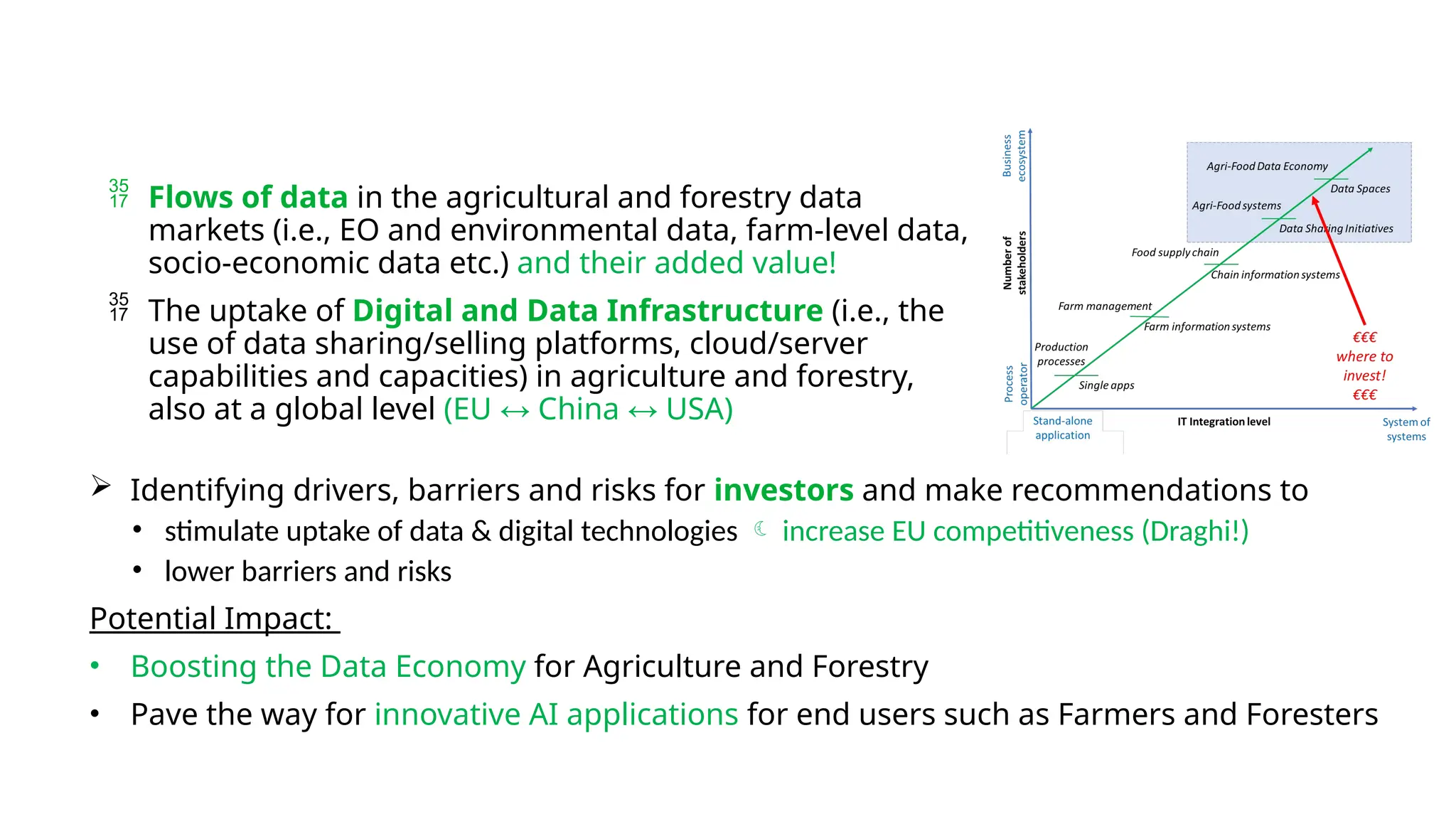
€€€
where to
invest!
€€€
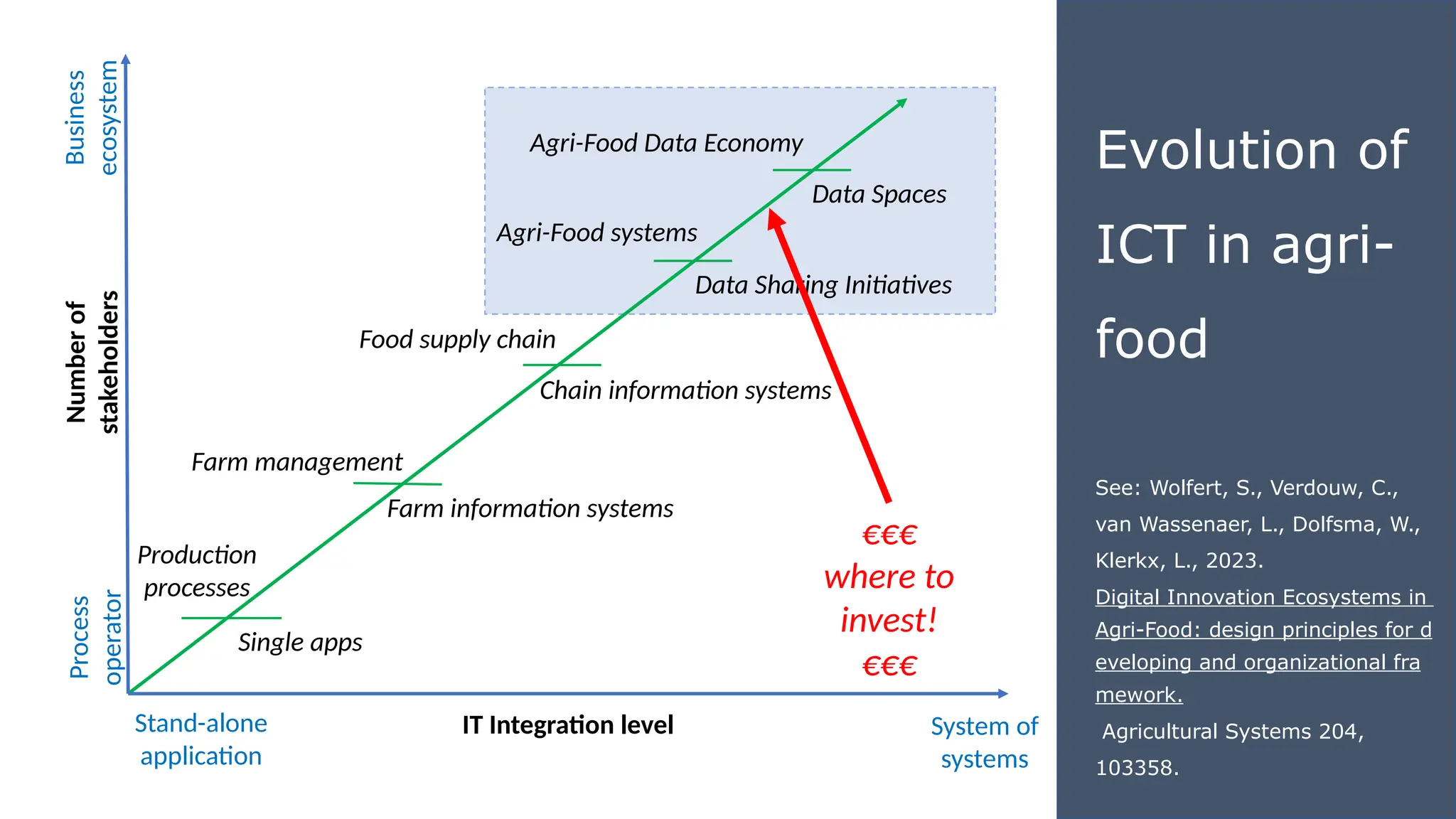
17.
Identifying drivers,barriers and risks for investors and make recommendations to
• stimulate uptake of data & digital technologies increase EU competitiveness (Draghi!)
• lower barriers and risks
Potential Impact:
• Boosting the Data Economy for Agriculture and Forestry
• Pave the way for innovative AI applications for end users such as Farmers and Foresters
Flows of data in the agricultural and forestry data
markets (i.e., EO and environmental data, farm-level data,
socio-economic data etc.) and their added value!
The uptake of Digital and Data Infrastructure (i.e., the
use of data sharing/selling platforms, cloud/server
capabilities and capacities) in agriculture and forestry,
also at a global level (EU ↔ China ↔ USA)
18.
1. Split upinto WP teams (WP 2, 3, 4, 5)
2. Individual (5’): post-its with key words/phrases that come to your mind after hearing the
pitch
• Inspiration, ideas, critics, …
• Discuss (10’) them briefly in your group
3. What does it mean for your WP/Task – what could/should you do different? (30’)
• analysis, design, approach
• (types of) data
• scenarios
• communication
• stakeholder involvement
• …
4.Summarize the outcome in one slide to include in your upcoming WP presentation (15’)
19.
4Growth-project.eu
THANK YOU
SUBSCRIBE TO
Fundedby the European Union under grant agreement no 101134855. Views and opinions expressed are however those of the
author(s) only and do not necessarily reflect those of the European Union or REA. Neither the European Union nor the granting
authority cannot be held responsible for them.
linkedin.com/showcase/4growth-project
x.com/4GrowthProject
OUR NEWSLETTER
Editor's Notes
#2 The food production chain - from farm to fork – is becoming increasingly digital.
[SLIDE 8] This is due to the so-called cyber-physical management cycle of smart sensing & monitoring, smart analysis & planning and smart control. Objects, such as crops, animals or trucks, are monitored by [CLICK] smart sensors, satellites or drones with cameras. They are smart because their observations go beyond human senses such as sight, smell and hearing. Moreover, they are capable of observation 24/7 without becoming tired. Smart sensing and monitoring results in a lot of data that is [CLICK] analysed through smart algorithms in software applications. The result could be an instruction to fertilize crops or to treat your animals. This planning is executed by [CLICK] smart machines that know the local context and what the optimal treatment for your crops or animals is. The loop is closed again by monitoring the effect of the control actions. In this way you can see if the growth of your animals or crops is going in the right direction. This decision-making cycle can be applied to every object and company in the whole value chain. Also, to consumers who are [CLICK] deciding what cheese they want to buy in the supermarket. This is the first application of digitalization in which data is used for decision-making for business and consumers.
[SLIDE 9] The second application of these data is for Food Integrity. Meaning you can [CLICK] pass the data through the whole chain to address questions such as: [CLICK] Where does my food come from? How was it produced? Is it sustainable?
[SLIDE 10] The third application of the same data is for public policies. The data could be used to control [CLICK] food safety, [CLICK] support environmental policy or [CLICK] health policies. What if you could plug into these real-time data to monitor the nitrogen emissions or detect a food contamination right at the source? That would be fantastic right? However, currently, most governments have their separate monitoring systems or censuses that are usually lagging behind the actual situation.
[SLIDE 11] The fourth and final application area of data is science and technology. Examples of technologies are: artificial intelligence, blockchain, internet of things or big data analytics. Actually, these technologies are main drivers behind this whole digitalization. But at the same time their development depends on the data that are produced through the application of these technologies. You can’t do big data analytics without access to big data!
#3 This development has so far led to a very dynamic landscape – or battlefield - for the Data of Farming and Food. Competing big AgMachinery and AgBusiness companies (green) were on of the first to collect lots of data from farmers to build their own platforms and applications. Sometimes this was even without farmers knowing their data was used. Thas had led to some reactions from the farmer’s community (e.g. Akkerweb, JoinData in NL) but so far these initiatives remained very small in comparison to the platforms from the big ones. Similar developments took place at the consumer side on food data by large food processors and retailers (orange). More independent platforms that are focusing on transparent information for the consumer (e.g. QuestionMark) were also established, but also for those platforms it is very difficult to survive in this competitive environment.
However beside these incumbents new players entered this arena. First, we can distinguish tech-start-ups that were supported – and later often acquired - by large tech companies. A good example of this is the Farmer’s business network in the USA. Second, there were data start-ups supported by venture capitalists that eventually followed the same pathway. Some of them are also now quite dominant players. A good example of this is Farmobile, also in the USA.
Sure, these developments have delivered a lot of innovative solutions for the benefit of farmers and consumers, but in most cases the position of these stakeholders is at stake. They feel they are out of control of their own data.
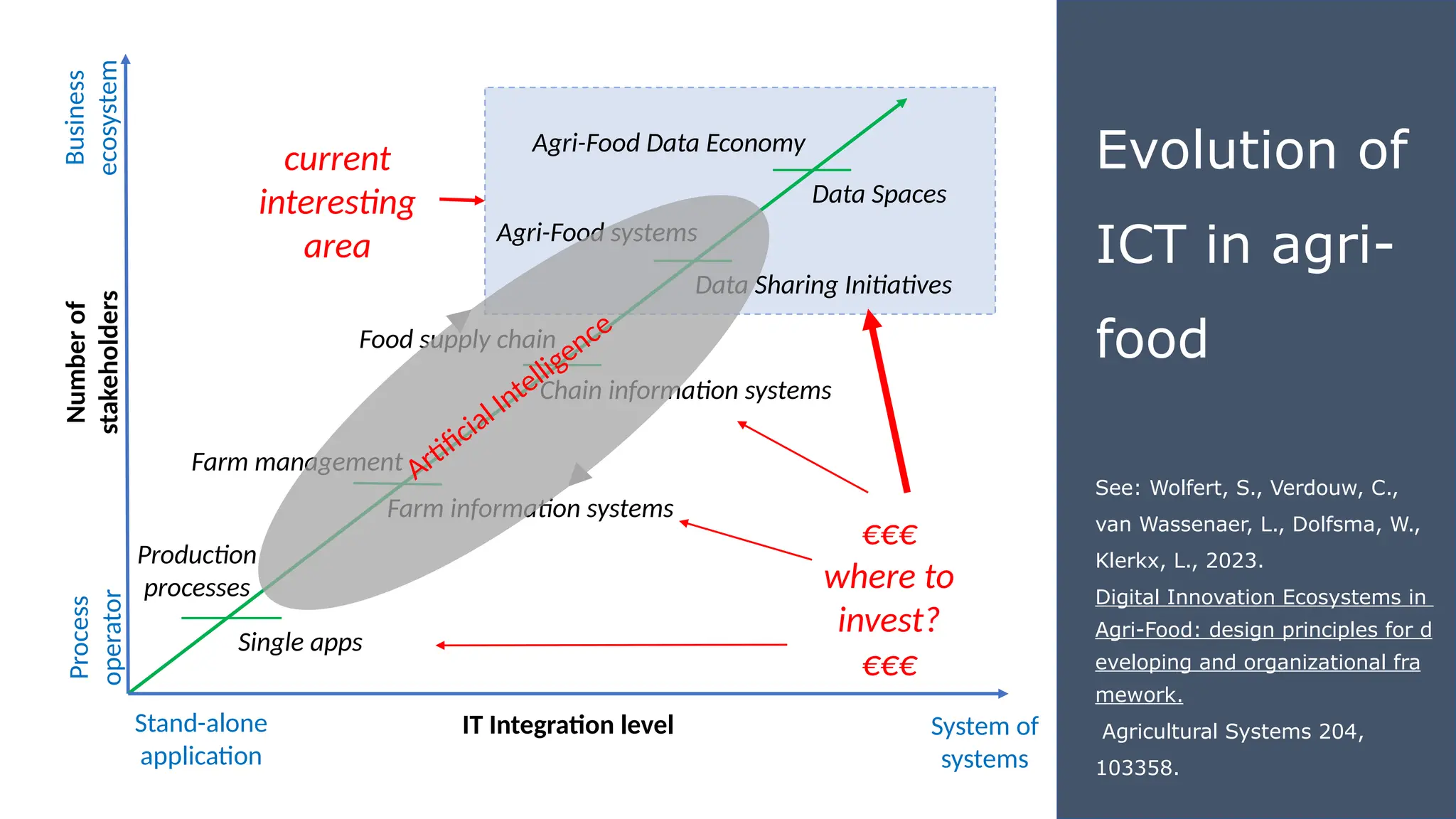
#6 Key message: although the elements at the lower left of the ‘ladder’ are also still needed, it is expected that the future developments will focus on the upper right part. The current sustainability challenges require integrated solutions which are at the level of food systems and a food data economy that are constituted by data platforms and – in the future – data spaces where data is available, also more in an aggregated/integrated way.
#16 Key message: although the elements at the lower left of the ‘ladder’ are also still needed, it is expected that the future developments will focus on the upper right part. The current sustainability challenges require integrated solutions which are at the level of food systems and a food data economy that are constituted by data platforms and – in the future – data spaces where data is available, also more in an aggregated/integrated way.


![Vibe Coding vs. Spec-Driven Development [Free Meetup]](https://cdn.slidesharecdn.com/ss_thumbnails/vibecodingvsspecdrivendevelopment-251209105622-43f455e7-thumbnail.jpg?width=640&height=640&fit=bounds)


