IODOFORM TEST BY: AKASH PATEL,12-M2
INDEX
❖CERTIFICATE
❖ACKNOWLEDGEMENT
❖INTRODUCTION
❖HALLOFORM REACTIN
❖IODOFORM
❖SYNTHESIS & REACTION
❖MATERIALS REQUIRED
❖ PROCEDURE FOR IODOFORM TEST
❖ USES
❖ DISADVANTAGES
❖BIBLIOGRAPHY
IODOFORM TEST BY: AKASH PATEL,12-M2
CERTIFICATE
This is to certify that, AKASH PATEL, student
of class 12th
– M2 of Sant Atulanand
Convent School has prepared the project on
IODOFORM TEST sincerely and honestly
under the supervision of MR. DINESH
SINGH in the academic year 2023-2024.
…………………….. ..……………………..
Dr. Neelam Singh Mr. Dinesh Singh
Principal Internal examiner
……………………………………….
External examiner
IODOFORM TEST BY: AKASH PATEL,12-M2
ACKNOWLEDGEMENT
I express my deep sense of gratitude to my guide
Mr. Dinesh Singh for his valuable guidance and
inspiration in every aspect of this project. I am
thankful for his constant evaluation for the
implementation of this project.
I would like to thank my lab assistant Mr.
Samarjeet sir for giving me such attention and
valuable time.
Nevertheless, I express my gratitude towards my
family and friends for their kind co-operation and
encouragement which helped me in completions
of this project.
AKASH PATEL
12th
M2
IODOFORM TEST BY: AKASH PATEL,12-M2
Iodoform is an organ iodine compound with the formula
CHI3. A pale yellow, crystalline, volatile substance, it has a
penetrating and distinctive odour (also referred as smell if
hospitals, where the compound is still commonly used) and
analogous to chloroform, sweetish taste. It is occasionally
use as disinfectant. It is also known as tri-iodomethane,
carbon triiodide and methyl triiodine.
Formula: CHI3
Molar Mass: 393.7g/mol
Boiling Point: 218o
C
Density: 4.01 g/cm3
Appearance: pale yellow
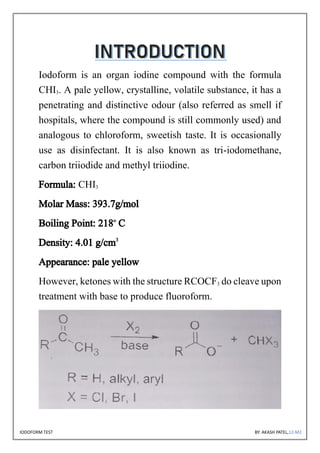
However,ketoneswiththestructureRCOCF3 docleaveupon
treatment with base to produce fluoroform.
IODOFORM TEST BY: AKASH PATEL,12-M2
Aldehyde and ketones having atleast one methyl group linked to
the carbonyl carbon atom (CH3CO – group) on treatment with
excess of halogen in presence of alkali produce a haloform. In
this reaction all the three H-atoms of methyl group are first
replace by an atom to form either a trihaloaldehyde or
trihaloketone which subsequently reacts with alkali to yield a
haloformand saltof a carboxylic acid containing one c-atom less
than the parent aldehyde/ketone. During this reaction C=C is not
attacked, if present in the molecule. When this reaction is carried
out with sodium hypoiodide (NaOH/I2), yellow ppt. of iodoform
is produced.
Substrates are broadly limited to methyl ketone and 20
alcohol
oxidizable to methyl ketone, such as isopropanol. The only 10
alcohol and aldehyde to undergo this reaction are ethanol and
acetaldehyde respectively. 1,3-Diketones such as acetylacetone
also give the halo form reaction.
B-ketoacids such as acetoacetic acid will also give the test upon
heating. Acetyl chloride and acetamide don’t give this test.
The halogen used may be Cl, Br, I, or sodium hypochlorite.
Fluoroform (CHF3) can’t be prepared by this method as it would
require the presence of highly unstable hypoflourite ion.
IODOFORM TEST BY: AKASH PATEL,12-M2
In the first step, the halogen disproportionate in the presence
of OH to give the halide hypohalite (e.g., with Br, but
reaction is the same in case of Cl/I).
Ifasecondaryalcoholispresent,itreactswiththehypohalite
in a three-step process:
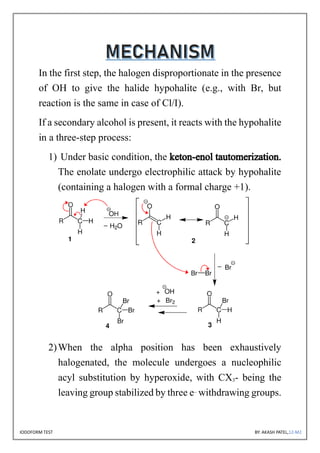
1) Under basic condition, the keton-enol tautomerization.
The enolate undergo electrophilic attack by hypohalite
(containing a halogen with a formal charge +1).
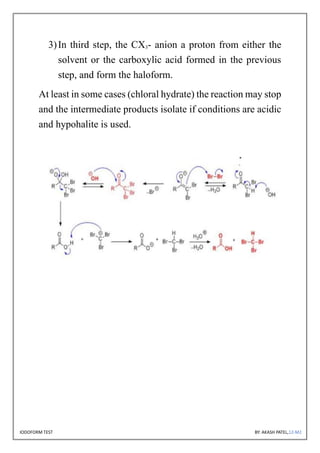
2)When the alpha position has been exhaustively
halogenated, the molecule undergoes a nucleophilic
acyl substitution by hyperoxide, with CX3- being the
leavinggroupstabilizedbythreee_
withdrawinggroups.
IODOFORM TEST BY: AKASH PATEL,12-M2
3)In third step, the CX3- anion a proton from either the
solvent or the carboxylic acid formed in the previous
step, and form the haloform.
Atleastinsomecases(chloralhydrate)thereactionmaystop
and the intermediate products isolate if conditions are acidic
and hypohalite is used.
IODOFORM TEST BY: AKASH PATEL,12-M2
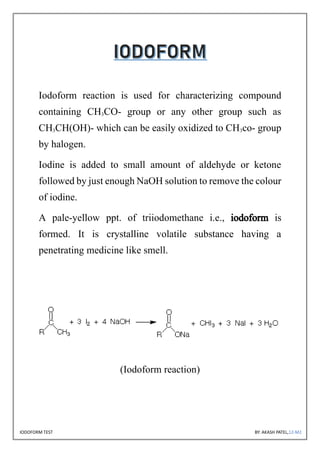
Iodoform reaction is used for characterizing compound
containing CH3CO- group or any other group such as
CH3CH(OH)- which can be easily oxidized to CH3co- group
by halogen.
Iodine is added to small amount of aldehyde or ketone
followedbyjustenoughNaOHsolutiontoremovethecolour
of iodine.
A pale-yellow ppt. of triiodomethane i.e., iodoform is
formed. It is crystalline volatile substance having a
penetrating medicine like smell.
(Iodoform reaction)
IODOFORM TEST BY: AKASH PATEL,12-M2
The haloform reaction is one of the oldest reactions known, in
1822, Georges Simon Serullas added potassium metal to a
solutionofiodineinethanolandwatertoformpotassiumformate
and iodoform.Atthe same time, john Thomas Cooper performed
the haloform reaction of iodine and sodium hydroxide (NaOH)
with four of these organic compounds namely methyl ketone,
acetaldehyde, ethanol and certain secondary alcohols.
The reaction of iodine and base with methyl ketone (CH3COR; R
=alkyl or aryl group) is so reliable that the iodoform test
(appearance of yellow ppt.) is used to prove the presence of
methyl ketones. Some reagents (e.g., hydrogen iodide) covert
iodoform to diiodomethane. Also, conversion to CO2 is possible.
Iodoform reacts with aqueous silver, nitrite to produce CO.
IODOFORM TEST BY: AKASH PATEL,12-M2
When treated with powdered element silver, the iodoform is
reduced producing acetylene, upon heating, iodoform
decomposes to produce diatomic iodine, HI gas and C.
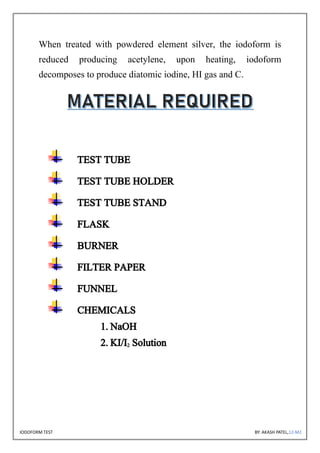
TEST TUBE
TEST TUBE HOLDER
TEST TUBE STAND
FLASK
BURNER
FILTER PAPER
FUNNEL
CHEMICALS
1.NaOH
2.KI/I2 Solution
IODOFORM TEST BY: AKASH PATEL,12-M2
Three drops of compound to be tested are added to 3ml of
water and 10 drop of KI/I2 solution (a dark purple brown
solution). 10% NaOH solution is added drop wise until the
dark colour of solution fades to yellow. The solution is
heated at 600
C. ifthe colour of the solution disappears, more
KI/I2 solution is added.
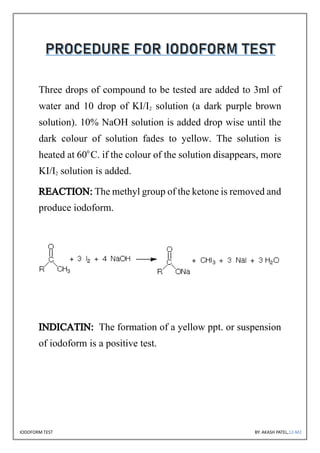
REACTION:Themethylgroupoftheketoneisremovedand
produce iodoform.
INDICATIN: The formation of a yellow ppt. or suspension
of iodoform is a positive test.
IODOFORM TEST BY: AKASH PATEL,12-M2
1. LABORATORY USES:
The iodoform test is commonly use as a chemical test to
determine the presence of a methyl ketone, or a 20 OH
oxidizable to a methyl ketone. When iodine and NaOH are
used as the reagents, a positive reaction gives iodoform,
which is solid at room temperature and tends to ppt. out of
solution causing a distinctive cloudiness.
In organic chemistry, this reaction may be used to convert
a terminal methyl ketone into the analogous carboxylic
acid.
2. INDUSTRIAL USES:
It was formerly used to produce iodoform, bromoform and
even chloroform industrially.
3. MEDICAL USES:
iodoform is mostly used as an antiseptic and for wound
debridement. The wound is packed with iodoform gauze,
after the gauze dries, it adheres to dead tissues.
Iodoform is primarily used to treat minor skin conditions
duetoantisepticproperties.Itisalsousedinvarioushuman
and animal disinfectant products.
4. OTHER USES:
Nowadays spectroscopic technique such as NMR and
infraredareeasyandquicktoperforminsteadofqualitative
tests.
IODOFORM TEST BY: AKASH PATEL,12-M2
Excessiveamountofiodoformthatareabsorbedintotheskin
or ingested can lead to systematic intoxication, which could
cause symptoms such as vomiting, rapid pulse,
hallucinations, delirium and fever.
Iodoform has been known to cause vision impairment and
possibly total blindness, although the vision usually
improves on its own overtime.
Although iodoform has been widely used for the treatment
ofwounds, can also cause side effects suchas consciousness
disturbance, tachycardia and headache.
IODOFORM TEST BY: AKASH PATEL,12-M2
NCERT CHEMISTRY TEXTBOOK
CHEMISTRY LAB MANUAL
www.google.com
www.byjus.com
www.learncbse.com

iodoform test project file.pdf

  • 1.
    IODOFORM TEST BY:AKASH PATEL,12-M2 INDEX ❖CERTIFICATE ❖ACKNOWLEDGEMENT ❖INTRODUCTION ❖HALLOFORM REACTIN ❖IODOFORM ❖SYNTHESIS & REACTION ❖MATERIALS REQUIRED ❖ PROCEDURE FOR IODOFORM TEST ❖ USES ❖ DISADVANTAGES ❖BIBLIOGRAPHY
  • 2.
    IODOFORM TEST BY:AKASH PATEL,12-M2 CERTIFICATE This is to certify that, AKASH PATEL, student of class 12th – M2 of Sant Atulanand Convent School has prepared the project on IODOFORM TEST sincerely and honestly under the supervision of MR. DINESH SINGH in the academic year 2023-2024. …………………….. ..…………………….. Dr. Neelam Singh Mr. Dinesh Singh Principal Internal examiner ………………………………………. External examiner
  • 3.
    IODOFORM TEST BY:AKASH PATEL,12-M2 ACKNOWLEDGEMENT I express my deep sense of gratitude to my guide Mr. Dinesh Singh for his valuable guidance and inspiration in every aspect of this project. I am thankful for his constant evaluation for the implementation of this project. I would like to thank my lab assistant Mr. Samarjeet sir for giving me such attention and valuable time. Nevertheless, I express my gratitude towards my family and friends for their kind co-operation and encouragement which helped me in completions of this project. AKASH PATEL 12th M2
  • 4.
    IODOFORM TEST BY:AKASH PATEL,12-M2 Iodoform is an organ iodine compound with the formula CHI3. A pale yellow, crystalline, volatile substance, it has a penetrating and distinctive odour (also referred as smell if hospitals, where the compound is still commonly used) and analogous to chloroform, sweetish taste. It is occasionally use as disinfectant. It is also known as tri-iodomethane, carbon triiodide and methyl triiodine. Formula: CHI3 Molar Mass: 393.7g/mol Boiling Point: 218o C Density: 4.01 g/cm3 Appearance: pale yellow However,ketoneswiththestructureRCOCF3 docleaveupon treatment with base to produce fluoroform.
  • 5.
    IODOFORM TEST BY:AKASH PATEL,12-M2 Aldehyde and ketones having atleast one methyl group linked to the carbonyl carbon atom (CH3CO – group) on treatment with excess of halogen in presence of alkali produce a haloform. In this reaction all the three H-atoms of methyl group are first replace by an atom to form either a trihaloaldehyde or trihaloketone which subsequently reacts with alkali to yield a haloformand saltof a carboxylic acid containing one c-atom less than the parent aldehyde/ketone. During this reaction C=C is not attacked, if present in the molecule. When this reaction is carried out with sodium hypoiodide (NaOH/I2), yellow ppt. of iodoform is produced. Substrates are broadly limited to methyl ketone and 20 alcohol oxidizable to methyl ketone, such as isopropanol. The only 10 alcohol and aldehyde to undergo this reaction are ethanol and acetaldehyde respectively. 1,3-Diketones such as acetylacetone also give the halo form reaction. B-ketoacids such as acetoacetic acid will also give the test upon heating. Acetyl chloride and acetamide don’t give this test. The halogen used may be Cl, Br, I, or sodium hypochlorite. Fluoroform (CHF3) can’t be prepared by this method as it would require the presence of highly unstable hypoflourite ion.
  • 6.
    IODOFORM TEST BY:AKASH PATEL,12-M2 In the first step, the halogen disproportionate in the presence of OH to give the halide hypohalite (e.g., with Br, but reaction is the same in case of Cl/I). Ifasecondaryalcoholispresent,itreactswiththehypohalite in a three-step process: 1) Under basic condition, the keton-enol tautomerization. The enolate undergo electrophilic attack by hypohalite (containing a halogen with a formal charge +1). 2)When the alpha position has been exhaustively halogenated, the molecule undergoes a nucleophilic acyl substitution by hyperoxide, with CX3- being the leavinggroupstabilizedbythreee_ withdrawinggroups.
  • 7.
    IODOFORM TEST BY:AKASH PATEL,12-M2 3)In third step, the CX3- anion a proton from either the solvent or the carboxylic acid formed in the previous step, and form the haloform. Atleastinsomecases(chloralhydrate)thereactionmaystop and the intermediate products isolate if conditions are acidic and hypohalite is used.
  • 8.
    IODOFORM TEST BY:AKASH PATEL,12-M2 Iodoform reaction is used for characterizing compound containing CH3CO- group or any other group such as CH3CH(OH)- which can be easily oxidized to CH3co- group by halogen. Iodine is added to small amount of aldehyde or ketone followedbyjustenoughNaOHsolutiontoremovethecolour of iodine. A pale-yellow ppt. of triiodomethane i.e., iodoform is formed. It is crystalline volatile substance having a penetrating medicine like smell. (Iodoform reaction)
  • 9.
    IODOFORM TEST BY:AKASH PATEL,12-M2 The haloform reaction is one of the oldest reactions known, in 1822, Georges Simon Serullas added potassium metal to a solutionofiodineinethanolandwatertoformpotassiumformate and iodoform.Atthe same time, john Thomas Cooper performed the haloform reaction of iodine and sodium hydroxide (NaOH) with four of these organic compounds namely methyl ketone, acetaldehyde, ethanol and certain secondary alcohols. The reaction of iodine and base with methyl ketone (CH3COR; R =alkyl or aryl group) is so reliable that the iodoform test (appearance of yellow ppt.) is used to prove the presence of methyl ketones. Some reagents (e.g., hydrogen iodide) covert iodoform to diiodomethane. Also, conversion to CO2 is possible. Iodoform reacts with aqueous silver, nitrite to produce CO.
  • 10.
    IODOFORM TEST BY:AKASH PATEL,12-M2 When treated with powdered element silver, the iodoform is reduced producing acetylene, upon heating, iodoform decomposes to produce diatomic iodine, HI gas and C. TEST TUBE TEST TUBE HOLDER TEST TUBE STAND FLASK BURNER FILTER PAPER FUNNEL CHEMICALS 1.NaOH 2.KI/I2 Solution
  • 11.
    IODOFORM TEST BY:AKASH PATEL,12-M2 Three drops of compound to be tested are added to 3ml of water and 10 drop of KI/I2 solution (a dark purple brown solution). 10% NaOH solution is added drop wise until the dark colour of solution fades to yellow. The solution is heated at 600 C. ifthe colour of the solution disappears, more KI/I2 solution is added. REACTION:Themethylgroupoftheketoneisremovedand produce iodoform. INDICATIN: The formation of a yellow ppt. or suspension of iodoform is a positive test.
  • 12.
    IODOFORM TEST BY:AKASH PATEL,12-M2 1. LABORATORY USES: The iodoform test is commonly use as a chemical test to determine the presence of a methyl ketone, or a 20 OH oxidizable to a methyl ketone. When iodine and NaOH are used as the reagents, a positive reaction gives iodoform, which is solid at room temperature and tends to ppt. out of solution causing a distinctive cloudiness. In organic chemistry, this reaction may be used to convert a terminal methyl ketone into the analogous carboxylic acid. 2. INDUSTRIAL USES: It was formerly used to produce iodoform, bromoform and even chloroform industrially. 3. MEDICAL USES: iodoform is mostly used as an antiseptic and for wound debridement. The wound is packed with iodoform gauze, after the gauze dries, it adheres to dead tissues. Iodoform is primarily used to treat minor skin conditions duetoantisepticproperties.Itisalsousedinvarioushuman and animal disinfectant products. 4. OTHER USES: Nowadays spectroscopic technique such as NMR and infraredareeasyandquicktoperforminsteadofqualitative tests.
  • 13.
    IODOFORM TEST BY:AKASH PATEL,12-M2 Excessiveamountofiodoformthatareabsorbedintotheskin or ingested can lead to systematic intoxication, which could cause symptoms such as vomiting, rapid pulse, hallucinations, delirium and fever. Iodoform has been known to cause vision impairment and possibly total blindness, although the vision usually improves on its own overtime. Although iodoform has been widely used for the treatment ofwounds, can also cause side effects suchas consciousness disturbance, tachycardia and headache.
  • 14.
    IODOFORM TEST BY:AKASH PATEL,12-M2 NCERT CHEMISTRY TEXTBOOK CHEMISTRY LAB MANUAL www.google.com www.byjus.com www.learncbse.com