 INTRODUCTION
 CHARACTERISTICS
 5 KEY INGREDIENTS TO INVESTIGATIVE
JOURNALIM.
 EXAMPLES.
 CONCLUSION
 Investigation journalism is form of journalism in
which reporters deeply investigate a single topic
of interest , such as serious crimes , political
corruption, or corporate wrongdoing.
 A investigative journalism may spend months or
years researching and preparing a report.
 Investigative journalism means the unveiling of
matters that are concealed either deliberately by
someone in a position of power ,or accidently
,behind a chaotic mass of facts and circumstances
and the analysis and exposure of all relevant facts
to the publics.
1.Systematic in depth original reporting-
 You are taking your time and going through
something in a systematic way to really
understanding what is going on in the world. The
work is original as well as in depth.
 2. Forming a hypothesis - Good investigative
reporters tend to think like an honest public
prosecutor or a good police detective.
 They form a hypothesis about what is going on.
 They use the scientific method. You form a
theory and you find the facts to support it. This is
one of the hardest parts in investigative
journalism.
 3. Analyse public documents and data - The third
element of investigative journalism involves using
lots of public records and public data.
 Investigative reporters often talk a lot about
following trails. Trails of people, money of
institutions and accountability.
 They do this through paper trails and collect as
much as they can on the public record.
 They got documents and data leaked to them and
then they analyse that to follow the trails.
 4. Making public things that are secret or
hidden –
 Investigative reporters are often dealing with
secret information.
 With things that people in power don’t want to
come out- it shows they’ve abused their position
or power in society.
 Part of our job is finding those things and
showing people what’s happening.
 5. Focus on social justice and accountability –
 There has always been this calling in the
investigative journalism profession to social
accountability.
 Their mission is to hold companies, institutions
and individuals accountable. Investigative
reporting has been called the journalism of
outrage and for a good reason.
 Investigative reporters believe in righting
wrongs.
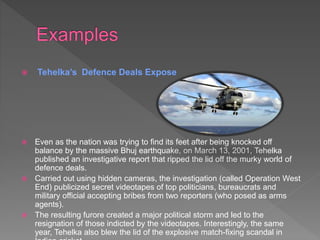
 Tehelka’s Defence Deals Expose
 Even as the nation was trying to find its feet after being knocked off
balance by the massive Bhuj earthquake, on March 13, 2001, Tehelka
published an investigative report that ripped the lid off the murky world of
defence deals.
 Carried out using hidden cameras, the investigation (called Operation West
End) publicized secret videotapes of top politicians, bureaucrats and
military official accepting bribes from two reporters (who posed as arms
agents).
 The resulting furore created a major political storm and led to the
resignation of those indicted by the videotapes. Interestingly, the same
year, Tehelka also blew the lid of the explosive match-fixing scandal in
 Investigative journalism is required to uncover
extraordinary stories that people might want to
hide and keep it as a secret. This type of
journalism will need all skills related to general
reporting.
 The primary job of the journalists is to gather
information and support them with proper
evidence if the news is challenged.
 It is advised to consult a lawyer if you want to
know about the legality of your work.
Investigative   journalism.pptx

Investigative journalism.pptx

  • 2.
     INTRODUCTION  CHARACTERISTICS 5 KEY INGREDIENTS TO INVESTIGATIVE JOURNALIM.  EXAMPLES.  CONCLUSION
  • 3.
     Investigation journalismis form of journalism in which reporters deeply investigate a single topic of interest , such as serious crimes , political corruption, or corporate wrongdoing.  A investigative journalism may spend months or years researching and preparing a report.
  • 4.
     Investigative journalismmeans the unveiling of matters that are concealed either deliberately by someone in a position of power ,or accidently ,behind a chaotic mass of facts and circumstances and the analysis and exposure of all relevant facts to the publics.
  • 5.
    1.Systematic in depthoriginal reporting-  You are taking your time and going through something in a systematic way to really understanding what is going on in the world. The work is original as well as in depth.
  • 6.
     2. Forminga hypothesis - Good investigative reporters tend to think like an honest public prosecutor or a good police detective.  They form a hypothesis about what is going on.  They use the scientific method. You form a theory and you find the facts to support it. This is one of the hardest parts in investigative journalism.
  • 7.
     3. Analysepublic documents and data - The third element of investigative journalism involves using lots of public records and public data.  Investigative reporters often talk a lot about following trails. Trails of people, money of institutions and accountability.  They do this through paper trails and collect as much as they can on the public record.  They got documents and data leaked to them and then they analyse that to follow the trails.
  • 8.
     4. Makingpublic things that are secret or hidden –  Investigative reporters are often dealing with secret information.  With things that people in power don’t want to come out- it shows they’ve abused their position or power in society.  Part of our job is finding those things and showing people what’s happening.
  • 9.
     5. Focuson social justice and accountability –  There has always been this calling in the investigative journalism profession to social accountability.  Their mission is to hold companies, institutions and individuals accountable. Investigative reporting has been called the journalism of outrage and for a good reason.  Investigative reporters believe in righting wrongs.
  • 10.
     Tehelka’s DefenceDeals Expose  Even as the nation was trying to find its feet after being knocked off balance by the massive Bhuj earthquake, on March 13, 2001, Tehelka published an investigative report that ripped the lid off the murky world of defence deals.  Carried out using hidden cameras, the investigation (called Operation West End) publicized secret videotapes of top politicians, bureaucrats and military official accepting bribes from two reporters (who posed as arms agents).  The resulting furore created a major political storm and led to the resignation of those indicted by the videotapes. Interestingly, the same year, Tehelka also blew the lid of the explosive match-fixing scandal in
  • 11.
     Investigative journalismis required to uncover extraordinary stories that people might want to hide and keep it as a secret. This type of journalism will need all skills related to general reporting.  The primary job of the journalists is to gather information and support them with proper evidence if the news is challenged.  It is advised to consult a lawyer if you want to know about the legality of your work.