Invertible Matrix and
Factorization
What is Invertible Matrix?
 A matrix A of dimension n x n is called invertible
 if and only if there exists another matrix B of the same dimension,
 such that AB = BA = I, where I is the identity matrix of the same order. Matrix
B is known as the inverse of matrix A.
 Inverse of matrix A is symbolically represented by A-1. Invertible matrix is also
known as a non-singular matrix or nondegenerate matrix.
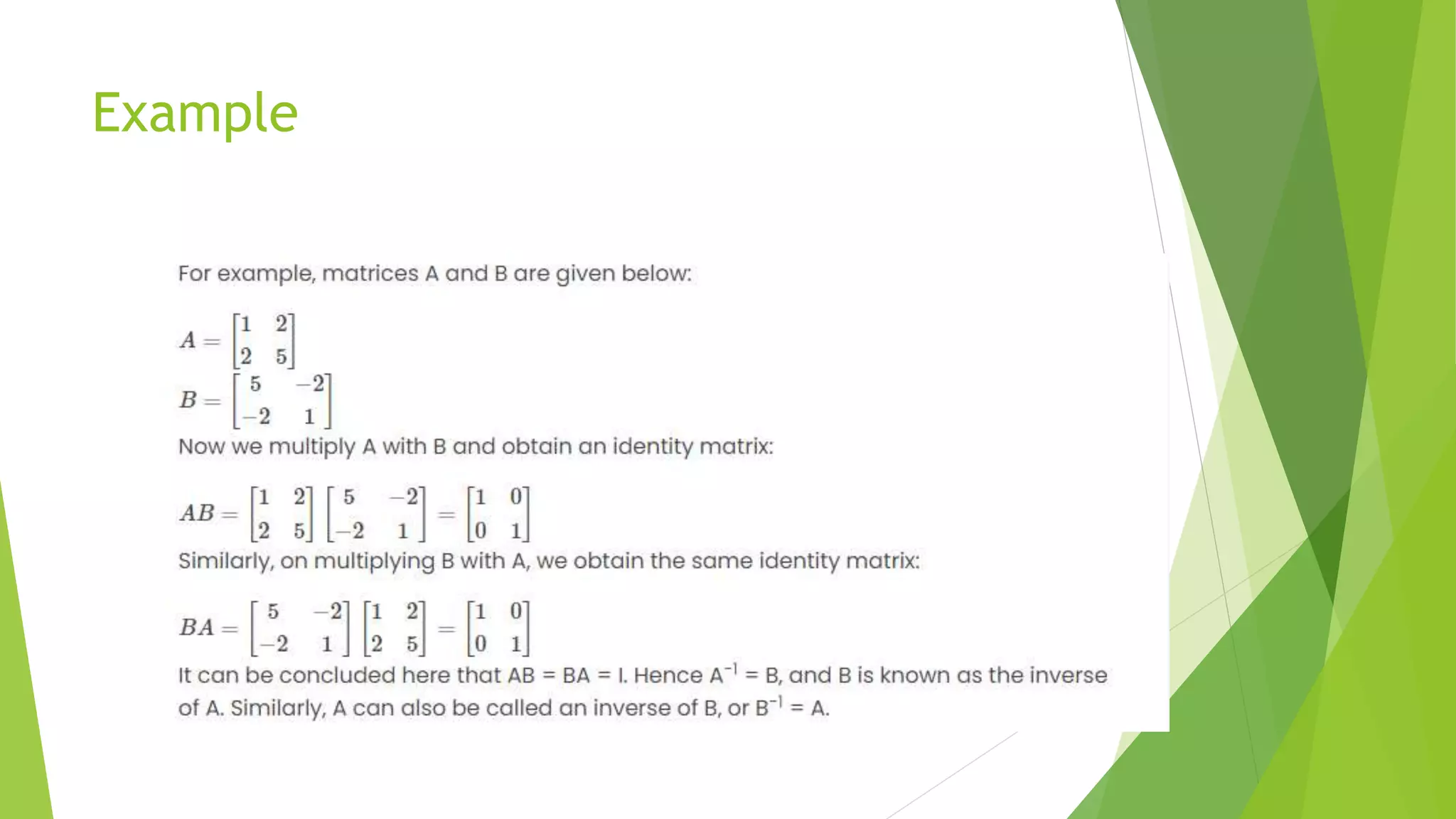
Example
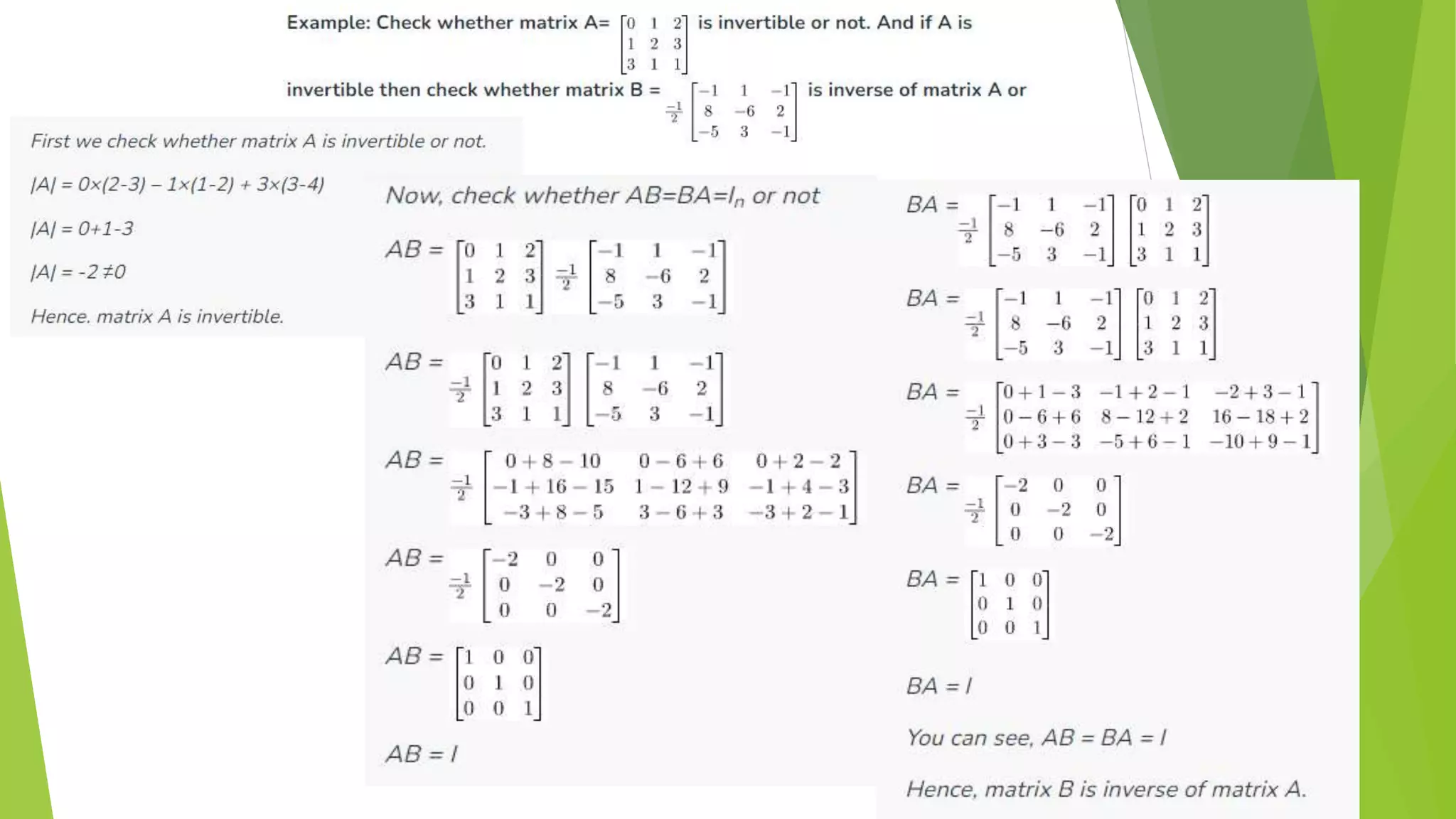
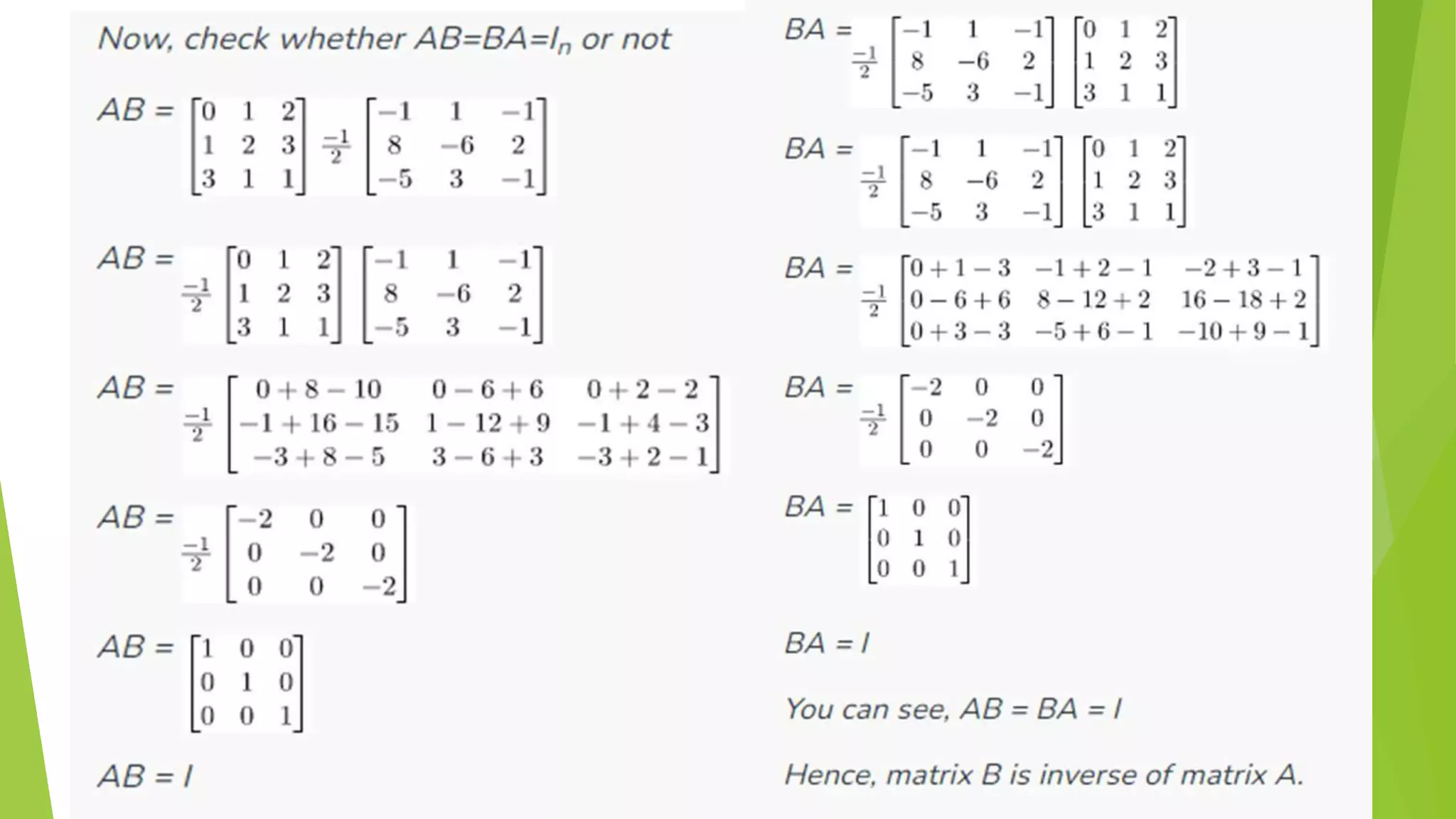
Example
Invertible Matrix Theorem
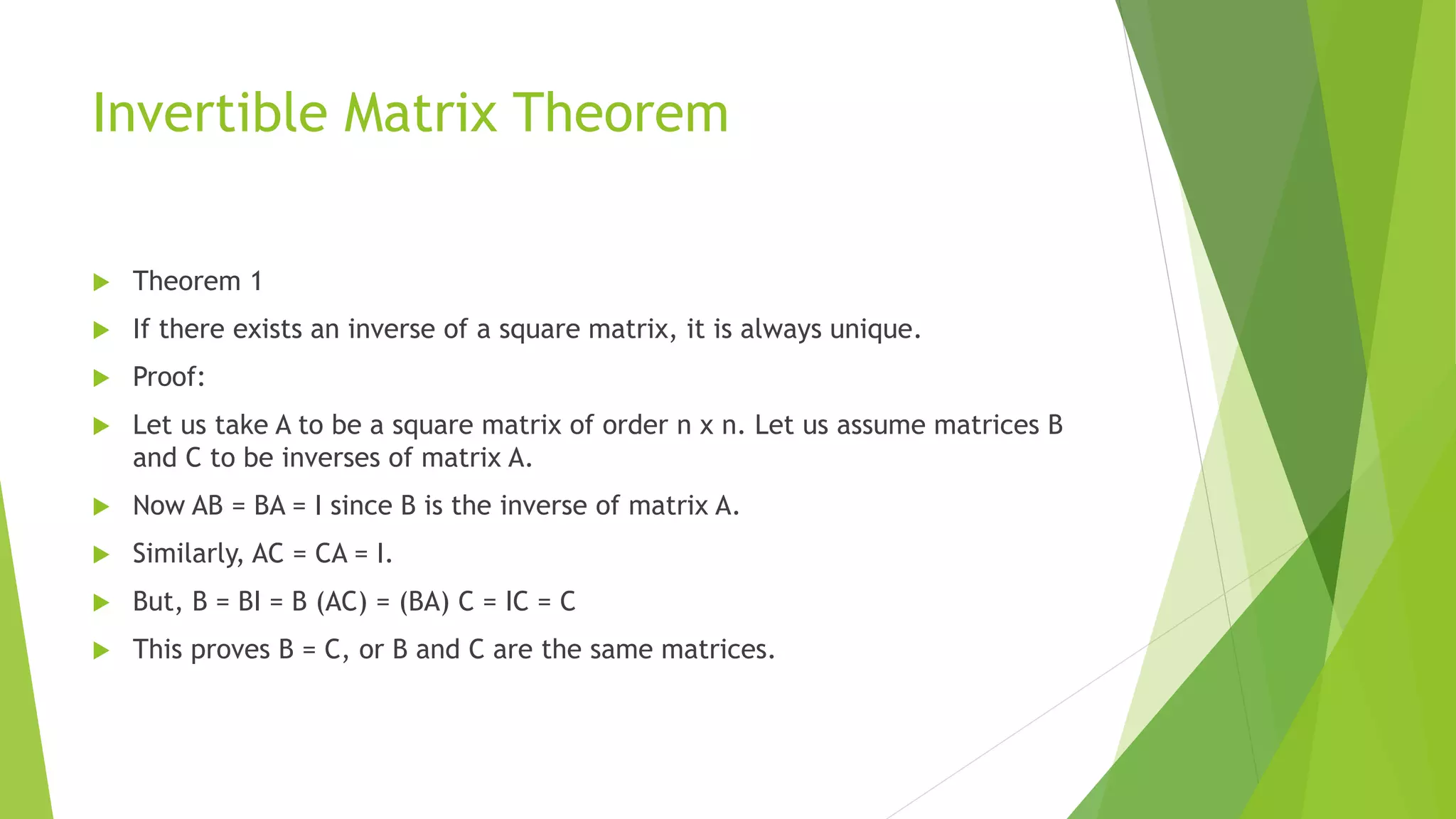
 Theorem 1
 If there exists an inverse of a square matrix, it is always unique.
 Proof:
 Let us take A to be a square matrix of order n x n. Let us assume matrices B
and C to be inverses of matrix A.
 Now AB = BA = I since B is the inverse of matrix A.
 Similarly, AC = CA = I.
 But, B = BI = B (AC) = (BA) C = IC = C
 This proves B = C, or B and C are the same matrices.
Applications of Invertible Matrix
 For many practical applications, the solution for the system of the equation
should be unique and it is necessary that the matrix involved should be
invertible. Such applications are:
 Simulations ( create real time like events like pilot training simulator
 MIMO Wireless Communication (antenna Technology Used in
Telecommunication
Properties
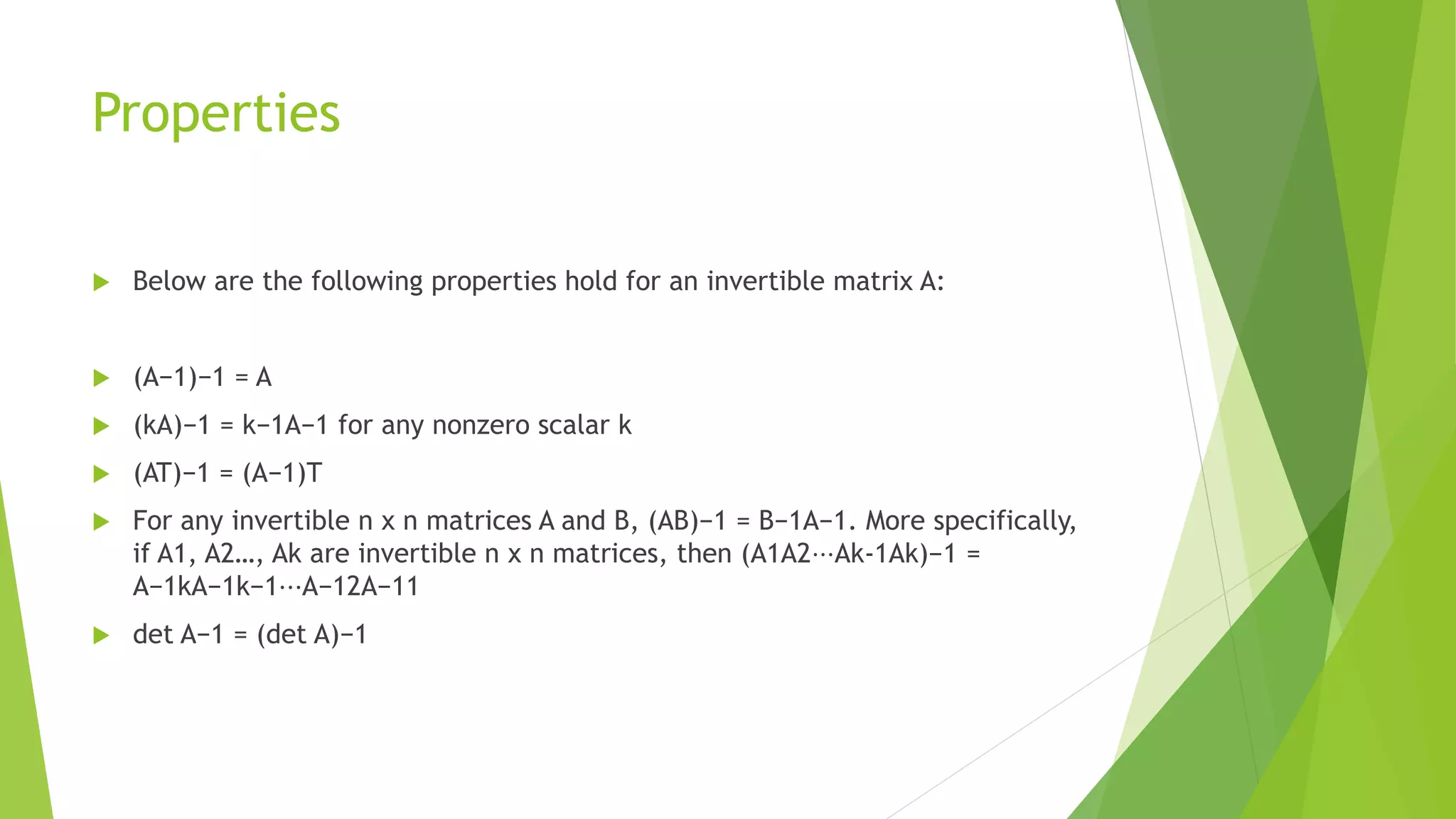
 Below are the following properties hold for an invertible matrix A:
 (A−1)−1 = A
 (kA)−1 = k−1A−1 for any nonzero scalar k
 (AT)−1 = (A−1)T
 For any invertible n x n matrices A and B, (AB)−1 = B−1A−1. More specifically,
if A1, A2…, Ak are invertible n x n matrices, then (A1A2⋅⋅⋅Ak-1Ak)−1 =
A−1kA−1k−1⋯A−12A−11
 det A−1 = (det A)−1
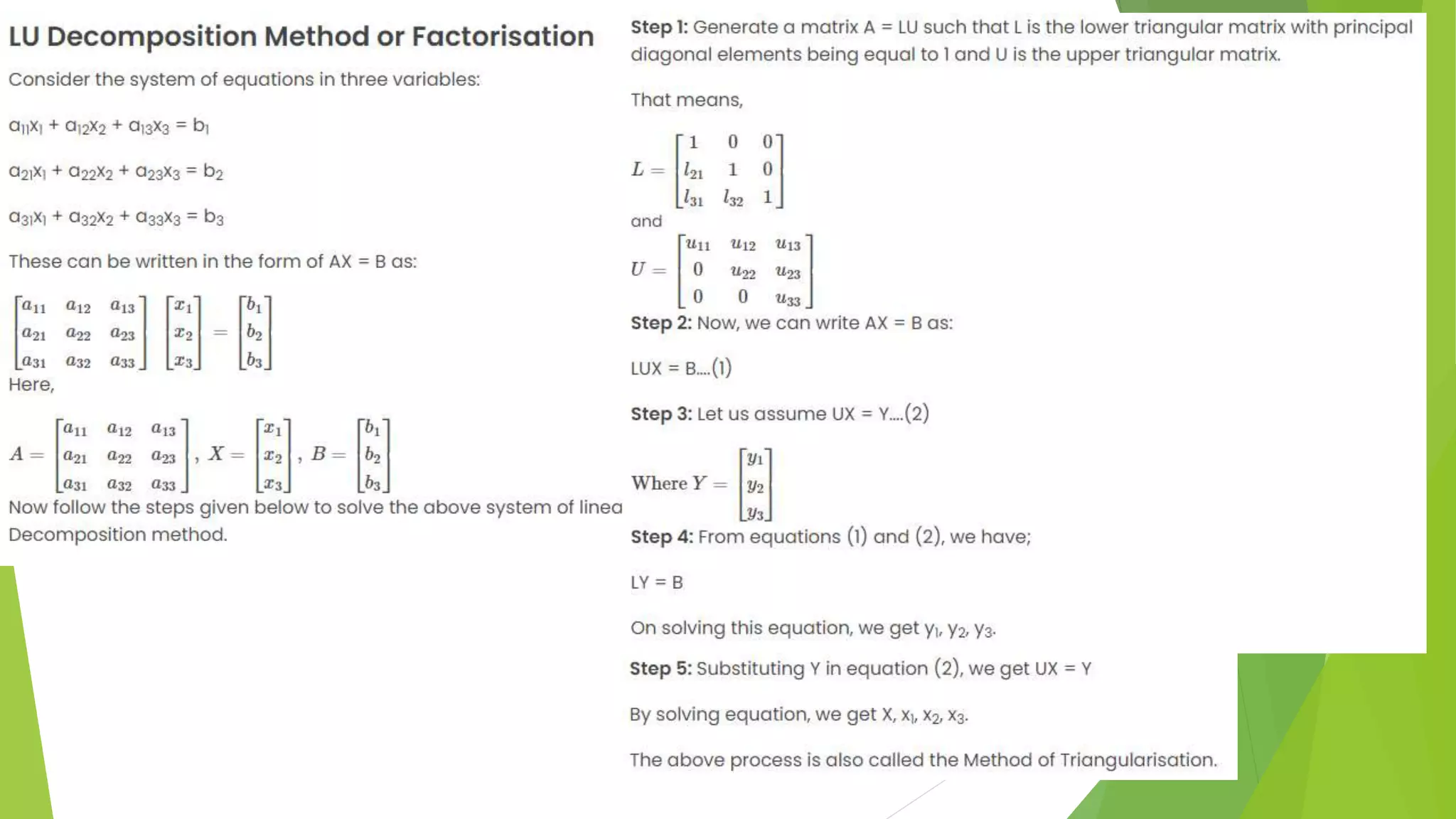
LU Decomposition
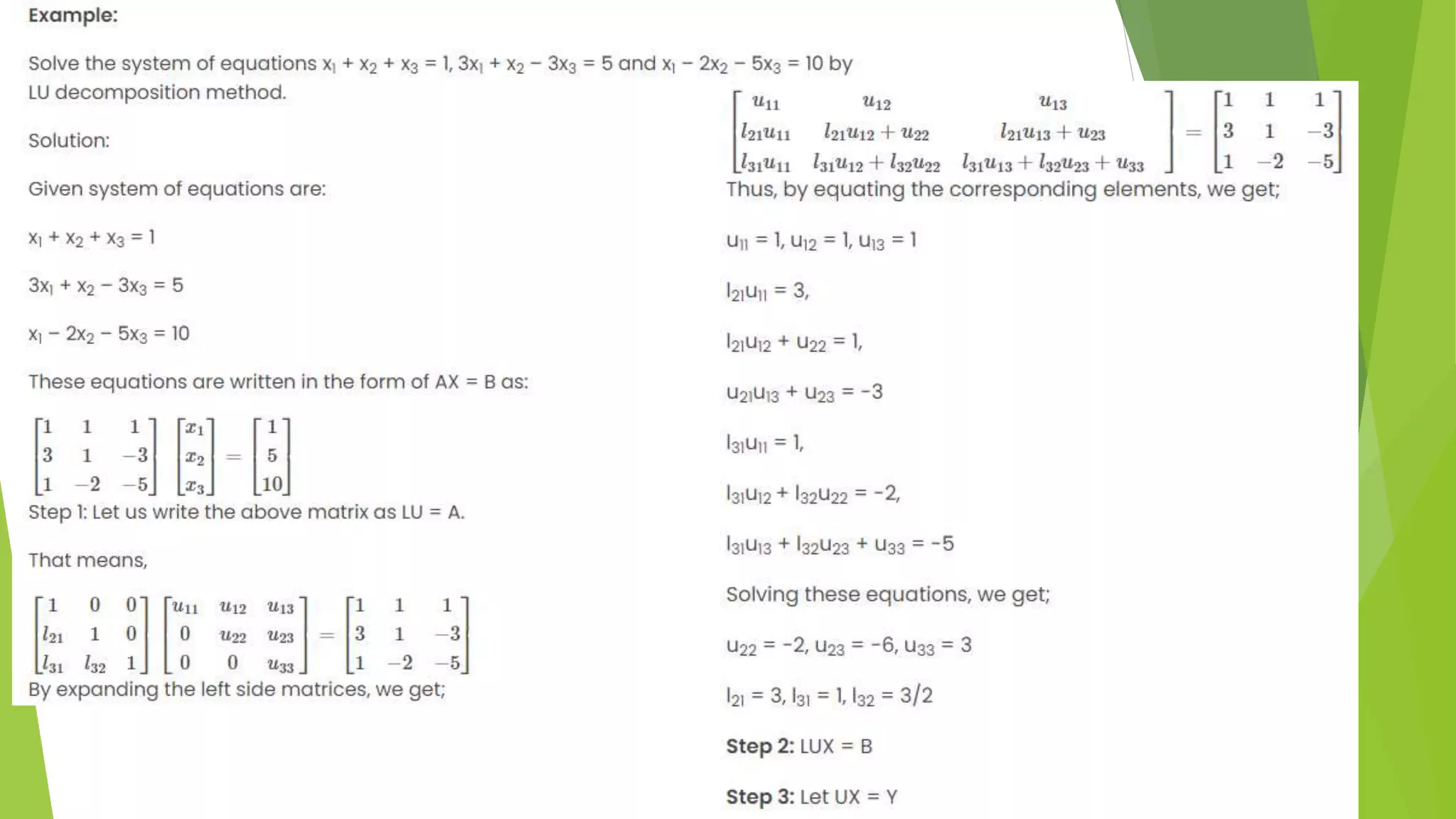
 In linear algebra, LU Decomposition, i.e., lower–upper (LU) decomposition or
factorization of a matrix, can be defined as the product of a lower and an
upper triangular matrices.
Invertible Matrix and Factorization.pptx

Invertible Matrix and Factorization.pptx

  • 1.
  • 2.
    What is InvertibleMatrix?  A matrix A of dimension n x n is called invertible  if and only if there exists another matrix B of the same dimension,  such that AB = BA = I, where I is the identity matrix of the same order. Matrix B is known as the inverse of matrix A.  Inverse of matrix A is symbolically represented by A-1. Invertible matrix is also known as a non-singular matrix or nondegenerate matrix.
  • 3.
  • 5.
  • 8.
    Invertible Matrix Theorem Theorem 1  If there exists an inverse of a square matrix, it is always unique.  Proof:  Let us take A to be a square matrix of order n x n. Let us assume matrices B and C to be inverses of matrix A.  Now AB = BA = I since B is the inverse of matrix A.  Similarly, AC = CA = I.  But, B = BI = B (AC) = (BA) C = IC = C  This proves B = C, or B and C are the same matrices.
  • 9.
    Applications of InvertibleMatrix  For many practical applications, the solution for the system of the equation should be unique and it is necessary that the matrix involved should be invertible. Such applications are:  Simulations ( create real time like events like pilot training simulator  MIMO Wireless Communication (antenna Technology Used in Telecommunication
  • 10.
    Properties  Below arethe following properties hold for an invertible matrix A:  (A−1)−1 = A  (kA)−1 = k−1A−1 for any nonzero scalar k  (AT)−1 = (A−1)T  For any invertible n x n matrices A and B, (AB)−1 = B−1A−1. More specifically, if A1, A2…, Ak are invertible n x n matrices, then (A1A2⋅⋅⋅Ak-1Ak)−1 = A−1kA−1k−1⋯A−12A−11  det A−1 = (det A)−1
  • 11.
    LU Decomposition  Inlinear algebra, LU Decomposition, i.e., lower–upper (LU) decomposition or factorization of a matrix, can be defined as the product of a lower and an upper triangular matrices.