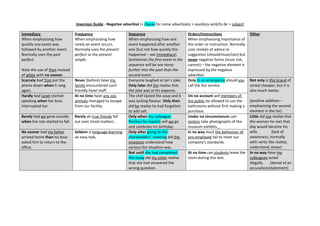
Inversion Guide - Negative adverbial (+ clause for some adverbials) + auxiliary verb/to be + subject
Immediacy
When emphasising how
quickly one event was
followed by another event.
Normally uses the past
perfect.
Note the use of than instead
of when with no sooner.
Frequency
When emphasising how
rarely an event occurs.
Normally uses the present
perfect or the present
simple.
Sequence
When emphasising how one
event happened after another
one (but not how quickly this
happened – see Immediacy).
Sometimes the first event in the
sequence will be one tense
further into the past than the
second event.
Orders/Instructions
When emphasising importance of
the order or instruction. Normally
uses modals of advice or
suggestion (should/must/can) but
never negative forms (must not,
cannot) – the negative element is
expressed by the negative
adverbial.
Other
Scarcely had Tom put the
phone down when it rang
again.
Never (before) have my
family encountered such
friendly hotel staff.
Everyone laughed at Ian’s joke.
Only later did Jim realise that
the joke was at his expense.
Only in an emergency should you
call the fire service.
Not only is this brand of
cereal cheaper, but it is
also much tastier.
(positive addition –
emphasising the second
element in the list)
Hardly had Janet started
speaking when her boss
interrupted her.
At no time have any zoo
animals managed to escape
from our facility.
The chef tasted the soup and it
was lacking flavour. Only then
did he realise he had forgotten
to add salt.
On no account will members of
the public be allowed to use the
bathrooms without first making a
purchase.
Barely had we gone outside
when the rain started to fall.
Rarely do true friends fall
out over trivial matters.
Only when my colleague
finishes his reports will we go
and celebrate his birthday.
Under no circumstances can
visitors take photographs of the
museum exhibits.
Little did Joe realise that
the woman he met that
day would become his
wife. (lack of
awareness; normally
with verbs like realise,
understand, know)
No sooner had my father
arrived home than his boss
asked him to return to the
office.
Seldom is language learning
an easy task.
Only after going to the
shareholders’ meeting did the
investors understand how
serious the situation was.
In no way must the behaviour of
any employee fail to meet our
company’s standards.
Not until she had completed
the essay did my sister realise
that she had answered the
wrong question.
At no time can students leave the
room during this test.
In no way have my
colleagues acted
illegally. (denial of an
accusation/statement)

Inversion table

  • 1.
    Inversion Guide -Negative adverbial (+ clause for some adverbials) + auxiliary verb/to be + subject Immediacy When emphasising how quickly one event was followed by another event. Normally uses the past perfect. Note the use of than instead of when with no sooner. Frequency When emphasising how rarely an event occurs. Normally uses the present perfect or the present simple. Sequence When emphasising how one event happened after another one (but not how quickly this happened – see Immediacy). Sometimes the first event in the sequence will be one tense further into the past than the second event. Orders/Instructions When emphasising importance of the order or instruction. Normally uses modals of advice or suggestion (should/must/can) but never negative forms (must not, cannot) – the negative element is expressed by the negative adverbial. Other Scarcely had Tom put the phone down when it rang again. Never (before) have my family encountered such friendly hotel staff. Everyone laughed at Ian’s joke. Only later did Jim realise that the joke was at his expense. Only in an emergency should you call the fire service. Not only is this brand of cereal cheaper, but it is also much tastier. (positive addition – emphasising the second element in the list) Hardly had Janet started speaking when her boss interrupted her. At no time have any zoo animals managed to escape from our facility. The chef tasted the soup and it was lacking flavour. Only then did he realise he had forgotten to add salt. On no account will members of the public be allowed to use the bathrooms without first making a purchase. Barely had we gone outside when the rain started to fall. Rarely do true friends fall out over trivial matters. Only when my colleague finishes his reports will we go and celebrate his birthday. Under no circumstances can visitors take photographs of the museum exhibits. Little did Joe realise that the woman he met that day would become his wife. (lack of awareness; normally with verbs like realise, understand, know) No sooner had my father arrived home than his boss asked him to return to the office. Seldom is language learning an easy task. Only after going to the shareholders’ meeting did the investors understand how serious the situation was. In no way must the behaviour of any employee fail to meet our company’s standards. Not until she had completed the essay did my sister realise that she had answered the wrong question. At no time can students leave the room during this test. In no way have my colleagues acted illegally. (denial of an accusation/statement)