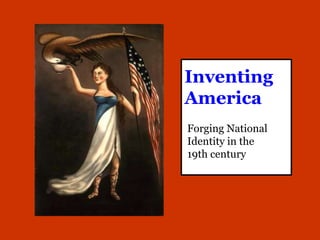
Inventing
America
Forging National
Identity in the
19th century
men fighting during Shays’s Rebellion


at first the United States was
an unstable nation . . .
–   Economic depression
–   Diplomatic weakness
–   Social unrest
–   Uncertain status of West


                        “We are going and doing wrong,
                        and therefore I look forward to
                        evils and calamities, but without
                        being able to guess at the
                        instrument, nature, or measure
                        of them.”
Louisiana Purchase
                             of 1803
                             vast new lands for
                             exploration and settlement


War of 1812
With victory over the
British, the United States
becomes an established
world power
 European powers rebuffed

 Territory doubled in size

 Hegemony on the continent secured!
Americans embarked upon a period of
dramatic growth and change. . .
•   Expansion of democracy
•   Population growth
•   Growth of cities
•   Industrial revolution
•   Westward expansion
•   Religion/reform
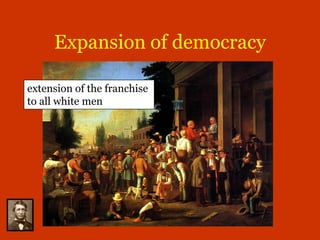
Expansion of democracy

extension of the franchise
to all white men
Population
Growth


      The population of the country was four
      times larger in 1850 than it was in 1815
       – Natural increase
       – Influx of immigrants
Growth of cities


    • By mid-century, 1 in 7 Americans was a city-dweller

    • 10 of the nations cities exceeded 50,000 people
Expansion of transportation and commerce

•   railroads
•   canals
•   steamboats
•   factories


        Industrial Revolution
Westward Expansion

             •   Louisiana Purchase 1803
             •   Lewis and Clark 1804-1806
             •   Mexican War 1846-1848
             •   Manifest Destiny
Religion and Reform
Second Great Awakening
inspired
• Abolition
• Women’s Rights
• Other social reforms
  – Prisons/Insane Asylums
  – Education
  – Temperance
  – Moral Reform
Observing this widespread
growth and change . . .
                       artists and intellectuals
                       begin wondering
       what            “what is an American?”
      makes us
      unique?
                       what
                     have we
                     become?


                 who are
                  we?
Cultural renaissance
• Ralph Waldo Emerson declares the intellectual
  independence of America

• Hudson river school explores the beauty of
  American landscapes

• Hawthorne, Melville, Poe, Whitman, develop
  new literary schools

• Henry David Thoreau takes to the woods
“Perhaps the time is
already come . . . when
the sluggard intellect of
this continent will look
from under its iron lids,
and fill the postponed
expectation of the
world with something
better than the
exertions of mechanical
skill. Our day of
dependence, our long
apprenticeship to the
learning of other lands,
draws to a close.”
Ralph Waldo Emerson, “The American Scholar”
“I celebrate myself;
And what I assume you shall assume;
For every atom belonging to me, as good
belongs to you.”
“No truer American existed than Thoreau”
          Ralph Waldo Emerson
“No truer American existed than Thoreau”
          Ralph Waldo Emerson

Inventing America

  • 1.
  • 2.
    men fighting duringShays’s Rebellion at first the United States was an unstable nation . . . – Economic depression – Diplomatic weakness – Social unrest – Uncertain status of West “We are going and doing wrong, and therefore I look forward to evils and calamities, but without being able to guess at the instrument, nature, or measure of them.”
  • 3.
    Louisiana Purchase of 1803 vast new lands for exploration and settlement War of 1812 With victory over the British, the United States becomes an established world power
  • 4.
     European powersrebuffed  Territory doubled in size  Hegemony on the continent secured!
  • 5.
    Americans embarked upona period of dramatic growth and change. . .
  • 6.
    Expansion of democracy • Population growth • Growth of cities • Industrial revolution • Westward expansion • Religion/reform
  • 7.
    Expansion of democracy extensionof the franchise to all white men
  • 8.
    Population Growth The population of the country was four times larger in 1850 than it was in 1815 – Natural increase – Influx of immigrants
  • 9.
    Growth of cities • By mid-century, 1 in 7 Americans was a city-dweller • 10 of the nations cities exceeded 50,000 people
  • 10.
    Expansion of transportationand commerce • railroads • canals • steamboats • factories Industrial Revolution
  • 11.
    Westward Expansion • Louisiana Purchase 1803 • Lewis and Clark 1804-1806 • Mexican War 1846-1848 • Manifest Destiny
  • 12.
    Religion and Reform SecondGreat Awakening inspired • Abolition • Women’s Rights • Other social reforms – Prisons/Insane Asylums – Education – Temperance – Moral Reform
  • 13.
    Observing this widespread growthand change . . . artists and intellectuals begin wondering what “what is an American?” makes us unique? what have we become? who are we?
  • 14.
    Cultural renaissance • RalphWaldo Emerson declares the intellectual independence of America • Hudson river school explores the beauty of American landscapes • Hawthorne, Melville, Poe, Whitman, develop new literary schools • Henry David Thoreau takes to the woods
  • 15.
    “Perhaps the timeis already come . . . when the sluggard intellect of this continent will look from under its iron lids, and fill the postponed expectation of the world with something better than the exertions of mechanical skill. Our day of dependence, our long apprenticeship to the learning of other lands, draws to a close.” Ralph Waldo Emerson, “The American Scholar”
  • 17.
    “I celebrate myself; Andwhat I assume you shall assume; For every atom belonging to me, as good belongs to you.”
  • 18.
    “No truer Americanexisted than Thoreau” Ralph Waldo Emerson
  • 19.
    “No truer Americanexisted than Thoreau” Ralph Waldo Emerson