Significant Events inUS History
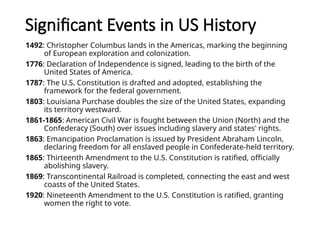
1492: Christopher Columbus lands in the Americas, marking the beginning
of European exploration and colonization.
1776: Declaration of Independence is signed, leading to the birth of the
United States of America.
1787: The U.S. Constitution is drafted and adopted, establishing the
framework for the federal government.
1803: Louisiana Purchase doubles the size of the United States, expanding
its territory westward.
1861-1865: American Civil War is fought between the Union (North) and the
Confederacy (South) over issues including slavery and states' rights.
1863: Emancipation Proclamation is issued by President Abraham Lincoln,
declaring freedom for all enslaved people in Confederate-held territory.
1865: Thirteenth Amendment to the U.S. Constitution is ratified, officially
abolishing slavery.
1869: Transcontinental Railroad is completed, connecting the east and west
coasts of the United States.
1920: Nineteenth Amendment to the U.S. Constitution is ratified, granting
women the right to vote.
3.
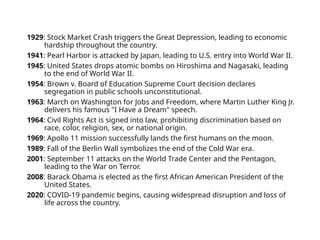
1929: Stock MarketCrash triggers the Great Depression, leading to economic
hardship throughout the country.
1941: Pearl Harbor is attacked by Japan, leading to U.S. entry into World War II.
1945: United States drops atomic bombs on Hiroshima and Nagasaki, leading
to the end of World War II.
1954: Brown v. Board of Education Supreme Court decision declares
segregation in public schools unconstitutional.
1963: March on Washington for Jobs and Freedom, where Martin Luther King Jr.
delivers his famous "I Have a Dream" speech.
1964: Civil Rights Act is signed into law, prohibiting discrimination based on
race, color, religion, sex, or national origin.
1969: Apollo 11 mission successfully lands the first humans on the moon.
1989: Fall of the Berlin Wall symbolizes the end of the Cold War era.
2001: September 11 attacks on the World Trade Center and the Pentagon,
leading to the War on Terror.
2008: Barack Obama is elected as the first African American President of the
United States.
2020: COVID-19 pandemic begins, causing widespread disruption and loss of
life across the country.
4.
”As long ashistory will be
written by hunters, lions shall
never be glorified”
"until the lions have their own historians the history
of hunt will always glorify the hunter”
5.
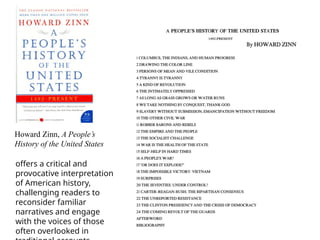
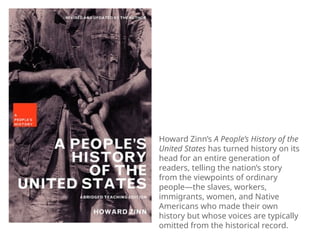
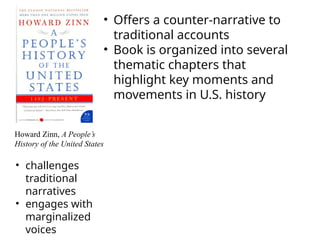
Howard Zinn, APeople’s
History of the United States
offers a critical and
provocative interpretation
of American history,
challenging readers to
reconsider familiar
narratives and engage
with the voices of those
often overlooked in
6.
Howard Zinn’s APeople’s History of the
United States has turned history on its
head for an entire generation of
readers, telling the nation’s story
from the viewpoints of ordinary
people—the slaves, workers,
immigrants, women, and Native
Americans who made their own
history but whose voices are typically
omitted from the historical record.
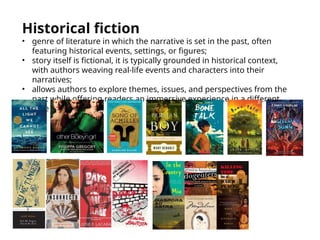
Historical fiction
• genreof literature in which the narrative is set in the past, often
featuring historical events, settings, or figures;
• story itself is fictional, it is typically grounded in historical context,
with authors weaving real-life events and characters into their
narratives;
• allows authors to explore themes, issues, and perspectives from the
past while offering readers an immersive experience in a different
time period
10.
Howard Zinn, APeople’s
History of the United States
• challenges
traditional
narratives
• engages with
marginalized
voices
• Offers a counter-narrative to
traditional accounts
• Book is organized into several
thematic chapters that
highlight key moments and
movements in U.S. history
11.
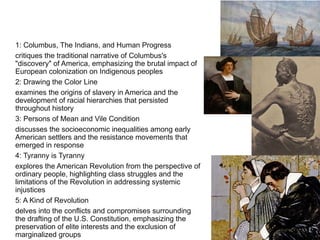
1: Columbus, TheIndians, and Human Progress
critiques the traditional narrative of Columbus's
"discovery" of America, emphasizing the brutal impact of
European colonization on Indigenous peoples
2: Drawing the Color Line
examines the origins of slavery in America and the
development of racial hierarchies that persisted
throughout history
3: Persons of Mean and Vile Condition
discusses the socioeconomic inequalities among early
American settlers and the resistance movements that
emerged in response
4: Tyranny is Tyranny
explores the American Revolution from the perspective of
ordinary people, highlighting class struggles and the
limitations of the Revolution in addressing systemic
injustices
5: A Kind of Revolution
delves into the conflicts and compromises surrounding
the drafting of the U.S. Constitution, emphasizing the
preservation of elite interests and the exclusion of
marginalized groups
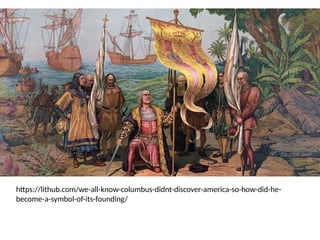
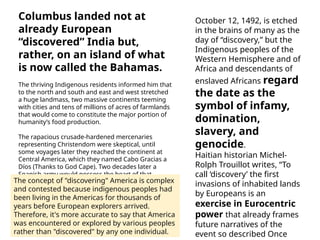
Columbus landed notat
already European
“discovered” India but,
rather, on an island of what
is now called the Bahamas.
The thriving Indigenous residents informed him that
to the north and south and east and west stretched
a huge landmass, two massive continents teeming
with cities and tens of millions of acres of farmlands
that would come to constitute the major portion of
humanity’s food production.
The rapacious crusade-hardened mercenaries
representing Christendom were skeptical, until
some voyages later they reached the continent at
Central America, which they named Cabo Gracias a
Díos (Thanks to God Cape). Two decades later a
Spanish army would possess the heart of that
landmass, destroying the most populated city in the
world at the time, Tenochtitlán, in the valley of
México.
October 12, 1492, is etched
in the brains of many as the
day of “discovery,” but the
Indigenous peoples of the
Western Hemisphere and of
Africa and descendants of
enslaved Africans regard
the date as the
symbol of infamy,
domination,
slavery, and
genocide.
Haitian historian Michel-
Rolph Trouillot writes, “To
call ‘discovery’ the first
invasions of inhabited lands
by Europeans is an
exercise in Eurocentric
power that already frames
future narratives of the
event so described Once
The concept of "discovering" America is complex
and contested because indigenous peoples had
been living in the Americas for thousands of
years before European explorers arrived.
Therefore, it's more accurate to say that America
was encountered or explored by various peoples
rather than "discovered" by any one individual.
14.
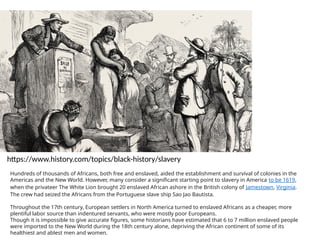
https://www.history.com/topics/black-history/slavery
Hundreds of thousandsof Africans, both free and enslaved, aided the establishment and survival of colonies in the
Americas and the New World. However, many consider a significant starting point to slavery in America to be 1619,
when the privateer The White Lion brought 20 enslaved African ashore in the British colony of Jamestown, Virginia.
The crew had seized the Africans from the Portuguese slave ship Sao Jao Bautista.
Throughout the 17th century, European settlers in North America turned to enslaved Africans as a cheaper, more
plentiful labor source than indentured servants, who were mostly poor Europeans.
Though it is impossible to give accurate figures, some historians have estimated that 6 to 7 million enslaved people
were imported to the New World during the 18th century alone, depriving the African continent of some of its
healthiest and ablest men and women.
15.
7: As LongAs Grass Grows or Water Runs
discusses the expansion of American territory and the displacement of
Indigenous peoples through policies of settler colonialism
8: We Take Nothing by Conquest, Thank God
examines the Mexican-American War and its consequences, including the
annexation of territory and the perpetuation of imperialist ambitions
9: Slavery Without Submission, Emancipation Without Freedom
explores the complexities of the abolitionist movement and the aftermath
of emancipation, including the persistence of racial discrimination
10: The Other Civil War
highlights the struggles of working-class Americans during the
Reconstruction era, including labor strikes and grassroots movements for
economic justice
11: Robber Barons and Rebels
examines the rise of industrial capitalism and the resistance movements it
sparked, including labor unions and populist uprising
12: The Empire and the People
discusses American imperialism and its impact on both domestic and
international affairs, from the Spanish-American War to interventions in
Latin America
16.
13: The SocialistChallenge
explores the rise of socialism in America and its contributions to progressive
reforms and labor rights movements
14: War is the Health of the State
examines the role of war in consolidating state power and stifling dissent, from
World War I to the Cold War era
15: Self-Help in Hard Times
discusses the grassroots organizing and mutual aid efforts that emerged
during the Great Depression, challenging prevailing narratives of individualism
and rugged individualism
16: A People’s War?
critiques the mythologizing of World War II as a "good war," highlighting the
injustices and contradictions within American society during wartime
17: "Or Does It Explode?":
examines the Civil Rights Movement and its legacy, emphasizing the ongoing
struggles for racial equality and social justice
18: The Impossible Victory: Vietnam
explores the Vietnam War and the anti-war movement, questioning the
morality and efficacy of U.S. foreign policy
19: Surprises
reflects on the enduring legacies of activism and resistance in American history,
emphasizing the power of ordinary people to effect change
17.
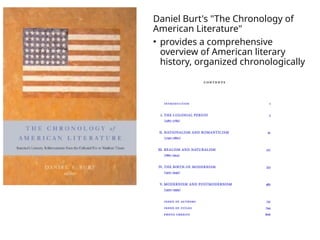
Daniel Burt's "TheChronology of
American Literature"
• provides a comprehensive
overview of American literary
history, organized chronologically
18.
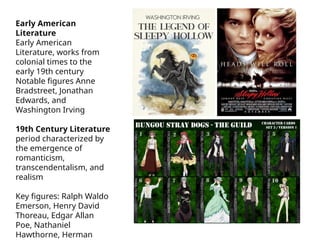
Early American
Literature
Early American
Literature,works from
colonial times to the
early 19th century
Notable figures Anne
Bradstreet, Jonathan
Edwards, and
Washington Irving
19th Century Literature
period characterized by
the emergence of
romanticism,
transcendentalism, and
realism
Key figures: Ralph Waldo
Emerson, Henry David
Thoreau, Edgar Allan
Poe, Nathaniel
Hawthorne, Herman
19.
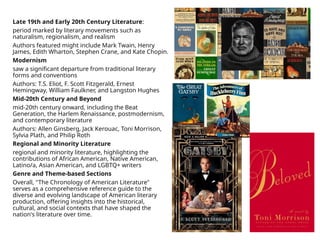
Late 19th andEarly 20th Century Literature:
period marked by literary movements such as
naturalism, regionalism, and realism
Authors featured might include Mark Twain, Henry
James, Edith Wharton, Stephen Crane, and Kate Chopin.
Modernism
saw a significant departure from traditional literary
forms and conventions
Authors: T.S. Eliot, F. Scott Fitzgerald, Ernest
Hemingway, William Faulkner, and Langston Hughes
Mid-20th Century and Beyond
mid-20th century onward, including the Beat
Generation, the Harlem Renaissance, postmodernism,
and contemporary literature
Authors: Allen Ginsberg, Jack Kerouac, Toni Morrison,
Sylvia Plath, and Philip Roth
Regional and Minority Literature
regional and minority literature, highlighting the
contributions of African American, Native American,
Latino/a, Asian American, and LGBTQ+ writers
Genre and Theme-based Sections
Overall, "The Chronology of American Literature"
serves as a comprehensive reference guide to the
diverse and evolving landscape of American literary
production, offering insights into the historical,
cultural, and social contexts that have shaped the
nation's literature over time.
20.
End
To ponder:
What eventsin US History are also considered
significant in Philippine historicization?
What are similarities in American and Philippine
literary history?