









Fifth Grade
Social Studies
   by Ms. Engelhard
        5/15/10
Native Americans
 Unit - August/
   September
Native Americans
    Keynotes
Native Americans
History Pockets
If You Lived Series:
 Native Americans
Watch Pocahontas
to Understand the
   Inaccuracies
Read Pocahontas:
  Young Peacemaker
(Childhood of Famous
  Americans Series)
Explorers Unit -
September/October
iWeb
English


• John Cabot
• Henry Hudson
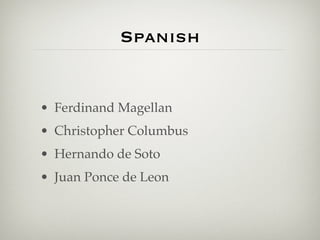
Spanish


• Ferdinand Magellan
• Christopher Columbus
• Hernando de Soto
• Juan Ponce de Leon
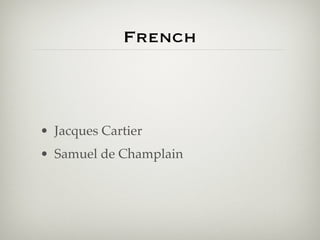
French


• Jacques Cartier
• Samuel de Champlain
Italian


• Amerigo Vespucci
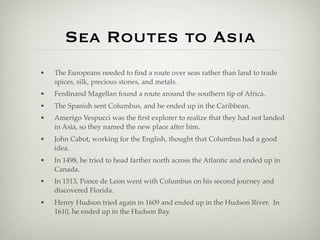
Sea Routes to Asia
•   The Europeans needed to find a route over seas rather than land to trade
    spices, silk, precious stones, and metals.
•   Ferdinand Magellan found a route around the southern tip of Africa.
•   The Spanish sent Columbus, and he ended up in the Caribbean.
•   Amerigo Vespucci was the first explorer to realize that they had not landed
    in Asia, so they named the new place after him.
•   John Cabot, working for the English, thought that Columbus had a good
    idea.
•   In 1498, he tried to head farther north across the Atlantic and ended up in
    Canada.
•   In 1513, Ponce de Leon went with Columbus on his second journey and
    discovered Florida.
•   Henry Hudson tried again in 1609 and ended up in the Hudson River. In
    1610, he ended up in the Hudson Bay.
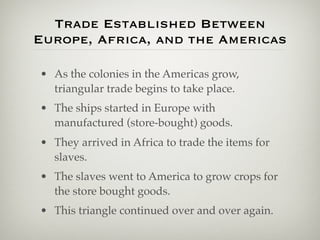
Trade Established Between
Europe, Africa, and the Americas

• As the colonies in the Americas grow,
  triangular trade begins to take place.
• The ships started in Europe with
  manufactured (store-bought) goods.
• They arrived in Africa to trade the items for
  slaves.
• The slaves went to America to grow crops for
  the store bought goods.
• This triangle continued over and over again.
Maps


• Natural Resources
• Major World Features
Economics


• Competition, markets, and prices
  influence behavior
Henry Hudson
Children’s Book:
Beyond the Sea of
       Ice
History Pockets
 from Evan Moor:
Explorers of North
      America
Increased Power of
  European Countries
• Spanish - Columbus in the Caribbean in
  1492
• Spanish - Hernan de Soto in Florida in
  1536
• French - Samuel de Champlain in Quebec
  in 1605
• English - Jamestown in 1607
• English - Plymouth in 1620
Colonial America -
October/November
Why Would You Come to
   the New World?


• Religious Freedom
• Desire for Land
• Economic Opportunity
• A New Life
Economics


• Costs of Coming to the New World
• Earn income by selling their labor to
  businesses or government
First American
• John Smith - Virginia
• William Penn - Pennsylvania &
  Delaware
• Lord Baltimore - Maryland
• Roger Williams - Rhode Island
• Anne Hutchinson - Massachusetts
• James Ogelthorpe - Georgia
The Development of
  American Democracy


• Geography
• Economy
• Religion
• Colonial Government
Government Documents


• Mayflower Compact
Maps


• Historical Maps
• Three Colonial Regions
• Boundary Change
Economics


• Specialization in three colonial regions
  improves standards of living
• Voluntary Exchange is helpful
If You Lived... Series
        Keynote

• If You Lived in Colonial Times
• If You Sailed on the Mayflower in 1620
• If You Lived in Williamsburg in
  Colonial Days
• If You Were at the First Thanksgiving
History Pockets
from Evan Moor:
Colonial America
American
   Revolution -
November/December
Events that Led to the
 American Revolution

• French and Indian War
• Proclamation of 1763
• Tea Act
• Stamp Act
• Boston Massacre
• Intolerable Acts
Government Documents


• Declaration of Independence
World Revolutions

• Characteristics of a Rebellion
• Revolution on a Society
• Causes and Outcomes of American
  Revolution in comparison with France,
  Haiti, Mexico, South America, and
  Russia
Events of the
   Revolutionary War

• Declaration of Independence
• Lexington and Concord
• Saratoga
• Aid from France
• Surrender at Yorktown
Individuals of the
       Revolution

• Benjamin Franklin
• Thomas Jefferson
• George Washington
• Patrick Henry
• Thomas Paine
• King George III
The Start of a
Nation - December/
     January
The Start of a Nation


• Constitutional Convention
• George Washington’s Presidency
• Political Parties
Government Documents


• Articles of Confederation
• United States Constitution - limits
  central government
• Bill of Rights
• Federalists vs. Anti-Federalists
Economics

• Function of banks - checking, savings,
  loans
• Function of government services
• Function of private business
• Personal Finance - cash, check, money
  order, debit card, credit card
Founding Fathers
• John Adams
• Benjamin Franklin
• Alexander Hamilton
• Thomas Jefferson
• James Madison
• John Marshall
• George Washington
Structure & Functions
   of Government


• Town Meetings and Representative
  Assemblies in Colonial Government
• Checks & Balances of Three Branches
  (Andrew Jackson’s Impeachment)
• Bill Becomes a Law
State Geography -
     January
Maps
• Contour (Topographical)
• Longitude and Latitude
• US Geographic Features (Physical and
  Political)
• Identify States
• Major World Features
• Construct Maps, Charts, and Graphs
Westward
Expansion -
 February
19th Century
         Presidents
• Thomas Jefferson - Louisiana Purchase;
  exploration of Lewis and Clark
• James Madison - War of 1812
• James Monroe - The Monroe Doctrine
• Andrew Jackson - Nationalism and
  Sectionalism; Trail of Tears
• James Polk - Mexican-American War;
  discovery of gold in CA
Read Sacagawea:
 American Pathfinder
(Childhood of Famous
  Americans Series)
Economics


• Trade improves Growth
Maps


• Boundary Change
Manifest Destiny
• Perspectives
 • Native Americans
 • Settlers
 • Spanish
 • US Government
 • Prospectors
• Migration Routes
Maps

• Population Density
• Regions
  • West
  • Midwest
  • Northeast
  • Southeast
  • Southwest
• Boundary Change During Mexican-American War
Industrial
Revolution - March
Industrial Revolution


• Manufacturing
• Textiles
• Transportation Improvements
• Other Innovations
Economics


• Entrepreneurs take risks to develop
  new goods and services
Civil War - april/
       May
Abolitionists


• Frederick Douglass
• Harriet Tubman
• William Lloyd Garrison
• Sojourner Truth
Causes of the Civil War


• Abolitionists and the Underground
  Railroad
• Separation between the North and
  South
• Westward Expansion
Maps


• Historical Maps
• North and South During Civil War
Structure & Functions
   of Government


• Dred Scott Decision
• State vs. Federal Rights (slavery)
Important Events of the
       Civil War


• Firing on Ft. Sumter
• Major Battles
• Emancipation Proclamation
• Surrender at Appomattox
Citizenship - May
Citizenship
• Ways Individuals Can Contribute to a
  School or Community
• Character Traits Important to
  Constitutional Democracy
• Involved in the government process
  (student government; political decision
  making; analyzing issues; petitioning
  public officials)
Propose a Bill to a
   Senator or
  Congressman

Fifth Grade Social Studies Outline