1
Physical Mechanism of Convection
• Conduction and convection are similar in that both mechanisms
require the presence of a material medium.
• But they are different in that convection requires the presence of
fluid motion.
• Heat transfer through a liquid or gas can be by conduction or
convection, depending on the presence of any bulk fluid motion.
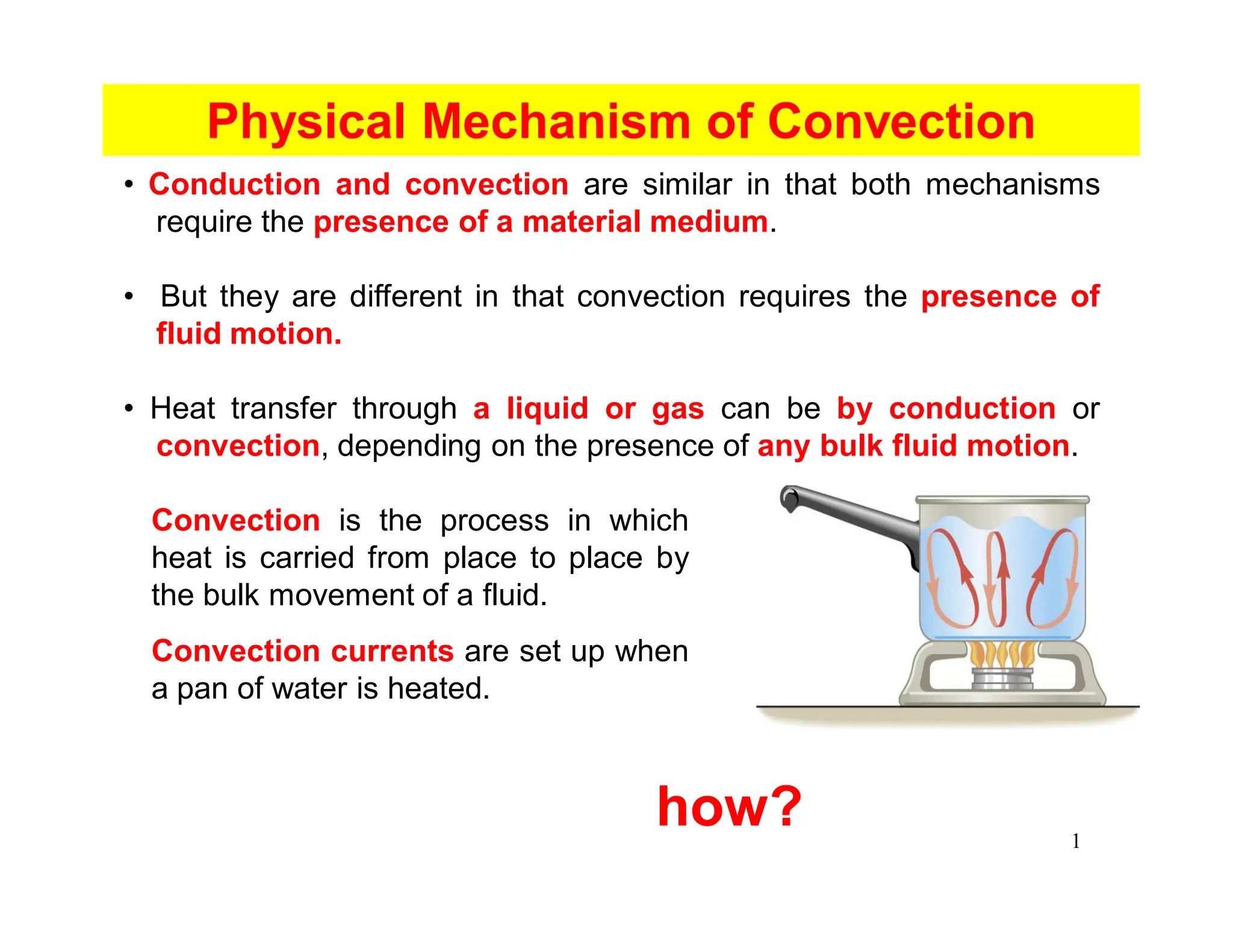
Convection is the process in which
heat is carried from place to place by
the bulk movement of a fluid.
Convection currents are set up when
a pan of water is heated.
how?
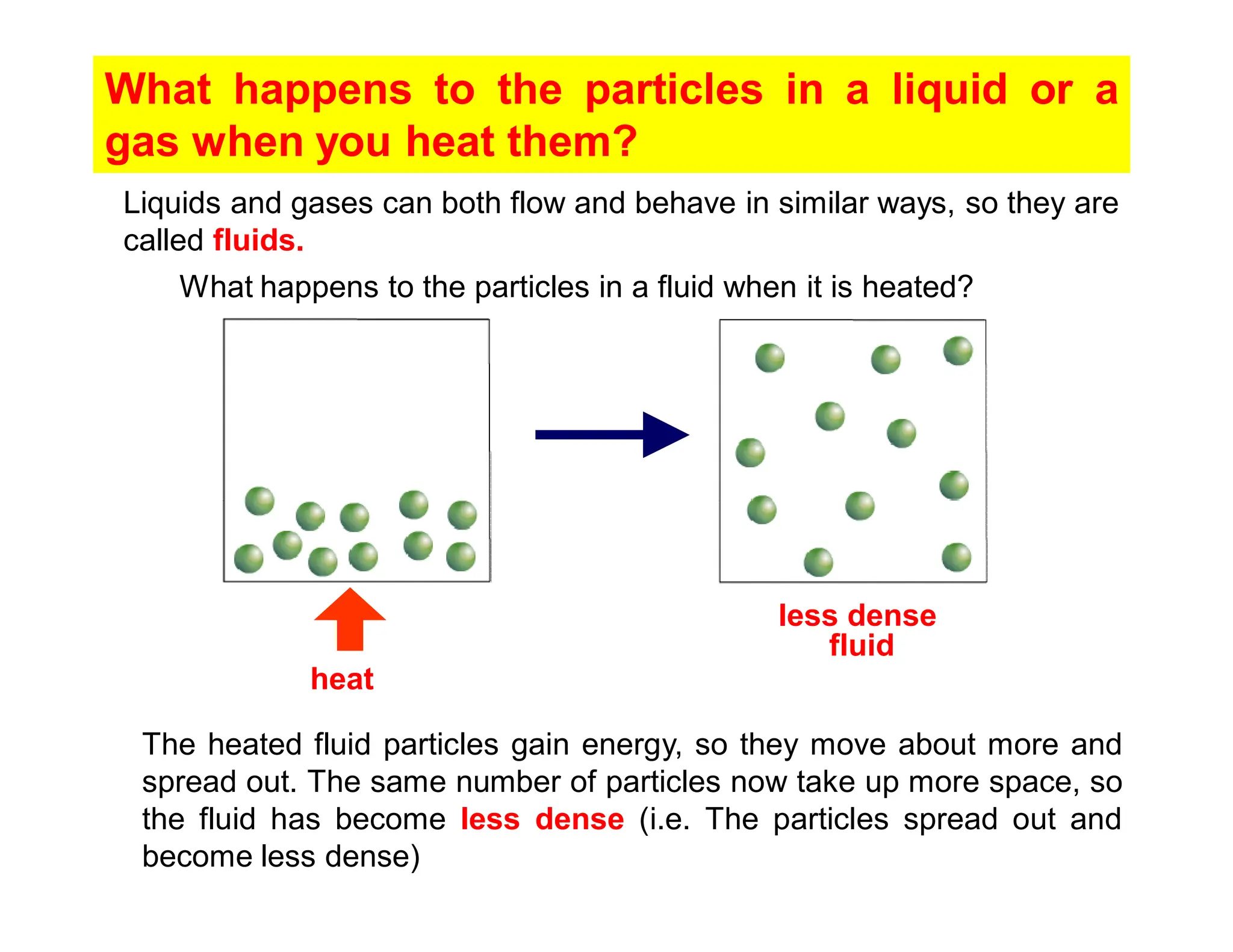
Liquids and gases can both flow and behave in similar ways, so they are
called fluids.
heat
less dense
fluid
The heated fluid particles gain energy, so they move about more and
spread out. The same number of particles now take up more space, so
the fluid has become less dense (i.e. The particles spread out and
become less dense)
What happens to the particles in a fluid when it is heated?
What happens to the particles in a liquid or a
gas when you heat them?
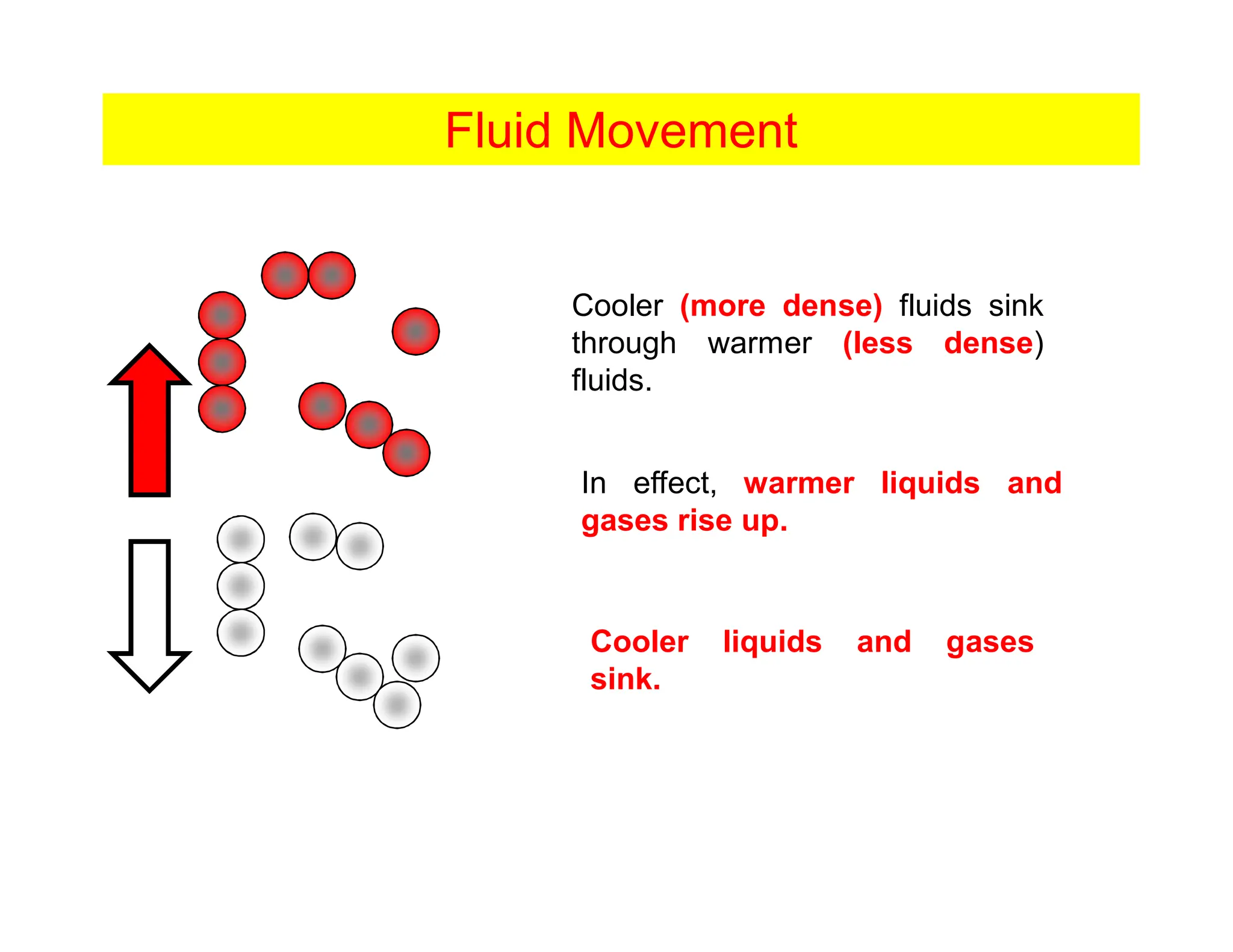
Cooler (more dense) fluids sink
through warmer (less dense)
fluids.
In effect, warmer liquids and
gases rise up.
Cooler liquids and gases
sink.
Fluid Movement
4
Convection
Convection is a process involving mass movement of fluids.
The mechanism of convection is the transfer of heat energy by actual
physical movement of fluid molecule from one place to another in
which there exists a temperature gradient.
This mode of heat transfer is comprised of two mechanism
• energy transfer due to random molecular motion (diffusion)
• and bulk motion of fluid
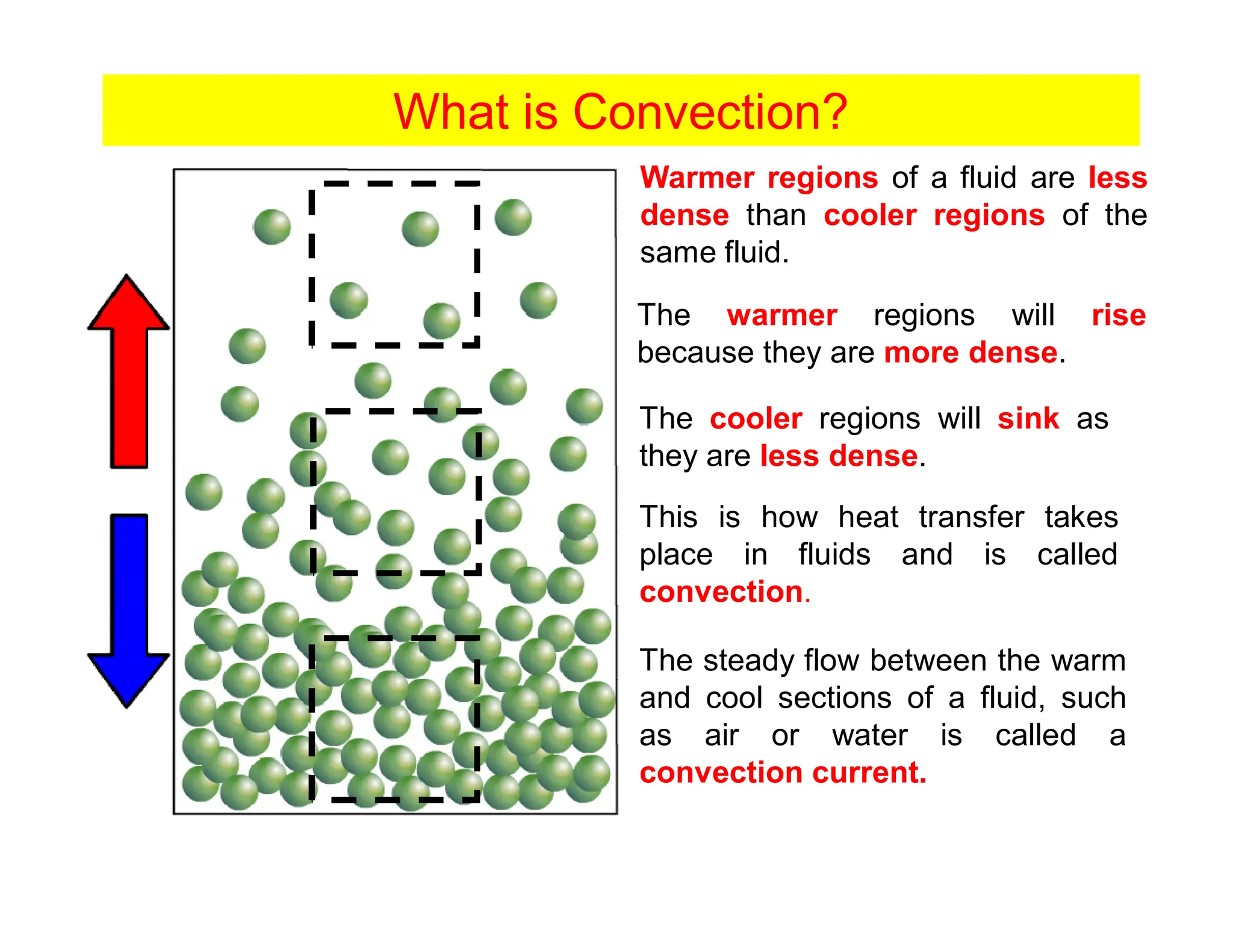
Warmer regions of a fluid are less
dense than cooler regions of the
same fluid.
The warmer regions will rise
because they are more dense.
The cooler regions will sink as
they are less dense.
This is how heat transfer takes
place in fluids and is called
convection.
The steady flow between the warm
and cool sections of a fluid, such
as air or water is called a
convection current.
What is Convection?
6
Conceptual Example 1. Hot Water
Baseboard Heating and Refrigerators
7
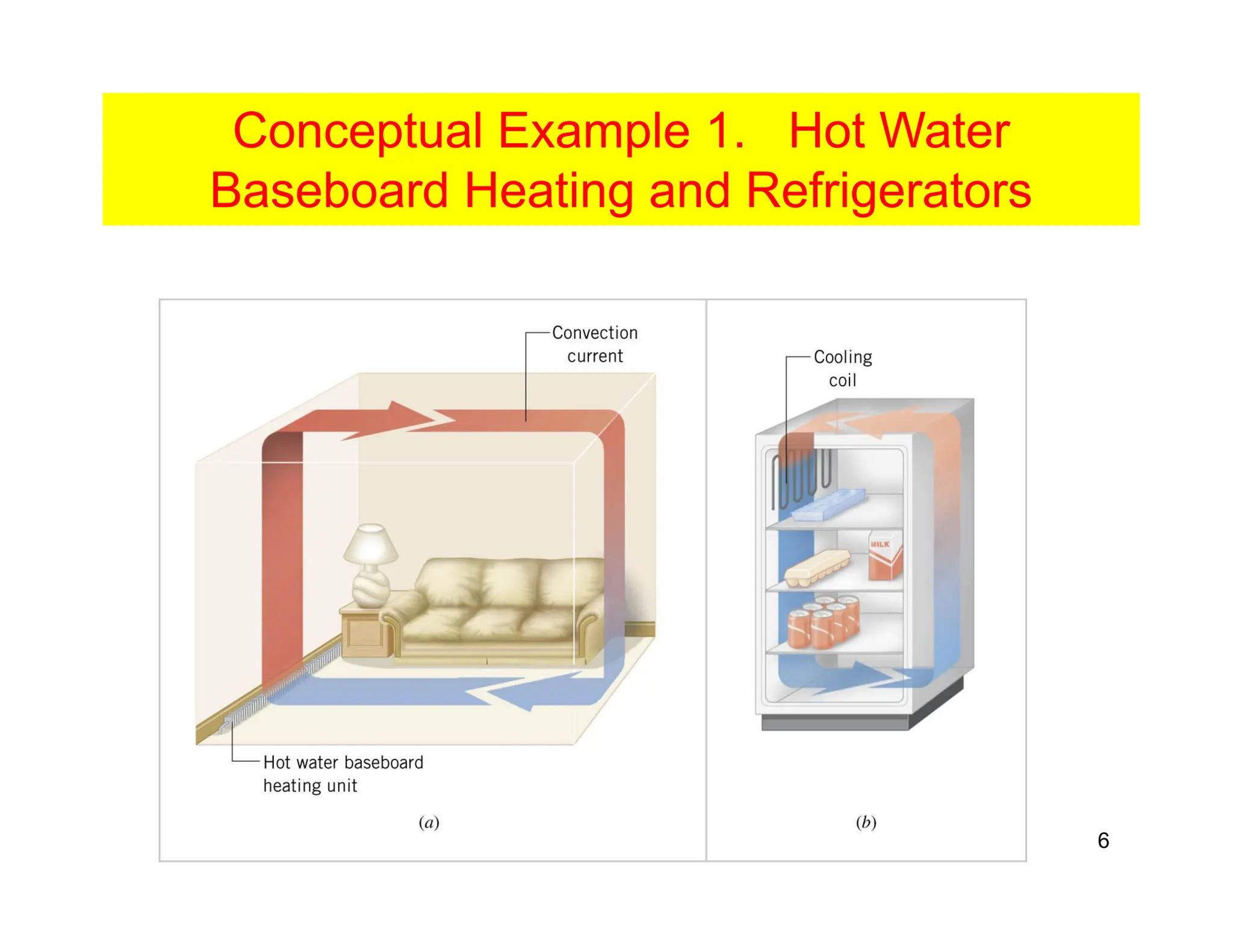
Hot water baseboard heating units are frequently used in homes,
where they are mounted on the wall next to the floor.
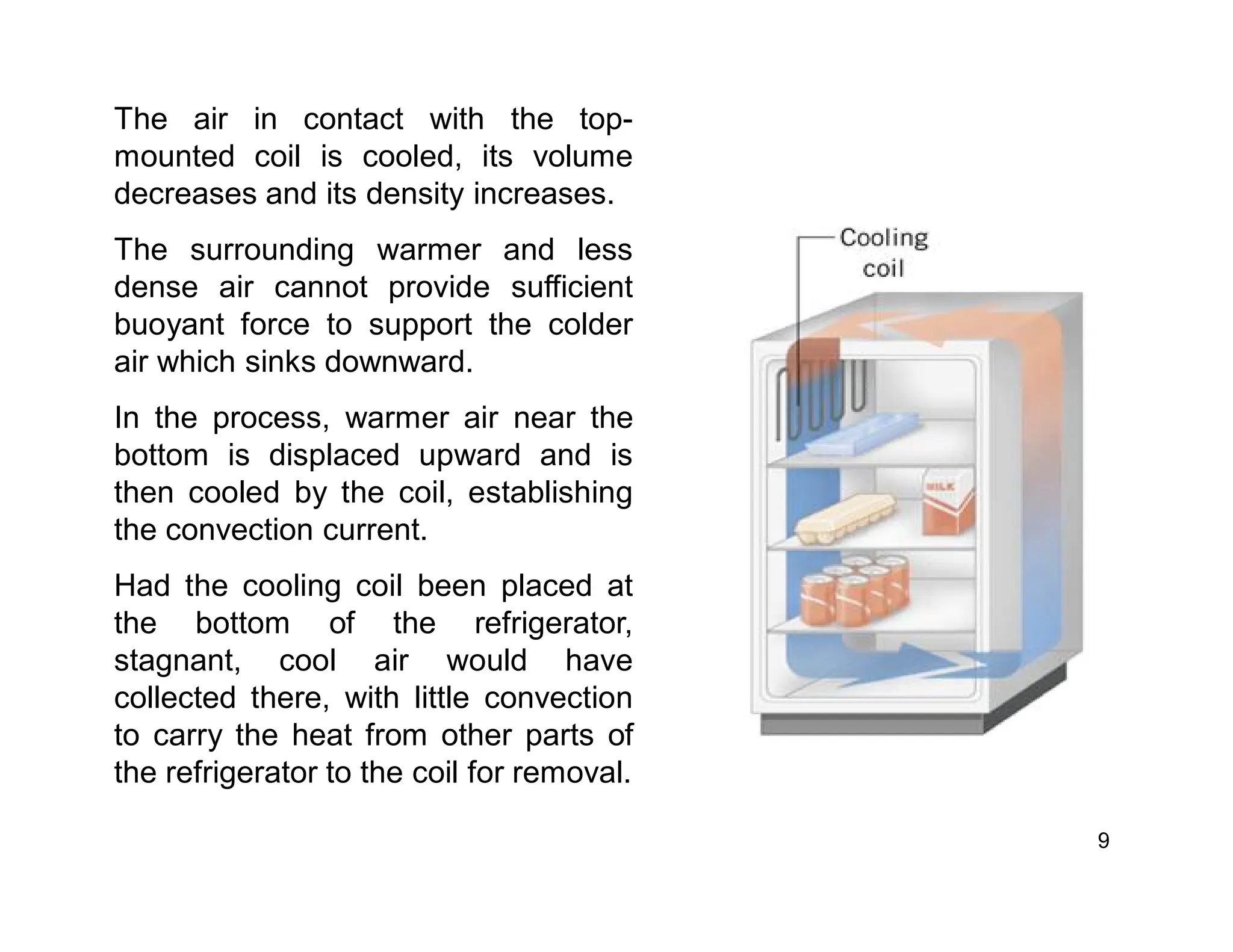
In contrast, the cooling coil in a refrigerator is mounted near the
top of the refrigerator.
The locations for these heating and cooling devices are different, yet
each location is designed to maximize the production of
convection currents.
How?
8
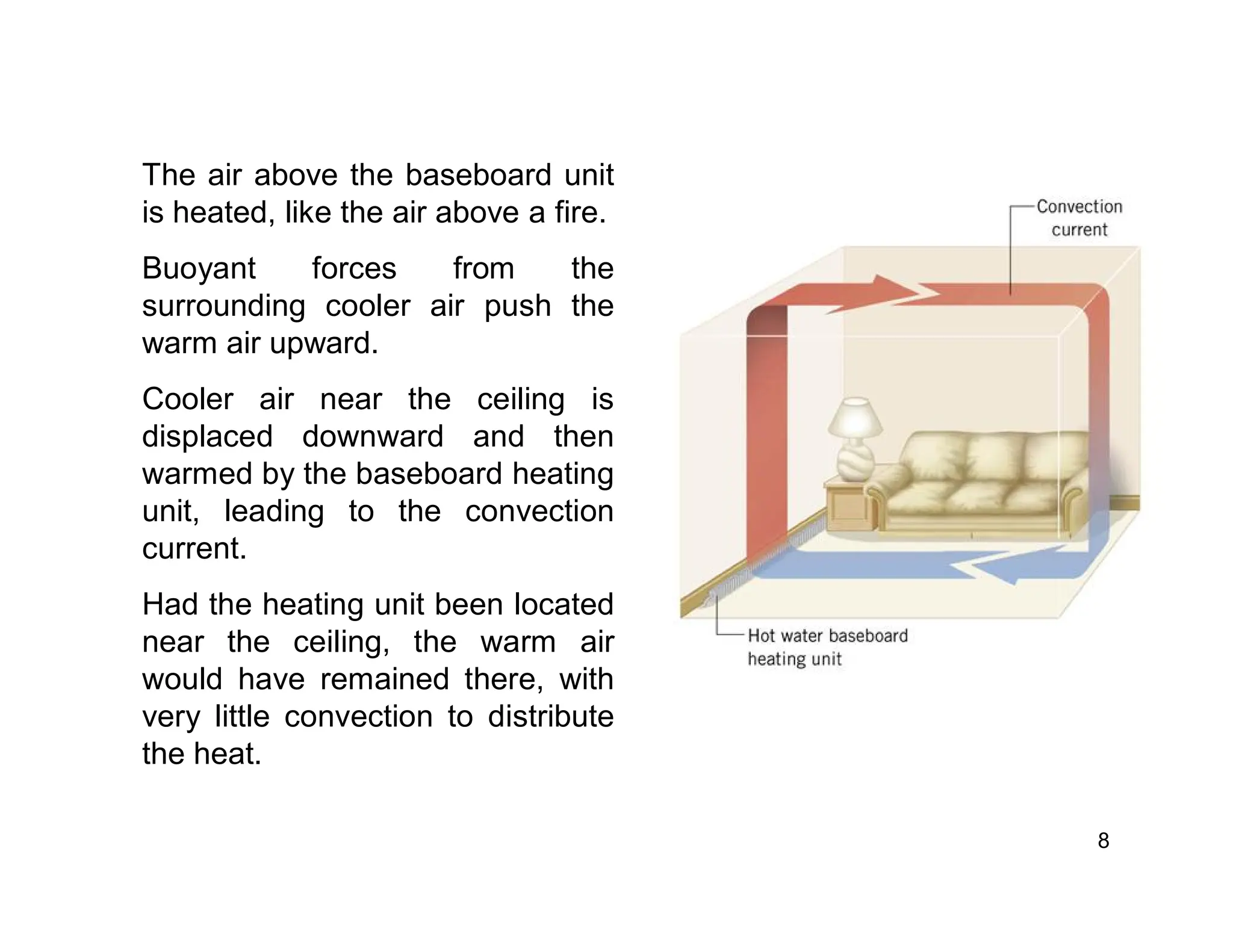
The air above the baseboard unit
is heated, like the air above a fire.
Buoyant forces from the
surrounding cooler air push the
warm air upward.
Cooler air near the ceiling is
displaced downward and then
warmed by the baseboard heating
unit, leading to the convection
current.
Had the heating unit been located
near the ceiling, the warm air
would have remained there, with
very little convection to distribute
the heat.
9
The air in contact with the top-
mounted coil is cooled, its volume
decreases and its density increases.
The surrounding warmer and less
dense air cannot provide sufficient
buoyant force to support the colder
air which sinks downward.
In the process, warmer air near the
bottom is displaced upward and is
then cooled by the coil, establishing
the convection current.
Had the cooling coil been placed at
the bottom of the refrigerator,
stagnant, cool air would have
collected there, with little convection
to carry the heat from other parts of
the refrigerator to the coil for removal.
10
Convection
Heat transfer engineering is the predication of the rate of heat transfer
between a fluid and solid boundary surface.
This take place in various steps.
Suppose the solid surface is at higher temperature than the fluid.
First, heat will flow by conduction from the surface to adjacent particles
of fluid.
The energy thus transferred will serve to increase the temperature and
the internal energy of these fluid particles.
Thus the fluid particles will move to a region of cold fluid (lower
temperature in the fluid) where they will mix with and transfer a part of
their energy to other fluid particles.
The energy is actually stored in the fluid particle and due to mass
motion of fluid particles, it is also carried away.
Thus the heat transfer between a solid surface and fluid is due to
conduction as well as convection.
11
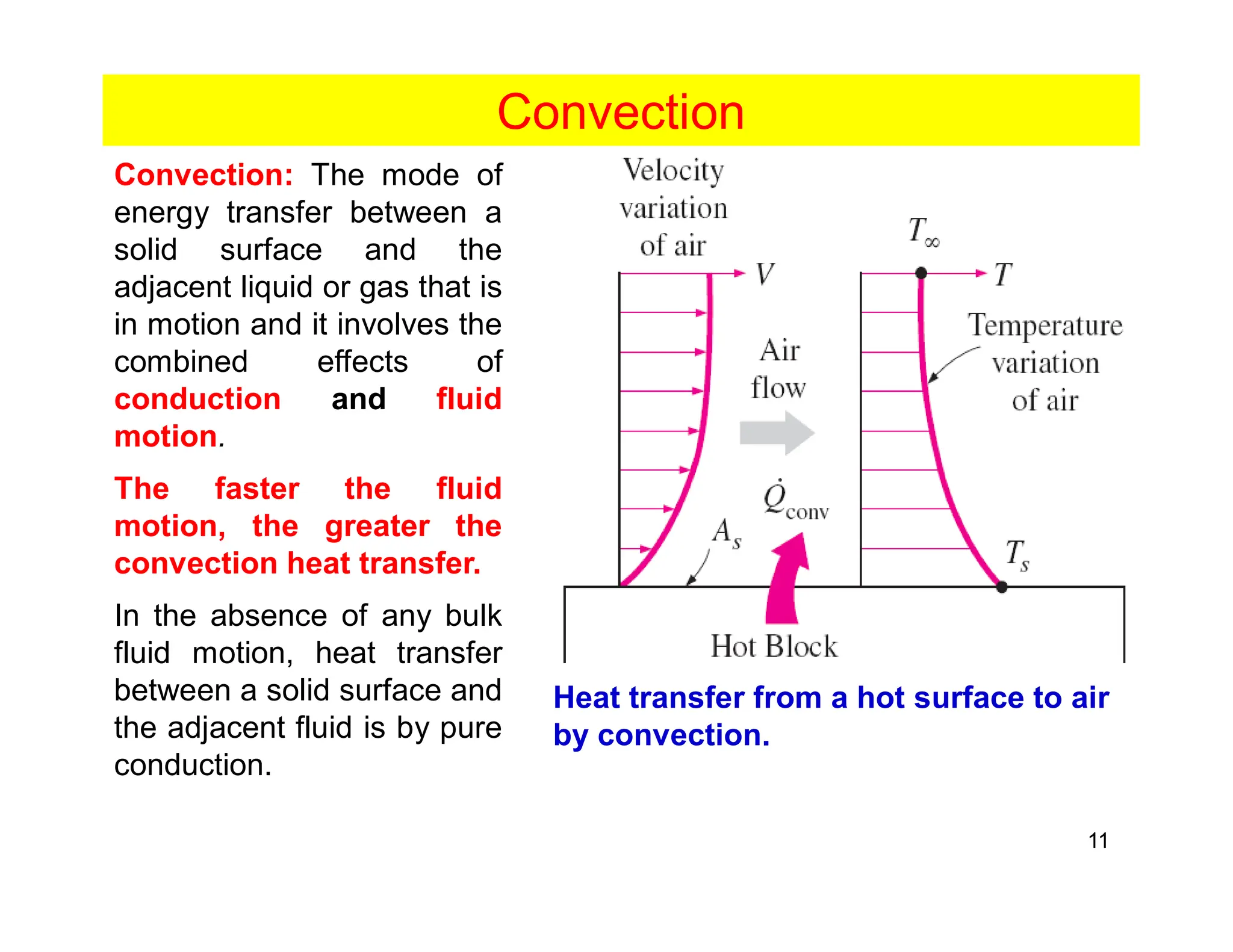
Convection: The mode of
energy transfer between a
solid surface and the
adjacent liquid or gas that is
in motion and it involves the
combined effects of
conduction and fluid
motion.
The faster the fluid
motion, the greater the
convection heat transfer.
In the absence of any bulk
fluid motion, heat transfer
between a solid surface and
the adjacent fluid is by pure
conduction.
Heat transfer from a hot surface to air
by convection.
Convection
12
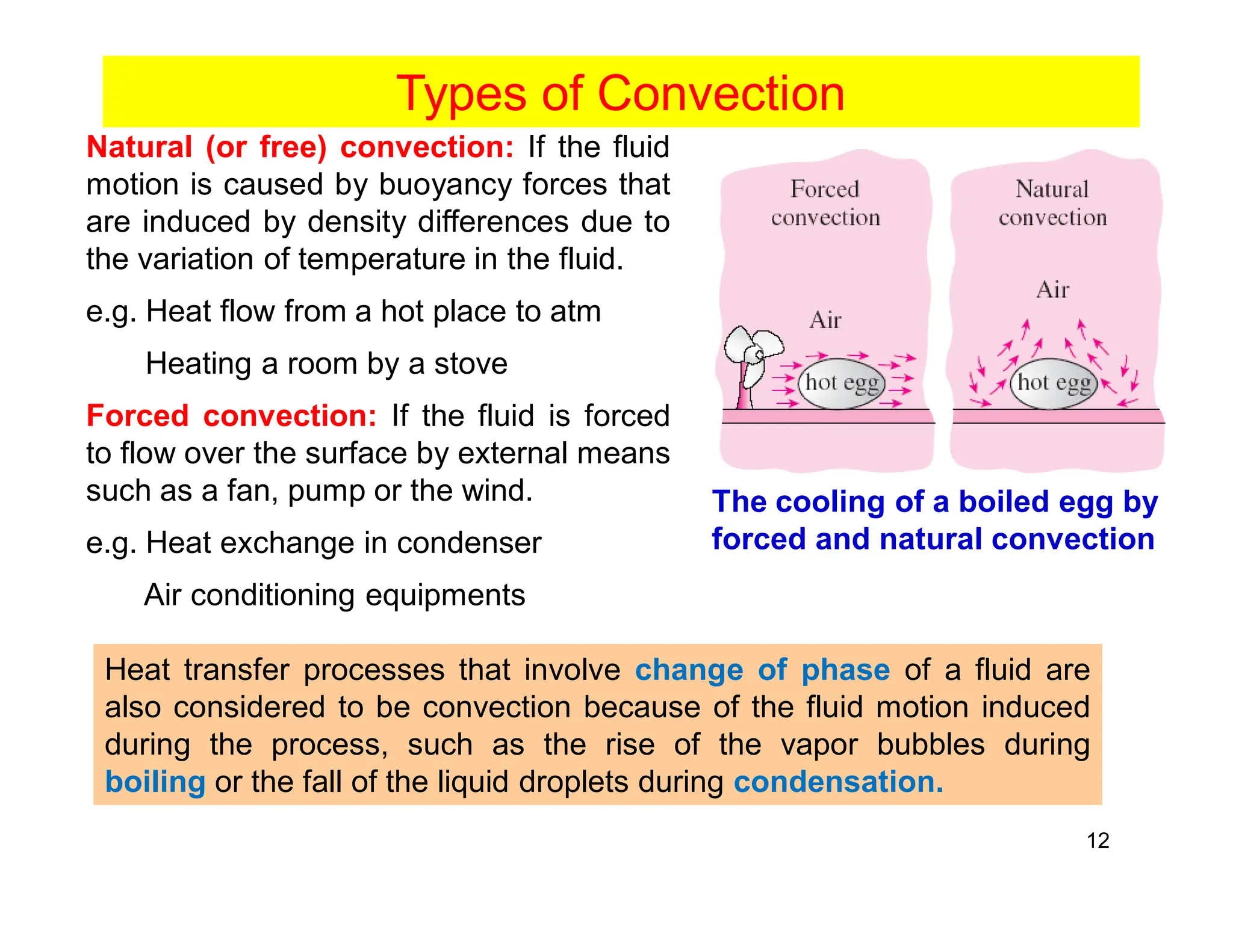
Natural (or free) convection: If the fluid
motion is caused by buoyancy forces that
are induced by density differences due to
the variation of temperature in the fluid.
e.g. Heat flow from a hot place to atm
Heating a room by a stove
Forced convection: If the fluid is forced
to flow over the surface by external means
such as a fan, pump or the wind.
e.g. Heat exchange in condenser
Air conditioning equipments
The cooling of a boiled egg by
forced and natural convection
Heat transfer processes that involve change of phase of a fluid are
also considered to be convection because of the fluid motion induced
during the process, such as the rise of the vapor bubbles during
boiling or the fall of the liquid droplets during condensation.
Types of Convection
13
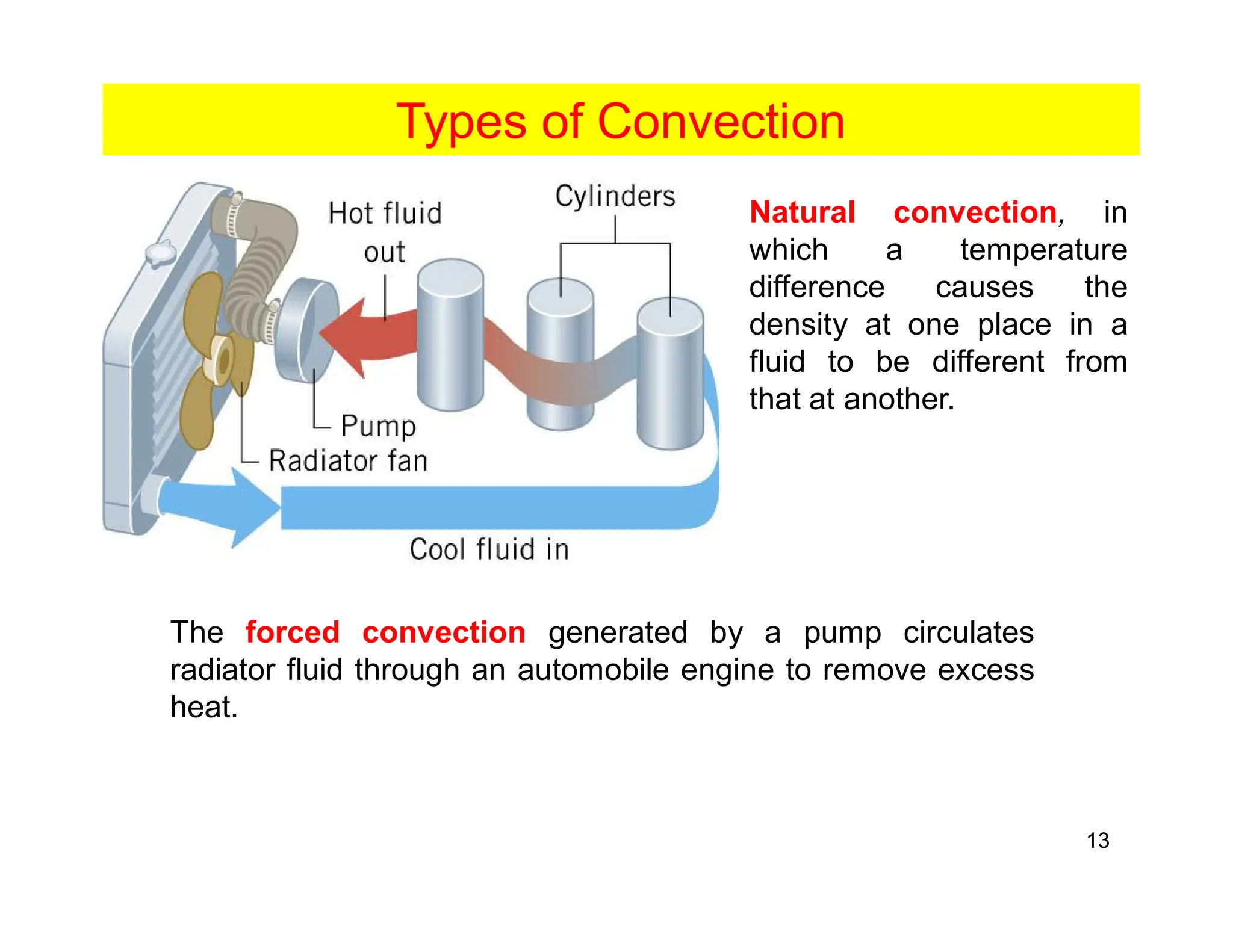
Natural convection, in
which a temperature
difference causes the
density at one place in a
fluid to be different from
that at another.
The forced convection generated by a pump circulates
radiator fluid through an automobile engine to remove excess
heat.
Types of Convection
14
Types of Convection
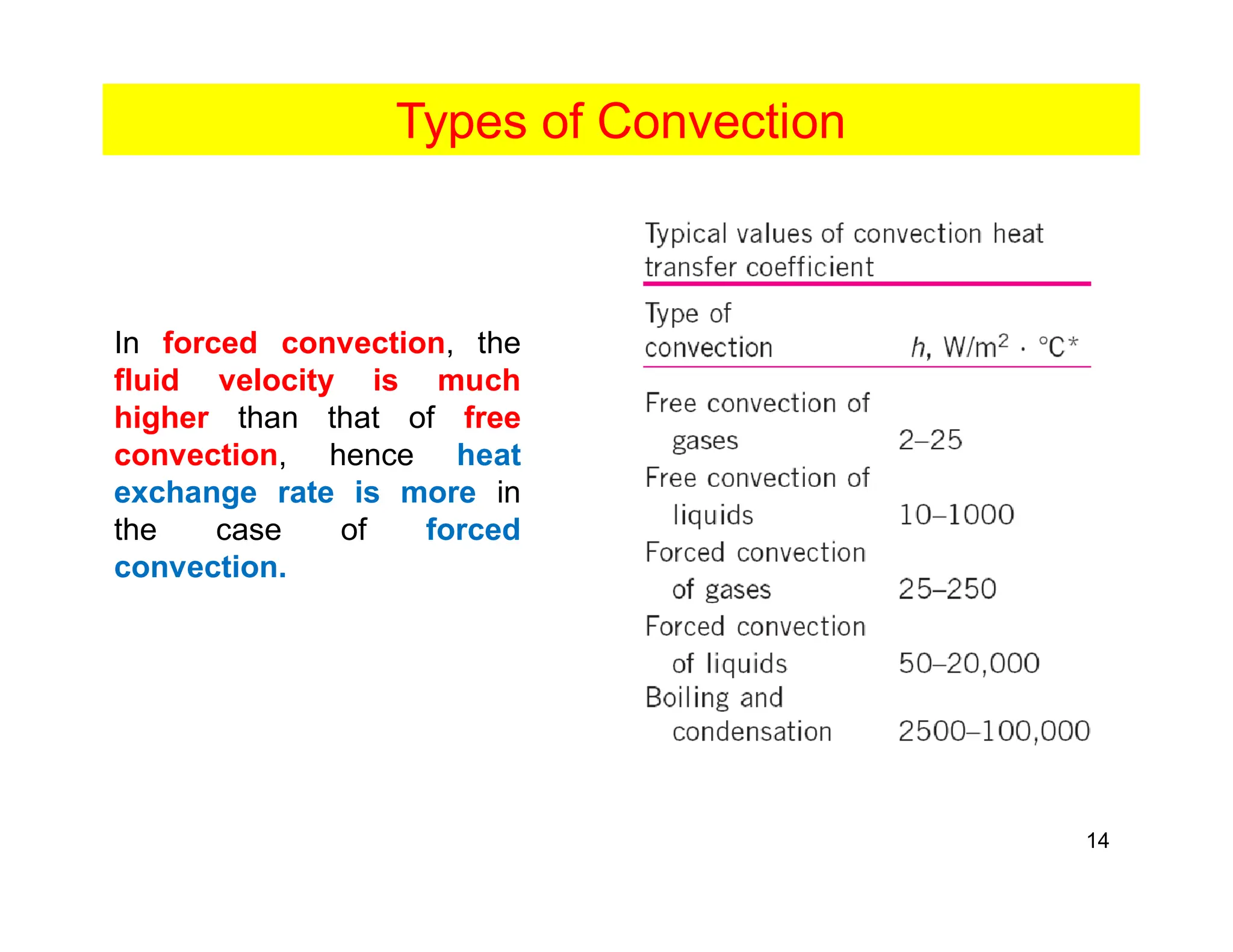
In forced convection, the
fluid velocity is much
higher than that of free
convection, hence heat
exchange rate is more in
the case of forced
convection.
15
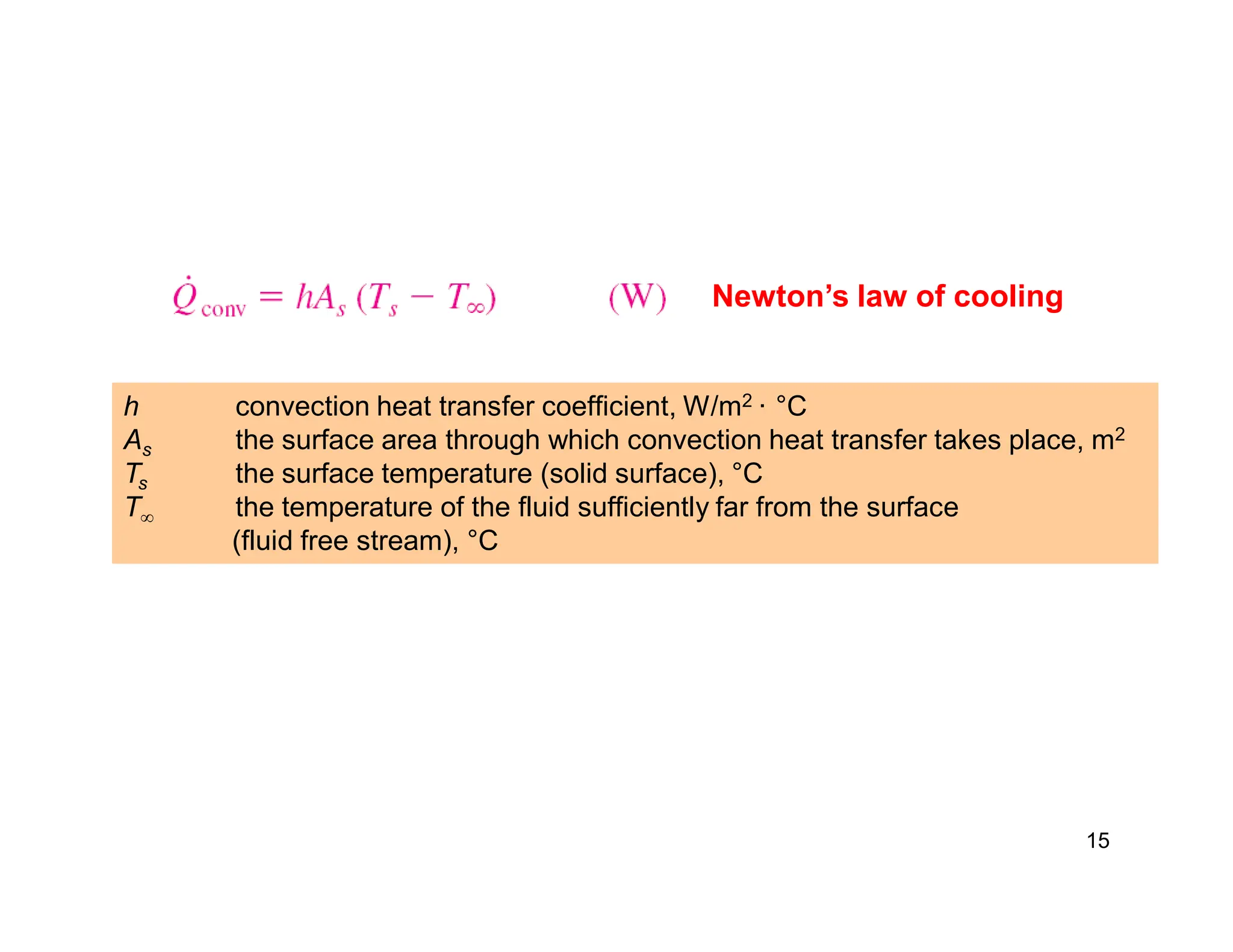
Newton’s law of cooling
h convection heat transfer coefficient, W/m2 · °C
As the surface area through which convection heat transfer takes place, m2
Ts the surface temperature (solid surface), °C
T¥ the temperature of the fluid sufficiently far from the surface
(fluid free stream), °C
16
17
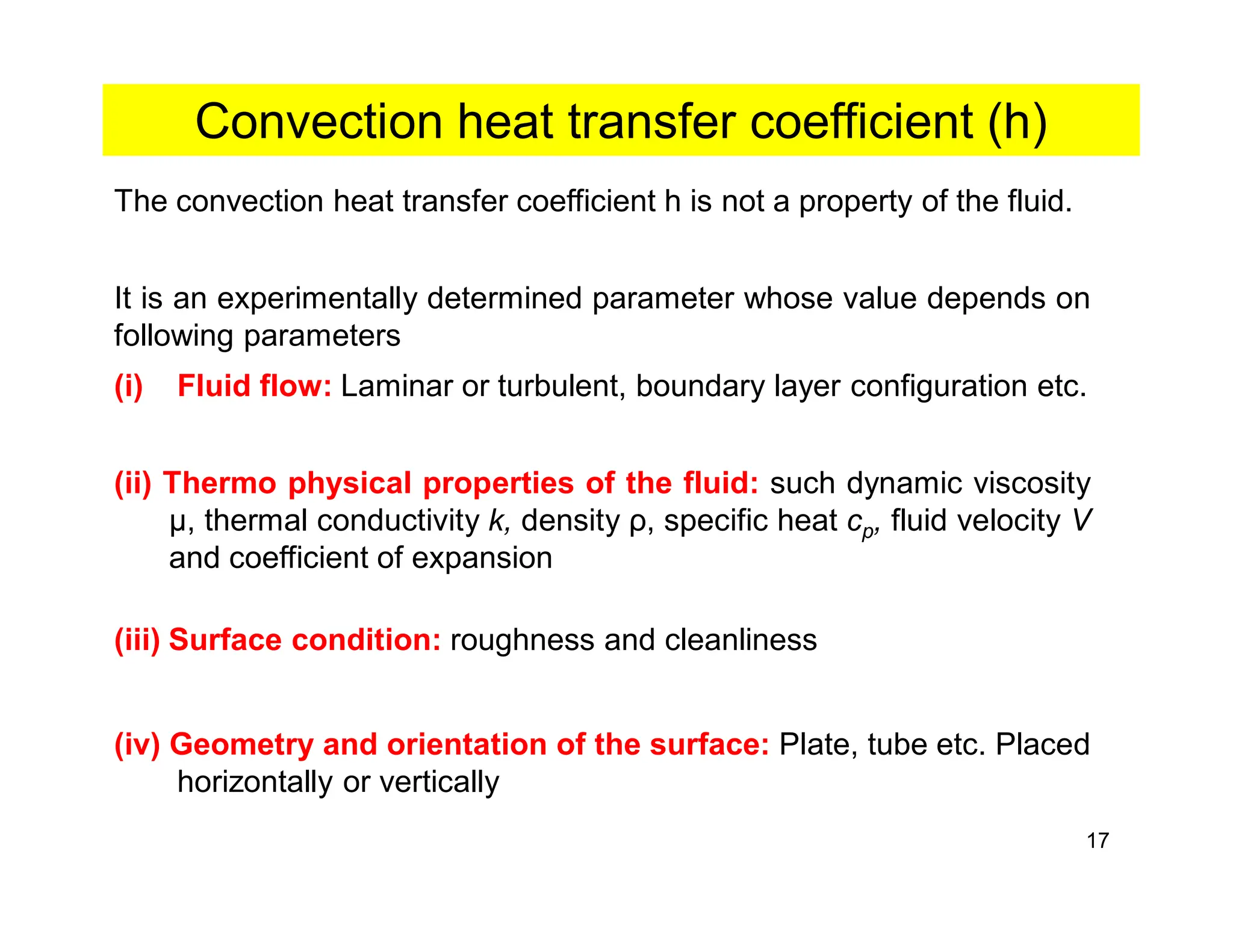
Convection heat transfer coefficient (h)
The convection heat transfer coefficient h is not a property of the fluid.
It is an experimentally determined parameter whose value depends on
following parameters
(i) Fluid flow: Laminar or turbulent, boundary layer configuration etc.
(ii) Thermo physical properties of the fluid: such dynamic viscosity
μ, thermal conductivity k, density ρ, specific heat cp, fluid velocity V
and coefficient of expansion
(iii) Surface condition: roughness and cleanliness
(iv) Geometry and orientation of the surface: Plate, tube etc. Placed
horizontally or vertically
18
Laminar and Turbulent flow
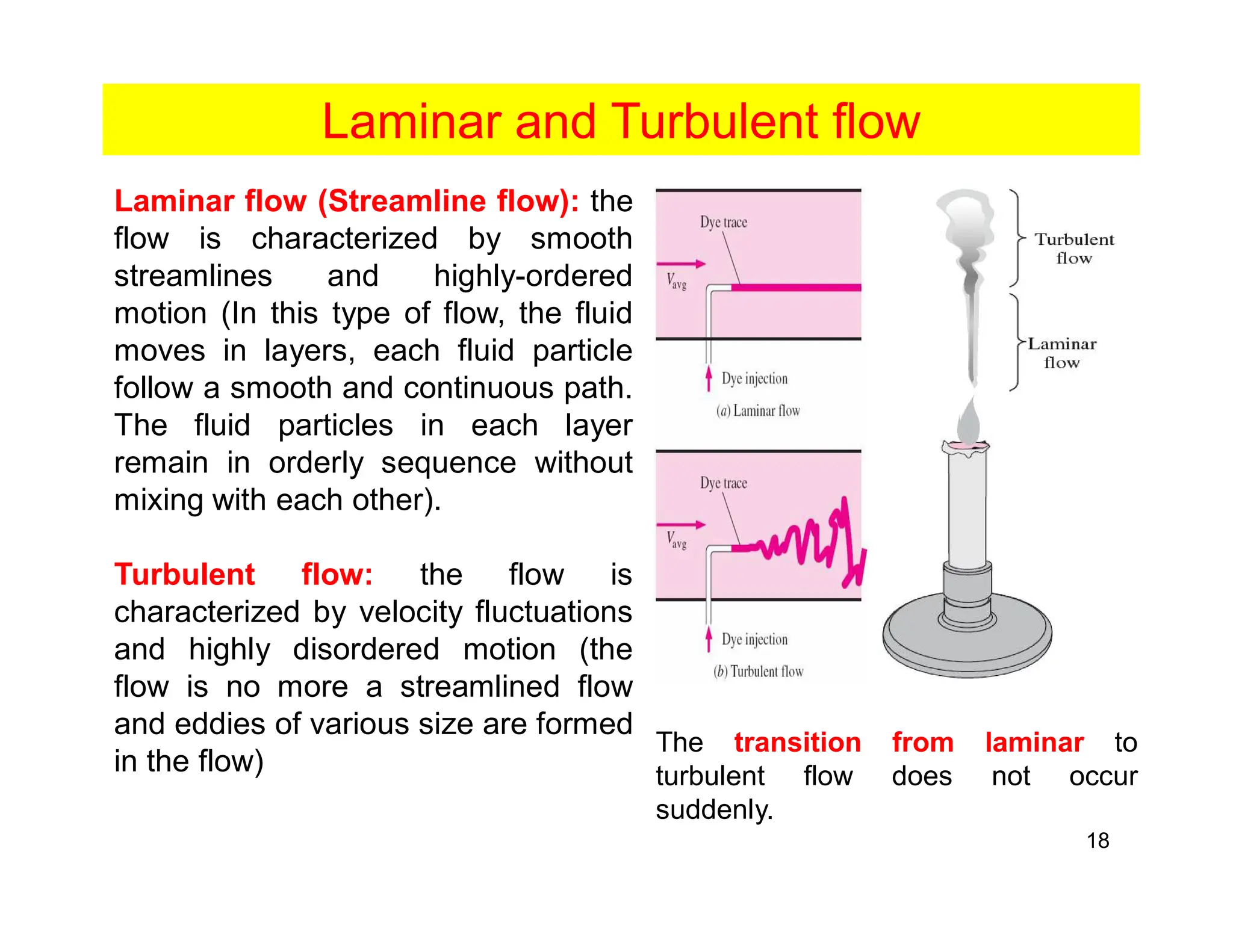
Laminar flow (Streamline flow): the
flow is characterized by smooth
streamlines and highly-ordered
motion (In this type of flow, the fluid
moves in layers, each fluid particle
follow a smooth and continuous path.
The fluid particles in each layer
remain in orderly sequence without
mixing with each other).
Turbulent flow: the flow is
characterized by velocity fluctuations
and highly disordered motion (the
flow is no more a streamlined flow
and eddies of various size are formed
in the flow)
The transition from laminar to
turbulent flow does not occur
suddenly.
19
Laminar and Turbulent flow
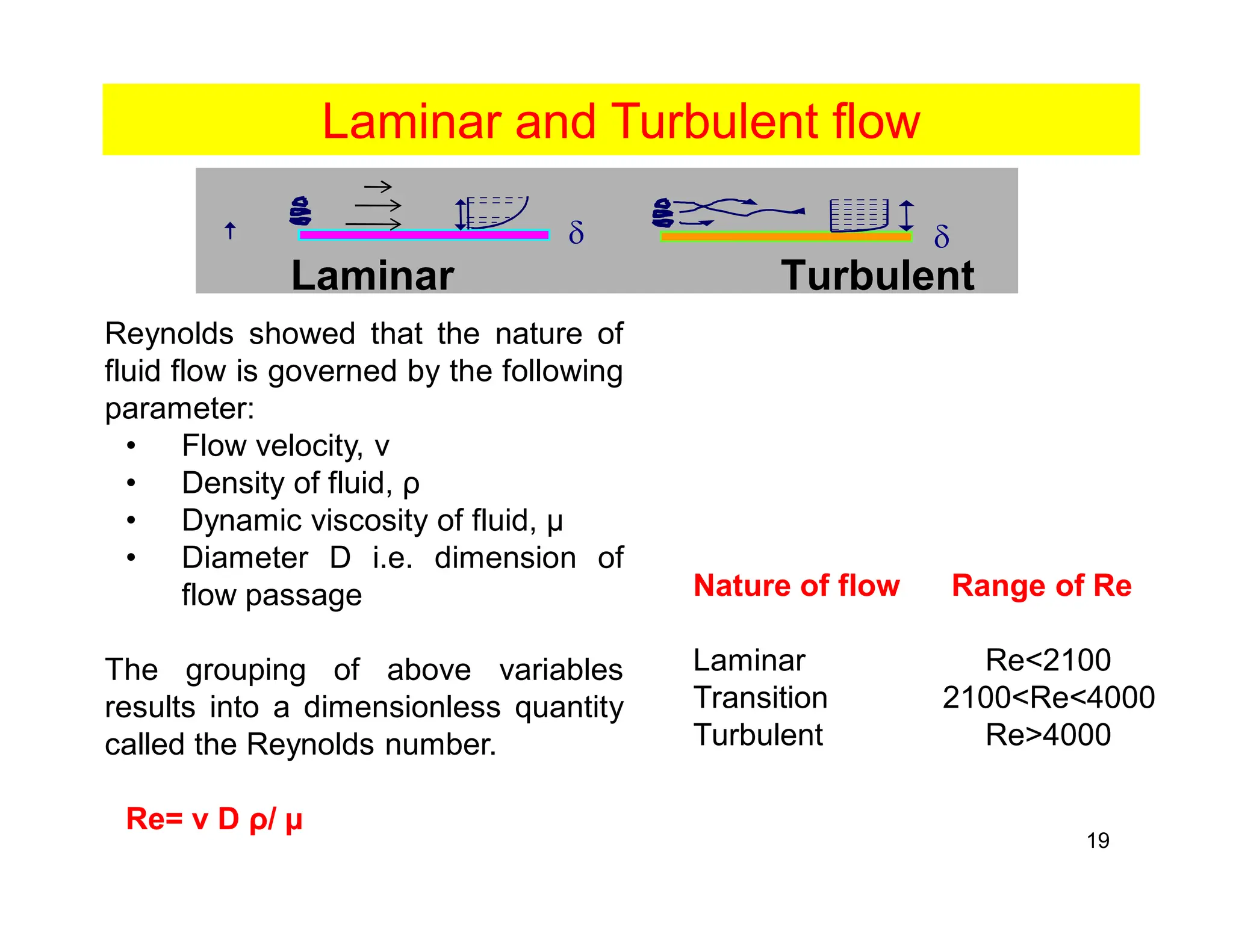
Reynolds showed that the nature of
fluid flow is governed by the following
parameter:
• Flow velocity, v
• Density of fluid, ρ
• Dynamic viscosity of fluid, µ
• Diameter D i.e. dimension of
flow passage
The grouping of above variables
results into a dimensionless quantity
called the Reynolds number.
Re= v D ρ/ µ
d
Laminar Turbulent
d
Nature of flow Range of Re
Laminar Re<2100
Transition 2100<Re<4000
Turbulent Re>4000
20
Boundary Layer
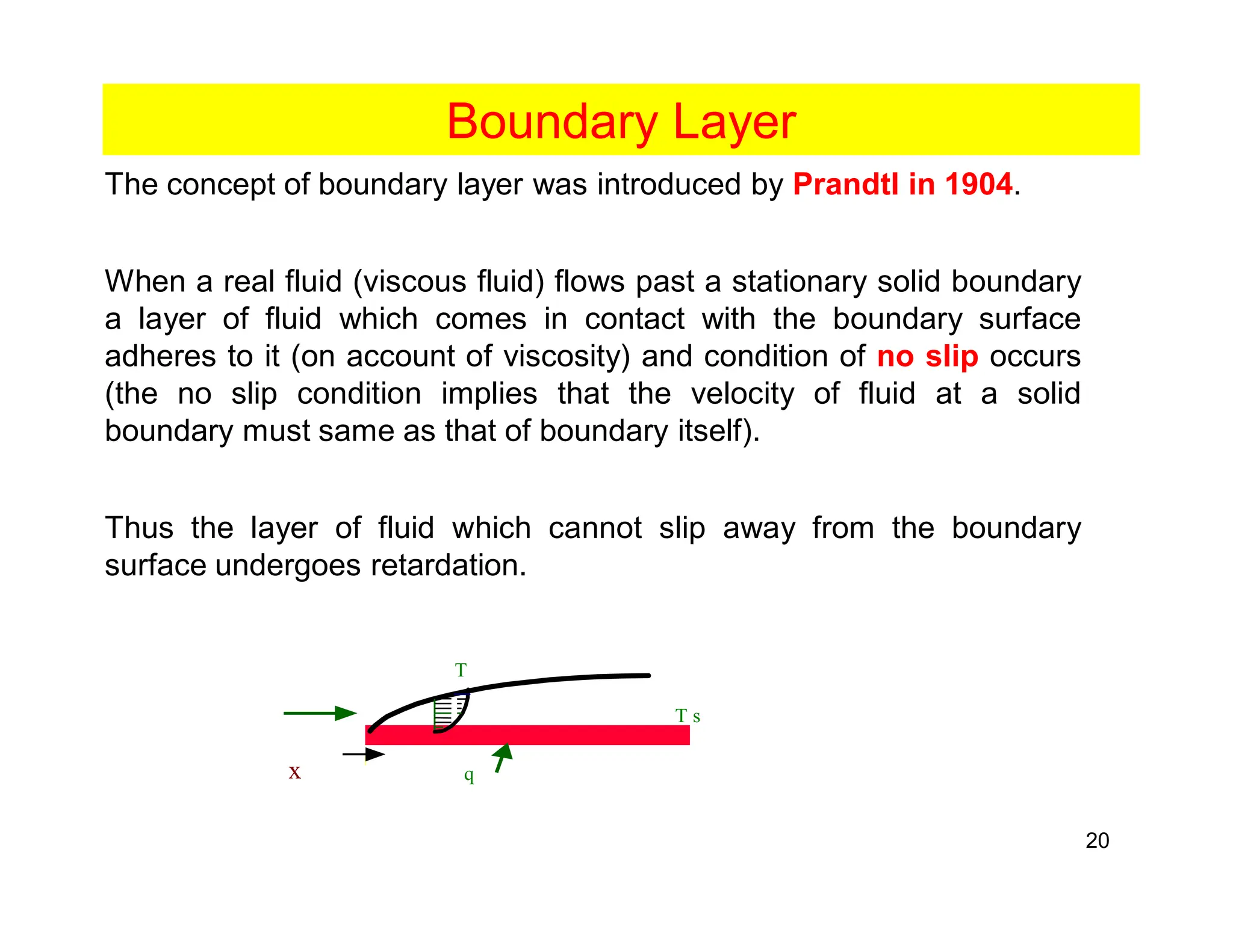
The concept of boundary layer was introduced by Prandtl in 1904.
When a real fluid (viscous fluid) flows past a stationary solid boundary
a layer of fluid which comes in contact with the boundary surface
adheres to it (on account of viscosity) and condition of no slip occurs
(the no slip condition implies that the velocity of fluid at a solid
boundary must same as that of boundary itself).
Thus the layer of fluid which cannot slip away from the boundary
surface undergoes retardation.
x q
T s
T
21
Boundary Layer
This retarded layer further causes retardation for the adjacent layers of
the fluid, thereby developing a small region in the immediate vicinity of
the boundary surface in which the velocity of the flowing fluid
increases rapidly from zero at the boundary surface and approaches
the velocity of main stream. The layer adjacent to the boundary is
known as boundary layer.
Boundary layer is formed whenever there is relative motion between
the boundary and the fluid.
Two types of boundary layer
(1) Hydrodynamic boundary layer
(2) Thermal boundary layer
22
Boundary Layer
(1) Hydrodynamic boundary layer
The fluid velocity decreases as it approaches the solid surface,
reaches to zero in the fluid layer immediately next to the surface.
This thin layer of stagnant fluid has been called hydrodynamic
boundary layer.
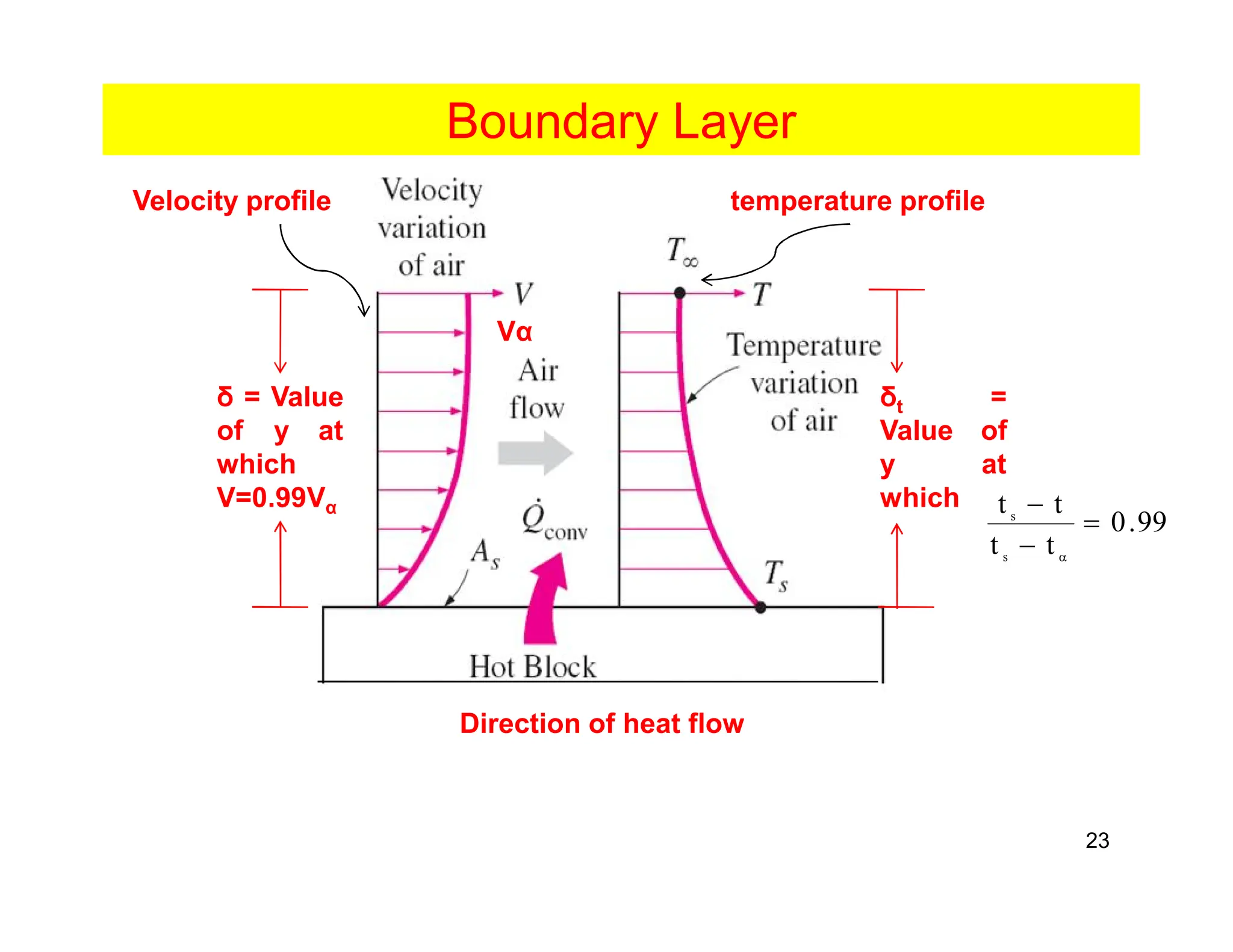
Its thickness δ is defined as the distance from the plate surface at
which the velocity approach 99% of free stream velocity.
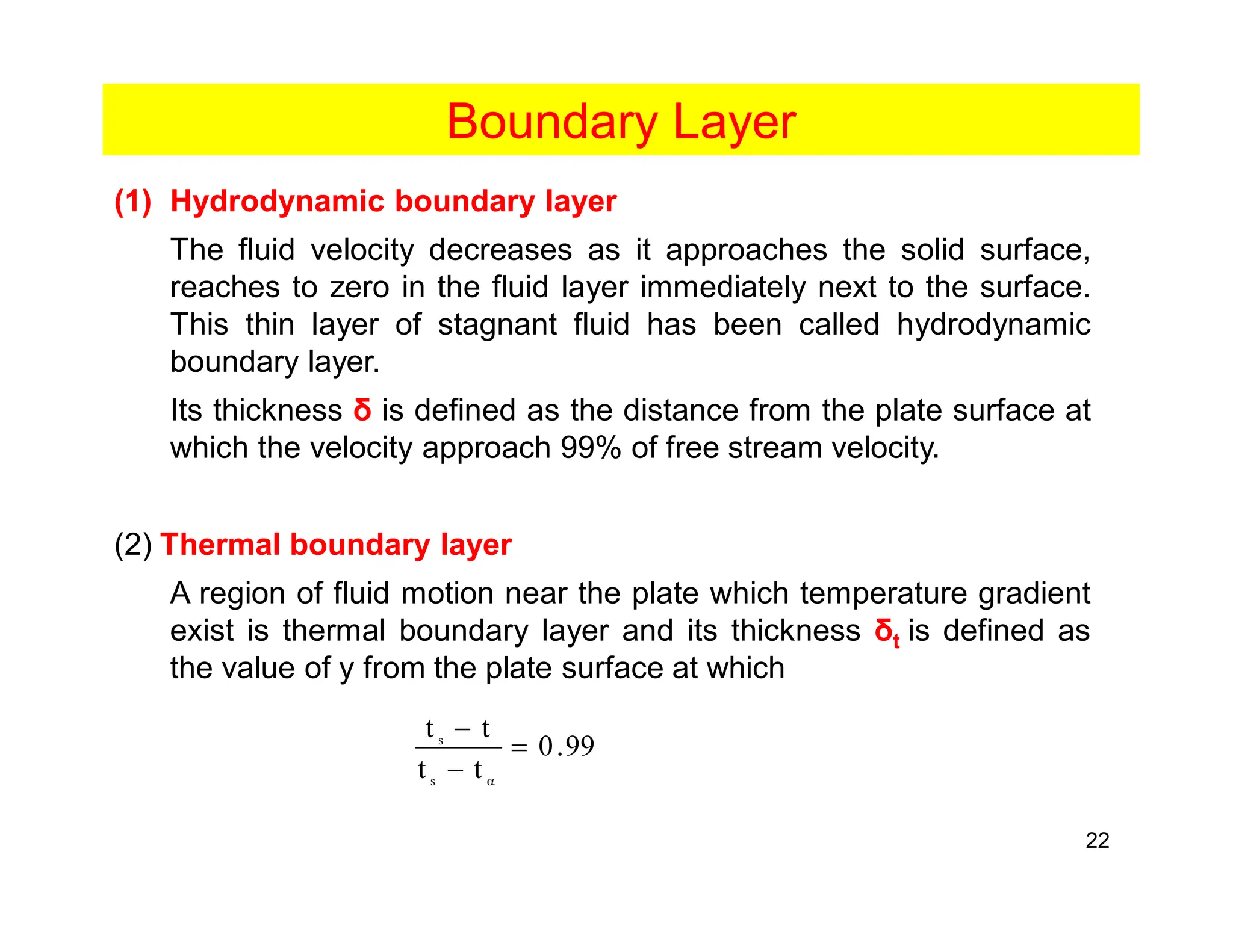
(2) Thermal boundary layer
A region of fluid motion near the plate which temperature gradient
exist is thermal boundary layer and its thickness δt is defined as
the value of y from the plate surface at which
99
.
0
t
t
t
t
s
s
=
-
-
a
23
Boundary Layer
99
.
0
t
t
t
t
s
s
=
-
-
a
δ = Value
of y at
which
V=0.99Vα
δt =
Value of
y at
which
Direction of heat flow
temperature profile
Velocity profile
Vα

introduction-to-convection-part-i1.pdf

  • 1.
    1 Physical Mechanism ofConvection • Conduction and convection are similar in that both mechanisms require the presence of a material medium. • But they are different in that convection requires the presence of fluid motion. • Heat transfer through a liquid or gas can be by conduction or convection, depending on the presence of any bulk fluid motion. Convection is the process in which heat is carried from place to place by the bulk movement of a fluid. Convection currents are set up when a pan of water is heated. how?
  • 2.
    Liquids and gasescan both flow and behave in similar ways, so they are called fluids. heat less dense fluid The heated fluid particles gain energy, so they move about more and spread out. The same number of particles now take up more space, so the fluid has become less dense (i.e. The particles spread out and become less dense) What happens to the particles in a fluid when it is heated? What happens to the particles in a liquid or a gas when you heat them?
  • 3.
    Cooler (more dense)fluids sink through warmer (less dense) fluids. In effect, warmer liquids and gases rise up. Cooler liquids and gases sink. Fluid Movement
  • 4.
    4 Convection Convection is aprocess involving mass movement of fluids. The mechanism of convection is the transfer of heat energy by actual physical movement of fluid molecule from one place to another in which there exists a temperature gradient. This mode of heat transfer is comprised of two mechanism • energy transfer due to random molecular motion (diffusion) • and bulk motion of fluid
  • 5.
    Warmer regions ofa fluid are less dense than cooler regions of the same fluid. The warmer regions will rise because they are more dense. The cooler regions will sink as they are less dense. This is how heat transfer takes place in fluids and is called convection. The steady flow between the warm and cool sections of a fluid, such as air or water is called a convection current. What is Convection?
  • 6.
    6 Conceptual Example 1.Hot Water Baseboard Heating and Refrigerators
  • 7.
    7 Hot water baseboardheating units are frequently used in homes, where they are mounted on the wall next to the floor. In contrast, the cooling coil in a refrigerator is mounted near the top of the refrigerator. The locations for these heating and cooling devices are different, yet each location is designed to maximize the production of convection currents. How?
  • 8.
    8 The air abovethe baseboard unit is heated, like the air above a fire. Buoyant forces from the surrounding cooler air push the warm air upward. Cooler air near the ceiling is displaced downward and then warmed by the baseboard heating unit, leading to the convection current. Had the heating unit been located near the ceiling, the warm air would have remained there, with very little convection to distribute the heat.
  • 9.
    9 The air incontact with the top- mounted coil is cooled, its volume decreases and its density increases. The surrounding warmer and less dense air cannot provide sufficient buoyant force to support the colder air which sinks downward. In the process, warmer air near the bottom is displaced upward and is then cooled by the coil, establishing the convection current. Had the cooling coil been placed at the bottom of the refrigerator, stagnant, cool air would have collected there, with little convection to carry the heat from other parts of the refrigerator to the coil for removal.
  • 10.
    10 Convection Heat transfer engineeringis the predication of the rate of heat transfer between a fluid and solid boundary surface. This take place in various steps. Suppose the solid surface is at higher temperature than the fluid. First, heat will flow by conduction from the surface to adjacent particles of fluid. The energy thus transferred will serve to increase the temperature and the internal energy of these fluid particles. Thus the fluid particles will move to a region of cold fluid (lower temperature in the fluid) where they will mix with and transfer a part of their energy to other fluid particles. The energy is actually stored in the fluid particle and due to mass motion of fluid particles, it is also carried away. Thus the heat transfer between a solid surface and fluid is due to conduction as well as convection.
  • 11.
    11 Convection: The modeof energy transfer between a solid surface and the adjacent liquid or gas that is in motion and it involves the combined effects of conduction and fluid motion. The faster the fluid motion, the greater the convection heat transfer. In the absence of any bulk fluid motion, heat transfer between a solid surface and the adjacent fluid is by pure conduction. Heat transfer from a hot surface to air by convection. Convection
  • 12.
    12 Natural (or free)convection: If the fluid motion is caused by buoyancy forces that are induced by density differences due to the variation of temperature in the fluid. e.g. Heat flow from a hot place to atm Heating a room by a stove Forced convection: If the fluid is forced to flow over the surface by external means such as a fan, pump or the wind. e.g. Heat exchange in condenser Air conditioning equipments The cooling of a boiled egg by forced and natural convection Heat transfer processes that involve change of phase of a fluid are also considered to be convection because of the fluid motion induced during the process, such as the rise of the vapor bubbles during boiling or the fall of the liquid droplets during condensation. Types of Convection
  • 13.
    13 Natural convection, in whicha temperature difference causes the density at one place in a fluid to be different from that at another. The forced convection generated by a pump circulates radiator fluid through an automobile engine to remove excess heat. Types of Convection
  • 14.
    14 Types of Convection Inforced convection, the fluid velocity is much higher than that of free convection, hence heat exchange rate is more in the case of forced convection.
  • 15.
    15 Newton’s law ofcooling h convection heat transfer coefficient, W/m2 · °C As the surface area through which convection heat transfer takes place, m2 Ts the surface temperature (solid surface), °C T¥ the temperature of the fluid sufficiently far from the surface (fluid free stream), °C
  • 16.
  • 17.
    17 Convection heat transfercoefficient (h) The convection heat transfer coefficient h is not a property of the fluid. It is an experimentally determined parameter whose value depends on following parameters (i) Fluid flow: Laminar or turbulent, boundary layer configuration etc. (ii) Thermo physical properties of the fluid: such dynamic viscosity μ, thermal conductivity k, density ρ, specific heat cp, fluid velocity V and coefficient of expansion (iii) Surface condition: roughness and cleanliness (iv) Geometry and orientation of the surface: Plate, tube etc. Placed horizontally or vertically
  • 18.
    18 Laminar and Turbulentflow Laminar flow (Streamline flow): the flow is characterized by smooth streamlines and highly-ordered motion (In this type of flow, the fluid moves in layers, each fluid particle follow a smooth and continuous path. The fluid particles in each layer remain in orderly sequence without mixing with each other). Turbulent flow: the flow is characterized by velocity fluctuations and highly disordered motion (the flow is no more a streamlined flow and eddies of various size are formed in the flow) The transition from laminar to turbulent flow does not occur suddenly.
  • 19.
    19 Laminar and Turbulentflow Reynolds showed that the nature of fluid flow is governed by the following parameter: • Flow velocity, v • Density of fluid, ρ • Dynamic viscosity of fluid, µ • Diameter D i.e. dimension of flow passage The grouping of above variables results into a dimensionless quantity called the Reynolds number. Re= v D ρ/ µ d Laminar Turbulent d Nature of flow Range of Re Laminar Re<2100 Transition 2100<Re<4000 Turbulent Re>4000
  • 20.
    20 Boundary Layer The conceptof boundary layer was introduced by Prandtl in 1904. When a real fluid (viscous fluid) flows past a stationary solid boundary a layer of fluid which comes in contact with the boundary surface adheres to it (on account of viscosity) and condition of no slip occurs (the no slip condition implies that the velocity of fluid at a solid boundary must same as that of boundary itself). Thus the layer of fluid which cannot slip away from the boundary surface undergoes retardation. x q T s T
  • 21.
    21 Boundary Layer This retardedlayer further causes retardation for the adjacent layers of the fluid, thereby developing a small region in the immediate vicinity of the boundary surface in which the velocity of the flowing fluid increases rapidly from zero at the boundary surface and approaches the velocity of main stream. The layer adjacent to the boundary is known as boundary layer. Boundary layer is formed whenever there is relative motion between the boundary and the fluid. Two types of boundary layer (1) Hydrodynamic boundary layer (2) Thermal boundary layer
  • 22.
    22 Boundary Layer (1) Hydrodynamicboundary layer The fluid velocity decreases as it approaches the solid surface, reaches to zero in the fluid layer immediately next to the surface. This thin layer of stagnant fluid has been called hydrodynamic boundary layer. Its thickness δ is defined as the distance from the plate surface at which the velocity approach 99% of free stream velocity. (2) Thermal boundary layer A region of fluid motion near the plate which temperature gradient exist is thermal boundary layer and its thickness δt is defined as the value of y from the plate surface at which 99 . 0 t t t t s s = - - a
  • 23.
    23 Boundary Layer 99 . 0 t t t t s s = - - a δ =Value of y at which V=0.99Vα δt = Value of y at which Direction of heat flow temperature profile Velocity profile Vα