MCE 6145
Convective HeatTransfer
Dr. Arafat Ahmed Bhuiyan
Associate Professor
Dept. of Mechanical and Production Engineering
Islamic University of Technology (IUT)
Contact: +8801712939252
E-mail: arafat@iut-dhaka.edu
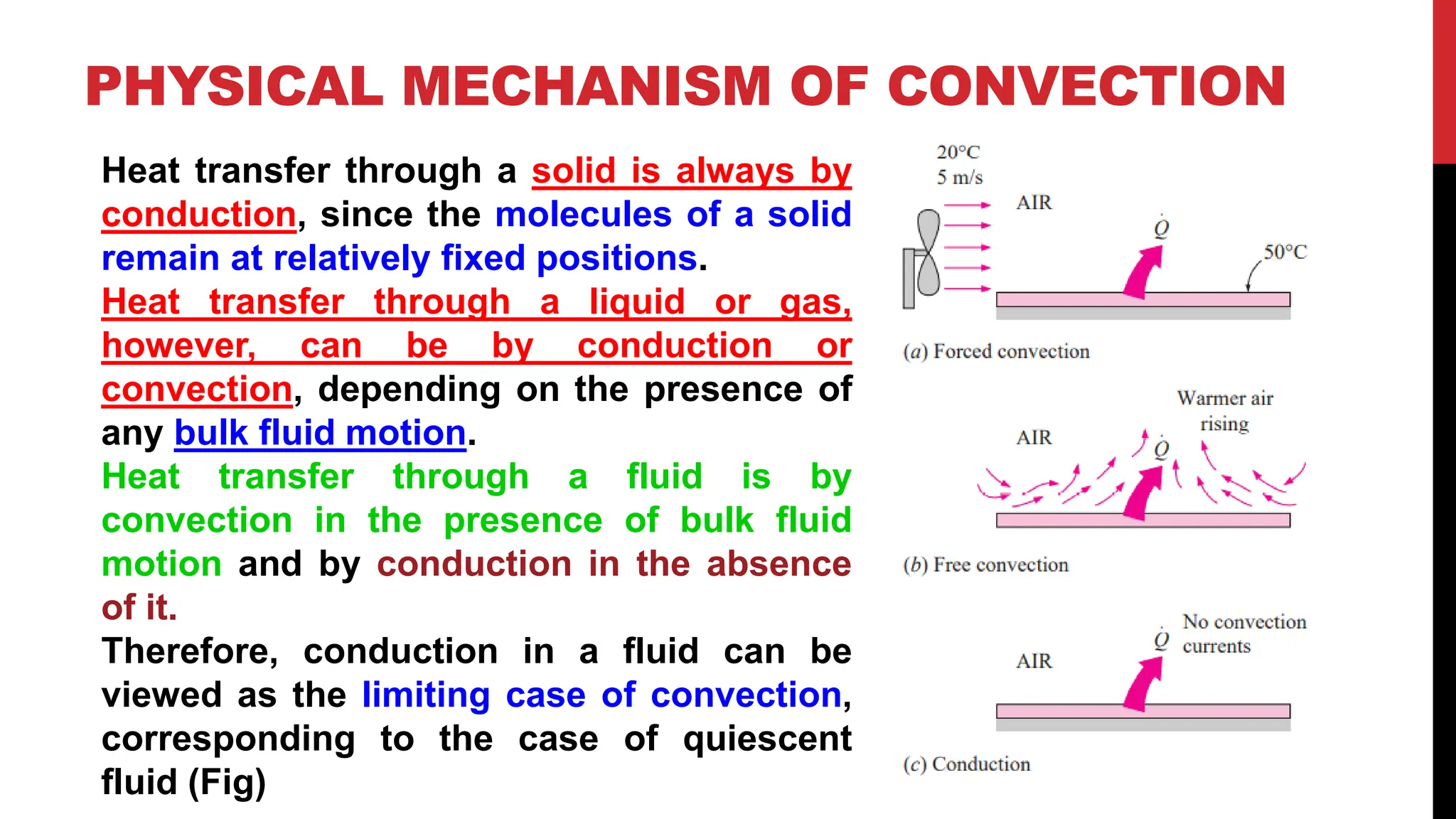
PHYSICAL MECHANISM OFCONVECTION
Heat transfer through a solid is always by
conduction, since the molecules of a solid
remain at relatively fixed positions.
Heat transfer through a liquid or gas,
however, can be by conduction or
convection, depending on the presence of
any bulk fluid motion.
Heat transfer through a fluid is by
convection in the presence of bulk fluid
motion and by conduction in the absence
of it.
Therefore, conduction in a fluid can be
viewed as the limiting case of convection,
corresponding to the case of quiescent
fluid (Fig)
4.
PHYSICAL MECHANISM OFCONVECTION
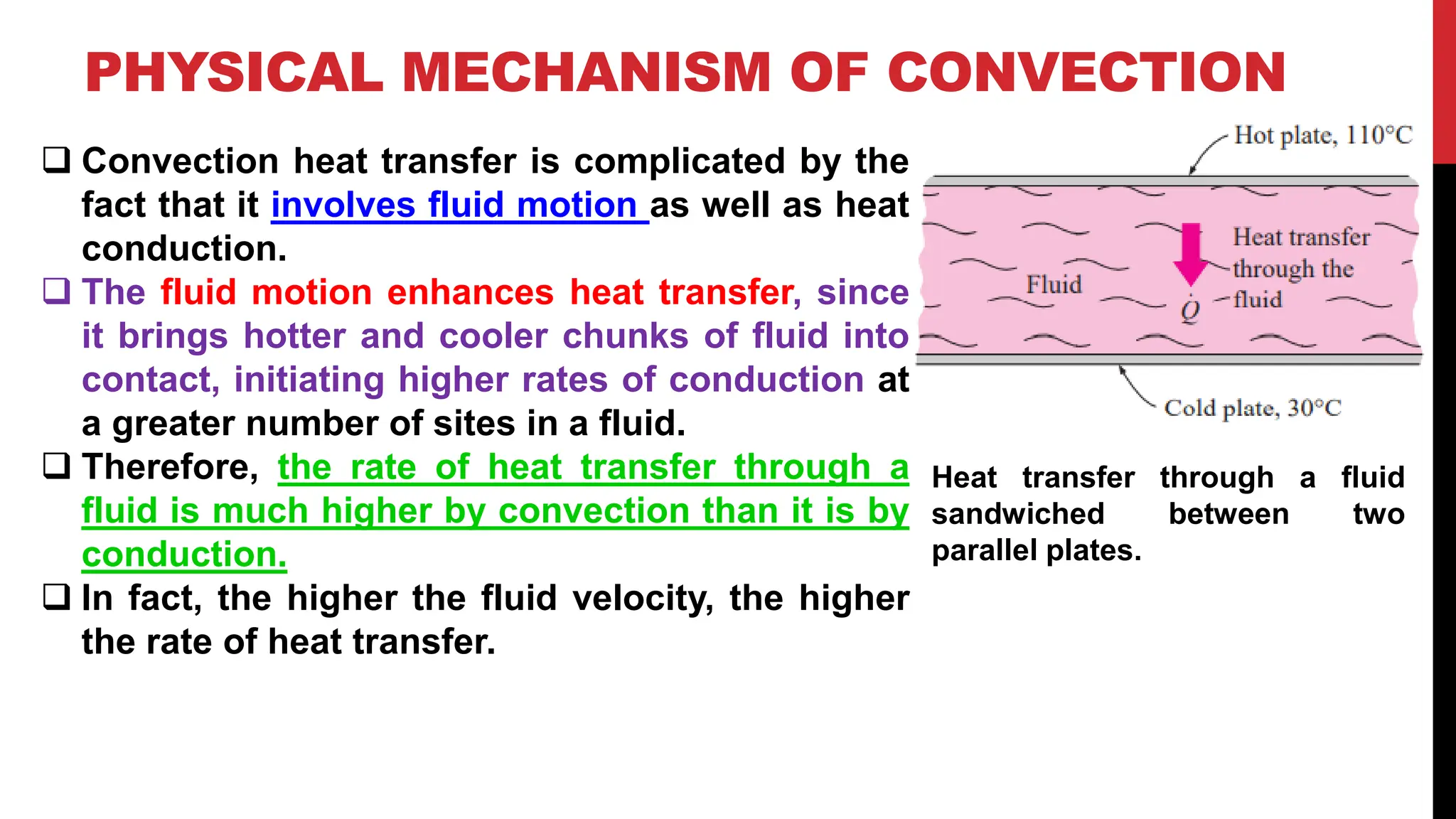
❑ Convection heat transfer is complicated by the
fact that it involves fluid motion as well as heat
conduction.
❑ The fluid motion enhances heat transfer, since
it brings hotter and cooler chunks of fluid into
contact, initiating higher rates of conduction at
a greater number of sites in a fluid.
❑ Therefore, the rate of heat transfer through a
fluid is much higher by convection than it is by
conduction.
❑ In fact, the higher the fluid velocity, the higher
the rate of heat transfer.
Heat transfer through a fluid
sandwiched between two
parallel plates.
5.
PHYSICAL MECHANISM OFCONVECTION
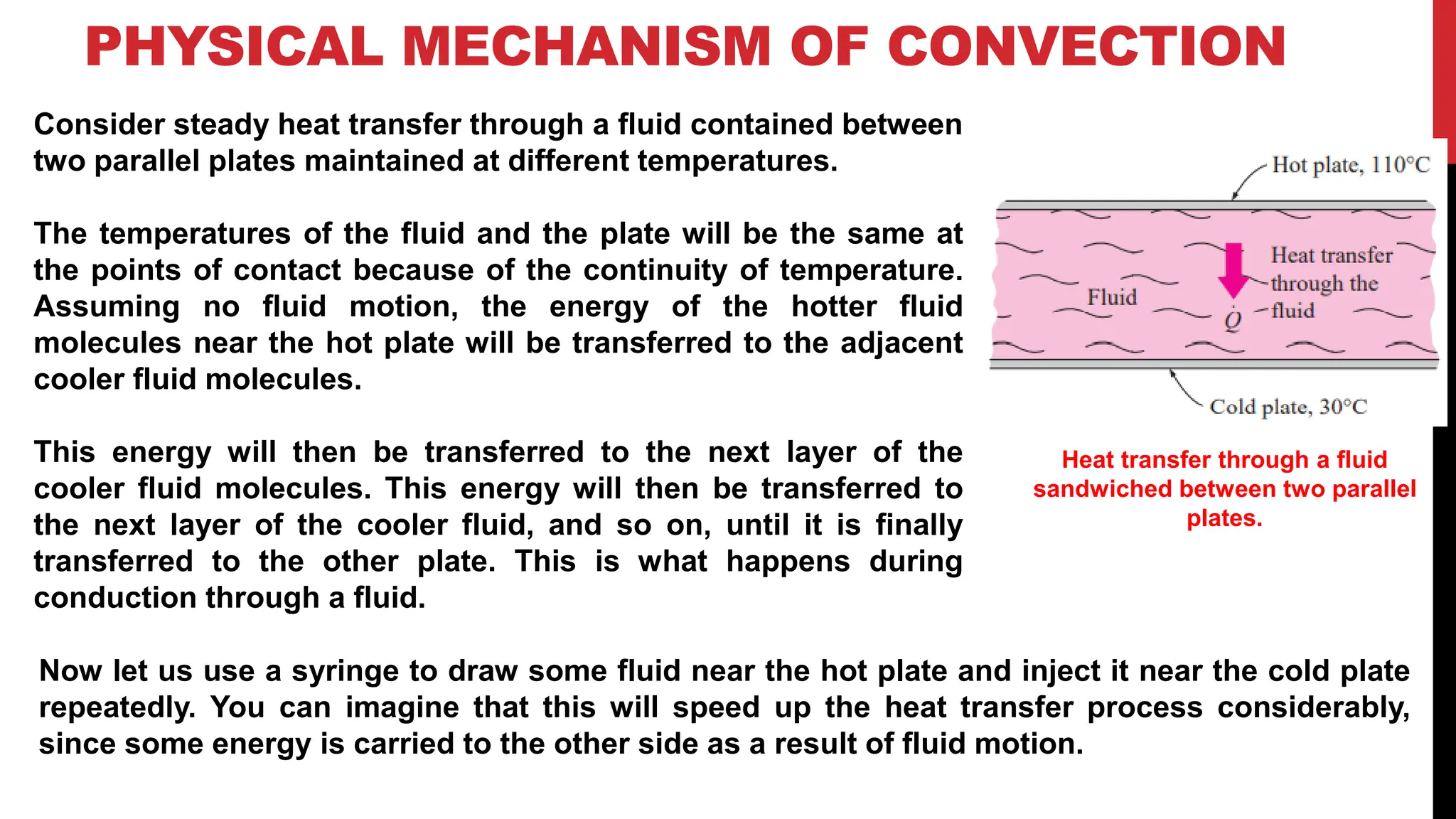
Consider steady heat transfer through a fluid contained between
two parallel plates maintained at different temperatures.
The temperatures of the fluid and the plate will be the same at
the points of contact because of the continuity of temperature.
Assuming no fluid motion, the energy of the hotter fluid
molecules near the hot plate will be transferred to the adjacent
cooler fluid molecules.
This energy will then be transferred to the next layer of the
cooler fluid molecules. This energy will then be transferred to
the next layer of the cooler fluid, and so on, until it is finally
transferred to the other plate. This is what happens during
conduction through a fluid.
Heat transfer through a fluid
sandwiched between two parallel
plates.
Now let us use a syringe to draw some fluid near the hot plate and inject it near the cold plate
repeatedly. You can imagine that this will speed up the heat transfer process considerably,
since some energy is carried to the other side as a result of fluid motion.
6.
PHYSICAL MECHANISM OFCONVECTION
• There are three basic mechanisms of heat transfer: conduction, convection
and radiation. Heat transfer through a fluid is by convection in the presence of
bulk fluid motion.
• Convection heat transfer strongly depends on the fluid properties dynamic
viscosity µ, thermal conductivity k, density r, and specific heat cp, as well as
the fluid velocity V. It also depends on the geometry and the roughness of the
solid surface, in addition to the type of fluid flow (such as being streamlined
or turbulent).
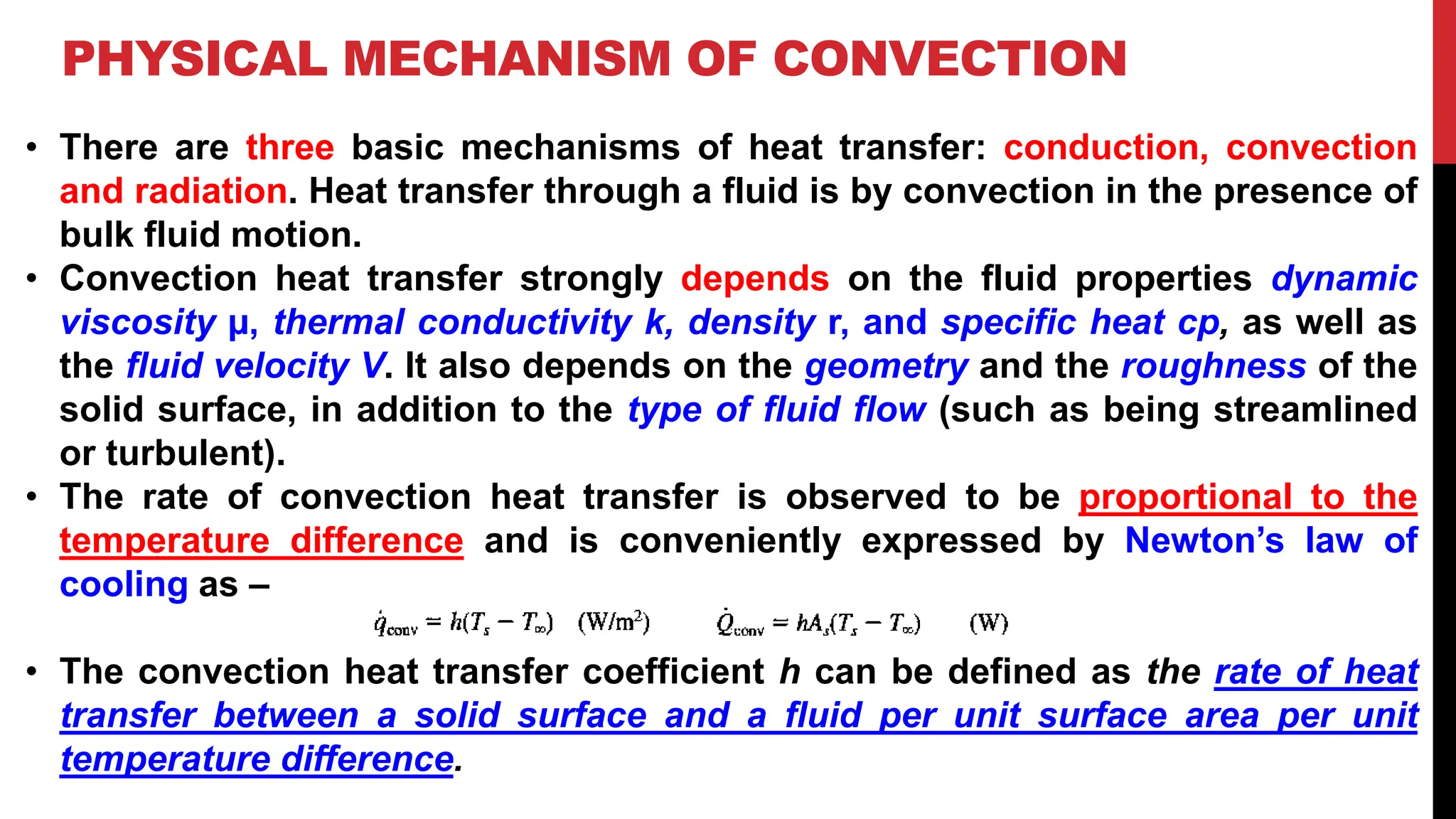
• The rate of convection heat transfer is observed to be proportional to the
temperature difference and is conveniently expressed by Newton’s law of
cooling as –
• The convection heat transfer coefficient h can be defined as the rate of heat
transfer between a solid surface and a fluid per unit surface area per unit
temperature difference.
7.
NO-SLIP CONDITION &BOUNDARY LAYER
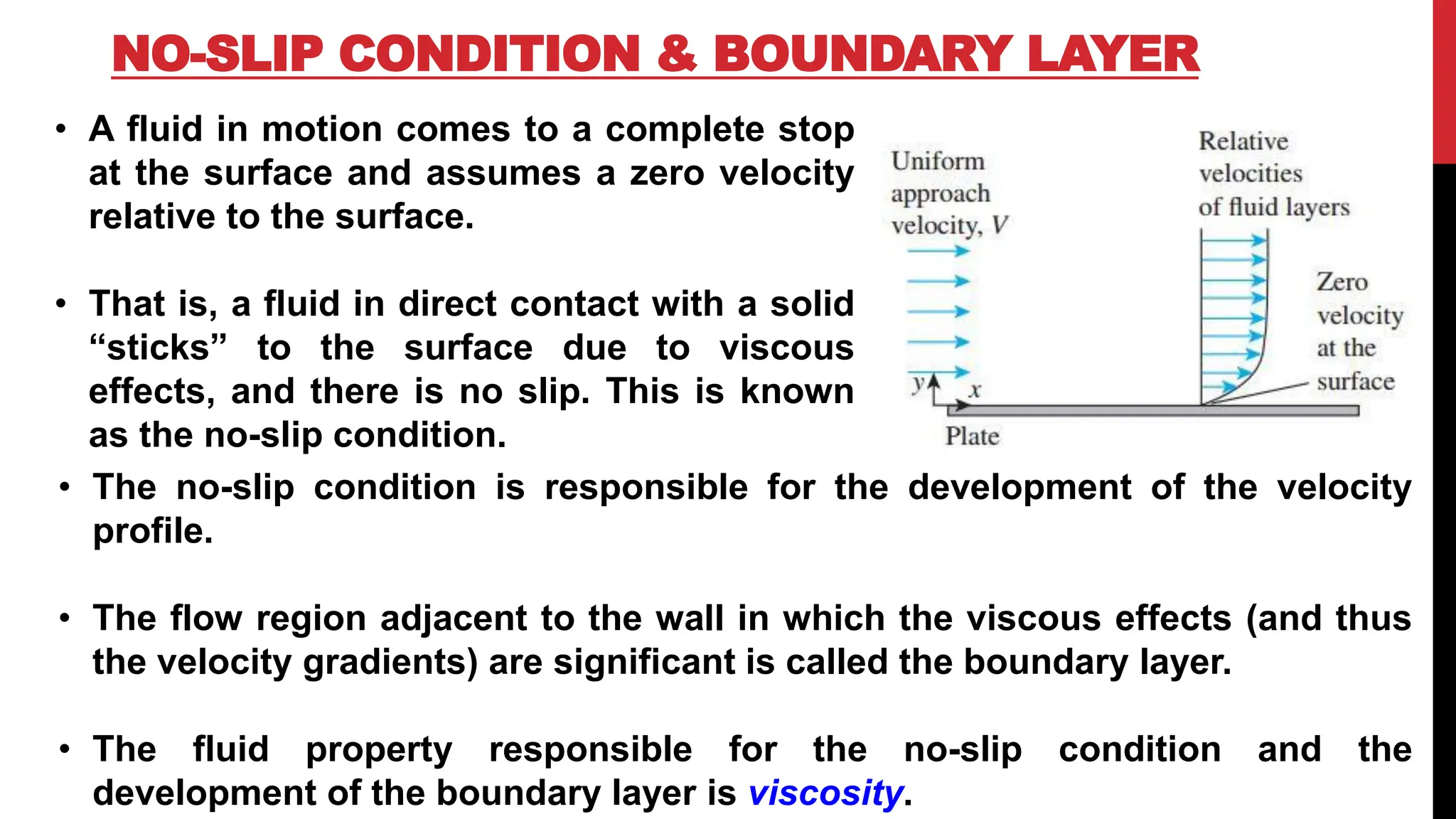
• A fluid in motion comes to a complete stop
at the surface and assumes a zero velocity
relative to the surface.
• That is, a fluid in direct contact with a solid
“sticks” to the surface due to viscous
effects, and there is no slip. This is known
as the no-slip condition.
• The no-slip condition is responsible for the development of the velocity
profile.
• The flow region adjacent to the wall in which the viscous effects (and thus
the velocity gradients) are significant is called the boundary layer.
• The fluid property responsible for the no-slip condition and the
development of the boundary layer is viscosity.
8.
NO-TEMPERATURE-JUMP CONDITION
When twobodies at different temperatures are brought into contact, heat
transfer occurs until both bodies assume the same temperature at the
point of contact.
Therefore, a fluid and a solid surface will have the same temperature at
the point of contact. This is known as no-temperature-jump condition.
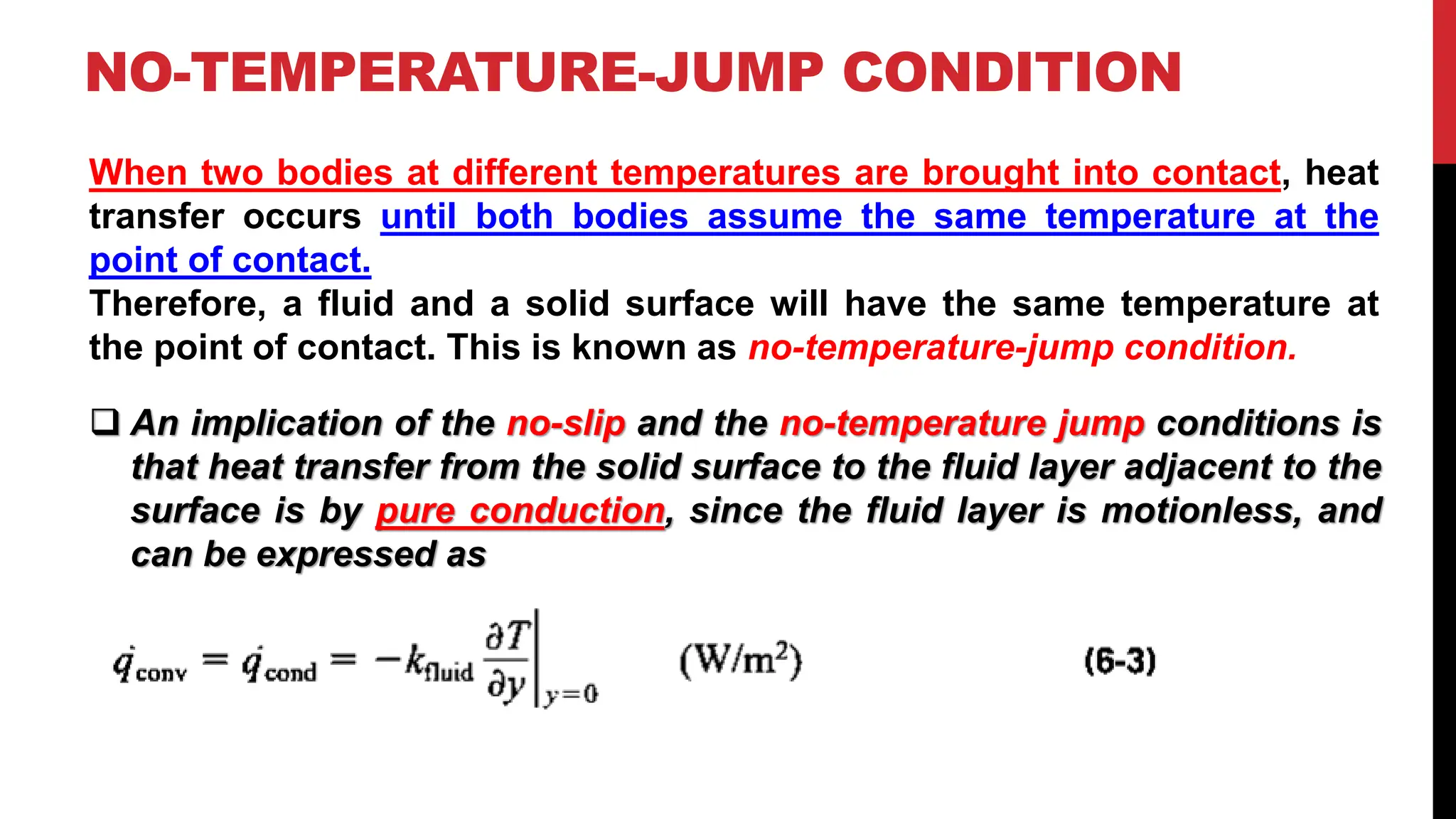
❑ An implication of the no-slip and the no-temperature jump conditions is
that heat transfer from the solid surface to the fluid layer adjacent to the
surface is by pure conduction, since the fluid layer is motionless, and
can be expressed as
9.
NO-TEMPERATURE-JUMP CONDITION
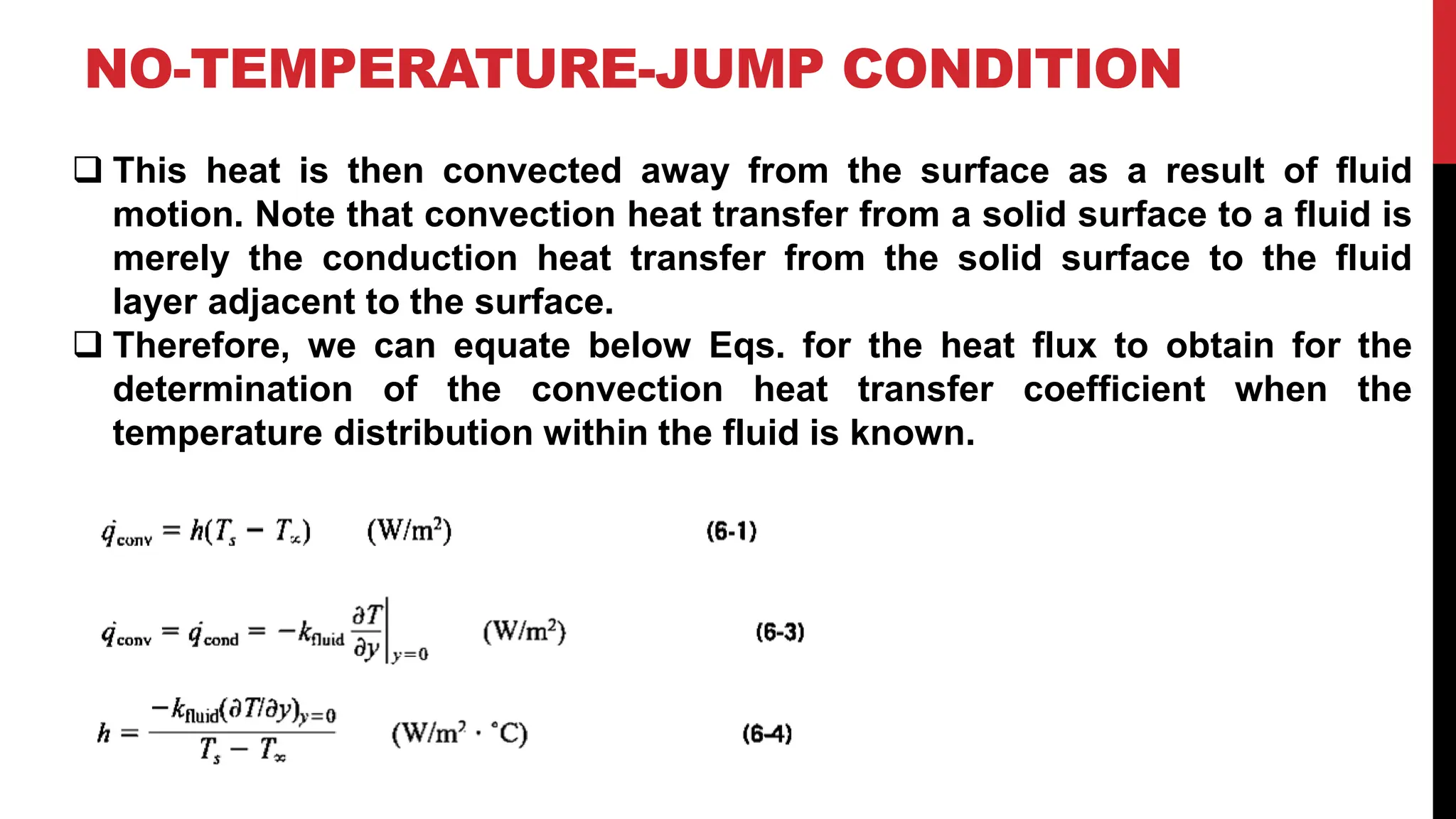
❑ Thisheat is then convected away from the surface as a result of fluid
motion. Note that convection heat transfer from a solid surface to a fluid is
merely the conduction heat transfer from the solid surface to the fluid
layer adjacent to the surface.
❑ Therefore, we can equate below Eqs. for the heat flux to obtain for the
determination of the convection heat transfer coefficient when the
temperature distribution within the fluid is known.
10.
NUSSELT NUMBER
• Inheat transfer at a boundary (surface) within a fluid, the Nusselt number
(Nu) is the ratio of convective to conductive heat transfer across (normal to)
the boundary. Convection includes both advection and diffusion. Named after
Wilhelm Nusselt, it is a dimensionless number.
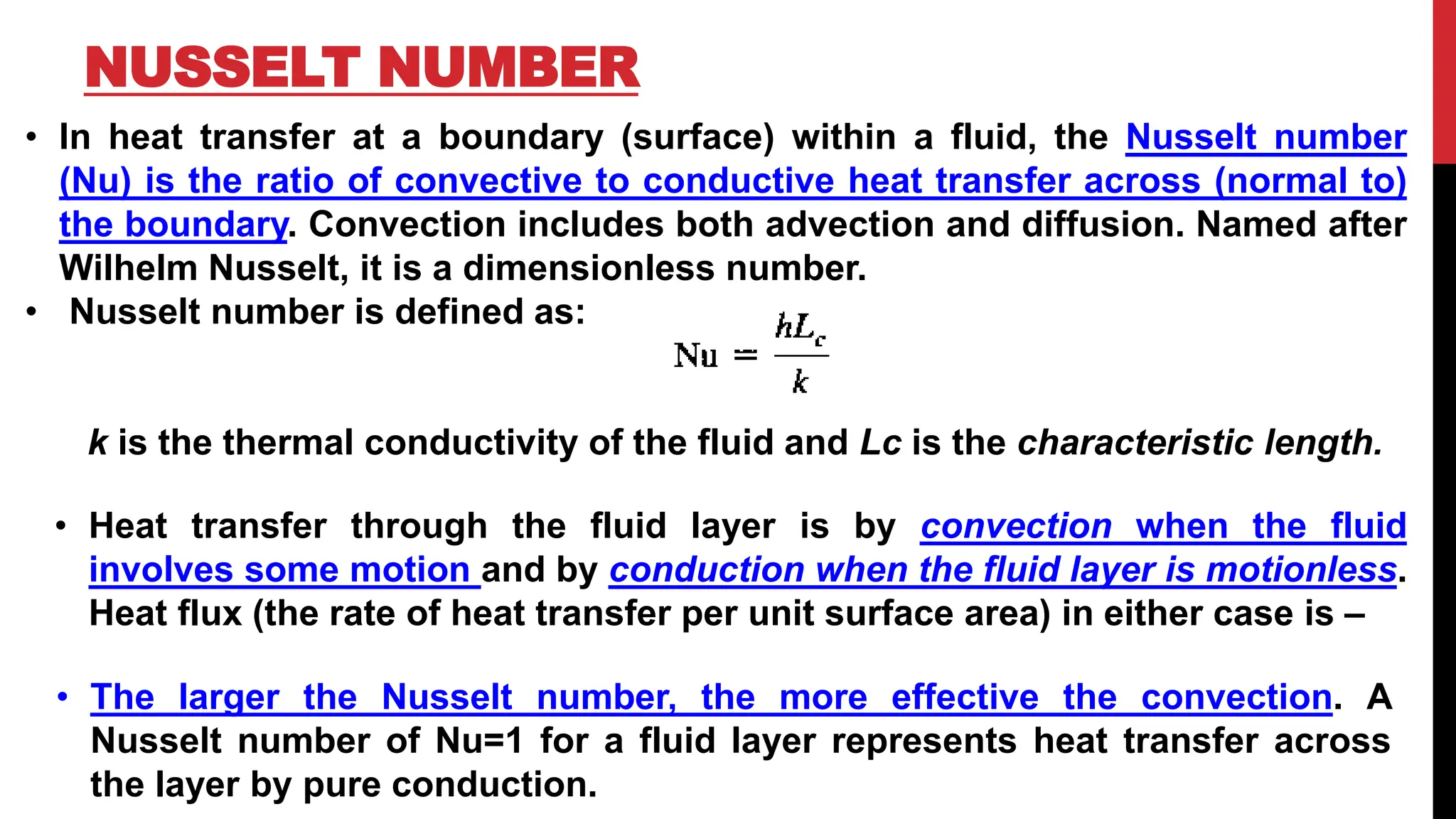
• Nusselt number is defined as:
k is the thermal conductivity of the fluid and Lc is the characteristic length.
• Heat transfer through the fluid layer is by convection when the fluid
involves some motion and by conduction when the fluid layer is motionless.
Heat flux (the rate of heat transfer per unit surface area) in either case is –
• The larger the Nusselt number, the more effective the convection. A
Nusselt number of Nu=1 for a fluid layer represents heat transfer across
the layer by pure conduction.
11.
NUSSELT NUMBER
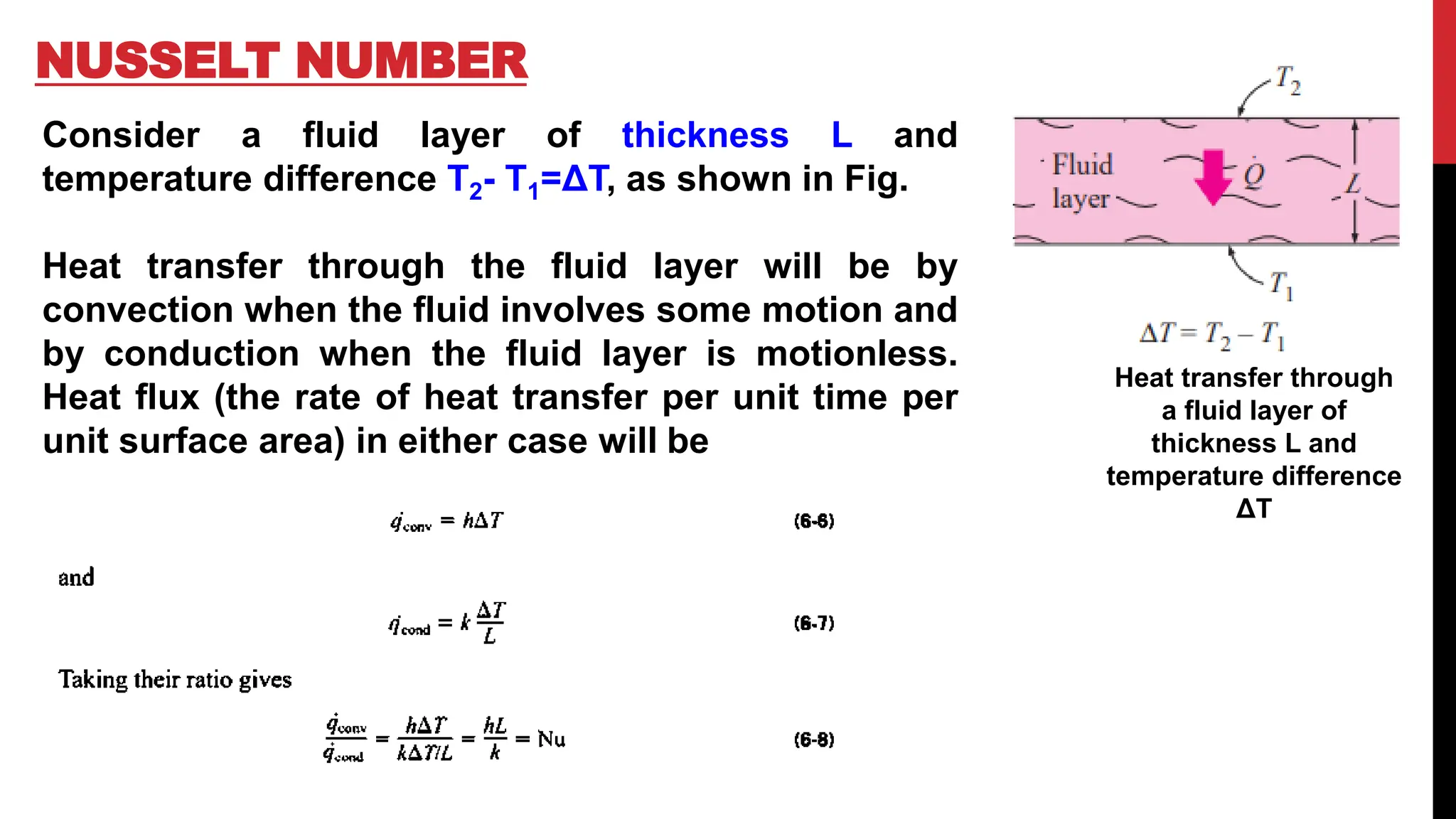
Heat transferthrough
a fluid layer of
thickness L and
temperature difference
ΔT
Consider a fluid layer of thickness L and
temperature difference T2- T1=ΔT, as shown in Fig.
Heat transfer through the fluid layer will be by
convection when the fluid involves some motion and
by conduction when the fluid layer is motionless.
Heat flux (the rate of heat transfer per unit time per
unit surface area) in either case will be
12.
TYPES OF FLUIDFLOWS
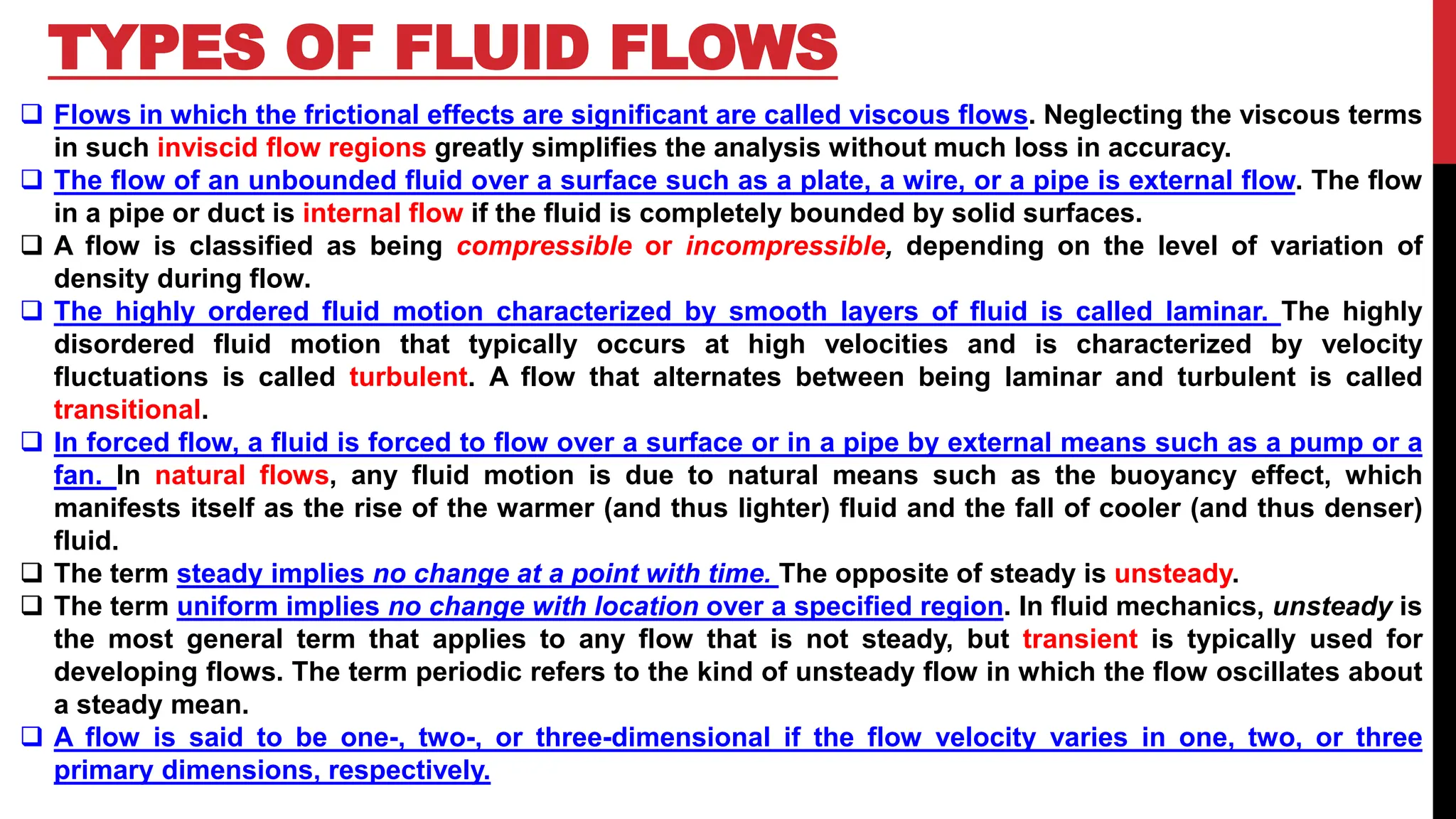
❑ Flows in which the frictional effects are significant are called viscous flows. Neglecting the viscous terms
in such inviscid flow regions greatly simplifies the analysis without much loss in accuracy.
❑ The flow of an unbounded fluid over a surface such as a plate, a wire, or a pipe is external flow. The flow
in a pipe or duct is internal flow if the fluid is completely bounded by solid surfaces.
❑ A flow is classified as being compressible or incompressible, depending on the level of variation of
density during flow.
❑ The highly ordered fluid motion characterized by smooth layers of fluid is called laminar. The highly
disordered fluid motion that typically occurs at high velocities and is characterized by velocity
fluctuations is called turbulent. A flow that alternates between being laminar and turbulent is called
transitional.
❑ In forced flow, a fluid is forced to flow over a surface or in a pipe by external means such as a pump or a
fan. In natural flows, any fluid motion is due to natural means such as the buoyancy effect, which
manifests itself as the rise of the warmer (and thus lighter) fluid and the fall of cooler (and thus denser)
fluid.
❑ The term steady implies no change at a point with time. The opposite of steady is unsteady.
❑ The term uniform implies no change with location over a specified region. In fluid mechanics, unsteady is
the most general term that applies to any flow that is not steady, but transient is typically used for
developing flows. The term periodic refers to the kind of unsteady flow in which the flow oscillates about
a steady mean.
❑ A flow is said to be one-, two-, or three-dimensional if the flow velocity varies in one, two, or three
primary dimensions, respectively.
13.
VISCOUS VERSUS INVISCIDFLOW
❑ When two fluid layers move relative to each other, a friction force develops
between them and the slower layer tries to slow down the faster layer.
❑ This internal resistance to flow is called the viscosity, which is a measure of
internal stickiness of the fluid.
❑ Viscosity is caused by cohesive forces between the molecules in liquids,
and by the molecular collisions in gases.
❑ There is no fluid with zero viscosity, and thus all fluid flows involve viscous
effects to some degree.
❑ Flows in which the effects of viscosity are significant are called viscous
flows.
❑ The effects of viscosity are very small in some flows, and neglecting those
effects greatly simplifies the analysis without much loss in accuracy. Such
idealized flows of zero-viscosity fluids are called frictionless or inviscid
flows.
14.
INTERNAL VERSUS EXTERNALFLOW
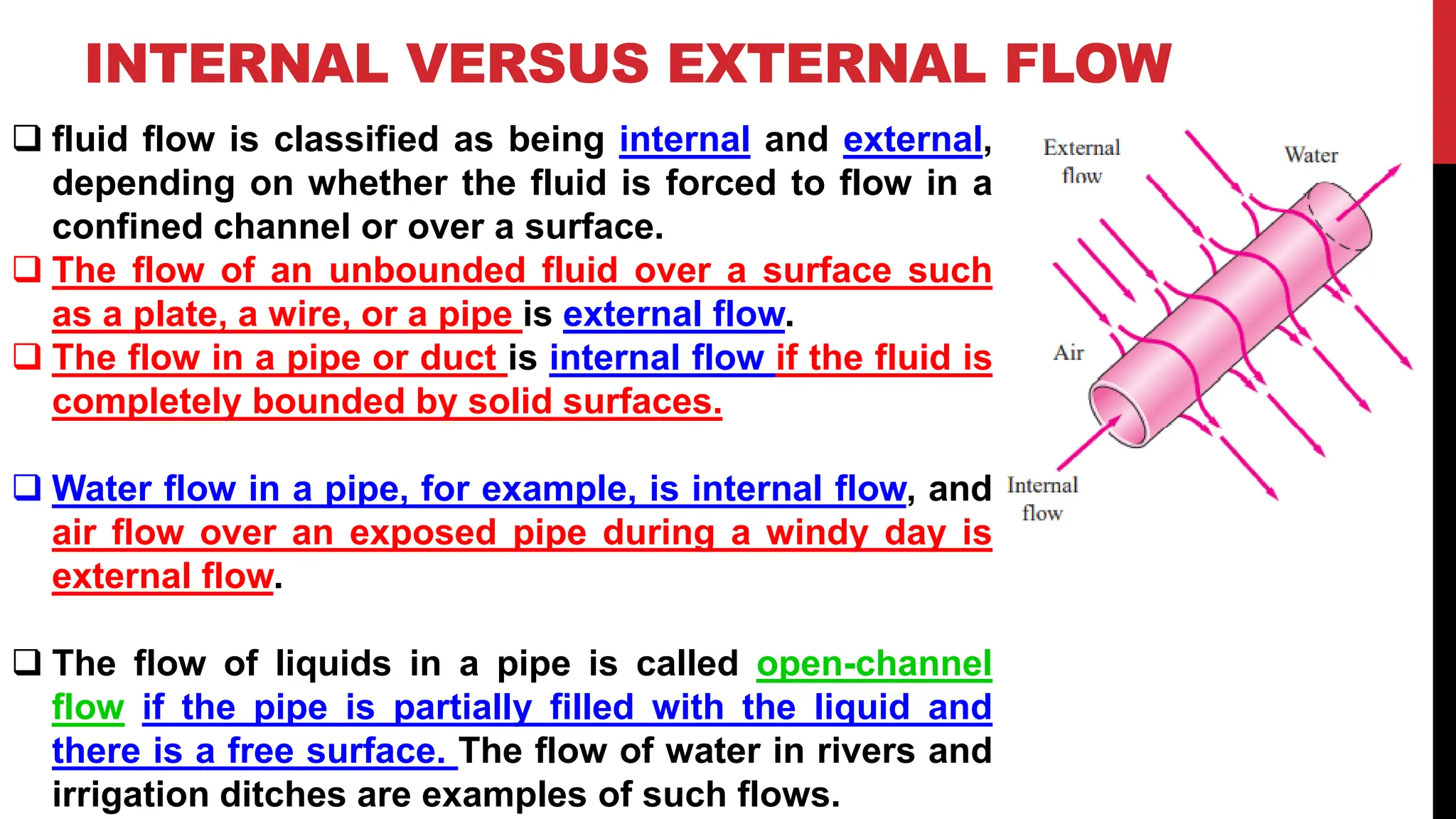
❑ fluid flow is classified as being internal and external,
depending on whether the fluid is forced to flow in a
confined channel or over a surface.
❑ The flow of an unbounded fluid over a surface such
as a plate, a wire, or a pipe is external flow.
❑ The flow in a pipe or duct is internal flow if the fluid is
completely bounded by solid surfaces.
❑ Water flow in a pipe, for example, is internal flow, and
air flow over an exposed pipe during a windy day is
external flow.
❑ The flow of liquids in a pipe is called open-channel
flow if the pipe is partially filled with the liquid and
there is a free surface. The flow of water in rivers and
irrigation ditches are examples of such flows.
15.
COMPRESSIBLE VERSUS INCOMPRESSIBLEFLOW
• A flow is classified as being compressible or incompressible, depending
on the level of variation of density during flow
• Incompressibility is an approximation, in which the flow is said to be
incompressible if the density remains nearly constant throughout
• Therefore, the volume of every portion of fluid remains unchanged over
the course of its motion when the flow is approximated as incompressible
• The densities of liquids are essentially constant, and thus the flow of
liquids is typically incompressible
• A pressure of 210 atm, for example, causes the density of liquid water at 1
atm to change by just 1 percent
• Gases, on the other hand, are highly compressible. A pressure change of
just 0.01 atm, for example, causes a change of 1 percent in the density of
atmospheric air
16.
LAMINAR VERSUS TURBULENTFLOW
• The highly ordered fluid motion characterized by smooth
layers of fluid is called laminar
• The flow of high-viscosity fluids such as oils at low velocities
is typically laminar
• The highly disordered fluid motion that typically occurs at high
velocities and is characterized by velocity fluctuations is called
turbulent
• The flow of low-viscosity fluids such as air at high velocities is
typically turbulent
• A flow that alternates between being laminar and turbulent is
called transitional
• Reynolds number, Re, as the key parameter for the
determination of the flow regime in pipes
17.
STEADY VERSUS UNSTEADYFLOW
• The term steady implies no change of properties, velocity,
temperature, etc., at a point with time.
• The opposite of steady is unsteady.
• The term uniform implies no change with location over a
specified region
• The terms unsteady and transient are often used
interchangeably, but these terms are not synonyms
• The term periodic refers to the kind of unsteady flow in which
the flow oscillates about a steady mean
18.
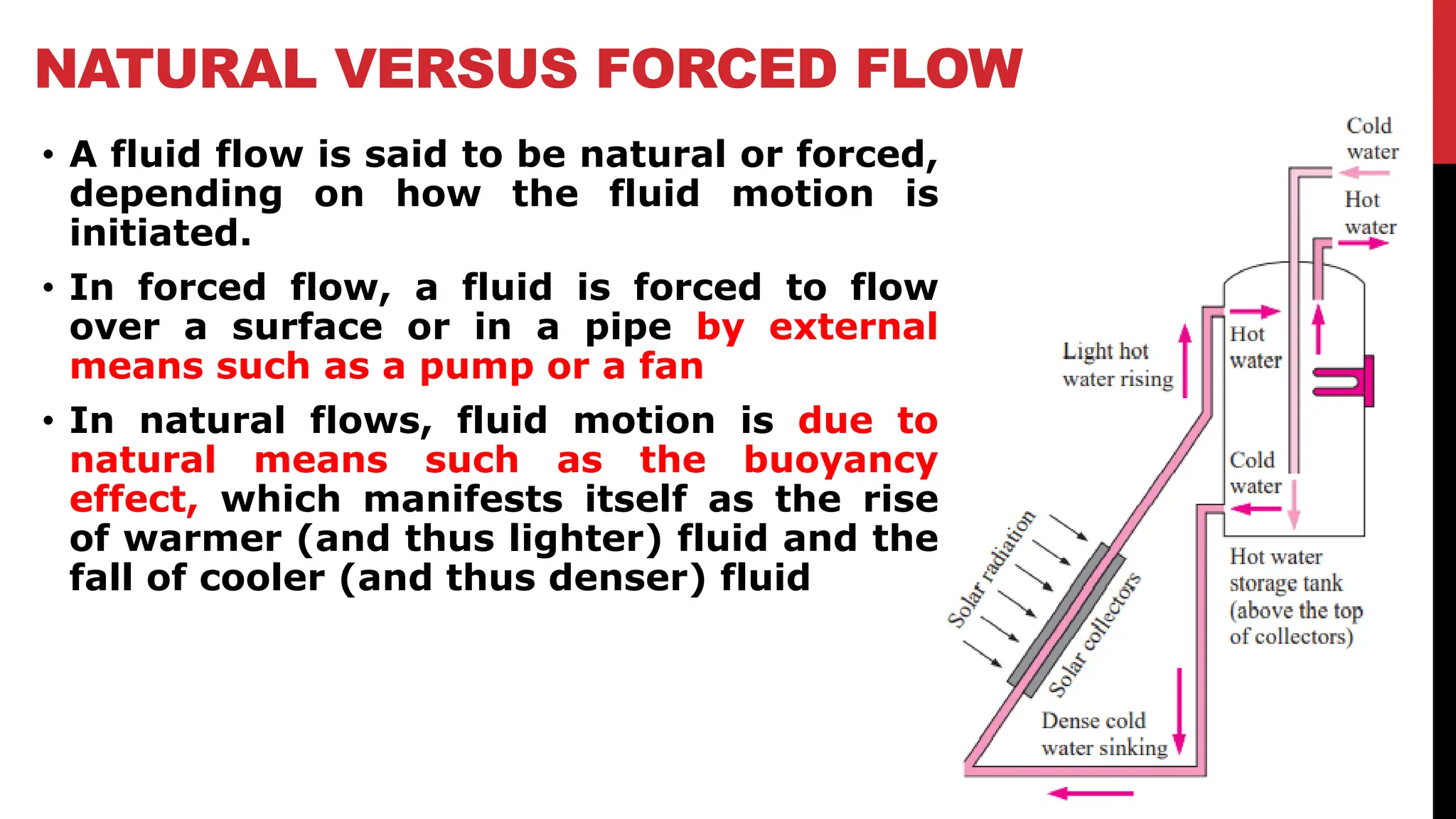
NATURAL VERSUS FORCEDFLOW
• A fluid flow is said to be natural or forced,
depending on how the fluid motion is
initiated.
• In forced flow, a fluid is forced to flow
over a surface or in a pipe by external
means such as a pump or a fan
• In natural flows, fluid motion is due to
natural means such as the buoyancy
effect, which manifests itself as the rise
of warmer (and thus lighter) fluid and the
fall of cooler (and thus denser) fluid
19.
ONE-, TWO-, ANDTHREE-DIMENSIONAL FLOWS
❖A flow field is best characterized by its velocity distribution, and
thus a flow is said to be one-, two-, or three-dimensional if the flow
velocity varies in one, two, or three primary dimensions,
respectively
❖A typical fluid flow involves a three-dimensional geometry, and the
velocity may vary in all three dimensions, rendering the flow three-
dimensional [V(x, y, z) in rectangular or V(r, θ, z) in cylindrical
coordinates]
❖Consider steady flow of a fluid entering from a large tank into a
circular pipe
❖The fluid velocity everywhere on the pipe surface is zero because of
the no-slip condition, and the flow is two-dimensional in the
entrance region of the pipe since the velocity changes in both the r-
and z-directions, but not in the θ-direction
20.
ONE-, TWO-, ANDTHREE-DIMENSIONAL FLOWS
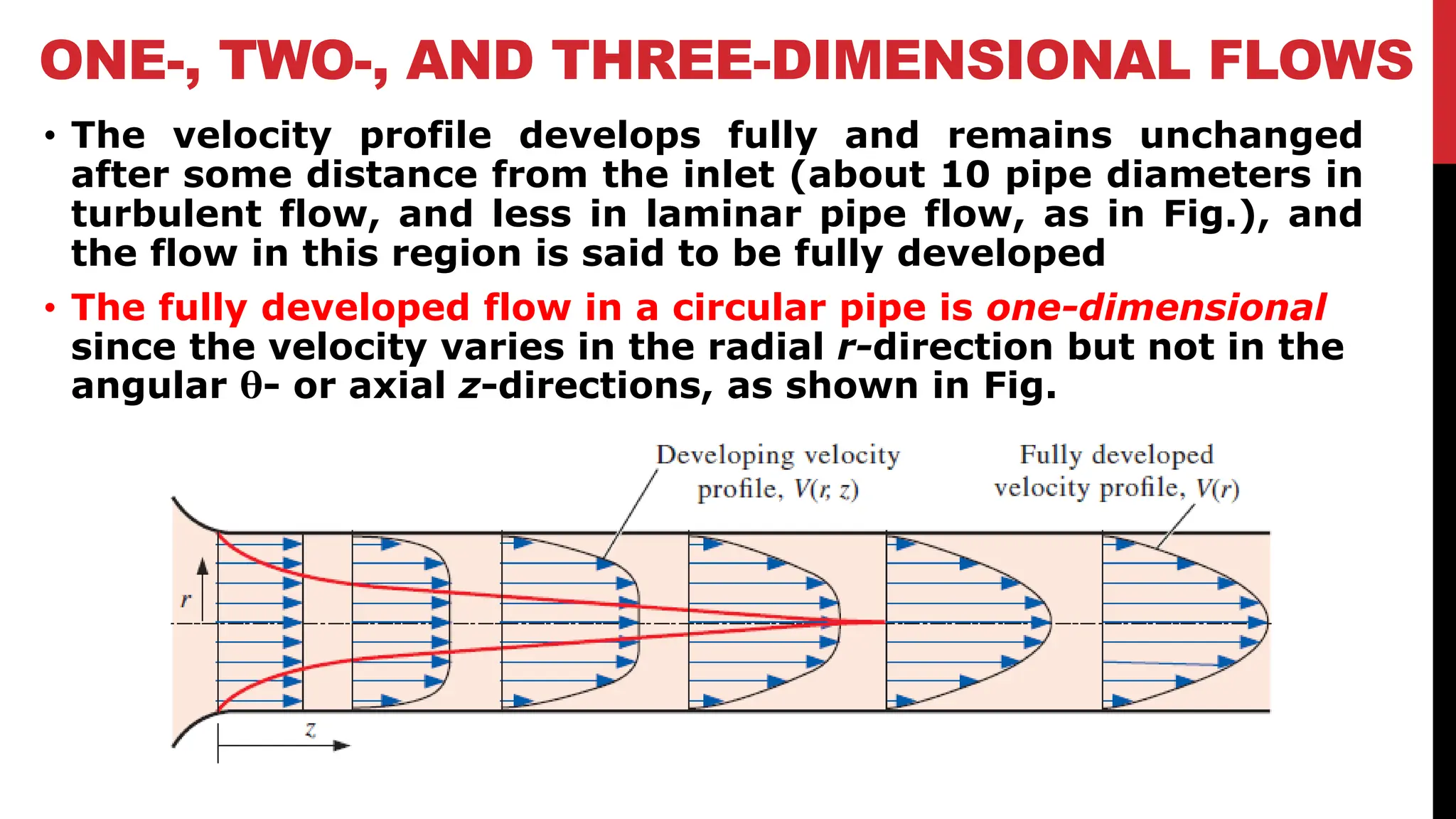
• The velocity profile develops fully and remains unchanged
after some distance from the inlet (about 10 pipe diameters in
turbulent flow, and less in laminar pipe flow, as in Fig.), and
the flow in this region is said to be fully developed
• The fully developed flow in a circular pipe is one-dimensional
since the velocity varies in the radial r-direction but not in the
angular θ- or axial z-directions, as shown in Fig.
21.
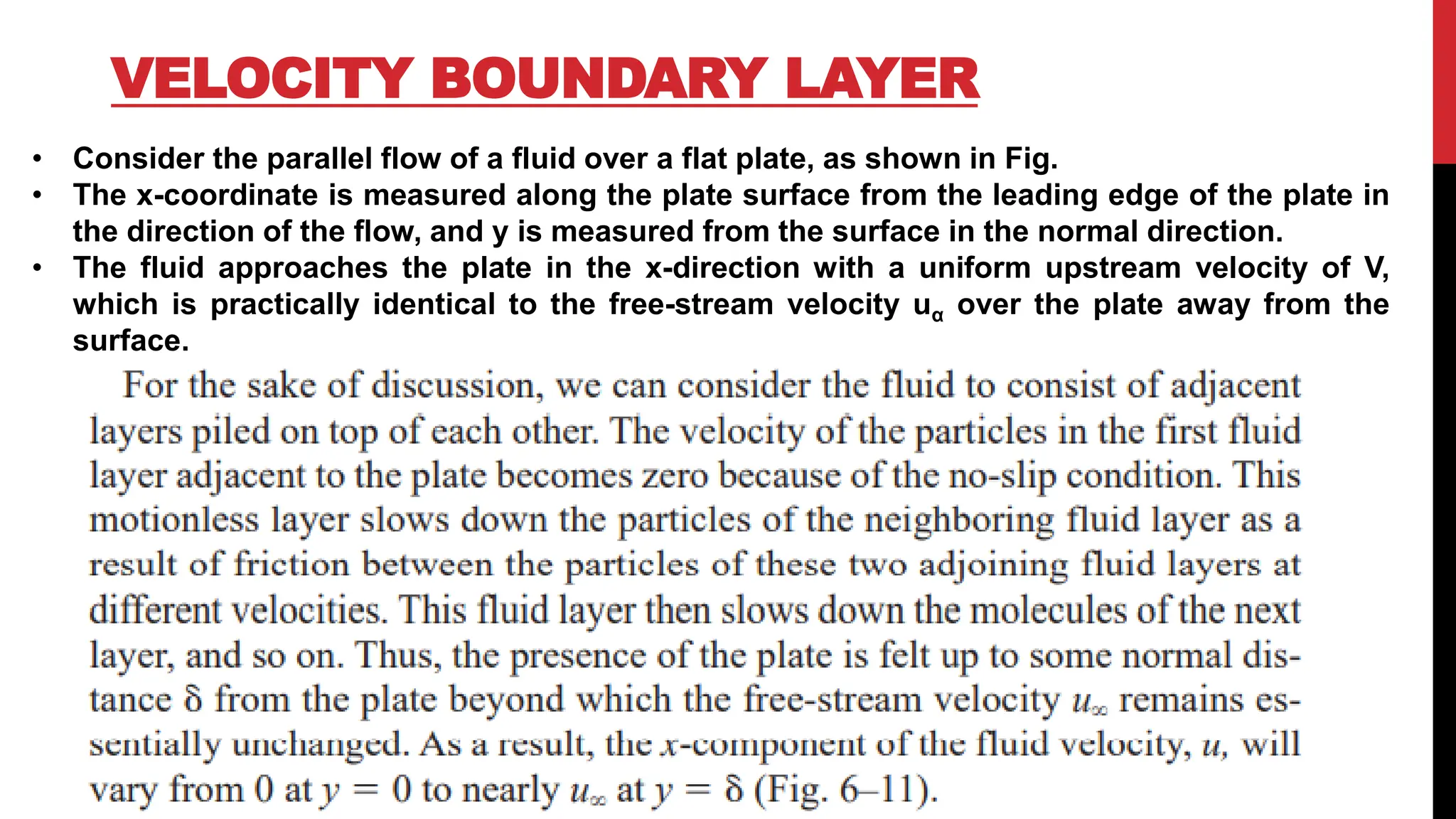
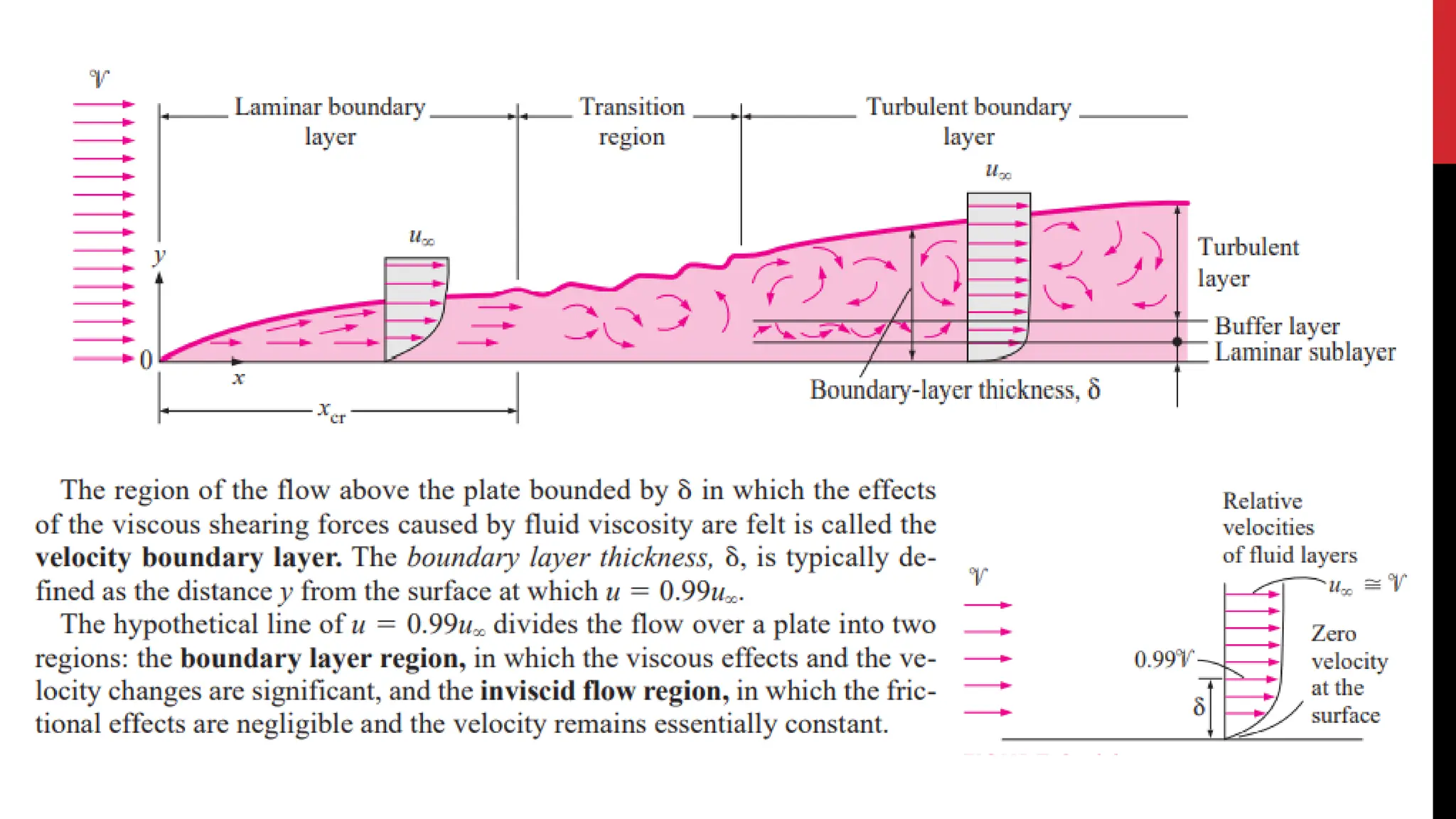
VELOCITY BOUNDARY LAYER
•Consider the parallel flow of a fluid over a flat plate, as shown in Fig.
• The x-coordinate is measured along the plate surface from the leading edge of the plate in
the direction of the flow, and y is measured from the surface in the normal direction.
• The fluid approaches the plate in the x-direction with a uniform upstream velocity of V,
which is practically identical to the free-stream velocity uα over the plate away from the
surface.
23.
WALL SHEAR STRESS
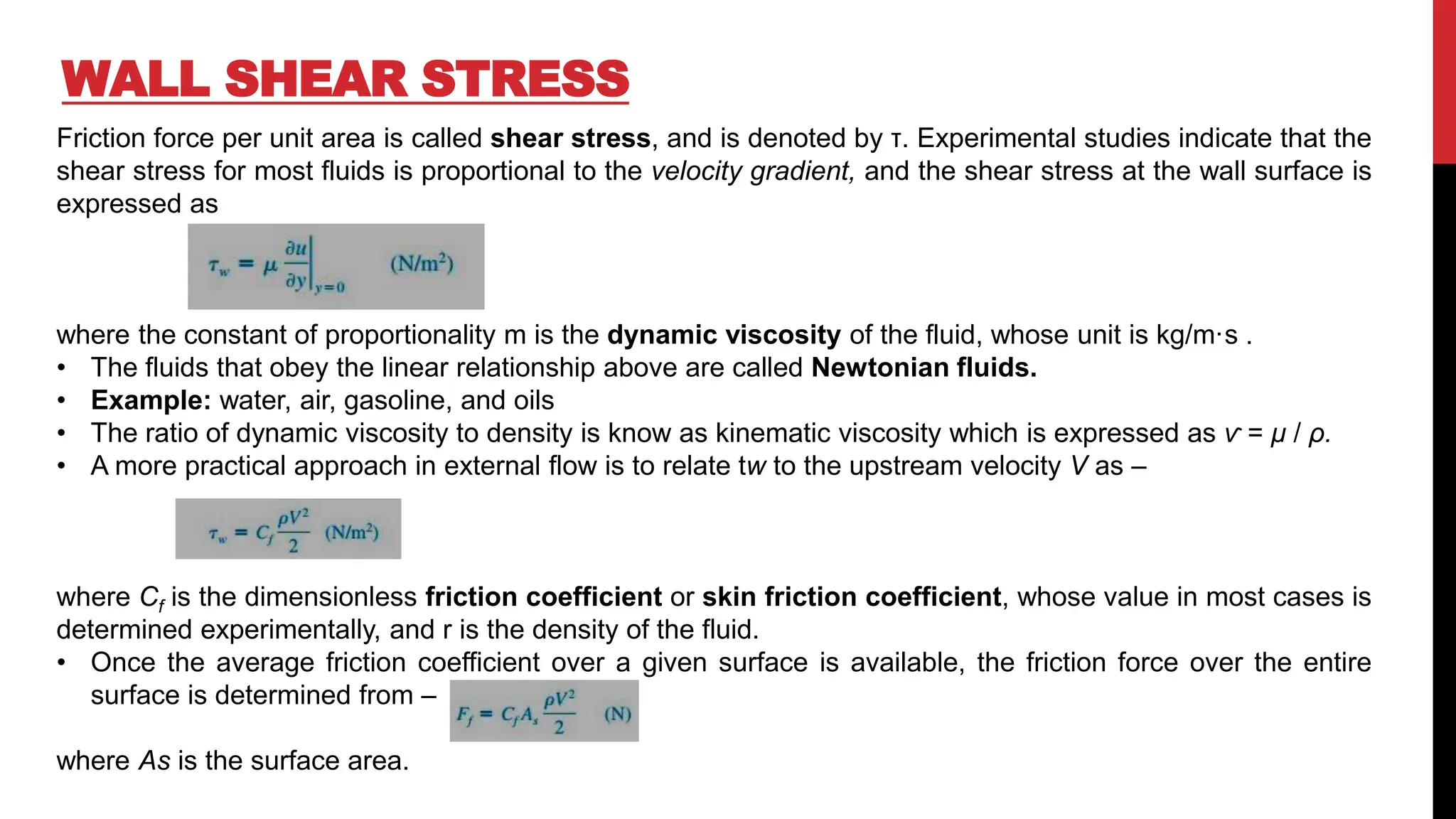
Frictionforce per unit area is called shear stress, and is denoted by τ. Experimental studies indicate that the
shear stress for most fluids is proportional to the velocity gradient, and the shear stress at the wall surface is
expressed as
where the constant of proportionality m is the dynamic viscosity of the fluid, whose unit is kg/m·s .
• The fluids that obey the linear relationship above are called Newtonian fluids.
• Example: water, air, gasoline, and oils
• The ratio of dynamic viscosity to density is know as kinematic viscosity which is expressed as ѵ = μ / ρ.
• A more practical approach in external flow is to relate tw to the upstream velocity V as –
where Cf is the dimensionless friction coefficient or skin friction coefficient, whose value in most cases is
determined experimentally, and r is the density of the fluid.
• Once the average friction coefficient over a given surface is available, the friction force over the entire
surface is determined from –
where As is the surface area.
24.
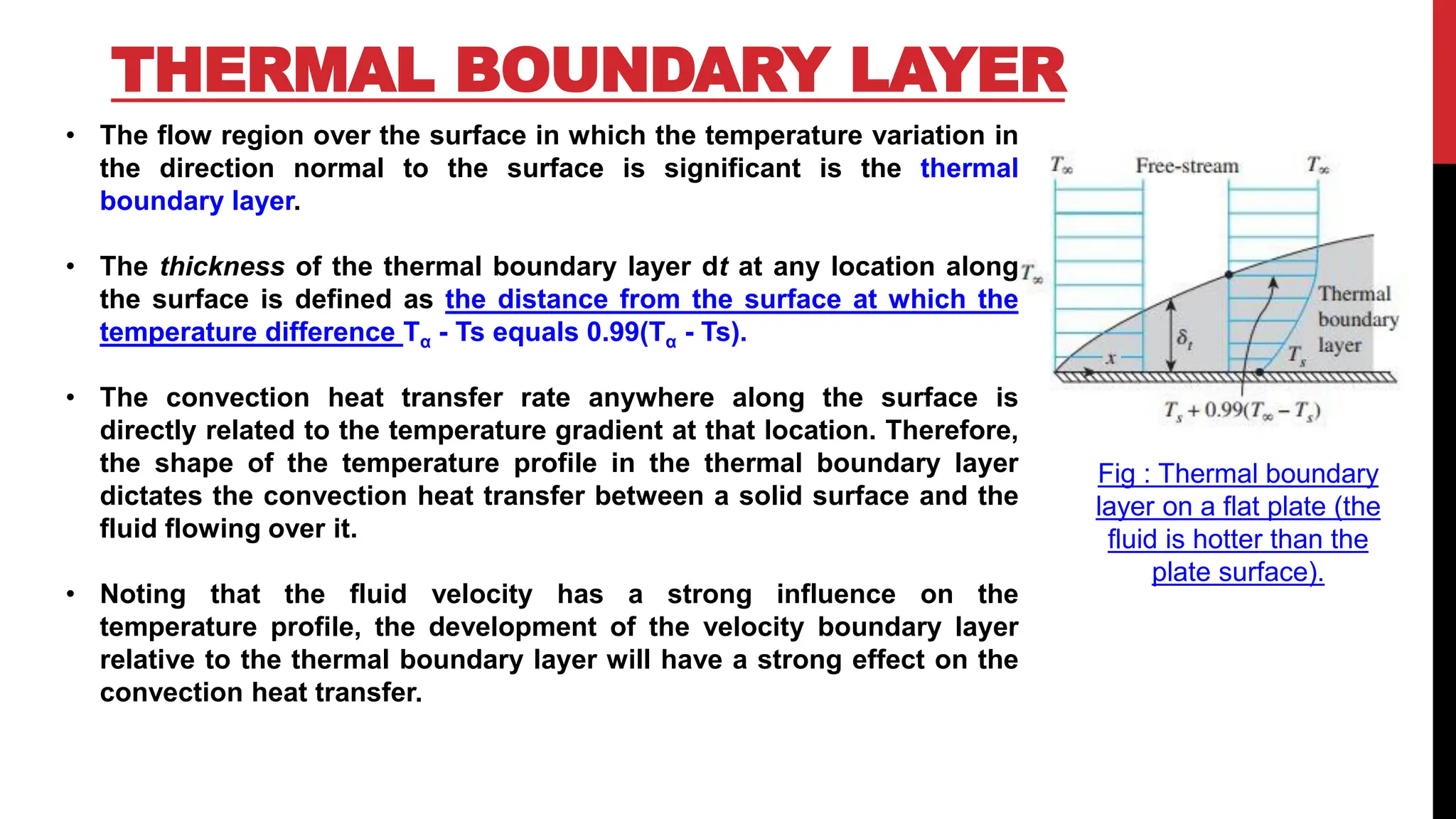
THERMAL BOUNDARY LAYER
•The flow region over the surface in which the temperature variation in
the direction normal to the surface is significant is the thermal
boundary layer.
• The thickness of the thermal boundary layer dt at any location along
the surface is defined as the distance from the surface at which the
temperature difference Tα - Ts equals 0.99(Tα - Ts).
• The convection heat transfer rate anywhere along the surface is
directly related to the temperature gradient at that location. Therefore,
the shape of the temperature profile in the thermal boundary layer
dictates the convection heat transfer between a solid surface and the
fluid flowing over it.
• Noting that the fluid velocity has a strong influence on the
temperature profile, the development of the velocity boundary layer
relative to the thermal boundary layer will have a strong effect on the
convection heat transfer.
Fig : Thermal boundary
layer on a flat plate (the
fluid is hotter than the
plate surface).
25.
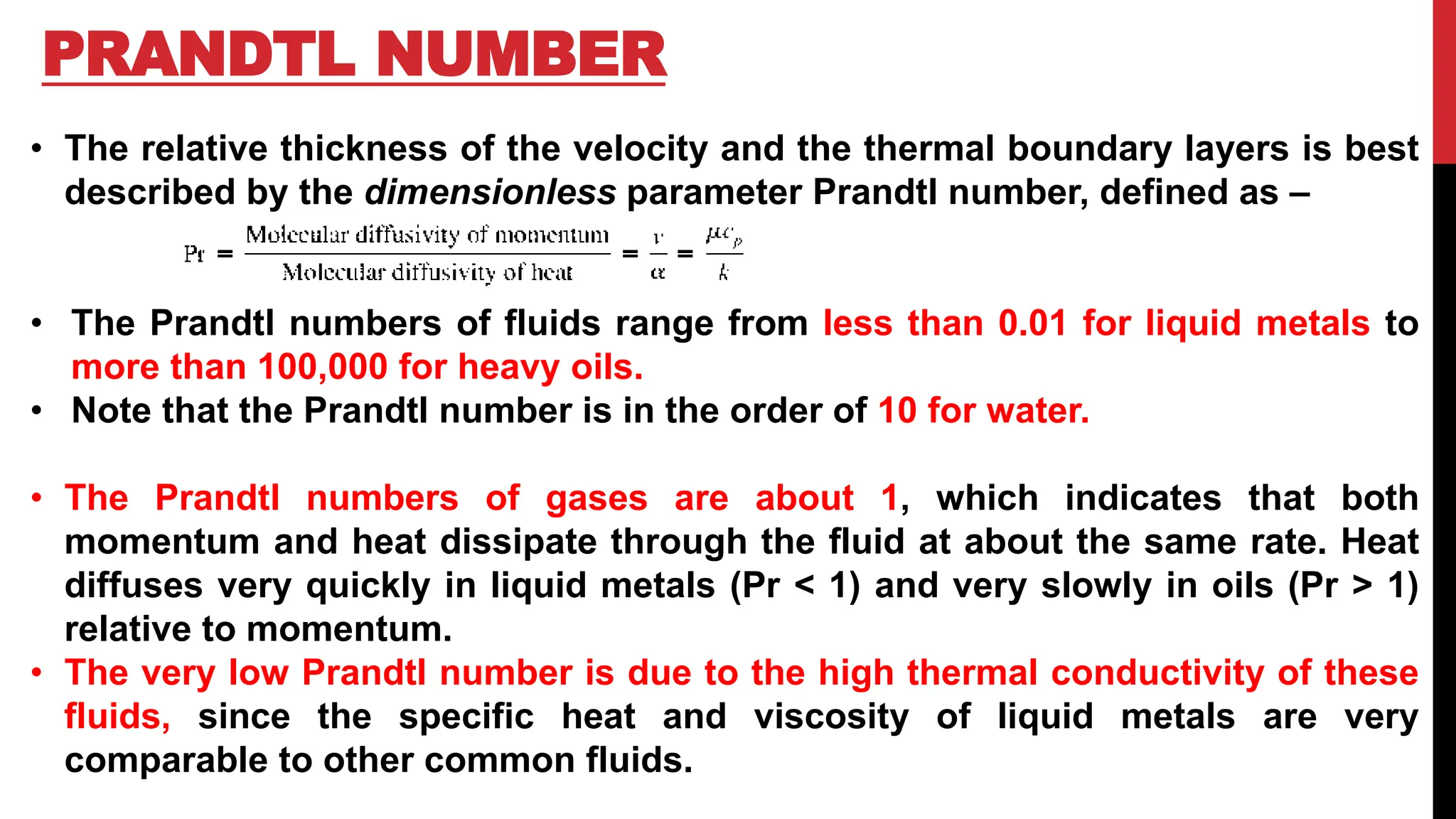
PRANDTL NUMBER
• Therelative thickness of the velocity and the thermal boundary layers is best
described by the dimensionless parameter Prandtl number, defined as –
• The Prandtl numbers of fluids range from less than 0.01 for liquid metals to
more than 100,000 for heavy oils.
• Note that the Prandtl number is in the order of 10 for water.
• The Prandtl numbers of gases are about 1, which indicates that both
momentum and heat dissipate through the fluid at about the same rate. Heat
diffuses very quickly in liquid metals (Pr < 1) and very slowly in oils (Pr > 1)
relative to momentum.
• The very low Prandtl number is due to the high thermal conductivity of these
fluids, since the specific heat and viscosity of liquid metals are very
comparable to other common fluids.
26.
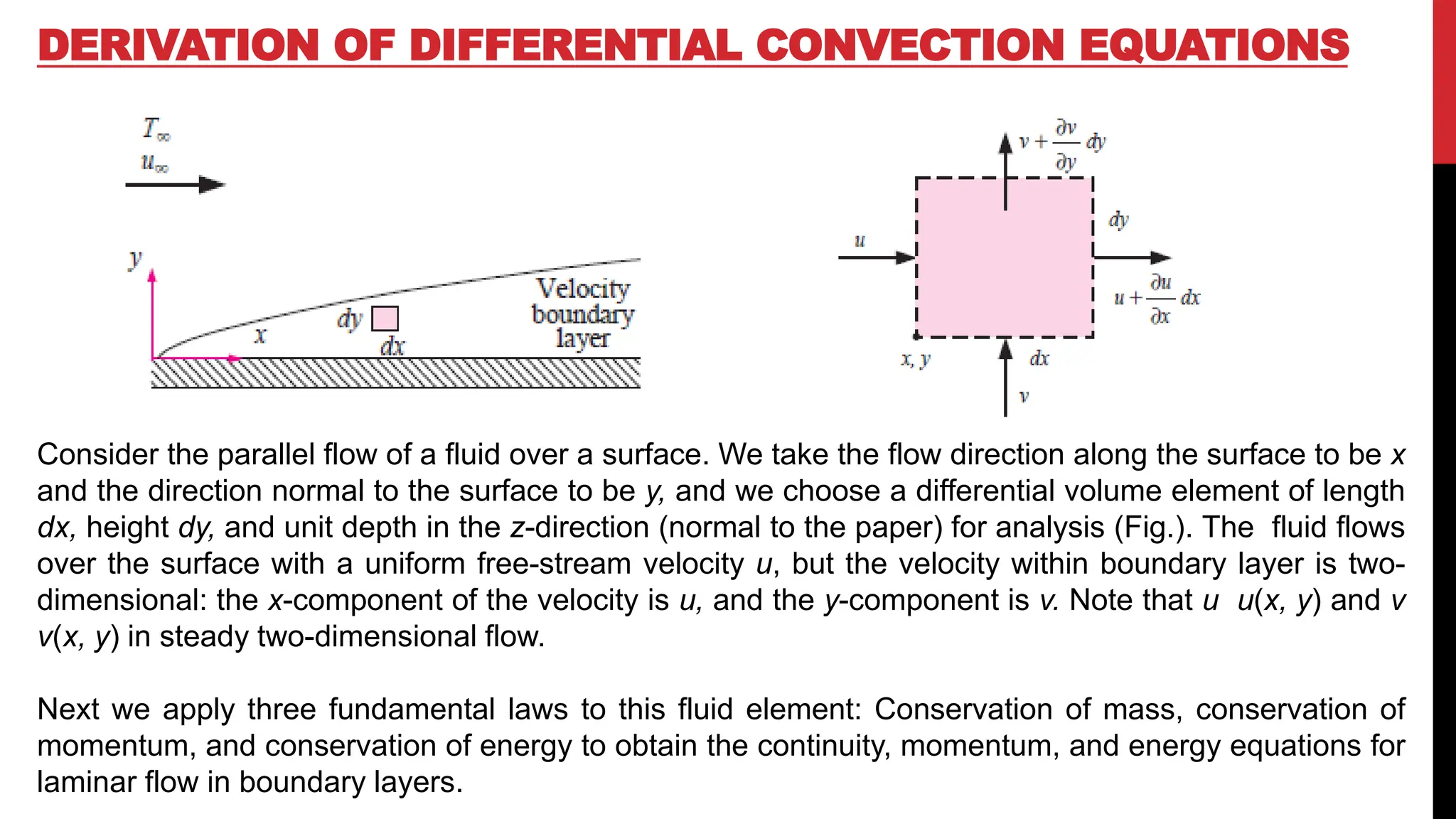
DERIVATION OF DIFFERENTIALCONVECTION EQUATIONS
Consider the parallel flow of a fluid over a surface. We take the flow direction along the surface to be x
and the direction normal to the surface to be y, and we choose a differential volume element of length
dx, height dy, and unit depth in the z-direction (normal to the paper) for analysis (Fig.). The fluid flows
over the surface with a uniform free-stream velocity u, but the velocity within boundary layer is two-
dimensional: the x-component of the velocity is u, and the y-component is v. Note that u u(x, y) and v
v(x, y) in steady two-dimensional flow.
Next we apply three fundamental laws to this fluid element: Conservation of mass, conservation of
momentum, and conservation of energy to obtain the continuity, momentum, and energy equations for
laminar flow in boundary layers.
27.
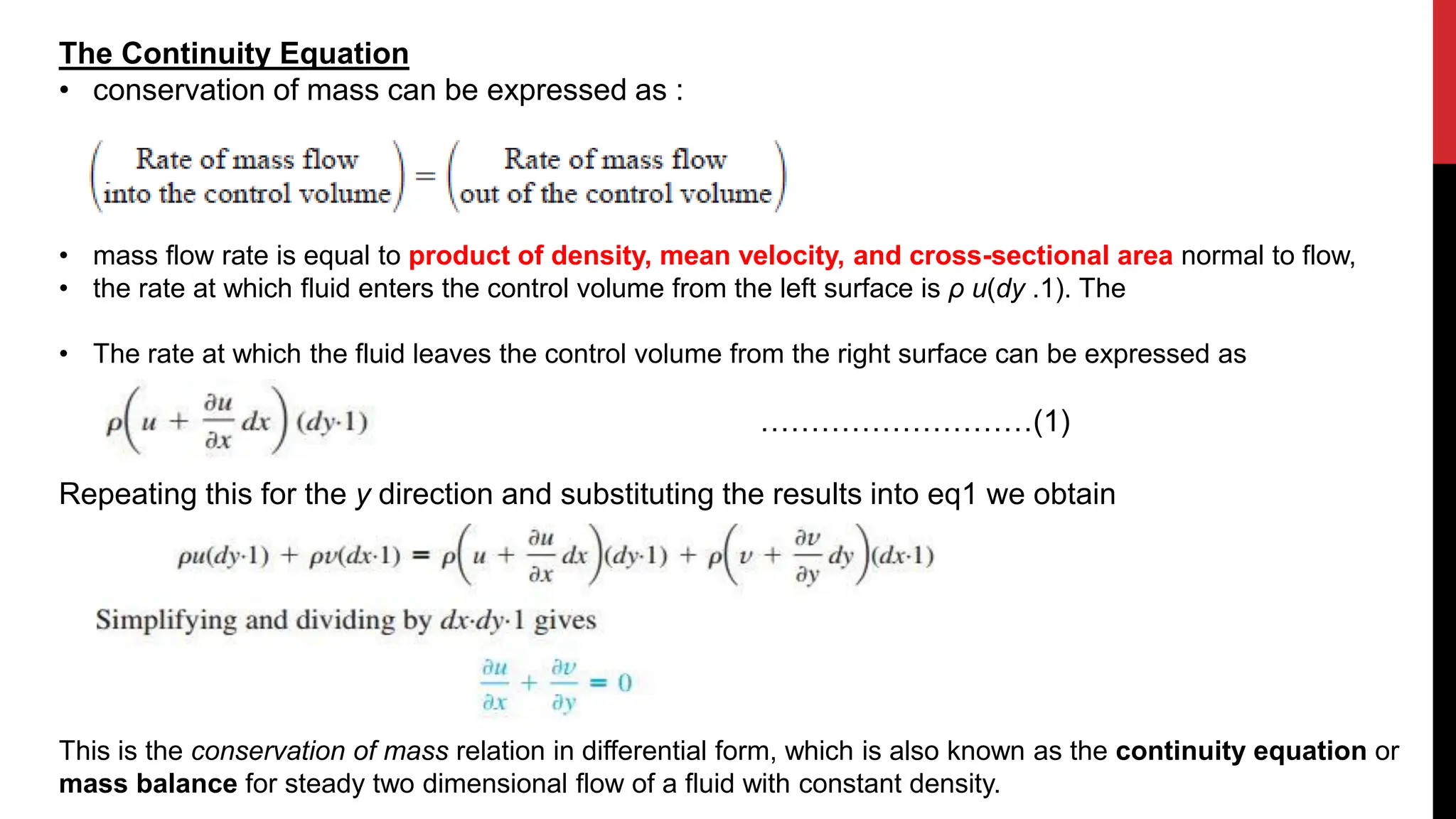
The Continuity Equation
•conservation of mass can be expressed as :
• mass flow rate is equal to product of density, mean velocity, and cross-sectional area normal to flow,
• the rate at which fluid enters the control volume from the left surface is ρ u(dy .1). The
• The rate at which the fluid leaves the control volume from the right surface can be expressed as
………………………(1)
Repeating this for the y direction and substituting the results into eq1 we obtain
This is the conservation of mass relation in differential form, which is also known as the continuity equation or
mass balance for steady two dimensional flow of a fluid with constant density.
28.
THE MOMENTUM EQUATIONS
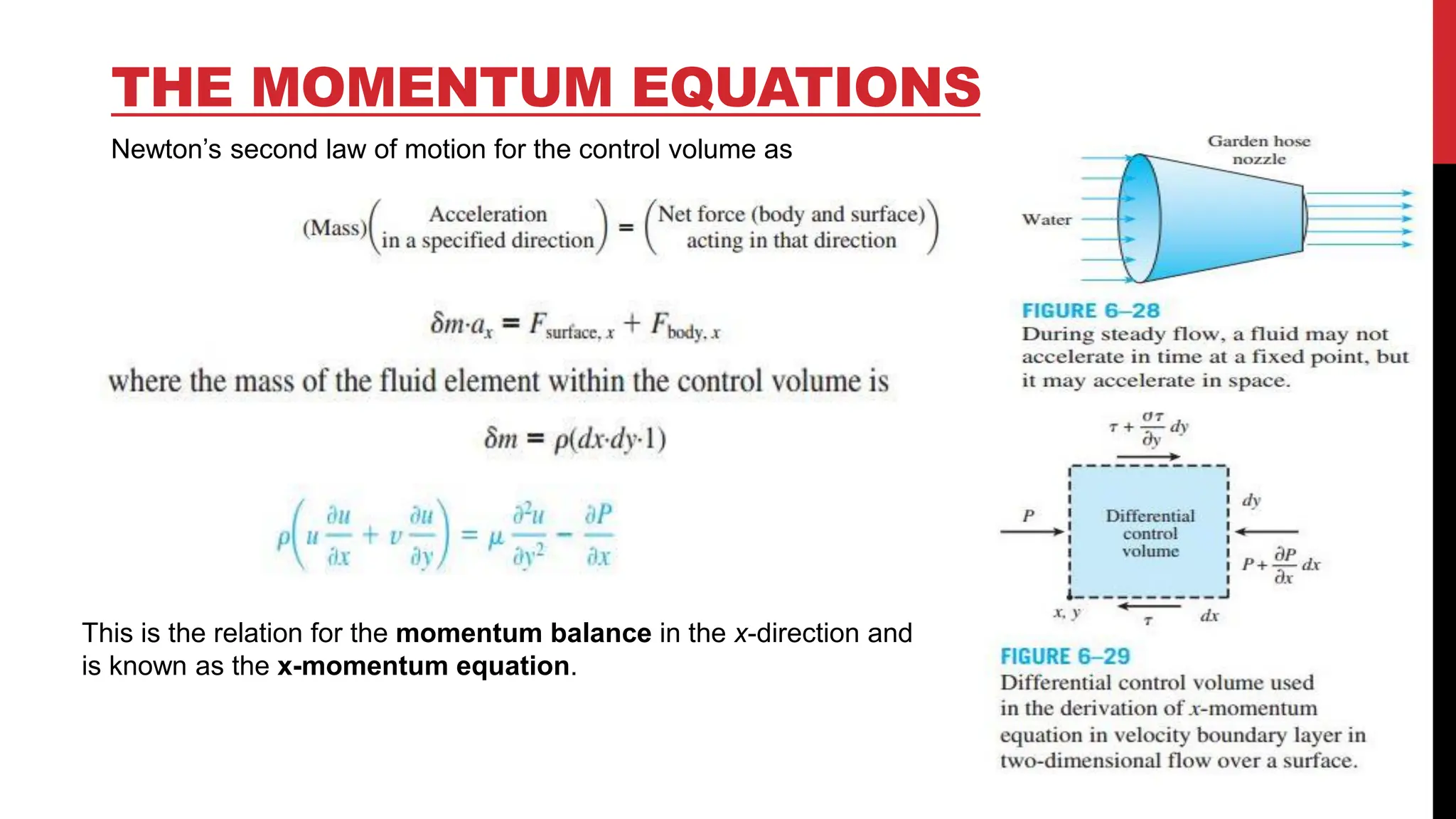
Newton’ssecond law of motion for the control volume as
This is the relation for the momentum balance in the x-direction and
is known as the x-momentum equation.
29.
CONSERVATION OF ENERGYEQUATION
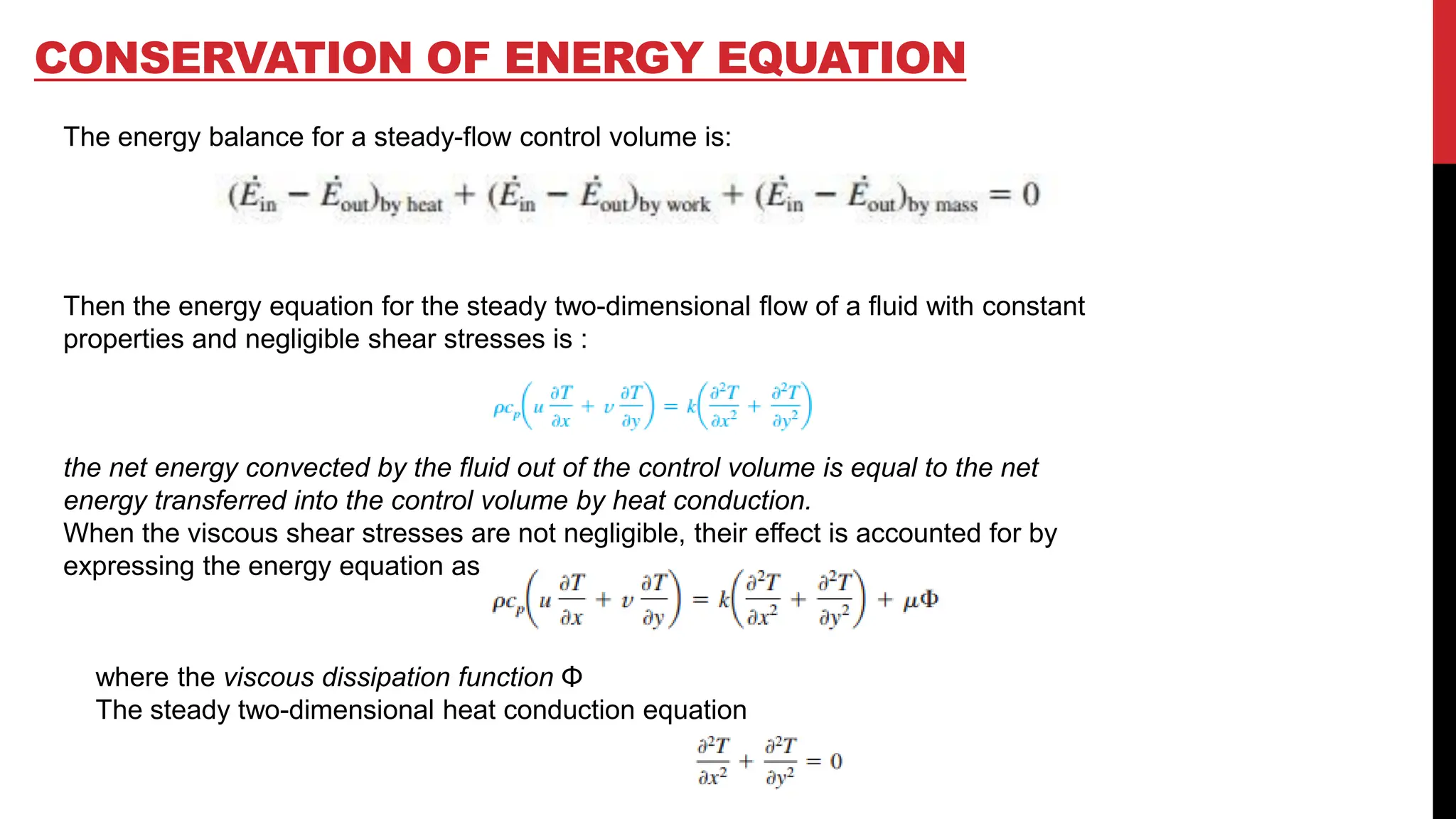
The energy balance for a steady-flow control volume is:
Then the energy equation for the steady two-dimensional flow of a fluid with constant
properties and negligible shear stresses is :
the net energy convected by the fluid out of the control volume is equal to the net
energy transferred into the control volume by heat conduction.
When the viscous shear stresses are not negligible, their effect is accounted for by
expressing the energy equation as
where the viscous dissipation function Φ
The steady two-dimensional heat conduction equation
31.
SOLUTIONS OF CONVECTION
EQUATIONSFOR A FLAT PLATE
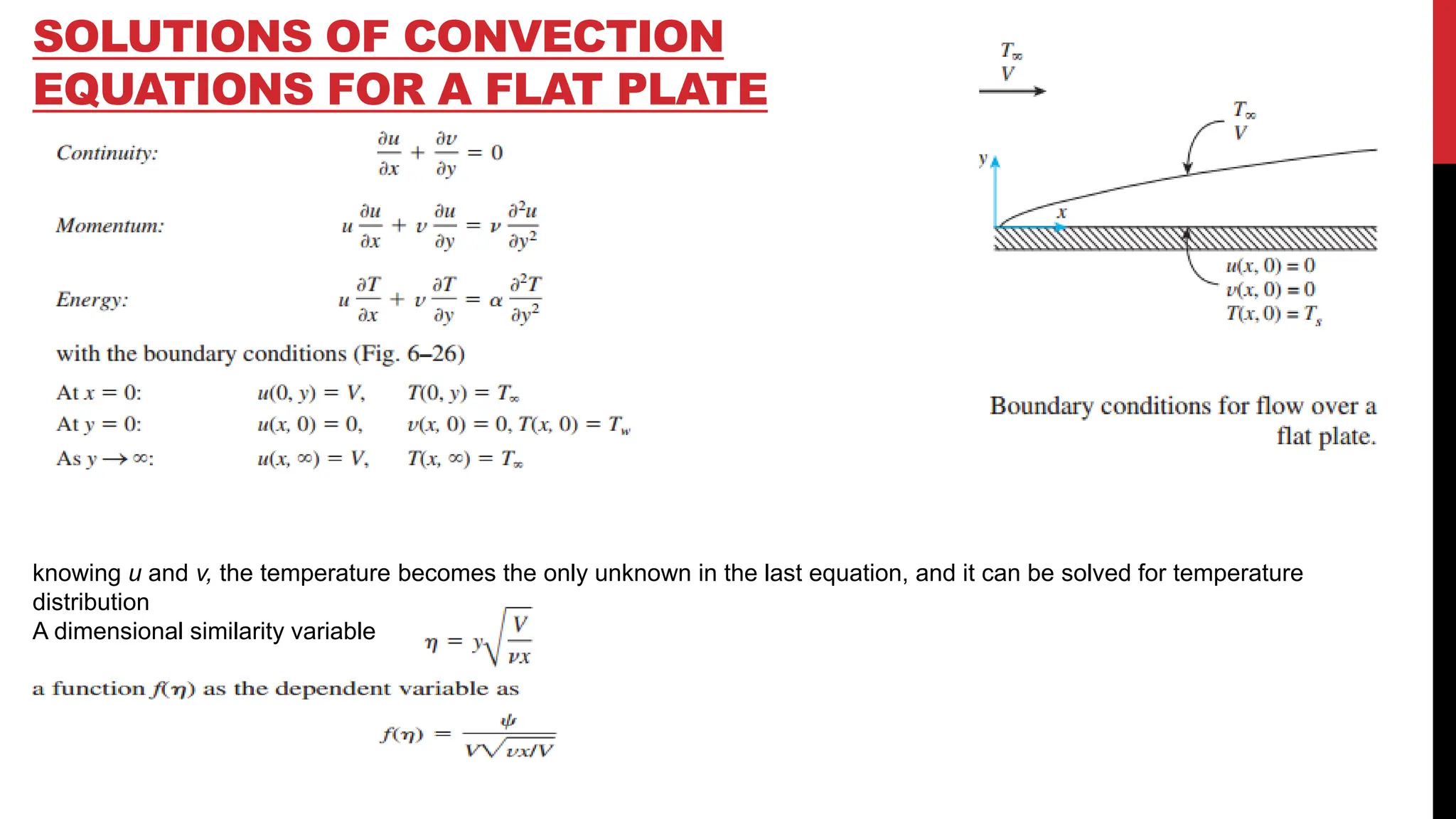
knowing u and v, the temperature becomes the only unknown in the last equation, and it can be solved for temperature
distribution
A dimensional similarity variable
32.
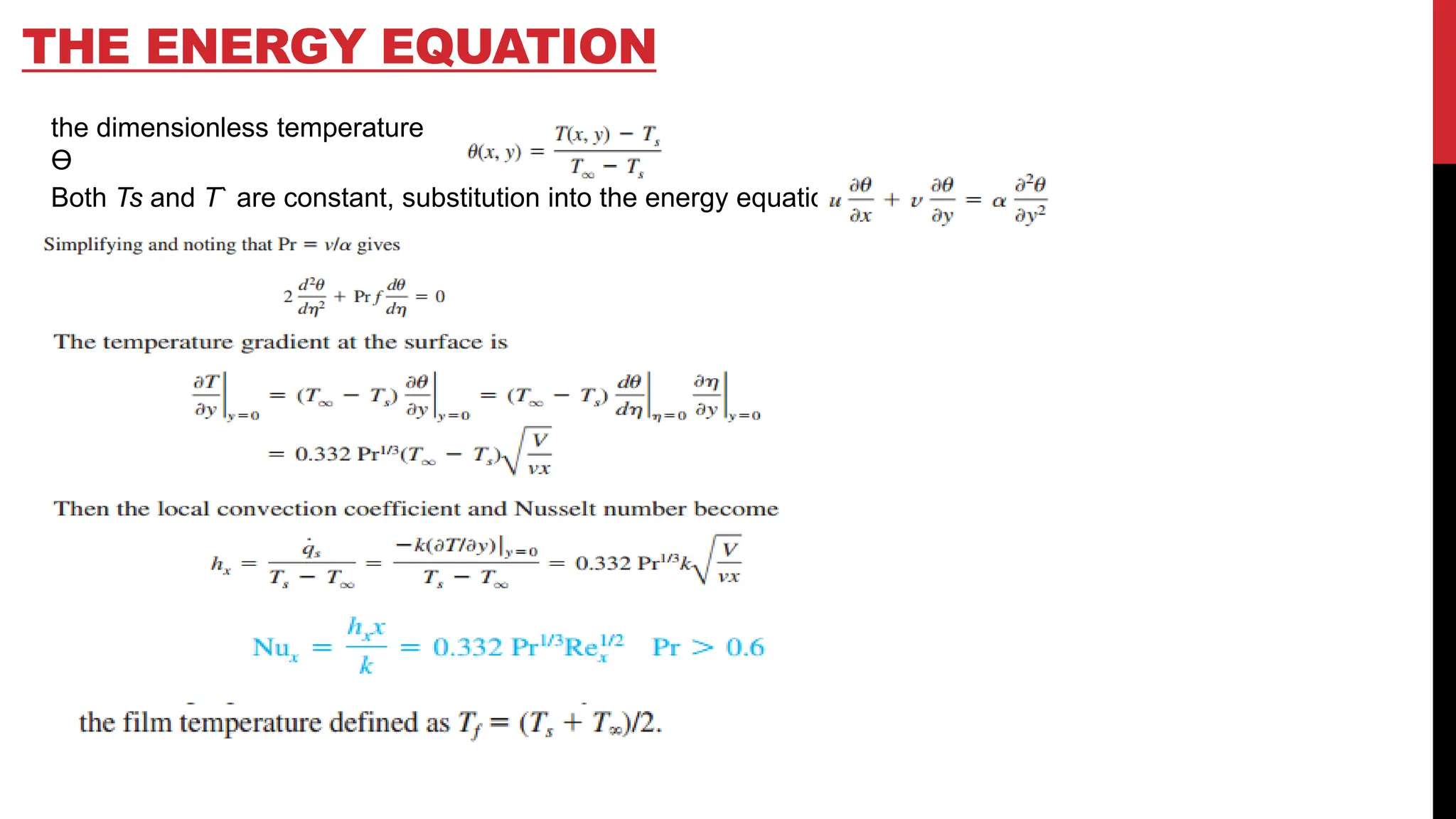
THE ENERGY EQUATION
thedimensionless temperature
ϴ
Both Ts and T` are constant, substitution into the energy equation
33.
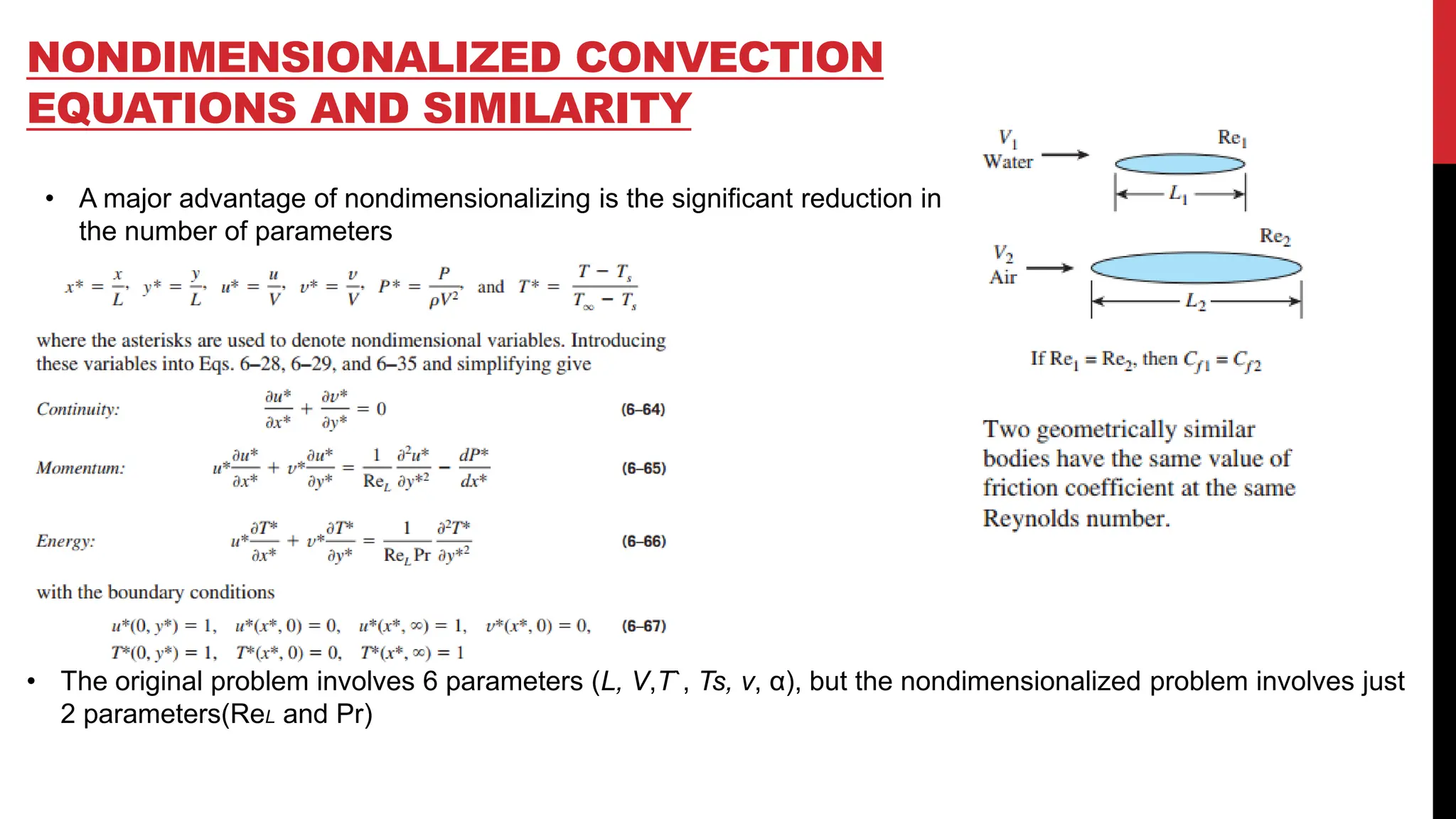
NONDIMENSIONALIZED CONVECTION
EQUATIONS ANDSIMILARITY
• A major advantage of nondimensionalizing is the significant reduction in
the number of parameters
• The original problem involves 6 parameters (L, V,T`, Ts, v, α), but the nondimensionalized problem involves just
2 parameters(ReL and Pr)

![ONE-, TWO-, AND THREE-DIMENSIONAL FLOWS
❖A flow field is best characterized by its velocity distribution, and
thus a flow is said to be one-, two-, or three-dimensional if the flow
velocity varies in one, two, or three primary dimensions,
respectively
❖A typical fluid flow involves a three-dimensional geometry, and the
velocity may vary in all three dimensions, rendering the flow three-
dimensional [V(x, y, z) in rectangular or V(r, θ, z) in cylindrical
coordinates]
❖Consider steady flow of a fluid entering from a large tank into a
circular pipe
❖The fluid velocity everywhere on the pipe surface is zero because of
the no-slip condition, and the flow is two-dimensional in the
entrance region of the pipe since the velocity changes in both the r-
and z-directions, but not in the θ-direction](https://image.slidesharecdn.com/chapter6fundamentalsofconvection-250306153911-0111cccb/75/Chapter-6-Fundamentals-of-convection-pdf-19-2048.jpg)